
Orlando Travel Guide — Theme Parks, Springs & the Real Central Florida Beyond the Gates
Orlando has a branding problem, and it’s this: everyone thinks they already know it. Say the name and most people picture a single mouse-eared gate, when in fact the “Orlando” on your itinerary is really a sprawl of theme park resorts, spring-fed lakes and suburban grid stretched across a chunk of Central Florida bigger than some countries. I’ve done the marathon four-park week with a minivan full of cousins, and I’ve also spent a quiet weekend paddling a clear spring an hour from the crowds without a single lanyard in sight — both are “doing Orlando” correctly. It is, by a wide margin, the single most-visited destination in the United States, pulling in more than 76 million visitors in 2025 alone — which means the machinery for handling tourists is extraordinary, but so is the tourist-trap density on the roads leading up to it. This guide is the honest version: where the magic actually is, where it’s a $9 bottle of water and a parking lot, and how to build a trip that doesn’t feel like a queue from the moment you land.
In This Guide
- Overview — Why Orlando Is Bigger Than Its Gates
- Festival Season — Food & Wine, Holidays & Marathon Weekends
- Best Time to Visit Orlando (Season by Season)
- Getting There — MCO, Sanford & the I-4 Corridor
- Getting Around — Rental Cars, Rideshare & SunRail
- Neighborhoods — Parks, I-Drive & Downtown
- Culture & People — A City Built by Migration
- A Food Lover’s Guide to Orlando
- Off the Beaten Path
- Day Trips from Orlando
- Practical Information
- Budget Breakdown — What Orlando Actually Costs in 2026
- Planning Your First Trip
- Frequently Asked Questions
Overview — Why Orlando Is Bigger Than Its Gates
Orlando the city proper has about 307,000 residents, but “Orlando” as a destination really means the metro area of nearly 2.7 million people spread across Orange, Seminole and Osceola counties. Walt Disney World isn’t even inside city limits — it sits about 20 miles southwest, straddling Orange and Osceola counties on roughly 25,000 acres, an area larger than Manhattan. That scale is the first thing to internalize: this isn’t a compact old-world city you wander on foot, it’s a car-dependent, park-anchored region where “downtown” and “the parks” can be a 25-minute drive apart with several other resort universes in between.
What earned Orlando its “Theme Park Capital of the World” nickname keeps compounding. Walt Disney World alone runs four theme parks — Magic Kingdom, EPCOT, Hollywood Studios and Animal Kingdom — drawing an average of more than 49 million visits a year, making it the most-visited vacation resort on Earth. A few miles east, Universal Orlando now runs its own four: Universal Studios Florida, Islands of Adventure, Volcano Bay water park, and the brand-new Epic Universe, which opened in May 2025 with Super Nintendo World and a full Wizarding World expansion. Orlando International Airport backs this up with real numbers — 57.7 million passengers in 2025, making it Florida’s busiest airport and the seventh-busiest in the country.
But treat the parks as one chapter, not the whole book. Central Florida sits on top of one of the densest concentrations of freshwater springs in the world, the city itself is dotted with genuine lakes and a walkable, craft-beer-and-brunch downtown, and an hour in any direction gets you to a space center, a national forest, or a Gulf or Atlantic beach. The region’s tourism board isn’t exaggerating when it calls this the country’s most-visited destination — the honest caveat is that most of those 76 million-plus annual visitors never leave the resort bubble, which is exactly the gap this guide tries to close.
Festival Season — Food & Wine, Holidays & Marathon Weekends
Orlando’s calendar is really a parks calendar. EPCOT’s International Food & Wine Festival typically runs late summer through November, turning the park’s World Showcase into a rotating tasting menu of global marketplaces — it’s one of the best-value ways to “travel” a dozen countries in an afternoon, food-and-drink-card in hand. From early November through early January, both Disney and Universal go all-in on holiday overlays: Mickey’s Very Merry Christmas Party-style events, a snow-dusted Hogsmeade, and the Magic Kingdom’s after-hours holiday party, which is worth the separate ticket if you can swing it.
January brings the Walt Disney World Marathon weekend, filling every nearby hotel with runners doing 5Ks through castle courtyards before dawn. Spring break (mid-March through early April) and the week around Christmas/New Year are the two hardest weeks to book anything last-minute or affordable — if your dates are flexible, avoid both.
Best Time to Visit Orlando (Season by Season)
Late January – early May · The sweet spot
Mild, dry-leaning weather, shorter lines outside spring break week, and the best value on hotels before summer rates kick in. This is the window locals recommend most.
June – September · Hot, wet, crowded with families
Central Florida’s rainy season runs roughly May to late October, with near-daily afternoon thunderstorms and highs in the low 90s°F plus heavy humidity. Summer break fills the parks to capacity despite the heat — go early morning, retreat midday, come back for fireworks.
November – mid-December · Cooler and festive
Comfortable temperatures, holiday decor and overlays at every park, and (outside Thanksgiving week) some of the calmer crowd days of the year.
Hurricane season · June–November
Florida sits in the Atlantic hurricane belt; direct hits on Orlando’s inland location are less frequent than on the coasts but tropical storms bring heavy rain and occasional park closures. Travel insurance is worth it August through October, the statistical peak.
Getting There — MCO, Sanford & the I-4 Corridor
Orlando International Airport (MCO) is the main gateway, about 6 miles southeast of downtown and roughly 20–25 minutes from the Disney/Universal resort area depending on traffic. It’s a genuinely huge operation — over 1,000 daily flights to more than 170 destinations on around 40 airlines, with Southwest as the largest carrier and Breeze, Frontier and JetBlue running significant operations of their own. A smaller secondary option, Orlando Sanford International Airport, sits about 45 minutes northeast and is popular with European charter and low-cost carriers — worth checking if you’re flying in from the UK or Europe, since fares can undercut MCO significantly.
International visitors from the 38 Visa Waiver Program countries (UK, most of the EU, Australia, Japan, South Korea and others) need an approved ESTA before boarding — apply online at least 72 hours ahead, though earlier is safer. Everyone else needs a US tourist visa arranged in advance; there is no visa-on-arrival. Driving in is straightforward too — Interstate 4 (the “I-4 corridor”) is the spine connecting Tampa, Orlando and Daytona, and most visitors from elsewhere in Florida simply drive.
Getting Around — Rental Cars, Rideshare & SunRail
Orlando is built for cars, full stop. A rental car (roughly $45–90/day plus the theme parks’ own $30+ daily parking fees) gives the most flexibility for hopping between resorts, springs and outlet malls. Uber and Lyft cover the whole metro reliably and are the easiest way to skip resort parking fees if you’re staying on Disney or Universal property, both of which also run their own free bus, monorail, skyliner gondola or water-taxi networks between their hotels and parks.
For getting around outside the resort bubble, SunRail is Central Florida’s commuter rail line — 61.3 miles and 17 stations running from DeLand down to Poinciana through downtown Orlando, with zone-based fares starting around $2. It’s genuinely useful for a downtown day trip but doesn’t reach the theme park resorts. Lynx public buses fill some gaps at a fraction of a rideshare’s cost, though routes and frequency reward patience. International Drive (“I-Drive”), the main tourist strip, has its own free trolley in many areas — handy for hotel-to-outlet-mall hops without the rental car.
Neighborhoods — Parks, I-Drive & Downtown
Walt Disney World Resort Area (Lake Buena Vista / Bay Lake)
Four theme parks, two water parks, dozens of resort hotels and Disney Springs’ shopping-and-dining district, all connected by Disney’s own internal transit. Stay here if the parks are the whole trip — you’ll rarely need a car.
Universal Orlando Resort Area
Universal Studios, Islands of Adventure, Volcano Bay and the new Epic Universe, plus CityWalk’s restaurants and nightlife and on-site hotels with early park-entry perks. Compact enough to walk between parks and hotels.
International Drive (“I-Drive”)
The tourist backbone linking both resort areas: mid-range hotels, the ICON Park observation wheel, outlet malls, mini-golf and the Orange County Convention Center. Convenient and walkable in patches, but this is peak “tourist trap” territory for chain restaurants and timeshare pitches — read reviews before booking a package deal here.
Downtown Orlando
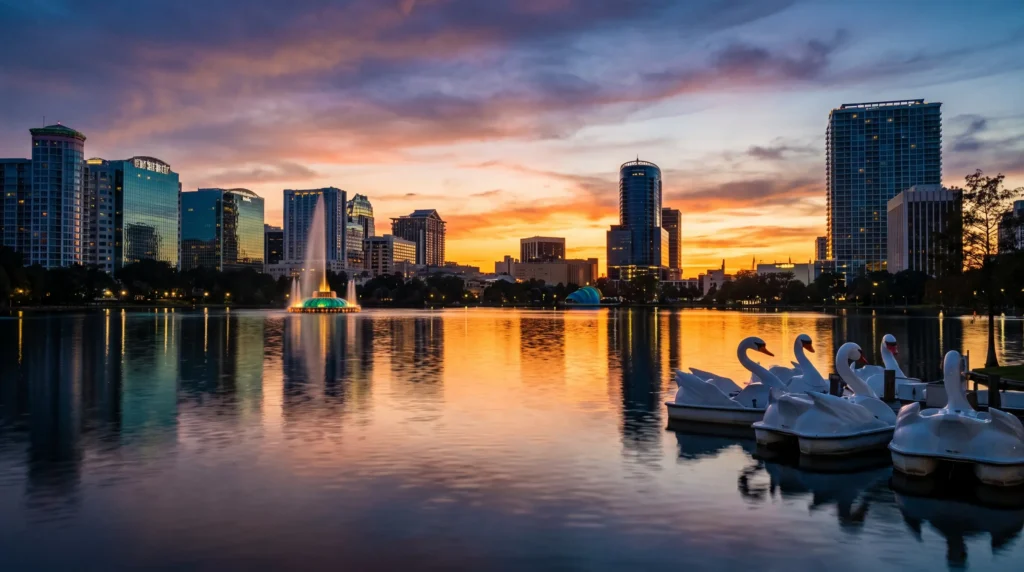
The city’s actual urban core: Lake Eola Park and its swan paddleboats, a growing high-rise skyline, craft breweries, and the Dr. Phillips Center for the Performing Arts. This is where you find the city that exists independent of the parks, and it’s a genuinely pleasant few hours or an overnight base if you rent a car.
Winter Park
A leafy, upscale enclave just north of downtown — Park Avenue’s boutiques and cafés, the Charles Hosmer Morse Museum’s Tiffany glass collection, and scenic pontoon-boat tours through the interconnected chain of lakes.
Kissimmee
South of the Disney parks, the historically working-class gateway town, now full of budget vacation-home rentals, Old Town’s retro strip, and easy access to Lake Tohopekaliga’s airboat rides.
College Park & Audubon Park
Quieter, tree-lined residential neighborhoods near downtown with an emerging indie food-and-brewery scene (the Audubon Park Garden District especially) — worth a meal even on a park-heavy itinerary.
Culture & People — A City Built by Migration
Orlando’s modern identity was largely built in two waves: the tourism boom that followed Walt Disney World’s 1971 opening, and decades of migration that made it one of the most diverse metros in the Southeast — sizable Puerto Rican, Haitian, Vietnamese and Colombian communities each shape their own corners of the city. That diversity shows up fastest in the food scene and in neighborhoods like the Mills 50 District, Orlando’s unofficial Vietnamtown, thick with pho houses and Asian markets.
The city’s arts and sports culture has grown up alongside the parks rather than in their shadow — the Dr. Phillips Center hosts touring Broadway and symphony, the Orlando Museum of Art anchors Loch Haven Park’s cultural district, and Orlando City SC’s soccer matches at downtown’s Inter&Co Stadium draw a genuinely local, non-tourist crowd worth experiencing if you want a night away from lanyards and character meet-and-greets.
A Food Lover’s Guide to Orlando
Skip the I-Drive chain restaurants where you can and head for two things Orlando actually does well: theme park dining that’s improved dramatically in the last decade (EPCOT’s World Showcase remains the single best “eat your way around the world in an afternoon” experience in American tourism), and the immigrant-community food scene that most visitors never see. Mills 50 is the epicenter for Vietnamese pho and banh mi; look for Colombian bandeja paisa and Puerto Rican mofongo in neighborhoods further from the resorts.
Florida citrus and Gulf seafood both show up on Central Florida menus — fresh grouper sandwiches and key lime pie are near-universal on local menus, even well inland. Winter Park’s Park Avenue and downtown’s Thornton Park both cluster higher-end brunch and dinner spots. For a distinctly Orlando splurge, book a character dining meal at one of the Disney resort hotels, or chase the rotating international food booths at EPCOT’s autumn Food & Wine Festival. Craft beer has taken off downtown and in the Audubon Park Garden District, a good antidote to a day of theme-park $15 souvenir cups.
Off the Beaten Path
Wekiwa Springs State Park
A crystal-clear, 72°F spring pool feeding the Wekiva River, with canoe and kayak rentals and hiking trails — a genuine wilderness experience about 25 minutes from the Magic Kingdom that most visitors never realize exists.
Blue Spring State Park
About an hour north, one of the largest springs on the St. Johns River and a major winter refuge for manatees — swimming is closed in the cold months specifically to protect them, so check the calendar before you go.
Gatorland
A scrappy, decades-old alligator park predating every mega-resort nearby — zipline over the swamp, watch a gator wrestling show, and get a much rawer slice of “old Florida” than anything on I-Drive.
Mills 50 District
Orlando’s real melting-pot neighborhood, thick with Vietnamese, Puerto Rican and Colombian restaurants and none of the theme-park pricing.
Leu Gardens
Fifty acres of botanical gardens near downtown with one of the largest camellia collections in the country — an easy, quiet counterpoint to a parks-heavy week.
Day Trips from Orlando
Kennedy Space Center
About an hour’s drive east on the Space Coast, with the Apollo/Saturn V Center, the US Astronaut Hall of Fame, and — if timing aligns — a public launch to watch from the visitor complex. Worth checking the launch schedule before you book park tickets for that day.
Cocoa Beach & the Space Coast
The closest proper Atlantic beach to Orlando, about an hour away, with surfing, the Ron Jon Surf Shop mega-store, and a laid-back beach-town vibe that’s a genuine palate cleanser after theme parks.
Ocala National Forest
Roughly 90 minutes north, with more spring-fed swimming holes (Alexander Springs, Juniper Springs), hiking on the Florida Trail, and none of the resort crowds.
Tampa
About 90 minutes west via I-4, with its own major theme park (Busch Gardens), a walkable Riverwalk, and Ybor City’s Cuban-American history and cigar-factory heritage.
St. Augustine
Roughly two hours northeast, the oldest continuously occupied European-founded city in the US, with a genuinely historic old town very different in feel from anything in Orlando.
Practical Information
Money. The US dollar is the only currency in play; cards (and increasingly Apple/Google Pay) are accepted virtually everywhere, including inside the theme parks, so there’s little need to carry much cash. Budget for resort/parking fees and gratuities on top of quoted ticket prices.
Entry requirements. Visitors from the 38 Visa Waiver Program countries need an approved ESTA; everyone else needs a US visa arranged before travel, as there is no visa-on-arrival option.
Safety. Orlando’s tourist zones — the resorts, I-Drive, downtown, Winter Park — are heavily patrolled and generally low-risk by big-city standards; ordinary US urban-travel precautions apply (secure valuables, be alert at night away from the main tourist strips). International travelers should check their own government’s current travel advisories for the United States before departure, as with any trip abroad.
Health & climate. Summer heat and humidity are the main physical hazard — hydrate constantly, use sunscreen, and pace park days around the worst midday heat. Afternoon thunderstorms are near-daily in summer; pack a poncho rather than fighting for an umbrella in the wind.
Connectivity. US carriers and eSIMs both work well throughout the metro; theme park Wi-Fi is generally solid given the crowds it handles. Plugs: US-style (Type A/B), 120V. Time zone: Eastern Time (UTC-5, UTC-4 with daylight saving).
Budget Breakdown — What Orlando Actually Costs in 2026
Orlando can be done cheaply or extravagantly, and the gap between the two is enormous. The 2025 destination-wide average daily hotel rate ran around $203 with occupancy over 71%, giving a sense of how tight the market runs even outside peak weeks.
Budget (US$120–200/day): Off-site chain hotel or vacation-home rental split across a group, one theme park day rather than a park-hopper, groceries or Mills 50 meals over resort dining, rideshare instead of a rental car.
Mid-range (US$250–450/day): On-site Universal or Disney value/moderate resort, park-hopper tickets, a mix of quick-service and one table-service meal a day, a rental car for day trips.
Deluxe (US$700+/day): Disney or Universal deluxe resort with early park access perks, Lightning Lane/Genie+ or Universal Express passes stacked daily, character dining, and a Kennedy Space Center or Space Coast add-on.
Fixed costs to budget for regardless of tier: daily park parking ($30+ per car even for hotel guests in some cases), resort destination fees, and tipping — 18–20% at sit-down restaurants is standard across the US.
Planning Your First Trip to Orlando
The classic first-timer split is parks + springs: four to five days across Disney and Universal (book park-hopper or Express passes ahead if budget allows), then one day out to Wekiwa or Blue Spring for a completely different Florida, and a half-day in downtown Orlando or Winter Park before you fly out. A week covers the headline parks without a death-march pace; ten days lets you add Kennedy Space Center or Cocoa Beach. If you’re combining an East Coast trip, pair it with our Miami guide for the Art Deco coastline, our New Orleans guide for a very different flavor of American South, or our Bahamas guide for an easy add-on island escape a short flight from MCO.
Frequently Asked Questions
How many days do I need in Orlando?
Four to five days covers one Disney park-hopper stretch or a full Universal visit; a week to ten days lets you do both resorts plus a springs or Space Coast day trip without rushing.
Do international visitors need a visa?
Travelers from the 38 Visa Waiver Program countries need an approved ESTA before flying; everyone else needs a US tourist visa arranged in advance, as there is no visa-on-arrival option at MCO.
Is it cheaper to stay on-site or off-site?
Off-site hotels and vacation-home rentals along I-Drive or in Kissimmee are usually cheaper per night, but you’ll need a rental car or rideshare budget and lose Disney/Universal’s free internal transit and early park-entry perks — factor both into the real comparison.
Which is better, Disney or Universal?
Disney World wins on scale and family-age range across its four parks; Universal wins on thrill rides and the Wizarding World’s immersive theming. Most first-timers with a week try to do a few days at each rather than choosing.
Is Orlando worth it if I don’t want to do theme parks at all?
Yes, though it takes intention — downtown’s Lake Eola, Winter Park’s museums and lakes, the springs of Wekiwa and Blue Spring, and a Kennedy Space Center day trip add up to a legitimate non-park week, just budget a rental car since none of it is walkable from the resort areas.
When should I avoid visiting?
Spring break (mid-March to early April) and the week around Christmas/New Year are the most crowded and expensive; late August through October carries the highest hurricane-season risk of a washed-out day or two.
Ready to Explore Orlando?
Four Disney parks, four Universal parks, a space center an hour away and springs cold enough to make you forget the Florida sun — Orlando rewards visitors who plan past the gates as much as it rewards the ones who never leave them. Book the parks you actually want, leave one day empty for a spring or a beach, and you’ll come home having seen a bigger, weirder, better Florida than the postcards show.
Explore More
- Miami Travel Guide — Art Deco, beaches and Cuban food a short flight south
- New Orleans Travel Guide — a completely different American South
- Las Vegas Travel Guide — America’s other family-and-adults theme city
- Bahamas Travel Guide — easy island add-on from MCO
How this guide was built
Published as part of Facts From Upstairs’ city guide series. Built from authoritative sources — Wikipedia entity pages for Orlando, Orlando International Airport, Walt Disney World, Universal Orlando Resort, Kennedy Space Center and SunRail; Visit Orlando’s official destination data and trends page; the US State Department’s Visa Waiver Program page; and the National Hurricane Center for seasonal risk context. Numeric claims carry inline citations.
Sources cited on this page
More city guides you might like


Plan your trip to Orlando
The booking tools we use ourselves. FFU may earn a commission at no extra cost to you.
Plan & book your trip to Orlando
Booking through these searches supports our guides at no extra cost to you.