
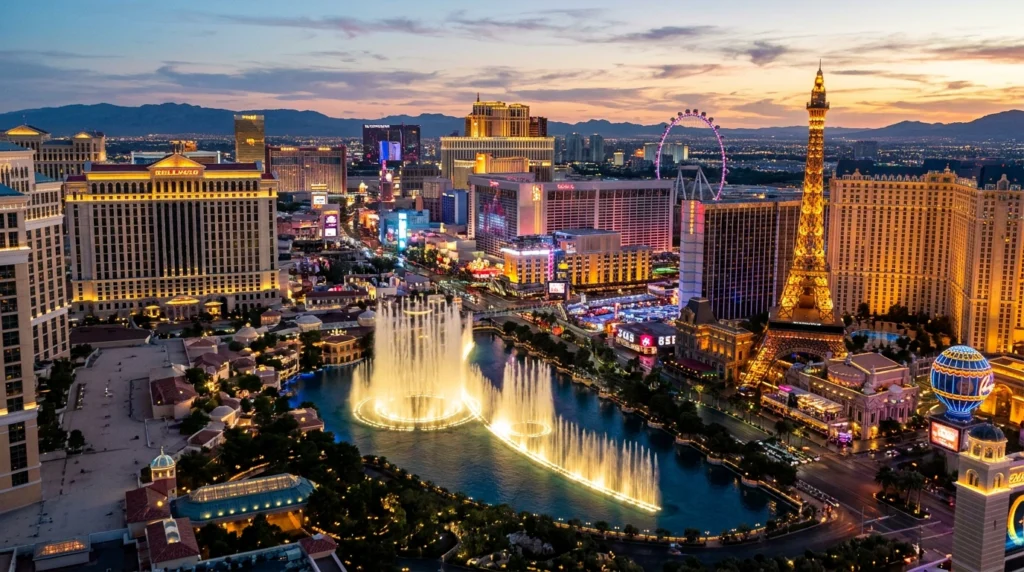
City Guide · The Mojave Desert
Las Vegas, United States: Neon in the Desert, a Strip That Never Sleeps, and Red-Rock Wilderness on the Doorstep
I have landed at Harry Reid airport at every hour the schedule allows, and the thing I tell every first-timer is that Las Vegas is far more than the casino caricature it trades on — it is a 24-hour entertainment city of roughly 660,000 residents in the city proper and nearly 2.3 million across the valley, dropped into the Mojave Desert and ringed by some of the most spectacular wilderness in the American Southwest . My favourite Vegas ritual has nothing to do with gambling: a pre-dawn drive out to Red Rock Canyon while the Strip is still glowing behind me, then back for a long, indulgent brunch and an afternoon by a pool the size of a small lake. We tell visitors to stop treating it as a place you only drink and lose money: give it three or four days, mix the spectacle of the Strip with a day in the desert and a night in the grittier, more characterful downtown, and the city’s manic generosity wins you over. Treat this guide as the brief I would hand my own family before they touched down — where to base on or off the Strip, the buffet-versus-celebrity-chef debate, the free attractions hiding among the paid ones, the brutal summer heat, and the monorail-and-rideshare logic that ties a deceptively spread-out city together .

Table of Contents
Why Las Vegas?
Las Vegas is the most improbable major city in America, and that improbability is exactly its appeal: a metropolis of nearly 2.3 million people conjured out of the bone-dry Mojave Desert in little more than a century, dedicated almost entirely to the business of entertaining the roughly 40 million visitors who arrive every year . The city proper holds around 660,000 residents, but the figure that matters to a traveller is the resort corridor — a four-mile stretch of the Las Vegas Strip lined with some of the largest hotels on earth, holding a share of the valley’s roughly 150,000 hotel rooms and more square footage of casino, theatre, restaurant, and convention space than anywhere comparable .
The city reads as a set of deliberate contradictions. It is a manufactured fantasy of replica Eiffel Towers, Venetian canals, and Roman fountains, yet it sits inside a genuinely wild and ancient landscape — the red sandstone of Red Rock Canyon, the engineering colossus of the Hoover Dam, and the immense waters of Lake Mead are all within an hour’s drive. It markets itself on excess and adult vice, yet it has quietly become one of the most serious dining cities in the country and a magnet for residency shows, world title fights, and Formula 1. And for all the neon, the surrounding Mojave is a place of profound silence and dark, star-filled skies the moment you leave the glow behind .
The geography is the secret to enjoying it. Almost everything a first-timer wants sits along that single Strip spine running south-to-north on Las Vegas Boulevard, with the older, cheaper, more characterful downtown and its Fremont Street canopy a short ride further north, and the desert wilderness fanning out west and east . The single best decision you can make is to break up the Strip with a half-day in that desert — a sunrise loop of Red Rock Canyon or an afternoon at the Hoover Dam — because the contrast is what makes a Vegas trip memorable rather than merely loud .
This guide covers the resorts and neighbourhoods you will actually use, the buffet-versus-celebrity-chef dining debate worth having, the free attractions hiding among the paid spectacle, the residency shows and Cirque productions and championship sport, the desert day trips locals take on weekends, and the practical realities of ESTA, the monorail, brutal summer heat, and a deceptively spread-out city. Start on the Strip, but get out into the desert; everything else flows from there.

Neighborhoods: Finding Your Las Vegas
📍 Las Vegas Map: Every Place in This Guide


Las Vegas is best understood not as a grid of neighbourhoods like most cities, but as a handful of distinct zones strung along Las Vegas Boulevard and out into the surrounding valley — and the single biggest mistake first-timers make is never leaving the central Strip. The visitor’s Las Vegas splits into three core areas: the Strip itself (the four-mile resort corridor that most people mean when they say “Vegas”), the older Downtown around Fremont Street to the north, and the off-Strip neighbourhoods like Chinatown and Summerlin where locals actually live and eat . Beyond those, the desert begins almost immediately at the city’s western and eastern edges.
This section walks the eight zones you will actually use, grouped by character: the resort corridor (the South, Central, and North Strip), the historic core (Downtown and the Arts District), the local-favourite off-Strip districts (Chinatown, Summerlin), and the gateway suburb of Henderson, with notes on access and who each area suits best.
The South Strip
The Strip’s southern anchor, home to some of its most photographed megaresorts and the entertainment-and-sport district that has reshaped the city — the home of the NFL’s Raiders and an emerging stadium scene. It is where many visitors first see the Strip, since it sits closest to the airport.
- The Bellagio fountains, the New York-New York skyline, and the MGM Grand
- Allegiant Stadium (Raiders), T-Mobile Arena, and the Sphere just east
- The “Welcome to Fabulous Las Vegas” sign on the median south of Mandalay Bay
Best for: first-timers, sport and big shows, travellers arriving by air. Access: Las Vegas Monorail (MGM Grand station); a short rideshare from Harry Reid airport.
The South Strip is where most visitors begin, and it holds an outsized share of the marquee sights — the dancing Bellagio fountains (free, every 15–30 minutes after dark), the miniature Manhattan of New York-New York, and the cluster of arenas and stadiums that has turned Las Vegas into a genuine sports town. The Sphere, the vast LED-skinned venue just east of the Strip, has become the city’s newest icon. Base here if your priority is being close to the airport and the big events; just know that the dense walking core is further north, so the South Strip rewards a rideshare or a monorail hop to reach the heart of it.
The Central Strip
The dense, walkable heart of the resort corridor — the highest concentration of casinos, celebrity-chef restaurants, and pedestrian bridges in the city, and where the Strip is at its most theatrical. This is the Vegas of a thousand postcards.
- Caesars Palace, the Bellagio, the Venetian, and the Forum Shops
- The Paris Eiffel Tower replica and the High Roller observation wheel at The LINQ
- The pedestrian bridges linking the resorts over the Boulevard
Best for: first-timers wanting everything within walking distance, dining, casino-hopping. Access: Las Vegas Monorail (Flamingo / Caesars and Harrah’s stations); walkable between resorts.
The Central Strip is the neighbourhood that solves the corridor’s biggest weakness, which is how spread out it is — here the megaresorts cluster tightly enough that you can walk (via air-conditioned skybridges) from Caesars Palace to the Bellagio to the Venetian in an evening. This is the most convenient base for a first trip: the celebrity-chef restaurants, the Forum Shops, the High Roller wheel, and the best people-watching all sit within a few blocks. It is also where the monorail is most useful. For a first trip that wants to walk everywhere and stay in the thick of the spectacle, the Central Strip is the single most convenient base in the city.
The North Strip & Resorts World
The corridor’s northern stretch, historically quieter but transformed by a wave of new megaresorts — anchored by the enormous Resorts World complex and the reborn Fontainebleau, with the Strat tower marking the boundary with Downtown.
- Resorts World, the Fontainebleau, and the Wynn / Encore complex
- The Strat tower with its observation deck and thrill rides
- A quieter, more spacious stretch with newer hotels and better value
Best for: travellers wanting newer rooms and slightly better rates, a calmer base. Access: Las Vegas Monorail (Westgate and SLS stations); rideshare to the Central Strip.
The North Strip is where the city’s most recent building boom landed, and it offers a quieter, more spacious alternative to the crush of the centre. The Wynn and Encore set the luxury benchmark, while Resorts World and the long-delayed Fontainebleau have brought tens of thousands of new rooms, restaurants, and a fresh nightlife scene to the area. The Strat tower, with its 350-metre observation deck and the highest thrill rides in the country, marks the transition toward Downtown. Stay here for newer accommodation and often better value, accepting a short hop south to reach the densest walking core.
Downtown & Fremont Street
The city’s original, gritty, and increasingly cool historic core — older casinos, the dazzling Fremont Street Experience light canopy, cheaper tables, and a concentration of vintage Vegas character that the Strip lost decades ago .
- The Fremont Street Experience and its overhead Viva Vision light canopy
- The classic Golden Nugget and the vintage neon of Glitter Gulch
- The SlotZilla zipline and the cheaper, lower-minimum gaming tables
Best for: budget travellers, vintage Vegas character, a livelier street scene. Access: the Deuce bus from the Strip; a short rideshare.
Downtown is the Vegas that existed before the modern Strip, and it has reinvented itself as the city’s most characterful district. Its spine is Fremont Street, a covered pedestrian mall topped by the Viva Vision canopy — a four-block-long LED screen that bursts into light-and-music shows every hour after dark — and lined with the old-guard casinos like the Golden Nugget, where table minimums and drink prices run far below the Strip. The neighbouring Arts District has filled with breweries, galleries, and independent restaurants. Reach it on the Deuce bus or a short rideshare; it makes an excellent value base and an essential evening out even if you stay on the Strip.
The Arts District (18b)
A walkable, low-rise district just south of Downtown that has become the city’s creative heart — independent galleries, craft breweries, vintage shops, coffee roasters, and a monthly First Friday street festival that draws thousands .
- Independent galleries, antique malls, and vintage clothing shops
- A dense run of craft breweries, distilleries, and coffee roasters
- The monthly First Friday arts-and-music street festival
Best for: travellers wanting a non-casino night, art and craft beer, younger crowds. Access: a short rideshare from Downtown or the Strip.
The Arts District — officially the 18b Las Vegas Arts District — is the neighbourhood that proves there is a real city behind the spectacle. A few walkable blocks of low-rise warehouses and old motels now hold the valley’s densest concentration of independent galleries, antique malls, craft breweries, distilleries, and third-wave coffee, with almost no gaming in sight. On the first Friday of every month the streets close for First Friday, a sprawling art-and-music festival that is one of the city’s best free nights out. There are no casinos or marquee sights here, which is exactly the appeal: you come to browse, drink, and feel the texture of local Las Vegas, a short rideshare from the Strip.
Chinatown
A long commercial strip along Spring Mountain Road west of the Strip that has become the city’s best eating district — a dense, pan-Asian run of Chinese, Korean, Japanese, Vietnamese, Thai, and Filipino restaurants where locals and chefs actually eat .
- Authentic ramen, hot pot, dim sum, Korean barbecue, and pho
- Late-night Asian dining when the Strip kitchens have closed
- Specialty Asian grocery markets and bubble-tea cafés
Best for: food crawls, late-night eating, value dining away from the Strip. Access: a short rideshare west from the Central Strip.
Chinatown is the off-Strip district that serious eaters fall for, and it is one of the most rewarding to explore. Spread along Spring Mountain Road just west of the Boulevard, it is not a single block but a sprawling, multi-mile run of strip malls packed with some of the best and most authentic Asian restaurants in the western United States — ramen counters, Sichuan hot pot, Korean barbecue, Cantonese dim sum, Vietnamese pho, and Filipino kitchens, many of them open well past midnight when the Strip’s dining rooms have closed. The food is the entire point, and it comes at a fraction of resort prices. A short rideshare from the Central Strip, it is an essential evening for anyone who wants to see — and taste — past the casino floor.
Summerlin & Henderson
The valley’s master-planned suburbs — leafy, affluent Summerlin on the western edge against the Red Rock foothills, and Henderson to the southeast — where most locals live, with their own dining, parks, and a calmer, residential pace.
- Downtown Summerlin’s shops, restaurants, and the Las Vegas Ballpark
- Henderson’s Water Street district and the District at Green Valley Ranch
- Red Rock Canyon trailheads and the foothill golf courses on the west side
Best for: families, repeat visitors, travellers wanting a quiet residential base near the desert. Access: rideshare or a rental car; well off the transit network.
Summerlin and Henderson are where Las Vegas actually lives, and they make a good base for a calmer trip or a longer stay. Summerlin, climbing the western foothills toward Red Rock Canyon, is a master-planned community of parks, golf courses, and the lively Downtown Summerlin shopping district anchored by the Las Vegas Ballpark; it puts the desert wilderness minutes from your door. Henderson, to the southeast, is the valley’s second-largest city and the gateway to Lake Mead and the Hoover Dam, with its own walkable Water Street core and the upscale resorts of Green Valley Ranch. Both are residential and quiet, far from the Strip’s intensity, and best reached with a rental car given the thin transit out here.
The Food

Las Vegas has quietly become one of America’s great eating cities, and it is far more than the all-you-can-eat buffet it is famous for — though we will get to that debate. Over the past two decades the resorts poached the country’s most celebrated chefs to open Strip outposts, turning the city into a place where you can eat a multi-course tasting menu from a name you know on Tuesday and a transcendent bowl of ramen in a Chinatown strip mall on Wednesday. The result is a city with two parallel food maps: the high-gloss, expense-account dining of the Strip, and the cheaper, often better local scene in Chinatown, the Arts District, and the suburbs. Approach it the way savvy visitors do: splurge on one or two marquee Strip meals, then eat the rest of your trip off-Strip where the value and authenticity live. If you organise even one day of your trip around eating — a celebrity-chef dinner, a Chinatown crawl, a classic Vegas buffet — it will likely be a highlight.
A little history explains why the food here is so good. For decades the Strip treated restaurants as loss-leaders to keep gamblers on the property, serving cheap steak-and-shrimp specials and bottomless buffets designed to feed crowds fast. That changed in the late 1990s when Wolfgang Puck opened Spago at the Forum Shops and proved that visitors would pay serious money for serious cooking; the resorts responded by recruiting the biggest names in the business, and within a decade the city had transformed from a buffet town into a genuine fine-dining destination. The legacy of both eras survives side by side today, which is exactly what makes eating here interesting: you can have a $400 tasting menu and a $3 taco in the same twenty-four hours, and both are authentically Las Vegas.
Celebrity-Chef & Fine Dining
The Strip’s defining culinary achievement is the celebrity-chef restaurant, and the roster reads like a who’s-who of global dining. Resorts brought in the biggest names to anchor their properties, and the result is a density of high-end rooms unmatched outside New York. This is the city of Joël Robuchon’s flagship at the MGM Grand — long the only restaurant in town with three Michelin stars during the guide’s earlier Vegas run — alongside rooms from Gordon Ramsay, Bobby Flay, and others. Reservations for the marquee tables are essential, often weeks ahead, and the bill climbs fast, but a single great Strip dinner is part of the Vegas experience.
- Joël Robuchon — the lavish MGM Grand flagship, a special-occasion tasting menu ($200–$500 per person)
- Hell’s Kitchen — Gordon Ramsay’s theatrical Caesars Palace room, beef Wellington the signature ($65–$120)
- Bouchon — Thomas Keller’s French bistro at the Venetian, famed for brunch ($40–$90)
A word on the strategy, because the marquee rooms are a real investment. Lunch and pre-theatre menus are far cheaper than dinner at the same restaurant and let you sample a famous kitchen for a fraction of the price, so consider a midday Robuchon or a Bouchon brunch rather than a blowout dinner. Many of the best chef rooms also have a more casual sibling on the same property — Ramsay’s pub or burger spot beside his fine-dining room, for instance — which delivers the same kitchen’s cooking at half the cost. Book the headline tables the moment you fix your dates; the best slots vanish weeks out, and Friday and Saturday are hardest. And remember that a 18–22% tip is expected on the (already substantial) bill, so factor it into the budget before you sit down.
The Buffet & the Casual Strip
The Las Vegas buffet is a genuine institution, even if it is a diminished one — the all-you-can-eat spreads that once defined cheap Vegas dining thinned out after the pandemic, but the survivors at the higher-end resorts have reinvented themselves as lavish, made-to-order affairs rather than steam-table free-for-alls. The Bacchanal Buffet at Caesars Palace and the Wynn buffet are the headline survivors, with crab legs, prime rib, and global stations, and weekend brunch versions add bottomless sparkling wine. Beyond the buffets, the Strip is dense with casual options — food halls, burger joints, and 24-hour cafés — for the meals between the splurges.
- Bacchanal Buffet — the Caesars Palace flagship, hundreds of dishes ($60–$90)
- The Wynn Buffet — an upscale, made-to-order spread ($55–$85)
- In-N-Out Burger — the West Coast cult chain, an essential cheap Vegas meal ($8–$14)
The honest truth about buffets is that they are no longer the bargain they were — a top buffet now costs as much as a sit-down meal — so treat one as a planned experience rather than an automatic default. Go hungry, go at an off-peak hour to dodge the queue, and pick a single high-end buffet for the spectacle rather than eating at several mediocre ones. For everyday eating between the big meals, the Strip’s casual scene has improved enormously: the resort food halls let you graze across a dozen kitchens, the 24-hour cafés are a Vegas tradition for a 3 a.m. plate of eggs, and chains like In-N-Out give you a genuinely good meal for under $15. The smart move is to save your money and your appetite for one great buffet and a couple of chef dinners, and eat casually the rest of the time.
Beyond the Strip: Chinatown & Local Eats
To eat only on the Strip is to miss where Las Vegas’s food scene is most alive, which is off it. The Chinatown corridor along Spring Mountain Road is the city’s best eating district by a wide margin — a multi-mile run of strip malls holding some of the finest and most authentic Asian restaurants in the western US, from late-night ramen and Sichuan hot pot to Korean barbecue, Cantonese dim sum, and Vietnamese pho, almost all at a fraction of resort prices. The Arts District and the suburbs add craft breweries, independent cafés, and a strong taco-and-Mexican scene reflecting the valley’s large Hispanic population. This is where chefs eat on their nights off, and where your best-value meals will come from.
- Monta Ramen — a Chinatown benchmark for tonkotsu ramen ($12–$18)
- Lotus of Siam — long hailed as one of America’s best Thai restaurants ($18–$40)
- Raku — an acclaimed Japanese izakaya beloved by Strip chefs ($25–$60)
- Tacos El Gordo — Tijuana-style tacos, a cheap Vegas classic ($3–$5 a taco)
It is worth understanding how the Strip dining economy actually works, because it shapes every meal you eat there. The marquee rooms are concentrated in a handful of resorts — Caesars Palace, the Bellagio, the Venetian, the Wynn, and the Cosmopolitan carry the densest run of name-chef kitchens — and the resorts treat dining as a profit centre, which is why a bottle of water can run $8 and a steak climbs past $80. The flip side is genuine quality: the city now holds a clutch of Michelin-recognised rooms following the guide’s return to Las Vegas, and the talent pool of line cooks drawn here keeps even mid-tier resort kitchens sharper than their equivalents in most American cities. The single most useful booking habit is to reserve through the resort’s own app or OpenTable the moment your dates are fixed, set a calendar alert for the exact day a famous room opens its reservation window (usually 30 to 60 days out), and keep a cheaper backup in the same property in case the headline table is gone.
Drinks and the bill itself deserve a strategy too. The “free” cocktails on the casino floor are real but slow and watered, and they expect a $1–$2 tip per round, so they are a convenience rather than a saving; the serious craft-cocktail bars and resort speakeasies charge $16–$22 a drink but pour at a level the floor never matches. Watch the bill for the increasingly common automatic service charge and the separate “concession and franchise fee” some resorts add, both of which sit on top of the tip line and catch first-timers out. And do not overlook breakfast: the 24-hour café is a true Vegas institution, and a 3 a.m. plate of eggs or a late-morning chilaquiles in Chinatown is often the most memorable, least expensive meal of the trip. Eat one great splurge, graze cheaply the rest of the time, and the city’s two food maps both work in your favour.
Cocktails, Coffee & the 24-Hour City
Las Vegas does the round-the-clock indulgence better than anywhere, and its drinking and café culture runs deeper than the casino bar. The cocktail scene has matured well beyond free-while-you-gamble well drinks into serious craft bars, speakeasies hidden inside resorts, and the breweries and distilleries of the Arts District; the rooftop and poolside bars are a Vegas institution in their own right. The city’s 24-hour rhythm means you can find a good coffee, a full breakfast, or a proper cocktail at almost any hour, and the new wave of independent roasters in the Arts District and the suburbs has finally given the city a real third-wave coffee scene. A nightcap at a hidden speakeasy, a craft beer flight in the Arts District, or a 4 a.m. diner breakfast all count as authentic Vegas nights. The through-line across the whole food map is the same: on the Strip you pay for spectacle, but the best value and the best flavour are usually a short ride away.
Food Experiences You Can’t Miss
- One marquee celebrity-chef dinner on the Strip, booked weeks ahead
- A late-night ramen or hot-pot crawl through Chinatown when the Strip kitchens close
- A single high-end buffet brunch with bottomless sparkling wine for the spectacle
- A craft-beer and taco evening in the Arts District away from the casino floor
Cultural Sights

For a city built on manufactured spectacle, Las Vegas is richer in genuine sights than its reputation suggests — and a striking number of the best things to do are free. The Strip itself is the headline attraction, a four-mile open-air gallery of architectural fantasy where the Bellagio fountains, the erupting Mirage-era volcano legacy, and the resorts’ free shows cost nothing to enjoy. Beyond the spectacle sit serious cultural institutions, a genuine engineering marvel at the Hoover Dam, and the newest icon on earth in the Sphere. A useful note before you start: many of the Strip’s best sights — the fountains, the conservatory, the free shows — are free, so budget your money for the paid headliners like the Sphere, the observation wheels, and the dam tour, and fill the rest of your time with the no-cost spectacle.
The Bellagio Fountains & Conservatory
The dancing fountains of the Bellagio are the Strip’s defining free sight — a vast choreographed water show set to music across the resort’s eight-acre lake, performed every 15 to 30 minutes from afternoon until midnight. Just inside, the Bellagio Conservatory and Botanical Gardens stages elaborate seasonal floral displays that change five times a year, also free. Both are open daily and cost nothing; arrive after dark for the fountains at their most dramatic, and time a viewing from the Eiffel Tower across the Boulevard for the best angle .
The Sphere
The city’s newest icon, opened in 2023 just east of the Strip — a 112-metre-tall spherical venue wrapped in the world’s largest LED screen, the Exosphere, which displays giant animations visible across the valley and is free to admire from outside. Inside, its wraparound 16K interior screen and haptic seating host concert residencies and the immersive film experience; tickets to shows run from roughly $50 to several hundred dollars, and the exterior light shows are a free spectacle in their own right .
The High Roller & Strip Observation Decks
For the city from above, three options compete. The High Roller at The LINQ is one of the world’s tallest observation wheels at 167 metres, with a 30-minute rotation in enclosed cabins; tickets run around $25–$37, more for the open-bar “Happy Half Hour” cabin . The Strat tower at the corridor’s north end offers a 350-metre observation deck and the highest thrill rides in the US, while the Eiffel Tower replica at Paris gives the best straight-on view of the Bellagio fountains. Sunset is the prime time on any of them.
The Neon Museum & Downtown History
For the city’s real history, the Neon Museum north of Downtown is the essential stop — an outdoor “Neon Boneyard” where the salvaged signs of demolished casinos, motels, and wedding chapels are preserved and, on the popular night tours, relit. Guided admission runs around $20 by day and more for the after-dark tour, and it is the single best place to understand vintage Las Vegas . Pair it with the Fremont Street Experience and the Mob Museum, housed in the former federal courthouse, for a full Downtown history half-day.
Museums & Indoor Attractions
The resorts hold a surprising run of paid attractions for hot afternoons or the rare rainy day. The Mob Museum tells the story of organised crime and law enforcement in a genuinely excellent exhibition (around $30); the Atomic Museum covers the nearby Nevada nuclear test site; and the resort attractions — the Shark Reef aquarium at Mandalay Bay, the Flamingo wildlife habitat (free), and various art galleries — fill the gaps . None demands a full day, but several make excellent escapes from the midday heat.
The Free Strip Walk
The single best “sight” in Las Vegas costs nothing: a slow evening walk along the Strip itself, taking in the Bellagio fountains, the canals and ceiling sky of the Venetian, the Forum Shops at Caesars, the Mirage-legacy volcano site, the Flamingo’s free wildlife habitat, and the endless people-watching. The whole corridor is an open-air theme park of free spectacle, and an unhurried Strip stroll after dark — when the heat drops and the neon peaks — is how most visitors fall for the city. Use the air-conditioned skybridges to cross the Boulevard, and build in stops for the free shows. Start at the south end near the “Welcome to Fabulous Las Vegas” sign and work north so the walk finishes among the densest cluster of lights, and pace it across an evening with dinner and a drink stop rather than trying to march the full four miles in one go — the spectacle rewards lingering far more than covering ground.
Entertainment

Entertainment is not one thing Las Vegas does — it is the entire reason the city exists, and the range is staggering. This is the global capital of the residency concert and the spectacle stage show, the home of more Cirque du Soleil productions than anywhere on earth, the world’s premier venue for championship boxing and UFC, and increasingly a major-league sports town with NFL, NHL, and Formula 1 all on the calendar. The trick, as ever, is to book the marquee acts ahead — the best shows and biggest fights sell out months out — and to balance the paid headliners with the free spectacle of the Strip itself.
Shows: Cirque, Residencies & Magic
The production show is the beating heart of Vegas entertainment. Cirque du Soleil alone runs multiple resident shows along the Strip, from the aquatic spectacle of “O” at the Bellagio to the Beatles-themed “LOVE” and the adult “Zumanity” legacy, with tickets typically $89–$250 . Alongside them sit the music residencies that draw global stars to purpose-built theatres, the long-running magic and comedy headliners, and the adults-only revues. Book the show you most want first and build the trip around it; weeknight performances are often cheaper and easier to get than weekends.
The Sphere & Concert Residencies
The Sphere has transformed the city’s concert scene since 2023, with major artists staging extended immersive residencies inside its wraparound screen, alongside the recurring “Postcard from Earth” film experience. Beyond it, the arena residencies at venues like the Colosseum at Caesars and Resorts World Theatre keep a rotating cast of A-list musicians in town. Tickets span an enormous range, and the Sphere’s technical spectacle is unlike any other live venue on earth.
Nightclubs & Dayclubs
Las Vegas reinvented the nightclub as a destination in its own right, and its megaclubs and poolside dayclubs draw the world’s top DJs to multi-thousand-capacity rooms. The clubs at resorts like the Wynn, Resorts World, and the Cosmopolitan headline the scene, with cover charges of $20–$75 and bottle service climbing into the thousands; the dayclubs turn the resort pools into party venues all afternoon in the warm months. Guest lists and pre-booking save both money and queueing time.
Pro Sports & Formula 1
Las Vegas has become a genuine major-league sports city in barely a decade. The NHL’s Golden Knights play at T-Mobile Arena, the NFL’s Raiders at the spectacular Allegiant Stadium, and a Major League Baseball team is on the way, while the Las Vegas Grand Prix has put a Formula 1 night race directly on the Strip each November . Add the city’s status as the home of championship boxing and UFC, staged at T-Mobile Arena and the resort venues, and a sports-timed trip is a serious draw in its own right.
Casinos & Gaming
Gambling remains the city’s foundation, and the casino floor is an experience even for non-gamblers. The Strip resorts run the glossiest floors with the highest minimums; Downtown’s Fremont Street casinos offer far cheaper tables and a more old-school feel. Newcomers should learn a game or two before they sit down, set a strict loss limit, and treat the free drinks (tip the server $1–$2 a round) and the comps as part of the entertainment budget rather than a path to profit. The house always wins in the long run — play for the fun, not the money.
If you do want to play, the cheapest entertainment-per-dollar is a low-minimum table game you understand: a $5 or $10 blackjack table Downtown will keep you in your seat far longer than the same money fed into a slot machine, whose house edge is both higher and invisible. Sign up for the free player’s-loyalty card at whatever property you base in — it costs nothing, tracks your play, and is how the resort decides whether to comp drinks, meals, or a room on a return trip, so even a casual gambler should always have the card in the machine or on the table. Above all, decide your loss limit before you walk onto the floor and leave the credit cards and the easy floor ATM out of reach: the entire environment, from the absence of clocks and windows to the free alcohol, is engineered to keep you playing past the point you meant to stop.
Day Trips

Las Vegas’s location in the heart of the American Southwest makes it one of the best day-trip bases in the country, and the variety within a couple of hours is genuinely spectacular — red-rock canyons, a colossal engineering marvel, an alpine forest, and the gateway to some of the world’s greatest national parks. A rental car helps for most of these, since transit beyond the Strip is thin, though several are reachable on organised coach tours. The golden rule in the warm months is to head out at dawn and be back before the worst of the afternoon heat, and to carry far more water than you think you need. Below are the five that consistently reward the effort, ordered roughly from the closest desert escape to the bigger expeditions. One general tip: the desert sun is merciless and distances are deceptive, so start every trip with a full tank, a full water supply, and a sun-strategy — these are not casual strolls in the heat of a Mojave summer.
Red Rock Canyon (about 30 minutes by car)
The closest taste of the real desert, a National Conservation Area of dramatic red-and-cream sandstone cliffs just west of the city, with a 13-mile scenic drive loop, world-class rock climbing, and dozens of hiking trails . Entry is around $20 per vehicle and the scenic-drive loop requires a timed reservation in the busy cooler months. Go at sunrise for the best light and the coolest temperatures, and it is the single easiest escape from the neon.
Hoover Dam & Lake Mead (about 45 minutes by car)
One of the great engineering feats of the 20th century, the 221-metre Hoover Dam spans the Colorado River on the Nevada-Arizona line, holding back Lake Mead, the largest reservoir in the US by capacity . Guided dam tours run around $15–$30, the visitor centre and the pedestrian bridge offer free views, and the surrounding Lake Mead National Recreation Area adds boating, beaches, and desert hikes . It is an easy half-day and a sobering counterpoint to the Strip’s excess.
Mount Charleston (about 45 minutes by car)
The valley’s alpine escape — the Spring Mountains rise to nearly 3,600 metres just northwest of the city, holding pine forests, hiking trails, and temperatures 15–20°C cooler than the Strip, plus a small ski area in winter . It is the locals’ summer bolt-hole from the heat, an easy drive into a completely different climate, and a reminder that the Mojave is far from uniformly flat and barren.
Valley of Fire State Park (about 1 hour by car)
Nevada’s oldest and largest state park, an otherworldly landscape of flaming-red Aztec sandstone formations, ancient petroglyphs, and slot canyons about an hour northeast of the city . Entry is around $15 per vehicle, the scenic drives and short trails are superb, and the colours are most intense at sunrise and sunset. It is a car trip and the hiking is the whole point — a genuine taste of the Southwest’s geology within easy reach.
The Grand Canyon (about 2.5 hours by car to the West Rim / 4.5 hours to the South Rim)
The headline expedition. The Grand Canyon West (Hualapai land, with the glass Skywalk) is about 2.5 hours by car and the focus of most one-day coach and helicopter tours from Las Vegas, while the far grander South Rim in Grand Canyon National Park is a long 4.5-hour drive better suited to an overnight . Organised tours from the Strip handle the logistics if you would rather not drive, and a flightseeing add-on over the canyon is a once-in-a-lifetime splurge.
Seasonal Guide
Las Vegas has a hot desert climate, and the seasons shape a visit more sharply than the climate-controlled resorts let on — the difference between a pleasant March afternoon strolling the Strip and a July midday when the pavement hits 45°C is dramatic. The single most useful thing to understand is the heat: summers are extreme, with the Mojave sun making midday outdoor activity genuinely dangerous, while winters are mild and dry but with surprisingly cold, breezy nights . Plan the desert and the outdoors around the season, and the indoor city around the clock.
Spring (March – May)
One of the two best windows to visit — warm, dry days climbing from around 20°C in March to the low 30s by late May, with comfortable evenings and the desert wildflowers blooming out at Red Rock . Spring is ideal for combining the Strip with desert day trips before the summer heat sets in, and the pool season opens. Crowds and rates are moderate outside major convention or event weekends. Pack layers for the cool nights and strong sun protection for the days.
Summer (June – August)
Brutally hot and not to be underestimated — daytime highs routinely exceed 40°C and can top 45°C, with warm nights, making midday outdoor activity genuinely hazardous . The upside is that this is peak pool-and-dayclub season, hotel rates can dip midweek, and the whole city is built to keep you cool indoors. Do any desert trip at dawn, carry far more water than feels necessary, and treat the pool, the casino floor, and the show theatre as your daytime refuge from the heat.
Autumn (September – November)
The other prime window, and arguably the finest — the brutal heat breaks through September into warm, clear, low-humidity days of 20–30°C through November, perfect for both the Strip and the desert . The event calendar peaks with the Formula 1 Grand Prix in November, which sends rates soaring that week, but the rest of autumn offers the best balance of weather, manageable crowds, and the full run of shows and dining. It is the easiest season to recommend without caveats.
Winter (December – February)
Mild, dry, and quiet — daytime highs of 13–18°C with plenty of sun, but genuinely cold nights that can dip near freezing, and the pools largely close . Winter brings the lowest hotel rates of the year outside the huge New Year’s Eve and convention spikes, festive Strip decorations, and comfortable daytime conditions for walking and desert hiking. Bring a warm layer for the evenings, skip the pool expectations, and enjoy a cheaper, calmer city.
Getting Around
The Las Vegas Monorail
The Las Vegas Monorail is the backbone of car-free travel along the resort corridor, running for 3.9 miles on the east side of the Strip with seven stations linking the major resorts from the MGM Grand at the south to the SLS/Sahara at the north . A single ride is around $6 and day passes run roughly $13–$15 for one day up to about $56 for seven; it is fast and beats walking the Strip in the heat, but note it runs behind the resorts rather than along the Boulevard, so factor in the walk through each property.
The Deuce & RTC Buses
The RTC’s double-decker “Deuce” bus runs 24 hours up and down the Strip and on to Downtown and Fremont Street, the single most useful transit line for visitors and the main link between the Strip and Downtown that the monorail does not serve . The faster SDX express supplements it, and the wider RTC network covers the valley. A 24-hour Deuce/SDX pass is around $8 and a 3-day pass about $20, bought from the on-street ticket machines or the rideMyRTC app.
Passes & Prepaid Transit
For transit, the rideMyRTC mobile app is the easiest way to buy and store Deuce and bus passes, while the monorail uses its own separate tickets and passes. There is no single integrated card across all systems, so decide whether the monorail (east-side resorts) or the Deuce (full Strip plus Downtown) better fits your plans and buy the matching multi-day pass. Most visitors find a Deuce 3-day pass plus the occasional rideshare covers everything, and pay it back over single fares within a couple of days .
Airport Access
- Harry Reid International (LAS) to the Strip — rideshare/taxi, 10–20 min, $20–$35
- Harry Reid (LAS) to the Strip — shared shuttle van, 30–45 min, $11–$18
Taxis & Rideshare
Licensed taxis queue at every resort and the airport, with a flag-fall around $3.50 plus mileage and a surcharge from the airport; Uber and Lyft operate citywide and are how most visitors cover the gaps, with a typical Strip-to-Downtown ride running $15–$25 depending on surge. Note that resorts route rideshare pickups to designated parking-garage areas rather than the front door, so allow extra time, and that a short Strip taxi can be surprisingly pricey in traffic — walking or the monorail often wins for short hops.
Walking, Driving & the Strip
The Strip is walkable in cool weather, but it is far longer than it looks — the resorts are enormous and the distance from end to end is over four miles, so a “quick walk” between two hotels can take 30 minutes through the crowds and the heat. Use the air-conditioned skybridges to cross the Boulevard safely. A rental car is unnecessary for a Strip-only trip and resort parking now carries daily fees, but it is genuinely worth having for the desert day trips, where transit barely reaches .
Navigation Tips
Two apps cover almost everything: the rideMyRTC app handles Deuce and bus fares and real-time arrivals, while Google Maps gives solid coverage of transit, walking, and driving across the valley. The cardinal rule is to overestimate Strip walking distances and budget for the heat — what looks like a two-block stroll between resorts can be a sweaty half-hour — so lean on the monorail, the Deuce, or a rideshare for anything beyond the immediate next casino in summer.
Budget Breakdown: Making Your Dollars Count
| Tier | Daily | Sleep | Eat | Transport | Activities | Extras |
|---|---|---|---|---|---|---|
| Budget | $90–$150 (~£72–£120) | Off-Strip / Downtown hotel $50–$90 | In-N-Out $10, food court $14, Chinatown bowl $15 | Deuce day pass $8 | Bellagio fountains free, Strip walk free | Resort fee $35 |
| Mid-Range | $200–$350 (~£160–£280) | 3–4-star Strip hotel $130–$240 | Sit-down dinner $35–$70 | Monorail pass + rideshare $20 | Show ticket $90, High Roller $30 | Cocktails $16–$22, resort fee $45 |
| Luxury | $600+ (~£480+) | 5-star Strip suite $400+ (event weeks $800+) | Celebrity-chef tasting $200–$500 | Private car / Uber Black $90 | Premium show seats $250, Sphere $300 | Club bottle service $500+, spa $200 |
Where Your Money Goes
Accommodation and the dreaded resort fee are the big levers in Las Vegas, and where and when you book decides whether the city feels cheap or punishing. Headline room rates can be startlingly low midweek — a Strip tower for under $100 a night is common Sunday to Thursday — but almost every resort tacks on a mandatory “resort fee” of $35–$55 a night that is not included in the advertised price, plus paid parking, so always add those before you compare. Rates also swing violently by date: a $90 midweek room can hit $400 over a fight weekend, a major convention, or the Formula 1 race, so timing is the single biggest cost decision you will make. Food splits sharply too — a celebrity-chef dinner climbs into the hundreds, but Chinatown, In-N-Out, and the food courts let you eat well for under $20.
The hidden costs that catch first-timers are the add-ons: the resort fee, paid parking, the automatic gratuity on bills and drinks, and the casino floor itself, where the “free” drinks and the easy ATM are designed to part you from your money. Set a strict gambling budget and treat any losses as an entertainment cost, not an investment. Skip the rental car for a Strip trip to dodge parking fees, and the gap between the budget and mid-range columns above is mostly a matter of when you visit and how disciplined you are on the floor.
Money-Saving Tips
None of these requires skipping what makes Vegas fun — much of the Strip’s spectacle is free already. The savings come from where and when you sleep, how you eat, and how you handle the casino floor:
- Visit midweek and avoid event weekends — room rates can quadruple over a fight, a convention, or the F1 race
- Always add the resort fee ($35–$55/night) and parking to the advertised room rate before comparing
- Eat off-Strip — Chinatown, In-N-Out, and food courts deliver great meals for under $20
- Lean on the free spectacle — the Bellagio fountains, the Strip walk, the Fremont light shows, the conservatory
- Set a strict gambling limit and treat losses as entertainment, not investment
Practical Tips
Language
English is the working language and there is no barrier for tourists in any visitor-facing situation. Las Vegas is a deeply multilingual city, though — Spanish is near-universal across the valley’s large Hispanic population, and Tagalog and Chinese are widely spoken — but every resort, restaurant, show, and casino operates fully in English, and the city is well practised at handling international visitors. A few words of Spanish are warmly received off the Strip.
Cash vs. Cards
Cards and mobile wallets (Apple Pay, Google Pay) are accepted nearly everywhere — hotels, restaurants, shows, shops, and rideshare — and contactless is the norm. The casino floor is the main place cash still rules: you will want bills for table buy-ins, slot tickets, and tipping dealers and cocktail servers. Carry $50–$100 in small bills for the floor and for cash tips, and be wary of the high fees on casino-floor ATMs — withdraw before you arrive.
Safety
Las Vegas is generally safe for tourists in the Strip and Downtown areas they actually visit, provided you take normal big-city and big-crowd precautions. The Strip and Fremont Street are heavily policed and busy at all hours, but the crowds make them prime ground for pickpockets and scams, and the surrounding areas off the tourist corridor can be rougher. Keep your phone and wallet secure in crowds, do not flash gambling winnings, be cautious of strangers offering “free” anything, and use licensed taxis or rideshare rather than unmarked cars. The all-purpose emergency number is 911 .
What to Wear
Dress for the desert and the venue. Summer demands light, breathable clothing, a hat, and serious sun protection for the daytime heat, while winter nights need a warm layer. The Strip is casual by day, but the upscale restaurants, nightclubs, and dayclubs enforce dress codes — no shorts, flip-flops, or athletic wear at night for the clubs and fine-dining rooms — so pack at least one smart outfit if a club or a chef dinner is on the agenda. Comfortable walking shoes are essential given the vast resort distances.
Cultural Etiquette
Tipping is not optional in the US and is woven through Las Vegas more than almost anywhere, because so many workers earn tipped wages: budget 18–22% at restaurants, $1–$2 per drink (including the “free” casino-floor drinks), a few dollars per bag for bellhops and per night for housekeeping, $1–$5 per hand for a winning dealer, and 15–20% for taxis and rideshare. Beyond tipping, the floor has its own etiquette — learn the basics of a game before you sit, do not touch your cards or chips once a hand is dealt where the rules forbid it, and keep your phone off the table.
Connectivity
4G/5G coverage is excellent across the valley, with strong signal everywhere a visitor will go. Visitors from abroad can buy a US prepaid SIM (T-Mobile, AT&T, Mint) at the airport, but the easiest option is an eSIM from Airalo or Holafly starting around $9, set up before you fly and activating on landing . Free Wi-Fi is widespread, though some resorts bundle it into the resort fee rather than offering it truly free, and the airport and most public spaces have open networks.
Health & Heat
The US has no national health service and medical care is expensive — travel insurance with medical coverage is essential. The bigger day-to-day risk is the heat: dehydration and heatstroke are genuine dangers in summer, so drink far more water than you think you need, especially if you are drinking alcohol, and limit midday sun exposure. Pharmacies (CVS, Walgreens) are everywhere and many run 24 hours. Tap water, treated Colorado River water, is safe to drink .
Luggage & Storage
The airport and most resorts offer bell-desk luggage storage, and the Bounce and Radical Storage networks place drop points across the Strip and Downtown from $6–$10 per bag per day. Most hotels will hold bags free on check-out day, which is worth using to squeeze in a final pool session, show, or desert trip before a late flight out of Harry Reid.
The 21+ Rule & Gambling Limits
You must be 21 to gamble, drink, or even linger on the casino gaming floor, and ID checks are strict and routine — carry a passport or driving licence at all times. Set a firm gambling budget before you arrive and stick to it; the city is engineered to keep you playing, so the single most important practical skill in Vegas is knowing when to walk away from the table.
Frequently Asked Questions
How many days do I need in Las Vegas?
Three full days is the honest sweet spot for a first visit — one for the Strip’s free spectacle, a show, and the casinos; one for a desert day trip to Red Rock Canyon and the Hoover Dam; and one for Downtown, the Arts District, and a Chinatown dinner. Two days is enough for a Strip-only blitz, while four or five lets you add the Grand Canyon, more shows or a fight, the pools, and a slower pace without the city’s intensity wearing you down — which it can, faster than you expect.
Is Las Vegas good for solo travellers?
Yes, surprisingly so. The Strip and Downtown are busy and walkable at all hours, counter dining and casino bars make eating alone completely normal, and shows, pools, and the desert tours are all easy to do solo. The main caveats are the usual big-crowd awareness against pickpockets and scams, the genuine risk of overspending alone on the casino floor with no one to rein you in, and the heat. Hostels and cheap rooms cluster Downtown, and the city’s relentless energy makes it easy to strike up a conversation, though solo travellers should set a firmer gambling limit precisely because there is no companion to call time .
Do I need a car, or can I use the monorail and buses?
For a Strip-and-Downtown trip you do not need a car, and you are often better off without one. The monorail links the east-side resorts, the 24-hour Deuce bus runs the full Strip and on to Downtown, and rideshare covers the gaps, while resort parking now carries daily fees . The exception is the desert: Red Rock, the Hoover Dam, and Valley of Fire are barely served by transit, so rent a car for those days specifically, or take an organised tour. Many visitors do a car-free Strip trip and add one rental day or a coach tour for the canyons.
What about the language barrier?
There is essentially none for tourists — English is universal in every visitor-facing situation, from resorts and restaurants to shows, casinos, and rideshare, and the city is highly practised at hosting international visitors. Las Vegas is a richly multilingual city, so you will also hear Spanish, Tagalog, and Chinese widely depending on the neighbourhood, but none of it creates any barrier for an English-speaking visitor. The only real adjustment is the casino-floor vocabulary and the tipping culture, both of which are quick to pick up and part of the experience rather than an obstacle.
When is the best time to visit Las Vegas?
Spring (March to May) and autumn (September to November) are the peak-quality windows — warm, dry, comfortable days ideal for both the Strip and the desert, with manageable crowds outside major events. Summer is the city at its most extreme: brutally hot, genuinely hazardous for midday outdoor activity, but peak pool-and-dayclub season with cheaper midweek rooms. Winter is mild and quiet with the lowest rates of the year, though nights turn cold and the pools close . Whatever the season, avoid major fight weekends, big conventions, and the November F1 race unless that is your reason for coming, as they send rates soaring.
Can I use credit cards everywhere?
Almost everywhere. Cards and mobile wallets work at hotels, restaurants, shows, shops, and in every rideshare, and contactless is the norm. The casino gaming floor is the main exception: you will want cash for table buy-ins, slot tickets, and tipping dealers and servers, and casino-floor ATMs charge steep fees, so withdraw before you arrive. Carry $50 to $100 in small bills for the floor and for the many cash tips Vegas expects, and use cards for everything else.
Is gambling the main thing to do in Las Vegas?
It is the foundation, but it is far from the only reason to come, and plenty of visitors barely gamble at all. The city has become one of America’s best dining destinations, the global capital of the residency show and Cirque du Soleil, a major-league sports town with NFL, NHL, and Formula 1, and the gateway to spectacular desert wilderness at Red Rock, the Hoover Dam, and the Grand Canyon. Treat the casino floor as one form of entertainment among many — set a strict budget, play for fun, and balance it with shows, food, pools, and the desert . Many repeat visitors come for a fight or a Formula 1 weekend, a residency concert, or a wedding and barely touch a table at all, and the city works perfectly well as a pure food-and-shows or desert-adventure destination — the gambling is there if you want it, but it is genuinely optional.
Ready to Experience Las Vegas?
Las Vegas rewards the traveller who balances it — a morning in the red-rock desert, an afternoon by the pool, a celebrity-chef dinner, a Cirque show, and a slow neon walk down the Strip after dark. Mix the spectacle with the desert and a night in characterful Downtown, set a firm budget for the floor, and the most improbable city in America wins you over fast. For the full national context and a route that pairs Las Vegas with the wider American trip, read the United States Travel Guide.
Explore More City Guides
- Los Angeles City Guide — the West Coast counterpart and a classic Vegas road-trip pairing
- San Francisco City Guide — the Northern California bay-and-tech capital
- Chicago City Guide — the Midwest’s lakefront capital of architecture and deep-dish
- United States Country Guide — the wider American frame: ESTA, tipping, distances and road-trip routes (see also the United States guide)
- All City Guides
Alex the Travel Guru
Alex has spent the better part of two decades turning a battered notebook and a tolerance for long walks into the FFU city guide archive. In Las Vegas specifically, he has driven out to Red Rock Canyon before dawn more times than he can count, argued the buffet-versus-celebrity-chef question across half the Strip, baked on a July afternoon and shivered on a January desert night, and learned that the best meals are almost always a short rideshare off the Boulevard in Chinatown. He writes these guides to answer the questions he needed answered the first time — where to base, when to come, how to balance the neon with the desert, and why this improbable city in the Mojave is so much more than its reputation.
More city guides you might like

Plan your trip to Las Vegas
The booking tools we use ourselves. FFU may earn a commission at no extra cost to you.
Plan & book your trip to Las Vegas
Booking through these searches supports our guides at no extra cost to you.