
Languages of São Tomé & Príncipe
All languages of Middle Africa →fluent beta classical · classes by phone with Maya at ranas.ai/maya
Sao Tome and Principe Travel Guide — The Chocolate Islands at the Center of the World
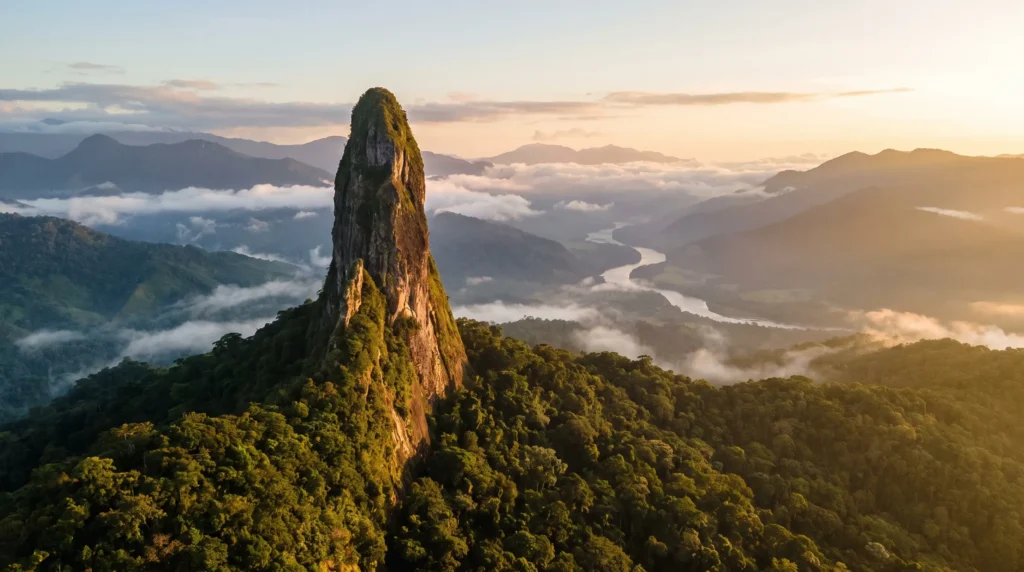
I’ll be honest: I had to look up where Sao Tome and Principe actually was the first time a reader asked me about it. Two volcanic islands sitting almost exactly on the equator in the Gulf of Guinea, a former Portuguese cocoa colony with barely 220,000 people, a jungle interior that pushes a single needle of rock 663 metres straight out of the rainforest canopy. Then I found out that in September 2025 this became the first country on Earth to have its entire territory designated a UNESCO Biosphere Reserve — every hectare of it, island to island. That’s when I stopped filing it under “obscure” and started filing it under “get there before everyone else figures this out.” This is not an easy trip — flights are limited, infrastructure is thin, and I’ll get into a real safety wrinkle below — but if you want beaches with your own footprints on them and cacao you can watch being roasted twenty feet from where it was picked, few places on the planet still offer it this cleanly.
In This Guide
- Overview — Two Volcanic Islands on the Equator
- Independence Day, July 12 — Sao Tome’s Biggest Party
- Best Time to Visit Sao Tome and Principe
- Getting There — TMS and the Only Way In
- Getting Around — Inter-Island Flights, Boats & Bad Roads
- Top Regions — Sao Tome, Principe & the Roças
- Culture & People — Forro, Tchiloli & Cacao Heritage
- A Food Lover’s Guide to Sao Tome and Principe
- Off the Beaten Path
- Practical Information
- Budget Breakdown — What Sao Tome Actually Costs in 2026
- Frequently Asked Questions
Overview — Two Volcanic Islands on the Equator
Sao Tome and Principe is Africa’s second-smallest country, a pair of volcanic islands roughly 140 kilometres apart in the Gulf of Guinea, straddling the equator off the coasts of Gabon and Equatorial Guinea. Portugal colonized the islands in the late 15th century and ran them for nearly five centuries as a plantation economy — first sugar, then coffee, then cocoa, which by 1905 had made this tiny archipelago the world’s largest producer of the crop. Independence came on 12 July 1975, and the plantation system left behind roças — grand, half-crumbling colonial estate compounds — scattered across both islands, several now reborn as hotels and cacao museums.
The two islands feel genuinely different. São Tomé, the larger, holds the capital, most of the population, and Obô Natural Park’s rainforest interior, crowned by Pico de São Tomé at 2,024 metres and punctuated by Pico Cão Grande, a sheer volcanic plug that rises 663 metres straight out of the jungle like something out of a fantasy film. Príncipe, smaller and far quieter, tops out at 948 metres on Pico de Príncipe and has built its entire identity around low-impact eco-tourism.
What makes 2026 a particularly interesting year to pay attention: in September 2025, UNESCO’s Man and the Biosphere Programme extended biosphere reserve status from Príncipe (designated in 2012) to cover the island of São Tomé as well — making this the first country in the world where the entire national territory carries that designation. That’s a conservation story, not a marketing slogan — but it’s also a good proxy for what you’re actually buying here: a country that has bet its future on keeping its forests, reefs and endemic species intact rather than paving over them.
Independence Day, July 12 — Sao Tome’s Biggest Party
If you’re reading this in mid-July, you’re two days out from the country’s single biggest civic celebration: Independence Day on 12 July, marking the 1975 break from Portugal. Expect parades and marching bands through the capital, flags strung across every street, speeches from national leaders, and the day tipping into music, street dancing and fireworks after dark. It’s the one week of the year when you’ll see the whole country dressed up at once.
Independence Day also overlaps with the tail end of the cocoa harvest and, in most years, performances of Tchiloli — a centuries-old masked theatrical tradition where actors in Renaissance costume narrate an epic tale of betrayal and justice to drums and shell rattles, one of the more striking fusions of African and Portuguese heritage you’ll find anywhere. Ask at your roça or guesthouse whether a troupe is performing nearby; it isn’t staged as a fixed tourist show, so timing takes a little local asking-around.
Best Time to Visit Sao Tome and Principe
June – September · Gravana (long dry season)
The most reliable window: cooler, drier, and the best conditions for hiking to Pico Cão Grande’s viewpoints or into Obô Natural Park, since trails turn slick and river crossings swell in the wet months. Whale and dolphin sightings off the south coast pick up in this window too.
December – February · Gravaninha (short dry season)
A second, shorter dry spell that’s a close second choice — good hiking weather, slightly warmer and more humid than mid-year, without the rains of the shoulder months.
March – May & October – November · Wet season
Heavier rain, especially inland and in the highlands, where annual totals can run into the thousands of millimetres. The upside is real: waterfalls run full, the forest is at its most lush and birdy, and this is prime cacao-harvest time on the roças. Roads and jungle trails get muddier, and flight schedules can slip in heavy weather — build in flex days if you’re island-hopping.
Getting There — TMS and the Only Way In
São Tomé International Airport (TMS), about 5 kilometres from the capital, is the country’s only real gateway. There is no way to arrive overland — this is an island nation with no land borders — so every visitor lands here or connects onward through Príncipe. TAP Air Portugal and STP Airways run the marquee route from Lisbon, the easiest connection for travelers from the US and Europe; TAAG Angola Airlines flies from Luanda, and ASKY Airlines and Afrijet connect via Libreville, Gabon.
Flight frequency is genuinely limited — this is not a route with hourly departures — so book well ahead and build a buffer day at each end of your trip in case of schedule changes. A yellow fever vaccination certificate is required if you’re arriving from a country with risk of transmission, so check that before you book.
Getting Around — Inter-Island Flights, Boats & Bad Roads
Between the two islands, STP Airways runs short domestic hops of roughly 30–40 minutes, typically daily except for a mid-week gap — the practical way to reach Príncipe, especially if your schedule is tight. A slower, cheaper boat connection also runs, but crossings can take anywhere from around six to twelve hours depending on vessel and weather, and are far more exposed to delay or cancellation — treat the boat as an adventure option, not a backup plan for a tight itinerary.
On São Tomé island itself, taxis and shared “collectivo” vans link the capital to outlying towns and roças; renting a car with a driver is the common way for visitors to reach Pico Cão Grande viewpoints, southern beaches and the botanical garden at Bom Sucesso. UK government guidance flags that many roads outside the capital are in poor condition and unlit, animals wander onto roads after dark, and heavy rain can trigger landslides that block routes — plan daytime travel and don’t rush after-dark drives between towns. On Príncipe, the tiny road network and even tinier population mean most lodges arrange transfers directly.
Top Regions — Sao Tome, Principe & the Roças
São Tomé City & the North
The capital is compact and colonial — the old Portuguese fort, the presidential palace, a lively central market — and the practical base for your first and last nights. The north coast around Micondó and Lagoa Azul offers easy beach time close to the airport.
Pico Cão Grande & Obô Natural Park
The interior is the country’s headline act: a national park covering roughly a third of São Tomé’s land area, protecting the rainforest that climbs toward Pico de São Tomé. The viewpoint hikes to see Pico Cão Grande’s needle-like spire are the most-photographed outing on the island — go with a local guide, since trails aren’t signposted and can be slick even in the dry season.
The Southern Roças & Ilhéu das Rolas
Roça São João dos Angolares and Roça Monte Café are among the old cocoa-plantation estates now open for tours and overnight stays, with rusting drying houses and manor buildings that tell the whole colonial-economy story better than any museum. At the southern tip sits Ilhéu das Rolas, a tiny islet the equator itself passes directly through — you can literally stand with one foot in each hemisphere at the marked monument.
Príncipe Island
Príncipe is the quieter, wilder half of the country: fewer than a few thousand residents, a coastline of dramatic sea stacks and hidden coves, and the country’s most deliberate eco-tourism model, built around its 2012 UNESCO biosphere reserve status. Bom Bom Island and the beaches around Praia Banana are the postcard shots; birders come for endemics found nowhere else on the planet.
Southern Beaches — Jalé & Praia Piscina
São Tomé’s south coast holds some of its best sand, including Praia Piscina, a natural tidal pool ringed by black volcanic rock that fills and calms at low tide. Come with time to spare — the drive south is slow, and that’s rather the point.
Culture & People — Forro, Tchiloli & Cacao Heritage
Portuguese is the official language, but daily life runs heavily through Forro (Santomean Creole), plus the smaller Angolar and Principense creoles — descendants of the languages Portuguese planters and enslaved and later contract laborers from across West and Central Africa built together over five centuries of plantation history.
Culturally, that plantation history shows up everywhere: in Tchiloli’s masked Renaissance theatre, in the Danço Congo warrior dance that dramatizes resistance to colonial rule, and in Ússua, another traditional dance form kept alive on both islands. Roman Catholicism, inherited from Portugal, remains the majority faith and shapes the calendar of local saints’ day festivals in villages around both islands — smaller, more local versions of the big July 12 celebration, worth asking your guesthouse host about if you’re visiting a particular town.
A Food Lover’s Guide to Sao Tome and Principe
This is cacao country in the truest sense — a place that was once the world’s top cocoa producer and still exports prized fine-flavor cacao today. Roça tours typically end with tastings of small-batch dark chocolate made a few dozen metres from where the pods were picked — one of the more direct farm-to-bar experiences you’ll find anywhere.
On the plate, expect calulu — a slow-cooked stew of fish or meat with greens, okra and palm oil, generally considered the national dish — alongside grilled fresh fish, breadfruit, and matabala (taro) served as a starchy side. Freshwater shrimp from the rivers, banana fritters, and strong Santomean coffee round out the table, and palm wine (“vinho de palma”) is the local tipple of choice in village settings.
Off the Beaten Path
Tinhosas Islets
Two tiny uninhabited islets off Príncipe’s coast, protected as a seabird sanctuary and folded into the Príncipe biosphere reserve — visitable by boat trip, weather permitting, for one of the region’s great seabird colonies.
Roça Monte Café’s Coffee Terraces
Once one of the world’s most productive coffee estates, now a slow, atmospheric stop where you can walk the drying terraces and colonial-era machinery rooms with almost no other visitors around.
Equator Monument, Ilhéu das Rolas
A short boat hop from São Tomé’s southern tip lands you on the tiny islet where the equator itself crosses land — quietly one of the more novel photo-ops on the entire continent.
Príncipe’s Interior Trails
Guided hikes through Príncipe’s biosphere-reserve forest turn up endemic birds and reptiles found nowhere else on Earth, in a landscape that sees a fraction of the (already small) visitor numbers São Tomé gets.
Practical Information
Safety and the current advisory. Here’s the honest catch: the US State Department raised its travel advisory for Sao Tome and Principe to Level 3 (“Reconsider Travel”) on 8 April 2026, citing the risk of unrest tied to the country’s 2026 election calendar — a presidential election on 19 July and legislative elections on 27 September — plus the country’s very limited medical evacuation capacity. UK guidance is calmer in tone: it notes the everyday crime rate is generally low, though burglaries and armed robberies do occur, and flags that economic and political disputes can occasionally spill into civil unrest. If your trip lands anywhere near the July or September election dates, check both advisories again close to departure, avoid demonstrations and political gatherings, and keep a flexible itinerary.
Health. Malaria risk from P. falciparum exists year-round across the entire country, and the CDC recommends antimalarial prophylaxis for every traveler, alongside strict mosquito-bite precautions. Medical facilities are limited nationwide, with no adequate trauma or ambulance services — serious conditions typically require evacuation to Europe, South Africa, Ghana or Gabon, so travel insurance with medical evacuation cover is non-negotiable.
Money. The dobra (STN) is pegged to the euro at €1 = 24.5 STN. Euros are the most useful hard currency to carry; credit cards are not widely accepted and ATMs are few, so bring enough cash for your whole stay.
Connectivity and logistics. Wi-Fi is workable in the capital’s hotels and patchy elsewhere; a local SIM is worth picking up on arrival. Plugs are European (type C/F), 220V. Time zone is UTC+0, no daylight saving.
Budget Breakdown — What Sao Tome Actually Costs in 2026
Prices sit above regional mainland-Africa norms, largely because so much — fuel, imported goods, even some produce — arrives by ship or plane.
Budget (US$70–130/day): Guesthouse rooms in the capital, grilled fish and calulu at local eateries, collectivo vans and shared taxis, self-guided beach days.
Mid-range (US$180–320/day): A roça hotel or boutique guesthouse, a driver-guide for a Pico Cão Grande viewpoint hike or roça-and-chocolate tour, one inter-island flight to Príncipe, restaurant dinners.
Luxury (US$450+/day): Príncipe’s flagship eco-lodges, private boat trips to Ilhéu das Rolas or the Tinhosas, chef-led tasting menus built around estate cacao.
Budget extra for the inter-island flight (pricier than most short domestic hops elsewhere in Africa) and for the entry fee payable on arrival — the exact amount can shift, so confirm the current figure before you fly.
Planning Your First Trip to Sao Tome and Principe
The classic first-timer route: fly Lisbon–São Tomé, spend three or four nights on the main island splitting time between the capital, a roça stay and a guided hike toward Pico Cão Grande, then take the short domestic flight to Príncipe for three nights of beaches and forest trails before flying home via Lisbon. Ten to twelve days covers both islands without feeling rushed; a week is enough if you commit to São Tomé alone. If you’re building a wider West/Central Africa itinerary, our Ghana travel guide pairs naturally with the Accra connection, and Senegal and Morocco round out an Atlantic-Africa loop for travelers continuing on from Lisbon.
Frequently Asked Questions
Is Sao Tome and Principe safe to visit in 2026?
Day-to-day crime is generally low, but the US State Department raised its advisory to Level 3 (“Reconsider Travel”) in April 2026 due to possible unrest around the July and September 2026 elections, combined with very limited medical evacuation capacity on the ground. If you’re traveling around either election date, check the current advisory again shortly before departure, steer clear of demonstrations, and carry solid medical evacuation insurance.
Do I need a visa?
US, UK and EU passport holders can enter visa-free for stays of up to 15 days. Longer trips require an e-Visa arranged in advance through the national e-VisaST system, typically processed within about a week. Bring a yellow fever certificate if arriving from a risk country.
Do I need malaria pills?
Yes. The CDC lists malaria risk as present year-round across the entire country and recommends antimalarial prophylaxis for all travelers, alongside standard bug-bite precautions.
How do I get between São Tomé and Príncipe?
A short STP Airways domestic flight, usually daily with one weekly gap, is the practical option; a slower boat crossing exists for a lower price but is far more exposed to weather delays and isn’t a reliable fallback if you’re on a tight schedule.
What currency should I bring?
The dobra is pegged to the euro at €1 = 24.5 STN, so euros are the most useful cash to carry. Credit cards are not widely accepted and ATMs are limited, so plan to carry enough cash for your whole stay.
Is this a beach trip or a jungle trip?
Both, genuinely — that’s the pitch. São Tomé pairs rainforest hikes toward Pico Cão Grande with black-volcanic-sand beaches and the equator monument at Ilhéu das Rolas; Príncipe leans harder into forest, endemic wildlife and quiet coves. Most first-timers who can manage the logistics do both islands.
Ready to Explore Sao Tome and Principe?
A country you can drive across in a day, a spire of volcanic rock rising straight out of the jungle, and — as of last September — the only nation on Earth where the whole territory carries UNESCO biosphere status. Sao Tome and Principe asks more of you logistically than most destinations on this site, and I won’t pretend otherwise. But for travelers willing to book the limited flights, carry cash, and check the current safety advisory before they go, it pays that effort back with beaches, cacao and rainforest that most of the world still hasn’t found.
Explore More
- Ghana Travel Guide — the nearest major Accra flight connection
- Senegal Travel Guide — another West African coastal culture
- Morocco Travel Guide — round out an Atlantic-Africa itinerary
- Madagascar Travel Guide — more African-island endemic wildlife
How this guide was built
Published . Built from authoritative sources — Wikipedia entity pages for Sao Tome and Principe, its currency and its main airport; UNESCO’s Man and the Biosphere Programme pages for the Príncipe and São Tomé biosphere reserves; the US State Department’s country travel advisory; the UK FCDO’s Sao Tome and Principe travel advice pages; and the US CDC’s traveler health page for the country. Numeric and checkable claims carry inline citations.
Sources cited on this page
- Wikipedia — Sao Tome and Principe
- Wikipedia — Sao Tome and Principe dobra
- Wikipedia — Visa policy of Sao Tome and Principe
- Wikipedia — Sao Tome International Airport
- UNESCO MAB — Island of Príncipe Biosphere Reserve
- UNESCO MAB — Ilha de São Tomé Biosphere Reserve
- US State Department — Sao Tome and Principe Travel Advisory
- UK FCDO — Sao Tome and Principe travel advice
- US CDC — Sao Tome and Principe traveler page
More country guides you might like
Plan your trip to Sao Tome and Principe
The booking tools we use ourselves. FFU may earn a commission at no extra cost to you.
Plan & book your trip to Sao Tome and Principe
Booking through these searches supports our guides at no extra cost to you.
Curated multi-day tours to Sao Tome and Principe — Exoticca →