
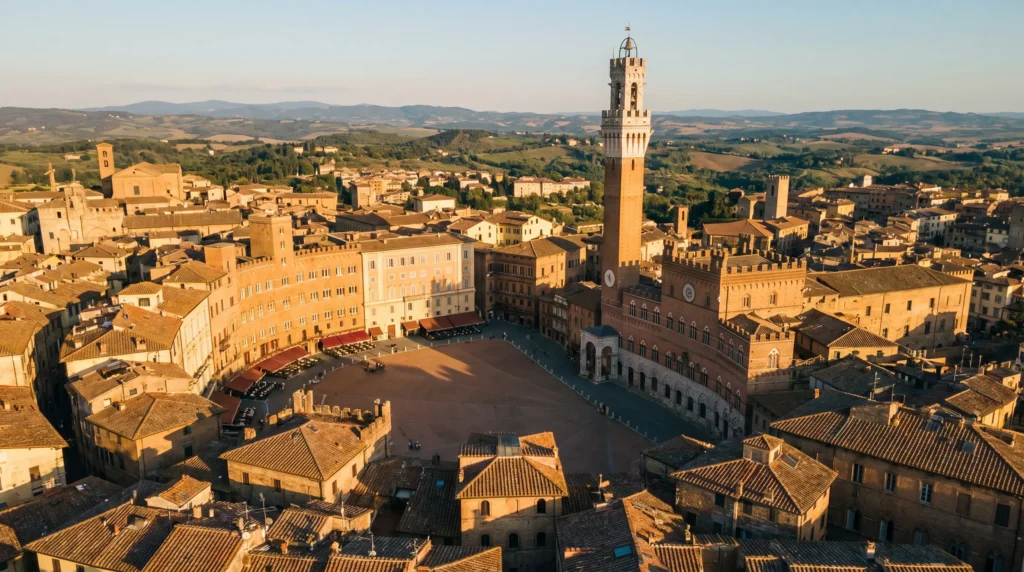
Siena Travel Guide — Tuscany’s Medieval Rival to Florence, Minus the Crowds
Everyone tells you to go to Florence. I’m telling you Siena is the one you’ll actually think about a year later. It’s a city that peaked, architecturally, around 1348 and then simply stopped competing — no Renaissance building boom papered over the medieval brickwork, because the Black Death gutted the population and the money dried up along with it. The accidental result is the best-preserved Gothic city in Italy: a shell-shaped square that still hosts a bareback horse race twice a year, a cathedral striped like a zebra, and seventeen self-governing neighborhoods that take their rivalries more seriously than most countries take their elections. I’ve done Siena as a Florence day trip and as a proper multi-night stay, and only one of those did it justice — here’s how to get it right, including the parts that are genuinely a hassle.
In This Guide
- Overview — Why Siena Beats Florence for a Slower Kind of Amazing
- The Palio — Siena’s 90-Second Obsession
- Best Time to Visit Siena (Season by Season)
- Getting There — Airports, Trains & the Florence Bus
- Getting Around — On Foot, Because You Have No Choice
- Neighborhoods — The Three Terzi & Seventeen Contrade
- Culture & People — Life Inside a Contrada
- A Food Lover’s Guide to Siena
- Off the Beaten Path
- Day Trips from Siena — Chianti, Val d’Orcia & Beyond
- Practical Information
- Budget Breakdown — What Siena Actually Costs in 2026
- Frequently Asked Questions
Overview — Why Siena Beats Florence for a Slower Kind of Amazing
Siena and Florence spent the medieval period as bitter rivals, and Siena lost — first on the battlefield of geopolitics, then, more decisively, to the plague of 1348, which killed a huge share of the city’s population and stalled its economic momentum for good. Florence went on to fund the Renaissance. Siena, deprived of the money to keep building, essentially froze in Gothic brick and stone. Walk the historic center today, inscribed by UNESCO as a World Heritage Site in 1995 for its uninterrupted medieval urban fabric, and you’re looking at a 14th-century townscape that never got a Renaissance facelift.
The physical heart of it is Piazza del Campo, a fan-shaped square unlike anything else in Italy, sloping down toward the Palazzo Pubblico and its Torre del Mangia — at 87 meters (102 with the lightning rod), built deliberately to match the height of Siena Cathedral as a statement that civic and church power stood equal. The Duomo itself, striped in the black-and-white marble that’s become the city’s visual signature, holds an inlaid marble floor and a Piccolomini Library most visitors somehow miss.
Siena is small enough to see the highlights in a day, but it rewards the opposite approach entirely. This is a city that still organizes its social life around seventeen medieval neighborhoods (contrade), each with its own church, museum, colors and fierce loyalties, all converging twice a year for the Palio — a 90-second bareback horse race around the Campo that locals will tell you, without irony, is the most important thing that happens here all year. Stay two or three nights and that layer of the city starts to show itself in ways a day-tripper from Florence never sees.
The Palio — Siena’s 90-Second Obsession
Twice a year, ten horses and riders — bareback, representing ten of the city’s seventeen contrade chosen partly by lottery — tear three laps around a dirt-covered Piazza del Campo in a race that’s usually over in under 90 seconds and decided as often by strategy and sabotage as by speed. A horse without its rider can still win. There are no real rules against interfering with rival jockeys mid-race. It is, by design, chaos.
The Palio di Provenzano runs on 2 July, honoring a local Madonna and dating back to 1656; the Palio dell’Assunta runs on 16 August, added in 1701 for the Feast of the Assumption. Both years’ races follow days of trial runs, blessing-of-the-horse ceremonies inside contrada churches, and a slow medieval costume procession into the square — all more atmospheric, honestly, than the race itself. Free standing-room in the infield is exactly that: free, and packed shoulder-to-shoulder for hours in July heat with no shade, no bathroom access, and no way out until it’s over. Paid grandstand seats cost considerably more but are the only realistic option if you want to actually see anything and still be able to leave.
Best Time to Visit Siena (Season by Season)
April – June · The sweet spot
Wildflowers across the Tuscan hills, comfortable walking weather, and crowds that are present but manageable outside the Palio’s own build-up in late June. This is the window most seasoned Tuscany visitors quietly prefer to summer.
July – August · Peak heat, peak crowds, Palio season
Hot — genuinely uncomfortable by midafternoon — and this is when Florence day-trippers flood in on the express bus. If you’re not here specifically for one of the two Palio dates, these months are the least pleasant time to visit the Campo itself, though evenings are lovely and long.
September – October · The other sweet spot
Harvest season across Chianti and the Val d’Orcia, grape and olive-picking energy in the countryside, cooler evenings, and the year’s best light for the hilltop views Siena’s whole region is built around.
November – March · Quiet and cold
Genuinely low season: thinner crowds, better hotel rates, but shorter museum hours, some rural agriturismi closed, and a real chance of raw, damp cold that Tuscan stone buildings do nothing to soften. Fine for a focused city visit; less rewarding if day trips into the countryside are the point.
Getting There — Airports, Trains & the Florence Bus
Siena has no airport of its own. Florence Airport (Peretola), about 81 kilometers to the north, is the closest, though it handles mostly short-haul European routes; Pisa’s airport is a similar distance and often has better long-haul connections. For intercontinental flights, most travelers route through Rome Fiumicino, roughly 265 kilometers southeast, and continue by train or car.
From Florence, the counterintuitive truth is that the bus beats the train. The Tiemme express coach (line 131R) covers the route in about 75 minutes direct into Siena’s historic center; the train, despite looking faster on paper, usually requires a change at Empoli and takes closer to 90 minutes door to door once you count the walk from Siena’s station up into town. Renting a car makes sense if you’re combining Siena with Chianti or the Val d’Orcia, but skip it for the city itself — the historic center is pedestrianized and largely closed to non-resident traffic (a ZTL zone), and parking is a real headache right at the walls.
Getting Around — On Foot, Because You Have No Choice
Siena’s historic center sits on three converging ridges, which means charming hill-town views in every direction and a lot of uphill walking between them — comfortable shoes are not optional here. The whole UNESCO core is compact enough to cross in twenty minutes, but “compact” doesn’t mean flat: side streets drop and climb sharply between the three terzi (thirds) of the city.
There are no cars to worry about inside the walls — the center is a ZTL (limited traffic zone) with cameras enforcing it, so if you’re driving in, park in one of the signposted lots outside the walls (Fortezza, San Francesco, or the Stadio) and walk or take the scale mobili — a series of covered escalators that haul you up from the lower car parks into the old town, a small mercy on a hot day. Local orange city buses (Tiemme) cover the modern outskirts, but you won’t need them for anything on the sightseeing list.
Neighborhoods — The Three Terzi & Seventeen Contrade
Siena’s historic center divides administratively into three terzi (thirds) — Città, Camollia and San Martino — which then split further into seventeen contrade, medieval neighborhood-wards that still function as genuine civic identities: each has its own church, museum, fountain, colors, mascot and, for ten of them each Palio, a horse.
Terzo di Città
The oldest third, built on the ridge holding the Duomo, the Baptistery and the Pinacoteca Nazionale. This is postcard Siena — narrow lanes radiating off the cathedral square, the best concentration of museums, and contrade including the Selva (forest) and the Nicchio (shell).
Terzo di San Martino
Anchored by Piazza del Campo itself and the Palazzo Pubblico, this terzo also holds the Basilica di San Francesco and quieter residential lanes as you head toward the southeastern gates. Home turf of the Torre (tower) and Onda (wave) contrade, among others.
Terzo di Camollia
The largest third, stretching north from the center toward Porta Camollia, Siena’s grand northern gate. Less postcard-dense, more everyday-Sienese, with good mid-range restaurants that don’t cater exclusively to day-trippers. Contrade here include the Istrice (porcupine) and Lupa (she-wolf).
Around Piazza del Campo
Technically shared civic ground rather than any one contrada’s turf, the Campo is where all seventeen converge for the Palio and where most first-time visitors spend the bulk of their time — reasonably, since the Palazzo Pubblico, Torre del Mangia and the square’s own Gothic palazzi are worth the crowds. Just don’t stop here; the city’s best moments are one or two streets back.
Wandering between contrade, look for the small ceramic plaques and flags marking each one’s boundary and colors — an easy, free way to understand the city’s real internal geography, far more telling than any terzo line on a map.
Culture & People — Life Inside a Contrada
Being born in Siena means being born into a contrada — baptisms often happen in the contrada’s own church rather than the Duomo, and the neighborhood identity runs deeper than city, region or, some Sienese will half-joke, nation. Each contrada runs its own small museum of Palio trophies and banners (the “drappelloni,” hand-painted silk banners awarded to the winning contrada each race), and many host communal dinners in the streets the night before a Palio — thousands of people at long tables, a genuinely moving sight if you happen to stumble into one.
Rivalries between certain contrade run centuries deep and are taken with total sincerity even by people who’ll laugh about almost anything else. Visitors are welcome to watch trial races and processions respectfully, but this isn’t a show staged for tourists — it’s the actual social fabric of the city, and treating it that way (asking before photographing inside a contrada church or museum, not wearing a rival contrada’s scarf inside “hostile” territory as a joke) goes a long way.
A Food Lover’s Guide to Siena
Siena’s signature pasta is pici — thick, hand-rolled, eggless noodles usually served all’aglione (garlic and tomato) or with a wild boar ragù. Pair it with Sienese cold cuts, especially cinta senese, a heritage pig breed raised across the province and turned into some of Tuscany’s best salumi.
The city’s real specialty, though, is dessert. Panforte, a dense, spiced fruit-and-nut cake dating back centuries, and ricciarelli, soft almond cookies dusted in powdered sugar, are both Sienese inventions now sold across Italy but best bought fresh from an old-school Siena pasticceria rather than an airport gift shop. Wash it down with a glass of local Chianti Colli Senesi or, if you’re near the Val d’Orcia, a Brunello di Montalcino.
Pecorino, the sheep’s-milk cheese of the surrounding hills, shows up everywhere from cheese boards to shavings over pici, often aged and paired with local honey or chestnut jam. Skip anywhere on the Campo itself flashing photo-menus in six languages — the good, honestly priced trattorie sit one or two streets back, in the terzi rather than on the square.
Off the Beaten Path
Facciatone & the Unfinished Duomo Nuovo
In the 1300s, Siena tried to build a cathedral bigger than Florence’s — the plague and the money running out stopped construction, leaving a soaring, roofless “new nave” wall known as the Facciatone. Climbing it gives arguably the best rooftop view over the city and the whole shell of the Campo, with a fraction of the queue for the Duomo’s own dome.
Fonte Gaia & the underground bottini
Beneath Siena runs a medieval network of hand-dug aqueduct tunnels (bottini) that supplied the city’s fountains centuries before modern plumbing — occasional guided tours run through local associations for anyone curious about how a hill town without a river ever kept its wells full.
A quiet contrada museum
Skip the queue at the Duomo one afternoon and instead ask at a contrada’s headquarters about visiting its small private museum of Palio banners and costumes — most welcome visitors by appointment, and it’s a far more intimate way into the city’s real obsession than watching the race itself from a packed infield.
San Domenico at sunset
The fortress-like Basilica of San Domenico, holding a relic associated with Siena’s patron Saint Catherine, has a terrace view over the Duomo and the valley that draws a fraction of the crowd gathered at the Facciatone or the Campo at the same hour.
Day Trips from Siena — Chianti, Val d’Orcia & Beyond
Siena’s real advantage over Florence as a base is what surrounds it. The Val d’Orcia, the classic cypress-lined, hilltop-village landscape south of the city, was inscribed by UNESCO as a cultural landscape in 2004, specifically for how thoroughly its Renaissance-era farming pattern survives intact. Within it, hit Pienza for pecorino shops and Renaissance urban planning packed into a village you can cross in ten minutes, and Montalcino for Brunello tastings in a hilltop fortress town.
San Gimignano, an hour northwest, is the “Manhattan of Tuscany” — a walled village bristling with surviving medieval tower-houses, genuinely striking despite being firmly on the tour-bus circuit; go early morning or late afternoon to dodge the worst of the day-trip crowds. Chianti proper sits between Siena and Florence, best explored slowly by rental car through Radda, Gaiole and Castellina, tasting-room to tasting-room.
Further out, Montepulciano pairs another hilltop old town with Vino Nobile tastings, and history-minded travelers add Volterra, quieter and Etruscan-rooted, about 90 minutes northwest. All of these work as long day trips by car; a few (San Gimignano, Montalcino) have direct or one-change bus connections from Siena’s bus station for anyone going car-free.
Practical Information
Money. Italy uses the Euro. Cards are widely accepted in restaurants and shops, but small trattorie, market stalls and some rural agriturismi are cash-preferred or cash-only — carry some cash outside the main tourist streets.
Safety. The US State Department rates Italy at Level 2 (“exercise increased caution”), citing terrorism risk at crowded sites generally rather than anything specific to Siena, and flags pickpocketing on public transit and in crowded tourist areas as the more everyday concern. Siena itself is a small, low-crime university town by Italian standards; standard city-travel caution (watch bags in crowds, especially during the Palio) covers it. Check current UK FCDO advice before travel as well.
Health. No special vaccines required for most travelers; the CDC recommends being current on routine vaccines (MMR especially, given rising measles cases globally) and considering Hepatitis A if you’ll be eating a lot of street food or visiting rural areas. Tap water is safe to drink, including from the city’s public fountains (nasoni).
Connectivity. An EU-wide eSIM is the easiest option and works seamlessly across any day trips. Plugs: Type C/F/L, 230V. Time zone: Central European Time (UTC+1, UTC+2 with summer daylight saving).
Budget Breakdown — What Siena Actually Costs in 2026
Siena is generally cheaper than Florence or Rome for equivalent quality, especially once you’re eating a street or two off the Campo.
Budget (US$70–120/day): Hostel bed or simple guesthouse just outside the walls, pici at a no-frills trattoria, museum entry to one or two sights, walking everywhere.
Mid-range (US$180–320/day): Boutique B&B inside the historic center, sit-down dinners with a bottle of Chianti, Duomo complex ticket plus Facciatone climb, a half-day Chianti or Val d’Orcia tour.
Luxury (US$500+/day): A converted-farmhouse agriturismo in the Val d’Orcia with pool and views, private wine-estate tastings in Montalcino, a Palio grandstand seat on race day (the single biggest splurge line item most visitors will hit).
Tipping isn’t obligatory the way it is in the US — rounding up or leaving small change for good service is normal; a “coperto” (cover charge) of a few euros per person is standard and legal on most restaurant bills.
Planning Your First Trip to Siena
Two to three nights is the sweet spot: one full day for the Duomo complex, Palazzo Pubblico and Torre del Mangia, Facciatone climb and a slow wander through all three terzi; a second day for a Chianti or Val d’Orcia trip by rental car or small-group tour. If you’re combining it with a longer Tuscany itinerary, pair Siena with our Florence guide for the Renaissance counterpoint just 75 minutes north, and consider bookending the trip with our Rome guide for the flight in or out through Fiumicino. Our Italy travel guide has the country-level essentials — rail passes, regional context, visa rules — that apply everywhere you go from here.
Frequently Asked Questions
Is Siena worth visiting if I’ve already seen Florence?
Yes — it’s a genuinely different kind of city, not a smaller Florence. Where Florence is Renaissance grandeur, Siena is intact medieval urbanism, and the two make a natural pair rather than a redundant one.
Can I do Siena as a day trip from Florence?
You can, and the express bus makes it logistically easy at about 75 minutes each way, but a day trip only really covers the Campo, the Duomo and a rushed wander. Staying even one night unlocks the quieter evening city and any day trip into the surrounding countryside.
How do I get Palio tickets?
Free standing space in the infield is available on a first-come basis but means hours of standing in summer heat with no exit until the race ends; paid seats in temporary grandstands around the Campo cost considerably more and must generally be booked well in advance through contrada contacts or authorized agencies — this is not a same-week booking.
Do I need a visa?
US, UK, Canadian and most Western passport holders enter visa-free under the Schengen rules, for stays up to 90 days within any 180-day period. Make sure your passport has at least three months’ validity beyond your departure date.
Is Siena walkable, or do I need a car?
The historic center itself is entirely walkable and largely closed to cars (ZTL zone) — you won’t want or need one inside the walls. A car only becomes useful once you’re heading into Chianti or the Val d’Orcia, where public transport thins out.
Siena or San Gimignano as a home base?
Siena, without much debate — it has far more depth (museums, neighborhoods, day-trip options, real restaurants), while San Gimignano is best treated as a half-day stop rather than a base.
Ready to Explore Siena?
A cathedral that never got finished, a square shaped like a shell, and a horse race that still decides neighborhood bragging rights for the whole year — Siena rewards anyone willing to give it more than an afternoon squeezed between Florence museum bookings. Go slow, eat one street back from the Campo, and let the contrade flags tell you where you actually are.
Explore More
- Florence City Guide — the Renaissance rival, 75 minutes north
- Rome City Guide — the likely gateway airport for long-haul flights
- Venice City Guide — round out a classic Tuscany-plus-Venice itinerary
- Italy Travel Guide — country-level essentials and regional context
How this guide was built
Published as part of Facts From Upstairs’ city guide series. Built from authoritative sources — UNESCO’s Historic Centre of Siena and Val d’Orcia inscriptions, the US State Department and UK FCDO Italy travel advisories, the US CDC traveler page for Italy, Visit Tuscany’s official Siena destination page, and Wikipedia entity pages for Siena, the Palio di Siena and the Torre del Mangia. Numeric claims carry inline citations.
More city guides you might like
Plan your trip to Siena
The booking tools we use ourselves. FFU may earn a commission at no extra cost to you.
Plan & book your trip to Siena
Booking through these searches supports our guides at no extra cost to you.