
Tenerife Travel Guide — Volcanoes, Black-Sand Beaches & Europe’s Best Winter Sun
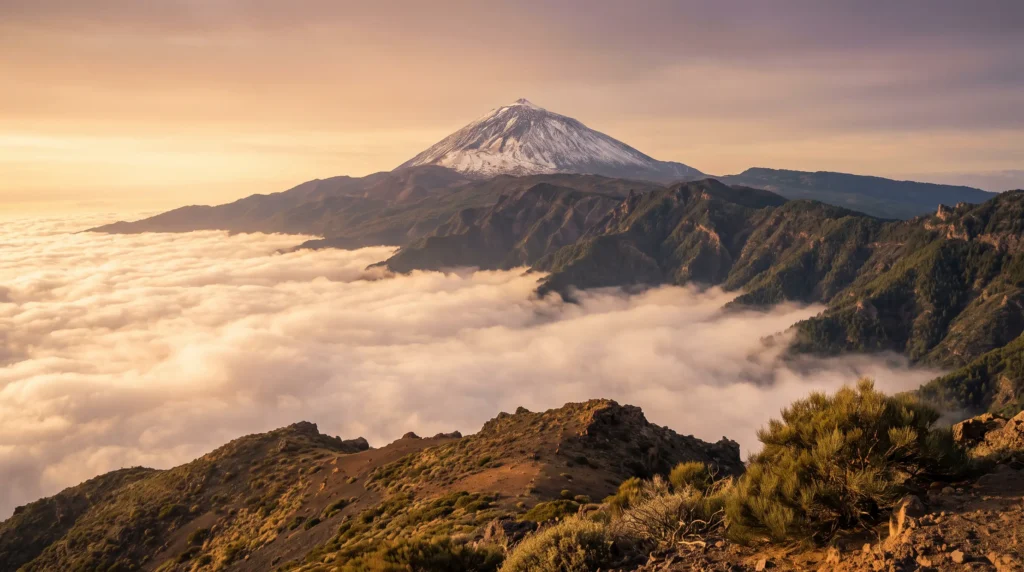
Tenerife is the island people book for a cheap beach week and then can’t stop talking about for reasons that have nothing to do with the beach. Yes, it’s the biggest of the Canary Islands, sitting off the coast of northwest Africa but flying the Spanish and EU flag, which means you get African-adjacent light and Atlantic swell with European plugs, prices in euros and zero border hassle if you’re coming from the EU. What surprises first-timers is the middle of the island: Mount Teide erupts (dormantly) out of the center at 3,715 metres, the highest point in Spain, and on a clear day it pokes above a “sea of clouds” that pools around its base like something out of a nature documentary. I’ve done the lazy resort week here and I’ve done the drive-up-a-volcano-before-breakfast week, and honestly you should plan for both — this island is far weirder and more varied than its all-inclusive reputation lets on, and I’ll tell you where the reputation is earned and where it’s selling the place short.
In This Guide
- Overview — Why Tenerife Is More Than a Beach Package
- Carnival de Santa Cruz — One of the World’s Biggest Street Parties
- Best Time to Visit Tenerife (Season by Season)
- Getting There — TFS, TFN & Ferry Links
- Getting Around — Buses, Trams & Rental Cars
- Neighborhoods & Key Areas — North vs. South
- Culture & People — Guanche Roots, Canarian Identity
- A Food Lover’s Guide to Tenerife
- Off the Beaten Path
- Day Trips From Tenerife
- Practical Information
- Budget Breakdown — What Tenerife Actually Costs in 2026
- Planning Your First Trip
- Frequently Asked Questions
Overview — Why Tenerife Is More Than a Beach Package
Tenerife is the largest and most populous of the Canary Islands, an archipelago that belongs to Spain but sits in the Atlantic off the coast of Morocco and Western Sahara — closer to Africa than to mainland Europe. That geography is the whole story: volcanic soil, near-constant trade winds, and a climate mild enough that Northern Europeans have been flying down for “winter sun” for decades, giving the south coast its reputation as one giant resort strip.
What the resort reputation undersells is the interior. Teide National Park protects the Teide-Pico Viejo volcanic complex, crowned by Mount Teide at roughly 3,715 metres — the highest peak in Spain and the highest point in any Atlantic island — and UNESCO inscribed the park as a World Heritage Site in 2007 for its otherworldly lava-field landscape. Up on the mountain’s shoulder sits the Teide Observatory, one of the world’s best sites for stargazing thanks to clean, still, high-altitude air.
The island’s old capital-in-spirit, San Cristóbal de La Laguna, is a UNESCO World Heritage town in its own right — inscribed in 1999 as the first unfortified Spanish colonial town, laid out on an unrealized grid plan that later influenced city planning across the Americas. Add whale and dolphin pods offshore (up to 21 species recorded in local waters), black-sand beaches from the volcanic rock, and a food scene built on Atlantic seafood and Andean-by-way-of-the-colonies potatoes, and you’ve got an island that rewards renting a car for at least a couple of days, even if you never leave your sun lounger for the rest of the week.
Carnival de Santa Cruz — One of the World’s Biggest Street Parties
Time a February or early March trip around the Carnival of Santa Cruz de Tenerife, routinely ranked among the largest carnival celebrations on the planet, second in scale only to Rio in the eyes of most guidebooks. Dates shift with the Christian calendar (Carnival runs on the Lent countdown), so check the year’s exact dates before booking, but expect roughly two to three weeks of build-up culminating in the Grand Coso parade — feathers, sequins, live murga bands and hundreds of thousands of people, both costumed and not, filling the capital’s streets.
The catch: hotels in Santa Cruz and nearby Puerto de la Cruz book out and prices spike well ahead of the dates, and the crowds are genuinely dense — leave valuables at the hotel and expect to be dancing shoulder-to-shoulder with strangers whether you planned to or not. If Carnival doesn’t line up with your dates, Corpus Christi in La Orotava (May/June), where locals lay elaborate sand-and-flower “carpets” on the streets, is a quieter but equally striking alternative.
Best Time to Visit Tenerife (Season by Season)
October – April · Winter sun (peak for northern Europeans)
This is Tenerife’s calling card: while the UK and Germany are grey, the south coast holds averages in the high teens to low 20s Celsius. Expect the fullest resorts and highest flight prices, especially around Christmas, New Year and February’s Carnival. Book accommodation two to three months out for these windows.
May – June & September · Shoulder sweet spot
Warm, drier, thinner crowds, and sea temperatures already comfortable from the long summer buildup. This is the value window serious repeat visitors favor — fewer package tourists, same weather.
July – August · Peak heat, peak Spanish domestic travel
The hottest stretch, and also when mainland Spanish families take their own summer holidays, so the south coast resorts and beaches fill from both directions at once. Interior hikes (including Teide) are best tackled at dawn to beat the heat; wildfire risk in dry pine forests is at its highest in these months.
Year-round microclimate quirk
Tenerife’s north (Puerto de la Cruz, La Orotava) catches more cloud and rain than the arid south (Costa Adeje, Los Cristianos) any time of year — it’s entirely possible to have a grey morning in the north and drive 45 minutes to blazing sun in the south. Plan flexible days around this rather than fighting it.
Getting There — TFS, TFN & Ferry Links
Tenerife has two airports, which trips up a lot of first-time visitors. Tenerife South–Reina Sofía (TFS), near Granadilla de Abona, is the main international gateway — it handled roughly 14 million passengers in 2025 and is a Ryanair base, with the bulk of package and charter flights from the UK, Germany and elsewhere in Europe landing here, conveniently close to the southern resort belt.
Tenerife North–Ciudad de La Laguna (TFN), just outside Santa Cruz and La Laguna, handled around 7.2 million passengers in 2025 and functions mainly as the inter-island and domestic hub — flights to Madrid, Barcelona and Seville, plus the short inter-island hops to Gran Canaria and La Palma that are often cheaper and faster than the ferry. If your hotel is in the north (Puerto de la Cruz, Santa Cruz), check which airport your flight actually lands at before booking a transfer — the two airports are roughly 45–60 minutes apart by road.
Ferries (Fred. Olsen Express and Naviera Armas) connect Tenerife to the other Canary Islands — Gran Canaria, La Gomera, La Palma and El Hierro — from ports at Los Cristianos and Santa Cruz, useful for island-hopping without flying.
Getting Around — Buses, Trams & Rental Cars
TITSA runs the island’s public bus network (called “guaguas” locally, not “autobuses” — use the local word and you’ll get a smile), reaching virtually every town and beach for a few euros a ride; a rechargeable Via·Tenerife card cuts fares further. Santa Cruz and La Laguna are also linked by a modern tram, the only one in the Canary Islands, which makes the museum-and-old-town day trip between the two effortless without a car.
That said, a rental car (from roughly €25–45/day) is the single best upgrade for a Tenerife trip — it’s what unlocks Teide National Park, the Anaga rural park’s hairpin roads, and the black-sand beaches of the north that buses reach slowly or not at all. Roads are well-paved but genuinely mountainous; budget more driving time than the map suggests, and rent an automatic if you’re not confident on switchbacks. Taxis are metered and reliable in resort towns but pricier for cross-island trips than a day’s car rental.
Neighborhoods & Key Areas — North vs. South
Santa Cruz de Tenerife
The island capital and largest city, home to around 212,000 people, with a genuine working port city feel rather than a resort vibe — Santiago Calatrava’s white-sailed Auditorio de Tenerife is the skyline’s signature building, and the Carnival happens here.
San Cristóbal de La Laguna
The historic former capital, a UNESCO World Heritage town since 1999, all pastel colonial facades, wooden balconies and a university-town buzz thanks to Universidad de La Laguna. Fifteen minutes by tram from Santa Cruz and easily paired in one day.
Puerto de la Cruz & the North Coast
The original tourist town from the 1960s, greener and cloudier than the south, with a faded-grand old-resort charm, Loro Parque zoo, and Lago Martiánez, César Manrique’s striking seawater lido complex. Base here for a more “real town” feel and easy access to La Orotava’s historic center.
Costa Adeje & Los Cristianos / Playa de las Américas
The modern resort belt: purpose-built hotel strips, the driest and sunniest stretch of coast, and the island’s nightlife and package-holiday density. This is what most people picture when they hear “Tenerife,” for better and worse — excellent for a straightforward beach week, less good if you want authentic Canarian life.
Anaga Rural Park
The island’s wild northeastern tip: ancient laurisilva (laurel) cloud forest, near-vertical ridgelines, and hamlets reachable only by hiking trail or a single winding road. A completely different Tenerife from the resort coast, and worth a full day.
Teide National Park & the Highlands
The volcanic core — lunar lava fields, the cable car partway up Mount Teide, and stargazing tours that take advantage of some of the clearest night skies in Europe. Roque Cinchado and the “Los Roques de García” rock formations are the most-photographed spot in the park.
Garachico & the Isla Baja
A picturesque northwestern town rebuilt after a 1706 volcanic eruption buried its original harbor, now known for natural volcanic-rock swimming pools carved into the coastline — a quieter, more local alternative to the south’s beach clubs.
Culture & People — Guanche Roots, Canarian Identity
Long before Spanish colonization in the 15th century, Tenerife was home to the Guanches, an indigenous Berber-related people whose mummification practices, cave dwellings and stone pyramids at Güímar still shape local identity and place names across the island. Canarian Spanish carries its own accent and vocabulary — shaped by centuries of trade with Latin America — and locals will gently correct you if you assume they’re culturally identical to mainland Spain; the Canarian flag flies almost as often as the Spanish one.
Beyond Carnival, look out for romerías — village pilgrimage-festivals honoring local patron saints with oxcarts, traditional dress and communal food, common across the island in spring and summer. Lucha Canaria, a traditional Canarian wrestling style dating back to the Guanches, still draws local crowds at island sporting events, and folk music built around the timple, a small five-string guitar unique to the Canaries, turns up at almost any local festival.
A Food Lover’s Guide to Tenerife
Start with papas arrugadas — small wrinkled potatoes boiled in heavily salted water and served with mojo sauce, either the red mojo picón (paprika, chili, garlic) or the green mojo verde (coriander and parsley). It’s on every menu on the island and it’s the single dish to order first. Gofio, a toasted-grain flour with Guanche roots, still turns up in soups, desserts and even ice cream.
Being an island, seafood is the backbone: fresh-caught vieja (parrotfish), grilled octopus (pulpo), and cherne (wreckfish) show up at simple coastal guachinches — informal, often family-run taverns, some technically operating out of someone’s garage, serving home wine and home cooking at prices resort restaurants can’t match. Look for the hand-painted signs pointing off the main road. For dessert, try bienmesabe, an almond-and-honey sweet, alongside a glass of Canarian wine — the island’s volcanic-soil vineyards, particularly around Tacoronte-Acentejo and the slopes below Teide, are an underrated find that rarely leaves the archipelago.
Off the Beaten Path
Masca Village & Gorge
A cliffside hamlet at the end of one of the most dramatic mountain roads in Europe, with a legendary hiking trail down the Masca Gorge to a tiny cove (permit and guide increasingly required due to rockfall risk — check current rules before attempting it).
Anaga’s Hidden Beaches
Playa de Benijo and Playa de Almáciga, black-sand beaches backed by jagged sea stacks, reachable only via Anaga’s winding roads — no resorts, no beach clubs, just surfers and locals.
Chinamada & the Cave Houses
A tiny Anaga hamlet where some residents still live in cave dwellings carved into volcanic rock, reachable by a short hike from the village of Taganana.
Icod de los Vinos’ Drago Milenario
A dragon tree estimated at several centuries old (exact age disputed and likely exaggerated by tradition, but it’s genuinely ancient), the emblem of the island’s flora and worth a stop between the north coast and Teide.
Day Trips From Tenerife
Teide National Park is the essential full-day trip from anywhere on the island — go early to beat the tour buses and clouds, and book the summit cable car and any hiking permits (for the very top crater) well in advance online. La Laguna and Santa Cruz pair easily into one day via the tram. La Orotava’s historic quarter and its ornate balconied houses make a natural add-on to a Puerto de la Cruz base.
By ferry, La Gomera is close enough for a day trip from the south coast — its Garajonay National Park protects ancient laurisilva forest that feels prehistoric. Gran Canaria is reachable by a short flight or longer ferry for those wanting to compare Canary Islands on one trip.
Practical Information
Money. The euro is the currency, and cards are accepted almost everywhere in resort areas; carry some cash for guachinches, markets and rural villages. The Canary Islands sit outside the EU VAT area and instead apply a lower local tax (IGIC, generally 7%), so shopping can be modestly cheaper than mainland Spain.
Safety. The US State Department rates Spain (which includes the Canary Islands) at Level 2 — “Exercise Increased Caution” — citing terrorism risk at tourist sites and transit hubs generally, plus common petty crime like pickpocketing in tourist areas and airports; there’s no Tenerife-specific warning beyond the standard advice to stay alert in crowds. The UK Foreign Office’s Spain advisory likewise carries no Canary Islands–specific alerts as of this writing, beyond general guidance to check for regional wildfire or weather notices before travel.
Health. No special vaccines are required; the CDC recommends being up to date on routine vaccines (particularly measles/MMR) for all international travel and suggests hepatitis A/B for travelers eating widely or visiting rural areas. Tap water is generally safe in developed areas, though many locals prefer bottled given the island’s desalination-heavy supply.
Connectivity. An EU-compatible SIM or eSIM gets good coverage across the resort coasts; signal thins out in Anaga’s deep valleys and near the Teide summit. Plugs: European two-pin (Type F), 230V. Time zone: WET (UTC+0), one hour behind mainland Spain, with EU daylight saving observed.
Budget Breakdown — What Tenerife Actually Costs in 2026
Tenerife is one of the better-value corners of Western Europe, especially outside the peak winter-sun window.
Budget (€45–75/day): Hostel or budget apartment in Los Cristianos or Puerto de la Cruz, guachinche lunches, TITSA buses everywhere, free hiking and beaches.
Mid-range (€110–200/day): Three- or four-star resort or aparthotel, a rental car for part of the trip, restaurant dinners, the Teide cable car (book ahead), and a whale-watching boat trip.
Luxury (€350+/day): Five-star Costa Adeje resorts, private Teide stargazing tours, chef-led wine dinners on the island’s volcanic-soil vineyards.
Fixed costs to expect: the Teide cable car and summit permit fees, whale-watching trips (regulated, so prices are fairly consistent operator to operator), and modest resort taxes in some accommodations. Tipping isn’t obligatory — rounding up or 5–10% for good service is plenty.
Planning Your First Trip to Tenerife
The classic split is volcano + coast: fly into TFS, base three or four nights in Costa Adeje or Los Cristianos for beach time and a day trip up to Teide National Park, then move north to Puerto de la Cruz for two or three nights to explore La Orotava, Garachico and Anaga’s cloud forest before flying home from either airport. A week covers the essentials without rushing; ten days lets you add La Gomera or Gran Canaria by ferry. Pair it with a wider Canary Islands itinerary, or bookend it with time on the Spanish mainland — our Málaga guide and Granada guide cover the closest mainland connections in Andalusia, our Spain guide covers the country as a whole, and our Morocco guide is worth a look if you want to add the nearest mainland country across the water.
Frequently Asked Questions
Is Tenerife safe for tourists in 2026?
Yes, in the sense that most visitors’ entire trip is package-resort towns, organized excursions and hiking trails, and the practical risks are the ordinary ones — pickpocketing in crowds, sunburn, and mountain-road driving fatigue. Spain overall sits at Level 2 (“Exercise Increased Caution”) on the US State Department’s scale, largely for general European terrorism risk at tourist sites, not anything specific to the Canary Islands.
Do I need a visa?
Tenerife is part of Spain and the Schengen Area, so EU/EEA citizens need nothing. US, UK, Canadian and Australian passport holders currently get visa-free entry for up to 90 days within any 180-day period; from late 2026, those same visa-exempt travelers are expected to need ETIAS pre-authorization, similar to the US ESTA system — check the current requirement before you fly.
Can beginners hike Mount Teide?
The cable car handles the elevation gain for most visitors, dropping you a short, fairly easy walk from a viewpoint near the summit. Reaching the actual crater rim requires a free permit booked in advance and is a longer, higher-altitude hike best suited to reasonably fit hikers with proper footwear and sun protection.
Tenerife or Gran Canaria?
Choose Tenerife for the volcano, the widest range of microclimates and landscapes on one island, and slightly calmer resort towns; choose Gran Canaria for its livelier capital (Las Palmas), famous sand dunes at Maspalomas, and a marginally shorter flight from parts of Europe. Many visitors do both via the short inter-island flight or ferry.
What’s the cheapest way to see the island?
Base in Los Cristianos or Puerto de la Cruz, use TITSA buses for the coast and the Santa Cruz–La Laguna tram for the cities, and save the rental car for a single focused day trip up to Teide and across Anaga rather than the whole stay.
Is it too touristy?
The southern resort strip genuinely is built for package tourism, and it’s fair to skip it if that’s not your style. But the north coast, Anaga, the highlands and the smaller inland towns feel like a different, much less crowded island entirely — the “too touristy” complaint mostly applies to a fraction of the coastline, not Tenerife as a whole.
Ready to Explore Tenerife?
A cable car ride above the clouds, black-sand coves at the end of a cliffside road, and a Carnival that rivals Rio — Tenerife earns its winter-sun crowds honestly, but it rewards anyone willing to drive an hour inland even more. Rent the car, book the volcano permit, and don’t let the resort strip be the whole story.
Explore More
- Spain Travel Guide — the mainland country Tenerife belongs to
- Málaga Travel Guide — the closest mainland Spanish connection, in Andalusia
- Granada Travel Guide — the Alhambra and Andalusia’s Moorish heart
- Morocco Travel Guide — the nearest mainland country across the water
How this guide was built
Published as part of Facts From Upstairs’ city guide series. Built from authoritative sources — UNESCO’s World Heritage listings for Teide National Park and San Cristóbal de La Laguna, the official Tenerife tourism board (webtenerife.com), the US State Department and UK FCDO advisory pages for Spain, the US CDC traveler page for Spain, and Wikipedia entity pages for Tenerife, its airports and its historic capital. Numeric claims carry inline citations.
Sources cited on this page
- Wikipedia — Tenerife
- UNESCO — Teide National Park
- UNESCO — San Cristóbal de La Laguna
- Wikipedia — San Cristóbal de La Laguna
- Tenerife official tourism board (Webtenerife)
- Wikipedia — Tenerife South Airport
- Wikipedia — Tenerife North Airport
- US State Department — Spain
- UK FCDO — Spain
- US CDC — Spain traveler page
- Wikipedia — Schengen Area
More city guides you might like
Plan your trip to Tenerife
The booking tools we use ourselves. FFU may earn a commission at no extra cost to you.
Plan & book your trip to Tenerife
Booking through these searches supports our guides at no extra cost to you.