
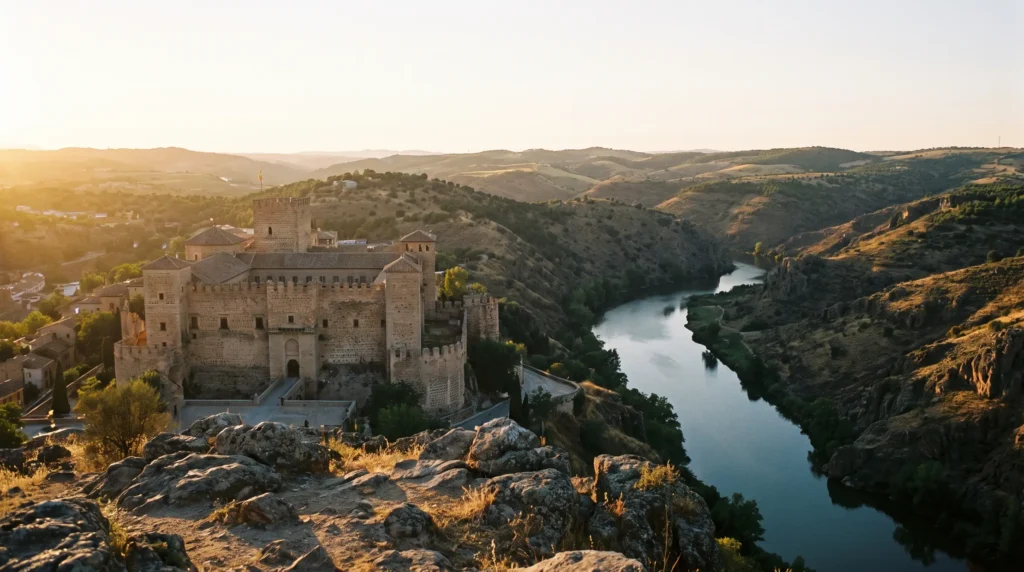
Toledo Travel Guide — Spain’s Walled City of Three Cultures, One Train Ride from Madrid
I almost skipped Toledo. Every guidebook filed it under “easy day trip from Madrid,” which made it sound like a theme park you tick off between museums. Then I got off the train, walked up through the Puerta de Bisagra, and realized the whole city is wrapped in a medieval wall on a granite hill wedged into a gorge of the Tagus River — and I hadn’t left enough time. Toledo spent twenty centuries as a Roman city, a Visigothic capital, and the seat of the Emirate of Córdoba’s northern frontier before becoming the place where Christian, Muslim, and Jewish communities built cathedrals, mosques, and synagogues within a few blocks of each other. UNESCO inscribed the entire old city as a World Heritage Site in 1986, not for one monument but for the accumulated layering of all of it. Yes, you can do it in a day. But the catch — and I’ll say this plainly, because a good friend would — is that the day-trip crowds hit their peak between 11am and 4pm, right when the tour buses from Madrid unload. Show up for sunset and stay the night, and you get a completely different, much better city.
In This Guide
- Overview — Why Toledo Is More Than a Madrid Day Trip
- Corpus Christi — Toledo’s Grandest Week
- Best Time to Visit Toledo (Season by Season)
- Getting There — AVE Trains, Buses & the Madrid Connection
- Getting Around — Walls, Escalators & the Zocotren
- Neighborhoods — Casco Histórico, Judería & the Cigarrales
- Culture & People — Three Faiths, One Skyline
- A Food Lover’s Guide to Toledo
- Off the Beaten Path
- Day Trips From (and To) Toledo
- Practical Information
- Budget Breakdown — What Toledo Actually Costs in 2026
- Frequently Asked Questions
Overview — Why Toledo Is More Than a Madrid Day Trip
Toledo is the classic day trip on our 10-day Madrid–Andalusia itinerary.
Toledo sits on a granite outcrop wrapped on three sides by a gorge of the Tagus River, about 71 kilometers south of Madrid by road. That defensive position is the whole reason the city exists where it does: Romans fortified it, Visigoths made it their capital, the Emirate of Córdoba held it as a northern stronghold, and Christian kings reclaimed it in 1085 — and instead of erasing what came before, each layer largely built on top of the last. The result is a walled old town of roughly 87,000 residents where a Visigothic church foundation, a 10th-century mosque, a Gothic cathedral, and a 14th-century synagogue can all sit within a fifteen-minute walk of each other.
UNESCO inscribed the entire historic city in 1986, citing its “extensive monumental and cultural heritage” built up over roughly twenty centuries. Toledo also briefly served as Spain’s imperial capital under Charles V before Philip II moved the court to Madrid in 1561 — after which Toledo’s population and political relevance shrank, but its skyline barely changed, which is exactly why it looks today almost the way El Greco painted it four centuries ago.
What Toledo doesn’t have is Madrid’s scale or Barcelona’s beach-and-Gaudí draw, and that’s the appeal. It’s compact enough to walk end to end in under an hour, dense enough with monuments to fill three full days, and close enough to Madrid that it works equally well as a half-day taste or a slow, overnight base for exploring central Spain.
Corpus Christi — Toledo’s Grandest Week
If you can time a trip around one date, make it Corpus Christi Thursday — in 2026, part of a “Grand Week” of festivities running late May into early June, with the main procession itself falling on 4 June. The centerpiece is the Custodia de Arfe, a roughly 500-year-old Gothic silver-gilt monstrance dating to 1515, carried through streets between Zocodover square and the cathedral on a route strewn with thyme, awnings, and flower petals. It’s one of the oldest processions in Spain, and in 2014 it was formally declared a Festival of International Tourist Interest.
Around the religious core, the week fills out with patio and garden competitions, concerts, and a full cultural program that turns the entire old town into an open-air stage. Book accommodation well ahead if your dates land anywhere near it — this is Toledo’s single busiest week of the year, and rooms inside the walls sell out early.
Best Time to Visit Toledo (Season by Season)
March – May · Spring (sweet spot)
Mild days, blooming courtyards, and Semana Santa processions in the weeks before Easter. Crowds build toward Corpus Christi at the end of the season, but April is close to ideal — warm enough to enjoy the miradors, cool enough to walk the old town’s uphill streets without wilting.
June – August · Summer (hot, busy)
Toledo’s semi-arid inland climate means genuinely hot, dry summers, with recorded highs pushing into the low 40s Celsius. Midday between roughly 1pm and 5pm is brutal for wall-to-wall walking; locals and savvy visitors shift sightseeing to morning and evening and rest in the shade or a museum in between. This is also peak day-trip season from Madrid, so mornings at the cathedral and Alcázar get genuinely packed.
September – November · Autumn (second sweet spot)
Harvest season on the surrounding Castilian plain, cooling evenings, and the crowds thin noticeably after the summer rush. Many locals rate this the best window of the year.
December – February · Winter (quiet, cold)
Cold and occasionally foggy — the Tagus gorge traps mist some mornings — but the old town is at its most atmospheric with almost no tour groups. Marzipan season peaks around Christmas, when Toledo’s confectioners work overtime.
Getting There — AVE Trains, Buses & the Madrid Connection
Almost everyone arrives via Madrid. There’s no airport in Toledo itself; the gateway is Madrid–Barajas Adolfo Suárez, connected to Madrid’s Atocha station by metro and cercanías rail. From Atocha, Renfe’s high-speed AVE service covers the roughly 58-kilometer route to Toledo in around 30 minutes, with about 15 departures a day. The line opened in 2005 and remains the fastest and most comfortable way in — Toledo’s station itself, a Neo-Mudéjar building worth a look on arrival, sits a 15–20 minute walk or a short bus ride from the old town gates.
Budget travelers can take the ALSA intercity bus from Madrid’s Plaza Elíptica station, which runs more frequently and costs less than the train, at the cost of a longer ride through Madrid’s southern suburbs. Driving is straightforward via the A-42 motorway, about an hour from central Madrid outside rush hour, but parking inside the walled city is scarce and complicated — plan on a car park just outside the walls (several sit near Paseo de Recaredo) rather than trying to drive in.
Getting Around — Walls, Escalators & the Zocotren
Toledo’s old town is a hill city built for defense, not for comfort — expect steep, narrow, cobbled streets and very few flat stretches. The good news: it’s genuinely walkable, small enough to cross in under an hour, and a network of outdoor escalators (Escalinatas de la Granja) helps visitors climb from the train station and parking areas up into the historic core without a full uphill hike.
For an orientation lap without the legwork, the Zocotren — a small tourist road-train — runs a roughly 50-minute narrated circuit from Plaza de Zocodover, tracing the outside of the city walls past the Alcázar, Puerta de Bisagra, the Puente de Alcántara, the Mirador del Valle overlook, and the Puente de San Martín. It’s a good first-hour orientation before you set off on foot. Local buses connect the station and outer neighborhoods to the old town, and taxis are plentiful and metered fairly. Cars are more hindrance than help once you’re inside the walls — leave it parked and walk.
Neighborhoods — Casco Histórico, Judería & the Cigarrales
Plaza de Zocodover & the Casco Histórico core
The city’s historic main square and natural starting point, ringed by cafés and leading directly into the tangle of streets toward the cathedral. Expect the highest concentration of shops, marzipan bakeries, and day-trip crowds here.
Judería (Jewish Quarter)
The old Jewish quarter in the southwest of the walled city holds Toledo’s two surviving synagogues — Santa María la Blanca and the Sinagoga del Tránsito — along with the Sephardic Museum and some of the quietest, prettiest lanes in town. Once home to one of medieval Spain’s largest Jewish communities before the 1492 expulsion, it’s essential walking for understanding the “three cultures” framing, even as historians note that framing simplifies a more complicated, often uneasy coexistence.
Alcázar & the eastern heights
The fortress that dominates Toledo’s skyline from the city’s highest point, rebuilt repeatedly since Roman times and today housing the Museum of the Army across thirteen thematic galleries. The surrounding streets are quieter than Zocodover but no less steep.
Antiguo Arrabal & Cristo de la Luz
North of the old center near the Puerta del Sol and Puerta de Bisagra, this district holds the Mezquita del Cristo de la Luz, a 10th-century mosque converted to a church, and feels noticeably more local and less polished for tourists.
San Juan de los Reyes & the western edge
Home to the Monasterio de San Juan de los Reyes, a Gothic monastery commissioned by Ferdinand and Isabella, with chains from freed Christian captives famously hung on its facade. Fewer crowds than the cathedral, similar architectural payoff.
Los Cigarrales (across the Tagus)
The hillside across the gorge, dotted with countryside villas (“cigarrales”) and home to the Mirador del Valle — the classic postcard viewpoint over the entire walled city, especially dramatic at sunset and framed by the same gorge El Greco painted in his famous view of Toledo.
Culture & People — Three Faiths, One Skyline
Toledo’s “City of Three Cultures” identity comes from centuries in which Christian, Muslim, and Jewish communities lived, worked, and built within the same walls — a coexistence real enough to leave behind a mosque-turned-church, two surviving synagogues, and a cathedral all standing today, even if modern scholarship is careful not to romanticize how equal or peaceful that coexistence actually was.
The city is also inseparable from the painter El Greco, the Cretan-born artist who settled here in the 1570s and whose distorted, luminous view of the city and its skyline remains the image most people carry of Toledo before they ever visit. Toledo steel has its own long reputation — the city’s swordsmiths supplied blades across Europe for centuries, and damascene metalwork (gold thread inlaid into blackened steel) is still practiced and sold in workshops throughout the old town, though quality and pricing vary enormously between artisan studios and souvenir stalls, so buy from a shop that will show you the actual process if the craftsmanship matters to you.
A Food Lover’s Guide to Toledo
The signature souvenir is mazapán de Toledo — an almond-and-sugar paste shaped into fruits, figures, and simple discs, which carries EU Protected Geographical Indication status (registered in 2008) requiring at least 50% almond content by weight. Its origins are debated — one local legend credits nuns at the Convento de San Clemente during a medieval famine, while food historians generally trace almond-paste sweets back through Al-Andalus to the wider Islamic world — but either way, buy it from a shop actually baking it, not a stall reselling mass-produced versions.
On the savory side, look for carcamusas (a rich pork stew in tomato sauce, a genuine Toledo original), roast partridge (perdiz) prepared in the old Toledan style with vinegar and herbs, game meats like venison reflecting the region’s hunting tradition, and hearty migas (fried breadcrumbs with chorizo and pepper) from the surrounding Castilian countryside. Manchego cheese, from the plains just south, shows up on nearly every menu. Wash it down with wine from the Méntrida or nearby La Mancha appellations rather than sangria aimed at day-trippers.
Off the Beaten Path
Mirador del Valle after dark
The classic viewpoint gets a steady stream of day-trip buses in the afternoon, but arrive after sunset when the Alcázar and cathedral are floodlit against the night sky and most tour groups have already left for Madrid — one of the most rewarding free things to do in the city.
Mezquita del Cristo de la Luz
A small 10th-century mosque, one of the very few surviving intact from Moorish Toledo, later consecrated as a church without losing its horseshoe arches and original brickwork. Far less visited than the cathedral, and arguably more atmospheric for it.
Toledo after the tour buses leave
Because most Madrid day-trippers arrive by mid-morning and depart by late afternoon, staying even a single night flips the entire experience — evening streets empty out, restaurants stop catering exclusively to lunch crowds, and you can walk the cathedral square in near silence.
Damascene workshops away from Zocodover
Skip the souvenir stalls immediately off the main square and look for small studios a few streets over where you can watch artisans inlay gold thread into steel by hand — ask before buying, and expect to pay noticeably more for genuine handwork than for machine-stamped pieces sold as the same thing.
Day Trips From (and To) Toledo
Toledo itself is most famous as Madrid’s classic day trip — the roughly 30-minute AVE ride means it’s entirely feasible to base yourself in Madrid and do Toledo in a single day, though an overnight is genuinely worth the trade-off. Going the other direction, Toledo also works as a base for exploring central Spain: Madrid itself is close enough for a museum-and-tapas day (Prado, Retiro Park, Mercado de San Miguel), while the wider Castilian plain to the south holds windmill-topped hill towns straight out of Don Quixote for travelers with a rental car and a free afternoon.
If your itinerary allows a longer loop, pair Toledo with a few nights in Madrid on either end — it’s easily the most natural pairing in central Spain, and our Madrid city guide covers the capital in full.
Practical Information
Money. Spain uses the euro; cards are accepted almost everywhere in the tourist core, but small bars, market stalls, and some family-run bakeries still prefer cash. ATMs are plentiful near Zocodover and the train station.
Safety. The US State Department currently rates Spain overall at Level 2 (“Exercise Increased Caution”), citing terrorism risk and petty crime concentrated in crowded tourist areas rather than any specific concern in Toledo itself. The UK’s FCDO gives similar guidance, flagging pickpocketing in crowded spots and occasional weather disruption. Toledo itself is a low-crime, heavily foot-trafficked old town; the main practical risk is a snatched phone or wallet in a packed plaza, not violent crime.
Health. No special vaccines are required for Spain; routine and travel vaccines (MMR given rising measles cases globally, hepatitis A) are generally recommended by the CDC as they would be for most international travel. Tap water is safe to drink throughout Toledo.
Visas. US, UK, Canadian, and Australian passport holders can enter visa-free for up to 90 days within any 180-day period under the Schengen rules; from late 2026, an ETIAS online travel authorization is expected to become a required extra step for the same visa-free entry, not a visa itself.
Connectivity. An EU-wide eSIM covers Toledo and the rest of Spain reliably; old-town Wi-Fi is decent in cafés and hotels. Plugs: European two-round-pin (Type C/F), 230V. Time zone: Central European Time (UTC+1), CEST (UTC+2) in summer.
Budget Breakdown — What Toledo Actually Costs in 2026
Toledo is noticeably cheaper than Madrid or Barcelona for food and lodging, even though its central monuments (cathedral, Alcázar, synagogues) charge separate admission.
Budget (US$60–100/day): Day trip from Madrid or a simple guesthouse inside the walls, menu-del-día lunches, walking the free viewpoints and church exteriors, one or two paid monument tickets.
Mid-range (US$130–230/day): Boutique hotel with a view inside or just outside the old town, sit-down dinners of carcamusas or roast partridge, a combined monument ticket covering several churches and synagogues, a damascene souvenir from a proper workshop.
Luxury (US$350+/day): The Parador de Toledo overlooking the gorge from the Cigarrales side, private guided walking tours through the Judería and cathedral, chef-led tasting menus, and a driver for day trips into the surrounding countryside.
A combined monument pass (covering several of the cathedral’s chapels, churches, and synagogues) is usually the best value if you’re seeing more than two or three sights — buy it at the first monument rather than each ticket separately.
Planning Your First Trip to Toledo
The simplest first-timer plan: catch an early AVE from Madrid Atocha, spend the day working from Zocodover through the cathedral, Alcázar, and Judería, then either take the last evening train back or — better — stay one night, walk up to the Mirador del Valle after dinner for the floodlit skyline, and catch a mid-morning train back before the day-trip crowds peak. If you’re building a longer central-Spain loop, our Spain travel guide and Madrid city guide cover the wider region, and Granada and Seville extend the Moorish-Spain thread further south if you have more than a week.
Frequently Asked Questions
Is Toledo worth visiting if I only have one day in the Madrid area?
Yes — the AVE train makes it a genuinely easy half-day-to-full-day trip from Madrid Atocha in around 30 minutes each way. If you can spare an overnight instead, you’ll trade the busiest midday hours for empty evening streets and a floodlit skyline.
Do I need a visa to visit Toledo?
US, UK, Canadian, and Australian citizens can enter Spain visa-free for up to 90 days in any 180-day period under Schengen rules; from late 2026 an online ETIAS authorization is expected to be required as an added step, not a visa.
Is Toledo safe?
Yes, in the sense that matters most to visitors — it’s a low-crime, heavily walked old town. Spain overall sits at a general Level 2 US advisory for terrorism risk and petty crime in crowded areas, the same caution that applies to most major European tourist cities, not a Toledo-specific concern.
How many days do I actually need in Toledo?
One full day covers the highlights at a rushed pace; two days lets you see the cathedral, Alcázar, both synagogues, and Cristo de la Luz without sprinting, plus an evening at the Mirador del Valle. Three days is only necessary if you want a genuinely slow pace or day trips into the surrounding countryside.
What’s the best souvenir to bring home?
Mazapán de Toledo from an actual bakery (look for EU Protected Geographical Indication labeling) travels well and is the real local specialty; damascene metalwork is the other classic choice, but buy from a workshop that will show you the process rather than a stall near Zocodover selling machine-stamped pieces at “handmade” prices.
When is the worst time to visit?
Midday in July and August, when temperatures push well into the high 30s or low 40s Celsius and the old town’s stone streets radiate heat straight back at you. If summer is your only option, front-load sightseeing into the morning and evening and rest through the early afternoon like the locals do.
Ready to Explore Toledo?
A walled hilltop city where a mosque, a synagogue, and a Gothic cathedral share the same few blocks, reachable from Madrid in about the time it takes to finish a coffee on the train. Toledo rewards anyone willing to stay past the last tour bus — go for the day if that’s all you have, but give it a night if you can.
Explore More
- Madrid City Guide — the capital, 30 minutes north by AVE
- Spain Travel Guide — plan the wider country trip
- Granada City Guide — continue the Moorish-Spain thread south
- Seville City Guide — Andalusia’s grand cathedral city
How this guide was built
Published as part of Facts From Upstairs’ city guide series. Built from authoritative sources — UNESCO’s Historic City of Toledo World Heritage inscription, Wikipedia’s Toledo entity page, the Spain national tourism board (spain.info) and the Toledo Provincial Tourist Board on Corpus Christi, the Castilla-La Mancha regional tourism board on the Alcázar/Army Museum, the UK’s official Protected Food Names register for Mazapán de Toledo, the US State Department’s Spain travel advisory and Europe travel guidance, the UK FCDO’s Spain travel advice, the US CDC’s Spain traveler health page, and route/distance data from Trainline and Travelmath. Numeric and checkable claims carry inline citations.
Sources cited on this page
- Wikipedia — Toledo, Spain
- UNESCO — Historic City of Toledo
- Trainline — Madrid Atocha to Toledo
- Travelmath — Madrid to Toledo distance
- Spain.info — Corpus Christi in Toledo
- Diputación de Toledo — Corpus Christi of Toledo
- Festivales de España — Corpus Christi Toledo 2026
- Tur4all — Zocotren tourist train
- Castilla-La Mancha Tourism — Alcázar / Army Museum
- UK Gov — Protected Food Name: Mazapán de Toledo
- US State Department — U.S. Travelers in Europe
- US State Department — Spain Travel Advisory
- UK FCDO — Spain Travel Advice
- US CDC — Spain Traveler Health Page
More city guides you might like
Plan your trip to Toledo
The booking tools we use ourselves. FFU may earn a commission at no extra cost to you.
Plan & book your trip to Toledo
Booking through these searches supports our guides at no extra cost to you.