
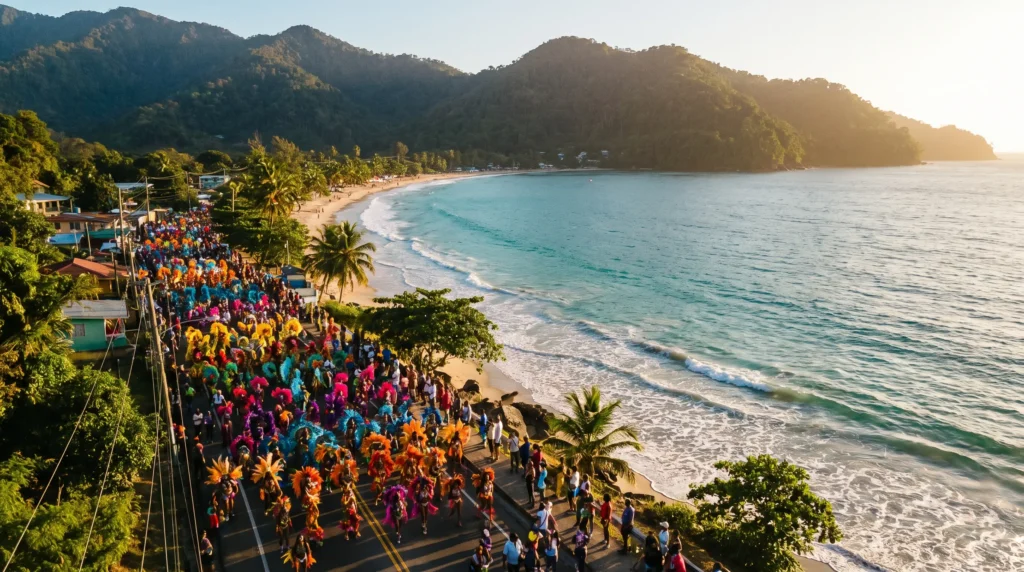
Trinidad and Tobago Travel Guide — Carnival, Steelpan & the Caribbean’s Least Touristy Twin Islands
Trinidad and Tobago is the Caribbean island that doesn’t act like one. It sits just off Venezuela’s coast, closer to South America than to most of the islands people associate with “the Caribbean,” and its economy runs on oil and gas rather than cruise ships. That single fact reshapes everything: there’s no wall of resorts, no scripted “island time” performance for visitors, and the biggest party on the calendar — Carnival — exists because Trinidadians throw it for themselves, not for tourists. I’ve spent time on both islands and they genuinely don’t feel like the same country: Trinidad is loud, industrious, and culturally dense, the birthplace of steelpan, calypso, and soca; Tobago, a twenty-minute flight away, is the sleepy, reef-fringed island your Trinidad friends go to for the weekend. I also won’t pretend the safety picture is simple right now — I’ll get into that honestly further down, because it genuinely affects how you should plan this trip in 2026.
In This Guide
- Overview — Two Islands, One Passport, Two Different Trips
- Carnival — “The Greatest Show on Earth”
- Best Time to Visit Trinidad and Tobago (Season by Season)
- Getting There — Piarco, Crown Point & the Inter-Island Hop
- Getting Around — Maxi Taxis, Rentals & the Domestic Flight
- Top Regions — Trinidad’s North Coast, the East, the South & All of Tobago
- Culture & People — Steelpan, Calypso, Hosay & Divali Nagar
- A Food Lover’s Guide to Trinidad and Tobago
- Off the Beaten Path
- Practical Information
- Budget Breakdown — What Trinidad and Tobago Actually Costs in 2026
- Frequently Asked Questions
Overview — Two Islands, One Passport, Two Different Trips
Trinidad and Tobago is the southernmost country in the Caribbean archipelago, sitting roughly 11 kilometres off Venezuela at its closest point — close enough that on a clear day from Trinidad’s northwest coast you can sometimes make out the South American mainland. The country became independent from Britain on 31 August 1962 and a republic in 1976, and English remains the official language, layered over Trinidadian and Tobagonian Creole, with historical Hindustani, French Creole and Spanish influence still audible in place names and vocabulary.
Unlike most of the Caribbean, tourism isn’t the backbone of the economy here — Trinidad’s oil and natural gas industry is — which means the visitor experience feels less curated and more like dropping into a country that has its own busy life going on regardless of who’s visiting. Ethnically, the population is close to an even split between Indo-Trinidadian and Afro-Trinidadian communities, with a large mixed population and smaller Chinese, Middle Eastern, European and Indigenous-descended communities, and that mix is exactly why the country produces the cultural output it does — Carnival, calypso, soca, chutney, and the steelpan, the only acoustic instrument widely credited as having been invented in the 20th century.
Tobago, the smaller sister island roughly 30 kilometres northeast of Trinidad and a short flight or ferry away, runs on a completely different rhythm — reef diving, rainforest, and a beach-town pace that Trinidadians themselves treat as a getaway. Neither island currently has a UNESCO-inscribed World Heritage Site, though Trinidad’s La Brea Pitch Lake and the Tobago Main Ridge Forest Reserve both sit on the country’s UNESCO tentative list. What the country does have is depth — a lived-in, working culture rather than a manicured resort strip, which is either exactly what you’re looking for or a genuine adjustment depending on what kind of Caribbean trip you’ve taken before.
Carnival — “The Greatest Show on Earth”
Everything in Trinidad revolves around one date on the calendar: Carnival Monday and Tuesday, which fall on 8–9 February 2027, immediately before Ash Wednesday. The season itself effectively opens on Boxing Day, when fetes (parties) start dropping across Port of Spain and the national conversation shifts entirely to Carnival — mas bands launch their costume collections between June and September the year before, and the big competitions build through January. J’ouvert, the pre-dawn Carnival Monday street takeover with paint, mud and oil, kicks the main event off, followed by two full days of masqueraders in feathers and sequins parading behind massive soundtrucks. Panorama, the steelband championship, is widely regarded as the world’s premier steelpan competition and culminates the Saturday before Carnival.
Book Carnival accommodation six to nine months out — flights and hotel rooms in Port of Spain sell out well ahead, and prices spike hard. If Carnival isn’t your window, Trinidad also runs Hosay (a Shia Muslim commemoration with elaborate tadjahs, timed to the Islamic calendar so its date shifts year to year) and Divali Nagar, the country’s major Hindu festival of lights each autumn — both genuinely worth building a trip around if you want cultural depth without the Carnival crowds and prices.
Best Time to Visit Trinidad and Tobago (Season by Season)
January – May · Dry season
The most reliable weather, lower humidity, and the run-up to (and through) Carnival in February. This is peak season for both islands — book Port of Spain hotels and flights months ahead if your trip touches Carnival.
June – August · Wet season begins, leatherback turtles
Rain arrives in short, heavy afternoon bursts rather than all-day washouts. This is also peak leatherback turtle nesting season on Trinidad’s north and east coast beaches, including Grande Riviere and Matura.
September – December · Green season, lower prices
The wettest stretch, but also the cheapest, and Trinidad sits south of the main Atlantic hurricane track — the islands get grazed far less often than islands further north, though tropical systems can still bring heavy rain. Divali Nagar (Hindu festival of lights) typically falls in this window, and it’s a genuinely spectacular, under-visited cultural event.
Getting There — Piarco, Crown Point & the Inter-Island Hop
Piarco International Airport (POS), about 30 kilometres east of downtown Port of Spain, is Trinidad’s main international gateway, with direct flights from Miami, New York, Toronto, London and several other Caribbean and South American hubs. Tobago has its own international airport, A.N.R. Robinson International (Crown Point, formerly Crown Point Airport), at the island’s southwestern tip, with some direct international service as well as constant shuttle flights from Trinidad.
The Trinidad–Tobago hop takes roughly 20 minutes by air and is the standard way most visitors — and most Trinidadians — move between the islands; a slower, cheaper interisland ferry also runs the route for those without a flight budget or in a hurry to bring a car across. US, UK, EU and Canadian passport holders enter visa-free for tourism, typically for up to 90 days, but every traveler must complete the online Arrival/Departure Card in the days before flying in — don’t skip this, immigration checks for it on arrival.
Getting Around — Maxi Taxis, Rentals & the Domestic Flight
On Trinidad, shared “maxi taxis” (minibuses running fixed routes, colour-coded by region) and route taxis are the backbone of local transport and are cheap, but they’re a system you learn by doing, not by app. Most visitors either rent a car for flexibility — driving is on the left, and Port of Spain traffic is genuinely heavy at rush hour — or arrange a driver through their hotel, which is the easier call for a first visit, especially at night.
Tobago is smaller and more visitor-friendly to navigate independently: a rental car opens up the whole island in a day or two, from Crown Point’s beaches to Charlotteville in the northeast. Between the islands, budget the roughly 20-minute flight (multiple carriers run the route daily) over the longer ferry crossing unless you specifically want to bring a vehicle or are traveling on a tight budget.
Top Regions — Trinidad’s North Coast, the East, the South & All of Tobago
Port of Spain & Environs
The capital and Carnival’s epicenter — Queen’s Park Savannah, the colonial “Magnificent Seven” mansions, and the country’s densest concentration of restaurants, fetes and steelpan yards. Base here for Carnival or festivals, but see the Practical section below on which downtown areas to treat with more caution after dark.
Maracas & the North Coast
A short, scenic drive over the Northern Range from Port of Spain to Maracas Bay, Trinidad’s most famous beach and the spiritual home of “bake and shark,” the fried-fish sandwich every Trinidadian has an opinion about. Las Cuevas and Blanchisseuse continue the coast road further east into quieter, less-developed beach territory.
The Northern Range & Asa Wright Nature Centre
A rainforest-clad mountain spine running along Trinidad’s north, home to the Asa Wright Nature Centre, one of the Caribbean’s best-known birdwatching lodges, where hummingbirds and toucans work the feeders right off the veranda.
Grande Riviere & the East Coast
A remote north-coast village that happens to host one of the largest leatherback turtle nesting concentrations in the Western Hemisphere — on the busiest nights during peak season, hundreds of leatherbacks can nest on a single kilometre of beach. Licensed guides are required for night viewing.
La Brea & South Trinidad
Home to the Pitch Lake, the largest natural asphalt deposit on Earth — around 40 hectares of slowly churning black pitch that has been quarried commercially for over a century and still occasionally surfaces prehistoric animal remains preserved in the tar. It’s on Trinidad and Tobago’s UNESCO tentative list, alongside Tobago’s Main Ridge Forest Reserve.
Crown Point & Store Bay, Tobago
Tobago’s tourism hub, right by the airport — resorts, the Nylon Pool, and easy glass-bottom-boat trips to Buccoo Reef, the island’s largest and most visited coral system.
Speyside, Charlotteville & the Main Ridge
Tobago’s wilder northeast: some of the Caribbean’s best shore diving off Speyside, the fishing village of Charlotteville tucked into a bay, and the Main Ridge Forest Reserve, believed to be among the oldest protected rainforests in the Western Hemisphere.
Culture & People — Steelpan, Calypso, Hosay & Divali Nagar
The steelpan was developed in Trinidad in the late 1930s and 1940s out of Carnival percussion traditions and repurposed oil drums left behind by wartime American bases — it made its first public Carnival appearance in 1940 and was formally declared the national instrument in 1992. Calypso and its faster modern descendant, soca, developed alongside it as Carnival’s musical voice — sharp, often satirical lyrics set to music built for dancing in the street, not sitting still.
That musical culture sits on top of one of the Caribbean’s most genuinely mixed societies: roughly even Indo- and Afro-Trinidadian populations plus a large mixed community, a legacy of both African enslavement and 19th-century indentured labor from India. That history shows up constantly in the culture calendar — Hosay, a Shia Muslim commemoration built around elaborately built and paraded tadjahs, and Divali Nagar, the country’s major Hindu festival of lights, are both treated as national cultural events, not minority sideshows, and both are worth visitors attending respectfully.
A Food Lover’s Guide to Trinidad and Tobago
Start with doubles — two pieces of fried flatbread (bara) sandwiching curried chickpeas, sold from carts and stalls at any hour and eaten standing up, the single most iconic Trinidadian street food. Roti — curried meat, potato and chickpea rolled into a soft flatbread — is the other everyday staple, and every neighbourhood has an opinion about its best roti shop.
At Maracas Bay, order bake and shark: fried shark fillet in fried bake bread loaded from a self-serve toppings bar of pepper sauces, tamarind and slaw. Look out too for crab and dumpling on the east coast, callaloo (a leafy, coconut-milk-based stew usually served alongside pelau, a one-pot rice dish), and pholourie — spiced split-pea fritters served with tamarind sauce. Angostura bitters, invented in Venezuela but produced in Trinidad since the 19th century, and local rums are the classic take-home bottles, alongside the ubiquitous Carib and Stag lagers.
Off the Beaten Path
Caroni Swamp
A mangrove wetland just south of Port of Spain where evening boat tours watch thousands of scarlet ibis — Trinidad and Tobago’s national bird — fly in to roost in a blaze of red against the mangroves.
Paria Waterfall & the North Coast Trails
A multi-hour hike along Trinidad’s rugged north coast to a waterfall that drops straight onto a secluded beach — one of the best rewards-for-effort hikes in the country, best done with a local guide.
Little Tobago
A small offshore islet near Speyside, a seabird sanctuary reachable by boat, with some of the best snorkelling on Tobago’s Atlantic side.
Chaguaramas
A former US naval base turned national park west of Port of Spain, with hiking, the Gasparee Caves, and marinas that make it the launch point for boat trips to the Bocas islands between Trinidad and Venezuela.
Practical Information
Money. The Trinidad and Tobago dollar trades in a managed range around 6.7–6.8 to the US dollar; check the Central Bank’s daily rate before you go, and note that US cash is widely but not universally accepted — cards work in most hotels, restaurants and malls, but carry TTD cash for maxi taxis, street food and rural areas.
Safety — read this one carefully. This is the honest catch of the guide. As of 2026, the US State Department rates Trinidad and Tobago a Level 3 “Reconsider Travel” advisory, citing crime, health system limitations and terrorism risk, and the government declared a nationwide State of Emergency in March 2026 after a spike in violent crime. The UK FCDO takes a somewhat less severe line — it is not advising against travel outright, but flags specific downtown Port of Spain neighbourhoods (parts of Laventille, Morvant, Beetham, Sea Lots and Carenage among them) for particular caution, along with reports of drink-spiking and dating-app-facilitated robberies in bars and nightclubs. Crime is consistently reported as concentrated in specific Trinidad neighbourhoods rather than spread evenly across the country, and Tobago has a markedly quieter reputation than Trinidad. Practically: stick to well-known tourist areas, avoid walking after dark outside your hotel or a supervised event, use licensed taxis and registered tour operators, be wary of casual online dating contacts, and check both your government’s current advisory and the latest State of Emergency status before you finalize a Trinidad trip in particular.
Health. Dengue is present year-round across both islands, so pack strong repellent and cover up at dawn and dusk; healthcare is limited in rural areas, so keep travel insurance with medical evacuation cover current.
Connectivity. A local SIM or eSIM is easy to pick up at either airport; coverage is solid across both islands outside deep rainforest. Plugs: mostly US/UK-style sockets depending on the building, 115V/230V both found — check before you plug in. Time zone: UTC-4 (Atlantic Standard Time), no daylight saving.
Budget Breakdown — What Trinidad and Tobago Actually Costs in 2026
Trinidad runs cheaper day-to-day than most Caribbean islands outside Carnival season, since it isn’t built around resort pricing; Tobago and Carnival week both run noticeably higher.
Budget (US$55–100/day): guesthouse or budget hotel, doubles and roti from street stalls, maxi taxis and route taxis, free beaches and hikes.
Mid-range (US$130–250/day): a solid hotel in Port of Spain or a Tobago beachfront guesthouse, restaurant meals, a rental car, a Buccoo Reef/Nylon Pool boat trip or a guided turtle-watching night at Grande Riviere.
Luxury / Carnival (US$400+/day): a Tobago resort or a Carnival-season Port of Spain hotel (rates spike hard in February), mas band costume and fete packages, private drivers, guided diving off Speyside.
Fixed costs to plan for: Carnival costumes and fete tickets are a separate, significant budget line if that’s your trip; tipping 10% is appreciated but less rigidly expected than in more tourism-dependent islands.
Planning Your First Trip to Trinidad and Tobago
The classic split is culture + coast: base in Port of Spain for three or four nights (Queen’s Park Savannah, Maracas Bay day trip, Caroni Swamp evening, Pitch Lake if you have a car), then fly the twenty minutes to Tobago for four or five nights of reef and rainforest around Crown Point or Speyside. If your trip lines up with early February, build the whole itinerary around Carnival instead and book Port of Spain accommodation six-plus months ahead. Pair the trip with our Barbados guide or Grenada guide for a wider southeastern Caribbean run, or continue toward Colombia’s Caribbean coast given how close Trinidad sits to South America.
Frequently Asked Questions
Is Trinidad and Tobago safe for tourists in 2026?
It’s a genuinely mixed picture right now. The US State Department has Trinidad and Tobago at Level 3 “Reconsider Travel” following a March 2026 State of Emergency over rising violent crime, while the UK FCDO takes a more moderate stance, flagging specific Port of Spain neighbourhoods rather than advising against travel entirely. Tobago has a quieter reputation than Trinidad. Check current advisories close to your travel dates, stick to well-known areas, and use licensed operators.
Do I need a visa?
US, UK, EU, Canadian and most Commonwealth passport holders get visa-free entry for tourism, typically up to 90 days — but everyone must complete the online Arrival/Departure Card before flying in.
Should I visit for Carnival or skip it?
If Carnival energy is what draws you to the Caribbean, this is genuinely one of the best versions of it anywhere — but book six-plus months ahead, expect peak pricing, and know that Port of Spain gets extremely crowded and loud for the better part of a week around 8–9 February 2027. If you’d rather see Trinidad and Tobago at a calmer pace, any other month works fine, and Hosay or Divali Nagar offer cultural depth without the crowds.
Trinidad or Tobago — which one first?
Trinidad for culture, food, Carnival and Pitch Lake; Tobago for reef diving, quiet beaches and rainforest. Most first-timers do both, since the flight between them is only about twenty minutes.
Is Trinidad and Tobago in the hurricane belt?
It sits at the southern edge of the Caribbean hurricane zone and is hit far less often than islands further north, but tropical systems can still bring heavy rain in the June–November window — travel insurance is still worth carrying.
What’s the one dish I have to try?
Doubles — curried chickpeas in fried bara bread, sold everywhere from carts at any hour. If you only try one thing, make it that.
Ready to Explore Trinidad and Tobago?
A steelpan yard rehearsing under streetlights, scarlet ibis dropping into the mangroves at dusk, a shark sandwich eaten with your feet in the sand at Maracas — Trinidad and Tobago doesn’t perform “Caribbean” for visitors, it just is what it is, loud and layered and completely its own thing. Go in with your eyes open on the safety picture, plan smart, and it rewards you more than almost anywhere else in the region.
Explore More
- Barbados Travel Guide — another southeastern Caribbean island, easier resort infrastructure
- Grenada Travel Guide — the “Spice Isle” a short hop north
- Jamaica Travel Guide — more Caribbean music culture and food
- Colombia Travel Guide — the nearest South American mainland coast
How this guide was built
Published as part of Facts From Upstairs’ country guide series. Built from authoritative sources — Wikipedia’s Trinidad and Tobago, Piarco International Airport, Pitch Lake, Steelpan and Trinidad and Tobago Carnival entity pages, the UNESCO World Heritage Centre’s Trinidad and Tobago states-party and tentative-list pages, the Central Bank of Trinidad and Tobago’s daily exchange rate page, the US State Department and UK FCDO Trinidad and Tobago advisory pages, the US CDC traveler page for Trinidad and Tobago, and the Visit Trinidad tourism board and Destination Trinidad & Tobago sites for regional and wildlife detail. Numeric and checkable claims carry inline citations.
Sources cited on this page
- Wikipedia — Trinidad and Tobago
- Wikipedia — Piarco International Airport
- Wikipedia — Pitch Lake
- Wikipedia — Steelpan
- Wikipedia — Trinidad and Tobago Carnival
- UNESCO World Heritage Centre — Trinidad and Tobago
- UNESCO World Heritage Centre — La Brea Pitch Lake (Tentative List)
- Central Bank of Trinidad and Tobago — Daily Exchange Rates
- US State Department — Trinidad and Tobago Travel Advisory
- UK FCDO — Trinidad and Tobago Safety and Security
- UK FCDO — Trinidad and Tobago Entry Requirements
- US CDC — Trinidad and Tobago Traveler Page
- Visit Trinidad — Leatherback Turtles
- Destination Trinidad and Tobago — Pitch Lake
- Destination Trinidad and Tobago — Grande Riviere Beach
More country guides you might like


Plan your trip to Trinidad and Tobago
The booking tools we use ourselves. FFU may earn a commission at no extra cost to you.
Plan & book your trip to Trinidad and Tobago
Booking through these searches supports our guides at no extra cost to you.