
Whistler Travel Guide — Two Mountains, One Gondola, and Canada’s Biggest Playground
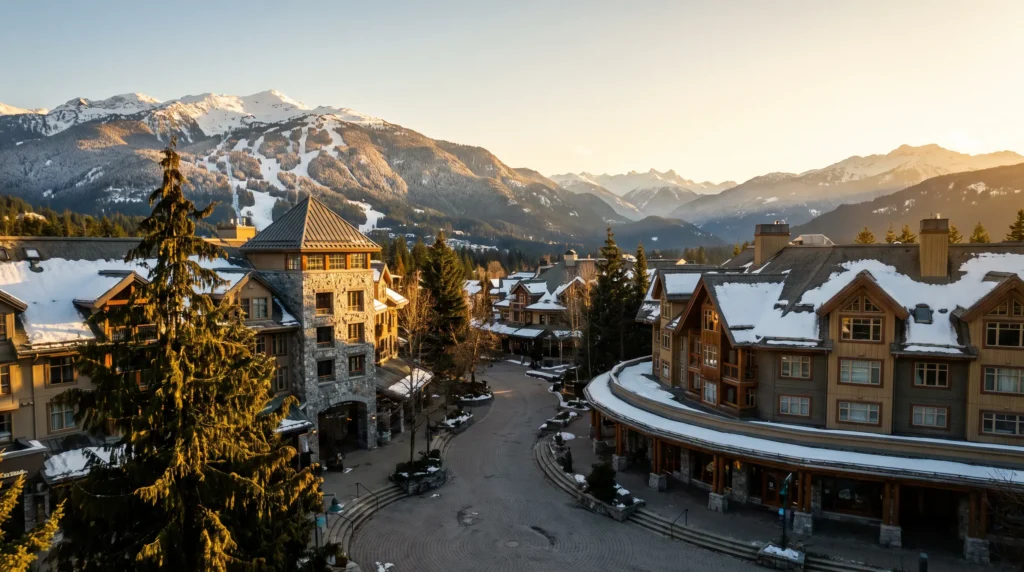
The view from the base of Whistler and Blackcomb lands every time: two mountains facing off across a single valley, joined mid-air by a gondola that hangs higher above the ground than any other lift of its kind on Earth. This is the largest ski resort in North America by skiable terrain, and it was the Host Mountain Resort for the 2010 Winter Olympics — but the thing people underrate is that Whistler is just as good a trip in July as it is in January. Swap skis for a downhill bike or a lakeside patio and the same village, the same gondolas, and most of the same mountain keep working all summer. It’s not cheap, and it’s not undiscovered — but it earns the hype in a way surprisingly few “bucket list” mountain towns actually do.
In This Guide
- Overview — Why Whistler Is Worth the Detour
- Festival Calendar — Cornucopia, WSSF & Whistler Pride
- Best Time to Visit Whistler (Season by Season)
- Getting There — YVR, the Sea-to-Sky Highway & Shuttles
- Getting Around — Walkable Village, Transit & Gondolas
- Neighborhoods — Village, Creekside, Upper Village & Beyond
- Culture & People — Squamish, Lil’wat & Ski-Town Life
- A Food Lover’s Guide to Whistler
- Off the Beaten Path
- Day Trips From Whistler
- Practical Information
- Budget Breakdown — What Whistler Actually Costs in 2026
- Frequently Asked Questions
Overview — Why Whistler Is Worth the Detour
Whistler began as a quiet fishing spot on Alta Lake, bought up by Myrtle and Alex Philip in 1914, and it took another five decades before Whistler Mountain opened to skiers in 1966 on the strength of a failed Olympic bid. In 1975 it became British Columbia’s first resort municipality, purpose-built to run itself as a ski town rather than grow into one by accident — which is why the village core still feels planned rather than sprawled.
The mountains are the headline act. Whistler and Blackcomb combine for 8,171 acres of skiable terrain — more than any other resort in North America — with vertical drops of 1,530 metres and 1,565 metres respectively, more than a vertical mile each. The two peaks are stitched together by the Peak 2 Peak Gondola, whose 3.02-kilometre unsupported span and 436-metre ground clearance are both world records for a lift of this kind — you can watch the valley floor disappear below you for the better part of five minutes. Vail Resorts has owned and operated Whistler Blackcomb since 2016, and it shows in the polish: this runs like a machine, for better (efficient lift lines, well-groomed runs) and worse (Vail-level pricing).
Then there’s the Olympics. Whistler was the Host Mountain Resort for the 2010 Vancouver Winter Games and Paralympics, running alpine skiing, Nordic events, bobsleigh, luge and skeleton — legacy venues like the Whistler Sliding Centre are still open for public rides today. What that Olympic-grade infrastructure means for you: this is a resort built to move a lot of people well, in both winter snow and summer sun.
Festival Calendar — Cornucopia, WSSF & Whistler Pride
Whistler doesn’t take a season off from throwing a party. Whistler Pride and Ski Festival kicks off the new year, running late January into early February with ski days, drag brunches and a genuinely warm LGBTQ+ welcome in a town that leans progressive. Come spring, the World Ski and Snowboard Festival (WSSF) closes out the season in early April with big-air jumps, live music and the unofficial last hurrah of ski season energy.
Summer flips the script entirely: Crankworx takes over the bike park with slopestyle and downhill competitions that draw the sport’s best riders, and GranFondo cycling events fill the Sea-to-Sky Highway with road bikes each August. Fall belongs to Cornucopia, Whistler’s food-and-wine festival, typically running across ten days in early-to-mid November with tastings, chef dinners and seminars scattered through the village. If your dates are flexible, build the trip around one of these — the village energy during a festival week is a different, louder, better thing than an ordinary Tuesday.
Best Time to Visit Whistler (Season by Season)
December – March · Ski season (peak)
This is what Whistler is famous for, and prices reflect it — especially the Christmas–New Year window and February’s school breaks. Average annual snowfall on the mountains runs around 11.7 metres (418.7 cm at the base), so a solid base is close to guaranteed, though early December can be hit-or-miss before the snowpack builds. January, once Christmas clears out, is a genuine value window within peak season.
April – May · Spring shoulder
Skiing often continues into April (sometimes on Blackcomb Glacier into summer for die-hards), WSSF closes out the season with a bang, and hotel rates start dropping hard once the lifts slow down. Trails are muddy and the bike park isn’t fully open yet — an awkward in-between for outdoor plans, but a great one for budget.
June – September · Summer (biking, hiking, lakes)
Whistler’s second identity: warm days, long light, the Whistler Mountain Bike Park running full gondola-assisted lift laps, and Alta Lake and Lost Lake warm enough to swim. Crankworx (July/August) and GranFondo bring crowds and higher prices, but summer overall is calmer and cheaper than ski season.
October – November · Fall shoulder
The quietest, cheapest stretch — bike park winding down, ski season not yet open, rain more likely. Cornucopia in early-to-mid November is the one reason to time a visit here deliberately.
Getting There — YVR, the Sea-to-Sky Highway & Shuttles
Vancouver International Airport (YVR) is the gateway, with nonstops from across North America, Asia and Europe. From the airport, Whistler is roughly the same 125-kilometre drive as from downtown Vancouver, taking a couple of hours on a good day and considerably longer in snow, rush hour or on winter weekends. Rental cars work, but most visitors take a direct shuttle — several operators run scheduled coaches between YVR and the Village multiple times a day at budget-friendly fares, cheaper the earlier you book. There’s no train service to Whistler.
The drive itself is the Sea-to-Sky Highway (Highway 99), a 134-kilometre, province-designated scenic route hugging Howe Sound from West Vancouver north — genuinely one of the best drives in Canada, not just a means to an end. Budget an extra hour if you plan to stop at Shannon Falls, the province’s third-highest waterfall at 335 metres, or wander Squamish beneath the Stawamus Chief. Winter driving here is serious business — check DriveBC conditions and carry chains or proper winter tires, which BC law requires on this route in season.
Getting Around — Walkable Village, Transit & Gondolas
Once you’re in Whistler, you barely need a car. Whistler Village is fully pedestrianized and compact enough to cross on foot in about ten minutes, and the Valley Trail — a paved, car-free path network — links the Village to Creekside, the Upper Village and Lost Lake for walking and cycling. BC Transit runs public buses connecting the neighborhoods and outlying areas, useful for reaching Function Junction or staying somewhere off the Village core without a car.
The mountains themselves are the other half of “getting around”: the Whistler Village Gondola and Blackcomb Gondola haul you up either massif in about 20 minutes, and the Peak 2 Peak connects the two mid-mountain so you can ski or ride both in a single day without ever coming back down to the valley. In summer, the same gondolas run for hikers, sightseers and mountain bikers riding the lift up to skip the climb.
Neighborhoods — Village, Creekside, Upper Village & Beyond
Whistler Village
The pedestrian heart of the resort and almost certainly where you’ll stay: cobblestone lanes, the base of the Whistler Village Gondola, and the highest concentration of restaurants, bars and shops. It’s touristy by design, but it’s well done — this is also where most festivals stage their main events.
Upper Village (Blackcomb Base)
A short walk or free shuttle from the main Village, built around the Blackcomb Gondola base with a quieter, more ski-in-ski-out luxury feel — think Fairmont Chateau Whistler territory.
Creekside
The original base area where Whistler Mountain first opened in 1966, a few minutes’ drive or a Valley Trail ride south of the Village. Smaller, calmer, and often overlooked — a good base if you want mountain access without Village-core noise and prices.
Function Junction
The unglamorous industrial-park end of town, but where locals actually eat and drink: breweries, a bakery with a cult following, and the closest thing Whistler has to an “authentic” strip away from the postcard version.
Alta Lake & Lost Lake
The original settlement site and the town’s summer swimming holes. Both ring with beaches, paddleboard rentals and forested walking trails that feel a world away from the Village bustle, despite being minutes from it.
Pemberton
Not technically Whistler, but close enough (about 36 kilometres north) to mention as an extension of the same trip. Farmland, hot springs access and noticeably lower prices than Whistler proper.
Culture & People — Squamish, Lil’wat & Ski-Town Life
Long before the lifts went in, this valley belonged to the Squamish and Lil’wat Nations, and Whistler has done more than most resort towns to make that visible rather than decorative. In 2001 the two nations signed a landmark Protocol Agreement — a first of its kind in Canada — to jointly pursue economic opportunities on their shared traditional territory, which led to the Squamish Lil’wat Cultural Centre opening in the Upper Village. Inside, a 40-foot Squamish hunting canoe hangs in the Great Hall, and guided tours, carving demonstrations and storytelling sessions run daily — it’s one of the best half-days you can spend in the village, ski conditions or not.
Layered on top is a classic international ski-town culture: seasonal workers from Australia, the UK and across Canada cycle through on working-holiday visas, which is why the bars feel more like a global backpacker hub than a small BC municipality. With around 14,000 permanent residents swelling to over two million annual visitors, Whistler runs on tourism, and the town knows it — service is polished, English-first, and geared entirely around getting you up the mountain and back down happy.
A Food Lover’s Guide to Whistler
Whistler’s food scene punches above what you’d expect from a town this size, largely because Vancouver’s restaurant talent is a two-hour drive away and plenty of it has relocated north. Après-ski is practically its own meal here — expect poutine, nachos and pitchers at village pubs the moment the lifts close, with the Longhorn Saloon and Garibaldi Lift Co among the classic slope-side spots.
For a proper dinner, the Upper Village and Village Square hold Whistler’s fine-dining cluster — expect West Coast Canadian cooking leaning on BC salmon, Pemberton-grown produce and Okanagan wine lists. Function Junction is the budget-and-local counterpoint: bakeries, breweries and unpretentious lunch spots where staff eat on their days off. Don’t skip a fondue night — it’s a Whistler cliché for a reason, and there are dedicated fondue restaurants built entirely around the ritual. Craft beer is serious business too, with several breweries (Coast Mountain, Whistler Brewing) pouring locally within a few minutes of the Village.
Off the Beaten Path
Train Wreck
A short forested hike (with a suspension bridge crossing) leads to a set of rusted, graffiti-covered rail cars that derailed and were abandoned decades ago — now a popular but still slightly secret photo spot most day-trippers never find.
Whistler Sliding Centre
The 2010 Olympic bobsleigh, luge and skeleton track is still active — you can book a public bobsleigh or skeleton ride down the same track Olympians raced, one of the more surreal adrenaline options in North America.
Cheakamus Lake
A relatively flat, family-friendly hike to a glacier-fed turquoise lake inside Garibaldi Provincial Park — busier trailheads (Joffre Lakes, Garibaldi Lake) get the Instagram traffic; this one, similarly beautiful, mostly doesn’t.
Ancient Cedars
A short, little-advertised trail near Cougar Mountain through old-growth cedar and hemlock forest, some trees estimated at over a thousand years old — quiet, shaded and almost entirely missed by the ski-and-bike crowd.
Day Trips From Whistler
Squamish (about 60 km / 45 minutes south) pairs the Sea to Sky Gondola’s panoramic views with world-class rock climbing on the Stawamus Chief and, for a splurge, the Sea to Sky suspension bridges.
Joffre Lakes Provincial Park (about 90 minutes north, past Pemberton) delivers three glacier-fed lakes in improbable turquoise — deservedly popular, so go early or expect a parking wait, especially in summer.
Vancouver itself (125 km / ~2.5 hours south) is an easy full-day loop for Stanley Park, Granville Island and a proper city meal if the mountain air starts to feel small.
Britannia Beach, roughly midway down the highway, holds the Britannia Mine Museum in a preserved former copper mine — an easy, kid-friendly stop to break up the drive either direction.
Practical Information
Money. The Canadian Dollar (CAD) is the only currency you’ll spend — cards and tap-to-pay are accepted almost universally, down to trailhead parking machines, so carrying much cash isn’t necessary.
Visa. US citizens need no visa or eTA. Most other visa-exempt nationalities (UK, EU, Australia, Japan, South Korea and more) flying into Canada need an Electronic Travel Authorization (eTA) — a quick CAD $7 online application, generally valid up to five years or until your passport expires. Arriving by land or sea from the US does not require an eTA even for otherwise eTA-required nationalities.
Safety. Canada sits at the US State Department’s lowest advisory tier, “exercise normal precautions,” with petty theft (vehicle break-ins especially) the main practical risk in tourist parking lots. Don’t leave gear visible in a parked car, and treat mountain weather with real respect — conditions above the village can turn fast in any season.
Health. No special vaccines are required for entry; routine and MMR vaccinations up to date is the standard CDC advice for Canada, plus normal food, water and UV precautions. Altitude at the peaks (over 2,000 metres) can affect sensitive travelers; hydrate and pace your first mountain day.
Connectivity. Cell coverage and Village Wi-Fi are both reliable; coverage thins out on remote backcountry trails and deep in Garibaldi Provincial Park. Plugs: North American style (Type A/B), 120V. Time zone: Pacific Time (UTC-8, UTC-7 with daylight saving), same as Vancouver, Seattle and Los Angeles.
Budget Breakdown — What Whistler Actually Costs in 2026
Whistler is priced like the international destination it is — closer to a European Alps resort than a typical North American mountain town, especially in ski season.
Budget (CAD $150–230 / ~US$110–170 per day): Hostel bunk or shared condo, groceries and Function Junction cafés over Village-core restaurants, day pass shared or bought well in advance, Valley Trail and free hiking over paid activities.
Mid-range (CAD $350–600 / ~US$260–440 per day): Village hotel or condo, one restaurant dinner a day, a lift ticket (single-day walk-up window tickets commonly run well over CAD $200 in peak season — advance-purchase multi-day passes cut this substantially), a rental car or shuttle for a day trip.
Luxury (CAD $800+ / ~US$590+ per day): Ski-in-ski-out Upper Village property, private ski or bike guide, fine dining, spa time after the mountain closes.
Fixed costs to plan for: lift tickets are cheapest booked online well ahead of your date and rise the closer you get to arrival; equipment rental adds CAD $50–90/day if you don’t own gear; and 15% tipping is standard at restaurants and bars.
Planning Your First Trip to Whistler
The classic first-timer split is arrive via Vancouver, base in the Village, pick your season and commit: fly into YVR, shuttle up the Sea-to-Sky Highway with a stop at Shannon Falls or Squamish, and settle into four or five nights either skiing both mountains via the Peak 2 Peak or, in summer, splitting time between the bike park and the lakes. Pair it with a couple of extra days in Vancouver if that guide existed — for now, extend the Sea-to-Sky drive north instead, or bookend the trip with time in the Canadian Rockies via our Banff guide, a similar mountain-town pace a flight away. If winter sports are the draw, our Seattle guide makes a natural US-side bookend for a Pacific Northwest loop, and our Canada guide is the place to plan the wider country trip around it.
Frequently Asked Questions
Is Whistler safe for tourists in 2026?
Yes — Canada sits at the lowest US State Department advisory tier, and Whistler is a well-run resort town built around visitors. The realistic risk is petty theft, mainly items left visible in parked cars at trailheads and lift lots, not violent crime.
Do I need a visa to visit Whistler?
US citizens need nothing beyond a valid passport. Most other visa-exempt travelers (UK, EU, Australia, Japan and more) flying into Canada need a CAD $7 Electronic Travel Authorization (eTA), applied for online in minutes and valid up to five years.
Is Whistler worth visiting in summer, or only for skiing?
Genuinely worth it either season. The bike park, hiking, Peak 2 Peak sightseeing and lake swimming make summer close to a second identity for the resort, usually at lower prices and with far shorter lift lines than ski season.
How do I get from Vancouver Airport to Whistler without renting a car?
Direct shuttle services (YVR Skylynx, Whistler Shuttle and others) run several times daily for roughly CAD $25–80 one-way, taking about two to two-and-a-half hours depending on conditions and stops.
Whistler or Banff — which should I pick?
Choose Whistler for the single biggest combined ski terrain in North America, a walkable Village-first layout, and an easy add-on to a Vancouver trip. Choose Banff for the Canadian Rockies’ more dramatic alpine scenery and a national-park-centered experience rather than a resort-municipality one.
Do I need a car once I’m in Whistler?
No — Whistler Village is fully pedestrianized, the Valley Trail links the main neighborhoods, and BC Transit covers the rest. A car mainly helps for day trips to Squamish or Joffre Lakes.
Ready to Explore Whistler?
Two mountains, one record-breaking gondola strung between them, and a village built specifically so none of it feels like a chore to reach. Whistler delivers on the postcard in winter and quietly runs a whole second, cheaper, sunnier version of itself all summer — the trick is just picking which Whistler you want, then booking it.
Explore More
- Vancouver City Guide — the gateway city, two hours south
- Banff City Guide — Canada’s other iconic mountain town
- Seattle City Guide — pair Whistler with a Pacific Northwest loop
- Canada Travel Guide — plan the wider country trip
How this guide was built
Published as part of Facts From Upstairs’ city guide series. Built from authoritative sources — Wikipedia entity pages for Whistler, British Columbia and Whistler Blackcomb, the Sea-to-Sky Highway (Highway 99) entry, the Resort Municipality of Whistler’s official festivals and events page, the Squamish Lil’wat Cultural Centre’s facts page, the Bank of Canada, the Government of Canada’s eTA eligibility page, the US State Department’s Canada travel advisory, and the US CDC’s Canada traveler health page. Numeric claims carry inline citations.
Sources cited on this page
- Wikipedia — Whistler, British Columbia
- Wikipedia — Whistler Blackcomb
- Wikipedia — Sea-to-Sky Highway
- Resort Municipality of Whistler — Festivals and Events
- What To Do In Whistler — Events Calendar
- Squamish Lil’wat Cultural Centre — Facts & FAQs
- Bank of Canada
- Government of Canada — eTA Eligibility
- US State Department — Canada Travel Advisory
- US CDC — Canada Traveler Health Page
More city guides you might like
Plan your trip to Whistler
The booking tools we use ourselves. FFU may earn a commission at no extra cost to you.
Plan & book your trip to Whistler
Booking through these searches supports our guides at no extra cost to you.