
Chiang Rai Travel Guide — Thailand’s Quiet Northern Capital of Temples, Tribes & the Golden Triangle
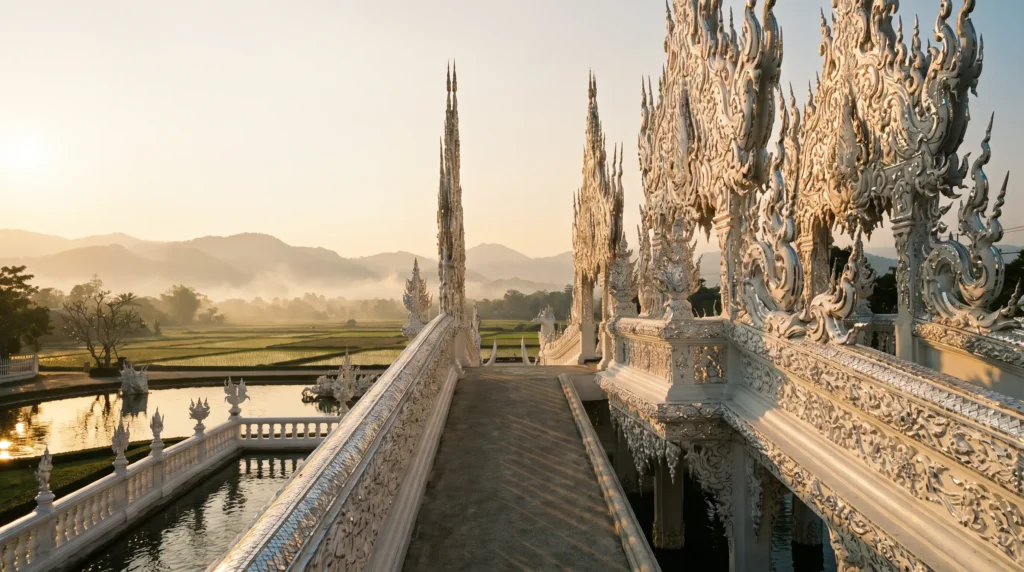
Everyone flies into Chiang Mai and calls it the north. I get it — but Chiang Rai is the actual original: a walled city founded by King Mangrai in 1262 as the first capital of what became the Lanna kingdom, three decades before Mangrai even built Chiang Mai as its replacement. Today it’s a small, unhurried river city of roughly 70,000 people that happens to sit inside three of Southeast Asia’s most photographed things: a blinding-white contemporary temple that looks like it was carved from bone china, a jet-black house of animal skulls, and the actual Golden Triangle where Thailand, Laos and Myanmar meet at the Mekong. I’ve sent friends here specifically to skip Chiang Mai’s tour-bus crush, and not one has come back disappointed — though I’ll tell you upfront about the one month of the year you should actively avoid, because nobody selling you a ticket will.
In This Guide
- Overview — Why Chiang Rai Is the Real First Capital of the North
- Flower Festival Season — Chiang Rai’s Prettiest Months
- Best Time to Visit Chiang Rai (Season by Season)
- Getting There — CEI Airport & Overland Routes
- Getting Around — Songthaews, Scooters & Walkability
- Neighborhoods — Old City, Riverside & Beyond
- Culture & People — Lanna, Tai Lue & Hill Tribes
- A Food Lover’s Guide to Chiang Rai
- Off the Beaten Path
- Day Trips — Golden Triangle, Doi Tung & Doi Mae Salong
- Practical Information
- Budget Breakdown — What Chiang Rai Actually Costs in 2026
- Frequently Asked Questions
Overview — Why Chiang Rai Is the Real First Capital of the North
Most travelers treat Chiang Rai as a two-day side trip from Chiang Mai, and that undersells it badly. King Mangrai founded Chiang Rai in 1262 on the banks of the Kok River, and it served as his capital before he moved the throne to the new city of Chiang Mai decades later — Chiang Rai eventually passed under Burmese control before becoming a Siamese vassal in 1786 and, much later, a full Thai province in 1933. That deep, layered history is still visible in the Old City’s temple ruins, even though the town itself feels sleepy and low-rise — the current city municipality wasn’t even formally established until 2004.
What actually pulls people here in 2026 is the art. Chiang Rai is home to three eccentric, privately built temple-and-museum complexes locals call the “Colors of Chiang Rai” — the dazzling White Temple, the cobalt Blue Temple, and the macabre Black House — each the singular vision of one Thai artist rather than a centuries-old royal commission. Add the fact that the actual Golden Triangle, where the borders of Thailand, Laos and Myanmar converge at the Mekong and Ruak rivers, sits only about 55 kilometers north of the city center, and you have a base for both serious art tourism and a genuinely storied stretch of geography.
It’s also just calmer than Chiang Mai. No ring-road gridlock, no queue of vans idling outside every temple gate, and a night bazaar you can actually walk without shoulder-checking every ten feet. The trade-off is fewer direct international flights and a shorter list of five-star hotels — Chiang Rai rewards people who don’t need everything handed to them on arrival.
Flower Festival Season — Chiang Rai’s Prettiest Months
Time a December or January trip around the Chiang Rai Flower Festival, held riverside at Haad Nakhon Chiang Rai Park from late December through mid-February, when the park is turned over to winter blooms and large floral sculptures. It runs alongside the related ASEAN Flower Festival events at Suan Mai Ngam Rim Khong and Nong Luang Public Park, which typically fill the back half of December and the first week of January with parades, night markets and lantern displays.
The timing isn’t an accident — this is also Chiang Rai’s coolest, driest, most comfortable stretch of weather, when the surrounding hills are green from the tail end of the rains and mornings can dip cool enough for a jacket. Book hotels a few weeks ahead if your trip lands over New Year’s, when domestic Thai tourists flood in alongside the festival crowds.
Best Time to Visit Chiang Rai (Season by Season)
November – February · Cool season (peak, and the right call)
The best window by a wide margin: dry skies, comfortable daytime heat, cool nights in the hills, and the flower festival in full bloom. This is when Chiang Rai is at its most photogenic and least sweaty.
March – mid-April · Burning season (avoid if you can)
Here’s the honest catch nobody selling a Chiang Rai package will lead with: this is agricultural burning season across northern Thailand, and Chiang Rai’s air quality can turn genuinely bad. Regional PM2.5 readings have spiked well above healthy thresholds in past Marches, with the smoky haze often lingering for weeks until rain breaks it. If you have flexibility, skip this window entirely, or at least pack a proper N95-style mask and keep outdoor time short on bad-air days.
Mid-April · Songkran
The Thai New Year water festival lands in the same smoky stretch but is worth planning around on its own terms — expect the entire city, hotel staff included, to be soaked in a citywide water fight for several days.
May – October · Green/monsoon season
Hot and increasingly wet as the season progresses, with the heaviest rain typically in August and September. Afternoon downpours are usually short and the countryside is lushest now, with the lowest hotel rates of the year — a reasonable trade for travelers who don’t mind ducking under an awning occasionally.
Getting There — CEI Airport & Overland Routes
Chiang Rai International Airport (CEI) sits about 8 kilometers from the city center and runs mostly domestic connections — Nok Air, Thai AirAsia, Thai Lion Air and Thai VietJet all fly Bangkok–Chiang Rai (both Don Mueang and Suvarnabhumi airports), with Thai Airways also on the Suvarnabhumi route. International service is thin but not zero — Scoot has resumed a direct Singapore link, and routings can change season to season, so check current schedules before booking.
Most international travelers actually fly into Bangkok or Chiang Mai first and connect onward. Chiang Rai sits about 860 kilometers north of Bangkok and roughly 200 kilometers northeast of Chiang Mai, and the Chiang Mai–Chiang Rai overland run (around three hours by bus or car on decent highway) is a popular and scenic way to link the two cities rather than doubling back through Bangkok.
Getting Around — Songthaews, Scooters & Walkability
Chiang Rai’s Old City core is genuinely walkable — small enough that you can cross most of it on foot in twenty minutes, unlike sprawling Chiang Mai. For anything further out, red songthaews (shared pickup-truck taxis) circulate fixed routes for a small flat fare, and metered taxis and ride-hailing apps cover the rest.
Scooter rental is the default move for reaching the White Temple, Blue Temple and Black House, which are spread several kilometers apart on the city’s edges — expect to pay a modest daily rate plus a passport or cash deposit at most rental shops. For day trips to the Golden Triangle or Doi Mae Salong, most visitors book a driver, a organized day tour, or rent a car, since public transport thins out fast once you’re past the city limits.
Neighborhoods — Old City, Riverside & Beyond
The Old City
The historic core, ringed by the remains of old city walls and moats, holds Chiang Rai’s oldest temples, including Wat Phra Kaeo — the temple where the famed Emerald Buddha was reportedly discovered in 1432 after lightning cracked open an old chedi, before the image eventually made its way to Bangkok. It’s compact, low-key, and the natural walking base for a first stay.
Riverside (Kok River)
The Kok River frontage is where the city breathes — riverside restaurants, the Flower Festival park at Haad Nakhon, and slow-boat piers. Evening river walks here are one of the simplest, best free things to do in town.
Night Bazaar district
South of the Old City near the clock tower and bus station, Chiang Rai’s night market is smaller and far less overwhelming than Chiang Mai’s — food stalls, a modest stage for cultural performances, and hill-tribe handicraft stands without the elbow-to-elbow crowds.
Pa O Don Chai (White Temple area)
A few kilometers south of the center, this is where Wat Rong Khun (the White Temple) sits — plan on a dedicated trip rather than a walk-by, since the surrounding area is otherwise residential and rural.
Mueang Chiang Rai outskirts
The Blue Temple and Baan Dam Black House sit north of downtown in more rural, spread-out settings — both easy scooter or taxi hops but not walkable from the center.
Mae Fah Luang District
The hill country toward Doi Tung and the Myanmar border, home to the Doi Tung Royal Villa, its coffee and macadamia plantations, and several hill-tribe villages — more a day-trip zone than a place to base yourself, but essential to the region’s identity.
Culture & People — Lanna, Tai Lue & Hill Tribes
Chiang Rai carries the Lanna cultural identity of Thailand’s old northern kingdom — distinct temple architecture, a Northern Thai dialect (Kham Mueang) still spoken alongside standard Thai, and a generally slower, more soft-spoken social rhythm than Bangkok or the beach south. Around Chiang Rai and up toward Doi Tung and the Golden Triangle, you’ll also meet a real mix of hill-tribe communities — Akha, Lahu, Tai Lue and Lawa peoples among others, many of whom settled the mountainous border districts over the past century.
The respectful way to engage with hill-tribe culture here is through cooperative or fair-trade-oriented visits — several villages and craft cooperatives around Doi Tung and Mae Salong welcome visitors and sell textiles, coffee and handicrafts directly, which is a better use of tourist dollars than the more staged “long-neck village” photo-op tours found elsewhere in the north. Buddhist temple etiquette applies everywhere: modest dress covering shoulders and knees, shoes off before entering any hall, and quiet respect during active prayer.
A Food Lover’s Guide to Chiang Rai
Northern Thai food (aahaan neua) is its own distinct cuisine, milder and herbier than central or southern Thai cooking, and Chiang Rai is a genuinely good place to eat it without tourist-menu markup. Start with khao soi — curried egg noodles in a coconut broth, topped with crispy noodles and usually chicken or beef — and sai ua, the grilled Northern Thai herb sausage packed with lemongrass, galangal and chilies.
Look for nam prik ong (a tomato-and-pork chili dip eaten with vegetables and sticky rice) and khao niao — sticky rice, the region’s staple carb, served in little woven baskets alongside almost everything. Because the hill country grows some of Thailand’s best coffee, don’t skip a proper cup from Doi Tung or Doi Chaang beans, both grown within day-trip distance of the city. The night bazaar and riverside restaurants are the easiest places to sample widely without committing to a full sit-down meal.
Off the Beaten Path
Wat Rong Suea Ten (the Blue Temple)
Quieter than its famous white cousin and free to enter, the Blue Temple was designed by Putha Kabkaew, a student of the White Temple’s creator, and completed in 2016 after roughly a decade of construction — sapphire-blue walls, gold detailing, and a striking white Buddha inside.
Baan Dam Museum (the Black House)
The late national artist Thawan Duchanee’s sprawling private compound of roughly 40 dark timber buildings, filled with animal skulls, hides and bones as a meditation on death and impermanence — the deliberate dark counterpart to the White Temple’s purity theme.
Wat Phra Kaeo’s quiet mornings
Skip the tour-bus midday window at the Old City’s most historically important temple and go at opening time instead, when the grounds where the Emerald Buddha was reportedly found are nearly empty.
Rural coffee farms beyond Doi Tung
Smaller, family-run coffee operations in the hills outside the main Doi Tung visitor circuit offer farm tours and cupping sessions with none of the crowd that the flagship royal project draws.
Day Trips — Golden Triangle, Doi Tung & Doi Mae Salong
The Golden Triangle (Sop Ruak)
The point where the Ruak River meets the Mekong, and Thailand, Laos and Myanmar’s borders converge, sits roughly 55 kilometers north of Chiang Rai city — an easy half-day or full-day trip. The riverside town of Sop Ruak has grown into a small tourist hub with opium-history museums documenting the area’s past as one of the world’s largest opium-producing regions before the trade shifted dramatically in recent decades. Boat trips out onto the Mekong for a view of all three countries at once are the classic move.
Doi Tung
A mountain rising to about 1,389 meters near the Myanmar border, Doi Tung is home to the former royal summer residence of the Princess Mother, now a public villa and museum, along with the flower gardens planted around it. It’s also the base of the Doi Tung Development Project, a royally-founded initiative that replaced opium poppy farming with coffee and macadamia cultivation — the mountain now supports roughly 3.5 million coffee trees and around 900 farming families, and per-capita incomes in the area rose sixfold between 1988 and 2016. It’s a genuinely rare chance to see a successful alternative-development story up close, not just a scenic viewpoint.
Doi Mae Salong
A former Kuomintang settlement turned hill-station tea town, with terraced tea plantations, Yunnanese-style food, and cool mountain air that makes it a popular overnight escape from the lowland heat. Combine it with Doi Tung for a full loop day.
Mae Sai and the Myanmar border
Thailand’s northernmost border town, useful for a quick look at the frontier crossing and border market, though onward travel into Myanmar itself requires checking current entry rules well ahead of time.
Practical Information
Money. The Thai baht floats freely against the dollar and has done so since Thailand abandoned its fixed exchange rate during the 1997 Asian financial crisis. Cards are widely accepted in Chiang Rai city hotels and restaurants; carry cash for markets, songthaews and rural villages.
Visas. Thailand overhauled parts of its visa-exemption system in 2026, changing terms for a large number of nationalities that previously enjoyed extended visa-free stays. Don’t rely on older blog posts — check your passport’s current allowance directly with Thai immigration or your nearest Thai embassy before booking flights.
Safety. Thailand overall sits at a “normal precautions” advisory level as of mid-2026, with elevated caution specifically flagged for the Thailand–Cambodia border and the far southern provinces — neither of which is anywhere near Chiang Rai. Standard city-travel sense applies: watch belongings in markets, use metered taxis or ride-hailing apps, and note that cannabis laws are strictly enforced at airports despite Thailand’s regulated domestic market.
Health. Routine vaccines should be current, and hepatitis A and typhoid are commonly recommended for travelers to Thailand; malaria prophylaxis generally isn’t needed for Chiang Rai city itself, though standard risk applies closer to the Myanmar border. Mosquito protection matters for dengue regardless of malaria risk — pack repellent, especially for evenings near the river.
Connectivity & logistics. A prepaid Thai SIM or regional eSIM is cheap and easy to set up on arrival. Plugs: mostly Type A/B/C sockets, 220V. Time zone: UTC+7, no daylight saving.
Budget Breakdown — What Chiang Rai Actually Costs in 2026
Chiang Rai is noticeably cheaper than Chiang Mai for equivalent quality, and far cheaper than Bangkok’s tourist zones.
Budget (US$25–45/day): guesthouse dorm or basic private room, street-food and night-market meals, songthaew rides, scooter rental for temple-hopping.
Mid-range (US$60–120/day): boutique hotel or riverside resort room, restaurant meals, a private driver or organized day tour to the Golden Triangle or Doi Tung, temple entrance fees.
Luxury (US$180+/day): hill-country resort or spa property, private guided day trips with a driver for the full Golden Triangle–Doi Tung–Mae Salong loop, fine-dining Northern Thai tasting menus.
Entrance fees are modest by global standards — expect roughly 100–200 baht for the White Temple and free entry at several others, like the Blue Temple. Tipping isn’t obligatory in Thailand but rounding up or leaving 20–50 baht for good service is appreciated.
Planning Your First Trip to Chiang Rai
Three nights is enough to cover the “Colors of Chiang Rai” temple trio, a relaxed morning at Wat Phra Kaeo, and one full day trip to the Golden Triangle and Doi Tung. Five nights lets you add an overnight in Doi Mae Salong’s tea hills. Most travelers pair Chiang Rai with a few days in Chiang Mai for the fuller northern Thailand loop, or continue the Golden Triangle theme with our Laos guide across the Mekong, or head south into our Bangkok guide to bookend the trip.
Frequently Asked Questions
Is Chiang Rai worth visiting if I’ve already done Chiang Mai?
Yes — they’re complementary, not redundant. Chiang Mai has more infrastructure and nightlife; Chiang Rai has the White Temple, Blue Temple, Black House and quick access to the actual Golden Triangle, all with a fraction of the crowds.
Do I need a visa to visit Chiang Rai?
It depends on your passport, and the rules changed in 2026 for a number of nationalities that previously had extended visa-free access. Check current requirements directly with Thai immigration or your nearest embassy before you book.
When should I avoid visiting Chiang Rai?
Late February through mid-April, when seasonal agricultural burning across the region can push air quality to unhealthy levels for days or weeks at a time. If you must travel then, monitor daily air quality readings and keep outdoor time limited on bad-air days.
Can I visit Chiang Rai as a day trip from Chiang Mai?
Technically yes by private tour, but it’s a long day — the drive alone runs a few hours each way. An overnight stay of at least two nights is a much better use of the trip.
Is the Golden Triangle actually dangerous?
Not for the Thai side that tourists visit. Sop Ruak, the riverside town at the confluence, is a developed, safe tourist stop with museums and river-boat trips; the region’s history as a major opium-producing area is largely that — history — with production patterns having shifted substantially over recent decades.
What’s the one thing people regret skipping?
Doi Tung. Everyone plans for the temples and the Golden Triangle photo-op, but the royal development project’s coffee farms and hill-tribe villages are the most genuinely moving stop on the whole loop.
Ready to Explore Chiang Rai?
A dazzling white temple, a cobalt-blue one, a house full of animal skulls, and the literal Golden Triangle within a single tank of scooter gas — Chiang Rai packs an outsized story into a small, walkable river city. Just build your trip around November through February, skip the smoke season, and you’ll wonder why everyone stops at Chiang Mai.
Explore More
- Chiang Mai City Guide — the north’s bigger, busier sister city
- Bangkok City Guide — bookend the trip in Thailand’s capital
- Luang Prabang City Guide — continue across the Mekong into Laos
- Vietnam Travel Guide — extend the Southeast Asia loop further east
How this guide was built
Published as part of Facts From Upstairs’ city guide series. Built from authoritative sources — Wikipedia entity pages for Chiang Rai, Chiang Rai International Airport, Wat Rong Khun, Wat Rong Suea Ten, Doi Tung, the Golden Triangle, Thai Baht and Thailand’s visa policy; the US State Department and UK FCDO Thailand advisory pages; the US CDC traveler page for Thailand; Thailand’s official government event portal for Chiang Rai flower festival dates; and Chiang Rai Times reporting on regional air-quality data. Numeric and checkable claims carry inline citations.
Sources cited on this page
- Wikipedia — Chiang Rai
- Wikipedia — Chiang Rai International Airport
- Wikipedia — Wat Rong Khun (White Temple)
- Wikipedia — Wat Rong Suea Ten (Blue Temple)
- Wikipedia — Doi Tung
- Wikipedia — Golden Triangle (Southeast Asia)
- Wikipedia — Thai Baht
- Wikipedia — Visa Policy of Thailand
- US State Department — Thailand
- UK FCDO — Thailand
- US CDC — Thailand traveler page
- Thailand.go.th — Chiang Rai ASEAN Flower Festival
- Chiang Rai Times — Air Quality Update for Chiang Rai
More city guides you might like
Plan your trip to Chiang Rai
The booking tools we use ourselves. FFU may earn a commission at no extra cost to you.
Plan & book your trip to Chiang Rai
Booking through these searches supports our guides at no extra cost to you.