
Languages of Yemen
All languages of Western Asia →fluent beta classical · classes by phone with Maya at ranas.ai/maya
Yemen Travel Guide — Sana’a’s Ancient Skyline, Socotra’s Alien Forests & Why You Shouldn’t Go Yet
I want to be upfront about something before we go any further: this is not a “pack your bags” guide. Yemen holds some of the most extraordinary geography and human history on the Arabian Peninsula — a walled desert city of mud-brick skyscrapers, a highland capital built like a wedding cake at 2,250 metres, an island so biologically isolated that a third of its plants exist nowhere else on Earth. I’ve written this guide the way I’d want it written if I were planning to go someday, once it’s safe — as a real, honest account of the place, not a brochure. Right now, though, the responsible thing is a warning, not an itinerary, so that’s where we start.
In This Guide
- Overview — A Crossroads of Arabia, Currently Closed
- Socotra’s Narrow Weather Window
- Best Time to Visit Yemen (In Theory)
- Getting There — What Little There Is
- Getting Around — Checkpoints, Front Lines & Why This Isn’t a Road Trip
- Top Regions — Sana’a, Hadhramaut, Aden & Socotra
- Culture & People — Tribes, Tradition & Qat
- A Food Lover’s Guide to Yemen
- Off the Beaten Path (Even by Yemen’s Standards)
- Practical Information
- Budget Breakdown — Why We Can’t Give You Real Numbers
- Frequently Asked Questions
Overview — A Crossroads of Arabia, Currently Closed
Yemen sits at the southwestern tip of the Arabian Peninsula, bordered by Saudi Arabia to the north and Oman to the northeast, with coastlines running along the Red Sea, the Gulf of Aden and the Arabian Sea. For most of history that position made it rich — a hinge between the Indian Ocean spice and coffee trade and the Mediterranean world, home to the ancient Kingdom of Saba (the biblical Sheba) and a coffee-exporting monopoly that lasted 150 years. Its highland capital, Sana’a, is one of the oldest continuously inhabited cities on Earth, its Old City a UNESCO World Heritage Site since 1986, packed with more than 100 mosques and roughly 6,500 tower houses, some climbing eight storeys with hand-carved gypsum window frames.
Since 2014, a civil war between the Houthi movement (which controls Sana’a and much of the north) and the internationally recognized government (now based in Aden in the south) has fractured the country, split its economy and currency in two, and made it, by most measures, the country you cannot currently visit. UNESCO has placed the Old City of Sana’a and the Old Walled City of Shibam on its List of World Heritage in Danger, citing airstrike and conflict damage. This guide exists so that when the situation changes — and it has shifted before, with brief truces and occasional resumed flights — there’s an honest, well-sourced starting point waiting, rather than nothing at all.
What makes Yemen worth writing about isn’t nostalgia. It’s that very little of what made it remarkable — the architecture, the highland terraces, the Socotra archipelago’s genuinely alien ecology, the depth of Sabaean and Himyarite history — has anything to do with the conflict. The tragedy is that almost none of it is reachable right now.
Socotra’s Narrow Weather Window
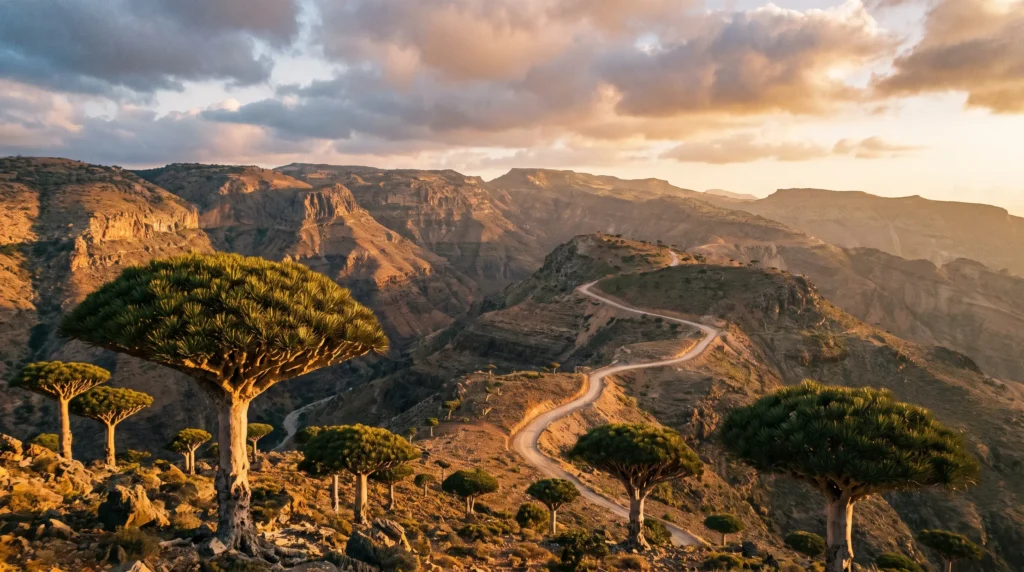
If there’s one seasonal fact worth knowing about Yemen, it’s this: even setting the conflict aside, the country’s most extraordinary natural site is only reachable part of the year on its own terms. Socotra, an island roughly 380 kilometres off the Yemeni mainland in the Arabian Sea, is home to the umbrella-shaped Dragon’s Blood Tree and other endemic species found nowhere else — around a third of its plant life exists only there. From roughly June to September, the island is hit by the kharif monsoon, which regularly cuts off boat and sometimes air access entirely.
Socotra has also followed its own political track since the broader war began — the UAE has maintained a military presence since 2018, and the Southern Transitional Council took administrative control of the island in 2020. Limited scheduled flights from Cairo and Abu Dhabi have operated in recent years, which is part of why Socotra is sometimes discussed separately from mainland Yemen in travel circles — though it remains part of Yemen, subject to the same national-level advisories, and any current access should be verified directly and cautiously rather than assumed from older reports.
Best Time to Visit Yemen (In Theory)
We’re including this section for completeness and for the future, not as current advice — see the safety note at the top of this guide.
October – April · Cooler, drier mainland months
The highlands around Sana’a sit above 2,000 metres and stay pleasantly cool through this stretch, while the coastal plains along the Red Sea and Gulf of Aden are far more bearable than in summer. This is also the window when Socotra’s monsoon has passed, making the island theoretically reachable.
May – September · Heat and monsoon
Coastal Yemen turns brutally hot and humid; the highlands stay milder but the southwest monsoon closes off Socotra for stretches of this period.
Year-round · The overriding factor
Security conditions, not weather, are what actually determine whether any of this is relevant. Front-line areas in central Yemen see continued violence, and both landmines and unexploded ordnance are present in unmarked locations nationwide. No calendar date changes that.
Getting There — What Little There Is
Sana’a International Airport and Aden International Airport are the country’s two main gateways, the latter serving as the airport for the internationally recognized government’s interim capital. Commercial air links into Sana’a have been severely restricted for most of the war; some routes resumed on a limited basis in 2022 under UN-brokered truce arrangements, though schedules have been unstable and subject to closure. Overland routes exist toward Saudi Arabia and Oman, but border areas sit near active or recent front lines and are not a realistic option for ordinary travelers.
In practice, the people currently entering Yemen are aid workers, diplomats, journalists, and those with Yemeni family ties — arranged through the specific channels each of those roles requires, not through ordinary tourist booking. Socotra has had its own separate, if limited, scheduled air service from Cairo and Abu Dhabi in recent years, but availability changes and should be verified with an operator directly rather than assumed.
Getting Around — Checkpoints, Front Lines & Why This Isn’t a Road Trip
We’re not going to describe Yemen’s internal transport the way we would a functioning tourist destination, because it isn’t one. The country is administratively split between Houthi-controlled areas in the north (including Sana’a) and areas held by the internationally recognized government in the south (including Aden), with front lines running through central governorates. Multiple armed checkpoints, unpredictable security conditions, and unmarked landmines and unexploded ordnance make overland movement genuinely dangerous, not merely inconvenient.
Anyone who does have a legitimate reason to be in Yemen right now — humanitarian, journalistic, diplomatic — moves with organizational security protocols, local fixers, and route intelligence that a standard travel guide simply cannot responsibly substitute for. That’s not us being cagey; it’s the honest limit of what a website can tell you about a war zone.
Top Regions — Sana’a, Hadhramaut, Aden & Socotra
Sana’a & the Old City
Yemen’s constitutional capital and one of the world’s oldest continuously inhabited cities, sitting at 2,250 metres in the highlands. Its UNESCO-listed Old City is famous for tower houses built of rammed earth and burnt brick, their windows outlined in white gypsum in a style found nowhere else, along with the 12th-century al-Mahdi Mosque. Conflict-related damage led UNESCO to add it to the List of World Heritage in Danger, and cash-for-work restoration efforts have continued where possible. Sana’a has been under Houthi control since September 2014.
Shibam & Wadi Hadhramaut
Called “the Manhattan of the Desert,” Shibam is a walled town of roughly 500 mud-brick tower houses, some rising 30 metres over five to eleven storeys, built in the 1500s on a site inhabited for around 1,700 years. It’s one of the earliest examples of deliberate vertical urban planning anywhere, originally built tall for defense against Bedouin raids. Like Sana’a’s Old City, it has been listed as endangered heritage since 2015.
Aden
A historic Gulf of Aden port city and, since 2015, the interim seat of Yemen’s internationally recognized government. Aden’s harbor has drawn traders for centuries and its volcanic peninsula setting is genuinely striking; it’s generally considered calmer than front-line areas, though it remains inside the country covered by the whole-country advisories above and has seen its own periods of instability.
Socotra Archipelago
A UNESCO World Heritage-listed island group in the Arabian Sea, isolated enough that roughly a third of its plant species are found nowhere else, most famously the umbrella-canopied Dragon’s Blood Tree. Around 60,000 people live there, mostly indigenous Soqotri, whose Semitic language is unrelated to mainland Yemeni Arabic dialects. Socotra has followed a somewhat separate political and security track from the mainland war, but it is still part of Yemen and still subject to the advisories above. For how the island’s tour pipeline actually works today — including the Jeddah flight route and the January 2026 stranding of hundreds of tourists — see Can You Visit Yemen in 2026? Socotra, Advisories and Reality.
Marib
Once the capital of the ancient Kingdom of Saba, Marib’s ruins — including the remains of the great Marib Dam — were inscribed by UNESCO in 2023 as the Landmarks of the Ancient Kingdom of Saba, recognizing one of pre-Islamic Arabia’s most important civilizations. Marib governorate has also been one of the most contested front-line areas of the current war.
Zabid
A historic Red Sea-plain town and former center of Islamic learning, UNESCO-listed in 2000 for its distinctive domestic and military architecture and its street layout, largely unchanged since the medieval period.
Culture & People — Tribes, Tradition & Qat
Yemeni identity draws on a genuinely ancient well — the pre-Islamic Sabaean and Himyarite kingdoms, centuries as a hub of the Red Sea and Indian Ocean trade, and a strong tribal and qabili social structure that still shapes local governance and dispute resolution across much of the country. Modern Standard Arabic is the official language, alongside distinct regional dialects, and the Soqotri language survives on Socotra as a living link to older South Arabian tongues.
Chewing qat — the leaves of a mildly stimulant shrub, usually in afternoon social gatherings — is one of the most widely practiced and visible traditions in Yemeni daily life, woven into business, socializing and hospitality customs in a way that’s hard to overstate and genuinely central to understanding how the country runs day to day. Traditional dress for Yemeni men often includes the curved jambiya dagger worn at the waist, a marker of status and tribal identity rather than a weapon of daily use. Yemen was also once home to one of the world’s oldest Jewish diaspora communities, with roots reaching back many centuries before most of the community relocated in the 20th century.
A Food Lover’s Guide to Yemen
Yemeni cuisine is heartier and more highland than its Gulf neighbors’ — built around slow-cooked meat, bread and stew rather than rice-forward Arabian Peninsula cooking. Saltah, a bubbling meat-and-vegetable stew topped with a fenugreek froth called hilbeh, is often called the national dish, usually mopped up with fresh flatbread straight from a clay tandoor-style oven. Mandi and mandi-style slow-roasted lamb or chicken over spiced rice, cooked in an underground pit, shows the country’s Hadhrami and Gulf trading links. For something sweet, bint al-sahn is a honey-drenched, layered flatbread often served at celebrations.
Yemen’s biggest culinary export, though, predates all of it: coffee. The Red Sea port of al-Mukha (Mocha) gave the English language its word for “mocha,” and for roughly 150 years starting in the 16th century, Yemen was essentially the world’s sole coffee supplier, with beans shipped out through that one port to Europe and beyond. Yemeni coffee, grown on ancient highland terraces, is still prized by specialty roasters internationally, even as domestic infrastructure for the trade has been badly strained by the war.
Off the Beaten Path (Even by Yemen’s Standards)
The Marib Dam ruins
The remains of one of the ancient world’s great engineering feats, part of the 2023 UNESCO inscription for the Kingdom of Saba, sitting in one of the current conflict’s most fought-over governorates.
The Soqotri highland forests
Beyond the postcard Dragon’s Blood groves, Socotra’s interior mountains hold cave systems, endemic bird species and Soqotri herding communities largely unconnected to any tourism infrastructure at all.
Zabid’s back streets
A UNESCO town most visitors have never heard of, let alone visited, with a medieval street plan and distinctive fortified house style largely unchanged for centuries.
Practical Information
Money. The Yemeni rial (YER) trades at sharply different rates depending on which side of the conflict controls the region — roughly 530 per US dollar in Houthi-held northern areas, which reject post-2017 banknotes, versus 2,150 or more per dollar in government-held southern areas, where continued currency printing has driven steep depreciation. This alone makes ordinary financial planning for a trip unusually complicated, on top of everything else.
Safety. See the advisory at the top of this guide. The US State Department rates Yemen Level 4 — Do Not Travel — citing terrorism, armed conflict, kidnapping risk and landmines; the UK FCDO advises against all travel to the whole country.
Health. The CDC flags increased malaria transmission (including in areas previously considered lower-risk), continued poliovirus circulation, and recommends hepatitis A and B, typhoid, and rabies vaccination given how commonly rabid dogs are found in Yemen; medical infrastructure nationwide is severely limited by the conflict.
Entry. Tourist visas are effectively unavailable; entry is realistically limited to those of Yemeni origin, NGO and international-organization staff, journalists and diplomats, arranged through the appropriate official channels.
Budget Breakdown — Why We Can’t Give You Real Numbers
Every other guide on this site gives you honest per-day budget tiers. We’re not going to fabricate them for Yemen, because there currently isn’t a functioning independent-tourism sector to price against — no network of hostels, tour operators or guesthouses serving ordinary international visitors the way there is in, say, neighboring Oman. The people who do travel to Yemen right now — aid workers, journalists, diplomats, returning Yemeni families — typically move through organizational logistics, chartered or restricted commercial flights, and security arrangements that bear no resemblance to a backpacker’s or even a luxury traveler’s cost structure.
The most honest number we can offer is this: the Yemeni rial’s value differs by roughly four-fold depending on which side of the country’s front lines you’re pricing in, which alone should tell you that “what does Yemen cost per day” isn’t currently a question with a stable answer. If and when commercial tourism resumes in earnest, we’ll rebuild this section with real, current numbers.
Planning Your First Trip to Yemen
Right now, the only responsible planning advice is: don’t, and check your government’s current travel advisory before you consider it further. If Arabian Peninsula history and architecture drew you to this guide, our Oman guide covers a neighboring country with its own stunning forts, wadis and coastline that’s genuinely open for visitors, and our Saudi Arabia guide covers the peninsula’s other emerging destination, including its own UNESCO-listed old towns and desert landscapes. For more UNESCO mud-brick and old-city architecture in a currently visitable setting, our Morocco guide and its walled medinas are a reasonable substitute for the Shibam and Sana’a experience until Yemen reopens.
Frequently Asked Questions
Is it safe to travel to Yemen right now?
No. The US State Department rates it Level 4 — Do Not Travel, its most severe rating, and the UK FCDO advises against all travel to the entire country. Check current advisories yourself before making any decisions.
Can foreigners even get a tourist visa to Yemen?
In practice, no — not for ordinary tourism. Entry visas are currently issued mainly to people of Yemeni origin, NGO and international-organization staff, journalists and diplomats.
What about Socotra — is that separate from the mainland situation?
Socotra has followed a somewhat distinct political and security track, with a UAE military presence since 2018 and Southern Transitional Council administrative control since 2020, and it has seen limited scheduled flights from Cairo and Abu Dhabi. But it remains part of Yemen and is covered by the same national-level advisories — treat any claim that it’s simply “safe to visit” with real skepticism and verify directly with your government’s current guidance.
Why write a guide to a country you’re telling people not to visit?
Because Yemen’s history, architecture and geography are genuinely remarkable and deserve honest documentation — and because advisories do change over time. We’d rather have a well-sourced, respectful guide ready for whenever conditions allow safe travel again than pretend the country doesn’t exist, or worse, understate the current risk to chase traffic.
Are Yemen’s UNESCO sites still standing?
Partially, and under real threat. The Old City of Sana’a and the Old Walled City of Shibam are both on UNESCO’s List of World Heritage in Danger due to conflict-related damage, with restoration work continuing where access allows.
What’s the single most important thing to know before considering any trip?
That “considering a trip” should mean checking your government’s official current advisory first, not reading a travel blog — including this one.
When Yemen Reopens, We’ll Be Ready
A mud-brick skyscraper city a thousand years old, a highland capital thick with carved gypsum windows, an island of dragon-blood trees found nowhere else on the planet — Yemen has always had the ingredients of a genuinely extraordinary destination. Right now, though, the honest answer is patience: check the current advisories, hope for stability, and let this guide be the starting point for the trip you plan once it’s actually safe to take.
Explore More
- Oman Travel Guide — forts, wadis and coastline on Yemen’s safer Arabian Peninsula doorstep
- Saudi Arabia Travel Guide — the peninsula’s other newly opening destination
- Jordan Travel Guide — ancient Middle Eastern history you can visit today
- Morocco Travel Guide — walled medinas and mud-brick architecture, safely
How this guide was built
Published as part of Facts From Upstairs’ country guide series. Because Yemen is currently under serious travel advisories, this guide was built with an emphasis on verified safety information first, drawn from the US State Department travel advisory, the UK FCDO’s Yemen travel advice, and the US CDC’s Yemen traveler health page, alongside Wikipedia entity pages for Yemen’s geography, cities, currency and UNESCO sites, UNESCO’s own reporting on the Old City of Sana’a and Old Walled City of Shibam’s endangered-heritage status, and the Wikipedia page on the historical Mocha coffee trade. Numeric and checkable claims carry inline citations; where a specific figure could not be verified, it has been described qualitatively instead.
Sources cited on this page
- US State Department — Yemen Travel Advisory
- UK FCDO — Yemen Travel Advice
- US CDC — Yemen Traveler Health Page
- Wikipedia — Yemen
- Wikipedia — Sana’a
- Wikipedia — Shibam
- Wikipedia — Aden
- Wikipedia — Socotra
- Wikipedia — Yemeni Rial
- Wikipedia — Visa Policy of Yemen
- Wikipedia — List of World Heritage Sites in Yemen
- UNESCO World Heritage Centre — Sana’a & Shibam Added to List of World Heritage in Danger
- Wikipedia — Mokha
More country guides you might like


Plan your trip to Yemen
The booking tools we use ourselves. FFU may earn a commission at no extra cost to you.
Plan & book your trip to Yemen
Booking through these searches supports our guides at no extra cost to you.