
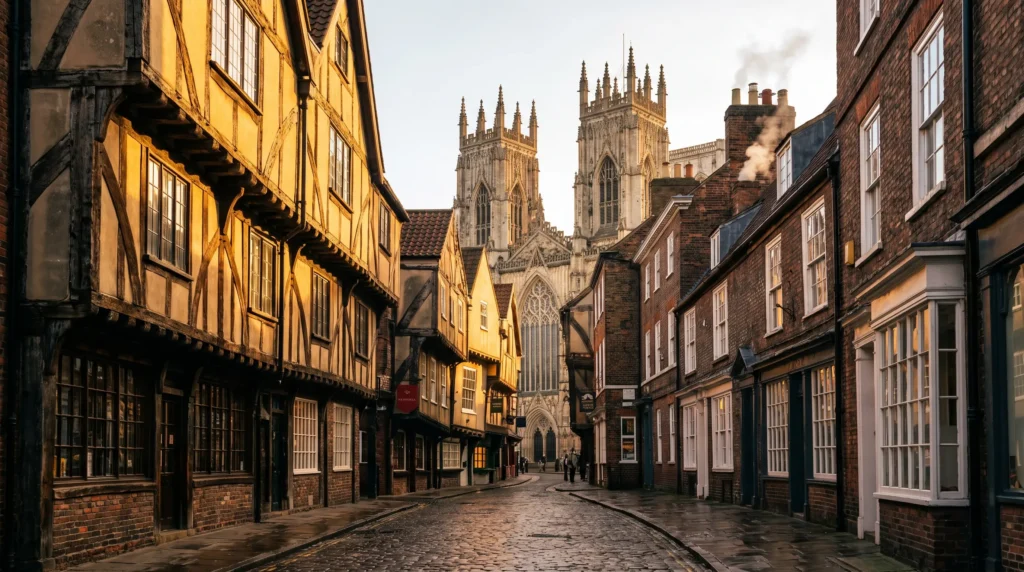
York Travel Guide — Vikings, a Cathedral You Can See From the Motorway, and England’s Most Walkable Old City
York is the city that makes you feel like you’ve read the whole history of England in an afternoon, because you basically have. The Romans built a fortress here in AD 71 and called it Eboracum; the Vikings took it in 866 and renamed it Jorvik; the medieval wool merchants built a cathedral that’s still the second-largest Gothic church in northern Europe. All of it survives inside 3.4 kilometres of medieval walls you can still walk the full loop of, which is not a metaphor — you can actually do it in about ninety minutes. I love York for how compact its ambition is: you get Roman ruins, Viking archaeology, a world-class cathedral, and the best-preserved medieval street in England, all within a fifteen-minute walk of each other. The catch is that everyone else knows this too — the Shambles at 2pm in August is a shuffling conveyor belt of phones held sideways, and York’s small footprint means it absorbs roughly 8.4 million visitors a year onto streets built for foot traffic and handcarts. Go anyway. Just go early, or go in November, and know which streets to duck down when the crowds thicken.
In This Guide
- Overview — Why York Punches So Far Above Its Size
- The Christmas Market & Ice Trail — York’s Festival Calendar
- Best Time to Visit York (Season by Season)
- Getting There — Trains, Airports & the East Coast Line
- Getting Around — Walls, Cobbles & Park & Ride
- Neighborhoods — Inside and Outside the Walls
- Culture & People — Vikings, Ghosts & Yorkshire Grit
- A Food Lover’s Guide to York
- Off the Beaten Path
- Day Trips From York
- Practical Information
- Budget Breakdown — What York Actually Costs in 2026
- Planning Your First Trip to York
- Frequently Asked Questions
Overview — Why York Punches So Far Above Its Size
York sits at the meeting of the Rivers Ouse and Foss in North Yorkshire, roughly midway between London and Edinburgh — 207 miles from London, about 90 miles south of Newcastle. That position made it a Roman military headquarters, a Viking trading capital of over 10,000 people, and later the wool-and-railway boomtown whose station once made it a genuine rival to London in importance. Almost none of that layered history has been paved over — it’s stacked, literally, in places like the Jorvik Viking Centre, built directly on top of a Coppergate excavation that pulled over 40,000 Viking-age artefacts out of the ground between 1976 and 1981.
The whole historic core still sits inside its medieval walls — 3.4 kilometres of surviving masonry, the longest town walls in England, built mostly in the 13th century on earthen ramparts and punctuated by four great gatehouses called “bars.” At the centre of it all is York Minster, begun around 1230 and finished in 1472, with a central tower rising 72 metres and a Great East Window — the largest expanse of medieval stained glass in Britain — commissioned in 1405.
What York doesn’t have is a lot of elbow room. The whole walled centre is walkable corner to corner in about twenty minutes, which is charming until you’re doing it at the same pace as a tour group of forty. Tourism brings in over £765 million a year and supports around 24,000 local jobs, so the city knows exactly what it’s selling — and it sells it hard around the Shambles and Minster Yard. Walk two streets off that spine, though, and York turns quiet, residential, and genuinely lovely almost immediately.
The Christmas Market & Ice Trail — York’s Festival Calendar
If you can time a trip to late November or December, do it. St Nicholas Fair, York’s Christmas Market, runs for around five weeks through the historic streets with dozens of chalets selling handmade gifts, mulled wine and street food, and it’s regularly ranked among the UK’s best Christmas markets. The whole city leans into it — Georgian townhouses strung with lights, the Minster floodlit above the stalls — and it’s one of the few times York’s grey winter weather actually works in its favour.
Come back in February for the York Ice Trail, the UK’s biggest outdoor ice-sculpture trail, which draws tens of thousands of visitors to wander a route of carved sculptures through the city centre. Summer has its own calendar too — the Ebor Festival horse racing meeting in August fills every hotel room in the city, so book that particular week well ahead if you’re not going for the races, or lean into it if you are.
Best Time to Visit York (Season by Season)
April – June · Spring into early summer
My favourite window: the Museum Gardens are in bloom, days are stretching out, and the crowds haven’t hit their summer peak. Weather is genuinely unpredictable — pack a proper layer regardless of the forecast.
July – August · Peak summer
Warmest weather of the year, with temperatures regularly topping 27°C, and also the busiest and most expensive stretch — school holidays plus the Ebor Festival race week in August. The Shambles and Minster Yard get genuinely crowded by mid-morning.
September – October · The value window
This is the stretch I’d point most first-timers toward: still mild, golden light for photos, noticeably thinner crowds, and hotel rates well below summer peak.
November – February · Christmas, ice, and honest grey
Cold, often damp, short daylight hours — York has a temperate oceanic climate that doesn’t do dramatic winters, just persistent drizzle and frost. What you’re trading that for is the Christmas Market, the Ice Trail, and a city centre that photographs beautifully half-lit and steaming with mulled wine.
Getting There — Trains, Airports & the East Coast Line
York has no international airport of its own, and honestly doesn’t need one — its whole appeal is being an easy add-on to a UK trip. The city sits directly on the East Coast Main Line: LNER’s fastest direct trains from London King’s Cross take about 1 hour 45 minutes over roughly 173 miles, with around 80 direct services a day, and the average journey (including semi-fasts) runs closer to two hours. The same line connects York to Edinburgh in a similar window heading north, and to Leeds in about 25 minutes.
By air, Leeds Bradford Airport is the closest, roughly 30–40 minutes by car, with Manchester Airport (about 1.5–2 hours away by train or road) offering a much wider range of long-haul connections — most international visitors fly into Manchester or London and take the train onward. Since 25 February 2026, travellers from visa-exempt countries — including the US, Canada, Australia and all 27 EU nations — need an approved UK Electronic Travel Authorisation before boarding, a £20, multi-entry digital permission valid for up to two years or six-month stays; British and Irish citizens are exempt.
Getting Around — Walls, Cobbles & Park & Ride
You will not need a car inside the walls, and you genuinely shouldn’t bring one — the historic core is largely pedestrianised, narrow, and cobbled, and a fair few streets bar vehicle access entirely. The whole walled city is walkable corner to corner in about twenty minutes, and walking the full 3.4-kilometre wall circuit is one of the best free things to do in York, taking roughly ninety minutes at an unhurried pace.
York railway station sits just outside the western wall, a five-minute walk from the Minster. If you’re driving in for a day trip, use one of the Park & Ride sites on the ring road rather than hunting for city-centre parking, which is scarce and not cheap. Buses run frequently between the Park & Ride lots and the centre. For day trips into the Dales, Moors or coast, a rental car (or a well-timed train) opens up far more than the city bus network will.
Neighborhoods — Inside and Outside the Walls
The Shambles & Historic Core
York’s oldest surviving street, running about 400 feet of overhanging timber-framed buildings dating largely from the 14th–15th centuries — once “the Great Flesh Shambles,” lined with over thirty butchers’ shops by 1885, today lined with fudge shops and, since 2017, a small cluster of wizard-themed stores riding the (author-denied) Harry Potter connection. It’s genuinely beautiful and genuinely the most crowded few hundred feet in the city — go before 9am if you want a photo without forty strangers in it.
Minster Quarter & Museum Gardens
The Minster itself, Dean’s Park, the Yorkshire Museum and the riverside Museum Gardens (with the ruined St Mary’s Abbey) form a genuinely peaceful cluster just steps from the Shambles crowds. Best entered early morning or at dusk when the tower is floodlit.
Micklegate & the Bar Walls
The southwestern quarter inside Micklegate Bar, historically the route royalty entered the city by, now a mix of Georgian townhouses, antiques shops and a livelier pub strip after dark. Good base for walking the walls in either direction.
Fossgate & Walmgate
York’s most interesting eating and drinking strip right now — independent bars, craft breweries and the beautifully preserved 14th-century Merchant Adventurers’ Hall, all a five-minute walk from the tourist crush but rarely mentioned in the guidebooks.
Bishopthorpe Road (“Bishy Road”)
Just outside the walls to the south, this is where locals actually eat — independent cafés, a proper Saturday food market feel, and none of the city-centre markup.
Clifton & Bootham
A leafy, largely residential stretch north of the walls near Bootham Bar, dense with guesthouses and B&Bs — a quieter base a genuine ten-minute walk from the Minster, and usually cheaper than staying inside the walls.
Culture & People — Vikings, Ghosts & Yorkshire Grit
York wears its layered identity openly: Roman Eboracum, Viking Jorvik, medieval ecclesiastical capital, Georgian gentry town, Victorian railway boomtown — and locals will happily tell you which century a given building belongs to unprompted. It’s also a university city, home to the University of York and York St John University, which keeps the population younger and livelier than the postcard version suggests. Yorkshire dialect and directness are part of the texture — expect “love” and “duck” as terms of address, and a dry, understated humour.
York also markets itself, with some justification, as one of the most haunted cities in Europe, leaning into centuries of plague pits, castle sieges and Guy Fawkes (born here in 1570) with nightly ghost walks that are more theatrical fun than genuinely spooky. The Bar Convent, near the station, is recognised as the oldest living convent in England, still an active community alongside its museum and café — a quieter, more contemplative counterpoint to the ghost-tour circuit.
A Food Lover’s Guide to York
Start with afternoon tea at Bettys Café Tea Rooms, a York institution since 1919 on St Helen’s Square — yes, there’s a queue, and yes, it’s usually worth it for the setting alone even if the tea itself is available cheaper elsewhere. York is also, less famously, a chocolate city: Rowntree’s and Terry’s built their empires here, and the small York Cocoa Works museum traces that industrial history with tastings.
For a proper meal, Yorkshire pudding shows up everywhere — traditionally served as a starter with gravy before the roast, not just alongside it, which surprises a lot of visitors. Real ale is serious business: York Brewery runs tours and a taproom, and pubs like the Guy Fawkes Inn and the tiny, ancient Ye Olde Starre Inne (one of the city’s oldest licensed pubs) are worth the detour. Fish and chips from a proper chippy, a Yorkshire curd tart for pudding, and a wander through Shambles Market for street food stalls round out a day of eating without ever needing a car or a reservation.
Off the Beaten Path
York Cold War Bunker
A preserved 1961 nuclear monitoring bunker on the city’s edge, run by English Heritage — genuinely eerie and almost entirely missed by day-trippers focused on the Minster.
Merchant Adventurers’ Hall
One of the best-preserved medieval guildhalls in the world, tucked just off Fossgate, still owned by the same trading guild that built it in the 1350s. Rarely has a queue.
Clifford’s Tower
The stone keep of York Castle, sitting on its mound above the river — smaller and quieter than the Minster crowds two streets away, with one of the best rooftop views in the city.
Rowntree Park & the Millennium Bridge riverside walk
A genuinely local stretch — follow the Ouse south from the centre past Rowntree Park (built by the chocolate firm for its workers) and across the Millennium Bridge for a green, crowd-free hour that most itineraries skip entirely.
Day Trips From York
Whitby — the Gothic seaside town that inspired part of Bram Stoker’s Dracula, with its own ruined abbey on the clifftop, reachable by car or the scenic Esk Valley rail line in about 90 minutes to two hours depending on route.
Castle Howard — the vast baroque stately home used as the filming location for Brideshead Revisited, about 30 minutes by car with its own bus service from York in summer.
Harrogate — the elegant Victorian spa town about 30 minutes away by car or train, home to the original Bettys tea rooms and the Turkish Baths.
North York Moors & Yorkshire Dales — two of England’s most dramatic national parks bracket York within roughly an hour’s drive, ideal for a day of hiking, drystone-wall villages and, in late summer, purple heather moorland.
Leeds — a 25-minute train ride for a bigger-city contrast: better shopping, a livelier nightlife scene, and a completely different (much more modern) architectural mood than York’s.
Practical Information
Money. The currency is the pound sterling (GBP); contactless card payment is near-universal, including on buses and at market stalls, so you’ll rarely need much cash.
Safety. York itself is low-crime and very walkable at night in the centre; the main things to watch are pickpockets in dense tourist crowds and standard pub-night common sense. The UK overall currently carries a US State Department Level 2 advisory (“exercise increased caution”) citing terrorism risk at major public venues nationwide — a broad national-level advisory rather than anything specific to York, but check current guidance before you travel.
Health. No special vaccinations are required for the UK; the CDC recommends travelers simply be up to date on routine vaccines like MMR, and standard travel insurance covering the NHS’s fee structure for visitors is worth having.
Connectivity. 4G/5G coverage in the city is strong; most cafés and hotels offer free Wi-Fi. Plugs: Type G, 230V. Time zone: GMT, with British Summer Time (UTC+1) from late March to late October.
Budget Breakdown — What York Actually Costs in 2026
York is mid-range by UK standards — pricier than most northern English cities, notably cheaper than London.
Budget (£55–90/day): Hostel or budget guesthouse outside the walls, café lunches and a chippy dinner, free wall walk and self-guided wandering, skipping paid attractions or picking just one.
Mid-range (£150–250/day): Three- or four-star hotel in Clifton or Micklegate, combined York Minster and Jorvik Viking Centre tickets, one sit-down dinner plus Bettys afternoon tea, a couple of paid attractions.
Luxury (£400+/day): Boutique hotel inside the walls, private guided history walk, a fine-dining tasting menu, and a day-trip car and driver out to Castle Howard or the Dales.
Tipping 10–12.5% is standard at sit-down restaurants where service isn’t already added to the bill; it’s not expected in pubs or cafés with counter service.
Planning Your First Trip to York
Two full days covers the essentials comfortably: day one for the Minster, the Shambles (early), and a wall walk; day two for Jorvik, the Castle Museum or Clifford’s Tower, and one further-flung neighborhood like Fossgate or Bishy Road. Three or four nights lets you add a day trip to Whitby, Castle Howard or the Dales without rushing. Most visitors pair York with a longer UK loop — our London city guide and England travel guide cover the obvious bookends, and the East Coast Main Line makes it just as easy to continue north into our Edinburgh guide, or west to Dublin by short flight for a fuller British Isles trip.
Frequently Asked Questions
How many days do you need in York?
Two full days covers the headline sights comfortably; three or four lets you add a day trip to Whitby, Castle Howard or the Yorkshire Dales without feeling rushed.
Do I need a visa to visit York?
York is in England, so standard UK entry rules apply. Since 25 February 2026, visitors from visa-exempt countries — the US, Canada, Australia and all EU nations among them — need an approved UK Electronic Travel Authorisation (£20, valid up to two years) before travel; British and Irish citizens don’t need one.
Is York walkable, or do I need a car?
Entirely walkable — the historic core sits inside 3.4 kilometres of medieval walls and can be crossed corner to corner in about twenty minutes. A car only becomes useful for day trips into the Moors, Dales or coast.
Can York be a day trip from London?
Technically yes — the fastest direct train is about 1 hour 45 minutes each way — but it’s a long day for a city this rich in layers. One overnight turns a rushed sightseeing dash into an actual visit.
Is the Shambles overrated?
Honestly, at peak midday hours in summer, it can feel more like a queue than a street. The buildings themselves are the real deal — genuine 14th–15th-century timber frames — but go at 8am or after 6pm if you want to actually see them rather than the backs of other people’s heads.
York or Bath — which is better for a first UK trip outside London?
York edges it for range: Roman, Viking, medieval and railway history stacked in one walkable core, plus easier onward travel north to Edinburgh. Bath wins on Georgian architectural unity and the Roman Baths themselves. Both pair naturally with London; York pairs better with a longer north-of-England or Scotland loop.
Ready to Explore York?
A cathedral tower you can see from the ring road, a Viking city rebuilt from 40,000 excavated artefacts, and a medieval street you can still walk the same cobbles of that butchers worked five centuries ago — York fits an absurd amount of England’s history into a town you can cross on foot in twenty minutes. Go early in the day, go outside July and August if you can, and let the crowds around the Shambles push you toward Fossgate instead.
Explore More
- London City Guide — the obvious bookend, 1h45 down the East Coast line
- Edinburgh City Guide — continue north on the same rail line
- Dublin City Guide — a short flight west for the rest of the British Isles
- England Travel Guide — the full country York sits inside
How this guide was built
Published as part of Facts From Upstairs’ city guide series. Built from authoritative sources — Visit York (the official tourism board), Wikipedia entity pages for York, York Minster, York city walls, the Shambles and the Jorvik Viking Centre, Britannica’s York article, GOV.UK’s Electronic Travel Authorisation page, the US State Department’s UK travel advisory, the US CDC’s UK traveler page, and LNER’s official London–York route page for train times. Numeric claims carry inline citations.
Sources cited on this page
- Wikipedia — York
- Wikipedia — York Minster
- Wikipedia — York city walls
- Wikipedia — The Shambles
- Wikipedia — JORVIK Viking Centre
- Britannica — York, England
- Visit York — Festivals
- GOV.UK — Electronic Travel Authorisation (ETA)
- US State Department — United Kingdom Travel Advisory
- US CDC — United Kingdom traveler page
- LNER — London King’s Cross to York route
More city guides you might like



Plan your trip to York
The booking tools we use ourselves. FFU may earn a commission at no extra cost to you.
Plan & book your trip to York
Booking through these searches supports our guides at no extra cost to you.