
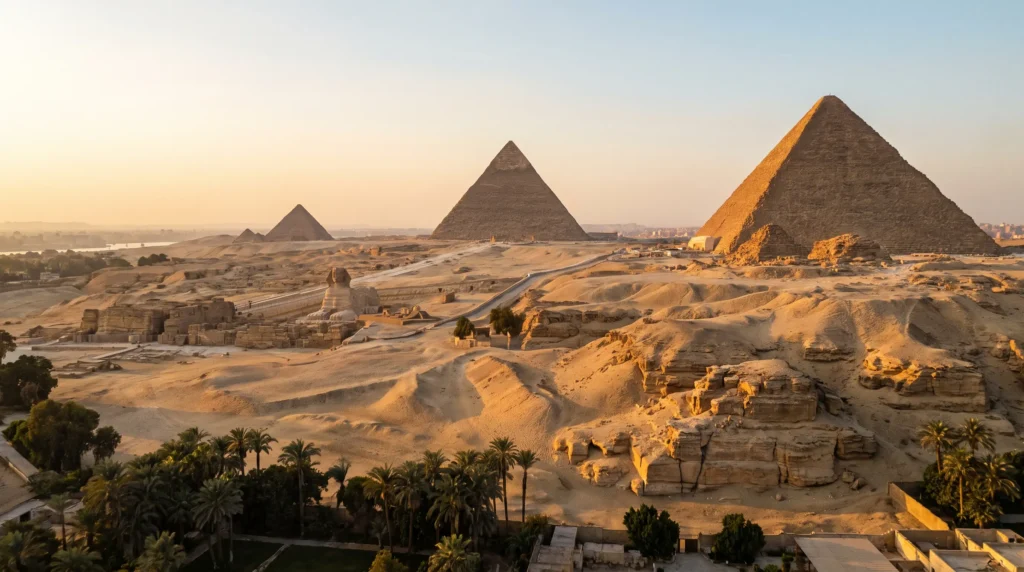
Giza Travel Guide — The Last Ancient Wonder, One City Bus From Downtown Cairo
Here is the thing nobody tells you about Giza before you go: the pyramids are not out in some remote desert you fly to. They are at the edge of a city of 4.4 million people, and on a clear afternoon you can see the Great Pyramid from a KFC parking lot. That collision — the last surviving Wonder of the Ancient World sharing a horizon with satellite dishes and traffic jams — is exactly what makes Giza so disorienting and so good. I’ve stood on that plateau at sunrise with the city humming awake behind me, and nowhere else has made 4,500 years of history feel this immediate. Giza is not a side trip from Cairo; treat it as its own city, because that’s what it legally is — the capital of its own governorate, just across the Nile. Go in with a plan for the heat, the hustlers, and the sheer scale of what you’re about to see, and it delivers completely.
In This Guide
- Overview — Why Giza Isn’t Just “the Pyramids Outside Cairo”
- The Grand Egyptian Museum Just Opened — Here’s What Changed
- Best Time to Visit Giza (Season by Season)
- Getting There — Airports, Metro & Nile Crossings
- Getting Around — Metro, Uber & Walking the Plateau
- Neighborhoods — Plateau, Haram Street, Dokki & Beyond
- Culture & People
- A Food Lover’s Guide to Giza
- Off the Beaten Path
- Day Trips — Saqqara, Dahshur & Memphis
- Practical Information
- Budget Breakdown — What Giza Actually Costs in 2026
- Frequently Asked Questions
Overview — Why Giza Isn’t Just “the Pyramids Outside Cairo”
Giza sits directly across the Nile from central Cairo and is the third-largest city in Egypt by population, home to roughly 4.46 million people as of the 2023 census. It’s technically a separate governorate with its own city administration, but in practice it functions as one half of the sprawling Greater Cairo metro area — you’ll cross between “Cairo” and “Giza” a dozen times a day without noticing a border.
What everyone actually comes for is the plateau at the western edge of the city: the Giza pyramid complex, built during Egypt’s Fourth Dynasty roughly between 2600 and 2500 BC. The Great Pyramid, built for the pharaoh Khufu around 2560 BC, is the only one of the ancient Seven Wonders of the World still standing, and was the tallest structure on the planet at the time of its completion. Beside it stand the pyramids of Khafre and Menkaure, plus the Great Sphinx, whose face Egyptologists generally agree was carved to resemble Khafre.
Zoom out and Giza is only the northern tip of something much bigger: UNESCO’s “Memphis and its Necropolis” World Heritage Site, inscribed in 1979, which strings together more than 38 pyramids and over 9,000 rock-cut tombs from the Giza plateau south through Zawyet el-Aryan, Abusir, Saqqara and Dahshur. The pull is obvious. What’s less obvious until you land: Giza attracted an estimated 14.7 million tourists in 2025 alone, making it Egypt’s single most-visited destination, and the crowds, touts and traffic that come with that number are as much a part of the experience as the monuments.
The Grand Egyptian Museum Just Opened — Here’s What Changed
If you last thought about visiting Giza more than a year or two ago, the single biggest reason to look again opened its doors on 1 November 2025: the Grand Egyptian Museum, sitting about 2 kilometers from the pyramids themselves. After two decades of construction and a reported $1.2 billion price tag, it’s now the largest archaeological museum devoted to a single civilization on Earth — 500,000 square meters total, with over 100,000 artifacts on display.
The headline draw is the complete Tutankhamun collection — all 5,398 pieces, including the golden mask, shown together in one place for the first time in history, across a dedicated 7,500-square-meter gallery. The museum has been drawing roughly 18,000–19,000 visitors a day since opening. Practical upshot: book GEM tickets online in advance and budget a genuinely separate half-day for it — treating it as a quick add-on to a pyramids morning is how people end up rushing through the best exhibit in the country.
Best Time to Visit Giza (Season by Season)
Late October – April · Peak season
Daytime highs sit in the comfortable 20s°C, mornings can be genuinely cool, and this is when tour buses, cruise groups and school trips all show up at once. Book Grand Egyptian Museum and Great Pyramid interior-entry tickets ahead, and get to the plateau at opening to beat both the heat and the crowds.
May & September–October · Shoulder season
Warmer but manageable, noticeably thinner crowds, and hotel rates that dip below winter peak. This is the value window most first-time visitors overlook entirely.
June – August · Peak summer heat
Daytime temperatures regularly push past 35–40°C on the open, shadeless plateau. Doable, but plan around it: sunrise entry, retreat indoors or to the museum by early afternoon, and drink far more water than feels necessary.
Ramadan shifts the whole city’s rhythm regardless of month — daytime restaurant hours contract and evenings come alive after iftar; the Giza sound-and-light show itself starts later, around 8:30pm, during the holy month versus 7–7:30pm otherwise.
Getting There — Airports, Metro & Nile Crossings
Cairo International Airport (CAI) is the main international gateway, sitting roughly 45 kilometers from Giza on the opposite side of the metro area — expect 45 minutes to over an hour by car depending on Cairo traffic, which is to say: always budget more time than the map suggests. Sphinx International Airport, opened in 2018 within Giza Governorate itself, offers a closer alternative on select domestic and charter routes, though CAI remains the default for most international arrivals.
From the airport, pre-booked hotel transfers or ride-hailing apps (Uber and the local Careem both operate widely in Cairo/Giza) are the least stressful option after a long flight — agree the fare or confirm the metered app price before committing to airport taxi touts. Once you’re in the city proper, the Cairo Metro’s Line 2 runs directly into Giza, making it one of the cheapest and most traffic-proof ways to shift between the two halves of the metro area.
Getting Around — Metro, Uber & Walking the Plateau
The Cairo Metro is Africa’s oldest metro system, opened in 1987, and now runs three operational lines across 106.8 kilometers and 89 stations, carrying roughly 5 million riders a day. Fares are distance-based and cheap — as of early 2026, roughly EGP 10 to 20 depending on how many stops you ride. Line 2 reaches into Giza and is the fastest way to dodge surface traffic, though the pyramid plateau itself sits a taxi or rideshare ride beyond the nearest station.
Within the city, ride-hailing apps are the practical default for visitors — cheaper and far less haggling than street taxis, and drivers use the meter honestly. Once you’re actually on the Giza plateau, you’ll be on foot, or optionally by camel, horse, or horse-drawn carriage between the three pyramids and the Sphinx — official ticket booths set fixed rates for animal rides, though touts outside the gates will quote you inflated “special price” figures; walk on and use the official stands instead. Traffic in Giza and Cairo alike is dense and can be chaotic to cross on foot outside marked crossings — move with a local crowd rather than solo.
Neighborhoods — Plateau, Haram Street, Dokki & Beyond
The Giza Plateau & Nazlet El-Semman
The plateau itself holds the three pyramids and the Sphinx, ringed by ticket gates and viewpoints. Immediately below it, the village of Nazlet El-Semman is the closest place to stay if you want a room with a pyramid view from the rooftop — it’s also the densest concentration of souvenir shops, camel touts and rooftop cafés angling for that exact photo.
Haram Street (Pyramids Road)
The main artery connecting central Giza to the plateau, lined with hotels across every price bracket, from backpacker guesthouses to five-star chains with pyramid-view pools. Convenient and well-served by transport, if a little removed from the historic-Cairo atmosphere.
Dokki & Mohandiseen
Leafier, more residential districts on the Giza side of the Nile, popular with expats and increasingly with visitors who want a quieter base with easy access to central Cairo across the river — good for longer stays, cafés and a more local pace.
Agouza & the Nile Corniche
A stretch of riverfront giving direct Nile views and access to felucca sailboats and floating restaurants — a pleasant, walkable evening base after a hot day on the plateau.
6th of October City
A planned satellite city further out in Giza Governorate, home to newer malls, film studios and expanding residential developments — mostly relevant to visitors staying with family or business travelers, less so for a short pyramids trip.
Across the river, central Cairo’s own districts — Downtown, Zamalek, Islamic Cairo — are a short bridge or metro ride away and worth folding into the same trip; see our Cairo city guide for the full breakdown.
Culture & People
Egyptian Arabic is the everyday language of Giza and Cairo alike, while Modern Standard Arabic remains the official written form used in media and government; English is widely spoken across the tourism industry, from plateau guides to hotel staff. Hospitality runs deep and can feel overwhelming at first — it’s genuinely normal to be invited for tea mid-transaction, and equally normal for that warmth to shade into a hard sales pitch. Both are part of the same cultural coin; a polite, firm “la, shukran” (no, thank you) closes most unwanted offers without friction.
Dress modestly, especially around religious sites and outside the main tourist zones — shoulders and knees covered is the safe default for all genders. Friday is the main day of rest and prayer, and the call to prayer sounding across the plateau at sunset, competing gently with the sound-and-light show narration, is one of Giza’s more memorable sensory collisions.
A Food Lover’s Guide to Giza
Egypt’s national dish is koshari — a carb-forward stack of rice, lentils, chickpeas and two kinds of pasta, topped with a tomato-vinegar sauce, crispy fried onions and as much chili as you can handle. It’s cheap, filling and everywhere — a proper plate rarely runs more than a couple of dollars. Alongside it, look for ful medames (stewed fava beans) and ta’ameya (Egypt’s herb-heavy take on falafel, made with fava beans rather than chickpeas) as the standard breakfast pairing, plus grilled kofta and hawawshi (spiced meat stuffed into flatbread) for dinner.
For the view as much as the food, the rooftop and terrace restaurants clustered around Nazlet El-Semman serve up grilled meats and mezze with the pyramids lit up after dark — worth doing once, priced accordingly for the view. Across the Nile, Khan el-Khalili’s coffeehouses, including El-Fishawy Café, operating continuously since 1773, are the classic spot for mint tea and shisha between rounds of haggling. Fresh mango and guava juice stands, sugarcane juice presses, and karkade (hibiscus tea, served hot or iced) round out the everyday drinks scene.
Off the Beaten Path
The Solar Boat Museum area & southern plateau viewpoints
Most visitors cluster at the standard photo points near the Sphinx; walk to the plateau’s southern rise instead for a wide-angle view of all three pyramids together with far fewer people in frame, especially in the hour after opening.
Nazlet El-Semman’s back streets
Step just one block off the main tourist strip below the plateau and you’re in an ordinary Giza neighborhood — bakeries, tea stands, kids playing football with a pyramid looming over the rooftops. It’s a genuinely surreal, low-key contrast to the ticketed side of the fence.
Wissa Wassef Art Centre
A tapestry and craft workshop founded to preserve traditional Egyptian weaving techniques, tucked away in Giza’s Harraniya district — a quieter, low-pressure alternative to the Khan el-Khalili souvenir crush, with work made on-site.
Early or late plateau visits
Camel and horse operators, tour buses and school groups thin out dramatically at official opening and again in the final hour before closing — both windows also give the best light for photos.
Day Trips — Saqqara, Dahshur & Memphis
The wider “Memphis and its Necropolis” UNESCO site stretches well beyond Giza, and the three classic add-ons pair naturally into one day.
Saqqara
Home to the Step Pyramid of Djoser — Egypt’s oldest monumental stone building and the missing link between flat mastaba tombs and true pyramids — plus a sprawling field of lesser-visited tombs with vividly preserved wall reliefs.
Dahshur
Quieter still, and home to two of the most architecturally important pyramids in Egypt: the Bent Pyramid and the Red Pyramid, both built under Sneferu, Khufu’s father, as the design experiments that made the Great Pyramid possible.
Memphis
Ancient Egypt’s first capital, now a modest open-air museum in the town of Mit Rahina, holding a colossal fallen statue of Ramesses II and an alabaster sphinx — a low-key, easily-combined stop between Giza and Saqqara.
Most day-tour operators bundle all three with the Giza plateau itself into a single long day; independent travelers can hire a driver for a half-day loop to Saqqara and Dahshur alone, skipping Memphis if time is tight.
Practical Information
Money. The Egyptian Pound floats freely and has moved substantially in recent years — check the Central Bank of Egypt’s current rate before you go rather than relying on any fixed number, and expect it to sit somewhere in the high-40s to low-50s EGP per US dollar through 2026. Cards are accepted at hotels and larger restaurants; carry cash for markets, tips, and the plateau’s ticket booths and vendors.
Safety. The US State Department rates Egypt Level 2 — “Exercise Increased Caution” — as of mid-2025, flagging terrorism, crime of opportunity like pickpocketing, and harassment of women as the main concerns; tourist zones including the Giza plateau are not flagged as no-go areas. The UK Foreign Office advises against all travel to North Sinai and most of the Western Desert, and against all but essential travel to areas near the Egypt-Libya border — none of which affect a standard Giza/Cairo itinerary, but check current guidance before adding side trips.
Health. The CDC recommends being current on routine vaccines plus Hepatitis A and Typhoid for most travelers to Egypt, and flags freshwater contact (including the Nile) as a schistosomiasis risk — stick to pools and bottled or well-treated water.
Visa. Most nationalities, including the US, UK, EU and Canada, need a visa: either a 30-day e-visa arranged online in advance or a visa-on-arrival (roughly US$25–30 cash) at the airport, with passports required to be valid at least six months.
Connectivity & practicalities. A local SIM or eSIM is cheap and easy to arrange on arrival. Plugs: European-style two-pin (Type C/F), 220V. Time zone: UTC+2, no daylight saving.
Budget Breakdown — What Giza Actually Costs in 2026
Giza and Cairo remain some of the best value major-monument destinations anywhere, especially with the pound’s current exchange rate stretching foreign currency further.
Budget (US$35–60/day): Hostel or budget guesthouse on Haram Street, koshari and street-food meals, metro and shared microbuses, standard plateau entry without the extra interior-pyramid ticket.
Mid-range (US$90–180/day): Three- or four-star hotel with a partial pyramid view, restaurant meals, a private driver for a Saqqara/Dahshur day trip, Grand Egyptian Museum admission, and one interior pyramid entry ticket.
Luxury (US$300+/day): Five-star Nile- or pyramid-view properties, private Egyptologist guides, the evening sound-and-light show with premium seating, and chauffeured touring across Giza, Saqqara and central Cairo.
Fixed costs to budget for regardless of tier: separate ticket lines for the plateau itself, the interior of the Great Pyramid, the Solar Boat exhibits, and the Grand Egyptian Museum — none are bundled by default. Tipping (“baksheesh”) is customary and expected well beyond restaurants, including for guides, drivers and anyone who “helps” with a photo — small notes add up, so carry plenty of low-denomination EGP.
Planning Your First Trip to Giza
The classic first-timer plan is two to three nights based on Haram Street or Nazlet El-Semman: one full day for the plateau itself (go at opening), a half-day for the Grand Egyptian Museum, and a half- or full-day loop to Saqqara and Dahshur. Add two or three nights across the river in central Cairo for Khan el-Khalili, the Egyptian Museum downtown and Islamic Cairo’s mosques — see our Cairo city guide for that half of the trip, and our Egypt country guide if you’re extending on to Luxor and Aswan. Travelers stacking a wider Middle East or North Africa itinerary often pair Giza with Petra in Jordan or Marrakech for a second dose of ancient-meets-modern souq culture.
Frequently Asked Questions
Is Giza safe for tourists in 2026?
The plateau and the main tourist areas are generally safe and heavily patrolled; the US State Department’s mid-2025 Level 2 advisory flags pickpocketing and harassment of women as the realistic risks rather than anything more severe, and doesn’t single out Giza’s tourist zones as areas to avoid. Standard precautions — licensed transport, agreed fares before you get in, politely declining unsolicited “guide” offers at the gates — cover most of it.
Do I need a visa to visit Giza/Egypt?
Yes — almost all foreign nationals, including US, UK, EU and Canadian passport holders, need either a pre-arranged e-visa or a 30-day visa-on-arrival paid in cash at the airport.
Can you go inside the Great Pyramid?
Yes, via a separate ticket sold in limited daily numbers beyond general plateau admission — narrow, steep, and not for the claustrophobic, but a genuinely different experience from viewing it outside.
How many days do you need for Giza?
One full day covers the plateau and Sphinx; two to three lets you add the Grand Egyptian Museum properly and a Saqqara/Dahshur day trip without rushing any of them.
Giza or Luxor — which pyramids/temples trip matters more?
They’re not substitutes: Giza has the pyramids and the new flagship museum; Luxor has the Valley of the Kings, Karnak and Luxor Temple. Most serious first-time visitors to Egypt do both, connected by a short domestic flight or overnight train.
What’s the deal with all the touts and camel-ride pressure?
It’s real and persistent, especially near the main gates — firm, polite refusals work better than engaging, and pre-booking camel/horse rides through your hotel or a licensed operator avoids most of the friction and the inflated “special price” routine entirely.
Ready to Explore Giza?
A 4,500-year-old pyramid, a brand-new billion-dollar museum showing Tutankhamun’s full collection together for the first time, and a city of 4.4 million people humming along in between — Giza rewards travelers who give it more than a rushed morning stop between flights. Go early, go hydrated, and go with a plan for the hustle, because the monuments themselves have never once disappointed anyone.
Explore More
- Cairo City Guide — the other half of the metro area, right across the Nile
- Egypt Travel Guide — Luxor, Aswan and the Nile beyond Giza
- Petra City Guide — another ancient wonder carved into rock, a short flight away
- Marrakech City Guide — souqs, history and hustle, North African style
How this guide was built
Published as part of Facts From Upstairs’ city guide series. Built from authoritative sources — Wikipedia’s entity pages for Giza, the Giza pyramid complex, the Grand Egyptian Museum, the Cairo Metro and Khan el-Khalili; UNESCO’s World Heritage listing for Memphis and its Necropolis; the Central Bank of Egypt’s exchange rate data; the US State Department’s Egypt travel advisory; the UK Foreign, Commonwealth & Development Office’s Egypt travel advice; and the US CDC’s traveler health page for Egypt. Numeric and checkable claims carry inline citations.
Sources cited on this page
- Wikipedia — Giza
- Wikipedia — Giza pyramid complex
- UNESCO — Memphis and its Necropolis, the Pyramid Fields from Giza to Dahshur
- Wikipedia — Grand Egyptian Museum
- Wikipedia — Cairo Metro
- Wikipedia — Khan el-Khalili
- Central Bank of Egypt — Exchange Rates
- US State Department — Egypt Travel Advisory
- UK FCDO — Egypt Travel Advice
- US CDC — Egypt Traveler Health Page
- GetYourGuide — Cairo/Giza nighttime activities & koshari reference
More city guides you might like
Plan your trip to Giza
The booking tools we use ourselves. FFU may earn a commission at no extra cost to you.
Plan & book your trip to Giza
Booking through these searches supports our guides at no extra cost to you.