
Languages of Kenya
All languages of Eastern Africa →fluent beta classical · classes by phone with Maya at ranas.ai/maya
Kenya Travel Guide — Great Migration Safaris, Swahili Coast & Mount Kenya Highlands
Kenya Travel Guide
📋 In This Guide
- Overview — Why Kenya Belongs on Every Bucket List
- 🦓 Great Migration 2026 — Masai Mara River Crossings
- Best Time to Visit Kenya (Season by Season)
- Getting There — Flights & Arrival
- Getting Around — SGR, Safari Flights & Matatus
- Top Cities & Regions
- Kenyan Culture & Etiquette
- A Food Lover’s Guide to Kenya
- Off the Beaten Path
- Practical Information
- Budget Breakdown
- Planning Your First Trip to Kenya
- Frequently Asked Questions
Overview — Why Kenya Belongs on Every Bucket List
Kenya is the country that invented the modern safari, and more than a century after Theodore Roosevelt’s 1909 expedition the formula still works: a dawn game drive in the Masai Mara, an afternoon at a Swahili coastal fort, and a late dinner of grilled goat and ugali under the jacaranda trees of Nairobi. Few destinations offer this density of landscape and culture within a single 10-day itinerary, and fewer still offer it with the direct international flight connections Kenya enjoys from Europe, the Gulf and the Americas.
Geographically the country covers 580,367 km² straddling the equator in East Africa, with coastline on the Indian Ocean, the Great Rift Valley splitting the interior north-to-south, and Mount Kenya rising to 5,199 m in the central highlands. Kenya shares borders with Tanzania, Uganda, South Sudan, Ethiopia and Somalia, and Lake Victoria’s eastern shore in the west. Population stood at roughly 55 million in 2024, distributed across 47 counties and more than 40 ethnic communities including Kikuyu, Luhya, Kalenjin, Luo, Kamba, Maasai, Swahili and Somali. Swahili (Kiswahili) and English are the two official languages.
Culturally the country runs on two broad traditions. The interior is Bantu, Nilotic and Cushitic farming and pastoralist country, with Maasai and Samburu herders still moving cattle across Rift Valley grasslands. The coast is Swahili — a 1,200-year-old Afro-Arab civilisation built on monsoon-driven Indian Ocean trade, evident in the Arabic loanwords in Swahili, the coral-stone architecture of Lamu and Mombasa’s Old Town, and the call to prayer that drifts over Fort Jesus five times a day. Nairobi, less than 125 years old, is where the two meet — a rising tech capital (nicknamed “Silicon Savannah”) that also hosts the United Nations Environment Programme headquarters, the only UN world headquarters in the Global South.
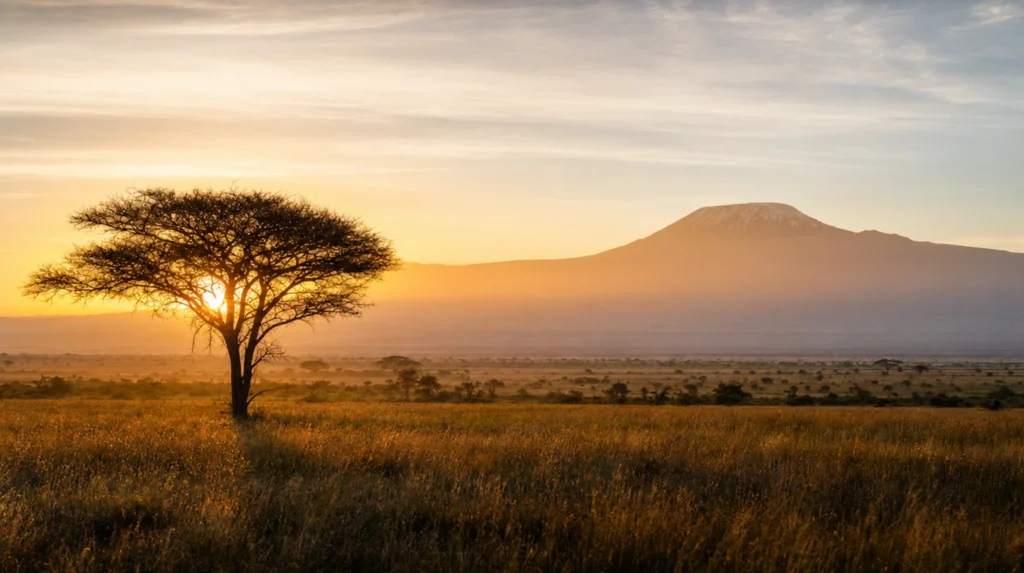
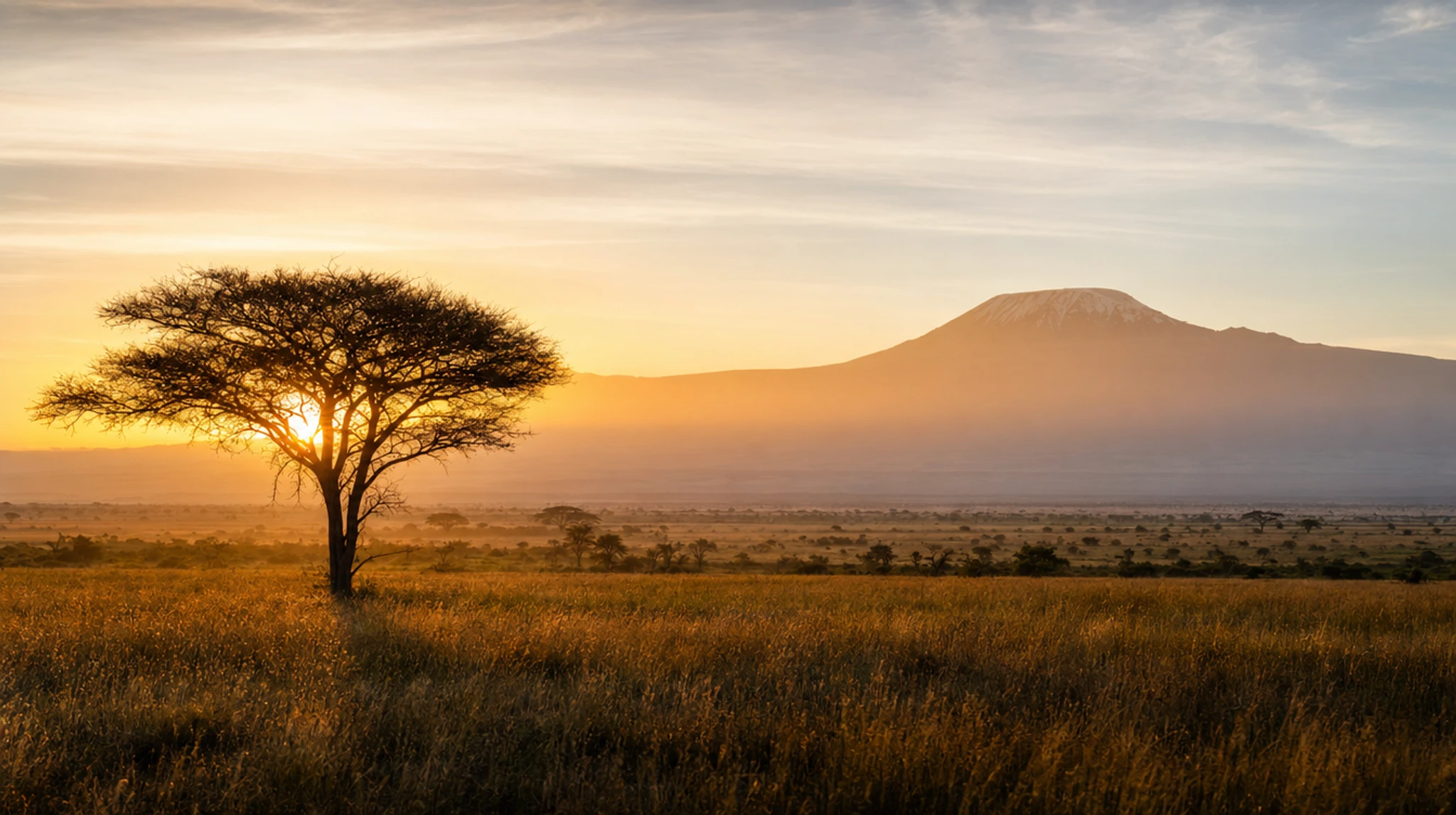
The bucket-list draws deliver. The Great Migration moves 1.5 million wildebeest into the Masai Mara every July through October; Amboseli’s elephants pose against Mount Kilimanjaro’s snows; Diani and Lamu string white-sand beaches along a coral-reef coast; and the Maasai and Samburu cultural visits rank among the most rewarding in Africa. Nyama choma (grilled goat or beef) with ugali and sukuma wiki is the national meal, shared on plastic stools at roadside joints that rival any chef-driven restaurant for memory-making. Karibu Kenya — welcome to Kenya.
🦓 Great Migration 2026 — Masai Mara River Crossings
Every year roughly 1.5 million wildebeest, 300,000 zebra and 500,000 Thomson’s gazelle move in a 2,900 km clockwise loop across the Serengeti-Mara ecosystem, chasing rain-grown grass between Tanzania and Kenya. The herds cross the Sand River into Kenya’s Masai Mara around July, spread across the 1,510 km² reserve and adjoining conservancies through August and September, and drift back south as the short rains arrive in late October. It is the largest overland mammal migration on Earth and the single strongest seasonal pull in African travel.
The visual headline is the Mara River crossing. Nile crocodiles several metres long hold station in deep river bends, and when a column of wildebeest finally commits — often after an hour of massing on the bank — the water churns with drowning and predation. Crossings are concentrated at Lookout Hill, Paradise Plain and the Sand River confluence. Arrive before 7 am and plan on a full-day game drive with a packed breakfast.
- First arrivals (Sand River): early July 2026
- Peak river-crossing window: 15 August – 20 September 2026
- Peak duration: 6–8 weeks in the Kenyan reserve
- Masai Mara National Reserve: 1,510 km² core, Narok County managed
- Mara North / Olare Motorogi / Naboisho: private conservancies with off-road driving and fewer vehicles
- Calving season follow-up: January–February 2027 in southern Serengeti — accessible as a Tanzania add-on
Best Time to Visit Kenya (Season by Season)
Kenya straddles the equator, so the familiar four-season calendar does not apply — temperatures stay broadly stable year-round, and the real driver is rainfall. There are two dry seasons and two wet seasons: the long rains (March–May), the cool dry (June–October), the short rains (November–December) and the hot dry (January–February). Altitude matters as much as the month: Nairobi sits at 1,795 m and is cool year-round, while the coast at sea level stays hot and humid.
Hot Dry (Jan–Feb)
Kenya’s hottest window along the coast (27–32°C in Mombasa) and a clear, sunny period in Nairobi (20–28°C). Big cats concentrate around waterholes in Amboseli, Tsavo and Laikipia; resident game viewing is outstanding and prices sit below peak. Cross-border add-ons to Tanzania land you in the Serengeti’s calving season, when more than 8,000 wildebeest are born every day in February around Ndutu — the ecosystem’s other great spectacle beyond the Mara crossings.
Long Rains (Mar–May)
Heavy afternoon storms sweep the highlands and coast; dirt roads in the Mara, Amboseli and Samburu can close entirely. Temperatures ease to 18–28°C, lodge rates drop 30–50% and the landscape turns a green that photographers dream of. Newborn antelope are everywhere. This is the travel-writer’s secret window but it is not for first-timers: budget weather contingency and build in a coastal backup.
Cool Dry (Jun–Oct)
The classic safari season. Cool, dry highlands (15–27°C in the Mara) thin the vegetation and concentrate wildlife at waterholes, and the Great Migration arrives in the Masai Mara from July through October. Lamu and Diani stay hot and sunny. This is peak pricing and peak bookings — private conservancies and premium camps often sell out 9–12 months ahead. Mount Kenya climbing windows are at their driest in August and September.
Short Rains (Nov–Dec)
Lighter, shorter afternoon storms break the heat; mornings stay clear and game driveable. Temperatures sit at 19–29°C. The Lamu Cultural Festival in late November draws dhow races, donkey races and Swahili poetry competitions to the UNESCO-listed island. Christmas and New Year at Diani book out months ahead; the first two weeks of November are one of the year’s best-value windows.
Shoulder-season tip: Late November and early June sandwich the rains and combine green-season rates with 80% of the dry-season wildlife viewing. Both are underbooked windows at premium camps.
Getting There — Flights & Arrival
Kenya is East Africa’s best-connected country. Nairobi’s Jomo Kenyatta International (JKIA) is the regional hub for Kenya Airways, Ethiopian, Qatar, Emirates, Turkish, KLM and British Airways, and the airport handles the bulk of international arrivals. Mombasa serves direct charters from Europe to the coast, and Eldoret covers the western circuit.
- Jomo Kenyatta International (NBO) — East Africa’s busiest airport; taxis or Uber to Westlands/CBD in 30–45 minutes for roughly KES 1,800–2,500.
- Moi International (MBA) — 20 minutes to Mombasa city centre; 45 minutes via the Likoni ferry (or the 2021 Dongo Kundu bypass) to Diani Beach.
- Eldoret International (EDL) — gateway to the Rift Valley, Mount Elgon and western Kenya; limited international schedule.
Flight times: London to Nairobi is about 8h 30m non-stop with Kenya Airways and British Airways; New York to Nairobi runs approximately 14h 45m non-stop on Kenya Airways’ JFK route; Dubai to Nairobi is 5h on Emirates.
Flag carrier: Kenya Airways (the Pride of Africa) plus domestic operators Jambojet, Safarilink and AirKenya.
Visa / entry: Almost every visitor now requires an Electronic Travel Authorization (eTA) applied for online before departure; the fee is USD $30 and stays are valid up to 90 days.
Getting Around — SGR, Safari Flights & Matatus
Kenya combines three transport modes in a single itinerary. The Standard Gauge Railway (SGR) links Nairobi and Mombasa on a 472 km line opened in 2017. Safari light aircraft — Cessna Caravans flying 45-minute hops to airstrips — are the default way into national parks. And inside cities, matatus (privately-run shared minibuses) do the heavy lifting alongside Uber and Bolt, which run in every major centre.
- Madaraka Express SGR (Nairobi ↔ Mombasa): max speed 120 km/h; journey time about 4h 30m.
- Nairobi → Masai Mara (charter flight): 45 minutes from Wilson Airport to Keekorok, Musiara or Ol Kiombo airstrip.
- Nairobi → Amboseli (road): 240 km / approximately 4h 30m via Namanga Road.
- Mombasa → Diani Beach: 45 minutes via Likoni ferry or Dongo Kundu bypass; 30 km south of the city.
Safari flights: Safarilink and AirKenya operate scheduled hops between Wilson Airport (Nairobi) and park airstrips. A one-way Mara fare typically runs USD $220–320 depending on the airstrip; Samburu USD $240; Amboseli USD $200.
SGR tickets: Economy class Nairobi–Mombasa costs KES 1,500 and first class KES 4,500 one-way, booked online at least 48 hours ahead.
Ride apps: Uber, Bolt and Little operate in Nairobi, Mombasa and Kisumu. Fares within Nairobi run KES 300–700 for most city trips.
Navigation apps: Google Maps is reliable in cities; Maps.me works offline for parks where signal drops.
Top Cities & Regions
📍 Map of Kenya: Every Place in This Guide
🏙️ Nairobi
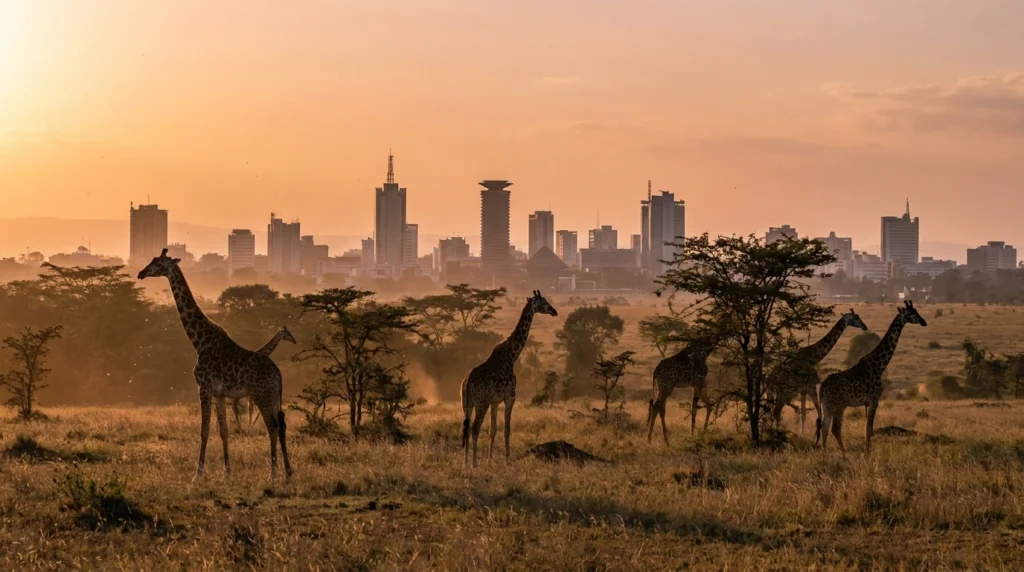
Kenya’s capital is the only world city with a national park inside its boundaries — 117 km² of savannah five minutes’ drive from the CBD, where lions hunt with the downtown skyline on the horizon. The city sits at 1,795 m, runs cool year-round, and has become East Africa’s tech, UN and humanitarian hub. Food centres on nyama choma pits in Kilimani and Westlands, with ugali, sukuma wiki and grilled goat the default order.
- Nairobi National Park game drive with skyline backdrop
- David Sheldrick Wildlife Trust elephant orphanage (11 am public hour)
- Karen Blixen Museum in the author’s original Ngong Hills farmhouse
🏝️ Mombasa
Kenya’s coastal capital is a 900-year-old Swahili trading island where Portuguese, Omani, British and Bantu histories layer on top of each other. The weather is hot and humid year-round, the muezzin calls compete with the harbour tugs, and the Old Town is a maze of coral-stone houses with carved Zanzibar doors. Food leans Swahili: biryani, coconut fish curry, mahamri doughnuts and fresh tamarind juice. Jambo and karibu will be heard fifty times a day.
- Fort Jesus — the Portuguese 1593 star fort, UNESCO-listed since 2011
- Old Town Swahili quarter walking tour
- Nyali and Bamburi beaches north of the island
🦓 Masai Mara
Kenya’s flagship safari reserve is the northern extension of Tanzania’s Serengeti — the same ecosystem under a different name. The Maasai people run most of the surrounding conservancies, and a morning game drive in August delivers sightings other reserves cannot match: cheetah on termite mounds, lion prides at kills, and wildebeest crossings that fill the river for an hour at a time. Book 9–12 months ahead for July–October peak.
- Mara River crossings from mid-July through September
- Big Five game drives — lion, leopard, elephant, buffalo, black rhino
- Maasai cultural village visits with warrior jumping dances and beadwork
🐘 Amboseli
A 392 km² reserve that delivers the most iconic Kilimanjaro views on the continent — elephants drinking from a marsh with the 5,895 m volcano rising across the Tanzanian border. Amboseli’s elephants include some of the last big tuskers in Africa, long-studied by the Amboseli Trust for Elephants. Lion, cheetah and flamingo numbers are high; the park suits two-night safaris combined with a Mara or coastal leg.
- Observation Hill viewpoint over the marshes and Kilimanjaro
- Big tusker elephant herds at Enkongo Narok marsh
- Maasai group-ranch homestays on the park’s edge
🏖️ Diani Beach
Kenya’s premier beach resort strings a long ribbon of white sand south of Mombasa — barefoot luxury hotels, reef-protected swimming, kitesurfing in the June–September monsoon, and a growing digital-nomad scene. The Shimba Hills reserve’s sable antelope and elephants sit a short drive inland, and Kisite-Mpunguti Marine Park offers dhow snorkelling with dolphins. Food is fresh grilled seafood, coconut rice and mahamri.
- Diani reef snorkelling and kitesurfing in the trade-wind months
- Colobus Conservation forest sanctuary with the rare Angolan colobus
- Kisite-Mpunguti Marine Park dhow trips from Shimoni
🦩 Lake Nakuru & Lake Naivasha
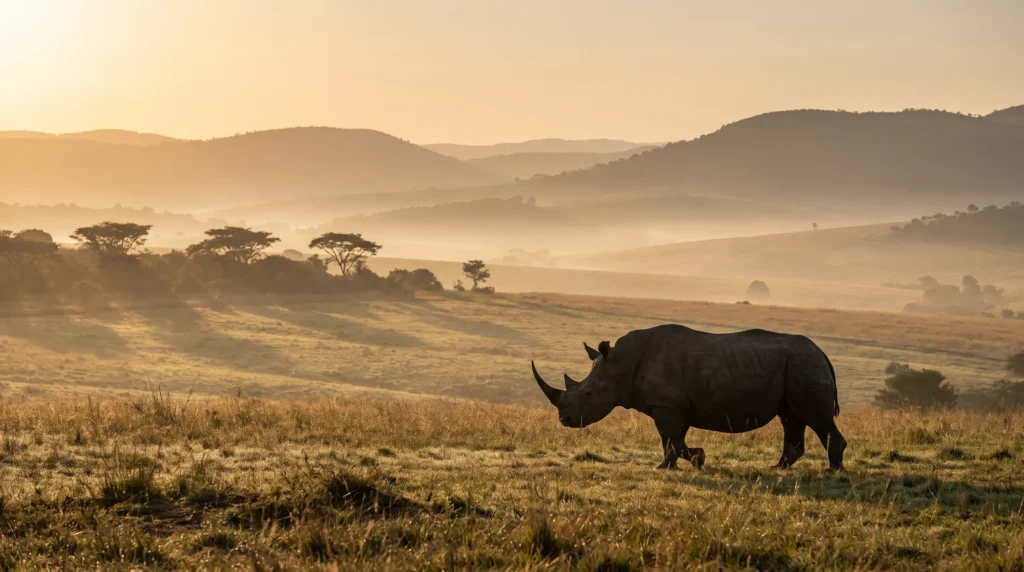
The Rift Valley lake circuit two to three hours northwest of Nairobi delivers a different style of safari — walking, cycling and boat-based game viewing at lower cost than the famous reserves. Lake Nakuru is a fenced rhino sanctuary with flamingos on the alkaline shore; Lake Naivasha is a freshwater hippo lake ringed with lodges; and Hell’s Gate nearby permits cycling and walking among zebra, giraffe and buffalo — a rare African park where you can dismount the vehicle. Food is fresh tilapia from the lakes alongside nyama choma.
- Lake Nakuru National Park white and black rhino sanctuary
- Hell’s Gate National Park cycling and walking safari
- Crescent Island walking safari with hippos, zebra and giraffe
Kenyan Culture & Etiquette — What to Know Before You Go
Kenya’s cultural identity runs along two axes. The highland interior is a Bantu, Nilotic and Cushitic mosaic of more than 40 ethnic communities — Kikuyu, Luhya, Kalenjin, Luo, Kamba and Maasai are the largest — with Christianity dominant and traditional beliefs still widely practised. The coast is Swahili, a 1,200-year Afro-Arab civilisation where Islam, Arabic loanwords and Indian Ocean trade shape daily rhythms. English and Kiswahili are both official languages, and “Sheng” — a Kiswahili-English Nairobi street slang — is the language of urban youth. Visitors will find Jambo and Karibu used endlessly, and the phrase Hakuna Matata (no worries) genuinely is everyday Kiswahili, not just a Disney song.
The Essentials
- Greet with a handshake and eye contact — elders receive a slight head bow. Jambo (hello), Karibu (welcome) and Asante sana (thank you very much) are the three phrases to learn first.
- A 10% tip is standard at restaurants; many bills now include a service charge, in which case an extra 5% is a bonus. Safari ranger/guide tipping runs USD $15–25 per guest per day.
- Dress modestly in Muslim coastal towns (Lamu, Mombasa Old Town) — covered shoulders and knees for both men and women. Resorts and beaches are relaxed.
- Photographing Maasai and Samburu people without asking is deeply rude; a negotiated tip of KES 200–500 or a formal village visit is the proper route.
- Public displays of affection draw attention and, on the coast, disapproval — keep it restrained.
Maasai Village & Safari Etiquette
- Stay inside the vehicle at all times on safari — predators read a standing human as prey.
- Book Maasai cultural visits through your lodge or a conservancy, not at the gate — arranged visits include dances, beadwork workshops and honest conversation; gate-crash visits are often staged tourist traps.
- Remove shoes before entering a manyatta (Maasai homestead).
- Tip rangers, trackers and camp staff in a sealed envelope on the final morning — USD $15–25 per guest per day split between the team is the norm.
A Food Lover’s Guide to Kenya
Kenyan food divides neatly between the highland interior and the Swahili coast. The interior plate is anchored by ugali (stiff maize-meal porridge), sukuma wiki (braised collard greens) and nyama choma (grilled meat), usually goat or beef, eaten with the fingers and with kachumbari tomato-onion relish on the side. The coast adds rice, coconut, tamarind, cardamom and Omani-Indian spice traditions, producing biryani, coconut fish curry, pilau and mahamri (cardamom-spiced doughnuts). Expect to pay KES 500–900 for a casual meal, KES 1,500–3,000 for a Nairobi bistro dinner with a Tusker beer, and KES 6,000+ per person at fine-dining leaders like Cultiva and Talisman.
Must-Try Dishes
| Dish | Description |
|---|---|
| Nyama choma | Kenya’s national social institution — goat, beef or chicken grilled over charcoal and served by the half-kilo with kachumbari relish and a cold Tusker. Ordered by weight at dedicated “choma joints” that double as the national living room. |
| Ugali & sukuma wiki | The everyday Kenyan plate — a dense maize-meal porridge eaten with the fingers, paired with braised sukuma wiki (collard greens with onion and tomato). Sukuma wiki literally means “push the week” — the payday-stretching vegetable. |
| Pilau & biryani (coast) | Swahili spiced-rice dishes inherited from Omani and Indian trade — pilau is a one-pot cardamom, clove and cinnamon rice with beef or chicken; biryani layers the rice and meat separately and is the celebration dish. |
| Coconut fish curry (coast) | Red snapper, kingfish or prawns simmered in coconut milk, tamarind, ginger and green chilli. Usually served with coconut rice and a side of chapati. Watamu and Lamu versions are considered the benchmark. |
| Githeri | Kikuyu staple of boiled maize and kidney beans, upgraded with tomato, onion and avocado into “githeri special” — cheap, filling and the classic matatu-stop lunch in Central Province. |
| Mandazi & mahamri | Triangular fried-dough snacks — mandazi is the inland plain version, mahamri the coastal cardamom-and-coconut-milk version eaten with chai for breakfast. KES 20–40 per piece at any bus-stop kiosk. |
Dukawalla Shops, Nyama Choma Joints & Matatu Stops
Kenya’s food scene runs on three informal networks. Dukawallas — the Gujarati-run corner shops found in every town — stock Cadbury, Weetabix, UHT milk and Kenyan staples; they are where road-trippers reload. Nyama choma joints are cash-and-M-Pesa pits where you pick the meat off a hook, pay by weight (KES 700–1,000/kg for goat), and wait roughly half an hour while it grills. And every matatu stop across the country has a stand selling mandazi, roasted maize, samosas and chai that matches any hipster café for flavour at a fraction of the price. Nairobi’s Kilimani and Westlands neighbourhoods and Mombasa’s Old Town offer the densest sit-down restaurant scenes.
- Chains and shops: Naivas Supermarket, Java House, Artcaffe, ChickenInn, Galitos
- Signature items: Tusker lager, Dawa cocktail (vodka, honey, lime, ginger), Stoney Tangawizi ginger ale, roasted maize (mahindi ya kuchoma), chapati, kachumbari relish, Kenyan AA coffee
- Classic roadside order: mandazi + chai + roasted maize (around KES 100)
Kenyan coffee deserves its own paragraph. The country produces some of the world’s most prized arabica — Kenya AA grade from the volcanic-soil highlands around Nyeri and Kiambu commands premium prices at European and North American specialty roasters. Java House is the domestic chain; boutique roasters like Connect, Point Zero and Artcaffe Roastery anchor Nairobi’s third-wave scene. A flat white runs KES 350–500 in Nairobi and the beans leaving the country at harvest are frequently better than those sold in it.
Off the Beaten Path — Kenya Beyond the Guidebook
Lamu Archipelago
A UNESCO-listed Swahili island town on Kenya’s far north coast where cars are outlawed, donkeys and dhows remain the primary transport, and the coral-stone buildings date to the 14th century. Lamu Old Town is the oldest and best-preserved continuously-inhabited Swahili settlement in East Africa, and the annual Lamu Cultural Festival each November fills the waterfront with dhow races, donkey races, Swahili poetry and henna competitions. Access is a 90-minute flight from Nairobi to Manda Airstrip plus a short dhow crossing.
Samburu National Reserve
North of Mount Kenya in the semi-arid lowlands, Samburu is where the northern specials live — Grevy’s zebra, reticulated giraffe, Somali ostrich, gerenuk and Beisa oryx — species not found in the Mara. The Ewaso Nyiro river cuts through doum-palm forest, elephant herds gather at the river, and the Samburu people (cousins of the Maasai) lead cultural visits with a distinct beadwork and song tradition. Lodge access is a 45-minute flight from Wilson Airport or a 5h drive via Nanyuki.
Hell’s Gate National Park
Ninety minutes northwest of Nairobi on the Rift Valley floor, Hell’s Gate is one of the only African parks that permits walking, cycling and rock climbing among the wildlife. No lions or elephants means you can rent a bicycle at the gate, pedal past zebra, giraffe and eland, and descend into Ol Njorowa Gorge on foot. The park inspired the landscapes of Disney’s The Lion King and Tomb Raider, and the geothermal steam vents were the reference for Pride Rock.
Mount Kenya
Africa’s second-highest peak at 5,199 m sits on the equator with permanent equatorial glaciers on its south-facing flanks. The trekkers’ summit of Point Lenana (4,985 m) is a four-to-five-day non-technical climb via the Sirimon and Chogoria routes; the technical Batian and Nelion peaks require rock climbing. August and January–February are the driest windows. UNESCO World Heritage-listed and often quieter than Kilimanjaro.
Gedi Ruins
Forty-five minutes south of Malindi on the north coast, Gedi is a 12th-century Swahili city-state abandoned around 1600 and now half-reclaimed by the indigenous Arabuko-Sokoke forest. The coral-stone palace, Great Mosque and multi-storey houses sit under 500-year-old baobab trees, and the site remains one of the least-visited significant historical ruins on the African coast. Sykes monkeys and golden-rumped elephant shrews are resident.
Practical Information
The table below collects the answers travellers look up most often. Every row cites an official source. Kenya is a cash-and-M-Pesa economy — card acceptance is widespread in cities but patchy at safari lodges, and carrying a working Safaricom M-Pesa line makes every transaction smoother.
| Currency | Kenyan shilling (KES / KSh); 1 USD ≈ KES 130 (April 2026) |
| Cash needs | Carry small-denomination KES for Maasai village tips, car-park attendants, matatu fares and curio markets. M-Pesa is dominant everywhere else. |
| ATMs | Equity, KCB, Standard Chartered and Absa ATMs widespread in cities and park gateway towns. Withdraw inside bank branches or mall lobbies where possible. |
| Tipping | Restaurants 10% if no service charge; safari guide/ranger USD $15–25 per guest per day; lodge camp staff tip pool USD $10–15 per guest per day. |
| Language | English and Kiswahili are both official; Sheng (slang) in Nairobi. Virtually every tourist-facing worker speaks English. |
| Safety | US State Department Level 2 (Exercise Increased Caution) for Nairobi, the coast and safari circuits; Level 3 (Reconsider Travel) for specific border areas with Somalia and parts of Turkana. |
| Connectivity | Safaricom SIM KES 1,000 for 20 GB; Airalo eSIM from USD $5. 4G covers all national parks and the coast. |
| Power | Type G plugs (three rectangular pins, UK style); 240V / 50Hz. |
| Tap water | Not drinkable anywhere in the country; stick to bottled or filtered. Most lodges provide filtered refill stations. |
| Healthcare | Private hospitals in Nairobi (Aga Khan, Nairobi Hospital, MP Shah) are world class; public system is overstretched. Yellow fever vaccination required on entry from endemic countries; malaria prophylaxis essential outside Nairobi and the highlands. |
Budget Breakdown — What Kenya Actually Costs
💚 Budget Traveller
USD $55–95 (KES 7,000–12,000) per day covers a hostel-and-shared-safari trip. Hostel dorm beds run KES 1,500–2,500 in Nairobi and KES 1,200–2,000 in Mombasa. A shared 3-day budget Mara safari from Nairobi (camping, group vehicle, meals included) costs USD $400–550 per person. SGR economy tickets to Mombasa are KES 1,500, and local food from nyama choma joints, chapati stands and matatu stops keeps daily meals under KES 800. Matatu fares within Nairobi are KES 50–150.
💙 Mid-Range
USD $220–400 (KES 28,000–52,000) per day is a realistic couple’s mid-range budget. A 3★ Nairobi hotel or Westlands apartment runs KES 8,000–15,000 per night; restaurant dinners come in at KES 1,500–3,000 per head with a Tusker; and a shared mid-range safari (4×4 van, full-board lodges) costs USD $350–550 per person per day in the Mara dry season. SGR first class between Nairobi and Mombasa is KES 4,500.
💜 Luxury
From USD $900 (KES 115,000) per day upward, effectively uncapped. Premier Mara conservancy lodges — &Beyond Bateleur, Angama Mara, Cottar’s 1920s, Mara Plains — run USD $1,500–2,800 per guest per night all-inclusive including private 4×4 game drives, all meals and drinks, laundry and airstrip transfers. A private charter from Wilson Airport to the Mara costs USD $3,500–4,500 return per aircraft (4 seats). Fine dining at Cultiva, Inti or Talisman in Nairobi runs KES 6,000–10,000 per person before wine, which adds KES 4,000–8,000 per bottle.
| Tier | Daily (USD) | Accommodation | Food | Transport |
|---|---|---|---|---|
| Budget | $55–95 | Hostel dorm KES 1,500–2,500 | Local joints KES 500–800 | Matatus + SGR economy |
| Mid-Range | $220–400 | 3★ hotel KES 8,000–15,000 | Bistro mains KES 1,500–3,000 | Shared safari USD $350–550/day |
| Luxury | $900+ | Conservancy lodge USD $1,500–2,800 | Fine dining KES 6,000–10,000 | Charter flight / private 4×4 |
Planning Your First Trip to Kenya
First trips to Kenya stumble in predictable ways — travellers underestimate how far the Mara is from Nairobi by road, skip yellow fever certificates that customs then demand, or miss the eTA and lose a day at the airport. Work through the five steps below in order and the planning clicks into place.
- Apply for the eTA online at least 3 days before departure — USD $30 fee, 90-day stay. Keep a PDF on your phone.
- Book flights into JKIA and lodges 6–12 months ahead for the July–October migration peak. Private conservancies fill 9–12 months out.
- Visit a travel clinic 4–8 weeks before departure — yellow fever vaccination required on arrival from endemic countries and malaria prophylaxis essential outside Nairobi.
- Decide safari style: shared van with a group versus private 4×4 Land Cruiser with dedicated guide. Shared saves 40–60% but gives up off-road flexibility.
- Register M-Pesa on arrival with a Safaricom SIM — the country’s default payment rail.
Classic 12-Day Itinerary: 1 day Nairobi arrival → 3 days Masai Mara (including river crossings if July–October) → 2 days Lake Nakuru / Naivasha → 2 days Amboseli (Kilimanjaro views) → 3 days Diani Beach coast → 1 day Nairobi departure.
Cities & Regions to Explore
Frequently Asked Questions
Is Kenya expensive to visit?
It is a two-speed country. Everyday travel — food, SGR, matatus, domestic flights and 3★ hotels — is cheap by Western standards; a backpacker can live well on KES 7,000–12,000 (USD $55–95) per day. What drives Kenya budgets sharply upward is the safari: premium Mara conservancy lodges run USD $1,500–2,800 per guest per night. Build the itinerary around how many lodge nights you want, and the rest costs what it costs.
Do I need to speak Swahili?
No — English is an official language alongside Kiswahili and is spoken fluently by nearly every tourist-facing worker, guide and hotel staff member. Learning a few Kiswahili phrases earns enormous goodwill: Jambo (hello), Karibu (welcome), Asante sana (thank you very much), Hakuna matata (no problem), Pole pole (slowly, slowly — the safari-pace mantra).
Is the SGR Madaraka Express worth it?
Yes, if you are travelling between Nairobi and Mombasa. Economy at KES 1,500 and first class at KES 4,500 are superb value; the 4h 30m journey beats the bus and rivals flying once airport time is counted. Book 48 hours ahead. It does not serve safari parks.
Is Kenya safe for solo travellers?
It is more nuanced than most destinations. The US State Department rates Kenya Level 2 — Exercise Increased Caution — for Nairobi, the coast and safari circuits, with Level 3 applied to specific border areas near Somalia and parts of Turkana. Stick to the tourist circuit (Nairobi, Mara, Amboseli, Nakuru, Diani, Lamu), use Uber after dark, and solo travel is comfortable and widely practised.
When is the Great Migration?
Wildebeest arrive in the Masai Mara from Tanzania’s Serengeti in early July, peak river-crossing action runs from mid-August to mid-September, and the herds drift back south in late October. Book lodges 9–12 months ahead for the peak window.
Can I get by as a vegetarian or vegan?
Yes, easily in Nairobi and Mombasa thanks to Kenya’s large Gujarati Indian community — expect excellent dosas, thalis and Gujarati snacks at spots like Chowpaty and Diamond Plaza. Safari lodges now all offer dedicated vegetarian and vegan menus with a day’s notice. Rural joints skew meat-heavy but ugali, sukuma wiki, githeri and chapati keep you fed anywhere.
Is malaria prophylaxis really needed?
Yes, for every destination below 1,800 m altitude — including the Masai Mara, Amboseli, Tsavo, coast and Lamu. Nairobi and the central highlands are effectively malaria-free. Atovaquone/proguanil or doxycycline are the common regimens; consult a travel clinic 4–8 weeks before departure.
Ready to Explore Kenya?
From the Mara’s river crossings to Amboseli’s Kilimanjaro elephants and Lamu’s car-free Swahili alleys, Kenya delivers more variety per fortnight than almost any country in Africa. Plan around the dry and wet seasons, apply for the eTA early, pack malaria prophylaxis, and leave room for the one extra night at a beach hotel you did not see coming. Karibu Kenya.
Explore More
Cities we cover in Kenya
Cities to explore in Kenya
Deep-dive guides to specific cities, neighbourhoods, and food scenes — written with the same magazine voice.
More country guides you might like
Plan your trip to Kenya
The booking tools we use ourselves. FFU may earn a commission at no extra cost to you.
Plan & book your trip to Kenya
Booking through these searches supports our guides at no extra cost to you.