
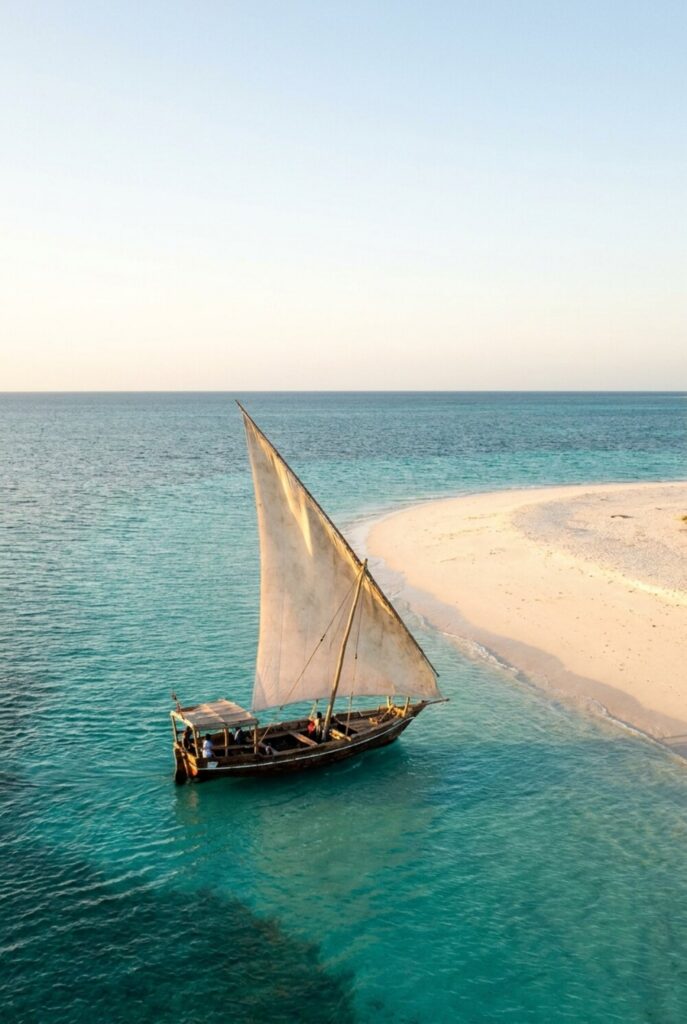
Zanzibar, Tanzania: Spice Islands, Stone Town & Indian Ocean Reefs
Part of our Tanzania travel guide.
Zanzibar Destination Guide
Table of Contents
Why Zanzibar?
Zanzibar is the place where a thousand years of Indian Ocean trade winds still steer daily life. The archipelago sits 40 kilometres off the Tanzanian mainland in a monsoon corridor that connected Arabia, Gujarat, Persia and the Swahili coast centuries before Europeans arrived, and its headline island — Unguja, which foreigners just call Zanzibar — grew rich on cloves, slaves and spice. Stone Town, the old Omani-era capital, was inscribed on the UNESCO World Heritage List in 2000 for the cultural fusion of African, Arab, Indian and European influences that you can still read on every carved Zanzibari door. Travellers arrive for the postcard beaches; they usually leave talking about the mosques and the markets.
The scale surprises people. Around 1.9 million people live across the archipelago as of a 2024 projection, with roughly 1.3 million on Unguja and 600,000 on Pemba, making Zanzibar substantially more populous than Iceland or Malta. Politically it’s semi-autonomous: the archipelago has its own president, parliament and immigration desk inside the United Republic of Tanzania, which means even travellers arriving from Dar es Salaam get a separate Zanzibar entry stamp stapled into their passport. The nickname “Spice Islands” is not a tourist-board invention — 19th-century Zanzibar supplied roughly three-quarters of the world’s cloves, and spice plantations around Bububu still produce cloves, nutmeg, cinnamon and cardamom on century-old trees.
The contradictions are what make the trip. A single short day can take you from the narrow coral-stone alleys of the UNESCO old town to a kitesurf lagoon at Paje, past the endemic red colobus monkeys of Jozani Forest and back for grilled octopus at the Forodhani Gardens night market. The waters off Mnemba Atoll hold more than 300 reef-fish species; the ferry to Pemba takes six hours and drops you on an island almost untouched by resort scale. This guide walks through nine regions — from Stone Town out through Nungwi, Kendwa, Paje, Jambiani, Matemwe, Kiwengwa, Pemba and Mnemba — more than a dozen restaurants and food experiences, five day-trip options that pair with any itinerary, and the practical rules — separate Zanzibar immigration, Ramadan-month logistics, yellow-fever requirements from Kenya arrivals, alcohol-and-dress-code expectations outside resorts — that decide whether you leave smitten or sunburnt and over-charged. Stone Town at sunset, a Mnemba snorkel, and one beach base on either the east or north coast are the three non-negotiables of a first visit.
Neighborhoods & Regions of Zanzibar: Finding Your Island
📍 Zanzibar Map: Every Place in This Guide
Zanzibar is an archipelago, not a single city, and the single most consequential planning decision you will make is which stretch of coast you base yourself on. The main island, Unguja, is roughly 85 kilometres long and 40 kilometres wide; getting from Stone Town on the west coast to Jambiani on the south-east takes about an hour and a quarter by taxi on the paved Dole–Paje road. Beyond Unguja, Pemba Island sits 50 kilometres north and runs to a completely different rhythm, while Mnemba Atoll off the north-east is a marine-protected pinhead you visit for a morning and remember for years. Nine regions matter for travellers, each pitched at a different kind of trip — history-first, beach-first, kite-first, dive-first, or party-first — and which one you pick decides nearly every other detail of your week.
Stone Town (Mji Mkongwe)
The old Omani-era capital on the west coast is the archipelago’s cultural core and the only region of Zanzibar that feels like a city rather than a beach. Its labyrinth of coral-stone lanes, carved Zanzibari doors, former sultan’s palaces and balconied Indian merchant houses was inscribed by UNESCO in 2000 for the layered Swahili-Arab-Indian-European cultural fusion that shaped the Indian Ocean world. Nothing here runs in a straight line; the best approach is to pick a landmark — the House of Wonders, the Old Fort, the Anglican Cathedral — and wander between them, ducking into side alleys when the shade looks cooler. Expect five daily calls to prayer from more than fifty mosques, scooters negotiating corners you would swear are too narrow, and shopkeepers who will remember your face three days later. Forodhani Gardens on the waterfront transforms from a shade-lawn by day into the island’s biggest open-air food market at dusk, with a hundred charcoal grills firing up between 18:00 and 22:00.
- Forodhani Gardens night market — grilled seafood, Zanzibar pizza, urojo soup
- House of Wonders (Beit-al-Ajaib) — Sultan Barghash’s 1883 palace, partially collapsed 2020, under restoration
- Old Fort (Ngome Kongwe) — late-17th-century Omani fortress, now an arts centre and ZIFF main venue
- Anglican Cathedral and former slave-market site — UNESCO Slave Route memorial since 1998
- Darajani Bazaar — the city’s daily fish, spice and produce market
Best for: first-time visitors who want history, architecture and the archipelago’s deepest food scene. Access: 20-minute taxi from Abeid Amani Karume International Airport (ZNZ); Azam Marine ferries from Dar es Salaam dock at the Malindi port, a 10-minute walk from Forodhani Gardens.
Nungwi
At the very northern tip of Unguja, Nungwi is the island’s original dhow-building village and its most developed resort strip. Its geographic trump card is the reef line: while most of the east and south coasts drop dramatically at low tide and leave a long walk across exposed sand, Nungwi stays swimmable on both tides, which is why it draws travellers who want beach time that actually includes the water. The catch is crowd density — this is where cruise-ship day-trippers go, where the beach is wall-to-wall sun-loungers in peak season, and where hawkers work the sand with carved wooden giraffes. Sunset here is the island’s best; the beach faces west without obstruction, and a steady parade of wooden dhows slides across the orange horizon. The old village core, set back one street from the beach, still has dhow carpenters working under tamarind trees and is worth an hour of wandering before dinner.
- Nungwi Beach — consistent-swimming sand on both tides
- Mnarani Aquarium turtle conservation centre — small-scale green-turtle rescue
- Baraka Natural Aquarium — tidal pool with rehabilitated sea turtles
- Dhow-building yards — active traditional boatyards on the village edge
- The Z Hotel, Essque Zalu and Riu Palace Zanzibar — the main resort anchors
Best for: beach-first travellers who want reliable swimming water and easy sunset access. Access: 60–75 minutes by taxi or shared minibus from ZNZ / Stone Town along the main B101 road.
Kendwa
Fifteen minutes’ walk south of Nungwi around a rocky headland, Kendwa is the quieter cove with longer uninterrupted sand and softer resort scale. Like Nungwi, it stays swimmable at low tide — a function of the reef geometry on the island’s north-west corner — but it’s noticeably less frantic, and most of its accommodation clusters in the mid-range rather than all-inclusive category. Kendwa Rocks, the oldest resort-bar on the beach, runs the island’s headline monthly Full Moon Party (tickets around 30,000 TSh, ~12 USD ), which draws a regional crowd that often outnumbers the local population for the night. For travellers who want nightlife within walking distance of their pillow but not resort-strip intensity the rest of the week, Kendwa is the compromise. The walk back from Nungwi at low tide is one of Zanzibar’s simple pleasures; at high tide you pay 3,000–5,000 TSh for a taxi or skirt the headland in flip-flops.
- Kendwa Beach — wide swimmable sand on both tides
- Kendwa Rocks Full Moon Party — monthly island-wide event
- Sunset Bungalows and Gold Zanzibar Beach House — boutique anchors
- Z Hotel Tide-Free Bay (just north, technically shared with Nungwi)
- Kendwa village — small fishing settlement inland from the resorts
Best for: travellers who want swimmable water plus nightlife within walking distance. Access: 65–80 minutes by taxi from ZNZ; daladala minibuses terminate in Nungwi with a short taxi or 20-minute beach walk south.
Paje
On the island’s east coast, two-thirds of the way down, Paje is the archipelago’s kitesurf capital — a long, shallow lagoon sheltered by an outer reef and scoured by the cross-onshore trade winds that blow roughly 250 days a year. The kusi (southeast trades, Jun–Sep) and kaskazi (northeast trades, Dec–Feb) deliver the two kite seasons; on any given afternoon in high kite season you will see 60–80 kites up off the beach at once. The village has evolved around this — there are more smoothie bowls and Ashtanga studios per square metre than anywhere else in East Africa — but it’s still a Swahili village at heart, with fishermen pulling outrigger ngalawas onto the sand at dawn and seaweed farmers working the reef flat at low tide. Paje is also the launch point for The Rock, the photograph-your-lunch restaurant perched on a boulder off Michanwi Pingwe 10 minutes south. The lagoon is tidal: low tide exposes hundreds of metres of sand that become impassable to swim across, which is why almost every hotel has a pool.
- Paje Beach — world-class flat-water kitesurf lagoon
- Kite Centre Zanzibar, Paje by Kite and Aquaholics schools
- Aya Beach Club — the beach’s main lunch-and-cocktails venue
- Mr. Kahawa café — the coffee/co-working anchor for Paje’s nomad scene
- The Rock restaurant (10-minute drive south to Michanwi Pingwe)
Best for: kitesurfers, digital nomads and travellers who want the east-coast trade-wind lifestyle. Access: 45–60 minutes by taxi from ZNZ via the central Dole junction; daladala Route 309 from Darajani in Stone Town runs frequently.
Jambiani
Immediately south of Paje, Jambiani stretches for nearly seven kilometres along the same east-coast reef lagoon but runs to a completely different beat. There are no kite schools, no full-moon parties and no mega-resorts — the village is still organised around fishing and seaweed farming, and most accommodation sits in low-rise boutique guesthouses owned by long-term European and Tanzanian residents. Seaweed farming is the region’s cultural signature: every low tide, several hundred women walk out onto the reef flat to tend lines of Kappaphycus algae that get dried and exported for carrageenan production. The Jambiani Seaweed Centre, run as a women’s cooperative, turns the same algae into soaps, face creams and lip balms that fund village schooling. For travellers who want the east-coast lagoon but not the Paje kite-scene intensity, Jambiani is the alternative, and it’s also the closest base for dolphin-watching out of Kizimkazi at the island’s southern tip.
- Jambiani Beach — long village beach with seaweed farming at low tide
- Jambiani Seaweed Centre — women’s cooperative soap and cosmetics workshop
- Kizimkazi dolphin-watching harbour (20-minute drive south)
- Blue Oyster Hotel and Hakuna Majiwe Lodge — the long-standing boutique anchors
- Village mosque and fisher’s market — Saturday fresh catch
Best for: travellers who want a lower-key beach village with living Swahili culture. Access: 55–70 minutes by taxi from ZNZ via Paje; daladala Route 309 continues south from Paje junction.
Matemwe
On the north-east coast directly opposite Mnemba Atoll, Matemwe is Zanzibar’s snorkel-and-dive base rather than a swim-and-party beach. The reef sits close to shore — within 200 metres at low tide — which is what makes Mnemba’s coral walls reachable in a 15-minute dhow transfer, but it also means the in-front-of-your-hotel swimming experience is about wading over reef flats rather than jumping in. Most travellers who choose Matemwe do so because they want the Mnemba snorkel without the Nungwi crowd-intensity, and because dive operators here run some of the more respected Padi shops on the island. The village itself stretches several kilometres along a single road; hotels are spread thin, and walking between two of them can take 20 minutes on loose sand. Sunrise here is memorable — east-facing, without land between you and the open Indian Ocean.
- Matemwe Beach — reef-fringed snorkel launch point
- Mnemba Atoll dhow and dive transfers
- Zanzibar Retreat Hotel and Sunshine Marine Lodge
- Kichanga Lodge and Asili Boutique Beach Resort
- Matemwe fishing village — dhow beach landing and morning fish market
Best for: snorkelers and divers who want Mnemba access without Nungwi crowds. Access: 60–75 minutes by taxi from ZNZ via the central road.
Kiwengwa
South of Matemwe and north of Pongwe, Kiwengwa is the east coast’s all-inclusive resort belt — a wide, long beach dominated by Italian-, Spanish- and Chinese-owned package hotels. The beach here is genuinely striking, among the widest on the island at low tide, and it’s one of the few east-coast stretches where high tide puts deep water close to shore so the swim-in-front-of-your-hotel promise actually holds. The trade-off is cultural immersion — most Kiwengwa resorts run as closed compounds with in-house restaurants, spas and tour desks, and village life largely happens out of view behind the hotels. The Kiwengwa-Pongwe Forest Reserve just inland protects a small patch of coastal forest and the last remaining bats’ caves on the east coast and can be visited on a 2–3-hour half-day tour out of the resorts.
- Kiwengwa Beach — wide, swimmable-at-high-tide east-coast sand
- Kiwengwa-Pongwe Forest Reserve — protected coastal forest and bat caves
- Shooting Star Lodge and Pongwe Beach Hotel — boutique mid-range alternatives
- Bluebay Beach Resort, TUI Blue Bahari and Diamonds Mapenzi — main all-inclusive anchors
- Uroa village — quieter fishing community 15 minutes south
Best for: all-inclusive travellers who want a swimmable beach with full resort infrastructure. Access: 55–70 minutes by taxi from ZNZ via the central Dole junction.
Pemba Island
Fifty kilometres north of Unguja across the Pemba Channel, Pemba is the archipelago’s lesser-known sister island and a totally different proposition. It’s hillier, greener, far less developed for tourism, and accounts for the bulk of the clove production that gave Zanzibar its Spice Islands nickname. The island has one major airstrip near Chake Chake, three small towns — Chake Chake, Wete and Mkoani — and almost no resort scale outside the Manta Resort in the north (famous for its 4-metre-underwater room). Divers come here for wall-diving that rivals anywhere in the Indian Ocean; the channel between Pemba and Misali Island drops sharply into cold, pelagic-rich water, and visibility regularly exceeds 30 metres in shoulder season. Adding Pemba to a Unguja trip adds at least three nights and a 30-minute flight or 6-hour ferry from Stone Town, but for travellers willing to slow down it’s the Zanzibar that existed before the beach-resort era.
- Ngezi Forest Reserve — rainforest-fringe with Pemba flying foxes
- Misali Island Marine Conservation Area — snorkel and nesting-turtle reserve
- Chake Chake town — 18th-century Omani fort and main airstrip
- Kigomasha lighthouse and Vumawimbi Beach on the north-west peninsula
- Manta Resort — includes the famous three-storey underwater bedroom suite
Best for: divers, clove-farm visitors and travellers who want Zanzibar without tourism scale. Access: 30-minute flight from ZNZ (ZanAir, Auric Air) or ~6-hour Azam Marine ferry from Stone Town.
Mnemba Atoll
Off Unguja’s north-east corner, Mnemba is a coral atoll surrounded by a ring of protected reef. The island itself is a single private-lease concession — andBeyond Mnemba Island Lodge, one of East Africa’s most expensive lodgings — and isn’t open to non-guests. Everyone else comes for the snorkel zone, a 20-minute dhow transfer from Matemwe that delivers you onto coral walls holding 300-plus reef-fish species, resident bottlenose and spinner dolphins, and frequent green-turtle sightings. Zanzibar’s most photographed marine site, worth the half-day; book through your hotel or a licensed Matemwe operator rather than Stone Town touts. Conservation fees are 33 USD per adult, collected at the boat.
- Mnemba Atoll snorkel drop-off — the main coral-wall site
- andBeyond Mnemba Island Lodge (private island, no public landing)
- Dolphin channel — pods between the atoll and Matemwe
- Outer coral wall dive site — 20-metre drop-off
- Matemwe launch beach — public boat pickup point
Best for: day-trip snorkelers from Matemwe/Nungwi and honeymooners at the single private lodge. Access: boat only — 15-minute dhow transfer from Matemwe; no public landing on the island itself.
The Food
Zanzibar eats as a crossroads. Every major trading culture that passed through the Indian Ocean monsoon corridor left something in the pot, and the result is a cuisine that belongs to no single ancestor: coconut-milk curries inherited from the Swahili coast, pilau and biryani brought by Omani and Gujarati merchants, samosas and chapatis from Indian dockworkers, Portuguese-era cassava and chilli, and a purely local night-market invention called Zanzibar pizza that exists in exactly one place on earth. The two food poles of the archipelago are the Forodhani Gardens night market in Stone Town — the densest street-food cluster in East Africa — and the coconut-fish-curry kitchens scattered across the coastal villages. Prices are dramatically lower than resort restaurants: a full plate of octopus curry at a Stone Town lunch spot runs 18,000–25,000 TSh (roughly 7–10 USD), against 40,000–60,000 TSh for the same dish inside a north-coast all-inclusive. What ties the whole food culture together is the Swahili-coast principle of the shared plate — a pile of pilau rice with a communal bowl of coconut fish curry that you share with whoever is next to you — and the near-universal use of locally grown spices: cloves, nutmeg, cinnamon, cardamom and black pepper from the Bububu plantations 10 km north of Stone Town.
Swahili Seafood (Coconut Curries & Grilled Catch)
The foundation of Zanzibar cooking is fresh-landed seafood cooked in coconut milk, often with tamarind, ginger, turmeric and locally grown bird’s-eye chilli. Kingfish (nguru), snapper (changu), tuna (jodari) and octopus (pweza) appear most often, grilled whole over coconut husks or simmered in samaki wa nazi coconut curry. Every decent Stone Town lunch spot has a version on the board; at the beach villages, many small hotels will cook whatever came in on the morning dhow. The best in-town spots are long-running institutions rather than trendy openings, and the pricing discipline is old-school Swahili — you pay roughly 15,000–30,000 TSh for a full plate (about 6–12 USD at the April 2026 exchange rate of 2,550 TSh per USD), and portion sizes are serious. Lukmaan, open since the 1980s, anchors the category on the Mkunazini side of Stone Town; Passing Show has operated continuously since 1952 and serves a different biryani each day of the week; Al-Maghrib is the quiet Stone Town favourite for octopus in coconut.
- Lukmaan Restaurant — whole grilled kingfish (nguru) with coconut rice, 18,000 TSh, ~7 USD
- Al-Maghrib Restaurant — octopus coconut curry (pweza wa nazi), 22,000 TSh, ~9 USD
- Passing Show Hotel Restaurant — biryani of the day, 12,000 TSh, ~5 USD
- Forodhani Gardens grills — mixed seafood skewer plate, 15,000–20,000 TSh, ~6–8 USD
- Emerson on Hurumzi Tea House — five-course Swahili set menu, 75,000 TSh, ~30 USD
- The House of Spices — tamarind-and-coconut prawn curry with coconut rice, 35,000 TSh, ~14 USD
- Beit el Chai (Stone Town) — rooftop Swahili grilled fish plate, 30,000 TSh, ~12 USD
Zanzibar Pizza & Forodhani Night Market
Forodhani Gardens is a waterfront park by day and the single most important food event in Zanzibar between roughly 18:00 and 22:30. About 100 numbered charcoal stalls roll in each evening and fire up grills for seafood skewers (pweza, octopus; jodari, tuna; kamba, prawns), sugar-cane juice pressed on the spot with lime and ginger, urojo “Zanzibar mix” soup, and the night market’s signature invention, Zanzibar pizza. This is not Italian pizza — it’s a thin wheat dough, stretched translucent, wrapped around a filling of minced meat, egg, onion, chilli mayonnaise and (optionally) shredded cheese and banana, then pan-fried flat on a griddle until the outside crisps and the egg sets. It was invented for Zanzibari dockworkers in the 1970s and has never left the archipelago. Prices at Forodhani are fixed and posted at each stall’s signboard; travellers get over-charged only if they fail to ask before ordering and end up disputing the bill at the end. Arrive hungry, walk the full stall line before committing, and try at least three different vendors in one visit — this is one of the few places on earth where you can eat six small plates for 20 USD and leave without spending more.
- Zanzibar pizza (savoury) — meat, egg, veg, mayo-chilli, 5,000–8,000 TSh, ~2–3 USD
- Zanzibar pizza (sweet) — banana, Nutella, honey, 5,000–7,000 TSh, ~2–3 USD
- Urojo (“Zanzibar mix”) — mango-turmeric soup with bhajia, cassava, potato, chilli, 3,000–5,000 TSh, ~1.20–2 USD
- Grilled seafood skewer plate — mixed catch with naan and salad, 15,000–20,000 TSh, ~6–8 USD
- Fresh sugar-cane juice — pressed to order with lime and ginger, 2,000 TSh, ~0.80 USD
- Grilled lobster tail — seasonal, when available, 30,000–45,000 TSh, ~12–18 USD
Beyond Seafood and Pizza
The archipelago’s Indian and Omani heritage gives Zanzibar one of East Africa’s deepest vegetarian streets, and its spice-trade history is literally still growing on the plantations around Bububu. Beyond the headline dishes, look for mandazi breakfast doughnuts, Zanzibar mix at any Stone Town street corner, pilau rice for lunch, and the date-and-cardamom halwa sold at the waterfront for dessert. Many older Stone Town restaurants also still serve full Omani mutton-on-rice feast dishes that rarely show up on the resort buffets — particularly around Eid al-Fitr and Eid al-Adha, when kitchen schedules stretch and extended family dishes come out. The best Indian-Zanzibari food sits near the Darajani bazaar rather than on the resort strip; Zanzibar Coffee House does proper chai and samosas all day, and Stone Town Café does the heavy Gujarati vegetable thali that Stone Town’s older Indian families still eat for Sunday lunch.
- Mandazi — cardamom-scented fried dough triangles, Stone Town breakfast carts, 500–1,000 TSh, ~0.20–0.40 USD
- Pilau — Swahili spiced rice pilaf with cardamom, cumin and cloves, 8,000–15,000 TSh, ~3–6 USD
- Biryani — layered rice-and-meat reflecting the islands’ Gujarati trade history, 10,000–18,000 TSh, ~4–7 USD
- Chapati and sukuma wiki — flatbread with braised collard greens, 4,000–7,000 TSh, ~1.60–2.80 USD
- Halwa — sticky date-cardamom-saffron paste-sweet, sold by weight at Darajani, 1,500 TSh per 100 g, ~0.60 USD
- Samosas and bhajia — Zanzibar Coffee House or street-corner carts, 1,500–3,000 TSh each, ~0.60–1.20 USD
- Madafu (green coconut water) — cut to order on the beach for the actual fruit, 2,000–3,000 TSh, ~0.80–1.20 USD
Food Experiences You Can’t Miss
Five food experiences are essentially non-negotiable on a first visit — each one takes between a couple of hours and half a day, and each one delivers something you cannot easily replicate elsewhere in East Africa. The cooking classes and spice tours both deepen what you’ll later taste at dinner, and the Rock restaurant lunch is one of the most-photographed meals on the entire Indian Ocean coast.
- Forodhani Gardens at dusk — arrive by 18:00, walk the full stall line before ordering, eat standing up; 25,000–35,000 TSh for a full meal, ~10–14 USD. Tuesday and Friday are usually the busiest and have the widest stall selection.
- Spice Tour at Bububu — half-day plantation tour through the island’s last working clove, nutmeg, cinnamon, cardamom and lemongrass estates 10 km north of Stone Town, usually ending in a Swahili lunch; 30,000–50,000 TSh per person, ~12–20 USD. Tour organisers are everywhere in Stone Town; ask for one that uses a small Bububu-village guide, not a resort operator.
- Swahili cooking class in a Stone Town family home — typically three hours at the market plus kitchen time, ending in a shared lunch of pilau, coconut fish curry and chapati. Good operators (Lukmaan, The Swahili House, Emerson on Hurumzi) run classes for 50,000–80,000 TSh per person, ~20–30 USD.
- The Rock restaurant lunch (Michanwi Pingwe, 10 minutes south of Paje) — the photograph-your-lunch restaurant perched on a boulder in the lagoon, reached by wading at low tide and rowboat at high tide; main courses 45,000–70,000 TSh, ~18–28 USD.
- Emerson on Hurumzi rooftop tea — the Stone Town institution’s five-course Swahili set menu with live taarab music on the highest accessible rooftop in the old town; 75,000 TSh, ~30 USD, booking essential.
- Darajani market morning tour — the spice, fish and produce market at dawn, best done with a local guide for 15,000–25,000 TSh plus tip, ~6–10 USD.
Coffee, Chai & Zanzibar Cafe Culture
Zanzibar is one of East Africa’s oldest coffee-trading hubs — beans from the Ethiopian and Yemeni highlands moved through Stone Town’s port for four centuries, and the island’s cafe culture still reflects both ends of that inheritance. Spiced chai, infused with cardamom, cinnamon and ginger, is the default hot drink at breakfast, and small cups of strong black Arabic-style coffee (kahawa) are served from brass dallah pots by wandering sellers on Stone Town’s main squares and outside mosques after morning prayers. For sit-down coffee, Zanzibar Coffee House on Mkunazini Street, Lukmaan’s adjacent coffee shop, and the Emerson on Hurumzi morning terrace are the three anchors of Stone Town’s modern cafe scene; over at Paje, Mr. Kahawa’s open-fronted wooden deck anchors the east-coast nomad-and-kite crowd. Expect 4,000–8,000 TSh (~1.60–3 USD) for a chai-and-mandazi breakfast at a local spot, 8,000–15,000 TSh (~3–6 USD) at a tourist-facing café.
- Zanzibar Coffee House — spiced chai, Swahili coffee, mandazi, samosas, 6,000–10,000 TSh, ~2.40–4 USD
- Stone Town Café — Indian-Zanzibari breakfast thali with masala chai, 12,000 TSh, ~5 USD
- Lukmaan Coffee Shop — post-lunch kahawa and halwa, 3,000–5,000 TSh, ~1.20–2 USD
- Mr. Kahawa (Paje) — Paje nomad flat-white anchor, 6,000–9,000 TSh, ~2.40–3.60 USD
- Emerson on Hurumzi breakfast terrace — Swahili spiced chai, fresh fruit, 25,000 TSh, ~10 USD
Ramadan Iftar Culture at Forodhani
During Ramadan 2026 (17 Feb – 19 Mar ), Forodhani Gardens transforms into something bigger and more communal than the rest of the year. From around 18:30 each evening, Zanzibari families gather on the lawn for iftar — the sunset fast-breaking meal — and the food-stall programme expands significantly to accommodate the Ramadan crowd. Expect extended family tables, more sweets (date-stuffed samboosa, rosewater-soaked halwa, coconut-milk puddings), and free glasses of fresh juice handed around as the call to prayer rings out from the House of Wonders side of the waterfront. Travellers are warmly welcomed — the gesture is pure hospitality — but the expectation is that visitors reciprocate by observing the earlier daytime fast at least inside Stone Town itself.
Cultural Sights
Stone Town UNESCO Old Quarter
Stone Town itself is the headline cultural sight — the whole old quarter was inscribed on the UNESCO World Heritage List in 2000 as an outstanding example of the Swahili coast trading town, with its fusion of African, Arab, Indian and European cultural influences. The heritage protected area covers roughly 96 hectares of coral-stone townhouses, at least 48 surviving mosques, six cathedrals and temples, and more than 560 catalogued carved Zanzibari doors. Walking it is free; the best approach is an early-morning loop starting from Forodhani Gardens, threading through Kenyatta Road and Hurumzi district, and ending at Darajani Market before the heat peaks around 11:30. Many small house-museums and former palaces charge separate entry fees between 5,000 and 15,000 TSh (~2–6 USD ) each; two or three on a single loop is plenty. The Zanzibar Tourism Commission publishes a free Stone Town walking-route map that most Stone Town boutique hotels hand out at check-in.
House of Wonders (Beit-al-Ajaib)
Sultan Barghash bin Said built this four-storey palace in 1883 as the first building in East Africa with electricity, piped water and a mechanical elevator — hence the name. Part of the main tower collapsed on Christmas Day 2020, and the building has been under UNESCO-led restoration since then, with a target reopening late 2026 as a fully renovated museum of Zanzibari heritage. Admission when reopened is expected at around 10,000 TSh, ~4 USD. Best viewed from the Forodhani Gardens side, with its cast-iron verandahs and 50-metre clock tower visible from most of the waterfront; the huge carved teak doors at ground level are among the largest in the old town.
Old Fort (Ngome Kongwe)
Built by the Omanis in 1698 on the foundation of a Portuguese chapel they destroyed in the expulsion of the Portuguese from the East African coast, this is Stone Town’s oldest surviving building and the single point that anchors the north end of Forodhani Gardens. Entry is free to the courtyard, where the main ZIFF film-festival venue and a small craft market operate year-round. A small open-air amphitheatre inside the fort hosts live taarab and Sauti za Busara concerts in February, and ZIFF’s main outdoor screen takes over the same space every July. Open 09:00–22:00 daily.
Anglican Cathedral & Former Slave Market
The Anglican Cathedral at Mkunazini was built in 1873–1879 directly over the site of East Africa’s largest slave market, which had been closed by treaty with Sultan Barghash in 1873 at British insistence. The altar stands on the spot where the whipping post once stood, and the adjacent holding cells — a pair of stone-walled underground rooms that once held up to 75 captives each — have been preserved as a UNESCO Slave Route memorial since 1998. Outside the cathedral, the haunting sunken-pit sculpture by Swedish artist Clara Sörnäs commemorates the people who passed through the market. Combined admission to the cathedral and slave-memorial museum is 15,000 TSh, ~6 USD . Open 09:00–18:00 daily.
Darajani Bazaar & Old Dispensary
The old covered market has operated continuously on this site since at least the 1920s and remains Stone Town’s main daily fish, spice and produce market. Arrive between 07:00 and 09:00 for the fish auction, when the dhows come in from the overnight trawl; later in the day it’s a spice-shopper’s destination, with bulk cloves, cinnamon sticks, cardamom pods and saffron sold by the scoop. Free entry. Closed Fridays 12:00–14:00 for Jummah prayers. Two streets west, the Old Dispensary (Ithnasheri Dispensary), built 1887–1894 as a charitable hospital by the Indian trader Tharia Topan, has been restored as a cultural centre and is worth 15 minutes for its carved-teak verandahs and stained-glass façades alone.
Jozani Chwaka Bay National Park
Forty-five minutes south-east of Stone Town, Jozani protects the last patch of Zanzibar’s indigenous coastal forest and the endemic Zanzibar red colobus monkey — a subspecies found nowhere else on earth, with a wild population of roughly 2,000 animals. Entry is 15 USD for international visitors (includes a guide); the main trail loop takes 60–90 minutes and usually delivers close-range red-colobus sightings within the first 20 minutes. An adjacent boardwalk runs for about 1 km through mangrove forest to the edge of Chwaka Bay. Open 07:30–17:00 daily.
Prison Island (Changuu)
A 30-minute dhow ride north-west of Stone Town, Changuu Island was built as a slave holding station in the 1860s, repurposed as a quarantine station for yellow-fever cases in 1893, and today houses a small colony of Aldabra giant tortoises, the oldest of which is recorded as over 190 years old. Entry is 4 USD plus roughly 10,000 TSh each way for the boat. Open 09:00–17:00. The island’s small beach and the partially-restored 19th-century prison ruins make the trip worthwhile even for travellers with limited interest in giant tortoises.
Entertainment
Sauti za Busara Festival
Sauti za Busara (Swahili for “Sounds of Wisdom”) is Zanzibar’s headline world-music festival, held every February inside the Old Fort amphitheatre in Stone Town. The 2026 edition runs four days in early-to-mid February and draws roughly 15,000 attendees over the weekend, with a programme that leans heavily on East African taarab, Congolese rumba, Malian desert-blues and Swahili-coast fusion acts. Day tickets run around 50,000 TSh (~20 USD), four-day passes around 150,000 TSh (~60 USD ). The festival has run continuously since 2004 and has become one of East Africa’s largest music events. Book accommodation early — Stone Town sells out months in advance for Busara weekend, and rates run 50–80% above shoulder-season pricing for the four festival nights.
ZIFF (Zanzibar International Film Festival)
The Old Fort’s other headline event is ZIFF, East Africa’s largest film festival, held every July across nine days. ZIFF screens around 100 films annually with a focus on Swahili-coast, pan-African and Indian Ocean cinema, and the Old Fort amphitheatre runs as the main outdoor screening venue after dark. Screenings are typically 10,000 TSh (~4 USD) each, festival passes around 80,000 TSh (~32 USD). Side events include dhow sailing races in the Stone Town harbour, a full Swahili-fashion runway programme, and a parallel Children’s Panorama at the Forodhani Gardens. The festival overlaps with Zanzibar’s long-dry-season peak tourism month, so book flights and accommodation a minimum of two months ahead.
Taarab & Live Swahili Music
Taarab — Zanzibar’s signature orchestral genre, built around Arab-influenced strings, Indian tabla and Swahili poetry — is the island’s traditional live-music form, and several Stone Town venues host regular evening sessions. Dhow Countries Music Academy on Mizingani Road runs student concerts on Thursdays and weekly ladies’ taarab on Tuesdays, Emerson on Hurumzi includes live taarab with its rooftop dinner on Fridays and Saturdays, and the Serena Inn hosts Sunday-evening sets on the waterfront terrace. Typical cover is included with dinner (75,000–90,000 TSh, ~30–36 USD) or a 20,000–30,000 TSh standalone entry (~8–12 USD). Dress code at Emerson’s is smart-casual. For travellers staying beyond Stone Town, the Palms at Bwejuu occasionally hosts travelling taarab ensembles; check local listings.
Kitesurfing (Paje & Jambiani)
Paje’s flat-water lagoon is the archipelago’s biggest active-holiday draw, and the kite industry has reorganised the entire village around it. Three main kite seasons run the year: the kusi south-east trades (June–September) deliver the most reliable wind, the kaskazi north-east trades (December–February) run slightly lighter and warmer, and the matlai shoulder periods (March, April, October, November) have enough wind for intermediates but are unreliable. Full IKO-certified instructor courses (three-day, beginner to independent rider) cost 450–600 USD at Kite Centre Zanzibar, Paje by Kite or Aquaholics. Equipment-only rentals run 50–70 USD per day for board plus kite. The lagoon is shallow for hundreds of metres and essentially flat, which makes Paje one of the world’s best beginner-friendly kite spots.
Diving & Snorkelling (Mnemba, Pemba, Misali)
Zanzibar’s reef network ranks among the Indian Ocean’s top diving destinations. Mnemba Atoll off Matemwe is the headline snorkel site with roughly 300 reef-fish species catalogued; Pemba’s Misali Island and the deep-water wall-dives of the Pemba Channel offer pelagic-rich advanced diving with visibility regularly exceeding 30 metres; Unguja’s south-east coast at Kizimkazi has resident bottlenose and humpback dolphins with daily morning boat trips. A single Mnemba snorkel day trip costs 60–80 USD including boat, gear, conservation fee and lunch; a two-tank dive with a PADI operator runs 90–130 USD. Open Water certification courses take 3–4 days and cost 450–550 USD. Book direct through PADI 5-star operators (One Ocean, Rising Sun, Scuba-Do) rather than Stone Town touts for quality control and equipment maintenance standards.
Full Moon Parties & Beach Nightlife
Kendwa Rocks runs Zanzibar’s headline full-moon party every month in Kendwa — an open-air, all-night beach rave that draws regional dance-music DJs and a crowd that often outnumbers the local population. Tickets are 30,000 TSh (~12 USD) in advance, 40,000 TSh at the door. Nungwi’s Cholo’s Bar and The Z Hotel’s Saruche beach bar run steadier nightly sunset-to-late scenes, with cocktail menus and modest cover charges. Paje’s Aya Beach Club and Kendwa’s Sunset Bungalows are the main east- and north-coast beach-day-into-night venues, running from 10:00 through to 02:00. Outside these pockets, Zanzibar goes quiet after 22:00 — especially in Stone Town, where nightlife is limited to a handful of licensed bars (Africa House Sunset Bar, Livingstone Beach, Serena’s terrace) rather than a continuous bar strip.
Day Trips
Prison Island / Changuu (30 minutes by dhow from Stone Town)
Changuu Island sits four kilometres north-west of Stone Town, a 30-minute wooden dhow ride from the Forodhani beachfront. Built by Sultan Barghash in the 1860s as an intended slave holding station (a use the 1873 British-forced treaty closure made obsolete before it opened), it was repurposed as a yellow-fever quarantine station in 1893 and today functions as a small nature reserve housing a colony of Aldabra giant tortoises — some over 190 years old — gifted by the Governor of the Seychelles in 1919. Entry is 4 USD plus roughly 10,000 TSh (~4 USD) each way for the dhow transfer; plan three to four hours total. The snorkelling off the island’s north beach is respectable but not world-class. Pair it with a late Stone Town lunch back at Lukmaan or Passing Show.
Mnemba Atoll Snorkel (60 minutes by dhow from Matemwe)
The island’s marquee snorkel day is a dhow transfer out to the protected waters ringing Mnemba Atoll off the north-east coast. Expect 300-plus species of reef fish, reliable bottlenose and spinner dolphin encounters, and frequent green-turtle sightings on the outer coral walls. The 33 USD Mnemba Marine Protected Area conservation fee is on top of the boat charter (usually 60–80 USD per person, including lunch and gear). Most Matemwe hotels run direct morning transfers; from Nungwi it’s typically combined with a separate snorkel stop at Kendwa. Book early in the week — Mnemba caps daily boat numbers to control reef impact, and peak-season weekend slots fill up 48 hours ahead.
Jozani Forest Red Colobus Monkeys (45 minutes by taxi south-east from Stone Town)
Jozani Chwaka Bay National Park is a 50-square-kilometre protected area 35 kilometres south-east of Stone Town that holds the world’s last wild population of Zanzibar red colobus — around 2,000 animals, a subspecies found only on Unguja. Entry is 15 USD including a mandatory guide, and the main trail loop takes 60–90 minutes with near-guaranteed red-colobus sightings within the first 20 minutes; they habituate to human presence in this one site. A separate 1-kilometre boardwalk runs through mangrove forest to Chwaka Bay. Combine with lunch at The Rock in Michanwi Pingwe or with a Paje beach afternoon for a full half-day loop. Open 07:30–17:00.
Spice Tour at Bububu (20 minutes by taxi north of Stone Town)
The Spice Islands nickname is not a marketing invention — 19th-century Zanzibar supplied roughly three-quarters of the world’s cloves, and several working plantations at Bububu 10 kilometres north of Stone Town still produce cloves, nutmeg, cinnamon, cardamom, lemongrass, pepper and turmeric. Half-day tours are widely sold in Stone Town for 30,000–50,000 TSh (~12–20 USD ) per person and typically include a guided walk through the spice beds, tastings, plaiting demonstrations of palm-leaf baskets, and a Swahili lunch at a plantation family house. Ask for a Bububu-based village operator rather than a resort-desk tour for a more authentic experience and a better share of the revenue going to the farming families.
Pemba Island (6 hours by Azam Marine ferry from Stone Town)
For travellers with an extra two or three days, the Azam Marine ferry from Stone Town to Mkoani (Pemba’s southern port) is a proper expedition — roughly six hours each way on the standard service, leaving Stone Town in the morning and overnighting on Pemba. Alternatively a 30-minute flight on ZanAir or Auric Air delivers the same jumping-off point. Once there, the draws are the Manta Resort in the island’s north-west, the Misali Island Marine Conservation Area, and wall-diving in the Pemba Channel. As a day trip it’s really a minimum overnight; as a three-night extension it adds the Zanzibar experience that existed before the resort-beach era.
Seasonal Guide
Zanzibar sits near the equator and has four distinct micro-seasons driven by the two monsoon trade winds rather than by temperature. Ambient air ranges narrowly — roughly 24–32 °C year-round — so season choice is about rain, wind, festival calendar and crowd density rather than heat.
Spring (March – May): Long Rains
The long-rains season is Zanzibar’s wettest and the single period most travellers should avoid for a primary beach trip. March starts sunny, April averages 400+ millimetres of rainfall, and May winds down but still carries afternoon squalls and choppy channel crossings. Many boutique Stone Town hotels close for a deep-clean fortnight in late April, and dive and snorkel visibility drops sharply. Upside: room rates fall 30–50%, the spice plantations are visibly at their greenest, and Ramadan 2026 falls on 17 Feb – 19 Mar, which mainly affects early-March travellers rather than late-spring ones. Temperatures 24–31 °C .
Summer (June – August): Kusi Trade Winds, Peak Season
June through August is Zanzibar’s headline high season — the kusi south-east trade winds blow steadily, rainfall drops to nearly zero, and the Mnemba snorkel waters settle into their clearest visibility of the year. This is when kitesurfing at Paje peaks, when ZIFF takes over the Old Fort in early July, and when European and Tanzania-safari-extension crowds converge. Expect resort rates up 40–70% over shoulder-season pricing, and book Mnemba boats and Stone Town accommodation a minimum of six weeks out. Temperatures 23–29 °C — cooler than most visitors expect. Evening trade winds on the north and east coasts make this the most comfortable swim season.
Autumn (September – November): Shoulder + Short Rains
September and October hold the kusi trade winds and deliver near-peak beach conditions at slightly reduced rates; this is the sweet spot for price-quality ratio on a first visit. November marks the arrival of the short rains — afternoon thunderstorms that clear as fast as they arrive and rarely knock out a full day. Wildlife bonus: whale-shark season runs October–February off Mafia Island (south of Zanzibar), and the Mnemba conditions remain excellent through September. Temperatures 23–31 °C.
Winter (December – February): Kaskazi Trade Winds + Festival Season
The kaskazi north-east trade winds define December through February, bringing slightly warmer and lighter breezes than kusi. Short rains continue through mid-December; January and February run dry, hot and clear. This is festival season — Sauti za Busara hits Stone Town in early-to-mid February, and the Christmas–New Year window is the second peak-price slot of the year alongside July–August. Kitesurfing at Paje runs lighter and more forgiving than in the kusi summer, making it the better season for beginners. Temperatures 25–32 °C — the warmest of the year.
Getting Around
Private Taxi (The Default)
For most travellers, Zanzibar is a private-taxi island. The paved trunk roads — Stone Town to Nungwi in the north, Stone Town to Paje/Jambiani on the east coast, Stone Town to Kiwengwa and Matemwe on the north-east — are all good-quality sealed tar, and a typical cross-island airport-to-beach transfer runs 50,000–80,000 TSh (~20–32 USD) negotiated in advance. Always agree the fare before getting in; meters are not used. Hotels book transfers for their guests at fixed rates, and booking through your accommodation is usually the most reliable path for longer runs.
Daladala Minibuses
Daladala are the shared-minibus system that most locals use; they radiate from the Darajani station in Stone Town and run along numbered routes. The main tourist-relevant routes are 502 (Stone Town to Nungwi, ~2 hours), 309 (Stone Town to Paje and Jambiani, ~90 minutes) and 206 (Stone Town to Kiwengwa/Matemwe). Fares are 3,000–5,000 TSh (~1.20–2 USD) per person regardless of distance, paid in cash to the conductor. Daladalas leave when full rather than on a schedule, can be hot and crowded, and sometimes require a second hop to reach the specific village — budget-travel authenticity rather than speed.
Airport Access (Abeid Amani Karume International, ZNZ)
Zanzibar’s main airport is Abeid Amani Karume International (ZNZ), 7 kilometres south of Stone Town. It handles roughly 2 million passengers annually and is the entry point for direct flights from Dar es Salaam (25 minutes), Nairobi (90 minutes), Addis Ababa, Doha, Istanbul and Amsterdam. Transfer options:
- Official airport taxi to Stone Town — 20 minutes, 30,000 TSh (~12 USD); fixed rate at the airport desk
- Official airport taxi to Nungwi / Paje — 60–75 minutes, 60,000–80,000 TSh (~24–32 USD)
Pre-booking through your hotel is almost always cheaper than the desk rate and skips the arrivals-hall negotiation.
Ferry (Dar es Salaam ↔ Stone Town)
Azam Marine runs the main Dar es Salaam to Stone Town ferry service roughly six to eight times daily on the Kilimanjaro-class catamarans, taking about two hours each way. Economy fares run around 35 USD one way, VIP around 60 USD; book at the Azam Marine office at the Dar or Stone Town port at least a day ahead in peak season. This is the standard option for travellers combining Zanzibar with a mainland safari through Dar; the 25-minute flight between Dar and ZNZ is a similar price and much faster but with more weather-driven cancellations in the long rains.
Scooter & Car Rental
Scooter rental (5,000–10,000 TSh per day, ~2–4 USD , plus fuel) is widely available across the beach villages and is a practical way to explore Paje/Jambiani or the Nungwi area. Two important caveats: Tanzania and Zanzibar both require a Zanzibar-specific temporary driving permit (~10 USD, issued on the spot at the Zanzibar police headquarters in Stone Town or through the rental shop), not just your home country’s licence; and accidents are common on poorly lit village roads at night. Full-size car rental (Toyota RAV4 class) runs 40–60 USD per day plus fuel; most travellers don’t need it given the low cost of day-rate drivers.
Walking & Navigation
Stone Town is entirely walkable, and almost nothing inside the walls is more than 15 minutes from anywhere else on foot. The Google Maps base layer is generally accurate for the trunk roads and the major Stone Town landmarks but often fails inside the old town’s alleyways; maps.me with offline Tanzania tiles downloaded before arrival is usually more reliable for Stone Town wandering. Beach villages (Nungwi, Paje, Matemwe) are walkable end-to-end in 20–30 minutes along the sand; just bring a head torch for the walk home after dinner — most village paths have no street lighting.
Budget Breakdown: Making Your Shillings Count
Zanzibar runs on both Tanzanian shillings and widely-accepted US dollars, with most resort-level activities, dive shops and boutique hotels quoting directly in USD. Mid-range village guesthouses, local restaurants and daladalas are shilling-only. The shilling trades at roughly 2,550 TSh per USD as of April 2026 ; keep a mix of small-denomination USD (5, 10, 20) and local shillings for day-to-day, and withdraw shillings at the Stone Town ATMs (NMB Bank, CRDB, Exim) rather than at beach villages where ATM availability is patchy and failure rates are higher. Compared to mainland Tanzania or Kenyan coastal destinations, Zanzibar runs about 15–25% more expensive across every tier, a premium driven by the Mnemba marine fees, the imported wine and spirits surcharge, and the resort-side of the island’s all-inclusive model. The good news: a traveller willing to split time between a Stone Town guesthouse and a boutique east-coast hotel can see every headline Zanzibar experience for around 110 USD a day.
| Tier | Daily | Sleep | Eat | Transport | Activities | Extras |
|---|---|---|---|---|---|---|
| Budget | 80,000 TSh (~32 USD) | 25,000 TSh guesthouse dorm/single | 15,000 TSh local lunches + Forodhani dinner | 8,000 TSh daladala | 20,000 TSh Jozani entry or Spice Tour share | 12,000 TSh water, SIM, laundry |
| Mid-Range | 280,000 TSh (~110 USD) | 150,000 TSh boutique guesthouse / beach bungalow | 50,000 TSh mix of local & hotel meals | 30,000 TSh shared taxi / scooter | 30,000 TSh half-day snorkel or spice tour | 20,000 TSh wine, tips, laundry |
| Luxury | 750,000 TSh (~295 USD)+ | 450,000 TSh boutique riad / 5-star resort | 150,000 TSh full-board resort / Emerson dinner | 50,000 TSh private driver half-day | 80,000 TSh Mnemba private boat / dive | 20,000 TSh spa, bottled water, tips |
Where Your Money Goes
The three biggest line items on a Zanzibar trip are accommodation, activities and transfers. Accommodation ranges widely — 25 USD a night for a Stone Town guesthouse double is achievable in shoulder season, while a north-coast all-inclusive in high season can clear 500 USD per night. Activities are the second-biggest line: a Mnemba snorkel (80 USD with fee), a dive day (130 USD), a spice tour (20 USD) and a Jozani Forest visit (15 USD) add up to roughly 250 USD per person for a four-activity week. Transfers can surprise first-timers — a single airport-to-Nungwi transfer runs 25–30 USD, and a spontaneous “run up to Kendwa for sunset” from the south coast can easily be another 50 USD round trip.
Money-Saving Tips
- Eat at Forodhani Gardens at least three nights — a full meal runs 6–10 USD against 25–40 USD for the equivalent at a beach-resort restaurant.
- Pick one base, not three — daily cross-island transfers compound fast; instead split a week as four nights on one coast and three in Stone Town, rather than moving every two nights.
- Book activities through your hotel the day before — Stone Town street touts routinely quote 30–50% above the hotel-desk rate for exactly the same tour.
- Pay USD for activities, TSh for meals — most dive and tour operators quote in USD; most local restaurants quote in TSh, and using USD there costs you the exchange rate twice.
Practical Tips
Visa & Zanzibar Entry Stamp
Zanzibar sits inside the United Republic of Tanzania but is semi-autonomous and runs its own immigration desk at Abeid Amani Karume International. Even travellers arriving from mainland Tanzania get a separate Zanzibar entry stamp stapled into their passport on arrival — no fee, but keep your Tanzania eVisa printout and yellow-fever card accessible. Tanzania single-entry eVisas (most nationalities, 50 USD) are valid for Zanzibar; US passport holders pay 100 USD for the multi-entry visa required under Tanzania’s reciprocity rules.
Alcohol (Muslim-Majority Context)
Zanzibar is roughly 99% Muslim, and alcohol is treated as a tourist-trade-only good. Practically this means beer, wine and spirits are freely served inside hotels, resorts and licensed restaurants; they are not sold at beach-village kiosks, not served at most non-tourist local eateries, and not legal to consume publicly on village streets. Stone Town has several licensed bars (Serena Inn, Emerson on Hurumzi, Africa House Sunset Bar). Ramadan tightens this significantly — most hotel bars continue serving, but licensed restaurants may restrict alcohol to inside-only consumption.
Dress Code Outside Beaches
Beach resorts and beach villages operate on beachwear norms — swimwear is fine at resort pools and on the sand. Stone Town, all non-resort villages and any excursion inland operate on Swahili-Muslim modesty norms: shoulders and knees should be covered for both women and men, and bathing suits / bikinis / board shorts without a shirt on are culturally not appropriate. A light long-sleeved shirt and trousers / long skirt works year-round. Mosques across Zanzibar are closed to non-Muslim visitors — don’t enter even if the door is open.
Ramadan (17 Feb – 19 Mar 2026)
Ramadan 2026 falls 17 February to 19 March , which overlaps the Sauti za Busara festival in its early days. Daytime restaurants outside resort compounds are sharply limited — most Stone Town local eateries close between dawn and dusk, though tourist-oriented restaurants generally stay open. Iftar (sunset fast-breaking) culture transforms Forodhani Gardens after 18:30 into a bigger and more communal scene than the rest of the year, and is a genuine highlight rather than a complication. Dress modesty expectations tighten slightly — a good month to leave the bikini at the beach.
Safety & Scams
Zanzibar is broadly safe for tourists; violent crime against visitors is rare, but scams targeting first-timers are common. The main pattern is unauthorised “guides” who attach themselves to you in Stone Town, walk you around for 20 minutes , then demand 30,000–50,000 TSh (~12–20 USD) in tips. Politely decline guide services unless you’ve arranged one in advance through your hotel. The second common scam is overpricing at Forodhani Gardens — always ask the price before ordering. Petty theft happens on unlit beach paths at night and on Stone Town alleys around Darajani; avoid carrying large cash or valuables after dark.
Cash vs. Cards
Card acceptance is patchy. Larger hotels, dive shops, Mnemba operators and boutique resorts take Visa and Mastercard (often with a 3–5% surcharge); local restaurants, daladalas, spice-tour guides, village guesthouses and Forodhani are cash-only. Bring USD bills in mixed small denominations (many Zanzibar operators will reject pre-2006 USD bills and torn bills outright), and use Stone Town ATMs for shilling withdrawals. Expect 10,000–20,000 TSh international ATM fees per withdrawal.
Connectivity
A local Airtel, Vodacom or Halotel SIM costs 10,000–20,000 TSh (~4–8 USD ) with 10–20 GB of data on a weekly plan and is worth buying at the airport or at a Stone Town branded shop (bring your passport — SIM registration is mandatory). Hotel Wi-Fi is reliable in Stone Town and the major resort belts but can be slow or intermittent at remote beach villages; a local SIM with mobile data hotspot is the better default for digital nomads.
Health & Yellow Fever
Malaria prophylaxis is strongly recommended for both Unguja and Pemba year-round; mosquitos are most active at dawn and dusk, and DEET-based repellent is widely effective. Yellow-fever vaccination is required on arrival if you’ve travelled through any WHO-listed yellow-fever country in the previous six days — this most commonly catches travellers arriving via Nairobi on a Kenya-safari extension. Bring the vaccination card in your passport sleeve; border officials at ZNZ check it routinely for travellers on Kenya-origin itineraries.
Frequently Asked Questions
How many days do I need in Zanzibar?
Five to seven days is the sweet spot for a first visit. A tight minimum is four days — two in Stone Town, two on a beach base — but that squeezes out Jozani Forest and any dive or snorkel day, and it wastes the airport-transfer overhead. Five days lets you pair Stone Town (two nights) with one beach base for three nights plus a Mnemba or Jozani day trip; seven days adds a second beach base or a three-night Pemba extension. Travellers combining Zanzibar with a mainland safari should budget at least three Zanzibar nights post-safari; Zanzibar after a safari is the sundowner, not the headline.
Is Zanzibar good for solo travellers?
Stone Town is excellent for solo travellers — it’s walkable, reasonably safe by day, full of boutique guesthouses with shared breakfasts, and with a proper backpacker scene around Jambo Guest House and Warere Town House. The beach villages are more couple-and-family oriented, though Paje stands out as a solo-friendly base because of the kite community: kite schools double as social hubs, and most have hostel-style dorm accommodation. Solo female travellers report comfortable experiences with the standard modesty-dress caveats and the usual night-time common-sense rules; avoid walking unlit beach paths alone after dark.
Do I need a separate Zanzibar visa or stamp?
Zanzibar uses Tanzania’s national visa system — your Tanzania eVisa (single-entry 50 USD, US multi-entry 100 USD) is valid for Zanzibar with no separate visa fee. However, Zanzibar runs its own immigration desk, and every arrival — including arrivals from mainland Tanzania — gets a separate Zanzibar entry stamp in their passport. No fee, but expect a 15–30-minute queue at ZNZ arrivals, and keep your Tanzania eVisa printout accessible. If you’re arriving via Nairobi with a Kenya stopover, you’ll also need your yellow-fever vaccination card ready.
What about the language barrier?
Zanzibar’s official languages are Swahili and English, and English is widely spoken in every tourist-facing context — hotels, restaurants, tour operators, taxi drivers, dive shops and airport staff all operate fluently. A handful of Swahili phrases (jambo, asante, karibu, habari) are appreciated and will usually earn a better tourist rate, but they’re not required. The real linguistic richness is in the deeper Swahili-coast mosaic — Arabic, Gujarati, Hindi and Shirazi vocabulary all show up in Stone Town, and older generations often speak multiple of these in addition to Swahili and English.
When is the best time to visit?
June through October is the weather-optimal window — the kusi trade winds blow steadily, rainfall is near zero, and Mnemba snorkel visibility peaks. July is the busiest because of ZIFF and European summer holidays, with rates up 40–70%. September and October offer near-identical weather at noticeably lower prices. December through February is the second peak window — warmer, drier, kaskazi trade winds, and festival season with Sauti za Busara in February. April is the single worst month (peak long rains); March is better but still wet. Ramadan 2026 (17 Feb – 19 Mar) is a mixed factor — daytime logistics tighten, iftar nights at Forodhani are memorable.
Can I use credit cards everywhere?
No. Card acceptance is patchy and concentrated in larger hotels, resorts, dive shops and Mnemba operators — usually with a 3–5% surcharge. Local restaurants, Forodhani Gardens, daladalas, village guesthouses, Stone Town guides and spice-tour families are cash-only, and the practical default across Zanzibar is a mix of small-denomination USD bills (5, 10, 20) and Tanzanian shillings withdrawn from Stone Town ATMs. Bring USD bills printed 2006 or later and in good condition — older or damaged bills get rejected routinely. Expect 10,000–20,000 TSh (~4–8 USD) international fees per ATM withdrawal.
Should I add Pemba Island to a first trip?
Usually not. Pemba is the archipelago’s magnificent sister island, but adding it to a first Zanzibar trip adds at least three nights, a 30-minute flight or six-hour ferry each way, and a slower-paced experience that doesn’t mix easily with a beach-and-Stone-Town Unguja itinerary. Divers who value Pemba Channel wall-diving over Mnemba snorkel should consider a Pemba-only trip with a night or two in Stone Town on the way in. For everyone else, Pemba belongs on a second visit — a four-to-six-night add-on that anchors a return trip rather than a detour from a first one.
Can I combine Zanzibar with a mainland Tanzania safari?
Absolutely, and it’s the single most common Tanzania itinerary structure. The classic seven-to-ten-day shape is three to four nights on a northern-circuit safari (Serengeti, Ngorongoro Crater, Tarangire), one short night in Arusha, then three to five nights on Zanzibar as the beach decompression. Fly from Arusha’s Kilimanjaro International (JRO) direct to ZNZ in roughly 90 minutes on Precision Air or Air Tanzania, or route via Dar es Salaam. Budget an extra day on each end for transfers — bush-strip flights in the Serengeti run to weather schedules, and the ZNZ immigration queue is routinely 30 minutes on safari-turnaround afternoons.
Ready to Experience Zanzibar?
Zanzibar rewards travellers who plan around the monsoon trade winds rather than fighting them, who spend at least two nights in Stone Town before moving to a beach base, and who build in one major day trip — Mnemba, Jozani or a Spice Tour — on top of the beach time. Pick a coast (north for reliable swimming, east for kite winds and boutique villages), commit to a single base for most of the week, and leave Pemba for a return trip. For the wider national context — safari circuit, Kilimanjaro, the mainland culture that Zanzibar complements — read the Tanzania Travel Guide.
Explore More City Guides
Where to Stay
Zanzibar hotels guide — Stone Town guesthouses, Nungwi resorts, Paje kite-camps and Matemwe boutique lodges.
- Dar es Salaam City Guide
- Serengeti Safari Guide
- Tanzania Country Guide
- Nairobi City Guide (common Kenya-extension gateway)
- All City Guides
Alex the Travel Guru
Alex has been writing the Facts From Upstairs travel desk since 2018, with a focus on Indian Ocean coastlines, East African safari circuits and Muslim-majority destinations that reward slower, more respectful travel. This Zanzibar guide is built from on-the-ground reporting across Stone Town, the north-coast resort belt, the east-coast kite villages and Pemba Island, plus published data from the Zanzibar Tourism Commission, the National Bureau of Statistics (Tanzania), UNESCO, ZIFF, Sauti za Busara, Abeid Amani Karume International Airport (ZNZ) and Azam Marine ferries. For the full mainland context — the Serengeti migration circuit, Kilimanjaro routes and Dar es Salaam city brief — read the Tanzania Travel Guide.
More city guides you might like
Plan your trip to Zanzibar
The booking tools we use ourselves. FFU may earn a commission at no extra cost to you.
Plan & book your trip to Zanzibar
Booking through these searches supports our guides at no extra cost to you.