
Languages of Ireland
All languages of Northern Europe →fluent beta classical · classes by phone with Maya at ranas.ai/maya
Ireland Travel Guide — Emerald Coasts, Trad Sessions & 7,000 Pubs
Ireland Travel Guide
📋 In This Guide
- Overview — Why Ireland Belongs on Every Bucket List
- ☘️ St. Patrick’s Festival 2026
- Best Time to Visit Ireland (Season by Season)
- Getting There — Flights & Arrival
- Getting Around — Trains, Buses & Left-Hand Driving
- Top Cities & Regions
- Irish Culture & Etiquette
- A Food Lover’s Guide to Ireland
- Off the Beaten Path
- Practical Information
- Budget Breakdown
- Planning Your First Trip to Ireland
- Frequently Asked Questions
Overview — Why Ireland Belongs on Every Bucket List
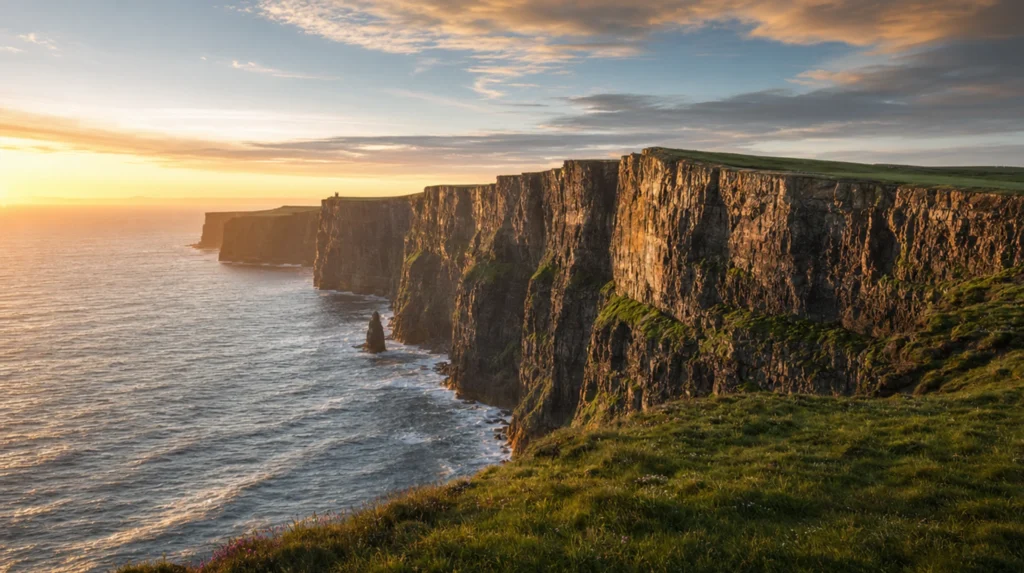
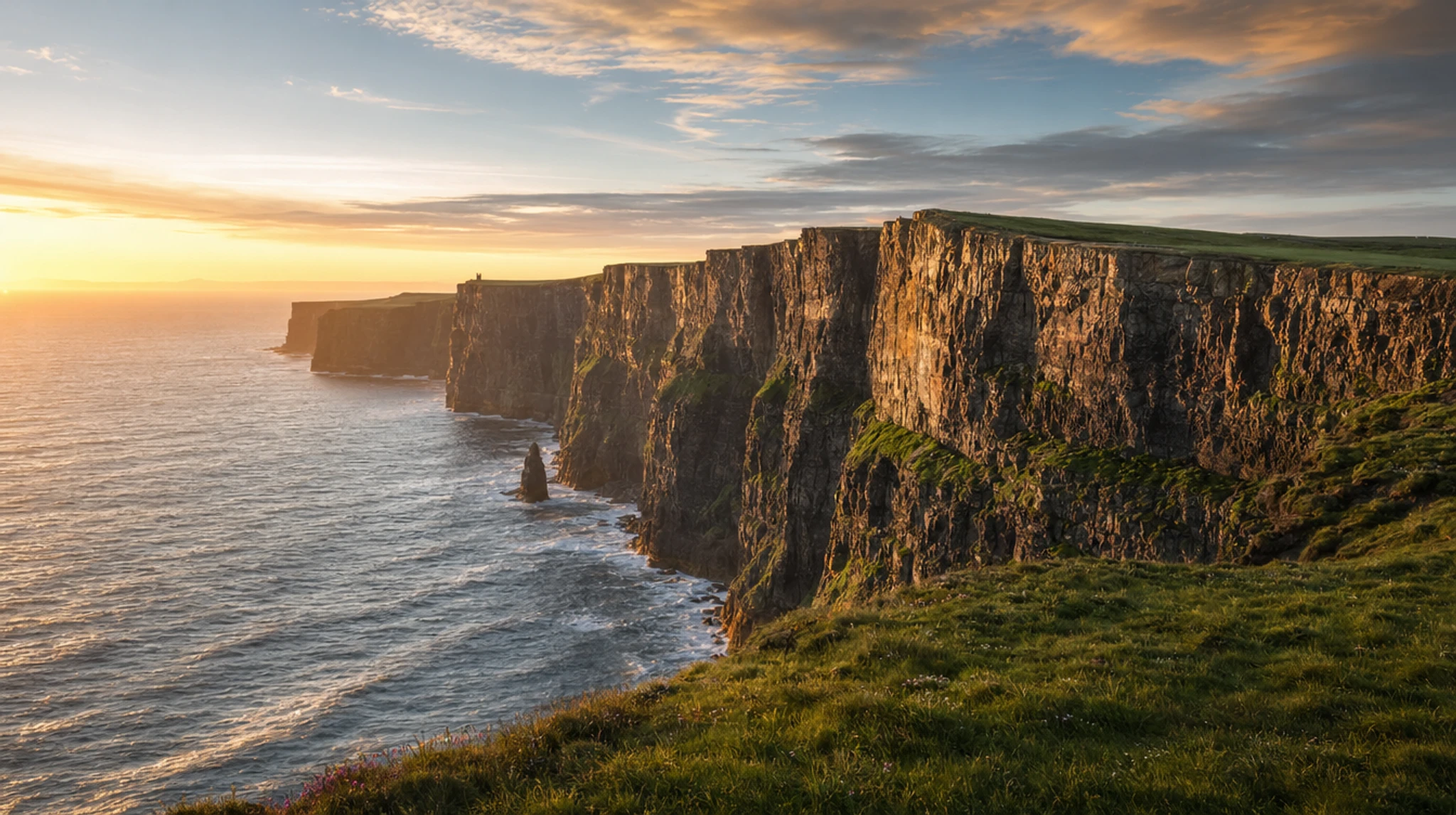
Ireland is a small island that packs in more coastline, folklore and convivial strangers per square kilometre than almost any country on earth. The island covers 84,421 square kilometres — roughly the size of the US state of Maine — split into two jurisdictions: the Republic of Ireland (ROI) at 70,273 km² and Northern Ireland (a constituent country of the United Kingdom) at 14,148 km². Between them they share a 7,524-kilometre Atlantic coastline that on the western flank produces the Cliffs of Moher, Slea Head and the Giant’s Causeway — three of the most photographed shorelines in Europe.
The recent past has reshaped how you cross this island. The Republic joined the European Economic Community (now the EU) on 1 January 1973, adopted the euro on 1 January 2002, and today operates a Common Travel Area with the UK that has let citizens of both countries cross the land border freely since 1923. Northern Ireland followed the rest of the UK out of the EU in 2020, so the moment you drive from Donegal into Derry you swap currencies, SIM-card networks, road-sign units (km/h to mph), and entry-authorisation regimes (ETIAS versus UK ETA). The border itself is still invisible — no checkpoints, no kiosks, just a change in road paint.
Culturally, Ireland punches far above its population of 5.38 million in the Republic plus roughly 1.9 million in Northern Ireland. The island has produced four Nobel literature laureates (Yeats, Shaw, Beckett, Heaney) from a smaller population than metropolitan Toronto, and a traditional music scene that keeps spontaneous pub sessions running from Dingle to Donegal. Irish (Gaeilge) is still the daily community language in Gaeltacht regions on the western seaboard — an indigenous Celtic language older than English, and the first official language of the Republic on every road sign. The history is heavier than the warm welcome suggests: the Great Famine of 1845–1852 cut the island’s population in half through death and emigration, and the 30-year conflict known as the Troubles (1968–1998) ended only with the Good Friday Agreement in your lifetime.
Practically, Ireland has quietly become one of the easiest countries in Europe to travel in. English is the working language across the entire island, it ranked 2nd in the world on the 2024 Global Peace Index, and the signature experience — a pint of Guinness in a trad-session pub — costs under €7 in Dublin and closer to €5 in a rural village. Bring a rainshell. You’ll use it.
☘️ St. Patrick’s Festival 2026 — Ireland’s Biggest Travel Pull
If you have one week to book, book 13–17 March 2026. St. Patrick’s Day on 17 March 2026 lands on a Tuesday, and Dublin’s St. Patrick’s Festival has expanded to a five-day programme of parades, céilís, literature readings and street performance across the city — the single biggest annual surge in visitor numbers to the Republic, pulling an estimated 500,000+ spectators to the Dublin parade alone. Hotels in central Dublin routinely sell out by December; Galway and Cork fill a month later. Book flights and accommodation at least four months in advance if you want the full festival week rather than a weekend window.
- Peak dates 2026: 13–17 March 2026 — festival runs five days, parade is 17 March
- Dublin parade: from Parnell Square down O’Connell Street and across the Liffey, ~12:00 noon on 17 March 2026
- Cork: afternoon parade along the Grand Parade; shortest route of the main city parades
- Galway: Eyre Square morning parade plus a traditional outdoor céilí in front of the Spanish Arch
- Dingle, County Kerry: dawn parade — traditionally the first St. Patrick’s Day parade anywhere in the world, stepping off at 6:00 am
- Armagh (NI), ‘Home of St. Patrick’: ten-day Home of St. Patrick festival with cathedral services and heritage-trail walks
Best Time to Visit Ireland (Season by Season)
Spring (Mar–May)
Spring is the shoulder sweet spot. Temperatures climb from a raw 7°C in early March to a pleasant 14°C by late May, daylight stretches past 9:00 pm by April, and the country greens up spectacularly — bluebell woods in Wicklow (late April into May) are one of the photographic peaks of the year. St. Patrick’s Festival (13–17 March 2026) is the one major crowd event; the rest of the season is quiet and sharply cheaper than summer.
Summer (Jun–Aug)
Summer is festival season and long-daylight season — in June the sun sets after 10:00 pm on the west coast. Temperatures sit 14–20°C with the occasional 25°C heatwave. Galway International Arts Festival and Willie Clancy Summer School (both July), Galway Races and Rose of Tralee (both August) are the anchors. Downside: every coach tour is on the Wild Atlantic Way at the same time, and Cliffs of Moher / Ring of Kerry car parks fill by 10:00 am.
Autumn (Sep–Nov)
Autumn is the photographer’s quiet season. September still holds 15°C and long light; October pulls the coach tours off the road and turns the Ring of Kerry, Killarney National Park and Glendalough into a pallet of copper and bronze. Cork Jazz Festival (late October bank holiday) and Dublin Theatre Festival (late September into October) anchor the cultural calendar. By November daylight drops fast — sunset around 4:30 pm.
Winter (Dec–Feb)
Winter is cold, dark and remarkably atmospheric. Temperatures hover 3–8°C, snow is rare outside the Wicklow Mountains, and rain is frequent — but the pub season is at full strength. Dublin, Galway and Belfast all run Christmas markets from late November, Wren Day in Dingle on 26 December keeps a 19th-century mumming tradition alive, and TradFest Temple Bar (late January) is the year’s biggest traditional-music gathering.
Shoulder-season tip: Late May and early-to-mid September offer the best ratio of light, warmth, dry days and empty headlands — you can drive Slea Head or the Ring of Kerry in late September with the road nearly to yourself and the coffee shops still open.
Getting There — Flights & Arrival
Ireland is one of the best-connected small countries in Europe for transatlantic travel. Dublin Airport is the busy hub — Aer Lingus, Delta, United, American and Air Canada all fly direct from North America — and Shannon offers the world’s oldest US Customs pre-clearance facility, which lets you clear US immigration in Ireland and land as a domestic passenger in the States.
- Dublin Airport (DUB) — 35.6M passengers in 2024; Aircoach and Dublin Express to the city centre in ~30 minutes for around €9
- Shannon Airport (SNN) — western gateway, US Customs pre-clearance; bus to Limerick in ~40 minutes
- Cork Airport (ORK) — 226 bus to Cork city centre in ~25 minutes for €2.80 on Leap card
- Belfast International (BFS) — Northern Ireland’s main airport (UK jurisdiction); Airport Express 300 to Belfast centre in ~40 minutes
Flight times: New York–Dublin ~6h 30m, Boston–Dublin ~6h, Toronto–Dublin ~6h 30m, London–Dublin ~1h 20m.
Flag carriers: Aer Lingus; Ryanair operates Europe’s largest short-haul network from Dublin.
Visa / entry: Around 60 nationalities (US, Canada, UK, EU/EEA, Australia, NZ, Japan, Singapore) are visa-free for up to 90 days in the Republic. Ireland is NOT in the Schengen Area, so ETIAS does not apply — but Northern Ireland requires the UK ETA for direct flights.
Getting Around — Trains, Buses & Left-Hand Driving
Ireland’s public transport is Dublin-radial. Iarnród Éireann (Irish Rail) runs fast, comfortable InterCity services from Dublin Heuston and Dublin Connolly to Cork, Galway, Limerick, Waterford and Belfast, but there is no east-west or south-north mainline — once you leave the Dublin radii, you are on buses, coaches or your own steering wheel. Translink operates the equivalent network in Northern Ireland, and the cross-border Enterprise service between Dublin and Belfast is run jointly by both.
- Irish Rail Mark 4 (Dublin–Cork): max speed 160 km/h — the only Irish line running at that speed
- Dublin Heuston → Cork Kent: ~2h 30m by InterCity, ~16 services daily
- Dublin Heuston → Galway Ceannt: ~2h 30m by InterCity, ~9 services daily
- Dublin Connolly → Belfast Lanyon Place: ~2h 15m on the Enterprise cross-border service, 8 services daily
Rail / transit pass: Irish Rail Trekker Four Day (4 consecutive days of rail travel in the Republic) is €123 (~$133). The InterRail One Country Pass for Ireland covers ROI and NI rail for 3, 4, 6 or 8 travel days in a month.
IC cards: Leap Card (Dublin Bus, Luas, DART, Bus Éireann, and city buses in Cork, Galway and Limerick); Translink’s iLink / mLink contactless in Northern Ireland. Contactless credit cards also work on most urban networks.
Apps: TFI Live (Transport for Ireland), Google Maps.
Top Cities & Regions
📍 Map of Ireland: Every Place in This Guide
🍀 Dublin
Ireland’s 1,000-year-old Viking and Georgian capital on the River Liffey — now a European tech hub that still keeps a pub on nearly every corner and a 9th-century book in its most-visited library.
- Trinity College and the Book of Kells in the Old Library — step into the Long Room for the most photographed interior in Ireland
- Guinness Storehouse at St. James’s Gate — the best-selling paid attraction in Ireland, ending in a 360° Gravity Bar view of the city
- Temple Bar traditional music quarter, Dublin Castle and Kilmainham Gaol for the Easter Rising history
Signature dishes: Dublin coddle (sausage, bacon and potato stew), a creamy pint of Guinness poured in two pulls, fish and chips at Leo Burdock on Werburgh Street.
🎶 Galway
Ireland’s bohemian west-coast city and a 2020 European Capital of Culture — a compact medieval port where Irish-language buskers share Shop Street with oyster festivals, and the Aran Islands ferry is a short bus ride away.
- Latin Quarter pub-trad scene on Quay Street — Tigh Neachtain, The Crane and Tig Cóilí all run nightly sessions
- Aran Islands day trip (Inis Mór, Inis Meáin, Inis Oírr) from Ros a’ Mhíl via Aran Island Ferries
- Cliffs of Moher day trip via Doolin, Salthill seafront promenade, the 16th-century Spanish Arch
Signature dishes: Galway Bay oysters with a half-pint of Guinness, west-coast seafood chowder, boxty potato pancakes at McDonagh’s.
🍞 Cork
Ireland’s self-declared ‘real capital’ in the deep south — a food-obsessed river-island city of narrow hills and arched bridges, home to the country’s best urban food market and the Blarney Stone fifteen minutes up the road.
- English Market — Ireland’s oldest covered municipal market, founded 1788, with 55 independent stalls
- Blarney Castle (15th-century tower house) and the Blarney Stone — lean backwards at the battlements for the ‘gift of the gab’
- Cobh harbour, RMS Titanic’s last port of call, and Fota Wildlife Park on the same train line
Signature dishes: drisheen (Cork black pudding), spiced beef, crubeens (pig’s feet) — paired with locally brewed Murphy’s or Beamish stout, not Guinness.
🏰 Kilkenny
The Marble City — a compact Norman medieval capital on the River Nore with a 12th-century castle, a 13th-century cathedral and the most walkable historic core in inland Ireland. An easy overnight between Dublin and Waterford.
- Kilkenny Castle (1195) and its 50-acre riverside parkland
- St. Canice’s Cathedral (13th century) and the adjacent 9th-century Round Tower — one of only two in Ireland you can still climb
- The Medieval Mile walking route, plus the Kilkenny Design Centre craft studios opposite the castle
Signature dishes: traditional Irish stew, Smithwick’s red ale (brewed in Kilkenny since 1710), farmhouse soda bread.
⚓ Belfast (Northern Ireland)
Northern Ireland’s capital, a separate jurisdiction on the same island — UK soil, pound sterling, and the birthplace of RMS Titanic. A post-Troubles renaissance has turned the shipbuilding yards into the Titanic Quarter and the peace walls into open-air political galleries.
- Titanic Belfast, opened 2012, named the World’s Leading Tourist Attraction at the 2016 World Travel Awards — built on the slipway where RMS Titanic launched in 1911
- Black Cab political mural tours along the Falls Road and Shankill Road explaining the Troubles
- Giant’s Causeway day trip — UNESCO World Heritage Site, ~1h north by road, 40,000 basalt columns
Signature dishes: Ulster Fry (fried breakfast with soda farl and potato bread), champ (mashed potato with spring onion), Bushmills whiskey from the world’s oldest licensed distillery (1608).
🌊 Ring of Kerry & Dingle Peninsula
The Atlantic south-west — the most-photographed stretch of the 2,500-km Wild Atlantic Way. A 179-km Ring of Kerry loop plus the Dingle Peninsula (An Daingean) combines sea cliffs, Gaeltacht Irish-speaking villages, and Star Wars filming sites.
- Skellig Michael (Sceilg Mhichíl) — 6th-century monastic UNESCO World Heritage Site and Star Wars: The Force Awakens filming location
- Slea Head Drive on Dingle, Dunquin Pier, and the beehive huts above Coumeenoole Bay
- Killarney National Park (Ireland’s first national park, 1932), Ladies’ View and the Gap of Dunloe jaunting cart
Signature dishes: Dingle Bay seafood chowder, Kerry hill-lamb stew, Murphy’s Ice Cream (Dingle-made, sea-salt flavour).
Irish Culture & Etiquette — What to Know Before You Go
The Essentials
- A nod of the head or a quick ‘how are ya?’ is the default greeting. The question is rhetorical — a long, detailed answer is not expected. ‘Grand’ (meaning ‘fine’) is the universal reply.
- Rounds are sacred in the pub. If your new friend buys you a pint, you buy the next round when the glasses are empty. Never skip your turn — it is noticed and it is remembered.
- Tipping is not obligatory, but 10–12% is now standard in table-service restaurants. Taxi fares are rounded up; pubs and bars are generally not tipped for drinks service.
- Irish (Gaeilge) is the first official language of the Republic and appears on every road sign (usually above the English). You are not expected to speak it, but a ‘Sláinte’ (slawn-cha, ‘health’) before the first sip of a pint is universally appreciated.
- Do not confuse the Republic with Northern Ireland. Asking a Dubliner about ‘the UK’ or a Belfast local about ‘Ireland’s’ Premier League team will both land awkwardly. Use ‘Ireland’, ‘the Republic’ or ‘the South’ for ROI, and ‘the North’ or ‘Northern Ireland’ for NI.
Pub Culture & Trad Sessions
- A ‘session’ (seisiún) is a pub musicians’ circle, not a performance. Sit at a respectful distance; clap between tunes, not during them, and never over the lead fiddler.
- Do not request songs from strangers at a trad session — the tunes are chosen by the musicians in turn. If you are a musician yourself, ask the table politely and bring your own instrument.
- Sing-along pub songs — ‘The Fields of Athenry’, ‘Molly Malone’, ‘Whiskey in the Jar’ — are fair game to join. The storytelling lulls between tunes are for listening, not for topping up your round.
- Pubs ring the last-orders bell around 11:30 pm on weeknights and 12:30 am at weekends in the Republic. Northern Ireland runs on UK licensing, which differs by area.
A Food Lover’s Guide to Ireland
Irish food has reinvented itself in the last two decades. The old clichés — overcooked lamb, soggy cabbage, potatoes three ways — have given way to a serious farm-and-sea cuisine built around grass-fed beef and dairy, Atlantic shellfish from Galway Bay and Cork’s west coast, and a revived artisan-bakery scene. Dublin now has two two-star Michelin restaurants; Kinsale, Dingle and Galway all field tasting menus that land in the European top 200. At the same time, the pub carvery, the chipper, and a plate of bacon-and-cabbage with buttered soda bread remain the daily bread of Irish eating.
Must-Try Dishes
| Dish | Description |
|---|---|
| Irish stew | Lamb or mutton with potatoes, carrots and onion, slow-cooked in a single pot — Ireland’s unofficial national dish. Traditionally thickened by the potatoes themselves rather than flour, and best in a country pub in Kerry or Connemara. |
| Boxty | Potato pancake made with a mix of grated raw and mashed cooked potato. The rhyme goes: ‘Boxty on the griddle, boxty on the pan; if you can’t make boxty, you’ll never get a man.’ Gallagher’s Boxty House in Temple Bar is the Dublin reference. |
| Soda bread | Traditional quick bread leavened with bicarbonate of soda and buttermilk instead of yeast — brown or white, farmhouse or bakery. Every region, and often every family, has its own recipe; look for it alongside seafood chowder. |
| Seafood chowder | Creamy chowder of smoked haddock, salmon and mussels with potato and a swirl of cream. Universal on west-coast menus from Donegal down to Kinsale; usually served with brown soda bread and butter for dunking. |
| Full Irish breakfast | Bacon rashers, Clonakilty pork sausage, black and white pudding, fried egg, grilled tomato, mushrooms, baked beans and toast. The Ulster Fry (Northern Ireland) swaps toast for soda farl and potato bread. |
| Colcannon & champ | Colcannon is mashed potato with kale or cabbage folded through melted butter; champ is mashed potato with spring onion. Both traditional autumn comfort food, usually served alongside ham or sausage. |
| Dublin coddle | Dublin’s own one-pot stew of pork sausages, rashers, potato and onion simmered in stock — historically a working-class Thursday leftovers dish, now a proud city specialty at pubs like The Hairy Lemon and L. Mulligan Grocer. |
Pub Food & Carvery Lunch
Ireland’s most reliable midday meal is the pub carvery — a hot-counter roast dinner (beef, ham, turkey) with three sides of vegetables, gravy and a roast potato, served from roughly 12:30 to 2:30 pm in most traditional pubs outside the tourist-core streets. €14–18 gets you a plate that will keep you walking until dinner. Outside carvery hours, standard pub menus lean on seafood chowder, fish and chips, toasted sandwiches, and the increasingly common buttermilk chicken goujon basket.
- Deli chains: SuperValu Deli, Centra Chef, Spar — Ireland’s equivalent of the Japanese konbini for on-the-road eating
- Signature items: chicken-fillet roll (Ireland’s sandwich of record), breakfast roll (sausage, rasher, pudding, egg, in a bread roll, eaten in cars between Dublin and Cork), ham-and-cheese toastie, 99 ice-cream cone with a Cadbury Flake
Off the Beaten Path — Ireland Beyond the Guidebook
Inis Meáin (Middle Aran Island)
The middle and least-visited of the three Aran Islands, reached by ferry from Ros a’ Mhíl 45 minutes west of Galway. Population around 150, all of them Irish-speakers — this is a working Gaeltacht, not a museum one. The reason to come is Dún Chonchúir, a prehistoric stone ringfort perched on the island’s high point; Teach Synge, the cottage where John Millington Synge spent five summers writing ‘Riders to the Sea’; and Inis Meáin Knitting, a working knitwear cooperative that supplies luxury brands in Tokyo and Milan. Stay at the island’s single small restaurant-with-rooms and you will sit at a communal breakfast table speaking Irish over tea.
Glendalough, County Wicklow
A 6th-century monastic settlement founded by St. Kevin in a glacial valley one hour south of Dublin. Two dark lakes, a 30-metre Round Tower that has stood since the 10th century, a ruined cathedral, and a network of looping hikes into Wicklow Mountains National Park. Get there before 9:30 am to have the upper lake to yourself; the afternoon coach tours arrive at eleven.
Loop Head, County Clare
A narrow finger of Atlantic cliff at the mouth of the Shannon estuary, less than an hour south of the Cliffs of Moher and with a fraction of the visitors. A working 1854 lighthouse you can tour in summer, bottlenose-dolphin watching boats out of Kilbaha (the resident Shannon pod numbers over 140), and Michelin-plate-level seafood at the Long Dock in Carrigaholt and the Lighthouse Keeper’s Cottage above the cliffs.
Achill Island, County Mayo
Ireland’s largest offshore island, connected to the mainland by a short swing-bridge off the N59 in County Mayo. Keem Bay — the shell-white crescent that opens the 2022 film ‘The Banshees of Inisherin’ — is the signature beach. The Atlantic Drive loop around Minaun Heights is a quieter alternative to the busier Wild Atlantic Way stretches between Galway and Sligo. Come for two nights, not a day trip.
Derry / Londonderry City Walls
A two-hour drive north of Galway and an hour west of Belfast — Ireland’s only fully walled city with its 1613–1619 walls intact, a 1.5-km intact parapet circuit that hasn’t been breached in any of the four sieges it has survived. Walk the walls, visit the Tower Museum’s Armada Shipwreck exhibit on the Spanish galleon La Trinidad Valencera, and cross the 2011 Peace Bridge at sunset. It also makes the best base for driving to the Giant’s Causeway and the ‘Game of Thrones’ Dark Hedges 40 minutes east.
Practical Information
| Currency | Euro (€) in ROI; pound sterling (£, GBP) in Northern Ireland. 1 USD ≈ €0.93 / £0.78 (XE, April 2026) |
| Cash needs | Contactless is universal for transit, taxis and shops. Carry €30–50 in small notes for rural pubs and family-run B&Bs that keep a €5 card minimum. ATM euro notes come in €5, €10, €20 and €50. |
| ATMs | Widely available across both jurisdictions. Most Irish bank ATMs do not charge foreign cards; Revolut, Wise and Chime pay at the interbank FX rate. Avoid independent Euronet machines in tourist areas — they markup up to 10%. |
| Tipping | 10–12% in sit-down restaurants, round up taxi fares, no tipping at pubs for drinks service. Hotel porters €2–3 per bag. |
| Language | English is the working language everywhere. Irish (Gaeilge) is co-official in the Republic and the community language in Gaeltacht areas of Conamara, Kerry and Donegal. Google Translate’s offline Irish pack works reliably for menus and signs. |
| Safety | Ireland ranked 2nd in the world on the 2024 Global Peace Index — one of the safest destinations for solo and female travellers. |
| Connectivity | 4G/5G is excellent in all cities and patchy on Wild Atlantic Way headlands. Three, Vodafone and Eir all sell a €20 tourist SIM with 80GB data, 28 days, including NI roaming. |
| Power | Type G plugs (three rectangular pins, same as UK), 230V / 50Hz on both sides of the border. |
| Tap water | Safe to drink across the island. Dublin’s water is chlorinated and mineral-soft; rural western water is softer still and often peat-tinged. |
| Healthcare | EU/EEA visitors use the European Health Insurance Card (EHIC). Non-EU travellers should carry full travel insurance — an uninsured A&E visit averages €100 before any treatment. |
Budget Breakdown — What Ireland Actually Costs
💚 Budget Traveller
Budget travel in Ireland runs roughly $95–$135 a day. A hostel dorm in Dublin or Galway runs €30–45 a night; a rural farmhouse B&B outside the tourist spine is €50–70 with a full Irish breakfast included. Eat one pub carvery lunch (€14–18), grocery-shop dinner ingredients at a SuperValu or Dunnes Stores, and nurse one pint in the evening — that’s a €6.50 Guinness in Dublin or €5 in a country village. City travel on Leap Card is €1.40–€3.00 a ride; an advance Dublin–Galway InterCity fare is €22.
💙 Mid-Range
Mid-range Ireland runs $190–$270 a day. Expect a 3-star hotel or boutique B&B at €110–170 a night, two sit-down meals (€28–40 per person with a glass of wine at €7), and a half-rental, half-rail transport mix. An advance Irish Rail return Dublin–Cork costs €55; a rental car runs €45 a day plus fuel and tolls. This is the natural tier for most North American first-time visitors.
💜 Luxury
Luxury Ireland is world-class. Ashford Castle in County Mayo, Adare Manor in County Limerick and the Merrion in Dublin run €450–1,200 a night in peak season. Michelin tasting menus at Chapter One Dublin or L’Ecrivain run €140–200 a head before wine. A private driver-guide with a seven-seat Mercedes is €350 a day, and a chauffeured Ring of Kerry day from Killarney runs €450.
| Tier | Daily (USD) | Accommodation | Food | Transport |
|---|---|---|---|---|
| Budget | $95–$135 | Hostel €30–45 / rural B&B €50–70 | Carvery €14, pint €5–6.50 | Leap Card €1.40–€3.00 / ride |
| Mid-Range | $190–$270 | 3-star hotel or boutique B&B €110–170 | Sit-down dinner €28–40, wine €7/glass | Rail Dublin–Cork €55, car €45/day |
| Luxury | $400+ | Ashford Castle / Merrion €450–1,200 | Michelin tasting €140–200 | Private driver €350/day |
Planning Your First Trip to Ireland
- Decide ROI-only or add Northern Ireland. Crossing into NI changes currency, SIM roaming, road-sign units (km/h to mph), and entry-authorisation regime.
- Book flights into Dublin (DUB) or Shannon (SNN) 10–12 weeks out. Aer Lingus, Delta, United and Air Canada all fly direct from North America; Shannon offers US Customs pre-clearance.
- Rent a car if you leave Dublin. Ireland drives on the left, and public transport thins west of the Galway–Limerick line. Book an automatic early — they sell out first.
- Build the classic 10–14 day loop: Dublin (3 nights) → Galway (2) → Cliffs of Moher & Loop Head (1) → Dingle or Ring of Kerry (2–3) → Cork & Kinsale (2) → Dublin. Belfast adds 2.
- Pack a rainshell and layers every month. There is no rainy season in Ireland — there is Ireland.
Classic 10-Day Itinerary: Dublin 3 / Galway 2 / Cliffs of Moher 1 / Dingle 2 / Cork 2. Belfast adds 2.
Cities & Regions to Explore
Frequently Asked Questions
Is Ireland expensive to visit?
Ireland is mid-to-high for Europe — cheaper than Iceland or Switzerland, more expensive than Portugal or Croatia. Expect $190–$270 a day mid-range in Dublin and slightly less on the west coast. Pub carvery lunch (€14–18) as your main meal keeps spend down; hostel-based budget travel still works at around $95–$135.
Do I need to speak Irish (Gaeilge)?
No. English is the working language everywhere. Irish is co-official in ROI and the community language in Gaeltacht regions of Conamara, Kerry and Donegal, but signs and services are bilingual. Learning ‘sláinte’ (cheers) and ‘go raibh maith agat’ (thank you) earns smiles.
Is the Irish Rail pass worth it?
Only for a specific trip shape. The Trekker Four Day pass (€123) pays off if you are doing Dublin → Cork → Galway → Belfast in a week with no side trips. For anything involving the Wild Atlantic Way or Ring of Kerry, rent a car — the best of Ireland is off the rail network.
Is Ireland safe for solo travellers?
Yes — Ireland ranked 2nd in the world on the 2024 Global Peace Index and is consistently among the safest destinations for solo female travellers. Standard late-night awareness applies in Dublin’s Temple Bar and Cork’s Oliver Plunkett Street; rural Ireland is genuinely one of the safest environments you will travel in.
When is the best time to visit?
Late May through June and the first three weeks of September offer the best balance — long daylight, modest crowds and milder rain. July–August peaks for festivals but also coach tours. 13–17 March 2026 is the St. Patrick’s Festival — the biggest annual crowd surge, especially in Dublin.
Can I get by as a vegetarian or vegan?
Yes in cities and on the west-coast tourist spine. Dublin’s Cornucopia and Galway’s Ard Bia at Nimmos run substantial plant-based menus. In rural pubs the default remains cheese-and-onion toastie or vegetable soup; vegans should consult Happy Cow before committing to a small town.
Is the Republic of Ireland the same as Northern Ireland?
No — two separate jurisdictions on one island. ROI is an independent EU state using the euro. Northern Ireland is part of the United Kingdom, uses pound sterling, and followed the UK out of the EU in 2020. The Common Travel Area lets you cross the invisible border, but SIM, insurance and ETA / ETIAS all change at the line.
Will it really rain every day?
It will rain most days, somewhere, but usually not for long. The west coast averages 1,200 mm a year and the east 750 mm. Layer up and remember the Irish saying: ‘if you don’t like the weather, wait twenty minutes.’
Ready to Explore Ireland?
Book your flights, pack a rainshell, and say yes to the first round. Ireland rewards slow travel — a single day spent on Slea Head or in a Galway trad session will stay with you longer than the checklist version.
Explore More
Cities we cover in Ireland
More country guides you might like
Plan your trip to Ireland
The booking tools we use ourselves. FFU may earn a commission at no extra cost to you.
Plan & book your trip to Ireland
Booking through these searches supports our guides at no extra cost to you.