
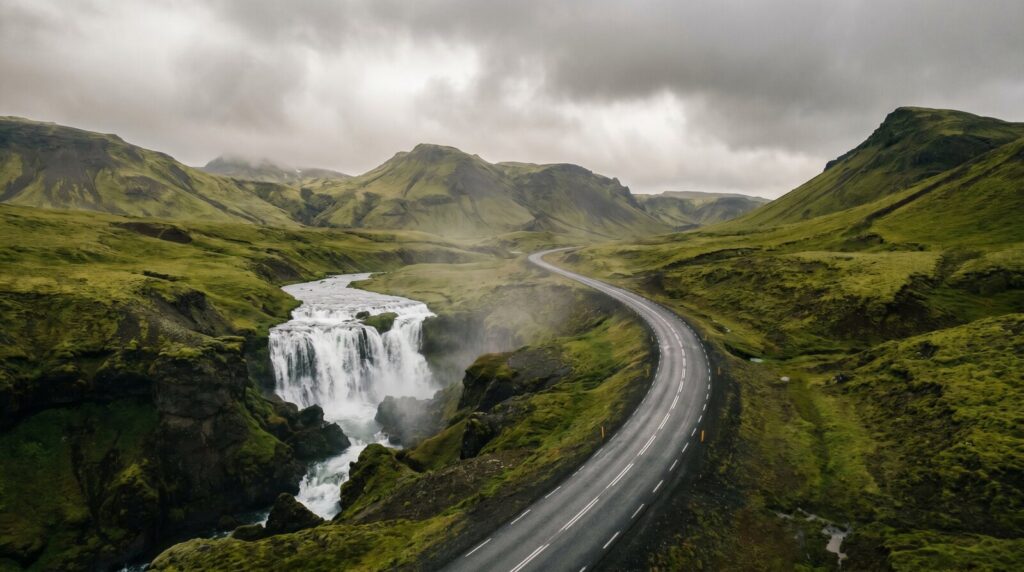
Iceland Ring Road — A Detailed 10-Day Itinerary, Day-by-Day Drive Times, Lodging Tiers and Photo Stops Driving logistics, seasons and budgets are covered in our full Iceland travel guide.
I have driven the full Ring Road three times — once in March under storm warnings, once in July with the Midnight Sun in the rear-view mirror, and once in October with the first snow on Vatnajökull. We tell first-time travellers that 7 days is the minimum and 10 is the right answer, and the daily distances below are why. My favourite single hour on Earth is still the Stokksnes evening light at the start of Day 6, with Vestrahorn black and the tide pulled out. Treat this guide as the day-by-day brief I would hand my own family before they collected their 4×4 from KEF.

In This Guide
- Overview — How This Itinerary Is Built
- When to Drive — Seasonal Year-Round Lights
- Best Time to Visit — Vehicle, Season & Tyres
- Getting There — Days 1–2 (Reykjavík & Golden Circle)
- Getting Around — Days 3–4 (South Coast)
- Top Cities & Regions — Days 5–6 (Glacier Lagoon & East Fjords)
- Cultural Days — Days 7–8 (Mývatn & Akureyri)
- Food & Last Days — Days 9–10 (Snæfellsnes & Reykjavík)
- Off the Beaten Path — Itinerary Variants
- Practical Information
- Budget Breakdown
- Planning Checklist
- Frequently Asked Questions
Overview — How This Itinerary Is Built
This is a clockwise Ring Road loop from Reykjavík with two strategic detours: the Snæfellsnes Peninsula on Day 9 and Stokksnes on Day 6. The total distance is around 1,632 km — the 1,332 km Ring Road plus 300 km of side trips and pullouts. The pacing leaves daily drives at 130–280 km, which is the sweet spot Icelandic operators use to keep travellers off cliffs and out of the dark.
The fundamental design choice is which side of Iceland gets two-day depth. This itinerary gives Days 5–6 to the south-east (Vatnajökull glacier lagoon, Stokksnes, Höfn) and Days 7–8 to the north (Mývatn, Akureyri). The trade-off accepted: a single Day-3 push along the south coast (Reykjavík → Vík) and a single Day-9 push through the Snæfellsnes Peninsula. Variants for a northern-priority trip are in the Off the Beaten Path section.
Lodging is mid-range default at every overnight: a 3-star guesthouse or hotel, ISK 22,000–38,000 per night for a double in 2026 (verify on Booking.com or the property’s site). Budget alternatives are flagged where camping or hostel space exists; premium alternatives where a known boutique property exists. No restaurant or hotel by name — only the destination and the typical price tier.
Day 6’s optional Stokksnes detour costs an entry fee at the Viking Café and adds around 60 km to the day. The base itinerary works without it; with it, Day 6 becomes the photographic highlight.
When to Drive — Year-Round Aurora Lights and the Highland Window
The Ring Road is paved end to end and theoretically drivable year-round, but the practical season splits in two.
- Late May to early September — Midnight Sun, all paved sections open, F-roads to Landmannalaugar / Þórsmörk / Askja open. The full classic itinerary works without compromise. Book accommodation 4–6 months ahead in July–August.
- Mid-September to late March — aurora season but increasing chance of road closures, especially the eastern Möðrudalsöræfi pass between Egilsstaðir and Mývatn. Winter-tyre 4×4 essential. Build a 2-day buffer into the itinerary.
- Shoulder weeks — late February to mid-March and late September to mid-October offer aurora visibility AND open Ring Road, with rental rates 30–40% off summer.
Solar Cycle 25’s post-maximum window (through 2026 and into 2027) makes a winter Ring Road drive an unusually generous proposition for aurora hunters. If aurora is the trip’s primary purpose, see our dedicated Northern Lights 2026 guide.
Best Time to Visit — Vehicle, Season & Tyres
June – August (Peak Summer)
Coastal temperatures 10–15°C; daylight 18–24 hours; F-roads open mid-June through early September. Small economy car or 2WD compact is enough on Route 1; a 4×4 (Toyota RAV4 class, ISK 16,000–22,000/day) is needed for Snæfellsnes gravel and any F-road detour.
September – October (Autumn Shoulder)
Temperatures 0–10°C; first snow on the Möðrudalsöræfi pass from mid-October. Standard 4×4 with all-weather tyres recommended; check road.is morning and night.
November – March (Winter)
Coastal −5°C to 4°C; highlands well below −15°C; daylight 4–8 hours. Studded winter-tyre 4×4 essential and required by Icelandic law from 1 November to 14 April. Aurora lights drive demand: book lodging 3–4 months ahead.
April – May (Spring Shoulder)
Temperatures rising from 0°C to 10°C ; aurora season ends 21 March; F-roads still closed until mid-June. The best-value window — rental cars and accommodation at off-peak rates while the Ring Road is fully open.
Getting There — Days 1–2 (Reykjavík & Golden Circle)

Day 1 — Arrival, Reykjavík (0 km driving)
Drive: Keflavík (KEF) → Reykjavík via the Flybus, 45 minutes, ISK 4,599 in 2026 (verify on site). Rental car pickup tomorrow at the city branch saves a day’s parking. Anchor activities: Hallgrímskirkja tower, Old Harbour walk, Sundhöll evening soak.
Photo subjects (Lane E queue): Hallgrímskirkja from Skólavörðustígur; Sun Voyager (Sólfar) on Sæbraut at 22:00 in summer / 17:00 in winter; Harpa facade close-up.
Food: harbour-side dinner; pylsur from Bæjarins Beztu as a pre-bed snack. Lodging: mid-range — 3-star hotel in 101 (Þingholt area) ISK 26,000–40,000/night. Budget — Loft Hostel or Kex Hostel from ISK 7,500/dorm. Premium — Reykjavík EDITION ISK 95,000+.
Day 2 — Golden Circle Loop (200 km, 7 hours including stops)
Drive: Reykjavík → Þingvellir (45 min) → Geysir / Strokkur (50 min) → Gullfoss (10 min) → Friðheimar tomato greenhouse (20 min) → Selfoss → Reykjavík (1h 15min). Total 200 km.
Anchor stops: Þingvellir Almannagjá rift wall (UNESCO 2004 ); Strokkur geyser eruptions every 6–10 minutes; Gullfoss two-tier 32 m falls.
Photo subjects: Þingvellir Öxarárfoss waterfall in the rift; Strokkur mid-eruption (3-second exposure recommended); Gullfoss panoramic with rainbow on a sunny day.
Food: Friðheimar tomato soup at the geothermal greenhouse (no reservation walk-in slots in low season); Efstidalur II farm ice cream on the way back. Lodging: back in Reykjavík — same hotel as Day 1.
Getting Around — Days 3–4 (South Coast)

Day 3 — Reykjavík to Vík (190 km, 5–6 hours including stops)
Drive: Reykjavík → Hveragerði → Selfoss → Seljalandsfoss (1h 50min, 130 km) → Skógafoss (30 min, 30 km) → Vík (40 min, 33 km). Total 186 km from Reykjavík.
Anchor stops: Seljalandsfoss curtain-walk; Skógafoss 527 steps to the top viewpoint; Reynisfjara black-sand beach (sneaker-wave warnings posted, take the warning seriously ); Reynisdrangar sea stacks at Vík. Photo subjects: Seljalandsfoss from below the curtain; Skógafoss with rainbow at 14:00 in summer; Reynisfjara basalt-column sea cave (Hálsanefshellir).
Food: kjötsúpa at any Vík café; arctic char at fjord-side restaurants. Lodging: mid-range — Vík guesthouse ISK 24,000–34,000/night. Budget — Vík HI Hostel from ISK 7,000/dorm. Premium — Hotel Kría or Hotel Vík ISK 38,000+.
Day 4 — Vík to Skaftafell (140 km, 4–5 hours including stops)
Drive: Vík → Eldhraun lava field (40 min, 50 km) → Fjaðrárgljúfur canyon (20 min, 20 km) → Skaftafell visitor centre at Vatnajökull (1h, 70 km). Total 140 km.
Anchor stops: Eldhraun moss-covered lava field (the Laki eruption of 1783–84 produced this — among the largest historical lava flows on Earth ); Fjaðrárgljúfur 100 m canyon; Skaftafell visitor centre and the Svartifoss basalt-column waterfall hike (1h 30min round-trip). Photo subjects: Fjaðrárgljúfur from the rim viewpoint; Svartifoss basalt columns; the glacier tongue at Skaftafell with hikers for scale.
Food: Skaftafell café for lunch; harðfiskur and skyr from the visitor-centre shop. Lodging: mid-range — Hotel Skaftafell or Fosshotel Glacier Lagoon ISK 30,000–48,000/night. Budget — Svínafell campsite ISK 2,500/pitch. Premium — Fosshotel Glacier Lagoon ISK 55,000+.
Top Cities & Regions — Days 5–6 (Glacier Lagoon & East Fjords)


Day 5 — Skaftafell to Höfn (140 km, 5 hours including stops)
Drive: Skaftafell → Jökulsárlón glacier lagoon (1h, 60 km) → Diamond Beach (5 min walk across the road) → Höfn (1h, 80 km). Total 140 km.
Anchor stops: Jökulsárlón Zodiac boat tour (around 1h 30min, ISK 11,000–13,500 in 2026, verify with operator); Diamond Beach photography session; Fjallsárlón as a quieter alternative if Jökulsárlón is busy. Photo subjects: Jökulsárlón icebergs at golden hour (Day 5 best with sun behind the bergs); Diamond Beach iceberg fragments on black sand; the bridge approach.
Food: Höfn is Iceland’s langoustine capital — most Höfn restaurants serve a langoustine-tail set. Lodging: mid-range — Hotel Höfn or Milk Factory Höfn ISK 26,000–42,000/night. Budget — Höfn campsite ISK 2,500/pitch. Premium — boutique guesthouses ISK 50,000+.
Day 6 — Höfn to Egilsstaðir (270 km, 6–7 hours including Stokksnes detour)
Drive: Höfn → Stokksnes (15 min, 12 km) → Höfn back → Djúpivogur (1h 30min, 105 km) → Reyðarfjörður (2h, 130 km) → Egilsstaðir (35 min, 30 km). Total 270 km plus the 24 km Stokksnes round-trip.
Anchor stops: Stokksnes Vestrahorn massif (Viking Café entry fee, around ISK 1,000 per person in 2026, verify on site); Djúpivogur Eggin í Gleðivík (38 stone-egg sculptures by Sigurður Guðmundsson). The East Fjords coast Route 1 is the Ring Road’s least-driven leg — quiet, dramatic, under-photographed. Photo subjects: Vestrahorn at sunset (Day 6 evening light is the trip highlight); Eggin í Gleðivík stone eggs at dusk; Reyðarfjörður at the head of the East Fjord.
Food: Reyðarfjörður Tærgesen restaurant is well-known for fish; Egilsstaðir bakery for breakfast next morning. Lodging: mid-range — Hotel Hérað or Lake Hotel Egilsstaðir ISK 24,000–38,000/night. Budget — Tehúsið or Fellabæ campsite ISK 2,500/pitch. Premium — Wilderness Center Óbyggðasetur Íslands ISK 55,000+.
Culture & Days 7–8 (Mývatn, Goðafoss & Akureyri)

Day 7 — Egilsstaðir to Mývatn (170 km, 5–6 hours)
Drive: Egilsstaðir → Möðrudalsöræfi pass (1h 15min, 100 km — closes in winter storms; check road.is) → Mývatn east shore (1h 10min, 70 km). Total 170 km.
Anchor stops: Námaskarð fumaroles and the Hverir geothermal hillside; Skútustaðagígar pseudo-craters; Dimmuborgir lava maze; Mývatn Nature Baths (around ISK 6,500 in 2026, verify on site ). Photo subjects: Námaskarð orange-and-yellow earth at midday; pseudo-craters reflected in the lake; the Mývatn Nature Baths at sunset.
Food: Vogafjós farm-to-table café bakes geothermal-oven rúgbrauð for 24 hours. Lodging: mid-range — Hotel Reynihlíð or Sel-Hótel Mývatn ISK 28,000–42,000/night. Budget — Hlíð campsite at Vogafjós ISK 2,500/pitch. Premium — Fosshotel Mývatn ISK 48,000+.
Day 8 — Mývatn to Akureyri (105 km, 4–5 hours)
Drive: Mývatn → Goðafoss (40 min, 50 km) → Akureyri (1h, 55 km). Total 105 km. Optional 90 km north-east detour to Húsavík for whale-watching adds 4–5 hours; book the cruise 1–2 weeks ahead.
Anchor stops: Goðafoss ‘Waterfall of the Gods’ (named for the moment Iceland adopted Christianity in 1000 CE ); Húsavík whale-watching (3-hour cruise, around ISK 13,500 in 2026, verify with operator); Akureyrarkirkja basalt-column church; Forest Lagoon evening soak. Photo subjects: Goðafoss two-tier panorama; Akureyri church above the harbour; Forest Lagoon over the fjord at sunset.
Food: Strikið fjord-view dinner; Brynja ice-cream at any time. Lodging: mid-range — Icelandair Hotel Akureyri or KEA Hotel ISK 25,000–38,000/night. Budget — Akureyri Backpackers ISK 7,500/dorm. Premium — Hótel Kjarnalundur ISK 45,000+. See the dedicated Akureyri City Guide for full options.
Food & Last Days — Days 9–10 (Snæfellsnes & Reykjavík)
Must-Eat Dishes Day by Day
The food layer of the itinerary is one of the under-marketed Ring Road draws. Here is the canonical day-by-day single-dish recommendation, all of them broadly available at the named overnight bases.
| Dish | Where on the loop |
|---|---|
| Pylsur (lamb hot dog) | Day 1 Reykjavík — at Bæjarins Beztu after the Flybus from KEF. |
| Friðheimar tomato soup | Day 2 Golden Circle — geothermal greenhouse lunch with optional tomato schnapps. |
| Kjötsúpa (lamb soup) | Day 3 Vík — refillable bowl at any Ring Road N1 stop on the way down. |
| Plokkfiskur (cod-and-potato) | Day 4 Skaftafell — hearty café fare for a glacier-walk afternoon. |
| Langoustine | Day 5 Höfn — Iceland’s langoustine capital. Most Höfn restaurants run a tail-set in season (May–Aug). |
| Smoked arctic char | Day 7 Mývatn — Vogafjós farm-to-table café, paired with their geothermal-oven rúgbrauð. |
| Skyr with berries | Day 8 Akureyri — supermarket Ísey or KEA brand at any Bónus / Krónan; the cheap reliable breakfast. |
| Hákarl & Brennivín | Day 9 Snæfellsnes — Bjarnarhöfn shark farm museum on the peninsula. For the curious only. |

Day 9 — Akureyri to Stykkishólmur (Snæfellsnes, 380 km, 6–7 hours)
Drive: Akureyri → Blönduós (2h, 145 km) → Borgarnes (2h, 145 km) → Stykkishólmur on Snæfellsnes (1h 15min, 90 km). Total 380 km. The longest single driving day of the loop.
Anchor stops: Glaumbær turf-house museum near Sauðárkrókur (around ISK 2,000 admission in 2026, verify on site ); Kirkjufell and Kirkjufellsfoss in the late afternoon at Grundarfjörður; Stykkishólmur old-town wooden houses. Photo subjects: Kirkjufell + Kirkjufellsfoss with the mountain reflected in the foreground falls; Stykkishólmur old harbour; Glaumbær turf walls.
Food: Stykkishólmur is a fishing town — fjord-fresh cod and plokkfiskur on most menus. Lodging: mid-range — Hotel Stykkishólmur or Fosshotel Stykkishólmur ISK 26,000–42,000/night. Budget — Stykkishólmur HI Hostel from ISK 7,500/dorm. Premium — Hotel Búðir on the south coast of the peninsula ISK 55,000+.
Day 10 — Snæfellsnes to Reykjavík + Blue Lagoon (270 km, 7–8 hours including Blue Lagoon)
Drive: Stykkishólmur → Arnarstapi (1h, 60 km) → Hellnar → Djúpalónssandur black-pebble beach → Borgarnes (1h 30min, 110 km) → Reykjavík (1h, 75 km) → Blue Lagoon (50 min, 50 km via Reykjavík bypass). Total 270 km plus the optional Blue Lagoon detour.
Anchor stops: Arnarstapi cliffs and Bárðar Saga Snæfellsáss stone giant; Hellnar coastal walk; Djúpalónssandur black-pebble beach with strength-test stones from the original fishing fleet; Snæfellsjökull stratovolcano panorama. Blue Lagoon Comfort entry ISK 9,990 in 2026 (verify on site); reserve at least 1–2 weeks ahead in peak weeks. Combine with KEF arrivals or departures.
Photo subjects: Arnarstapi natural arches; Djúpalónssandur black-pebble beach with the rusted shipwreck remains; Blue Lagoon silica-mud face mask shot. Food: last Reykjavík dinner — Hlemmur Mathöll if budget; a tasting-menu lunch (Dill or Matur og Drykkur) for the splurge. Lodging: back to the Day 1 Reykjavík hotel for a final night, or KEF airport hotel if early flight. See the dedicated Reykjavík City Guide.
Off the Beaten Path — Itinerary Variants

Northern-Priority Variant (Days 5–6 swap)
Compress the south-coast leg into one long Day 3 (Reykjavík → Höfn, 460 km, 6–7 hours) and free up two days at Mývatn / Húsavík / Tröllaskagi. Best for travellers prioritising whale-watching and aurora over glacier scenery.
Westfjords Add-On (12-day variant)
Add 3 nights between Days 8 and 9 — Akureyri → Hólmavík (4h 30min, 240 km) → Ísafjörður (3h 30min, 200 km) → Látrabjarg → Stykkishólmur via the Baldur ferry. Adds Iceland’s emptiest quarter and the country’s largest seabird cliffs.
Highland F-Road Add-On (summer only)
Add 2–3 days for Landmannalaugar via F26/F208 from the south or F88 from the north (Askja). Genuine 4×4 with high clearance required; rental insurance does not cover river damage.
Aurora-Lights Variant (Sep–Mar)
Same itinerary, but each evening dedicates 21:00–02:00 to aurora hunting — see the dedicated Northern Lights 2026 guide. The Mývatn cabin night (Day 7) is statistically the best aurora bet of the loop because of the dry inland microclimate.
Speed-Run Variant (7-day)
Skip Snæfellsnes and the East Fjords detours, drive Day 9 direct from Akureyri to Reykjavík (388 km, 5h ), and trim the south coast to one day. Possible but loses the photographic highlights.
Reverse-Direction Variant (counter-clockwise)
Drive Reykjavík → Snæfellsnes → Akureyri → Mývatn → East Fjords → south coast → Reykjavík. Same total distance but puts the long Day 9 push at the start (when energy is highest) and finishes with the south-coast drama. Photographically slightly less effective at golden hour.
Practical Information
| Total distance | ~1,632 km (1,332 km Ring Road + ~300 km detours) |
| Daily average | ~135 km, 5–6 hours including stops |
| Vehicle (summer Route 1) | Small economy car or compact 2WD adequate; ISK 8,000–12,000/day |
| Vehicle (winter or detours) | 4×4 with studded winter tyres; ISK 16,000–22,000/day; required by law 1 Nov–14 Apr |
| Fuel | ISK 320–360 per litre in 2026 (verify); a Toyota RAV4 round-trip uses ~150 litres, around ISK 50,000 |
| Lodging budget | Mid-range 3-star hotel ISK 22,000–38,000/night × 9 nights ≈ ISK 220,000–340,000 |
| Speed limits | 50 km/h towns, 80 km/h gravel, 90 km/h paved rural |
| Visa / entry | Schengen 90/180; ETIAS €7 expected late 2026 |
| Apps | Veður (Met Office), road.is / Umferðin, SafeTravel.is, Google Maps offline (download Iceland tile-set before driving) |
| Emergency | 112 — covers police, ambulance, fire and ICE-SAR mountain rescue |
Budget Breakdown — What 10 Days on the Ring Road Actually Costs
Budget
Hostel dorms or campsites + Bónus + small economy car + 1 paid activity (Blue Lagoon Comfort). Plan ISK 19,000–32,000 per day (USD 150–250); around USD 1,500–2,500 per person for the 10-day loop.
Mid-Range
3-star hotels + 4×4 rental + 3–4 paid activities (Blue Lagoon, whale-watching, Mývatn Nature Baths, Forest Lagoon). Plan ISK 38,000–65,000 per day (USD 300–500); around USD 3,000–5,000 per person for 10 days.
Premium
Boutique hotels + private 4×4 charter or chauffeured Land Cruiser + multiple Super-Jeep / glacier-walk / helicopter add-ons. Plan ISK 110,000+ per day (USD 800+); USD 8,000+ per person for 10 days.
| Tier | Daily (USD) | Lodging | Vehicle | Activities |
|---|---|---|---|---|
| Budget | $150–250 | Hostel ISK 6,500–9,500 / camping ISK 2,500 | Small car ISK 8,000–12,000 | Blue Lagoon Comfort ISK 9,990, Mývatn Baths ISK 6,500, free national parks |
| Mid-Range | $300–500 | 3-star hotel ISK 22,000–38,000 | 4×4 rental ISK 16,000–22,000 | Whale-watching ISK 13,500, glacier walk ISK 25,000, Forest Lagoon ISK 7,990 |
| Premium | $800+ | Boutique hotel ISK 50,000–95,000 | Private 4×4 ISK 95,000+ | Super-Jeep ISK 55,000–120,000, helicopter from ISK 95,000 |
Planning Checklist
- 4–6 months out: book the rental car (4×4 in summer; studded 4×4 in winter), book the first and last Reykjavík nights.
- 3 months out: book the Blue Lagoon Comfort, the Glacier-walk slot, and Akureyri / Mývatn lodging.
- 1 month out: book Húsavík whale-watching, Forest Lagoon, and any tasting-menu lunches.
- 2 weeks out: install Veður, road.is, SafeTravel and Klappið apps; download the Iceland Google Maps offline tile-set.
- Day before flight: confirm 4×4 pickup time at KEF, file your daily route on safetravel.is.
- Pack: waterproof shell, base layer, mid-layer, gloves, beanie, swimsuit, microfibre cloth for camera lens, two camera batteries.
Frequently Asked Questions
Is 10 days really enough for the Ring Road?
Yes for the canonical loop with no Westfjords or Highland detours. 7 days is a speed-run that loses photo time; 14 days lets you add the Westfjords and a Highlands F-road night without compressing the highlights. Most first-timers find 10 days exactly right.
Should I drive clockwise or counter-clockwise?
Clockwise (this itinerary) puts the long Day 9 drive at the back end after acclimatisation, and gives you golden-hour light at Stokksnes (Day 6 evening) and Kirkjufell (Day 9 afternoon). Counter-clockwise inverts the scenic drive but otherwise covers the same ground.
Do I need a 4×4?
For Route 1 alone in summer, no — a small economy car is fine. For Snæfellsnes gravel, F-road detours, winter, or any Westfjords leg, yes. From 1 November to 14 April, studded winter tyres are required by law.
What if a road closes mid-trip?
Build a 1–2 day buffer into the middle of the trip (Days 5 or 7 work best). Storms cut the Möðrudalsöræfi and south-coast routes most often; closures last a few hours to 2 days. Reroute via the alternative segment of the loop or wait it out at the nearest town.
Are the lodging prices fixed?
Highly seasonal. July rates are 30–60% above winter; December–January is a soft local peak; late February–early March is the year’s best price-quality window. Always book direct or via the property’s own site for the best refund flexibility.
Can I do this trip with a campervan?
Yes — and it’s the budget-traveller’s preferred option. Iceland’s campsite network is dense and well-marked; the Camping Card (around ISK 17,500 in 2026) covers around 30 campsites for a flat fee. Wild-camping is legally restricted to designated sites since 2015. Add 1 day to the loop for slower campervan pacing.
Is the Ring Road safe in winter?
For confident winter drivers with a studded 4×4 and morning road.is checks, yes. For first-time winter drivers, take a small-group winter tour for the first 3 days and self-drive only the safer paved Day 9 / 10 stretches. Iceland’s winter roads are not the place to learn winter driving.
Ready to Drive the Ring Road?
10 days, 1,632 km, three UNESCO sites, and the most concentrated landscape on Earth between two coasts. Book the 4×4 in February, leave a half-day buffer mid-trip, and let weather pick the order. For the full country context, read the Iceland Travel Guide; for aurora season pacing, see the Northern Lights 2026 guide; for city-anchor depth, the Reykjavík and Akureyri city guides.
Explore More
FFU contains affiliate links. We earn a commission when you book through them — at no extra cost to you.
Plan your trip
- Tours & experiences: browse tours and experiences on Klook.
- Airport pickup: pre-book an airport transfer with GetTransfer.
- Car hire: compare rental cars on GetRentacar.
- Bag storage: store your bags with RadicalStorage.
Disclosure: some links above are affiliate links — booking through them supports Facts From Upstairs at no extra cost to you.