
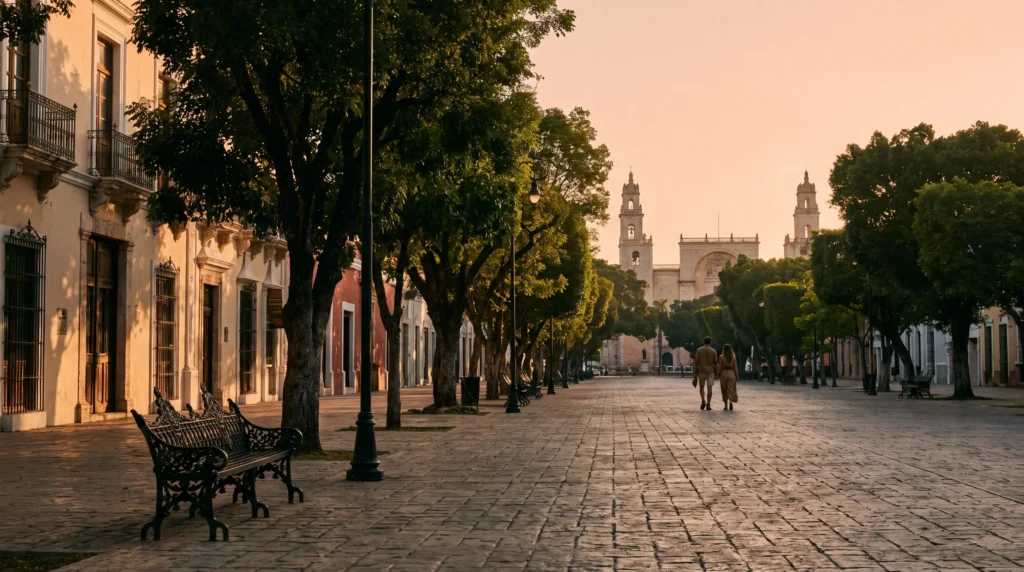
Merida Travel Guide — Mexico’s Safest Big City, Colonial Mansions & a Thousand Cenotes Next Door
I keep telling people that Merida is the Mexico trip nobody plans and everybody should. It’s a genuine city of nearly a million people with a cathedral older than anything in the United States, a boulevard built by 19th-century henequen barons trying to out-Paris Paris, and a reputation — backed by UN-Habitat’s own numbers — as the city with the best quality of life in the entire country. It has none of Cancún’s spring-break energy and none of Mexico City’s altitude or edge. What it has instead is a walkable historic core, a food scene that will quietly ruin tacos from anywhere else for you, and roughly two thousand limestone sinkholes within day-trip range once you widen the map to the whole Yucatán interior. I won’t pretend it’s undiscovered anymore — expat interest has pushed up rents in the center — but for a first Yucatán trip, or a slower alternative to the coast, it is still one of the best-value, lowest-stress bases in the country.
In This Guide
- Overview — Why Merida Is Mexico’s Most Livable City
- Hanal Pixán — Yucatán’s Day of the Dead
- Best Time to Visit Merida
- Getting There — MID Airport & Overland Routes
- Getting Around — Walking, Buses & the Vaivén
- Neighborhoods — Centro, Paseo de Montejo & Beyond
- Culture & People — Maya, Mestizo & Henequen Legacy
- A Food Lover’s Guide to Merida
- Off the Beaten Path
- Day Trips — Uxmal, Chichén Itzá & Cenote Country
- Practical Information
- Budget Breakdown — What Merida Actually Costs in 2026
- Frequently Asked Questions
Overview — Why Merida Is Mexico’s Most Livable City
Merida is the capital of Yucatán state, founded in 1542 on top of the Maya city of T’hó, and today home to roughly 922,000 people in the city proper and around 1.2 million across the metro area. It sits inland, about 35 kilometers from the Gulf coast port of Progreso, on a flat limestone plain barely 10 meters above sea level. That geography — no mountains, no ocean breeze in the historic center — is the one honest catch: Merida runs hot nearly year-round, with average temperatures swinging from the low 30s°C in December to the mid-30s°C in May.
What Merida trades for that heat is safety, walkability and history. The city earned International Safe Community certification in 2015, and in 2022 UN-Habitat’s City Prosperity Index ranked it the city with the highest quality of life in Mexico. The Centro Histórico is one of the largest colonial historic districts in the Americas, anchored by a cathedral consecrated in 1598 — built in part from stones pulled off nearby Maya structures, and generally cited as the oldest cathedral on the mainland of the Americas.
Merida is also the obvious hub for the rest of the Yucatán Peninsula’s greatest hits. Two UNESCO World Heritage Maya sites, Uxmal and Chichén Itzá, are both reachable as day trips, and the region around the city holds thousands of cenotes — the limestone sinkholes that give the peninsula its underground rivers. Compared to Cancún or the Riviera Maya, Merida is quieter, cheaper, less built for cruise-ship crowds, and — a real plus for a first Mexico trip — genuinely one of the calmer, lower-crime corners of the country.
Hanal Pixán — Yucatán’s Own Day of the Dead
Time a late-October or early-November trip around Hanal Pixán (“food for the souls” in Yucatec Maya), the regional version of Día de Muertos, observed 31 October through 2 November. Homes and businesses build altars stacked with marigolds, candles, sugar skulls and the deceased’s favorite foods, and Merida’s Paseo de Montejo hosts a citywide parade with painted faces, marigold petals and live music that draws crowds from across the peninsula.
Unlike the more famous Día de Muertos scenes in central Mexico, Hanal Pixán keeps a distinctly Yucatecan flavor: families cook mucbipollo, a large tamale baked in an underground pit oven, and cemetery visits are as much a quiet family ritual as a public spectacle. If you’re building a trip around it, book Centro hotels well ahead — this is the one week of the year Merida genuinely fills up.
Best Time to Visit Merida
November – February · Cooler, driest, high season
This is the comfortable window: daytime highs in the high 20s to low 30s°C, minimal rain, and the best weather for walking the Centro and doing multiple cenotes or ruins in a day. It’s also the busiest and priciest stretch, especially around Hanal Pixán and the Christmas–New Year period.
March – May · Hot and dry
The driest months are also the hottest, with the average annual peak around late April into May. Doable if you front-load outdoor plans for early morning and treat afternoons as pool-or-cenote time, but this is not the season for marathon ruins-hopping under a midday sun.
June – October · Rainy season
Short, heavy afternoon downpours, lush green countryside, and the year’s lowest hotel rates. June through November is the Atlantic hurricane season; direct hits on Merida itself are uncommon since the city sits inland, but tropical storms and heavy rain events do affect the whole peninsula, so travel insurance and flexible bookings are worth having.
Getting There — MID Airport & Overland Routes
Manuel Crescencio Rejón International Airport (MID) sits on the southwest edge of the city and is Merida’s only real gateway by air, with domestic connections from Mexico City, Guadalajara, Monterrey and a growing set of direct international routes from the US. Many travelers still fly into Cancún International Airport, which has far more international nonstops, and then bus or drive west — the trip covers roughly 300–320 kilometers and takes about four hours by highway. First-class ADO buses run this route multiple times daily and are the standard budget option; renting a car gives more flexibility for cenote-hopping en route.
Overland, Merida is also reachable by bus from Campeche (about two hours), Valladolid, Tulum and Playa del Carmen along the peninsula’s well-maintained toll highway network. There is no passenger rail service to Merida.
Getting Around — Walking, Buses & the Vaivén
The Centro Histórico is compact and walkable, and it’s genuinely the best way to see the mansions of Paseo de Montejo and the market stalls around the main plaza. Heat is the real obstacle, not distance — plan walking blocks for morning or evening and duck into a café or museum at midday.
For anything beyond the center, ride-hailing apps operate widely and are the easiest way to reach the airport, outlying neighborhoods, or bus terminals. City buses are cheap but route information is aimed at locals rather than visitors; the “Vaivén” bus rapid transit corridor and colectivo vans cover longer hops for a few pesos. On Sundays, several streets around the Centro close to cars for “Bici Ruta” cycling routes and the long-running “Merida en Domingo” street fair, when a bike or your own two feet are the only way through anyway.
Neighborhoods — Centro, Paseo de Montejo & Beyond
Centro Histórico
The heart of the city and almost certainly where you’ll stay: Plaza Grande, the 1598 cathedral, the Casa de Montejo, and the surrounding grid of pastel colonial houses now hosting boutique hotels, galleries and restaurants. Traffic-calmed and dense with life, especially at night when the plaza fills with families, musicians and ice-cream carts.
Paseo de Montejo
Merida’s grand boulevard, laid out in the late 1800s during the henequen (sisal) boom, when Yucatán produced much of the world’s rope fiber and its barons built French-style mansions to match their fortunes. Many survive today as museums, consulates and hotels; it’s the city’s most photogenic stretch and the natural route for the Hanal Pixán parade and Sunday closures.
Santiago
A quieter, more residential barrio just west of Centro, known for its own small plaza, a lively Tuesday-night dance gathering in the park, and some of the best casual seafood in the city.
Santa Ana & La Ermita
Historic working-class barrios on the eastern edge of Centro, with their own colonial churches, cheaper eats, and a slower pace that’s increasingly popular with longer-stay visitors priced out of the core.
Garcia Gineres & Itzimná
Leafy, upper-middle-class residential neighborhoods northwest of Centro, popular with expats and digital nomads for their quieter streets and easy access to Paseo de Montejo’s cafés without Centro’s crowds or noise.
Norte (North Merida)
The modern side of the city — shopping malls, chain restaurants, gated developments and most of the newer hotels. Convenient if you need familiar comforts or are near the Siglo XXI convention center, but it has none of the historic character that’s the reason to visit Merida in the first place.
Culture & People — Maya, Mestizo & Henequen Legacy
Yucatán has one of Mexico’s largest Indigenous populations, and Yucatec Maya is still spoken widely in towns around Merida, alongside Spanish. That heritage shows up everywhere: place names, ingredients, the huipil dresses worn at festivals, and a regional identity that Yucatecans will tell you, with some pride, feels distinct from “mainland” Mexico.
The late-19th and early-20th-century henequen boom — when Yucatán’s sisal fiber industry made Merida one of the wealthiest cities in the Americas — left behind the mansions of Paseo de Montejo and a class divide between hacienda owners and Maya laborers that still shapes local memory. Today that history is visible in restored haciendas around the region, several now boutique hotels or museums. Sunday afternoons at Plaza Grande — with jarana dancing, trova musicians and vendors — are the easiest window into contemporary Merida life, and visitors are welcome to watch from the benches.
A Food Lover’s Guide to Merida
Yucatecan food is its own distinct Mexican cuisine, built around sour orange, achiote and slow roasting rather than the chili-forward flavors of central Mexico. The signature dish is cochinita pibil — pork marinated in achiote and sour orange, wrapped in banana leaf and pit-roasted — usually eaten in tacos with pickled red onion. Its chicken cousin, poc chuc, is grilled rather than pit-cooked and just as essential.
Breakfast or a light lunch means panuchos and salbutes: fried tortillas topped with shredded turkey or chicken, lettuce, tomato and avocado, the panucho distinguished by a pocket of refried black beans stuffed inside the tortilla. Look for sopa de lima, a lime-and-turkey soup that’s the local answer to chicken noodle soup, and marquesitas — crispy rolled crepes filled with cheese and Nutella — sold from street carts around Centro at night.
Merida’s market halls, especially Mercado Lucas de Gálvez, are the cheapest and most authentic way to eat, alongside long-running local institutions serving these dishes at lunch counters rather than tourist-facing restaurants. Pair meals with horchata or a cold Montejo or León beer, both brewed in the state.
Off the Beaten Path
Mercado Lucas de Gálvez
The city’s main market, sprawling over several blocks with produce, spices, hammocks, leather huaraches and food stalls — far more real than the souvenir shops around the plaza, and a genuine sensory overload worth an hour with no agenda.
Hacienda Yaxcopoil
A former henequen hacienda south of the city, preserved with original machinery and furnishings, offering a much quieter window into the sisal-boom era than the mansions of Paseo de Montejo.
Celestún Biosphere Reserve
A coastal town about 90 minutes west, best known for boat tours through mangrove channels to see flocks of American flamingos — a full-day trip that swaps ruins and cenotes for wetlands and birdlife.
Cuzamá’s cenote trio
Southeast of the city, three connected cenotes reached the old-fashioned way — by horse-drawn cart along disused henequen railway tracks — before you drop into cool turquoise water inside limestone caverns.
Day Trips — Uxmal, Chichén Itzá & Cenote Country
Uxmal, roughly an hour south of Merida, is a UNESCO World Heritage Site inscribed in 1996 and one of the finest examples of Puuc-style Maya architecture, centered on the striking round-cornered Pyramid of the Magician. It draws far fewer visitors than Chichén Itzá, making it the better pick if you want ruins without the crowds.
Chichén Itzá, about 120 kilometers and roughly a two-hour drive east, is the peninsula’s headline site — a UNESCO World Heritage Site since 1988 and one of the New Seven Wonders of the World, famous for El Castillo pyramid and its equinox light-and-shadow serpent effect. Go at opening time to beat both the heat and the tour-bus crowds, which build fast by mid-morning.
Beyond the ruins, the Yucatán interior around Merida is riddled with cenotes — freshwater sinkholes formed as the peninsula’s limestone bedrock collapsed into underground rivers, many linked into what locals call the Ring of Cenotes. Homún and Cuzamá, both under an hour from the city, are the most popular cenote-hopping bases; both Uxmal and Chichén Itzá can be paired with a cenote stop on the same day if you start early.
Practical Information
Money. The Mexican peso traded at roughly 17.5 to the US dollar in mid-2026. Cards are widely accepted at hotels and sit-down restaurants in Centro and Paseo de Montejo; carry cash for the market, street food, taxis and smaller towns on day trips.
Safety. Yucatán state is one of only two Mexican states rated Level 1 — “Exercise Normal Precautions” — by the US State Department, the lowest of its four advisory levels, while Mexico overall sits at Level 2. Standard city-travel sense still applies — watch belongings in markets and bus stations, use licensed taxis or ride-hailing apps at night — but this is genuinely one of the calmer regions to visit.
Health. Tap water is not safe to drink anywhere in Mexico, including Merida; stick to bottled or purified water. Dengue is present across the Yucatán Peninsula, so daytime mosquito repellent matters as much as sunscreen. Confirm routine and destination-specific vaccinations with your doctor before you go.
Connectivity & entry. US, UK, Canadian and EU citizens enter visa-free with an FMM tourist permit issued on arrival, valid for up to 180 days at the immigration officer’s discretion — keep the paper or digital copy until you leave. An eSIM or local prepaid SIM gives solid coverage across Merida and the main day-trip routes. Plugs: US-style Type A/B, 127V. Time zone: Central Time (UTC-6).
Budget Breakdown — What Merida Actually Costs in 2026
Merida is one of the better-value city bases in Mexico, especially compared to Cancún or the Riviera Maya coast just a few hours east.
Budget (US$35–60/day): Hostel dorm or basic guesthouse in Centro, market lunches and street tacos, city buses and colectivos, free plaza evenings and museum days.
Mid-range (US$80–160/day): Boutique colonial-house hotel, restaurant meals, a shared van tour to Uxmal or Chichén Itzá with a cenote stop, occasional ride-hailing rides.
Luxury (US$250+/day): Restored-hacienda hotel or Paseo de Montejo mansion stay, private guided day trips with a driver, tasting-menu dinners, spa afternoons.
Fixed costs to expect: small entry fees at Uxmal and Chichén Itzá (plus a light-and-sound show fee some evenings), cenote entry fees of a few dollars each, and tipping 10–15% at sit-down restaurants where it isn’t already included.
Planning Your First Trip to Merida
Four or five nights covers Merida well: two days for the Centro and Paseo de Montejo at a slow pace, one full day for Uxmal or Chichén Itzá paired with a cenote, and a spare day for Celestún’s flamingos or the Cuzamá cenote trio. Fly into Cancún if you want the cheapest international fares and don’t mind the four-hour transfer, or into MID directly if your route allows it. Pair Merida with a few beach days in our Cancún guide, or continue the trip in our full Mexico guide for the rest of the country beyond the peninsula.
Frequently Asked Questions
Is Merida safe for tourists in 2026?
Yes, relative to most of Mexico. Yucatán state carries the US State Department’s Level 1 rating, its lowest and most favorable advisory tier, while Mexico as a whole sits at Level 2. Normal city precautions still apply, but Merida is consistently cited as one of the country’s calmest large cities.
Do I need a visa to visit Merida?
US, UK, Canadian and EU passport holders don’t need a visa — you’ll get an FMM tourist permit stamped or issued on arrival, generally valid up to 180 days depending on the immigration officer. Keep it until you leave the country.
Should I fly into Merida or Cancún?
If your only goal is Merida and the ruins nearby, flying directly into MID is simplest. If you’re combining a beach stay with Merida, Cancún usually has cheaper and more frequent international flights, with a roughly four-hour bus or drive west.
Uxmal or Chichén Itzá — which is worth the day trip?
Both are UNESCO World Heritage Maya sites and both are excellent. Choose Chichén Itzá for the single most famous pyramid in Mexico and don’t mind bigger crowds; choose Uxmal, the closer of the two, for similar grandeur with far more room to yourself.
How hot does Merida get?
Hot most of the year — April and May are the peak, with average temperatures in the mid-30s°C, while December is the coolest month. Plan outdoor time for mornings and evenings, and treat midday as cenote, museum or air-conditioning time.
Is tap water safe to drink?
No — stick to bottled or purified water throughout Merida and the wider Yucatán, the same as the rest of Mexico.
Ready to Explore Merida?
A cathedral older than the United States, a boulevard built on rope-fiber fortunes, and two UNESCO Maya cities within a morning’s drive — Merida packs an outsized trip into one of Mexico’s calmest, most livable cities. Go for the ruins and cenotes, stay for how easy the city itself makes everything feel.
Explore More
- Cancún Travel Guide — the beach half of a Yucatán Peninsula trip
- Mexico Travel Guide — plan beyond the peninsula
- Havana Travel Guide — more faded colonial grandeur, Caribbean side
- Cartagena Travel Guide — another walkable Spanish-colonial old town
How this guide was built
Published as part of Facts From Upstairs’ city guide series. Built from authoritative sources — Wikipedia’s Mérida, Yucatán entity page, UNESCO’s World Heritage inscriptions for Uxmal and Chichén Itzá, the official Yucatán state tourism board (yucatan.travel), Mexico’s official tourism portal (visitmexico.com) for entry requirements, the US State Department’s Mexico travel advisory, the US CDC traveler page for Mexico, and Banco de México for the peso exchange rate. Numeric claims carry inline citations.
Sources cited on this page
- Wikipedia — Mérida, Yucatán
- UNESCO — Pre-Hispanic Town of Uxmal
- UNESCO — Pre-Hispanic City of Chichen-Itza
- Yucatán Travel — official state tourism board, Mérida region
- VisitMexico — official tourism portal, visa & passport
- US State Department — Mexico Travel Advisory
- US CDC — Mexico traveler page
- Banco de México — exchange rate
- Travelmath — Merida–Cancún distance
- US National Hurricane Center
More city guides you might like
Plan your trip to Merida
The booking tools we use ourselves. FFU may earn a commission at no extra cost to you.
Plan & book your trip to Merida
Booking through these searches supports our guides at no extra cost to you.