
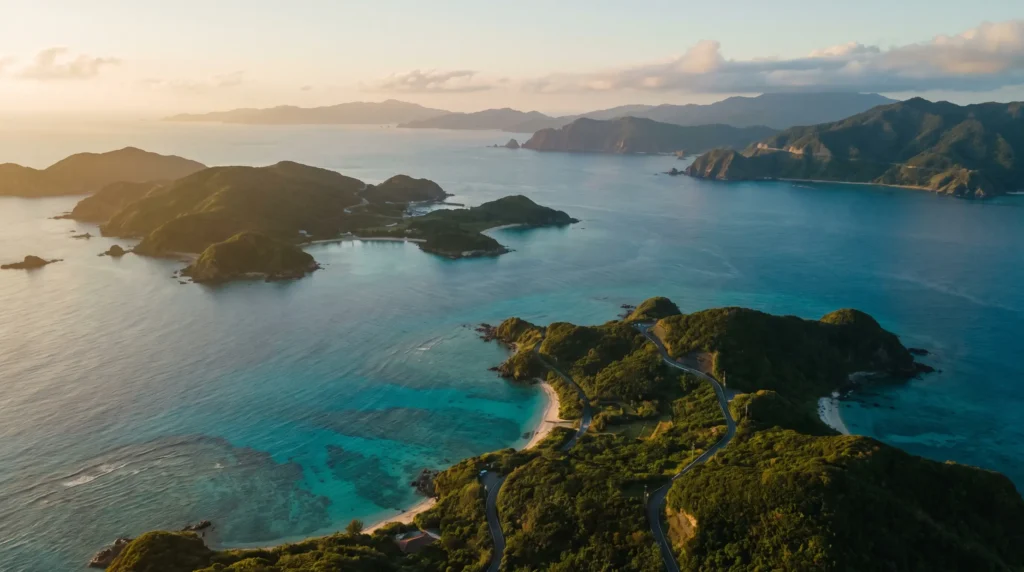
Okinawa Travel Guide — Kerama-Blue Water, Ryukyu Castles & Japan’s Slowest Island Time
Okinawa is the Japan nobody prepares you for. You land expecting bullet trains and vending-machine efficiency, and instead you get a subtropical island chain with its own language family, its own cuisine, its own centuries-old kingdom, and a sea so specific in color that it has its own name — Kerama blue. This was never quite “Japan” the way Tokyo or Kyoto are Japan; the Ryukyu Kingdom ran its own foreign policy with China and Japan for four centuries before annexation in 1879, and you can feel that independent streak everywhere — in the food, the funeral customs, the slower cadence people call uchinaa time. I’ve done the reef-and-ruins version and the just-lie-on-a-beach version, and honestly the best trips mix both: a morning at a 500-year-old castle, an afternoon snorkeling over coral, dinner built around a pork dish your doctor would not approve of. Okinawa rewards people who slow down to its speed rather than trying to Tokyo their way through it.
In This Guide
- Overview — Why Okinawa Feels Like Its Own Country
- Eisa Season & the 10,000 Dancers Parade
- Best Time to Visit Okinawa (Season by Season)
- Getting There — Naha Airport & Flight Options
- Getting Around — Yui Rail, Rental Cars & Inter-Island Ferries
- Neighborhoods & Key Areas of Naha and the Main Island
- Culture & People — Ryukyu Heritage, Uchinaa Time & the Bases
- A Food Lover’s Guide to Okinawa
- Off the Beaten Path
- Day Trips — Kerama Islands, Churaumi & the North
- Practical Information
- Budget Breakdown — What Okinawa Actually Costs in 2026
- Planning Your First Trip to Okinawa
- Frequently Asked Questions
Overview — Why Okinawa Feels Like Its Own Country
For 450 years Okinawa was the Ryukyu Kingdom, an independent maritime trading state that paid tribute to both China and Japan without fully belonging to either, until the Meiji government formally annexed it as a prefecture in 1879. That history is the whole story of why Okinawa doesn’t feel like the rest of Japan: different food, different funeral rites, different architecture, and — among older generations — different languages entirely, in the Ryukyuan family rather than Japanese dialects.
Then came the Battle of Okinawa in the spring of 1945, one of the bloodiest ground campaigns of the Pacific War, followed by 27 years of direct US administration before reversion to Japan in 1972. The scars and the complicated present are still visible: US military installations cover roughly a quarter of the main island today, a fact that shapes local politics and comes up in conversation more than you might expect for a beach destination.
None of that history stops Okinawa from being gorgeous. Okinawa Island itself runs about 107 kilometers north to south, ringed by coral reef, with a humid subtropical climate that keeps water warm most of the year. Nine gusuku (castle) and related sites across the island — Shuri Castle chief among them — were inscribed as a single UNESCO World Heritage listing in 2000, giving you genuine, centuries-deep culture to pair with the reef time. It’s marketed in Japan as the domestic Hawaii, and the comparison isn’t wrong — except the castles are older, the food is stranger and better, and almost nobody outside Japan and South Korea has heard of it yet.
Eisa Season & the 10,000 Dancers Parade
If you can time a trip around one weekend, make it the first Sunday of August, when Naha’s main street, Kokusai Dori, fills with the 10,000 Eisa Dancers Parade — taiko drums, paranku hand drums and the three-stringed sanshin driving lines of dancers in bright, knotted-turban costume down the entire thoroughfare. Eisa is Okinawa’s Obon dance, performed to send off ancestral spirits, and it traces back to organized city festivals in Koza (now Okinawa City) starting in 1956 and in Naha from 1964 — real folk tradition that scaled into a genuine spectacle rather than a tourist invention.
The Okinawa Zento Eisa Matsuri runs for three days in Okinawa City around the same period, with dozens of local youth groups competing informally to out-drum each other into the night — smaller crowds than Naha’s parade, more raw energy. If your dates land in mid-to-late July or August, check both calendars; either is worth restructuring an itinerary around, and neither requires a ticket.
Best Time to Visit Okinawa (Season by Season)
March – May · Spring shoulder (a local favorite)
Warm but not brutal, seas calming down from winter swell, and the best value window before Golden Week (late April–early May) pushes domestic Japanese travel — and prices — up sharply for about ten days. Diving visibility is good and improving toward summer.
June – September · Peak heat, peak humidity, typhoon watch
Hot, sticky, and the water is at its best for swimming and snorkeling — but this is also the core of Western Pacific typhoon season, when storms can disrupt inter-island ferries and flights with little warning. August brings Eisa season and school-holiday crowds simultaneously; book accommodation early if this is your window.
October – November · Autumn shoulder
Storm risk tapers, humidity drops, and the crowds thin out while the water is still warm enough for comfortable diving — arguably the single best window if you want fewer people without sacrificing beach weather.
December – February · Mild winter, earliest sakura in Japan
Too cool for most people to swim but mild by any other Japanese standard, and this is when Okinawa quietly does something no other part of the country can: the deep-pink Kanhizakura cherry trees bloom from late January into February, weeks before Honshu’s famous Somei Yoshino, with festivals at Nago and on Mount Yaedake drawing sakura chasers who want a head start on spring.
Getting There — Naha Airport & Flight Options
Naha Airport (OKA), on the southern edge of the city, is Okinawa’s main gateway, with domestic connections from every major Japanese hub and a growing set of international routes from Taipei, Hong Kong, Seoul and other regional Asian cities. From Tokyo, ANA, JAL and budget carriers fly Haneda–Naha in roughly two hours twenty minutes to two hours fifty, covering about 1,550 kilometers — genuinely closer to Taipei than to Tokyo in flight time.
Most Western travelers connect through Tokyo (Narita or Haneda) or Osaka (Kansai) on the way in, since there’s no realistic surface route — this is an island chain, and everything beyond the immediate main-island region requires a further flight or ferry. If your itinerary already includes mainland Japan, treat Okinawa as an add-on leg rather than a day trip: budget at minimum three to four nights to make the flights worthwhile.
Getting Around — Yui Rail, Rental Cars & Inter-Island Ferries
The Okinawa Urban Monorail, universally called Yui Rail, is the island’s only rail line and the sole survivor-successor to any railway since World War II — 17 kilometers and 19 stations running from Naha Airport through downtown Naha out to Tedako-Uranishi, a full run taking about 37 minutes for a ¥390 fare. It covers central Naha and Shuri well but stops well short of the beach resorts up the coast.
For anywhere north of Naha — the Churaumi Aquarium, Nago, the Motobu Peninsula, most beach resorts — a rental car is close to essential; Okinawa Expressway makes the drive north manageable, but public bus networks are sparse and slow by comparison. International driving permits are required for foreign licenses. To reach outlying islands like the Kerama group, high-speed ferries leave from Tomari Port in Naha, with several island-hopping options for day or overnight trips.
Neighborhoods & Key Areas of Naha and the Main Island
Naha — Kokusai Dori & Makishi
The capital and transit hub, home to roughly 320,000 people in the city proper. Kokusai Dori (“International Street”) is the tourist spine — souvenir shops, awamori bars, kitschy shisa-lion everything — while the neighboring Makishi Public Market is where locals actually shop, stacked with tropical fish, pork parts you won’t recognize, and a second-floor food court that will cook your market purchases for a small fee.
Shuri
The former royal capital, up the hill and 15 minutes from central Naha via Yui Rail, built around Shuri Castle — the seat of the Ryukyu Kingdom from 1429 until the 1879 annexation and a UNESCO-listed gusuku site. Quieter, more residential, dotted with stone-walled lanes and smaller Ryukyuan sites like Tamaudun mausoleum.
Chatan & American Village
A strip of US-influenced strip malls, boardwalk bars and a Ferris wheel next to Kadena’s perimeter — surreal, very photogenic at sunset, and the easiest place on the island to find a proper burger or a late-night bar scene.
Motobu Peninsula & Nago
The north’s tourism anchor: home to the Churaumi Aquarium, Nago’s pineapple-and-orchid attractions, and the Kanhizakura cherry blossoms that bloom earliest in Japan each January. Resorts here trade Naha’s convenience for genuinely quiet beaches.
Onna Village
The main island’s resort corridor, a strip of coastline between Naha and Nago lined with beachfront hotels and some of the best easy-access snorkeling and diving on the main island — Cape Manzamo’s cliffside views are the classic photo stop here.
Yomitan
Pottery villages, a lighthouse-topped cape, and Zakimi Castle ruins — one of the nine UNESCO gusuku sites — make this a good half-day loop for anyone based in Onna or Naha who wants ruins without a long drive.
Itoman & the South
The Battle of Okinawa’s final ground, now home to the Peace Memorial Park and Himeyuri Peace Museum — sobering, essential context for understanding the island, and a short drive from Naha.
Culture & People — Ryukyu Heritage, Uchinaa Time & the Bases
Okinawans distinguish themselves from mainland Japanese (naichaa) as Uchinaanchu, with a slower, more relational pace of life locals call “Okinawa time” or uchinaa time — meetings and buses run on a looser clock than Tokyo’s, and nobody apologizes for it. Shisa, the lion-dog guardian statues you’ll see on every roofline and gatepost, descend directly from Ryukyu Kingdom iconography and remain the island’s most recognizable folk symbol, typically displayed in pairs (mouth open to invite good fortune, mouth closed to keep it in).
The US military footprint is impossible to ignore once you notice it: bases occupy roughly a quarter of the main island’s land, a legacy of the 1945–1972 occupation era that remains a live local political issue, occasionally visible as protest signage or base-adjacent traffic. It’s worth knowing before you go rather than being surprised by it — most visitors experience it only as American Village’s strip-mall aesthetic and English-friendly signage near Kadena, not as anything that touches a typical itinerary.
Traditional Ryukyuan performing arts — Eisa drumming, sanshin music, classical Ryukyu court dance — remain living practice rather than museum pieces, taught in community centers and performed at festivals genuinely attended by locals, not staged solely for tourists.
A Food Lover’s Guide to Okinawa
Okinawan food shares almost nothing with what most visitors picture as “Japanese food.” The signature dish is goya champuru — bitter melon stir-fried with tofu, egg and thin pork or Spam slices, a genuinely acquired-taste vegetable that Okinawans credit for the island’s historic longevity reputation. Okinawa soba is a separate noodle tradition entirely from mainland soba: thick wheat noodles in a pork-and-bonito broth, usually topped with a slab of soki (stewed pork rib).
Pork runs through everything here — rafute (soy-and-awamori braised pork belly) and mimigaa (pickled pig’s ear) both use parts of the animal mainland Japanese cuisine mostly skips, a habit locals trace to Chinese culinary influence from the tribute-trade centuries. Spam and other tinned meat, a WWII-and-occupation-era holdover, shows up in everything from stir-fries to onigiri without irony. For a snack, try sata andagi, a dense fried doughnut ball sold from street stalls and markets across Naha.
To drink: awamori, Okinawa’s own distilled rice spirit, distinct from mainland sake or shochu and often aged for years in clay pots; and Orion, the local beer brand every izakaya on the island pours before reaching for a mainland label. Makishi Public Market’s upstairs food stalls are the easiest place to try several of these dishes in one sitting.
Off the Beaten Path
Kudaka Island
A small, sacred island off the southeast coast, historically considered the birthplace of the Ryukyu creation myth and still treated with a degree of reverence locals extend to few other places — some sites are closed to visitors out of respect. A short ferry from Itoman, with almost none of the crowds of the main resort coast.
Yomitan’s pottery villages
Yachimun-no-Sato gathers dozens of working ceramics studios in traditional climbing kilns, selling shisa statues and glazed tableware straight from the artisans who made them — a far better souvenir stop than anything on Kokusai Dori.
Ie Island
A short ferry from Motobu, dominated by the volcanic cone of Mount Gusuku and lily fields that bloom each spring, with a sleepy, almost entirely domestic-tourist beach scene.
Northern Yanbaru forest
Okinawa’s least-visited region: subtropical rainforest in the island’s far north, home to endemic species like the Okinawa rail, with hiking and river-kayaking outfits just starting to build infrastructure around what UNESCO recognized as a natural heritage area alongside neighboring Amami-Oshima.
Day Trips — Kerama Islands, Churaumi & the North
Kerama Islands
Twenty-plus islands roughly 30–40 kilometers off Naha, only four inhabited, famous for the exact shade of turquoise-blue water that gives the archipelago its “Kerama blue” nickname. High-speed ferries run from Tomari Port to Tokashiki (about 40 minutes), Zamami (50–70 minutes) and Aka (about 50 minutes) — all doable as a long day trip, though an overnight lets you catch sunrise on the beaches before the day-trippers arrive. January through March brings migrating humpback whales into these same waters, watchable on dedicated boat tours from Naha.
Churaumi Aquarium & the Motobu Peninsula
A roughly 90-minute drive north from Naha, Churaumi is one of Japan’s most-visited aquariums, built around a vast tank of whale sharks and manta rays; pair it with nearby Nago for pineapple farms and, in season, the earliest cherry blossoms in the country.
Southern battle sites
Peace Memorial Park and the Himeyuri Peace Museum in Itoman, less than an hour from Naha, cover the ground war’s final and bloodiest phase — heavy but essential context, and a common half-day add-on to a Naha-based itinerary.
Practical Information
Money. Japan runs on the Yen, a freely floating currency, so check the current rate before budgeting rather than assuming last year’s numbers. Cash is still preferred at smaller Okinawan restaurants and markets even as cards spread in Naha and resort areas; carry some yen for izakayas, market stalls and rural bus fares.
Safety. The US State Department rates Japan overall at its lowest advisory tier, “Exercise Normal Precautions,” with specific cautions mostly concentrated around mainland nightlife districts rather than Okinawa itself. The UK FCDO gives similar guidance, flagging Japan’s ongoing earthquake, typhoon and extreme-heat risks rather than crime as the main planning concern. Japan’s drug laws are strict and enforced without leniency for foreign visitors, even for substances legal or prescribed elsewhere.
Health. Routine vaccinations should be current before you travel; hepatitis A and, for longer rural stays, Japanese encephalitis are worth discussing with a travel clinic. Okinawa’s subtropical heat and humidity make sun protection and hydration a bigger daily concern than any single disease risk.
Connectivity. An eSIM or airport-rental pocket Wi-Fi covers the whole island reliably; hotel and cafe Wi-Fi in Naha is solid. Plugs: Type A/B, 100V — different from most of the world, so US devices work without a converter but European ones need one. Time zone: Japan Standard Time, UTC+9, no daylight saving.
Budget Breakdown — What Okinawa Actually Costs in 2026
Okinawa runs cheaper than Tokyo or Kyoto but not dramatically so — budget similarly to a mid-tier mainland Japanese destination, with resort areas pricing closer to a beach holiday than a city trip.
Budget (US$65–110/day): Naha guesthouse or capsule-style stay, Okinawa soba and market-stall meals, Yui Rail and buses, snorkeling with your own gear or a budget group tour.
Mid-range (US$150–260/day): Business hotel or a modest Onna Village resort, rental car for a few days, one dive trip or Kerama day tour, sit-down dinners mixing local and mainland Japanese food.
Luxury (US$400+/day): Beachfront resort in Onna or Motobu, private boat charters to the Kerama Islands, whale-watching tours in season, high-end kaiseki or Ryukyu-cuisine tasting menus.
Fixed costs to expect: rental car rates spike around Golden Week and Obon; marine-park or dive-operator fees on most reef excursions; and, unlike mainland Japan, real currency-risk exposure since the yen has moved significantly over the past year.
Planning Your First Trip to Okinawa
The classic split is Naha base + north loop: three nights in Naha for Shuri Castle, Kokusai Dori and a Kerama Islands day trip, then two to three nights up in Onna or Motobu for Churaumi Aquarium, beach time and Cape Manzamo, returning to Naha for the flight out. Five nights covers the essentials without rushing; seven to eight lets you add a Kerama overnight or push further north into Yanbaru. Most Western visitors pair Okinawa with a mainland leg — flying in via Tokyo or Osaka, or bookending it with the temples of Kyoto — since there’s no direct international gateway comparable to Naha’s connections through those larger hubs.
Frequently Asked Questions
Is Okinawa safe for tourists in 2026?
Yes — Japan as a whole carries the US State Department’s lowest advisory tier, and Okinawa’s specific concerns run more toward typhoons, strong currents and heat than crime. Standard precautions around swimming conditions and storm tracking during typhoon season matter more here than personal safety worries.
Do I need a visa?
Most Western passport holders — US, UK, EU, Canada and dozens more — get visa-free entry for short tourist stays, typically up to 90 days. Always confirm current entry-system requirements (electronic pre-registration systems have been rolling out for visa-exempt travelers) before you fly, since rules can change faster than guides get updated.
Is Okinawa the same as “Japan proper,” culturally?
Related but distinct. It was an independent kingdom until 1879, has its own Ryukyuan languages, its own cuisine and its own funeral and festival customs — think of it as a Japanese prefecture with a genuinely separate cultural history, not a regional variation on mainland culture.
Can I visit Okinawa without a rental car?
Naha, Shuri and the Kerama ferries are all doable via Yui Rail, bus and boat. Anywhere north of Naha — the aquarium, Nago, most beach resorts — is far easier with a car, since bus service thins out fast once you leave the capital.
Okinawa or a mainland Japan beach town?
Choose Okinawa for genuinely warm, clear water, real coral reef and a distinct culture within a single flight of Tokyo. Mainland Japan’s coastlines are cooler and less reef-oriented but easier to combine with a rail-based itinerary. Okinawa is worth treating as its own leg, not a side trip.
What’s the single best day if I only have one?
Morning at Shuri Castle, lunch at Makishi Public Market, afternoon snorkeling off Onna Village or a fast Kerama ferry run if timing allows, dinner back in Naha built around Okinawa soba and awamori.
Ready to Explore Okinawa?
Five-century-old castles a bus ride from water so blue it earned its own name, a cuisine that tastes nothing like what you expect from Japan, and a pace of life locals will tell you to just relax into. Okinawa rewards travelers willing to treat it as its own destination rather than a Tokyo add-on — go slow, and it gives more back.
Explore More
- Tokyo City Guide — the classic gateway most Okinawa trips connect through
- Kyoto City Guide — temples and gardens to pair with Ryukyu castles
- Osaka City Guide — Japan’s food capital, an easy add-on leg
- Taipei City Guide — closer by air than Tokyo, and a natural onward hop
How this guide was built
Published as part of Facts From Upstairs’ city guide series. Built from authoritative sources — UNESCO’s Gusuku Sites and Related Properties of the Kingdom of Ryukyu inscription, the Japan National Tourism Organization’s official pages on the Gusuku sites and the Kerama Islands, the Japanese Ministry of Foreign Affairs visa-exemption page, the Bank of Japan’s daily exchange rate data, the US State Department and UK FCDO Japan travel advisories, the US CDC traveler page for Japan, and Wikipedia entity pages for Okinawa Island, Shuri Castle, the Okinawa Urban Monorail and Eisa dance. Numeric claims carry inline citations.
Sources cited on this page
- Wikipedia — Okinawa Island
- UNESCO — Gusuku Sites and Related Properties of the Kingdom of Ryukyu
- Japan National Tourism Organization — Gusuku Sites
- Wikipedia — Shuri Castle
- Japan Ministry of Foreign Affairs — Visa Exemption
- US State Department — Japan
- UK FCDO — Japan
- US CDC — Japan traveler page
- Wikipedia — Okinawa Urban Monorail
- Wikipedia — Eisa (dance)
- Japan National Tourism Organization — Kerama Islands
- Bank of Japan — Daily Foreign Exchange Rates
More city guides you might like
Plan your trip to Okinawa
The booking tools we use ourselves. FFU may earn a commission at no extra cost to you.
Plan & book your trip to Okinawa
Booking through these searches supports our guides at no extra cost to you.