
City Guide · Southern California
San Diego, United States: Seventy Miles of Coast, a Year of Perfect Weather, and a Border That Shapes the Plate
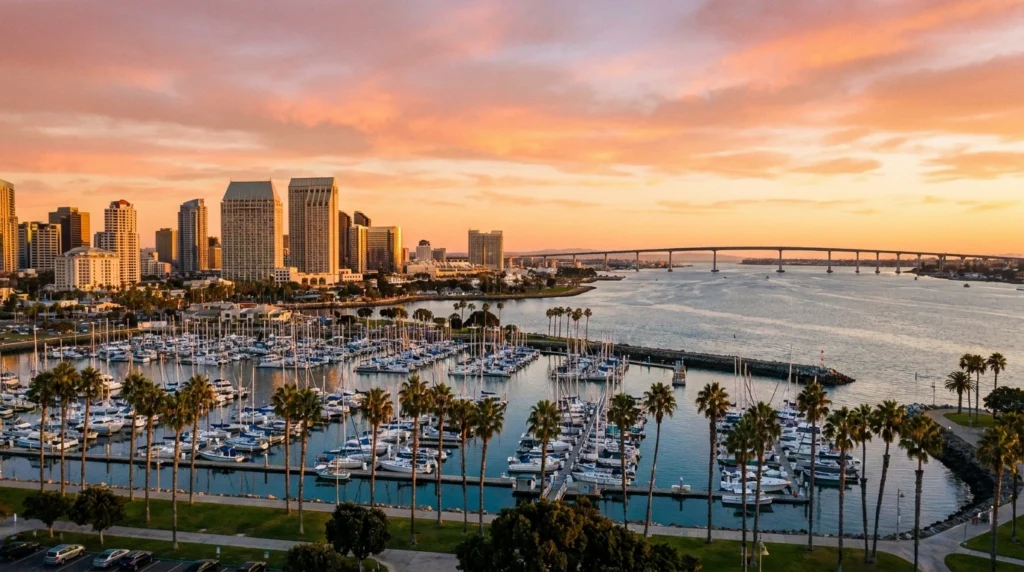
I have lost whole weeks to San Diego without ever feeling I was working at it, and that is precisely the city’s trick — it asks nothing of you but a swimsuit and a flexible dinner plan. This is a city of roughly 1.39 million people, the second-largest in California and the eighth-largest in the United States, spread along seventy miles of Pacific coastline at the very bottom corner of the country, a twenty-minute drive from the Mexican border . My favourite San Diego ritual is the slow morning: a breakfast burrito from a beach-shack taqueria, a barefoot hour watching the surf at La Jolla, then the easy decision of which of a dozen near-identical 22-degree afternoons to spend on. We tell first-timers to resist the theme-park checklist and instead let the coast and the canyons set the pace — pick a beach town to base in, accept that everything good is a short, sunny drive apart, and let the city’s astonishingly consistent weather do the rest . Treat this guide as the brief I would hand my own family before they picked up the rental car — the beaches, the fish tacos, Balboa Park, the border-shaped food, and the freeway logic.

Table of Contents
Why San Diego?
San Diego is the rare big American city that feels, almost from the moment you land, like a holiday rather than a destination to be conquered — and that ease is the whole point. The city proper holds roughly 1.39 million people, making it the second-largest in California and the eighth-largest in the United States, yet it wears its size lightly, spread thin and low along seventy miles of Pacific coast at the country’s south-western corner . It is a city you read by the coast — beach town by beach town, bay by canyon — and learning to slow to its rhythm is the single skill that turns a frantic San Diego trip into a restorative one.
The city reads as a series of gentle contradictions. It is a major US Navy and biotech hub with a serious research-university backbone, yet daily life happens in flip-flops, in taco shacks and craft-beer taprooms and on surf breaks that locals have been riding since dawn. It sits twenty minutes from the Mexican border, and that proximity shapes everything from the bilingual street life to the plate — this is the birthplace of the Americanised fish taco and a city where the best Mexican food north of the border is taken as a civic right . And it is famous for sunshine and surf, yet just inland the terrain climbs into chaparral canyons, desert, and mountains within an hour’s drive.
The weather is the secret engine. San Diego enjoys one of the most stable, benign climates of any major US city — dry, mild, and sunny for most of the year, with average highs hovering in the low twenties Celsius and rainfall concentrated into a handful of winter weeks . That reliability is why the coast organises itself around the outdoors: 1,200-acre Balboa Park, one of the largest urban cultural parks in the United States and home to the world-famous San Diego Zoo, anchors the city centre, while the beaches run almost without a break from the Mexican border up to the surf town of Oceanside .
This guide covers the beach towns and neighbourhoods you will actually base in, the fish-taco shacks and border-shaped tasting menus worth the drive, the museum-and-landmark tier (Balboa Park, the USS Midway, Cabrillo, the Gaslamp Quarter), the five day trips San Diegans themselves take on weekends, and the practical realities of ESTA, the trolley, marine-layer mornings, and the easy hop across the border. Everything here flows from one fact: the weather almost never lets you down.

Neighborhoods: Finding Your San Diego
📍 San Diego Map: Every Place in This Guide
San Diego is not a city you “do” downtown and then leave; it is a loose constellation of beach towns and inland villages, each with its own dress code, parking logic, and reason to stay. The single most important planning decision you will make is which neighbourhood you base in, because that choice quietly decides how much of your holiday you spend behind the wheel. Get it right and you can walk to dinner, the beach, and a museum; get it wrong and you spend an hour a day on the I-5 just to reach the things you came for. Below are the eight worth knowing, ordered roughly from the touristy core out to the coast and then inland to the local-favourite quarters.
A quick mental map helps. Downtown and the Gaslamp sit on the bay’s edge, with Little Italy and Balboa Park a few minutes north. The beach towns — Ocean Beach, Mission Beach, Pacific Beach — string up the coast to the west and northwest, while La Jolla caps that run with its sea cliffs. Coronado faces the city across the bay, reached by ferry or the soaring bridge, and the hip inland neighbourhoods of North Park, South Park, and Hillcrest sit just east of Balboa Park. Distances between them are short on paper but freeway-dependent in practice, which is why locals talk about the city in terms of “which side” you are staying on rather than how many miles apart things are.
The honest way to choose a base is to be clear-eyed about what kind of trip you want, because each of these neighbourhoods quietly enforces a different daily rhythm. If your holiday is built around sand and surf, you want to wake up able to walk to the water, which points you to the beach towns or Coronado and lets you forgo a car for whole days at a time. If it is built around food, museums, and nightlife, you want the walkable urban core — the Gaslamp, Little Italy, or Bankers Hill near Balboa Park — where dinner, a gallery, and a rooftop bar are all on foot and the Trolley handles the rest. And if you want to see how San Diegans actually live, the inland quarters of North Park and its neighbours trade the ocean view for cheaper rents, better coffee, and a denser run of independent shops and taprooms. Many returning visitors split the difference, spending the first half of a trip on the coast and the second in town, or vice versa, which neatly samples both halves of the city’s split personality.
One thing worth internalising before you book is just how decisive the parking question is here. Almost every coastal neighbourhood — Pacific Beach, Mission Beach, La Jolla, Ocean Beach — shares the same affliction on warm weekends: far more cars than spaces, meters that fill by mid-morning, and circling locals who know the side-street tricks you do not. A hotel or rental with its own dedicated parking spot is worth paying a premium for if you are bringing a car, and conversely, basing somewhere walkable enough that you can leave the car parked all day is the single best stress-saver a coastal San Diego trip can buy. This is the practical reason the “which side are you staying on” question matters so much: it determines not just your commute but whether your mornings begin with a beach walk or a parking hunt.


Gaslamp Quarter & Downtown
The sixteen-block Victorian core is San Diego’s nightlife and convention engine — restored 19th-century facades over rooftop bars, steakhouses, and clubs that fill on game nights at the adjacent Petco Park. It is the most walkable district in the county and the obvious base for a short, car-free first trip, with the Trolley, the bay, and the Embarcadero all on its doorstep. By day it is busy with conventioneers and cruise passengers; by evening the rooftop bars and the dining rooms along Fifth Avenue come alive, and on Padres home nights the whole quarter buzzes. The trade-off is that it goes quiet and faintly seedy in the small hours, and hotel parking is among the priciest in the city, so it suits travellers who want to step out of the lobby straight into the action rather than those after a residential calm.
- Gaslamp Quarter Historic District & Fifth Avenue
- Petco Park (San Diego Padres)
- USS Midway Museum on the waterfront
Best for: first-timers and nightlife without a car. Access: MTS Trolley Gaslamp Quarter station .
Little Italy
A few blocks north of the Gaslamp, Little Italy has quietly become the city’s best eating-and-walking neighbourhood — a tight grid of trattorias, third-wave cafés, design shops, and the sprawling Saturday Mercato farmers’ market, all stitched together by the fountain-centred Piazza della Famiglia. Once a working tuna-fishing community, it has reinvented itself over the last two decades into the place San Diegans take visitors when they want to show off the city’s grown-up side. It feels residential and lived-in in a way the Gaslamp does not, with leafy side streets, new apartment blocks, and a genuine café culture, yet it is still an easy ten-minute walk from the waterfront and the convention centre — which makes it many travellers’ favourite base for a longer, food-led stay.
- Little Italy Mercato (Saturday farmers’ market)
- Piazza della Famiglia
- India Street restaurant row
Best for: food-led couples and longer stays. Access: Trolley Little Italy station, walkable from downtown.
Balboa Park & Bankers Hill
Wrapped around the 1,200-acre park, this is the cultural heart of the city: seventeen museums, the world-famous San Diego Zoo, Spanish-Colonial pavilions, ornate gardens, and open-air theatres, with the leafy Edwardian townhouses and craftsman homes of Bankers Hill spilling down its western edge . Base here and you can be inside a gallery or strolling the rose garden before breakfast, then back for a cocktail on a Bankers Hill terrace with a bay view at dusk. It is quieter at night than the Gaslamp and more central than the beaches — a sensible compromise for culture-first travellers and families who want green space, the zoo, and the airport all within easy reach, without the surf-town parking scramble.
- San Diego Zoo
- Spanish Village Art Center & the Botanical Building
- Bankers Hill cocktail bars
Best for: families and culture-first travellers. Access: MTS bus routes 7 and 215 Rapid.
La Jolla
“The Jewel” — the literal meaning locals give the Spanish name — is San Diego’s most photogenic stretch: sea-cliff coves, a resident colony of barking sea lions, sandstone caves you can kayak into, tide pools at low water, and an upscale village of galleries, jewellers, and restaurants perched on the bluff above. The contrast within a few hundred metres is remarkable, from the gentle, family-friendly sand of La Jolla Shores to the dramatic cliff drama of the Cove and Children’s Pool. It is noticeably pricier than the rest of the coast — this is San Diego’s Beverly Hills-by-the-sea — but it earns the splurge, and even if you sleep elsewhere it deserves a full day for snorkelling, the sea-lion show, and a sunset on the bluff.
- La Jolla Cove & the sea lions
- La Jolla Shores (gentle swimming & kayaking)
- Mount Soledad veterans’ memorial viewpoint
Best for: scenery, snorkelling, and a splurge. Access: MTS bus 30 from downtown, or a 20-minute drive.
Pacific Beach & Mission Beach
This pair of adjoining beach towns is the classic California fantasy made real: a continuous boardwalk you can cycle for miles, the vintage wooden Giant Dipper roller coaster at Belmont Park, surf shops and taco windows, and a young, loud bar-and-brunch scene concentrated along Pacific Beach’s Garnet Avenue. Mission Beach occupies a narrow sandy spit between the open ocean and the calm waters of Mission Bay, so families rent bikes and surreys on one side and learn to paddleboard on the other. It is the most energetic, least polished stretch of coast — wonderful if you want the surf-and-party version of San Diego, less so if you are after quiet. Parking is the perennial headache, so arrive early or come by bus.
- Mission Beach Boardwalk & Belmont Park
- Crystal Pier
- Garnet Avenue bars (Pacific Beach)
Best for: surfers, students, and beach-first holidays. Access: MTS bus 8/9; limited paid parking — arrive early.
Coronado
Technically a tied island across the bay — reached by the graceful, sweeping 2.1-mile Coronado Bridge or the little ferry from the Broadway Pier — this genteel village is anchored by the red-roofed, turreted Hotel del Coronado of 1888 and by one of America’s most-awarded white-sand beaches, whose mineral content actually makes it sparkle in the sun. Home to a large naval base, Coronado has a tidy, slightly formal, almost small-town-East-Coast feel: manicured lawns, a walkable Orange Avenue lined with boutiques and ice-cream parlours, and bike paths along the shore. It feels a world away from the city it faces, which is exactly its appeal — base here for a slower, polished coastal stay, and cross to downtown only when you want the energy.
- Hotel del Coronado
- Coronado Central Beach
- Orange Avenue boutiques
Best for: a polished, slower coastal stay. Access: Coronado Ferry from the Broadway Pier, or the 901 bus.
Ocean Beach
The county’s bohemian holdout — a longboard-and-tie-dye village clustered around one of the longest piers on the West Coast, with dog-friendly sand at Dog Beach, a lively Wednesday farmers’ market down Newport Avenue, and a deliberately un-gentrified main drag of antique shops, taco joints, dive bars, and head shops. Locals fiercely protect its character; there are no chain hotels and the vibe stays defiantly counter-cultural. It is where San Diego keeps its 1970s soul, and the sunsets from the pier railing draw a nightly crowd of surfers, retirees, and buskers. Base here if you want the most characterful, least corporate slice of the coast and do not mind a slightly rough-around-the-edges charm.
- Ocean Beach Pier
- Dog Beach (off-leash)
- Newport Avenue antique shops
Best for: free spirits, dog owners, and sunset-watchers. Access: MTS bus 35; easiest by car.
North Park
Inland and unapologetically hip, North Park is San Diego’s craft-beer-and-coffee capital and the neighbourhood where you see how locals actually live — a walkable grid of breweries, taprooms, vintage and record shops, taquerias, brunch spots, and the lovingly restored 1929 Observatory theatre. Just east of Balboa Park, it pairs naturally with neighbouring South Park and University Heights for an easy day of grazing and browsing. San Diego County has well over 150 craft breweries, a density that has made it a global beer pilgrimage, and the stretch of 30th Street through North Park is the best single place to drink your way through a flight of them . It is the antidote to the touristy waterfront: cheaper, younger, and full of the kind of independent businesses that give a city its texture.
- 30th Street brewery corridor
- The Observatory North Park
- University Avenue cafés & vintage shops
Best for: beer lovers and design nerds who want the local side. Access: MTS bus 7 along University Avenue.
Hillcrest & South Park
Rounding out the inland cluster east of Balboa Park are two more neighbourhoods worth a visitor’s time. Hillcrest, just north of the park, is San Diego’s historic LGBTQ heart and one of its most vibrant, walkable urban villages — a dense, friendly run of brunch spots, bookstores, bars, and one of the city’s best Sunday farmers’ markets, all wrapped around the landmark neon Hillcrest sign over University Avenue. It buzzes day and night and is the most pedestrian-friendly of the inland quarters, which makes it a comfortable, central, slightly less touristy alternative base to the Gaslamp. South Park, on the park’s quieter south-eastern edge, is the leafy, residential counterpoint: a small, low-key grid of craftsman bungalows, a handful of excellent neighbourhood restaurants and cafés, and a genuine local-village feel that rewards an afternoon’s slow wander. Together with North Park they form a continuous, very liveable inland belt that shows off the everyday San Diego the waterfront hides — and all three are an easy walk or short bus ride from the museums and gardens of Balboa Park, which makes any of them a smart, affordable base for a culture-and-food trip that still wants quick coastal access by car or rideshare.
- The Hillcrest farmers’ market (Sundays)
- The neon Hillcrest sign & University Avenue
- South Park’s bungalow-lined café streets
Best for: a central, walkable, local-feeling base near Balboa Park. Access: MTS buses 1, 3, and 10; walkable from Balboa Park.
The Food

San Diego eats with a border accent. Twenty minutes from Tijuana, the city’s food culture is fundamentally Cal-Baja: this is the place that turned the humble Ensenada-style battered-fish taco into an American staple, the home of the carne-asada-and-fries “California burrito,” and the launch pad for a wave of Baja-Med chefs cooking some of the most exciting food on the West Coast. Add to that one of the country’s deepest craft-beer scenes, a serious cold-water seafood larder, and a year-round farmers’-market culture fed by the produce of inland San Diego County, and you have a city where the best meals are very often the cheapest — a $4 taco from a counter with no website can comfortably out-eat a $40 plate on the tourist waterfront.
The geography explains the menu. The cold California current offshore supplies spiny lobster, uni, and white seabass; the back country grows citrus, avocados, and tomatoes; and the constant flow of people and ingredients across the world’s busiest land border keeps the Mexican cooking here more authentic than almost anywhere else in the US. The result is a food scene that is simultaneously humble and ambitious — beach-shack taquerias and Michelin-recognised tasting menus drawing on the same Baja pantry. The strategy for eating well is simple: graze widely, follow the queues of locals, and do not skip the breweries, which often serve some of the best casual food in town.
It helps to understand the cultural logic of how San Diego eats, because it is unlike most American cities. Here, the prestige does not automatically attach to the expensive restaurant. A cult taco shop in a strip mall, a taco truck that only parks on a certain corner after dark, a Sunday-only birria stand with a line down the block — these carry just as much local pride as any white-tablecloth dining room, and often more. The flip side of the famously casual surf-town ethos is that nobody here is too proud to eat standing up out of a paper boat, and the food culture rewards that openness. So the single best piece of advice for an eating-led trip is to lower your guard about where good food is supposed to come from: the meal you will still be talking about a year later is at least as likely to come from a counter with hand-written prices and no website as from anywhere you had to book.
Timing and rhythm matter too. Breakfast is a genuine event here, built around the breakfast burrito and a strong taqueria coffee, and it is the meal most worth eating like a local — early, cheap, and ideally near the sand. Lunch is the taco hour, when the shops are busiest and the fish is freshest. Dinner stretches late and casual, often blurring into a brewery patio, and weekend brunch is practically a civic institution. Sundays add their own specialities — barbacoa, birria, menudo — at the more traditional shops in Barrio Logan and the South Bay, which are worth planning a weekend around. Keep this loose calendar in mind and you will catch each dish at its best moment rather than chasing it at the wrong time of day.
Fish Tacos & Cal-Baja
If you eat one thing in San Diego, eat a fish taco — ideally twice, once the classic battered Ensenada style and once grilled. The form crossed up from Baja California in the early 1980s and never left; the canonical version is white fish in a light beer batter, fried crisp, folded into a warm corn tortilla, and dressed with shredded cabbage, a squeeze of lime, and a cooling crema or white sauce. Today it ranges from $3 beach-shack versions eaten with sandy feet to refined, single-origin plates downtown, and arguing about the city’s best is a local sport. Order one battered and one grilled so you can taste the spectrum, and resist the urge to over-sauce — the good ones need very little help.
- Oscar’s Mexican Seafood — the cult smoked-fish and grilled-shrimp tacos (~$4)
- TJ Oyster Bar — Bonita institution for Baja-style shrimp & fish tacos (~$4–5)
- The Taco Stand — La Jolla & North Park, sleek grilled & battered fish tacos (~$5)
- Mariscos German — taco-truck royalty, the marlin and shrimp tacos (~$3–4)
Burritos & Taquerias
The California burrito — carne asada, cheese, guacamole, pico de gallo, and, crucially, french fries packed inside the tortilla — was invented in San Diego and is the city’s late-night and post-surf sacrament. It sounds like a dare and tastes like genius. Every neighbourhood defends its own taqueria with the loyalty other cities reserve for sports teams, and the best of them are unglamorous, family-run, and frequently cash-only. Beyond the California burrito, look for rolled tacos (taquitos) smothered in guacamole and cheese, carne asada fries, and Sunday-only barbacoa and birria from the more traditional shops in Barrio Logan and the South Bay.
- Lucha Libre Taco Shop — Mission Hills, the wrestling-themed “Surfin’ California” burrito (~$11)
- Las Cuatro Milpas — Barrio Logan, a century-old institution for rolled tacos & chorizo-and-egg plates (~$8)
- Lolita’s Taco Shop — the local benchmark California burrito (~$10)
- El Borrego — slow-cooked birria & barbacoa tacos (~$3 each)
Beyond Tacos and Burritos
San Diego’s plate runs well past Mexican, even if the border accent is never far away. The Pacific delivers spiny lobster and some of the country’s best sea urchin; the back country supplies the citrus, avocados, and tomatoes that anchor the farm-to-table tier; and the city’s chefs have built a genuine fine-dining and Baja-Med scene over the last decade, from Little Italy’s celebrated rooms to the experimental kitchens working both sides of the border. Brunch is a serious local institution, the craft-beer culture has spawned a parallel world of brewpub food, and the immigrant communities of City Heights add some of the city’s best Vietnamese, Somali, and Ethiopian cooking.
- San Diego uni (sea urchin) — local divers supply the city’s sushi counters; market price (~$8–14 a course)
- Carlsbad / Spiny lobster — in season Oct–Mar, sold at coastal seafood markets (~$20+/lb)
- Craft beer flight — San Diego is a global IPA capital, a four-pour flight runs ~$10–14
- Hash House A Go Go — outsized “twisted farm food” brunch (mains ~$18–24)
If you have time for a real meal out, San Diego’s standout sit-down experiences span the spectrum. Little Italy’s dining rooms cover modern Italian and seasonal Californian cooking; the waterfront has its share of polished seafood houses; and a growing number of border-spanning chefs are turning out genuinely exciting Baja-Mediterranean tasting menus. But the soul of eating here remains casual — a brewery patio, a taco window, a Sunday birria, a bag of churros after a beach walk.
The immigrant neighbourhoods deserve a special mention, because they are where the city’s most underrated food hides in plain sight. City Heights, a few miles east of Balboa Park, is one of the most diverse zip codes in the country, and its strip malls hold some of San Diego’s best Vietnamese pho, Somali and Ethiopian platters, Cambodian noodles, and Mexican home cooking, almost all of it cheap, generous, and family-run. Convoy Street in Kearny Mesa, meanwhile, is the city’s pan-Asian dining corridor — a dense, neon-lit run of Korean barbecue, Sichuan kitchens, Japanese izakayas, ramen counters, and bubble-tea shops that rivals the Asian food scenes of much larger cities. Neither of these areas is on the typical tourist map, which is exactly why they reward a detour: you eat better, pay less, and see a side of San Diego that the beaches and the Gaslamp never show. A meal in one of them is the easiest way to understand that the city’s food story is far broader than fish tacos and IPA, even if those are the headline acts.
Brunch, Sweets & Coffee
San Diego takes its mornings seriously. Brunch is a weekend ritual that stretches lazily toward lunch, and the city is dense with cafés doing serious third-wave coffee, avocado toast that actually earns its cliché thanks to the local fruit, and the outsized “twisted farm food” plates the city is known for. On the sweet side, the border accent returns: churros dusted in cinnamon sugar, Mexican pan dulce from the panaderías, paletas (fresh-fruit ice pops) on a hot beach afternoon, and the date shakes that are a Southern California desert-country tradition. Add the year-round farmers’ markets piled with stone fruit, citrus, and avocados, and a sweet tooth is very easily satisfied. None of it is expensive, and a morning pastry-and-coffee stop is one of the cheapest pleasures a San Diego trip offers.
- Breakfast burrito — the local morning sacrament, eaten on the sand (~$8–11)
- Churros & Mexican pan dulce — from a panadería or a beach stand (~$2–4)
- Third-wave coffee — North Park and Little Italy lead the scene (~$4–6)
- Paleta or date shake — fruit ice pop or a desert-country milkshake (~$4–7)
Food Experiences You Can’t Miss
Beyond any single restaurant, San Diego rewards a few set-piece food rituals that double as a way to see the city. Build at least one of these into your trip:
- A Saturday morning at the Little Italy Mercato, one of the largest farmers’ markets in the state, grazing your way down the stalls of olive oil, fresh pasta, tamales, and stone fruit before an early lunch.
- A guided taco crawl across the border in Tijuana — now a serious culinary destination in its own right — or a self-driven evening at the city’s food halls and Valle de Guadalupe wineries an hour beyond (carry your passport and budget for the return queue).
- A brewery-hop along North Park’s 30th Street corridor, the densest run of taprooms in the county, sampling the West Coast IPAs and hazy pales that made the city famous.
- An early breakfast burrito eaten on the sand after a dawn surf — the most San Diego meal there is.
Cultural Sights

San Diego’s cultural sights cluster into two main hubs — the museum-dense expanse of Balboa Park and the historic waterfront and Old Town — with the dramatic Point Loma peninsula bookending the city to the west. You could fill three days with them, but a focused traveller can hit the essentials in one full day in the park and a half-day along the bay. Most of the city’s great public spaces are free or cheap; the big-ticket items are the zoo and the museum admissions, both of which reward a multi-attraction pass.
Balboa Park
San Diego’s cultural anchor is a 1,200-acre Spanish-Colonial dreamscape of seventeen museums, ornate gardens, fountains, and open-air theatres, laid out across mesas and canyons just north-east of downtown. Founded as a city park in 1868 and built out into its ornate present form for the 1915 Panama–California Exposition, it is one of the largest urban cultural parks in the United States. You can spend a morning on art and natural history, an afternoon among the cactus gardens and the Botanical Building’s lily pond, and an evening at a Spreckels Organ Pavilion concert. Admission to the grounds and gardens is free; individual museums charge roughly $15–20, and a multi-day Explorer pass that bundles several is excellent value. Allow at least a full day, and pick up a map at the visitor centre to plan a route.
San Diego Zoo
Inside Balboa Park, the San Diego Zoo is one of the most famous in the world — a pioneer of open-air, cageless, naturalistic habitats spread over 100 hilly, lushly planted acres, and a global leader in conservation breeding. Highlights run from the long-time giant pandas’ successors and koalas to the Africa Rocks and Northern Frontier exhibits, and the guided bus tour and aerial Skyfari gondola are worth the queue for the overview they give. Admission is roughly $73 adult and $63 child for a one-day ticket, with combo passes covering the larger Safari Park up in the San Pasqual Valley. Open daily from 9am; arrive right at opening to catch the animals at their most active before the midday heat.
USS Midway Museum
The longest-serving US Navy aircraft carrier of the 20th century is now a floating museum moored at Navy Pier on the downtown waterfront, and it is one of the most visited ship museums on earth. A self-guided audio tour, narrated by sailors who served aboard, leads you across the cavernous hangar and flight decks past more than 30 restored aircraft, into the cramped berthing spaces, the galley, the brig, and up to the bridge and primary flight control. It gives a vivid, human sense of what life was like on a floating city of 4,500 sailors. Admission is around $34 adult and $24 child. Open daily 10am–5pm, with last entry at 4pm; allow two to three hours.
Cabrillo National Monument
On the dramatic tip of the Point Loma peninsula, this National Park Service site marks the 1542 landing of Juan Rodríguez Cabrillo, the first European to set foot on what is now the US West Coast. It rewards the short drive out with the single best panorama in the city — downtown, the bay, Coronado, and the Navy fleet laid out below, with the Mexican coastline beyond — plus the restored 1855 Old Point Loma Lighthouse, a small visitor centre on Cabrillo’s voyage, and excellent rocky tide pools on the ocean side. In winter it is also a prime spot to watch migrating gray whales offshore. Admission is $20 per vehicle, valid seven days. Open 9am–5pm; time your visit for low tide if you want the tide pools.
Gaslamp Quarter
A 16-block national historic district of restored Victorian commercial buildings dating from the 1880s boom years, the Gaslamp is now the city’s dining-and-nightlife heart but still wears its frontier-era architecture proudly. By daylight it is a pleasant, low-key wander past ornate brick facades, wrought-iron balconies, and the period gas lamps that give it its name; by night it transforms into the densest concentration of bars, clubs, and restaurants in the county. It is free to explore on foot, and the small Gaslamp Museum at the 1850 Davis-Horton House (around $15) tells the district’s wild-west, gambling-hall origins. Best appreciated on foot in the early evening, before the late-night crowds arrive.
Old Town San Diego
Billed as the “birthplace of California,” Old Town is preserved as a state historic park on the site of the first Spanish mission and presidio of 1769, the beginnings of the European settlement of the West Coast. The compact, mostly pedestrian site recreates the Mexican and early-American town of the 1820s–1870s with original and reconstructed adobes, a working blacksmith, a one-room schoolhouse, and costumed interpreters. Entry to the park and its little museums is free, and it is also home to the city’s most enjoyably touristy Mexican restaurants, where mariachi bands play over sizzling fajitas and house-made tortillas. Open daily; pair it with a visit to the nearby Junípero Serra Museum on the hill above.
Entertainment

San Diego’s entertainment skews outdoors and casual, but there is more after-dark life here than the beach-town reputation suggests — a beloved ballpark, a globally important beer scene, a surprisingly deep live-music calendar, and the family theme parks that draw millions a year. Here is how to spend your evenings and your rainy-day hours.
The defining feature of going out in San Diego is how affordable and unpretentious it can be if you lean into the local grain. Unlike Los Angeles or Las Vegas, the city has very little velvet-rope, bottle-service culture; the most cherished nights out here are a lawn ticket at the ballpark, a flight of beers on a brewery patio, a sunset harbour cruise, or live music in a beautifully restored old theatre. None of those requires a big budget or a reservation made weeks ahead. The one genuinely splurgy corner is the family theme parks, which are a full-day, full-price commitment, so it pays to decide in advance whether those are part of your trip and to book them online for the discounts. For everything else, the smart approach is to follow the casual, outdoorsy rhythm of the city and let the evenings stay cheap and low-key, the way locals actually do them.
Baseball at Petco Park
The San Diego Padres play Major League Baseball downtown at Petco Park, regularly rated one of the most-loved ballparks in the sport. The design is genuinely clever: the historic 1909 Western Metal Supply Co. brick warehouse is built into the left-field corner, the sightlines frame the downtown skyline and the bay, and a grassy “Park at the Park” beyond centre field lets families and budget fans sprawl on the lawn. Even if you have no interest in baseball, a summer evening here with a craft beer and carne asada fries is a quintessential San Diego night out. Tickets run roughly $20–80, with the outfield lawn the cheapest seat in the house; book ahead for weekends and Dodgers rivalry games.
Craft Beer & Taprooms
With over 150 breweries county-wide, San Diego is a genuine world capital of the West Coast IPA — the hop-forward, bitter style that the city’s brewers did as much as anyone to define. The two great hubs are walkable North Park, with its 30th Street corridor of independent taprooms, and the industrial-park sprawl of Miramar that locals call “Beeramar,” home to several of the bigger names. A tasting flight of four pours runs about $10–14 and a full pint $7–9, and many breweries run free or cheap weekend tours of their tanks. It is one of the most rewarding and affordable nights out in the city.
Live Music
For a mid-sized city, San Diego’s live-music calendar runs deep. The lovingly restored 1929 Observatory North Park handles touring indie and rock acts in a gorgeous old movie palace; the tiny, legendary Casbah near the airport has been a launchpad for the likes of Nirvana, the White Stripes, and countless local bands; and the architecturally striking, bayside Rady Shell at Jacobs Park hosts the San Diego Symphony and big-name summer concerts with the skyline as a backdrop. Tickets typically run $20–60, more for headliners; check listings for the week you are in town.
Harbour Cruises & Whale Watching
The bay and the open ocean are entertainments in themselves. Year-round narrated harbour cruises leave from the Embarcadero, gliding past the Navy fleet, the Coronado Bridge, and the downtown skyline, and there are dinner and brunch cruises for a special evening. From roughly December to April, the same operators run gray-whale-watching trips as the whales migrate down the coast, with blue whales and dolphins appearing in summer. Expect about $30–50 for a narrated harbour tour and $45 and up for whale watching; bring a warm layer, as it is cooler on the water.
SeaWorld & the Theme Parks
San Diego is a major family-holiday destination, and the marquee draws are SeaWorld San Diego on Mission Bay — with its marine shows, aquariums, and increasingly thrilling roller coasters — and LEGOLAND California, a short drive north in Carlsbad, which is pitched squarely at younger children. Both are full-day outings. Single-day tickets run roughly $70–110, but buying online well in advance, or bundling with the zoo, brings meaningful discounts; arrive at opening to beat the queues and the afternoon heat.
Gaslamp Nightlife
When the sun goes down, the Gaslamp Quarter packs the city’s densest run of rooftop bars, dance clubs, speakeasies, and late-night kitchens into its sixteen historic blocks. It ranges from polished hotel rooftops with skyline views to high-energy clubs and dive bars, and it is at its liveliest on Padres game nights and convention weekends. Expect cover charges of $10–30 at the bigger clubs and cocktails around $14–18. Things peak Thursday through Saturday; midweek is mellower and easier on the wallet.
Day Trips

One of San Diego’s quiet luxuries is how much variety sits within an hour or two of the coast — a foreign country, wine country, mountains, and the desert are all day-trippable. These are the five excursions San Diegans themselves make on weekends, roughly in order of how essential they are to a first visit.
Tijuana, Mexico (30 minutes by car/trolley)
The world’s busiest land border crossing puts an entire other country just thirty minutes from downtown, and it would be a shame to come this far and not cross. Today’s Tijuana has shed much of its old reputation to become a serious food-and-art destination: the revitalised Avenida Revolución, the buzzing food halls and craft-beer scene, the gritty-cool galleries, and — an hour beyond, in the Valle de Guadalupe — some of Mexico’s most exciting wineries and open-air restaurants. The easy way is to ride the Blue Line trolley to its San Ysidro terminus and walk across; carry your passport, keep your re-entry documents handy, and budget plenty of extra time for the northbound queue back into the US, which is the real bottleneck.
La Jolla & Torrey Pines (20 minutes by car)
Even if you are sleeping downtown, give a full day to the coast immediately north of the city. Start with La Jolla’s coves, the barking sea-lion colony, and some of California’s clearest snorkelling in the underwater ecological reserve, then drive a few minutes north to walk the wind-sculpted sandstone cliff trails of Torrey Pines State Natural Reserve, home to the rare twisted pines that grow nowhere else and to clifftop views straight down to the surf. It is the most scenic, least effortful day trip on this list. The reserve’s small car parks fill early on weekends and in summer, so aim to arrive before 10am or take the bus and walk in.
Temecula Wine Country (60 minutes by car)
An hour north on the I-15, the Temecula Valley spreads more than 40 wineries across rolling, golden hills — a genuine wine region with tasting rooms, vineyard restaurants, dawn hot-air-balloon flights, and a walkable, restored Old Town full of antique shops and gastropubs. It makes a relaxed, grown-up day out, especially in spring and autumn. Designate a sober driver or, better, book one of the wine-tour shuttles that handle the logistics; most tasting flights run about $20–30, often waived with a bottle purchase.
Carlsbad & LEGOLAND (45 minutes by car/train)
The polished North County beach town of Carlsbad makes an easy family day, pairing LEGOLAND California and its adjacent water park and aquarium with the famous spring ranunculus flower fields, a charming village of shops and cafés, and gentle, swimmable beaches. The smartest way to get there is the COASTER commuter train, which runs up the coast from downtown on a genuinely scenic, traffic-free line — a relief on summer weekends when the I-5 north clogs. Combine the village and the beach if the theme parks are not your thing.
Julian & the Mountains (90 minutes by car)
An hour and a half inland and 4,000 feet up in the Cuyamaca Mountains, the historic gold-rush town of Julian is San Diego’s apple-pie-and-pine-forest escape, and proof of how fast the landscape changes here. Expect crisp mountain air, a main street of pie shops and cider houses, hiking and big-tree forests in Cuyamaca Rancho State Park, and, on a lucky winter day, a dusting of snow that sends coastal families scrambling for the hills. Go on a weekday if you can, both to dodge the legendary weekend pie queues and to enjoy the quiet of the back country. Push another hour east and you reach the wildflower-season spectacle of Anza-Borrego, California’s largest state park, in the desert.
Seasonal Guide
San Diego’s great gift is that there is no genuinely bad time to visit — the climate is mild and dry year-round, and the difference between seasons is one of nuance, crowd levels, and price rather than wholesale change. That said, the city has its quirks, and knowing them helps you plan. The two surprises that catch first-timers out are both about the coast specifically: the late-spring and early-summer marine layer that can grey beach mornings until midday, and the fact that the ocean is actually warmest in autumn rather than at the height of summer, having spent the whole season slowly heating up. Crowds and hotel prices, meanwhile, track the school calendar far more than the weather, peaking in summer and over holidays and easing markedly in the shoulder months. Match those rhythms to your priorities and you can have near-perfect conditions at a fraction of the peak cost.
Spring (March – May)
A lovely, good-value window. Wildflowers carpet the back country and the Anza-Borrego desert, Carlsbad’s ranunculus flower fields open in a riot of colour, and daytime highs sit at a comfortable 18–21°C. The season’s one real catch is the coastal “May Gray” marine layer, a low blanket of cloud that can keep beach mornings overcast until it burns off around midday — inland and at the desert it is sunny throughout. Crowds and hotel prices are moderate, making spring one of the best-value times to come.
Summer (June – August)
This is peak season: warm, dry, reliably sunny days of 22–26°C, the warmest ocean swimming, and packed beaches, festivals, and patios — along with the highest hotel rates of the year. Early June often brings “June Gloom,” the marine layer’s encore, before the dependable sun settles in for July and August. Book accommodation well in advance, expect company everywhere, and arrive at the beaches before 10am if you want any hope of parking. The energy is fantastic, but it is the busiest and priciest time to travel.
Autumn (September – November)
Many locals’ quiet favourite, and an easy recommendation. The marine layer has vanished, the ocean is at its warmest after a summer of heating, the crowds thin noticeably once the kids go back to school after Labor Day, and the highs hold in the comfortable low-to-mid 20s°C. The only wrinkle is the occasional hot, dry Santa Ana wind day, when desert winds push temperatures up and humidity down. For the best balance of weather, value, and elbow room, this is the season to choose.
Winter (December – February)
San Diego enjoys the mildest winter of any major US city — daytime highs of 17–19°C, the bulk of the year’s modest rainfall concentrated into a handful of weeks, and the lowest crowds and rates of the year. It is prime gray-whale-watching season offshore, an excellent time for the museums, the zoo, and a snow-dusted day trip to Julian, and the desert wildflower season begins to stir. Evenings are cool, so pack a light jacket, but you can still comfortably walk the beaches by day.
Getting Around
San Diego is fundamentally a car city, but a well-chosen base lets you do a lot without one. Here is how the pieces fit together, and when each is worth using.
The MTS Trolley
San Diego’s light-rail Trolley is the backbone of car-free travel. Three colour-coded lines — Blue, Green, and Orange — connect the airport-adjacent downtown with Old Town, the Santa Fe Depot rail station, Mission Valley, the convention centre, the universities, and, on the Blue Line, all the way south to the San Ysidro border crossing for Tijuana. The newer Mid-Coast extension now runs up to UC San Diego and the La Jolla area, widening the network’s reach considerably. It is clean, frequent, safe, and cheap, and for a visitor staying downtown or near a Trolley stop it is comfortably the single most useful transit tool in the city.
MTS Buses
An extensive Metropolitan Transit System bus network fills the gaps the Trolley does not reach, most usefully the beaches (routes 8 and 9 to Pacific and Mission Beach, the 30 to La Jolla, the 35 to Ocean Beach) and Coronado (the 901). The Rapid express routes, such as the 215 along El Cajon Boulevard and the 235 from the suburbs, are quicker for longer hops. Coverage is genuinely good downtown and along the coast, but it thins out in the sprawling inland suburbs, where headways grow long and a car or rideshare becomes the practical choice.
PRONTO Cards & Fares
One simple system covers all of it. Tap the contactless PRONTO card or the PRONTO smartphone app on the reader as you board every Trolley and bus; a single one-way fare is $2.50 and a one-day pass is $6, and the app automatically caps your daily and monthly spend so you never overpay even if you ride all day. You can buy and reload a physical PRONTO card at the ticket machines in any Trolley station, or just use the app and a phone. Children under six ride free, and reduced fares apply for seniors.
Airport Access
- Route 992 “Flyer” bus to downtown — ~15 minutes, $2.50
- Taxi or rideshare to downtown — ~10 minutes, ~$18–25
Taxis & Rideshare
Metered taxis exist, with a flag-fall of roughly $2.80 plus about $3.30 a mile, but in practice almost everyone uses Uber and Lyft, which are widely available and usually cheaper than a cab. Rideshare is the sensible choice for beach trips when you do not want to fight for parking, for late nights in the Gaslamp when you have had a drink, and for the airport run, where public transit is thin and a car drops you at the door for $18–25. Surge pricing kicks in after big events and on weekend nights, so build a little buffer into your budget.
Driving & Navigation
For navigation, Google Maps and Waze are the standards, and both handle San Diego’s freeway-heavy geography well, including live traffic and the toll-free border-wait estimates. San Diego is, at heart, a car city: distances between attractions are short on the map but freeway-dependent in reality, and the genuine challenge is not driving but parking — especially at the beaches on summer weekends, where you may circle for ages. A rental car makes the day trips to Temecula, Julian, and the North County effortless and is well worth it for those, but expect to pay $30–50 a night for parking at downtown hotels and to budget time for the beach-parking scramble. Many visitors split the difference, exploring the walkable core on transit and renting a car only for the days they head out of town.
Budget Breakdown: Making Your Dollars Count
| Tier | Daily | Sleep | Eat | Transport | Activities | Extras |
|---|---|---|---|---|---|---|
| Budget | $80–130 | $40–70 hostel/motel | $20–30 tacos & markets | $6 day pass | $0–15 beaches & parks | $10 |
| Mid-Range | $180–320 | $130–220 3★ hotel | $45–70 | $25 rideshare | $30–60 zoo/museum | $25 |
| Luxury | $550+ | $350+ resort | $120+ fine dining | $60 car & parking | $100+ tours | $60+ |
San Diego can be done on almost any budget, because the things that make it special — the beaches, the weather, the coastal walks, the taco shops — are cheap or free, while the splurges are entirely optional. Use the table above as a rough daily framework, remembering that prices are in US dollars and that a 7–8% sales tax and 18–20% restaurant tipping are added on top of listed prices.
The most important thing to grasp about a San Diego budget is that the gap between a frugal trip and a lavish one is almost entirely a matter of choice rather than necessity. The city does not force expensive experiences on you the way some destinations do: you can fill day after day with free beaches, free coastal trails, the free grounds and gardens of Balboa Park, the cheap and excellent taquerias, and a few-dollars transit pass, and still feel you have had a complete, quintessential San Diego holiday. The money disappears, when it disappears, into a handful of optional big-ticket items — the resort-tier hotels in peak summer, the theme-park admissions, a rental car and its parking, and the splashier sit-down meals. The savvy traveller treats those as deliberate, occasional splurges rather than defaults, picking the one or two that matter to them and keeping everything else in the cheap-and-cheerful lane. Do that, and San Diego is genuinely one of the better-value major beach destinations in the country, despite its reputation as a pricey California city.
Where Your Money Goes
Accommodation is overwhelmingly the budget swing factor in San Diego — a beachfront room in peak summer can cost more than double the same room in the quiet of winter, so when you travel matters as much as where you stay. Food, by contrast, can be remarkably cheap thanks to the taqueria-and-food-truck culture; a couple can eat very well for $25 a head if they follow the locals rather than the tourist waterfront. Many of the headline attractions cost little or nothing: the beaches, the Balboa Park grounds and gardens, Cabrillo’s views, the Coronado shoreline, and the coastal trails are all free or nearly so. The genuine big-ticket items are the San Diego Zoo, SeaWorld, and LEGOLAND, plus a rental car and its parking. Numbeo’s cost-of-living index places San Diego among the more expensive US cities for lodging but only around average for everyday meals and groceries.
Money-Saving Tips
- Travel in the autumn or winter shoulder season for the warmest ocean swimming and the lowest hotel rates of the year — the weather is barely different from summer.
- Eat like a local: the cash-only taquerias, the food halls, the brewery patios, and the Saturday Little Italy Mercato beat the waterfront tourist restaurants on both price and quality.
- Bundle your sightseeing — a Balboa Park Explorer multi-day pass covers several museums for the price of two or three, and the PRONTO app’s automatic daily fare cap means you never overpay for transit.
- Skip the rental car for the city portion of your trip and lean on the Trolley, the Coronado ferry, and rideshare; rent only for out-of-town day trips to dodge nightly downtown parking fees.
- Book the zoo, SeaWorld, and LEGOLAND online in advance, where multi-day and combo tickets carry meaningful discounts over the gate price.
Practical Tips
Language
English is the working language everywhere, so anglophone visitors will have no difficulty at all. What is distinctive about San Diego is how genuinely bilingual it feels thanks to the border: Spanish is everyday currency, menus and signage often appear in both languages, and conversation in the best taquerias flips easily between the two. You need no Spanish to get by, but a little restaurant Spanish — a “gracias,” a “por favor,” an order placed in the local way — is warmly received and goes a long way.
Cash vs. Cards
Credit and debit cards, along with Apple Pay and Google Pay, are accepted almost universally, and many travellers go days without touching cash. That said, carry $20–40 in small bills for the cash-only taco shops, beach and street parking meters, farmers’-market stalls, and tips. Tipping is a genuine part of the cost of eating out here: 18–20% in restaurants and bars is expected and is rarely added to the bill automatically for small parties, so factor it into your budget and check whether a service charge has already been applied before adding more.
Safety
San Diego is consistently rated one of the safest large cities in the United States, with violent-crime rates well below the average for cities of its size, and most visitors feel entirely comfortable throughout. Ordinary big-city common sense still applies: keep an eye on belongings, take care in the Gaslamp Quarter and the East Village late at night when the bars empty, and do not leave valuables visible in a parked car. In the water, respect the ocean — swim near a lifeguard tower, obey the coloured warning flags, and be especially careful of rip currents, which are the genuine hazard at the beaches.
What to Wear
San Diego is famously, almost defiantly casual — flip-flops, shorts, and a T-shirt will see you through nearly everything by day, and even smart restaurants lean relaxed. The thing first-timers underestimate is the evening chill: the ocean keeps nights and marine-layer mornings noticeably cooler than the sunny afternoons, so always pack a light jacket or hoodie. A single smart-casual outfit is plenty for the Gaslamp’s nicer dining rooms and rooftop bars; there is almost nowhere in the city that requires a jacket and tie.
Cultural Etiquette
The prevailing mood is relaxed, friendly, and unhurried — “no worries” is practically the civic motto, and a laid-back beach courtesy governs daily life. In the water, respect surf etiquette above all: never drop in on a wave another surfer is already riding, and wait your turn in the line-up. On the sand, keep noise and music down near families, clean up after yourself and your dog, and note that fires are only allowed in designated pits. Recreational cannabis is legal for adults but cannot be consumed in public, and open alcohol is banned on most beaches and boardwalks.
Connectivity
Mobile coverage and free public Wi-Fi are excellent across the city, in cafés, hotels, the airport, and many public spaces. Visitors from abroad will find the simplest option is a US eSIM activated on arrival, or an international roaming plan from their home carrier; coverage from all the major US networks is strong throughout the metro area and reaches the day-trip towns, though it can drop out in the back-country mountains around Julian and in parts of the desert.
Health & Medications
The US has no national health service, so travel insurance is essential — a routine clinic visit can cost hundreds of dollars. Pharmacies (CVS, Walgreens) are everywhere for over-the-counter needs, and the sun is strong year-round, so pack high-SPF sunscreen.
Luggage & Storage
The airport and downtown have luggage-storage services (Bounce, Vertoe, and hotel bell desks) if you arrive early or leave late; most beach towns do not, so plan around your hotel check-in times.
Frequently Asked Questions
How many days do I need in San Diego?
Four to five days is the sweet spot for a first visit, and it divides up neatly: one day for downtown, Balboa Park, and the zoo; one for the La Jolla and Torrey Pines coast; one for the beach towns and a Coronado afternoon; and one or two for a day trip to Tijuana, Temecula wine country, or the mountains at Julian. Three days will cover the essential highlights if you stay focused, while a full week lets you actually adopt the city’s slow rhythm — beach mornings, long lunches, and unhurried sunsets — which is really the whole point of coming here.
Is San Diego good for solo travellers?
Very much so. It is safe, friendly, easy to navigate, and full of natural openings for conversation. There is a sociable hostel scene in Pacific Beach and the Gaslamp, the neighbourhoods are walkable, and the abundance of counter dining at taquerias, breweries, and food halls means eating alone never feels awkward. The relaxed, outdoorsy surf-town culture makes it easy to strike up a chat — at the line-up, on a brewery tour, or over a flight of beers — and a solo traveller will rarely feel out of place. The activity-based social scene helps enormously: group surf lessons, kayak tours of the La Jolla caves, brewery crawls, and whale-watching trips all throw you together with other travellers, so even a shy solo visitor can find easy company. Practically, base yourself somewhere walkable and well served by the Trolley so you are not dependent on driving alone at night, keep the usual big-city awareness in the Gaslamp after the bars empty, and you will find San Diego one of the most relaxed and welcoming US cities to explore by yourself.
Do I need a car in San Diego, or is transit enough?
It genuinely depends on your itinerary. The Trolley, the MTS buses, and the Coronado ferry comfortably cover downtown, Balboa Park, Old Town, and Coronado, so a car-free city break is entirely realistic if you base near a Trolley line. Where transit struggles is the beaches and the out-of-town day trips, which are far easier with your own wheels. The smart compromise that many visitors land on is to explore the urban core on transit and rideshare and rent a car only for the specific days they plan to chase beaches or leave the city, which also dodges the steep nightly downtown parking fees.
What about the language barrier?
There is none for English speakers — English is universal across the city, from hotels and restaurants to transit and attractions. San Diego’s bilingual, border-shaped culture means Spanish is also very widely spoken, but this is a bonus rather than any kind of barrier. You will never struggle to be understood, and the only Spanish you might want is a few polite words to use in the best family-run taquerias, where it is always appreciated.
When is the best time to visit San Diego?
Autumn, roughly September to November, is many locals’ top pick: the ocean is at its warmest, the skies are clear after the marine layer has gone, the crowds thin out after the summer peak, and hotel rates drop accordingly. Spring is also excellent value and very pleasant, with the one caveat being the coastal “May Gray” and “June Gloom” cloud that can grey late-spring and early-summer mornings before burning off. Honestly, though, there is no bad time — even winter is mild and dry by any other city’s standard.
Can I use credit cards everywhere?
Almost everywhere — cards, contactless, and mobile payment such as Apple Pay are the default across the city, and many travellers barely touch cash. The exceptions are some of the best cash-only taco shops, beach and street parking meters, and small market stalls, so it is worth carrying $20–40 in small bills. Remember too that US tipping (18–20% in restaurants and bars) is added by you rather than included in the menu price, and that a sales tax is added at the register, so the final total runs a little above the listed figure.
Is it easy to cross the border to Tijuana from San Diego?
Yes, surprisingly so. The Blue Line trolley runs straight from downtown to the San Ysidro crossing — the busiest land border in the world — where you can simply walk across into Tijuana in a matter of minutes. Always bring your passport and keep your re-entry documents handy. The one real catch is the northbound return queue back into the United States, which can range from about 30 minutes to well over two hours depending on the day and time, so cross early in the day, build in a generous buffer, and avoid heading back on a Sunday evening when the wait is at its worst.
Ready to Experience San Diego?
Pick a coast town, eat the fish tacos, and let the weather plan the rest — San Diego rewards the unhurried traveller above all. For the full country context, read the United States Travel Guide.
Explore More City Guides
Where to Stay
Base yourself in the Gaslamp for a car-free first trip, in La Jolla or Coronado for a coastal splurge, or in North Park for the local craft-beer side of the city. For more California, our sibling guides cover the rest of the coast.
- Los Angeles City Guide
- San Francisco City Guide
- Las Vegas City Guide
- United States Country Guide
- All City Guides
Alex the Travel Guru
Alex has spent two decades turning long, sun-soaked research trips into the kind of brief you’d actually want before a holiday — opinionated, practical, and obsessively fact-checked. For San Diego that meant a lot of fish tacos, a lot of marine-layer mornings, and a firm belief that the best plan here is the one that leaves room to do nothing at all.
More city guides you might like

Plan your trip to San Diego
The booking tools we use ourselves. FFU may earn a commission at no extra cost to you.
Plan & book your trip to San Diego
Booking through these searches supports our guides at no extra cost to you.