
Sigiriya Travel Guide — Climbing Sri Lanka’s Lion Rock, the Right Way
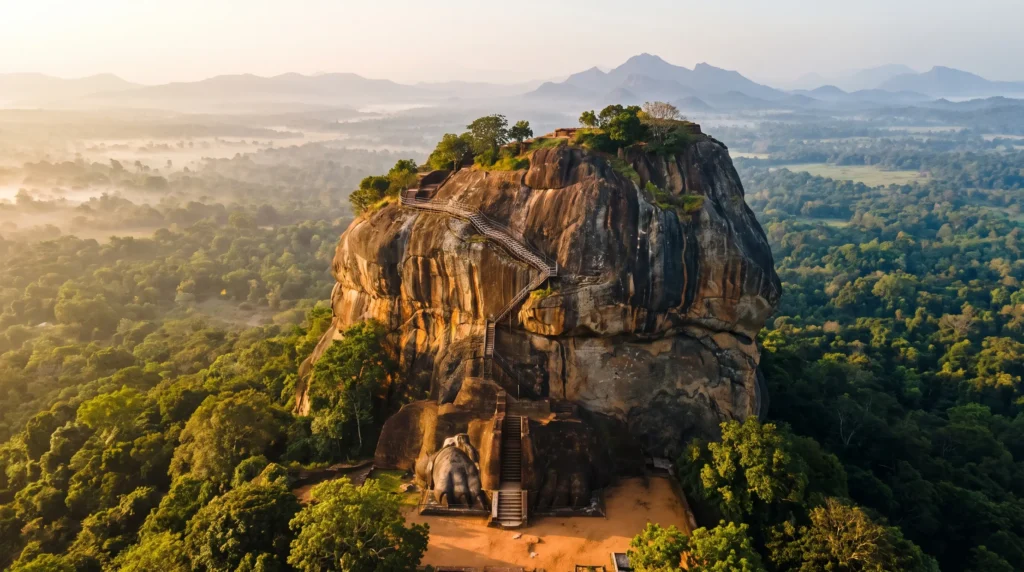
I will tell you the thing every other guide buries: the famous “Lion’s Gate” at Sigiriya lost its lion’s head centuries ago, so what you’re actually climbing past is a pair of enormous stone paws — and somehow that’s more impressive, not less, because it means the whole carved beast was once bigger than a house. This is a rock fortress a fifth-century king built on top of a 180-metre granite outcrop, part palace, part pleasure garden, part paranoid bunker against a brother he’d deposed — and somehow it still works exactly as a viewpoint, a hike, and a genuine “how did they do this” moment all at once. It’s Sri Lanka’s single most-visited paid attraction for good reason, and it’s also hot, steep, and crowded by mid-morning if you don’t plan around it — so let’s plan around it.
In This Guide
- Overview — Why Sigiriya Stops People Mid-Sentence
- The Minneriya Elephant Gathering — Sigiriya’s Neighbor Event
- Best Time to Visit Sigiriya
- Getting There — Airports, Trains & the Habarana Junction
- Getting Around Sigiriya
- Key Areas — The Rock, Pidurangala & the Village
- Culture & People
- A Food Lover’s Guide to Sigiriya
- Off the Beaten Path
- Day Trips from Sigiriya
- Practical Information
- Budget Breakdown — What Sigiriya Actually Costs in 2026
- Frequently Asked Questions
Overview — Why Sigiriya Stops People Mid-Sentence
Sigiriya sits in Sri Lanka’s Central Province, Matale District, a short drive from the town of Dambulla, and it’s built around one improbable object: a sheer granite monolith rising about 180 metres from the surrounding jungle plain, with the archaeological site itself perched at roughly 349 metres above sea level. King Kashyapa built his royal citadel on top of it during his reign from 477 to 495 CE, in the Anuradhapura period, reportedly after deposing his father and fleeing potential retaliation from his half-brother’s forces. Whatever the palace intrigue, the engineering that survives is the real headline: water gardens, boulder gardens and terraced gardens climb the base in sequence, among the oldest surviving landscaped gardens in the world, feeding into moats and hydraulic systems that still function today.
Partway up, you pass through what’s left of the Lion Gate — two colossal carved paws flanking a staircase, all that remains of a lion’s face and body that once formed the final approach to the summit. Nearby, a sheltered gallery preserves a fraction of the site’s original frescoes — the “Sigiriya damsels” — from a painted surface that once ran some 140 metres by 40 metres across the rock face; most of it is long gone, and what survives was restored after a 1967 vandalism attack, completed by April 1968. UNESCO inscribed the whole site as the “Ancient City of Sigiriya” World Heritage property in 1982, citing its artistic, cultural and engineering value.
Here’s the honest part: Sigiriya is genuinely Sri Lanka’s most-visited paid attraction, and it shows. The climb is a real workout — narrow metal staircases bolted to a cliff face, no shade, and by 10am a queue forms at the final ascent. It’s absolutely worth it. It’s just not a casual stroll, and I’d plan the whole day around avoiding the worst of the heat and the crowds rather than around anything else.
The Minneriya Elephant Gathering — Sigiriya’s Neighbor Event
If you’re picking a month to visit Sigiriya, let the elephants tip the scales. From roughly July through October, as the dry season empties smaller water sources across the North Central Province, wild Asian elephants converge on the shrinking Minneriya Tank — a 25-minute drive from Sigiriya — to drink and graze on the exposed grassland. At the peak, typically August and September, jeep safaris regularly report 200 to 300 elephants visible at once — one of the largest elephant gatherings anywhere in Asia.
Practically: book a half-day safari (most Sigiriya hotels and every tuk-tuk driver in town can arrange one) out of Minneriya or the adjoining Kaudulla National Park, and pair it with a late-afternoon Sigiriya climb once the sun has softened. It’s the single best two-activity day this region offers, and unlike the rock climb, nobody minds if you show up sweaty.
Best Time to Visit Sigiriya
January – March · Driest window
The most reliable stretch for a comfortable climb — lower humidity, minimal rain, best long-distance visibility from the summit. Also peak season for the whole Cultural Triangle, so book cave-hotel rooms in Sigiriya town ahead.
April – June · Hot shoulder
Temperatures climb before the southwest monsoon properly sets in over the island’s wet zone (which barely touches this dry-zone region anyway). Fewer crowds, still generally climbable, but midday heat on the exposed staircases is brutal — go at opening time.
July – September · Elephant season
The dry-zone advantage: this region doesn’t get the southwest monsoon rains that soak Sri Lanka’s south and west coasts in these months, so Sigiriya and Habarana stay dry and hot while Galle and the beaches get wet. This is exactly when the Minneriya elephant gathering peaks.
October – December · Wettest
The northeast monsoon brings this region’s main rains, heaviest around October–November. Showers tend to be short, intense afternoon downpours rather than all-day washouts, and the gardens and moats look their greenest, but come prepared for mud on the lower terraces and slippery rock stairs.
Getting There — Airports, Trains & the Habarana Junction
There’s no airport or train station in Sigiriya itself. Nearly everyone arrives via Bandaranaike International Airport (CMB) outside Colombo, Sri Lanka’s sole major international gateway, then continues overland — a private car or taxi transfer typically takes 3.5 to 4.5 hours depending on traffic, covering roughly 170–180 kilometres of mostly two-lane highway.
By rail, there’s no direct line to Sigiriya, but the Colombo Fort–Habarana–Polonnaruwa/Trincomalee/Batticaloa line stops at Habarana station, about 10 kilometres from Sigiriya and roughly 25 kilometres from Dambulla — from there it’s a short tuk-tuk or taxi hop. Long-distance buses run from Colombo’s Bastian Mawatha terminal toward Dambulla, with a change for the final short leg into Sigiriya town. Most travelers combine Sigiriya with Kandy (about 91 kilometres away by road) either before or after, since it sits roughly in the middle of the classic Colombo–Kandy–Cultural Triangle loop.
Getting Around Sigiriya
Sigiriya town is tiny and spread along a single main road, so you won’t be navigating a metro or bus network — you’ll be negotiating with tuk-tuk drivers. A tuk-tuk (three-wheeler) is the default way to shuttle between your hotel, the rock’s entrance, Pidurangala, and dinner; agree the fare before you climb in, or ask your guesthouse to book a driver for the day at a flat rate, which is usually cheaper than per-trip haggling.
Hired cars with drivers are the standard way to cover the wider Cultural Triangle (Dambulla, Polonnaruwa, Minneriya, Kandy) — most visitors book one for their whole Sri Lanka trip rather than per-day here. Self-driving is legal for visitors with an International Driving Permit but genuinely uncommon; Sri Lankan road etiquette and the sheer volume of buses, tuk-tuks and livestock sharing the tarmac make a local driver worth the modest cost. Walking works fine within Sigiriya town itself and around the rock’s base, but the archaeological site and Pidurangala are climbs, not strolls — wear proper shoes, not sandals.
Key Areas — The Rock, Pidurangala & the Village
Sigiriya Rock & the Archaeological Site
The main event: ticketed entry through the water gardens and boulder gardens, up past the Lion’s Paws terrace, to the summit ruins of Kashyapa’s palace. Budget two to three hours round trip including photo stops, and go either at the 7am opening or in the late afternoon to dodge both heat and tour-bus crowds.
Pidurangala Rock
The unofficial “photograph Sigiriya from the outside” spot — a separate, smaller rock a short tuk-tuk ride away with a rougher scramble to the top, a Buddhist temple partway up, and arguably the single best sunrise view over Sigiriya Rock itself in the region. Cheaper entry, thinner crowds, and most guides consider it the essential companion climb rather than an alternative.
Sigiriya Village
The strip of guesthouses, mid-range hotels and a handful of boutique cave-style properties clustered along the main road toward the site entrance. This is where you’ll actually sleep, eat, and hire tuk-tuks — small, walkable, and increasingly geared entirely to the tourist trade.
Habarana
The transport and safari hub 10 kilometres away, with the nearest train station and easiest access to both Minneriya and Kaudulla National Parks. Several elephant-safari and jeep-tour operators are based here rather than in Sigiriya proper.
Dambulla
The nearest real town, about 20 minutes south, home to the Rangiri Dambulla Cave Temple — a separately UNESCO-listed cave monastery complex with five sanctuaries, murals covering some 2,100 square metres and 157 statues, inscribed in 1991. Dambulla also has the region’s main produce market and better bank/ATM access than Sigiriya village.
Culture & People
Sigiriya sits within Sri Lanka’s Sinhala-majority Central Province, part of a country of roughly 21.8 million people where Sinhala and Tamil are the official languages and English is widely used in government, education and tourism. Buddhism is the island’s majority religion and its imprint is everywhere here — Kashyapa’s fortress itself later became a Buddhist monastery for centuries after the royal court moved on, and the working temple at Pidurangala is a direct descendant of that same monastic tradition.
Dress modestly at temple sites — shoulders and knees covered, shoes off before entering shrine rooms — and expect to remove footwear at several points on the Pidurangala climb too. Village life here still runs on agriculture and, increasingly, tourism income; a village-walk or bullock-cart experience through the paddy fields and home-cooked lunch, offered by several Sigiriya guesthouses, is a good-faith way to put money directly into local hands rather than only into hotel chains.
A Food Lover’s Guide to Sigiriya
This is rice-and-curry country in the classic Sri Lankan sense: a mound of rice surrounded by four or five small curries — often dhal, jackfruit or pumpkin curry, a green-leaf mallung, and a fiery sambol — usually served on a banana leaf at village restaurants around the site entrance. Breakfast leans toward string hoppers (steamed rice-noodle nests) or kottu roti, chopped flatbread stir-fried with egg, vegetables and your choice of meat on a sizzling griddle.
Because Sigiriya is squarely inland, seafood is less of a draw than it is on the coast; instead lean into freshwater fish curry, buffalo-milk curd with treacle (kithul palm syrup) for dessert, and king coconut water straight from the shell at every roadside stall — the single best rehydration after the climb. Several hotels and guesthouses run cooking classes pairing a market visit with a hands-on curry lesson, a good rainy-afternoon alternative to a second rock climb.
Off the Beaten Path
Sigiriya Museum
Easy to skip, worth the twenty minutes: exhibits on the site’s engineering, the frescoes, and Kashyapa’s story, air-conditioned and usually near-empty even when the rock itself is heaving.
Kaudulla National Park
Minneriya’s quieter neighbor, part of the same elephant corridor but with a fraction of the jeep traffic — worth asking your safari operator to route here instead, especially outside the July–September peak.
Ritigala Strict Nature Reserve
A forested, largely unrestored monastic ruin site northwest of Sigiriya, reachable with a local guide and a 4×4 — ancient stone pathways swallowed by jungle, with essentially no other visitors on most days.
Village bullock-cart and canoe circuits
Several Sigiriya operators run a half-day loop through paddy fields by bullock cart, a dugout-canoe paddle across a village tank, and a home-cooked lunch — a low-key, low-cost counterpoint to the ticketed heritage sites, and a direct way to support village households.
Day Trips from Sigiriya
Polonnaruwa
Sri Lanka’s medieval capital, roughly an hour’s drive away, and itself a separate UNESCO World Heritage Site — a compact, bicycle-friendly archaeological park of temples, moated palace ruins and the monumental Gal Vihara Buddha statues carved from a single granite outcrop. Easily paired with Sigiriya in one long day if you start early.
Dambulla Cave Temple
Twenty minutes south; the largest and best-preserved cave-temple complex in Sri Lanka, with five painted sanctuaries dating back over two millennia. Combine it with the nearby Golden Temple complex at the hill’s base.
Minneriya & Kaudulla safaris
Covered above under the elephant gathering — a half-day jeep safari is the standard add-on and, in July–September, arguably the highlight of the whole area.
Kandy
Sri Lanka’s hill-country cultural capital, about 91 kilometres and roughly 2.5–3 hours by road, home to the Temple of the Sacred Tooth Relic and the annual Esala Perahera pageant. Most itineraries treat Kandy as an overnight stop rather than a same-day round trip given the drive time.
Practical Information
Money. The Sri Lankan rupee floats freely and has moved significantly against the US dollar in recent years; check a current rate before budgeting, as it was trading around 335 LKR per USD in July 2026. Cards work at hotels and larger restaurants; carry rupee cash for tuk-tuks, village meals and site tickets, some of which are USD-denominated but settled in rupees at the counter.
Visa. All foreign visitors need an Electronic Travel Authorization before departure. As of 25 May 2026, nationals of 40 countries — including the US, UK, Canada, most of the EU and Australia — get a free 30-day, double-entry tourist ETA; other nationalities still pay the standard ETA fee. Apply only through the official eta.gov.lk site.
Safety. The US State Department rates Sri Lanka Level 2, “Exercise Increased Caution,” citing occasional unrest, isolated terrorism concerns, and marked minefield areas in parts of the east — none of which affects the Sigiriya/Cultural Triangle route directly, but check current guidance before travel. The UK FCDO flags bank-card fraud as a real, common risk — use ATMs inside banks or hotels, and keep your card in sight when paying.
Health. Dengue is present year-round with periodic spikes; there is no substitute for mosquito-bite prevention — repellent, covered skin at dawn and dusk, and screened or air-conditioned rooms. Drink bottled or filtered water, and carry electrolytes for the rock climb — heat exhaustion is the more common holiday-ender here than anything exotic.
Connectivity & other basics. A local SIM or eSIM from Dialog or Mobitel gives solid 4G coverage even in Sigiriya village. Plugs: a mix of British-style three-pin (Type D/G) sockets, 230V — bring an adapter. Time zone: Sri Lanka Standard Time, UTC+5:30, no daylight saving.
Budget Breakdown — What Sigiriya Actually Costs in 2026
Sigiriya itself is inexpensive to sleep and eat in; the main line item is the rock’s foreign-visitor entrance ticket, priced around US$30 for adults, which most travelers only pay once.
Budget (US$30–60/day): Guesthouse room, rice-and-curry meals at village restaurants, tuk-tuk transfers, the Sigiriya ticket amortized over a short stay.
Mid-range (US$80–160/day): Comfortable hotel with a pool near the site entrance, a private driver for day trips to Polonnaruwa or Dambulla, a half-day Minneriya safari (typically US$40–70 per person including jeep and park fees), restaurant dinners.
Luxury (US$250+/day): Boutique cave-style or design hotels with rock views, private guided tours of the Cultural Triangle, a dedicated vehicle and driver for the whole regional loop.
Fixed costs to expect: the Sigiriya entrance fee, separate entry fees at Polonnaruwa and Dambulla if you visit them, national park entry plus jeep hire for safaris, and small tips for drivers and guides — 10% is generally appreciated, not obligatory.
Planning Your Trip to Sigiriya
Most itineraries treat Sigiriya as a two-night stop inside a wider Sri Lanka loop: fly into Colombo, spend a night or two in the capital, drive up through the Cultural Triangle for Sigiriya, Dambulla and Polonnaruwa, add Kandy on the way back, and finish on a beach. Two nights in Sigiriya is enough for the rock, Pidurangala and one safari; three lets you add a Ritigala or village day. Pair this leg with our full Sri Lanka travel guide for the island-wide itinerary, and start or end in our Colombo city guide for the airport-adjacent capital.
Frequently Asked Questions
Is climbing Sigiriya hard?
It’s a genuine climb — roughly 1,200 steps in stretches, including exposed metal staircases bolted to the cliff near the summit, with no shade for most of the route. Anyone reasonably fit can do it, but go early or late to avoid climbing in full midday sun, and expect two to three hours round trip.
Do I need a visa to visit Sri Lanka for Sigiriya?
Yes — an Electronic Travel Authorization is required for every foreign visitor. Since 25 May 2026, 40 nationalities including the US, UK, Canada and most EU countries get a free 30-day, double-entry tourist ETA; apply online in advance through the official eta.gov.lk portal only.
Is Sigiriya safe?
Yes, for the areas travelers actually visit. Sri Lanka overall sits at a Level 2 “Exercise Increased Caution” US advisory, largely tied to occasional political unrest and specific minefield zones in the east, well away from the Cultural Triangle. The most common real risk here is heat exhaustion on the climb and card-skimming at ATMs, not crime.
Sigiriya or Pidurangala — which climb first?
Do both if you have two days: Sigiriya for the archaeology and gardens, Pidurangala at sunrise for the view of Sigiriya itself from across the valley. If you only have time for one, most repeat visitors say Pidurangala’s view is the more memorable photo, but Sigiriya’s ruins are the more complete experience.
How much time do I need in Sigiriya?
Two full days covers the rock, Pidurangala and a Minneriya or Kaudulla safari comfortably. Add a third for Polonnaruwa or Dambulla if you don’t plan to see them from elsewhere in your Sri Lanka route.
What’s the best month for both the climb and the elephants?
August or September: the dry season keeps the climb comfortable and coincides with peak elephant numbers at Minneriya, typically 200–300 animals visible at once.
Ready to Explore Sigiriya?
A fifth-century king’s fortress on top of a bare granite dome, painted ladies still smiling from a cliffside gallery, and — if you time it right — a few hundred wild elephants wading into a lake down the road. Sigiriya rewards showing up early, dressing for a real climb, and building in one lazy safari afternoon to balance it out.
Explore More
- Sri Lanka Travel Guide — the full island itinerary around Sigiriya
- Colombo City Guide — the capital and main international gateway
- Malé City Guide — a very different Indian Ocean escape, just a short flight away
- Kathmandu City Guide — more temple-and-mountain heritage travel in South Asia
How this guide was built
Published as part of Facts From Upstairs’ city guide series. Built from authoritative sources — UNESCO’s Ancient City of Sigiriya World Heritage inscription and List of World Heritage Sites in Sri Lanka, Sri Lanka’s official ETA visa portal (eta.gov.lk), the Central Bank of Sri Lanka’s exchange rate data, the US State Department and UK FCDO Sri Lanka travel advisories, the US CDC traveler page for Sri Lanka, Wikipedia entity pages for Sigiriya, Sri Lanka and the Dambulla Cave Temple, and specialist regional sources on Sigiriya’s ticketing and the Minneriya elephant gathering. Numeric claims carry inline citations.
Sources cited on this page
- Wikipedia — Sigiriya
- UNESCO — Ancient City of Sigiriya
- Wikipedia — List of World Heritage Sites in Sri Lanka
- Wikipedia — Dambulla Cave Temple
- Wikipedia — Sri Lanka
- Sri Lanka Official ETA Portal — Visa Information
- Central Bank of Sri Lanka — Exchange Rates
- US State Department — Sri Lanka Travel Advisory
- UK FCDO — Sri Lanka Travel Advice
- US CDC — Sri Lanka Traveler Page
- Rome2Rio — Bandaranaike Airport to Sigiriya
- Rome2Rio — Kandy to Sigiriya
- Sigiriya Fortress — Opening Hours & Ticket Prices
- Natural World Safaris — Elephant Gathering in Minneriya
More city guides you might like
Plan your trip to Sigiriya
The booking tools we use ourselves. FFU may earn a commission at no extra cost to you.
Plan & book your trip to Sigiriya
Booking through these searches supports our guides at no extra cost to you.