
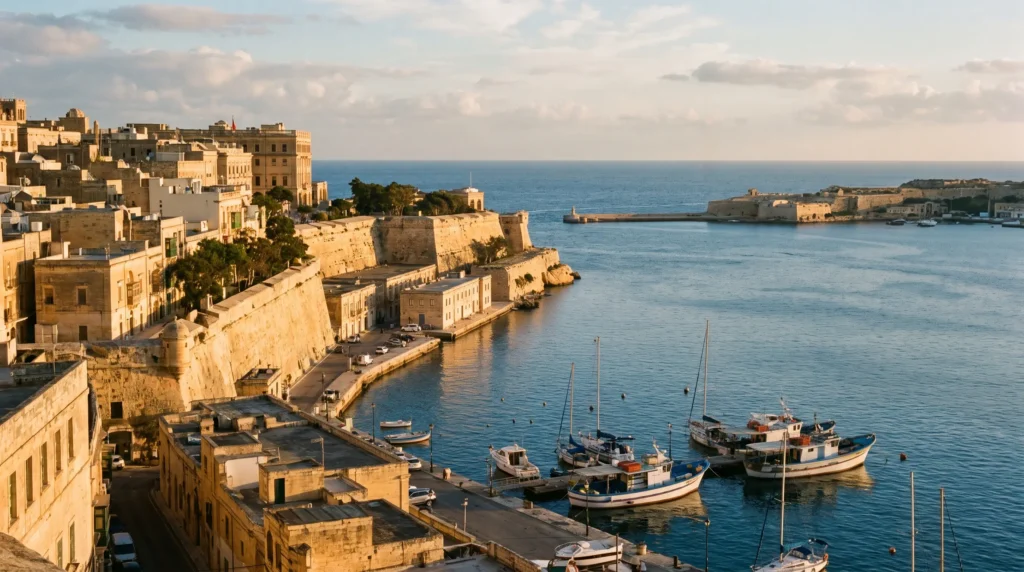
Valletta Travel Guide — Europe’s Smallest, Densest, Most Fortified Capital
Valletta is a city you can walk across in twenty minutes and never run out of things to look at. It was built in fifteen years flat, by the Knights of St John, as a giant fortified thank-you note after they survived the Great Siege of 1565 — and the whole thing still fits inside walls you can trace on foot before lunch. The city’s grid of honey-colored limestone streets rewards visits in both blazing August heat and soft January light: this is one of the only capital cities on Earth where the entire historic core is a single UNESCO World Heritage site, packed with more monuments per square metre than almost anywhere in the world. The catch — because there’s always a catch — is that Valletta is tiny and popular, so in peak summer the main streets can feel like a cruise-ship conveyor belt. Time it right, or duck one street over, and it’s one of the most rewarding city breaks in the Mediterranean.
In This Guide
- Overview — Why Valletta Punches Above Its Size
- The Valletta International Baroque Festival
- Best Time to Visit Valletta
- Getting There — Malta International Airport & Ferries
- Getting Around — On Foot, By Bus, By Harbour Ferry
- Neighborhoods — Inside the Walls and Across the Harbours
- Culture & People
- A Food Lover’s Guide to Valletta
- Off the Beaten Path
- Day Trips from Valletta
- Practical Information
- Budget Breakdown — What Valletta Actually Costs in 2026
- Frequently Asked Questions
Overview — Why Valletta Punches Above Its Size
Valletta is, by most measures, the smallest capital city in the European Union — a fortified peninsula of roughly 0.61 square kilometres holding a resident population of around 5,200 people. It was built from scratch starting on 28 March 1566, commissioned by Grand Master Jean Parisot de Valette of the Knights Hospitaller in the wake of the Great Siege of Malta, and became the Order’s capital just five years later in 1571. That speed of construction, combined with the fact that almost nothing has since been knocked down, is why the entire city was inscribed as a single UNESCO World Heritage site in 1980 — some 320 monuments packed into 55 hectares, one of the most architecturally concentrated historic areas anywhere in the world.
The city sits on the Sciberras Peninsula between two natural harbours — Marsamxett to the west, the Grand Harbour to the east — and it earns its “Fortress City” nickname honestly: bastion walls up to 47 metres high still ring the whole peninsula. Inside those walls is a tight Renaissance grid of honey-limestone streets holding St John’s Co-Cathedral (with two Caravaggio paintings), the Grandmaster’s Palace, Fort St Elmo, and the Upper and Lower Barrakka Gardens looking straight down over the Grand Harbour.
What Valletta doesn’t have is scale — you can walk from City Gate to Fort St Elmo, the entire length of the city, in about twenty minutes. What it has instead is density: layer after layer of Knights-era, British colonial and independent-Malta history stacked into a space you can properly see in two or three days, then use as a base for the rest of the island and a quick ferry hop to Sicily.
The Valletta International Baroque Festival
If you can time a trip around one thing, make it January: the Valletta International Baroque Festival fills the city’s palaces, churches and the Grandmaster’s Palace courtyard with period-instrument orchestras and international soloists over roughly two weeks. It’s a fitting match for the setting — this is a city whose skyline and interiors are themselves a baroque set piece, and hearing period music echo off the same stone the Knights built makes the whole city click into place in a way daytime sightseeing alone doesn’t.
Valletta also throws itself into Malta’s wider calendar: Maltese Carnival in February brings costumed parades and float processions to Republic Street, and Valletta’s turn as European Capital of Culture in 2018 left a legacy of stronger year-round arts programming — more gallery openings, more open-air concerts in St George’s Square, more reasons to linger past the day-trip crowds. The Malta in winter post covers the Baroque Festival’s dates, tickets and what else opens in the off-season in full.
Best Time to Visit Valletta
April – June · Spring sweet spot
Warm, dry, and green before the summer crowds and heat peak — arguably the best all-round window, with sea temperatures rising nicely for a June dip and the Baroque Festival’s momentum still fresh in the city’s cultural calendar.
July – August · Peak heat, peak crowds
Valletta was named Europe’s sunniest city in a 2016 comparison, and in July and August you feel every degree of it — average daytime temperatures well above 30°C with little relief, plus the highest visitor volumes of the year on Republic Street and around St John’s Co-Cathedral. Go early morning or evening; midday is for air-conditioned museums.
September – October · Quiet shoulder
Sea still warm, crowds thinning, prices softening. My honest pick for a first visit if you can only choose one window.
November – March · Mild winter, festival season
Malta’s mild-winter Mediterranean climate keeps daytime temperatures comfortable even in January, which is exactly why the Baroque Festival works here — layer up for evenings and the occasional rain squall, but you’ll dodge both heat and crowds entirely. Travelers weighing up an off-season trip can see exactly what opens, what pauses and what it costs in our Malta in winter guide.
Getting There — Malta International Airport & Ferries
Malta International Airport (MLA), about 8 kilometres from Valletta, is the country’s only airport and the near-universal gateway, with direct flights from most major Western European hubs plus a growing list of seasonal long-haul and North African connections. It’s been fully operational since March 1992 and sits close enough to the capital that a taxi or rideshare into Valletta typically takes 15–20 minutes; public buses also run the route directly to the city gate.
Malta is also a genuine ferry hop from Sicily. Virtù Ferries runs high-speed catamarans from Valletta to Pozzallo in about 1 hour 45 minutes, and to Catania (seasonally, mostly in summer) in around 3 hours, with 2–3 sailings a day year-round on the core routes. It’s a genuinely pleasant way to combine a Malta trip with Sicily rather than flying between the two.
As an EU and Schengen member, Malta requires no visa for short stays from the US, UK, EU, Canada or Australia — standard 90-days-in-180 Schengen rules apply.
Getting Around — On Foot, By Bus, By Harbour Ferry
Valletta itself is entirely walkable — genuinely one of the easiest historic centres in Europe to cover on foot, since the whole peninsula is barely a kilometre long. It is hilly, though, and the streets running perpendicular to Republic Street are stepped, so comfortable shoes matter more than in most flat old towns. There’s no metro and no need for one; a lift at the Upper Barrakka Gardens even carries pedestrians straight down to the Valletta waterfront if you’d rather skip the stairs.
To reach the rest of Malta, the central bus terminus just outside City Gate is the hub for Malta Public Transport’s island-wide network, covering Sliema, St Julian’s, Mdina and the south coast for a few euros a ride. Valletta introduced a road congestion charge back in 2007 to keep the historic core from being overrun by cars, which tells you most of what you need to know about driving here — don’t, if you can avoid it. For crossing the Grand Harbour, small passenger ferries link Valletta directly to the Three Cities (Vittoriosa) and to Sliema across Marsamxett — cheap, scenic, and faster than the bus for those routes.
Neighborhoods — Inside the Walls and Across the Harbours
City Gate & Republic Street
The main spine, running the length of the peninsula from the modern City Gate (redesigned by Renzo Piano) past the Grandmaster’s Palace to Fort St Elmo. This is where the crowds concentrate — shops, cafés, the main museums — and the best reason to also explore one street either side.
St John’s Co-Cathedral Quarter
The single most-visited site in the city, its plain façade hiding an interior of gilded baroque excess and two Caravaggio works, including his only signed painting. Book a timed entry in high season; queues without one can eat an hour.
Upper & Lower Barrakka Gardens
Bookending the city on its harbour side, these terraced gardens deliver Valletta’s best views — straight across the Grand Harbour to the Three Cities, with the noon and evening cannon-fire salute from the Saluting Battery below the Upper Barrakka a genuine highlight.
The Three Cities (Vittoriosa, Senglea, Cospicua)
A five-minute harbour ferry from Valletta’s waterfront, this trio of fortified towns predates Valletta itself and gets a fraction of the foot traffic — narrow lanes, working marinas, and views back at Valletta’s skyline that are arguably better than the ones from inside it.
Floriana
The buffer town just outside City Gate, built as an additional line of fortification — worth a wander for its own bastions and gardens, and where a lot of locals actually live and eat away from the tourist core.
Sliema & St Julian’s
Across Marsamxett Harbour by ferry or bus, Malta’s modern seafront strip of hotels, shopping and nightlife — a practical, if less atmospheric, base if Valletta’s old-town accommodation is booked out or overpriced.
Culture & People
Maltese culture is a genuine crossroads — Semitic-rooted Maltese language (the only Semitic language written in Latin script and an official EU language) sits alongside near-universal English, a legacy of both the Knights’ multinational order and nearly a century and a half of British rule that ended with independence in 1964. Catholicism runs deep in daily life; village and city festas — patron saint feast days with fireworks, band marches and street decorations — happen somewhere on the islands almost every summer weekend, and Valletta’s own feast of St Paul’s Shipwreck in February is one of the calendar’s oldest.
Valletta’s 2018 stint as European Capital of Culture left a visible mark: more contemporary galleries tucked into Knights-era buildings, a stronger year-round events calendar, and civic pride in a city that, for decades, some Maltese themselves treated mainly as a place to work rather than live. That’s shifting — restoration of townhouses into boutique guesthouses has brought slow but real repopulation of the old core.
A Food Lover’s Guide to Valletta
Maltese food reflects the same crossroads position as the culture — Sicilian, North African and British influences all show up on the same table. Start with pastizzi, flaky ricotta- or pea-filled pastries sold from hole-in-the-wall bakeries for under a euro, the closest thing Malta has to a national snack. For a proper meal, try rabbit stew (fenkata), Malta’s unofficial national dish, traditionally slow-cooked in wine and garlic and best eaten at a village fenkatarrija outside the city, though several Valletta restaurants do a respectable version.
Ftira — a dense, ring-shaped Maltese bread split and filled with tuna, olives, capers, tomato and onion — makes the best quick lunch in the city, and bragioli (beef olives, thin steak rolled around a savoury stuffing) is a hearty Sunday-lunch staple worth seeking out. Wash it down with Kinnie, Malta’s distinctive bittersweet bitter-orange soda, or a glass of local wine from Gozo or the Marsovin/Meridiana vineyards. Valletta’s Is-Suq tal-Belt covered market is the best one-stop spot to sample several of these under one roof.
Off the Beaten Path
Fort St Elmo & the National War Museum
At the tip of the peninsula, this is where the Great Siege’s fiercest fighting happened in 1565 — most visitors reach the Barrakka Gardens and stop, leaving the fort itself and its war museum comparatively uncrowded even in peak season.
Manoel Island & the Msida creek walk
A short walk or ferry from Valletta’s Marsamxett side, this small fortified island and its surrounding waterfront are largely ignored by day-trippers focused on the Republic Street sights.
Valletta’s underground: the Lascaris War Rooms
A World War II command bunker carved into the bastion rock, used to coordinate the Allied defence of Malta and now open as a museum most cruise-day visitors never find.
The Three Cities’ back streets
Beyond Vittoriosa’s postcard marina, Senglea and Cospicua’s residential lanes offer a much quieter, more lived-in counterpoint to Valletta proper, five minutes away by ferry.
Day Trips from Valletta
Mdina and Rabat — Malta’s hilltop former capital, a near-silent walled city of golden stone, is roughly 30–40 minutes away by bus and pairs naturally with neighbouring Rabat’s catacombs and St Paul’s Grotto.
The Three Cities — close enough to combine with a half-day in Valletta itself via the harbour ferry, but worth a dedicated slower visit for Vittoriosa’s marina and fortifications.
Gozo — Malta’s quieter sister island, reachable via a bus-and-ferry combination or a direct tour, known for the Azure Window’s former site at Dwejra, the Ġgantija megalithic temples, and a noticeably slower pace than Valletta.
Blue Grotto & the south coast — a cluster of sea caves best visited by small boat in the morning light, plus the Ħaġar Qim and Mnajdra megalithic temple complexes nearby.
Sicily — with Virtù Ferries running Valletta–Pozzallo in under two hours, a long weekend combining Malta with Sicily’s southeastern baroque towns is entirely realistic for anyone with extra days. For the fuller pick-one-or-both breakdown — costs, ruins, beaches and getting around each island — see Malta vs Sicily.
Practical Information
Money. Malta uses the Euro, adopted 1 January 2008; cards are accepted almost everywhere in Valletta, though small pastizzi bakeries and market stalls often prefer cash.
Safety. The US State Department rates Malta Level 1 — Exercise Normal Precautions, its lowest advisory tier, describing it as generally a safe destination. Watch for pickpocketing in crowded tourist areas, heed lifeguard flags at beaches given periodic rip-current drownings, and take extra care around the Paceville nightlife district, which has seen reports of drink-spiking and theft.
Health. No special vaccines are required for entry; the US CDC recommends being current on routine vaccines and considering hepatitis A/B for most travelers, standard advice for Southern Europe. Tap water is generally safe.
Connectivity. Good 4G/5G coverage and widespread café Wi-Fi; an EU-roaming SIM or eSIM works smoothly given Malta’s EU membership. Plugs: UK-style three-pin, 230V — a holdover from British rule. Time zone: Central European Time (UTC+1, UTC+2 in summer). Driving: traffic keeps to the left, one of the quirks left over from the British era.
Budget Breakdown — What Valletta Actually Costs in 2026
Valletta sits mid-pack for Western Europe — pricier than Eastern Europe’s capitals, generally cheaper than Rome, Paris or Amsterdam.
Budget (US$70–110/day): hostel dorm or budget guesthouse just outside the walls (or across the ferry in Sliema), pastizzi and ftira lunches, public buses, free walking routes through the bastions and gardens.
Mid-range (US$150–260/day): boutique townhouse hotel inside the walls, a proper sit-down dinner with local wine, St John’s Co-Cathedral timed entry plus one or two paid museums, a Three Cities harbour ferry crossing, maybe a Gozo day tour.
Luxury (US$400+/day): five-star harbour-view properties (several occupy restored Knights-era palazzi), private boat trips to the Blue Grotto or around the Grand Harbour, fine dining, a driver for day trips to Mdina and the south coast.
Tipping 10% is appreciated but not obligatory where a service charge isn’t already added; museum and cathedral entry fees add up quickly if you’re seeing everything, so a multi-site pass is worth pricing out before you go.
Planning Your Valletta Trip
Two full days covers Valletta’s headline sights comfortably — St John’s Co-Cathedral, the Grandmaster’s Palace, both Barrakka Gardens and Fort St Elmo — with a third day for the Three Cities ferry crossing and Is-Suq tal-Belt market. Base yourself inside the walls for atmosphere or across the water in Sliema for a bit more value and nightlife. If you have five days or more, add Mdina, the south coast temples, and either Gozo or a Sicily ferry day trip. Malta pairs naturally with a wider Mediterranean itinerary — many visitors bookend a Valletta stay with time in Naples or a longer look at the rest of the country via our full Malta travel guide. Short on time? Our hour-by-hour Valletta in one day itinerary fits the headline sights into a single visit, cruise-day timings included.
Frequently Asked Questions
Is Valletta safe for tourists in 2026?
Yes — the US State Department rates Malta at its lowest advisory tier, Level 1, describing it as a generally safe destination. Normal city precautions apply: watch belongings in crowded areas, heed beach lifeguard warnings, and be cautious in the Paceville nightlife district.
Do I need a visa for Malta?
Not for short stays if you hold a US, UK, EU, Canadian or Australian passport — Malta is a full Schengen Area member, so the standard 90-days-in-180 rule applies with no separate visa required.
How many days do I need in Valletta?
Two to three days covers the city itself properly; add extra days if you want Mdina, Gozo, the south coast temples, or a Sicily ferry day trip from the same base.
Is Valletta walkable?
Extremely — the whole peninsula is barely a kilometre long and the historic core has no need for a car or metro, though the cross streets are steep and stepped, so wear proper shoes.
What currency does Malta use?
The Euro, adopted on 1 January 2008 — cards are widely accepted, though it’s worth carrying some cash for small bakeries and market stalls.
Can I day-trip to Sicily from Valletta?
Yes — Virtù Ferries’ high-speed catamaran reaches Pozzallo in about 1 hour 45 minutes, with seasonal direct sailings to Catania in around 3 hours, making a long day trip or overnight hop genuinely feasible. Deciding between the two islands (or doing both) is covered in full in Malta vs Sicily.
Ready to Explore Valletta?
A city small enough to cross on foot before your coffee gets cold, dense enough with 320-odd monuments to keep you looking up for days, and fortified enough that you’ll still be finding new bastion viewpoints on your last afternoon. Go in the shoulder months if you can, book the Co-Cathedral ahead, and give yourself at least one evening on the Upper Barrakka watching the light change over the Grand Harbour.
Explore More
- Malta Travel Guide — Gozo, the south coast temples and the rest of the island
- Dubrovnik City Guide — another walkable, fortified Mediterranean old town
- Athens City Guide — ancient history and island-hopping further east
- Naples City Guide — pair Valletta with Italy’s own fortress-and-food city
How this guide was built
Published as part of Facts From Upstairs’ city guide series. Built from authoritative sources — UNESCO’s City of Valletta World Heritage inscription, the US State Department’s Malta travel advisory, the US CDC’s Malta traveler health page, Virtù Ferries’ published Malta–Sicily schedule, and Wikipedia entity pages for Valletta and Malta. Numeric claims carry inline citations.
More city guides you might like
Plan your trip to Valletta
The booking tools we use ourselves. FFU may earn a commission at no extra cost to you.
Plan & book your trip to Valletta
Booking through these searches supports our guides at no extra cost to you.