
☰ On this page
- 📋 In This Guide
- Overview — Why Botswana Belongs at the Top of the Safari List
- 🌊 Late-April / Early-May 2026 — Okavango Flood Peak Begins
- Best Time to Visit (Season by Season)
- Getting There — Flights, Charters & Border Crossings
- Getting Around — Bush Flights, Mokoros, 4WDs
- Top Regions & Reserves
- 🗓️ Sample Itineraries
- Tswana Culture & Etiquette
- A Food Lover’s Guide to Botswana
- 📸 Photography Notes
- Off the Beaten Path — Beyond the Delta
- Practical Information
- Budget Breakdown — What Botswana Actually Costs
- ✅ Pre-Trip Checklist
- 🤔 What Surprises First-Timers
- Frequently Asked Questions
- Ready to Explore Botswana?
- Explore More
Botswana Travel Guide — Okavango Floods, Kalahari Stars & Africa’s Conservation Model
Botswana is the only country in southern Africa where rain is a unit of currency — the national money is literally called Pula, the Setswana word for rain — and the only one whose tourism industry was built, deliberately and over fifty years, on the assumption that fewer visitors are worth more than more. It is a landlocked, semi-arid republic the size of France with a population the size of Birmingham (about 2.6 million), bordered by Namibia, Zambia, Zimbabwe and South Africa, and crossed by the only inland delta on Earth that empties into a desert rather than a sea. The Okavango Delta, where the Cubango River from Angola spreads across 15,000 square kilometres of seasonal floodplain before evaporating into the sand, is a UNESCO World Heritage Site as of 2014 and one of the great wildlife densities of the planet.
What makes Botswana different is the model. After independence in 1966 from Britain, the country’s first president — Sir Seretse Khama — inherited a colony of 600,000 people, no sealed roads outside the capital, three secondary schools, and the world’s third-poorest GDP per capita. Within three years of independence the De Beers diamond find at Orapa transformed Botswana into the largest gem-diamond producer in the world by value, and the Khama government chose, against most prevailing wisdom, to channel the proceeds into education, conservation and a high-cost low-impact tourism doctrine that has held without serious revision for half a century. The country today retains 38% of its surface as protected wildlife area, hosts the largest concentration of African elephants on Earth (130,000+ in the Chobe-Linyanti complex alone), and is the only nation on the continent where the elephant population has grown steadily for 30 years.
This guide covers Botswana from the Okavango Delta’s seasonal flood pulse to the salt-pan extremes of the Makgadikgadi. For East African counterpoints see our Kenya travel guide and Tanzania travel guide; for the South African gateway most travellers route through, our South Africa travel guide picks up where this country guide hands off; for an Indian Ocean island add-on consider Madagascar.
📋 In This Guide
- Overview — Why Botswana Belongs at the Top of the Safari List
- 🌊 Late-April / Early-May 2026 — Why You’re Right in the Window
- Best Time to Visit (Season by Season)
- Getting There — Flights, Charters & Border Crossings
- Getting Around — Bush Flights, Mokoros, 4WDs
- Top Regions & Reserves
- 🗓️ Sample Itineraries — 5, 7, 10 and 14 Days
- Tswana Culture & Etiquette
- A Food Lover’s Guide to Botswana
- 📸 Photography Notes
- Off the Beaten Path — Beyond the Delta
- Practical Information
- Budget Breakdown — What Botswana Actually Costs
- ✅ Pre-Trip Checklist
- 🤔 What Surprises First-Timers
- Frequently Asked Questions
- Ready to Explore Botswana?
Overview — Why Botswana Belongs at the Top of the Safari List
Botswana sits in the centre of southern Africa, on a high plateau averaging 1,000 metres above sea level — roughly the same elevation as Denver — and 80% of the country is covered by the Kalahari, a fossil sand sea that stopped being a true desert about 10,000 years ago and now supports a sparse Acacia and Mopane savanna over deep sand. The Cubango River, rising in the Angolan highlands 1,500 km north, flows southeast across the Caprivi Strip of Namibia and then fans out across the Kalahari sand to form the Okavango Delta — the largest inland delta in the world that does not reach the sea. The water arrives in northern Botswana between March and May, peaks in the central delta in June and July, and evaporates entirely by November.
The modern country is improbable in a different way from Iceland or Switzerland: politically stable for 60 uninterrupted years, classified upper-middle income since 2005, and the only African nation to have transitioned from least-developed to upper-middle-income status without civil war, coup or one-party rule. The flag — light blue (water) above black-and-white-and-black horizontal stripes (racial unity) — is the most cited national flag on civics syllabi for that reason. The currency is Pula (BWP), pegged loosely to a basket dominated by the rand and the dollar, and trades around 13.5 to USD 1 in 2026. The capital Gaborone is the administrative centre and home to about 235,000 people; tourists rarely stop there.
For a traveller, the practical consequence is that Botswana is not the cheap volume-safari country Kenya or South Africa is. The “high-cost, low-impact” tourism doctrine deliberately concentrates visitors at small, fly-in-only camps inside the concessions adjoining Moremi Game Reserve and the various wildlife management areas. A typical Delta camp holds 12–24 guests in raised tented suites; the lowest legal price is set by concession fees that run $300–$700 per person per day before accommodation. The reward is a wilderness density and an absence of roadside crowds that travellers who have done the busier circuits rarely fail to notice.
🏛️ Historical Context
Moremi Game Reserve, gazetted in 1963 by Chief Moremi III’s wife Mrs. Moremi III on behalf of the BaTawana people, is the first wildlife reserve in Africa established by an indigenous tribe rather than a colonial administration. The Tawana, having watched commercial hunting and cattle disease decimate the wildlife of the eastern Delta in the 1950s, voluntarily set aside 5,000 km² of their tribal land — ahead of any colonial conservation push, and a year before the country’s own independence. Moremi today forms the protected core of the Okavango Delta complex; the surrounding wildlife management areas were modelled on the Tawana precedent. The Moremi name is one of the few in southern African conservation history that belongs to the indigenous communities first.
🎌 Did You Know?
The Okavango Delta is one of only a handful of places on Earth where lions hunt regularly in water. The Duba Plains and Selinda lion prides have been documented swimming between islands and ambushing buffalo in waist-deep flood — a behaviour rarely seen elsewhere in Africa. National Geographic filmmakers Beverly and Dereck Joubert have followed the Duba pride for 15 years, producing the documentary Relentless Enemies in 2006 and tracking the bloodlines through generational changes. Lions in the Kalahari Game Reserve, by contrast, are the largest-bodied subspecies in southern Africa — some adult males weigh 230 kg, 30% heavier than typical East African lions, an adaptation to longer ranging in sparse-prey country.
🌊 Late-April / Early-May 2026 — Okavango Flood Peak Begins
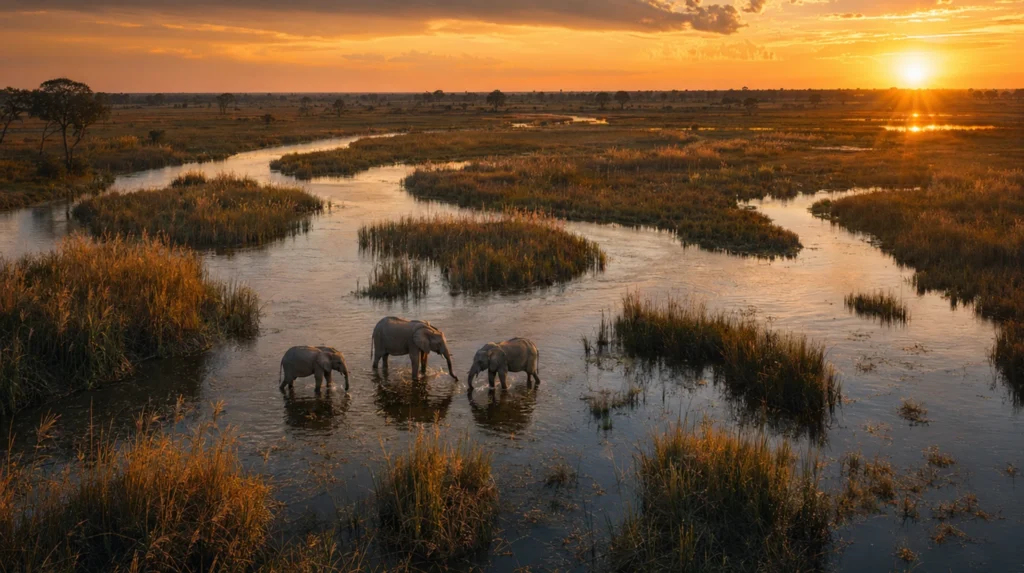
Late April through mid-May is one of the most underrated three-week windows on the Okavango calendar. The Angolan summer rains, which fall on the Bie Plateau between November and April, take roughly four months to travel the 1,500 km down the Cubango catchment and reach the panhandle of the Botswana Delta around late March. By late April the flood front has reached the Moremi heartland; by late May or June the water has spread through the central Delta channels and reached its peak inundation; by July the flood is subsiding. The shoulder window of late April to mid-May is the genuine in-between — water is rising but channels haven’t yet maxed, the islands are at their greenest, mokoro (dugout canoe) routes are opening one by one as channels fill, and the bird life is exceptional.
This is also the window when most camps reset their pricing tier. Botswana operators run roughly four pricing seasons — Low (Dec-Mar), Shoulder (Apr-mid Jun), High (mid Jun-Oct) and Festive (Dec 20-Jan 5) — and late April catches the bottom of Shoulder, with rates 25-40% below July-September peak. The mosquito load drops sharply as the rain ends; daytime temperatures sit at 28-31°C and night temperatures at 12-16°C, the most comfortable thermal bracket of the year. Wildlife densities have not yet concentrated around the dry-season water sources (that intensification happens August through October), but the clay-pan greenery of the rainy season is giving way to the gold-grass aesthetic safari photographers prefer.
One important caveat for spring 2026: the timing of the flood peak depends entirely on Angolan rainfall patterns from the previous wet season, and recent years have shown the front arriving 2-3 weeks earlier than the historical mean. If the 2025-26 Angolan rains were heavy, expect channels to be navigable for mokoros from early April; if they were light, mokoro routes may not open until mid-May. Camps in the panhandle (Jao, Vumbura, Duba) feel the flood first; camps in the south-eastern Delta (Khwai, Sandibe) feel it last.
⚠️ Important — Charter Flight Weight Limits & Malaria
Two non-negotiables for a Botswana safari. First, almost all Delta camps are accessed by single-engine Cessna 208 Caravan charter flights from Maun (MUB) airport, and the strict luggage limit is 20 kg per person total — including cabin baggage, camera gear, and the bag itself — in soft-sided form only (no hard cases or wheels). The weight policy is enforced by the bush airlines (Mack Air, Wilderness Air, Helicopter Horizons) and there are no exceptions; overweight bags are stored in Maun until your return flight. Second, Botswana’s northern circuit (Okavango, Chobe, Linyanti, Savute) is a malaria-risk zone year-round but particularly May through October. Take prophylaxis (most travellers use Malarone or doxycycline starting 1-2 days before arrival and continuing 7 days after departure). Sleep under provided nets even when camps appear screened. The Central Kalahari is malaria-low-risk; Gaborone is malaria-free.
Best Time to Visit (Season by Season)
Botswana has two genuine seasons — wet (November-March) and dry (April-October) — and the safari experience changes radically between them. The rule for first-time visitors is simple: visit in the dry season for big-game density, in the wet season for birds and newborn antelope. The Delta flood pulse runs out of phase with the rainy season; the flood arrives during the dry months, which is the strange biology that defines the place.
Late Wet / Shoulder (March – May)
The transition window described above. Daytime temperatures climb from 28°C in March to a comfortable 27°C by late May, the rains end progressively from late February in the south to mid-April in the north, and the floodwaters arrive in the Delta. Bird life peaks — over 530 bird species have been recorded in Botswana, and the migrant breeding population is at its most concentrated. Newborn impala, lechwe and tsessebe lambs are abundant. Vegetation is still relatively thick, which makes big-cat sightings harder but rewards travellers who like a less-engineered safari rhythm. Rates 25-40% below peak; reservations possible 4-8 weeks ahead rather than the year-ahead booking required for July-September.
Peak Dry / High Game (June – August)
The classic safari window. The Delta flood is at maximum extent through July, mokoro and motorboat activities are at their best, vegetation has died back to gold and the predator-prey concentration around remaining water sources has begun. Daytime highs 24-28°C, night lows 5-10°C (genuinely cold on dawn game drives — closed vehicles aren’t a thing in Botswana, so layer up). Mosquitos are minimal. Camps run at 90%+ capacity and rates are at their highest. June 30 to August 30 is the peak of peak — book 8-12 months ahead.
Late Dry / Predator Season (September – October)
The hottest, driest, most-concentrated wildlife window of the year. October daytime highs reach 38-42°C in the Linyanti and Savute, and the desperation of the dry season produces the kind of predator activity safari brochures use as headline imagery — lion prides hunting in mid-afternoon, leopard kills in low trees, hyena clans patrolling waterholes. The Delta floodwaters are subsiding; some camps lose mokoro access by late September. Night drives produce the year’s best leopard sightings. This is also the window for the Savute lion-vs-elephant predation phenomenon, where the resident pride has learned to take sub-adult elephants — a behaviour found nowhere else in Africa. Rates remain at peak but the experience justifies it.
Wet / Green Season (November – February)
The flip-side experience. Daytime highs 30-36°C, daily afternoon thunderstorms (typically 3-5 pm, often dramatic and brief), mosquitos at peak, and animals dispersed into the bush. The Makgadikgadi Pans transform — dry, white, alien from May through October, they fill with rainwater between December and March, attract one of the largest zebra migrations in Africa (about 25,000 zebras and 5,000 wildebeest move from the Boteti River to the pans in November), and host pelagic flocks of flamingos. Most northern Delta camps stay open through the wet but at lower rates and reduced game density. Birding is at its peak. The Central Kalahari is at its best in the wet — the cracked-clay floor of Deception Valley fills with sweet grass and the lion prides come out of the dunes to hunt the dispersed antelope.
🧳 Travel Guru Tip
If you have one trip to Botswana and want the optimal trade-off of game density, comfortable temperature and reasonable price, target the second half of June. The flood is peaking, the dry-season concentration is beginning, the predators are visible but not yet desperate, the temperatures are at their year-round best (24-26°C days, 8-10°C nights), and rates haven’t yet reached the August peak. Camps that block-book July onward sometimes have residual June availability six weeks out. Locals who run safari operations call it “the perfect three weeks.”
| Experience | Best months | Best regions | Notes |
|---|---|---|---|
| Big cat density | Aug – Oct | Savute, Linyanti, Moremi | Predator concentrations peak in late dry season |
| Mokoro canoe | May – Sep | Inner Okavango Delta | Channel-dependent; flood peaks Jun-Jul |
| Elephant herds | May – Oct | Chobe Riverfront, Linyanti, Savute | 130,000 elephants in Chobe complex alone |
| Zebra migration | Nov – Mar | Boteti River → Makgadikgadi Pans | Africa’s second-longest zebra movement (~500 km round-trip) |
| Birding (migrant peak) | Nov – Mar | Delta panhandle, Linyanti, Pans | 530+ species recorded; migrants Oct-Apr |
| Wild dog dens | Jun – Aug | Linyanti, Khwai, Selinda | Africa’s most reliable wild dog viewing |
Getting There — Flights, Charters & Border Crossings
Botswana has three airports that matter for travellers, and one of them — the international gateway — is one of the smallest on a busy safari circuit. Maun (MUB) is the bush-flight hub on the southern edge of the Okavango Delta. Kasane (BBK) is the small airport on the Chobe River near Victoria Falls. Gaborone (GBE), the capital airport, handles regional traffic but rarely sees safari travellers. Most international visitors fly into Johannesburg (JNB) or Cape Town (CPT) and connect on regional carriers — Airlink, SA Express or Air Botswana — to Maun or Kasane.
From North America, expect 22-30 total transit hours via Johannesburg or Doha. The fastest US routings: Atlanta or New York JFK on Delta or South African to JNB, then Airlink to MUB (5h flight from JNB to JNB then 2h to MUB; ~$280-450 round trip JNB-MUB). From Europe, London Heathrow to Johannesburg is 11 hours overnight (BA, Virgin), Frankfurt to JNB on Lufthansa, then the connection to Maun. From the UAE, Dubai to JNB is 8 hours on Emirates. Combined safari packages routinely build in two-night Cape Town or Victoria Falls stops to break the journey.
The land border most-used by travellers is the Kazungula crossing on the Zambezi between Botswana and Zambia, where the new 2021 Kazungula Bridge has replaced the historical pontoon ferry — Botswana, Zambia, Zimbabwe and Namibia all meet within a few hundred metres of this point, the only quadripoint of countries in the world. Self-drive 4WD travellers commonly cross from Victoria Falls into Chobe National Park here. The Pioneer Gate from South Africa near Lobatse is the standard southern road entry. Always check the latest at the Botswana Department of Immigration website; border hours and ID requirements have changed twice since 2023.
✨ Pro Tip
If your itinerary includes Victoria Falls (which sits on the Zambia/Zimbabwe border, not in Botswana), the smartest routing is to fly into Maun for your Delta camps, transfer overland to Kasane for Chobe, then road-transfer 90 minutes through the Kazungula border into Livingstone (Zambia) or Victoria Falls Town (Zimbabwe) for the falls, then fly out from VFA or LVI. Many safari operators sell this as a single package with all border paperwork pre-cleared, saving you 4-6 hours of independent crossing time. The total Botswana-plus-Falls trip works in 7-10 days.
Getting Around — Bush Flights, Mokoros, 4WDs
Botswana’s safari geography is built around the Cessna 208 Caravan — the workhorse single-engine bush plane that links Maun to roughly 70 airstrips across the Delta and surrounding concessions. Most camps are fly-in only, full stop: the road access is either non-existent, seasonally cut by water, or restricted to camp staff and supply runs. The standard model is a “fly-in, fly-around” itinerary in which you arrive at Maun, board a charter to your first camp, hop between camps by short bush flights of 25-45 minutes, and finally fly back to Maun for your international connection. Most charter flights are included in camp pricing, but verify before booking; some operators quote camps before charter add-ons.
The luggage rules for these charters are strict and non-negotiable: 20 kg per person total, soft-sided bags only, no hard frames or wheels. The 20 kg includes your camera bag and personal items. The reason is small-aircraft loading geometry, not corporate rule-making — overweight or rigid bags genuinely cannot fit in the curved cargo holds. Most camps provide laundry service daily (often free), so you genuinely don’t need more than 5-7 days of clothing. Excess luggage is stored at Maun airport for the duration of your trip.
Within the Delta camps, the iconic mode of transport is the mokoro — a traditional dugout canoe (now usually fibreglass for conservation reasons) propelled by a poler standing at the stern, sliding through 60-80 cm of clear floodwater between papyrus channels and lily-pad coves. A mokoro outing is typically 90 minutes to a half-day; the perspective is at water-level, the silence is total, and the wildlife encounters at mokoro height are radically different from a 4WD vehicle’s. Game drives use open-sided Toyota Land Cruisers in concession areas (rules in Moremi proper require closed vehicles). Boat safaris on the Chobe River from Kasane are a separate experience entirely — flat-bottomed pontoons that drift among elephant herds drinking and crossing.
Self-drive is possible — Botswana’s Central Kalahari, eastern Tuli Block and a portion of Chobe Riverfront can be done in a high-clearance 4WD with rooftop tent — but it is harder, more dangerous, and culturally different from the camps experience. Self-drivers must carry recovery equipment, satellite phone, water for 4 days minimum, and a Trans-Frontier permit if crossing into the Kgalagadi from South Africa. Maun-based operators like Bushlore and Travel Adventures Botswana rent fully-equipped 4WDs at $180-280 per day. Sand-driving experience is essential.
⚠️ Important — Driving Permits & Vehicle Insurance
Self-drive travellers need an International Driving Permit (IDP) issued in your home country alongside your domestic licence — Botswana police enforce this strictly at roadblocks. South African-issued vehicles routinely cross the border with the standard SA registration; non-SA hire vehicles need a cross-border permit (charged at the rental desk) and proof of insurance for Botswana specifically. Diesel availability is reliable in the towns (Maun, Kasane, Francistown) but can be 200+ km between stations in the Kalahari. Carry a 60-litre jerry can if you’re going beyond Tsabong or Rakops. Wildlife on roads at night is a genuine risk — donkeys and cattle cause more accidents than wild animals; never drive between dusk and dawn outside towns.
Top Regions & Reserves
📍 Map of Botswana: Every Place in This Guide
Botswana’s safari geography is conventionally divided into a northern circuit (Okavango Delta + Chobe + Linyanti + Savute), a central pan country (Makgadikgadi + Nxai), the southern Kalahari (Central Kalahari Game Reserve), and the eastern Tuli Block. Below are the bases worth building an itinerary around.
🌊 The Okavango Delta — Inner Channels & Permanent Waters
The flagship and the reason most travellers come. The Delta’s 15,000 km² of seasonal floodplain is divided into Moremi Game Reserve at its eastern edge (the Tawana-gazetted protected core) and a network of wildlife management areas (concessions) leased to private operators around it. The “permanent water” zone in the panhandle and inner Delta — fed year-round by the Okavango River — supports the iconic camps of Vumbura, Jao, Mombo, Chitabe, Duba, Sandibe and Xigera. The “seasonal flood” zone, which fills only between May and October, has higher wildlife rotation and lower lodge density.
Mombo Camp on Chief’s Island, in the heart of Moremi, has held the title of “Africa’s #1 game-viewing camp” in industry rankings for 15+ years; the lion density on Chief’s Island runs 25-30 animals per 100 km². Vumbura Plains, in a private concession at the Delta’s northern edge, is the consistent leopard performer. Duba Plains, the Joubert documentary location, retains the buffalo-and-lion-in-water dynamic that made the place famous. Chitabe and Sandibe, in the south-central Delta, balance Delta-water activities with productive woodland game drives.
Activities at every Delta camp typically include: morning game drive (3-4 hours), bush brunch, mokoro outing or motorboat trip in the afternoon (depending on water levels), evening game drive ending around sunset with sundowners. Walking safaris are offered in some private concessions but prohibited inside Moremi proper. Night drives are concession-only.
- What to do: Mokoro outing through papyrus channels; elephant-herd boat drift on the Boro or Khwai rivers; walking safari at Vumbura or Selinda (concessions only); Mombo lion tracking.
- Signature wildlife: Lion (water-hunting), leopard, African wild dog, hippo, sitatunga (the swamp antelope), red lechwe, and 530+ bird species including African fish eagle, Pel’s fishing owl and the Pink-throated Twinspot.
- Access: Charter flight from Maun (MUB) to camp airstrip — typically 25-45 minutes.
🐘 Chobe National Park — Elephants on the Riverfront
The northeastern park stretching from the Chobe River south to the Linyanti and Savute regions. Chobe holds the highest concentration of African elephants on Earth — about 130,000 in the broader Chobe-Linyanti complex, including a dry-season concentration along the Chobe Riverfront where 800-1,000 elephants come down to drink in a single afternoon. The Riverfront, accessible from Kasane (BBK) airport just outside the park, is the easiest part of Botswana to visit on a tight schedule and the only one accessible by self-drive without 4WD experience.
The signature Chobe activity is the river boat safari at sunset — a flat-bottomed pontoon trip lasting 2-3 hours during which the boat positions among elephant herds crossing the river to the Sedudu Island grazing grounds, Cape buffalo herds, hippo pods, crocodiles, and the kingfisher and bee-eater colonies that nest in the riverbanks. The boat is unbeatable for elephant photography — the eye-level water perspective puts you within 20-30 metres of swimming animals.
Beyond the Riverfront, Chobe extends south through Linyanti (a private-concession landscape of marsh, mopane and palm) and Savute (a dry-pan region 1,500 km² in size where the resident lion pride has been documented hunting elephants — a behaviour found in only one other place in Africa). Both Linyanti and Savute are best done via fly-in camps; Wilderness’s DumaTau and Selinda Camp in Linyanti are the two most-cited.
- What to do: Sunset boat safari from Kasane (the iconic Chobe shot); game drive on the Chobe Riverfront; fly-camp transfer to Linyanti or Savute for full-package experience.
- Signature wildlife: Massive elephant herds, sable antelope (Linyanti is the most reliable Botswana location), Savute’s elephant-killing lions, hippo, crocodile.
- Access: Kasane (BBK) airport, 8 km from the park gate; or fly-in to Linyanti / Savute camp airstrips.
🐺 Linyanti & Savute — Wild Dogs and Elephant-Hunting Lions
The private-concession buffer between Chobe National Park and the Caprivi-Strip border. Linyanti is a shallow river-and-marsh system carrying the overflow from the Kwando River; Savute is a 1,500 km² dry-channel and pan landscape. Both are accessible only by air and are run as concessions by Wilderness Safaris (DumaTau, Linyanti Tented), Great Plains (Selinda Camp, Zarafa), and Belmond (Savute Elephant Lodge).
The unique selling point is wild dog density. African wild dogs (Lycaon pictus) are the second-most endangered carnivore in Africa, with only 6,600 left in the wild — and Linyanti’s resident packs make it the single most reliable wild-dog viewing location on the continent. Pack denning seasons (June-August) are the best window. Savute’s lion-vs-elephant predation, documented continuously since 2005, is the other unique behaviour — adult male lions in the Savute pride have learned to take sub-adult elephants by exhausting them in repeated nighttime ambushes. The behaviour appears to be cultural; cubs in the pride learn it from mothers, and it has not spread to neighbouring populations.
- What to do: Wild dog tracking (Linyanti, Jun-Aug peak); night drives at Selinda or Zarafa; Savute lion-pride morning drives.
- Signature wildlife: Wild dogs, big-bodied Kalahari lions, sable, roan, eland.
- Access: Charter flight from Maun (MUB) or Kasane (BBK) — typically 35-50 minutes.
🧂 Makgadikgadi & Nxai Pans — The White Desert
One of the largest salt-pan complexes on Earth, covering roughly 16,000 km² of central Botswana — the dry remnant of the prehistoric Lake Makgadikgadi, which 30,000 years ago covered an area larger than modern Switzerland. The pan surface is white salt-crust over deep clay; in the dry season (May-October) the pans are flat, lifeless, and disorienting (you can drive a quad bike at 40 km/h with the horizon in every direction); in the wet season (December-March) they fill with rainwater, the cracked mud blossoms with sweet grass, and the second-largest zebra migration in Africa arrives — about 25,000 zebra and 5,000 wildebeest move from the Boteti River 200 km to the pans, then back, on an annual cycle that was only confirmed by GPS-collar studies in 2012.
The signature camps are Jack’s Camp and San Camp (Uncharted Africa, 1962-founded), Camp Kalahari, and Meno a Kwena. All are fly-in or 4WD-access, and all run a programme that mixes the Pans’ surreal landscape (sleep-out under the stars on a salt crust, no light pollution within 200 km), quad-biking the pan, walks with habituated meerkat colonies, and tracking the seasonal wildlife. The Pans are also home to one of the largest baobab trees on Earth — Chapman’s Baobab, which collapsed in 2016 after standing for an estimated 1,400 years.
- What to do: Quad-biking the salt crust; meerkat-colony morning visit (the colonies use humans as look-out perches); sleep-out on the pan under the dark-sky stars; Kubu Island ancient baobab walk.
- Signature wildlife: Zebra/wildebeest migration (Dec-Mar), brown hyena, aardwolf, meerkat colonies, flamingos when pans flood.
- Access: Charter from Maun (MUB) — 25-35 minutes; or 4WD self-drive from Maun with permit.
🦁 Central Kalahari Game Reserve — Ancestral Bushmen Lands
The second-largest game reserve in the world at 52,800 km² — about the size of Denmark — and the most underrated wildlife area in Botswana. The Central Kalahari is a deep-sand savanna of mopane, acacia and pan-fed grasslands, and it is the ancestral land of the San (Bushmen) people, who have lived here for at least 30,000 years and whose hunter-gatherer relationship with the landscape was disrupted, then re-litigated through the courts (the 2006 Sesana case) and partially restored. The Reserve’s interior contains roughly 200 family-affiliated San communities; safari operators with respectful relationships (Kalahari Plains Camp, Tau Pan) include guided walks with San trackers as part of the experience.
Wildlife in the Central Kalahari is sparser than the Delta but the species mix is distinctive: black-maned Kalahari lions (the largest-bodied lion subspecies in southern Africa, with adult males reaching 230 kg), gemsbok, springbok, brown hyena, aardwolf, bat-eared fox, cheetah on the open pans (Deception Valley is the most reliable cheetah location in Botswana), and the densely-burrowed pangolin colonies at the southern edge. The wet-season experience (December-April) is genuinely better than the dry — Deception Valley fills with sweet grass and the predator-prey cycle compresses into the green pans.
- What to do: San tracker walking safari (Tau Pan, Kalahari Plains); Deception Valley cheetah drive; brown hyena tracking at night.
- Signature wildlife: Black-maned Kalahari lions, cheetah, gemsbok, springbok, brown hyena, pangolin (rare).
- Access: Charter from Maun (MUB) — 1 hour; or experienced 4WD self-drive from Maun (10-12 hours one-way, fully provisioned).
🐆 Tuli Block — Eastern Limpopo Confluence
The narrow, eastern strip of Botswana along the Limpopo River, where Botswana, South Africa and Zimbabwe meet at the Mapungubwe confluence. Tuli is a small, lesser-known reserve of 720 km² with the highest leopard density per square kilometre of any reserve in southern Africa — the boulder-studded basalt landscape, sparse population pressure and abundant rock hyrax populations have produced an unusually concentrated leopard ecosystem. The area’s premier camp is Mashatu Game Reserve (the Mashatu name is a tree, the Mashatu Tree, that gave the original concession its identity).
Tuli’s appeal is partly the leopards and partly the cultural-historical context: Mapungubwe (the South African side, just across the Limpopo) was the first kingdom to flourish in southern Africa between 1075 and 1220 CE — predating Great Zimbabwe by 200 years — and the gold artifacts from the kingdom’s hilltop royal complex are now on display at the University of Pretoria. The Tuli landscape was the Mapungubwe royal hinterland; ruins are scattered along the Limpopo on both sides. Game drives, mountain bike safaris, and horseback safaris are all available at Mashatu — Tuli is one of the few Botswana destinations where horseback safaris among elephants are run.
- What to do: Leopard tracking; mountain-bike safari (rare in Botswana); horseback safari; Limpopo confluence visit.
- Signature wildlife: Leopard (highest density), elephant, kudu, eland, cliff-spring gnu.
- Access: Limpopo Valley (LMV) airstrip via charter from JNB (Johannesburg); or self-drive from Polokwane via Pont Drift border post.
“A nation without a past is a lost nation, and a people without a past is a people without a soul.”
— Sir Seretse Khama, first President of Botswana, on independence (September 30, 1966)
🗓️ Sample Itineraries
Botswana itineraries reward depth over coverage. The single biggest mistake first-time visitors make is trying to fit too many camps into too few days; charter flights eat travel time and acclimating to a new camp takes 24 hours. Below are four templates that work cleanly with Maun-based logistics.
5 Days — The Essential Delta + Chobe Combo
Day 1: Arrive Johannesburg, transfer to Maun (2h flight), charter to Delta camp (45 min), afternoon mokoro and sundowner game drive. Day 2: Full day in Delta camp — morning game drive, mokoro, afternoon walk or boat. Day 3: Morning game drive in Delta camp, charter transfer to Chobe Riverfront (90 min flight to Kasane), afternoon Chobe river boat safari. Day 4: Morning game drive in Chobe, afternoon river boat (the elephant herds are the day’s payoff). Day 5: Final morning Chobe activity, transfer to Kasane airport, fly to Johannesburg or Victoria Falls for international departure.
7 Days — Add Linyanti Wild Dogs
The 5-day above with two days inserted between Delta and Chobe at a Linyanti camp (DumaTau, Selinda or Linyanti Tented). The wild dog viewing alone justifies the cost; June-August is peak denning season, where puppies emerge from the natal den at six weeks and the pack rotates around them. Days 1-2: Delta camp. Days 3-4: Linyanti — wild dogs, predator concentration, walking safari options. Days 5-6: Chobe Riverfront. Day 7: Kasane departure.
10 Days — Delta + Linyanti + Pans + Falls
The recommended length for a first comprehensive Botswana trip. Day 1: Arrive Maun. Days 2-4: Inner Delta camp — three nights, three full safari days. Days 5-6: Linyanti camp — wild dogs, sable, walking safari. Days 7-8: Chobe Riverfront — boat safaris, elephant herds. Day 9: Road or charter transfer to Victoria Falls (Zambia or Zimbabwe side), afternoon falls visit. Day 10: Final falls activities, fly out from Livingstone (LVI) or Victoria Falls (VFA).
14 Days — Add Kalahari and Pans
For travellers willing to go beyond the standard circuit. The 10-day above plus: Days 11-12: Charter to Central Kalahari Game Reserve (Kalahari Plains or Tau Pan) — black-maned lions, San tracker walking safari, Deception Valley cheetah. Days 13-14: Charter to Makgadikgadi (Camp Kalahari, Jack’s, San Camp) — quad-biking, meerkat colonies, sleep-out on the pan. Return via Maun for departure.
🎯 Strategy
If this is your only Botswana trip, do the 10-day Delta+Linyanti+Chobe+Falls itinerary in dry season (June-September) — it captures the country’s flagship wildlife experience and pairs cleanly with one of Africa’s iconic geological wonders next door. If you’ve been on safari before and want a less-engineered experience, do the 14-day with the Kalahari and Pans extension. Save Tuli for a dedicated leopard-photography trip; it doesn’t pair efficiently with the northern circuit. The country pairs naturally with our South Africa travel guide for the gateway and our Madagascar travel guide for an Indian Ocean island finale.
Tswana Culture & Etiquette
Botswana is the home of the Tswana people (the BaTswana — the prefix Ba- denotes the people, Bo- the country), with smaller minorities of San (Bushmen, the country’s original inhabitants), Kalanga, Herero, Wayeyi and others. Setswana is the national language alongside English (the official language of government and commerce). The cultural register Botswana visitors encounter most often — at camps, on game drives, at Maun airport — is gentle, formal and notably understated, with handshakes lingering, eye contact direct without intensity, and a deliberate pace of conversation that rewards travellers who slow down to match.
The single concept worth internalising is botho — sometimes translated “ubuntu” elsewhere on the continent — the Setswana ethic of “I am because we are.” It produces a society with low aggression, high deference to elders, and a famously consensus-driven public life that traces back to the kgotla, the open-air community council where every adult male (and now adult female, since 1990s reforms) has the right to speak before any communal decision is taken. The kgotla model is still active in rural villages and in Parliament’s culture; you may attend a public kgotla as a respectful observer (long trousers, women cover shoulders, no recording devices). Loud-on-arrival energy reads as American or European and is the most-mocked tourist behaviour in safari-camp circles.
Tipping at safari camps is genuinely expected and structurally important — most camp staff are paid modest base wages and genuine portions of their income come from guest gratuities. Industry standard is roughly $15-25 per guest per day for the general staff (collected by the camp manager and distributed equally) plus $15-25 per guest per day for your specific guide and tracker. Pula or US dollar cash is fine; cards work too at most camps. Plan to carry $300-500 in small US bills for a 10-day trip.
💬 The Saying
“Pula.” It means “rain,” it’s the country’s currency, and it’s the toast at every formal Botswana gathering — substituted for “cheers” when raising a glass. The greeting “Pula!” at the start of an event invokes blessing, abundance, and the sustaining force of the rains that built the Delta and the country itself. Travellers who pick it up and use it correctly at the right moment — usually when raising a sundowner with their guide on the first evening — earn a genuine smile. The full ceremonial form is “Pula!” (called) and “A pule!” (responded to, “may it rain”).
A Food Lover’s Guide to Botswana
Botswana is not a food-tourism destination in the conventional sense — there is no Cape Town-style restaurant scene, no Marrakesh-style street food, no farm-to-table coastal corridor. But camp dining at the high end is genuinely accomplished, traditional Tswana home cooking is hearty and memorable, and the bush brunch as a category is one of the more-civilised experiences a traveller can have anywhere on the continent.
Seswaa is the national dish — slow-cooked beef pounded into a coarse, salted shred, traditionally prepared in cast-iron three-legged pots over open fire by community elders for major gatherings (weddings, funerals, the annual independence celebrations). The flavour is concentrated, salty, fundamentally satisfying, and rich enough that small portions go a long way. Camp menus often feature a refined version on a “Tswana night.”
Bogobe is the daily porridge — sorghum, maize-meal or millet-based, served with morogo (wild greens), seswaa or relish. The “bogobe ja lerotse” version is sweetened with melon and is a breakfast staple in rural homes. Pap (the maize-meal version) is the African staple in 20+ countries and is functionally identical to South Africa’s mieliepap.
Mophane (Mopane) worms are the country’s signature edible-insect protein — the caterpillar of the Gonimbrasia belina moth, harvested from mopane trees in November and February-March, sun-dried, and eaten as a high-protein snack or stewed with onion and tomato. Mophane worms are 60% protein by dry weight (more than beef) and have been a Tswana staple for thousands of years. The dried version tastes mildly nutty; the stewed version tastes like tomato-and-fungus. Try them at the Maun market or on a Tswana-night menu at camp.
Kalahari truffles (n’abba) are the country’s culinary surprise — underground fungi that fruit after summer rains in the Kalahari sand, harvested traditionally by San women who track them by the fine cracks in the sand surface that mark their growth. They are not closely related to European Périgord truffles but have a similar mushroomy-earthy profile and are now exported to Cape Town and London markets. In-country availability is January-March only.
Camp dining at the high end (Wilderness, &Beyond, Belmond, Great Plains) is genuinely accomplished — most chefs trained in Cape Town or Johannesburg, menus rotate three-week cycles, and dietary requirements are accommodated with notice. A typical day’s camp food: light cereal-and-fruit before the morning drive, full bush brunch on return (bacon and eggs to fish curry to South African boerewors), light lunch at 1 pm, high tea before the afternoon drive, and a multi-course dinner at 8 pm. Vegetarian options are universally available; vegan diets are accommodated but require advance notice. Wine pairings on the standard list run South African (Stellenbosch) and Cape; champagne is on most lists.
Coffee is taken seriously at high-end camps — most use Origin Coffee (Cape Town) or local-roaster Botswana Coffee Co. The bush-brewed Toko coffee on a fly-camp morning, prepared in a Bedouin coffee pot on the open fire, is a signature experience in itself.
📸 Photography Notes
Botswana is one of the most-photographed safari countries in Africa precisely because the lighting conditions are remarkable — high-altitude clear air, low pollution, and a flood pulse that produces water reflections in landscapes you would not normally associate with water. Dry-season golden hour (May-September) runs roughly 5:30-7:00 am and 4:30-6:00 pm; wet-season golden hour is shorter and often interrupted by storm-cloud build-up.
Best light by month: May-July for soft golden-hour with the flood at full extent; August-October for hard, contrasted golden light against gold grass and dust haze (the “African dust” aesthetic); November-March for thunderstorm landscapes and dramatic skies; June-August at Makgadikgadi for the cleanest dark-sky astrophotography conditions on the continent (Bortle Class 1 — completely zero light pollution).
Five locations worth the detour:
- Chobe River at sunset (-17.7833°S, 25.0500°E) — elephant herds crossing or drinking, photographed from a boat at water-level. Use a 100-400mm zoom; the boat motion is the limiting factor.
- Mombo Camp on Chief’s Island — the lion density justifies the cost. Sunrise on the floodplain with Vumbura herd herds is the canonical Delta image.
- Makgadikgadi Pans by quad bike — the salt-crust landscape at golden hour with no horizon reference produces a photograph that does not look like Earth. Best in the dry months (May-October) when the surface is firm.
- Deception Valley, Central Kalahari — black-maned lions on the ancient grass-pan, especially in March-April when the wet-season grass is high and the predator-prey concentration is at the pan edge.
- Tuli Block boulder country — leopards on basalt, a subject-and-environment combination unique in southern Africa. Mashatu’s photographic hides at waterholes are purpose-built for this.
Drone rules: Botswana is one of the strictest drone-regulation countries in Africa. Drones are banned outright in all national parks, game reserves and wildlife management areas without a written permit from the Department of Wildlife and National Parks (DWNP) — and these permits are issued only for documented professional film projects, not tourist photography. The rule covers Okavango Delta, Chobe, Linyanti, Savute, Moremi, Makgadikgadi, Nxai, Central Kalahari, and Tuli. Penalties for unauthorised drone flights include fines up to BWP 10,000 and confiscation of equipment. Privately-owned land outside protected areas is the only realistic option, and even then advance permit applications are recommended.
✨ Pro Tip — Camera Gear and Charter Weight
The 20 kg charter weight limit is the photographer’s hardest constraint. Plan a 2-body / 2-lens setup at most: a fast wildlife body (Sony A1, Canon R3, Nikon Z9) with a 100-400mm or 200-600mm zoom, and a second lighter body with a 24-70 or 70-200 zoom for landscapes. Skip the tripod — most camps provide bean bags and the vehicle bracing is your stabilisation. Bring a small soft camera bag (no hard cases). Charge nightly via 230V multi-plug at camp; bring 3-4 spare batteries. A polarising filter is worth the weight for the Delta water reflections; ND filters are not.
Off the Beaten Path — Beyond the Delta
The Delta plus Chobe accounts for roughly 80% of Botswana visits. The remaining 20% spreads across landscapes that are emptier, harder to access, and closer to the Botswana that locals and conservation researchers actually navigate.
🪨 Tsodilo Hills — The Louvre of the Desert
A cluster of four quartzite hills rising from the Kalahari sand 40 km west of Shakawe in the far northwest. Tsodilo Hills is a UNESCO World Heritage Site (2001) with over 4,500 documented rock paintings spanning 100,000 years of human presence — among the densest concentrations of San rock art in Africa, and possibly the oldest archaeological site of continuous human occupation on the continent. The Hills are sacred to local San and Mbukushu communities; respectful visitor protocols are mandatory, and a local guide is required. Day-trip access from Shakawe with 4WD; book through the Shakawe community trust.
🦛 Khwai Community Concession
The buffer area on the eastern edge of Moremi — a community-managed concession run by the Khwai Development Trust on behalf of the local BaSarwa community. Khwai is one of the few places in Botswana where you can do a budget self-drive safari with high game density (the Khwai River is full year-round and concentrates wildlife) at non-luxury prices — campsites are $50-80 per person per night, and the Khwai Tented Camp is a mid-priced fly-in option. The community trust’s land-use revenue model is studied in conservation economics courses worldwide.
🦒 Mashatu & the Limpopo Confluence
The Tuli reserve in the southeast — covered above in the regions section, but worth a second mention as a stand-alone, off-circuit destination. Mashatu’s leopard density, mountain-bike safari, and horseback safari options make it a unique add-on for travellers who have done the standard northern circuit and want something different. Direct Johannesburg charter access (1 hour) makes it logistically separate from the rest of Botswana.
🌳 Kubu Island & the Lekhubu Baobabs
A granite outcrop rising from the western Sowa Pan within the Makgadikgadi complex, covered in baobab trees up to 1,000 years old, surrounded by white salt crust that stretches to the horizon. Kubu (the Setswana word for “hippo,” referencing the rock’s silhouette) was a sacred site for prehistoric peoples — Iron Age stone walls and pottery shards have been recovered. Access is 4WD only, ideally with a local guide; the National Monument is administered by the Gaing-O Community Trust. Camping permits BWP 50 per person.
🐺 Khutse Game Reserve — The Quiet Kalahari
The southern entrance to the Central Kalahari Game Reserve, accessible by 4WD from Gaborone in 4-5 hours. Khutse (the name means “place where you can kneel down to drink”) is far smaller than the main CKGR and far less visited — fewer than 2,000 international visitors a year — but offers identical Kalahari ecosystem experience at fraction the cost. Camping only (no lodges); BWP 200 per person park fee. Best in wet season (December-March) for predator viewing.
Botswana by Numbers
- 2.6 million — country population (2026 estimate)
- 38% — proportion of land surface protected as parks, reserves and WMAs
- 130,000+ — African elephants in the Chobe-Linyanti complex
- 15,000 km² — Okavango Delta seasonal floodplain at peak
- 52,800 km² — Central Kalahari Game Reserve (2nd largest reserve worldwide)
- 20 kg — strict charter flight luggage limit, soft-sided only
Practical Information
Currency: Botswana Pula (BWP). The Setswana word for “rain” — a deliberate choice on independence (1976 introduction, replacing the South African rand) to embed the value of water into the national symbology. Trades around 13.5 BWP to USD 1 in 2026. Major cities (Gaborone, Maun, Kasane, Francistown) have ATMs that accept international Visa/Mastercard. US dollars are accepted at most safari camps and lodges (the high-end concessions price in USD); Pula are useful in Maun town and at petrol stations.
Visa & entry: Botswana grants visa-free entry for 90 days within any 12-month period to citizens of the US, UK, EU, Canada, Australia, New Zealand, South Africa, Namibia, Zimbabwe, Zambia, and most other Commonwealth and SADC countries. Passport must be valid 6 months past entry, with at least two blank pages. Yellow fever vaccination certificate required only if arriving from a yellow-fever-risk country. As of 2024 Botswana has implemented an online “eVisa” pre-clearance system for some non-visa-free nationalities; check evisa.gov.bw.
Language: Setswana and English are the two official languages. English is universal in tourism, government and commerce; you genuinely don’t need any Setswana to travel in Botswana. Local San communities in the Central Kalahari speak click-language Khoisan dialects (the “Ju” languages); guides translate.
Connectivity: 4G covers Maun, Kasane, Gaborone, Francistown and most highways in between. Most safari camps have satellite Wi-Fi in main areas (often free, sometimes guest-only) but no cell signal at camp; this is part of the experience. Buy an Orange or Mascom local SIM at Maun airport for in-country use, BWP 100-200 for 5-15 GB. International roaming is expensive.
Tap water: Safe in Gaborone, Maun and Kasane (treated municipal supply). At remote camps, bottled or filtered water is provided.
Plug type: Type D and Type M (the round-pin South African standard, 230V/50Hz) are the most common. Some newer camps also offer Type G (UK three-pin). Bring a multi-region adapter; safari camps usually have one in your tent.
Health: Malaria prophylaxis is recommended for any travel to the Okavango/Chobe/Linyanti complex (Malarone is the standard, doxycycline is the cheaper alternative). Yellow fever vaccination is not required unless arriving from yellow-fever-risk countries. Tap water in towns is safe; in camps, drink the provided filtered or bottled water. Sunscreen and DEET are essentials.
Budget Breakdown — What Botswana Actually Costs
Botswana is the most expensive safari destination in Africa per night, structurally and deliberately. The “high-cost, low-impact” doctrine — set by the Khama government in the 1990s and unchanged since — uses concession fees and lodge density caps to keep visitor numbers low. The result is camps that charge $1,500-2,500 per person per night fully-inclusive (food, drinks, activities, charter flights, park fees), with the cheapest realistic safari experience starting around $400 per person per day for a Maun-based mid-range mobile camping operation.
💚 Budget Traveller — $80–180 / day
Self-drive 4WD camping circuit. Maun B&B in town BWP 800-1,500 (~$60-110). Public campsite in Khwai or Moremi BWP 250-400 per person ($18-30). Self-catered meals $20-40 a day. Vehicle hire BWP 1,800-2,800 a day ($130-210, often with fridge and tents) but split between 2-4 people. Park fees BWP 120 per person per day in Moremi. This is the realistic per-day cost for a self-drive couple, excluding the vehicle. Add Khwai Community Concession nights for community-based wildlife densities.
💙 Mid-Range — $400–900 / day
Mid-tier fly-in camps like Camp Kalahari, Khwai Tented Camp, Sango Safari Camp, Pom Pom. Fully-inclusive (accommodation, full board, 2 daily activities, park fees, drinks). Mobile mokoro safaris from Maun (4-7 day camping circuits in the Delta with a private guide and tents) run $300-600 per person per day. Charter flights between camps add $250-450 per person each leg. This is the realistic mid-range — comfortable, full-package, but not at the &Beyond / Wilderness flagship-camp level.
💜 Luxury — $1,500+ / day
The famous flagship camps: Wilderness’s Mombo, Vumbura, Jao, DumaTau ($1,800-3,200 ppd); &Beyond’s Sandibe ($1,600-2,400 ppd); Belmond’s Eagle Island and Savute Elephant ($1,500-2,200 ppd); Great Plains’ Duba Plains, Selinda, Zarafa ($2,000-3,500 ppd); Singita Pamushana on the Zimbabwe side ($2,500+); Uncharted Africa’s Jack’s Camp on the Pans ($1,800-2,400). All-inclusive with charter flights, premium wines, spa, butler service in some cases. Private vehicle and guide can be added for $400-700 per day extra. Botswana scales beautifully at the top end; nowhere else in Africa gives you this level of seclusion and wildlife density.
| Item | Budget (USD) | Mid-range (USD) | Luxury (USD) |
|---|---|---|---|
| Bed (per night, all-in) | $30–80 (camping) | $400–900 (fly-in mid-tier) | $1,500–3,500 |
| Daily food | $20–40 (self-cater) | Included | Included + premium wines |
| Charter flight per leg | n/a (self-drive) | $250–450 per person | Included or $400+ |
| Park fees | BWP 120 / day | Included | Included |
| Tipping (per day) | n/a | $30–50 / guest | $40–60 / guest |
| USD daily total | $80–180 | $400–900 | $1,500+ |
🧳 Travel Guru Tip — The Mobile Mokoro Alternative
If the $1,500-per-night fly-in camps are out of range and the self-drive option feels logistically intimidating, consider the mobile mokoro safari — a 4-7 day fully-guided camping trip from Maun into the Delta, with all gear, food, mokoro polers, and licensed guide included. Operators like African Bush Camps, Audi Camp Safaris and Letaka Safaris run these at $300-600 per person per day, all-in. You sleep in standing tents on private campsites, eat camp-cooked traditional meals, mokoro the Delta channels with experienced local polers (the polers are the actual hidden experts of Delta navigation), and pay roughly one-third of a fly-in-camp price for an experience that is, arguably, more authentic. June-September are the prime months.
✅ Pre-Trip Checklist
The minimum kit and admin to have sorted before you fly. Botswana punishes underprepared travellers more than its safari brochure suggests — the charter weight limits, the malaria prophylaxis schedule, and the camp dress codes all reward planners.
- Documents: Passport valid 6 months past return date with 2+ blank pages. Yellow fever certificate if arriving from a risk country. Print all camp confirmations and charter manifests; offline copies on phone.
- Insurance: Travel insurance with medical evacuation coverage of at least $250,000 (the bush-flight-to-Johannesburg medivac is the major cost; evacuation insurance via Flying Doctors of Africa or Global Rescue is the standard). Adventure activities cover for walking safaris, mokoro, horseback.
- Malaria prophylaxis: Start Malarone 1-2 days before arrival in northern Botswana, continue daily through trip, continue 7 days post-departure. Doxycycline is the cheaper alternative (start 2 days before). Consult your travel doctor 4-6 weeks before departure.
- Vaccinations: Confirm tetanus, hepatitis A, typhoid current. Yellow fever if arriving from risk countries.
- Charter weight: Pack to 20 kg total per person, including camera bag and personal items. Soft-sided bags only — no hard cases, no wheels. Most camps offer free daily laundry.
- Clothing: Earth-tone neutrals (khaki, olive, dust-grey) for game drives. Avoid bright white, blue (attracts tsetse flies in some regions), and black. Long sleeves and trousers for evening (mosquitoes). Warm fleece and beanie for dawn drives June-August (genuinely 5-10°C). Swimsuit for camp pools.
- Footwear: Closed-toe walking shoes or light boots for game drives and walking safaris. Sandals for camp.
- Camera gear: 100-400mm or 200-600mm zoom is the workhorse. 24-70mm for landscapes. Beanbag for vehicle bracing (camps usually provide one). 3-4 spare batteries; 230V multi-plug.
- Apps: Maps.me (offline maps for self-drive), iNaturalist for species ID, Sasol Birds Southern Africa for birding, Skype or WhatsApp for camp Wi-Fi calls.
- Cash: $300-500 small US bills for tips and incidentals. BWP 1,000-2,000 in small notes for park fees and Maun town.
- Credit card: No-foreign-transaction-fee Visa/Mastercard. Amex acceptance limited.
🤔 What Surprises First-Timers
- The 20 kg luggage limit is the real constraint. Travellers who pack American-style (“I’ll pack everything just in case”) get hit hard at Maun airport, where the bush-airline scales are calibrated and unforgiving. Plan to pack as if you’re going on a week-long backpack trip, not a week-long hotel stay. Camps do laundry daily, often free, and most provide soap and shampoo.
- Botswana is not cheap, even at the budget end. Compared to Kenya, Tanzania or even Zambia, the floor price is higher. The trade-off is solitude and density — fewer roadside crowds, fewer convoys at every leopard sighting.
- Maun has a Walmart-equivalent. Choppies (the Botswana supermarket chain) at the Maun town centre carries everything from spare batteries to wine to charcoal. Most self-drivers re-stock here before heading to Khwai or Moremi.
- It gets cold at dawn. June-August dawn temperatures genuinely drop to 3-8°C in the Delta and 0-5°C in the Kalahari. Camps provide blankets and hot water bottles in the vehicles, but pack a fleece, beanie and gloves. The shock of cold is the recurring tourist mistake.
- Tipping is structural, not optional. Camp staff are paid modest base wages and the gratuity system is how the actual income is distributed. $30-50 per guest per day across general staff and your specific guide is the industry standard. Bring cash; most camps have a tip envelope at the end of stay.
- Walking safaris are real and are unmissable. In private concessions (Vumbura, Selinda, Linyanti, Tau Pan) you can walk with armed guides through landscapes that have lions and elephants in them. The experience changes your relationship to the bush completely. Inside Moremi proper walking is prohibited; check the concession status of your camp.
- Cell signal is gone at camp — and this is the point. Most camps have Wi-Fi at the main lounge (often slow but functional for emails); cell signal in tents is universally absent. Travellers who arrive expecting connectivity report this as the highest-friction surprise. Set out-of-office before you fly.
- Wildlife at camp is real. Most camps are unfenced. Elephants walking through the dining area at lunchtime, hippos grazing past tents at night, hyenas calling from the perimeter — these are normal. Camp guides escort guests to and from tents after dark; do not walk alone after sunset.
Frequently Asked Questions
Is Botswana really as expensive as people say?
Yes, but predictably so. Fly-in camps run $400-3,500 per person per day fully-inclusive depending on tier. The cheapest realistic safari experience is mobile mokoro camping at $300-600 per person per day. Self-drive camping with shared 4WD costs $80-180 per person per day excluding the vehicle. Compared to peers, Botswana is roughly 2x Kenya, 1.5x Tanzania, similar to Rwanda gorilla-tracking trips, and the most expensive safari destination on the continent on a per-night basis.
When are the big cats best?
August through October — the late dry season. Wildlife concentrations around remaining water sources peak, vegetation has died back to gold grass, and predator-prey desperation drives mid-day hunting visibility. The Savute lions hunt elephants in this window; the Linyanti wild dogs are denning June-August; Mombo’s leopards on Chief’s Island are at their most-photographed.
Do I need malaria prophylaxis?
Yes for the northern circuit (Okavango, Chobe, Linyanti, Savute) — particularly May through October when the disease vector is active. Malarone is the standard prescription (start 1-2 days before, continue daily, continue 7 days after). Doxycycline is the cheaper alternative (start 2 days before, continue 4 weeks after). The Central Kalahari is low-risk; Gaborone and the Pans are functionally malaria-free year-round but check current advisories.
Is self-drive really an option?
Yes for experienced 4WD drivers with sand-driving skill, recovery equipment and at least one travelling companion. The Khwai community concession, the eastern Chobe Riverfront, the Tuli Block, and the Central Kalahari are the most accessible self-drive routes. The inner Okavango Delta is not realistically self-drivable. Maun-based operators rent fully-equipped vehicles at $180-280 per day. Carry a satellite phone or PLB for the deeper Kalahari routes.
Do I need a visa?
No, for citizens of the US, UK, EU, Canada, Australia, New Zealand, South Africa, and most Commonwealth and SADC countries — visa-free entry for 90 days within any 12-month period. Passport must be valid 6 months past entry with 2+ blank pages. Some non-visa-free nationalities now use the eVisa pre-clearance system at evisa.gov.bw. Yellow fever certificate required only if arriving from a yellow fever risk country.
Is Botswana safe for solo or female travellers?
Yes — Botswana is consistently rated among the safest African countries on the Global Peace Index, with low violent crime rates and stable politics. Solo female travellers report the safari camp experience as comfortable; staff are professional and protective. The genuine risks are environmental (wildlife at camp, malaria, road accidents on long highway drives) rather than human. Standard precautions for any African travel apply (no walking alone after dark in towns, no flashy jewellery in markets) but Maun, Kasane and Gaborone are not high-risk.
What’s the deal with the strict luggage limits?
The 20 kg per person limit on charter flights to safari camps is enforced by physics, not policy — single-engine Cessna 208 Caravan aircraft have specific weight-and-balance requirements, and the soft-sided bag rule reflects the curved cargo holds. Hard cases, wheels and frame structures genuinely don’t fit. Excess luggage is stored at Maun airport for the duration of your trip (free or low cost) and reunited with you on departure. Most camps provide free daily laundry to compensate.
Can I see the Big Five in Botswana?
Yes, all five — lion, leopard, elephant, buffalo and rhino — are present in Botswana, plus African wild dogs (which are easier to see in Linyanti than anywhere else in Africa). Black and white rhinos are the rarest of the five; rhino populations are concentrated at the Khama Rhino Sanctuary near Serowe and at Mombo Camp on Chief’s Island, where a successful 2003 reintroduction has built a small breeding herd. Most travellers see lion, leopard, elephant and buffalo on a 7-day Botswana circuit; rhino requires a deliberate stop.
Do I need to book years ahead?
For peak July-September at flagship camps (Mombo, Vumbura, Jao, DumaTau) — yes, 12-15 months ahead. For shoulder season (April-June, October-November) at the same flagship camps — 6-8 months ahead. For mid-tier camps (Camp Kalahari, Khwai Tented) — 3-6 months ahead. For mobile mokoro safaris from Maun — 4-8 weeks ahead is often sufficient. Travel agents specialising in Botswana hold blocks of inventory and can sometimes secure shorter-notice bookings the public cannot.
What’s the one thing first-timers always regret skipping?
The walking safari. Travellers spend their entire trip on game drives in vehicles, never get out on foot, and miss the visceral experience of the Delta or Linyanti at human pace. Walking safaris (only available in private concessions, not in Moremi or Chobe National Park proper) put you on foot with an armed guide for 2-4 hours, tracking lions, reading dung, identifying birdsong, and processing the bush sensorily rather than visually. Most camps offer it as part of the standard programme; if yours doesn’t, ask. The elephant up-close from a vehicle is impressive; the elephant up-close on foot rearranges your sense of proportion.
Ready to Explore Botswana?
Botswana rewards travellers who plan deliberately and arrive curious. The Delta flood, the elephant herds, the wild dogs, the black-maned Kalahari lions, the salt-pan dark sky — they will be there. The charter weight, the malaria pills, the dawn cold and the camp dress codes are the small admins that decide whether you arrive ready to receive what the country offers. Pula! May it rain.
For a tailored Botswana trip — including 2026 flood-cycle routing, mobile-mokoro alternatives to fly-in luxury, or a Tuli leopard photography week — start with our trip-planning team. We can match you with the right camp tier, charter logistics, and tip envelope.
Explore More
🏙️ Gaborone city guide
Gaborone is Botswana’s flagship city guide — start here for the on-the-ground capital experience before heading out to the wider country.
🇿🇦 South Africa travel guide
The gateway to most Botswana itineraries, with its own world-class safari and wine country. Pair Botswana with a Cape Town or Kruger leg.
🦒 Kenya travel guide
The East African counterpoint — Maasai Mara migration, Amboseli elephants under Kilimanjaro, more accessible price points.
🐃 Tanzania travel guide
Serengeti, Ngorongoro Crater, Zanzibar — the other safari heavyweight, with bigger plains and the Great Migration.
🦎 Madagascar travel guide
The lemur-and-baobab island add-on for travellers who want to follow a Botswana safari with something completely different.
🗺️ Plan a custom trip
Tell us when you’re going and we’ll design a day-by-day Botswana itinerary that respects the flood cycle, the charter weights, and your budget.
More country guides you might like
Plan your trip to Botswana
The booking tools we use ourselves. FFU may earn a commission at no extra cost to you.
Plan & book your trip to Botswana
Booking through these searches supports our guides at no extra cost to you.