Malaysia Travel Guide
Rainforests, Skyscrapers, Island Beaches & the Most Underrated Food in Asia
📋 In This Guide
- Overview — Why Malaysia Belongs on Every Bucket List
- Malaysia in April 2026 — Pre-Monsoon Magic
- Best Time to Visit (West Coast vs East Coast vs Borneo)
- Getting There — Flights & Arrival
- Getting Around — Trains, Buses & Ferries
- Top Cities & Regions
- Culture & Etiquette
- A Food Lover’s Guide to Malaysia
- Off the Beaten Path
- Practical Information
- Budget Breakdown
- Planning Your First Malaysia Trip
- Frequently Asked Questions
Overview — Why Malaysia Belongs on Every Bucket List
Malaysia is Asia’s most quietly excellent travel destination. It has everything its more famous neighbours have — Thailand’s beaches, Indonesia’s jungles, Singapore’s food scene, Vietnam’s colonial architecture — and it has them with fewer crowds, better infrastructure, and prices that still feel like a bargain in 2026. What it doesn’t have is a global reputation to match, and that is exactly why travellers who come here leave slightly smug about discovering it.
The country is effectively two travel destinations in one. Peninsular Malaysia, the long finger of land hanging south from Thailand, is where you’ll find the capital Kuala Lumpur, the street-food temples of Penang, the red-shophouse charm of Malacca, the tea fields of the Cameron Highlands, and a chain of turquoise-water islands along both coasts. Malaysian Borneo — the states of Sabah and Sarawak, two hours’ flight across the South China Sea — is a different country in all but name: wild rainforest, orangutans, the world’s largest cave chambers, indigenous longhouse cultures, and Mount Kinabalu towering over it all.
Malaysia is also one of the most genuinely multicultural places on earth. Malay, Chinese, and Indian communities have lived alongside each other for centuries, and the result is a country where you can have nasi lemak for breakfast, dim sum for lunch, and banana-leaf biryani for dinner without travelling more than three blocks. Mosques, Buddhist temples, Hindu shrines, and colonial churches sit on the same streets. Public holidays come from four different religious calendars. English is widely spoken — Malaysia was British until 1957 and the legacy endures in the language, the legal system, and the obsession with good tea.
If you are planning your first trip to Southeast Asia, Malaysia is the easiest place in the region to travel. If you’ve been coming here for years, it’s the place you keep returning to because the food keeps getting better. Either way, this guide will get you oriented.
🌴 Malaysia in April 2026 — Pre-Monsoon Magic
If you’re reading this in April 2026, your timing is excellent. April sits in the sweet spot between Peninsular Malaysia’s two monsoon seasons: the northeast monsoon (which soaks the east coast from November to February) has finished, and the southwest monsoon (which brings showers to the west coast from May to September) hasn’t fully started. Translation: it’s the one month where almost every corner of the country is dry, warm, and ready to visit at the same time.
April is also the tail end of Malaysia’s biggest travel window. Ramadan 2026 ran from mid-February to mid-March, meaning the Hari Raya Aidilfitri holiday rush has already cleared. Domestic flights are cheaper, island resorts still have shoulder-season rates, and the weather in Kuala Lumpur is about as good as KL weather ever gets — hot (32°C / 90°F) but with the afternoon thunderstorms that clear the haze and drop temperatures by evening.
A few timely tips for an April trip:
- The east-coast islands are open again. Perhentian, Redang and Tioman all shut down from November through February. By April they’re fully operational with calm seas and visibility of 15–25 metres — some of the best snorkelling in Southeast Asia.
- Borneo is between rains. Sabah’s dry season runs roughly March to October. April is prime time for climbing Mount Kinabalu, river safaris on the Kinabatangan, and diving Sipadan.
- The Cameron Highlands are cool. Tea-country temperatures drop to 15°C at night. Pack a light jumper.
- Festival-wise, keep an eye out for Wesak Day (early May this year) — Buddhist temples across KL, Penang and Malacca fill with candles and lanterns.
Best Time to Visit Malaysia (Season by Season)
Malaysia sits just 2–7 degrees north of the equator, so “seasons” here mean rain patterns, not temperature swings. Highs stay between 29°C and 33°C year-round; lows rarely drop below 23°C at sea level. The question isn’t whether it’s warm — it will be — but which coast is getting rained on.
☀️ December – February
Best for: Peninsular west coast (KL, Penang, Malacca, Langkawi), Borneo. Avoid: East coast islands (Perhentian, Redang, Tioman) — most resorts close entirely. Expect heavy rain and rough seas from Kelantan to Pahang. Peak tourist season on the west coast; book Langkawi and KL hotels ahead.
🌤️ March – May
Best for: Everywhere. This is the shoulder-season sweet spot — east-coast islands have reopened, Borneo is dry, and the west coast hasn’t hit its wet phase. Hari Raya (end of Ramadan) can cause a 3-day domestic travel spike; check dates before booking KL accommodation.
🌧️ June – September
Best for: East-coast islands and Borneo. West coast gets afternoon thunderstorms but mornings stay clear — you can still travel comfortably, just plan Petronas Towers and Batu Caves for early in the day. Fewer crowds, lower prices.
⛅ October – November
Best for: West coast and KL. East coast monsoon starts building in late October; avoid Perhentian after mid-October. Borneo starts getting wetter but remains accessible. Good shoulder-season pricing across the country.
Bottom line: if you want to see everything in one trip, aim for March, April, or early May. If you’re only interested in the west coast and Borneo, you can travel almost any month of the year.
Getting There — Flights & Arrival
Most international visitors land at Kuala Lumpur International Airport (KLIA), one of Southeast Asia’s busiest hubs and a major stopover on the kangaroo route between Europe and Australia. KLIA sits about 55 km south of central KL and is split into two terminals: Terminal 1 (full-service carriers — Malaysia Airlines, Emirates, Singapore Airlines, Cathay, Qatar, BA) and Terminal 2 (low-cost carriers — AirAsia, Jetstar, Scoot, Batik Air).
The other airports worth knowing about:
- Penang International (PEN) — direct flights from Bangkok, Singapore, Hong Kong, Taipei and several Chinese cities. Closer to George Town than KLIA is to KL, with a fast airport-to-city taxi ride (~30 min).
- Kota Kinabalu (BKI) — gateway to Sabah and Mount Kinabalu. Direct flights from Tokyo, Seoul, Shanghai, Taipei, Manila and all major Malaysian cities. The airport is five minutes from the city.
- Kuching (KCH) — gateway to Sarawak, the longhouses, Bako National Park and (by onward flight) Mulu Caves. Limited international routes — most travellers connect via KL.
- Langkawi (LGK), Johor Bahru (JHB) and Ipoh (IPH) — useful regional airports for AirAsia’s domestic network.
Visa: Most Western passports (US, UK, EU, Canada, Australia, NZ, Japan, Korea) get 90 days visa-free on arrival. Some Middle Eastern and Latin American nationalities get 30 days; a few require a pre-arranged e-visa. Check the official Malaysian immigration site before you fly.
KLIA to city centre: The KLIA Ekspres train is the fastest option — 28 minutes non-stop to KL Sentral for RM55 (~US$12). Grab (Southeast Asia’s Uber) from KLIA to central KL runs RM80–120 depending on traffic. The airport bus is the cheapest at RM15 but takes 75+ minutes.
Getting Around — Trains, Buses & the Ferry Network
Malaysia has the best domestic transport infrastructure in Southeast Asia. Roads are paved, trains are modern, and you can cross Peninsular Malaysia end-to-end in about 12 hours without breaking a sweat.
🚄 Trains (Peninsular Malaysia)
The ETS (Electric Train Service) is the fastest and most comfortable way to travel up and down the west coast. KL Sentral to Ipoh takes 2.5 hours; KL to Butterworth (for Penang) takes 4 hours; KL to Padang Besar (the Thai border) takes 6 hours. Tickets cost RM35–90 depending on class, and seats book up fast on weekends — reserve online a few days ahead via KTMB eTicket.
Sleeper trains run the same route overnight; they’re slower than the ETS but save you a hotel night.
🚌 Buses
Long-distance buses are cheap, frequent, and much more comfortable than you’d expect. A first-class bus from KL to Penang costs RM40 and comes with reclining seats and air-con aggressive enough to require the blanket they hand out. The booking platforms redBus and EasyBook cover most routes. KL’s main long-distance terminal is TBS (Terminal Bersepadu Selatan), connected to the city by LRT.
🚇 City transit (Kuala Lumpur)
KL has a tangled but genuinely useful rail network: LRT, MRT, Monorail, KTM Komuter, plus a free city-centre bus (“Go KL”). Get a Touch ‘n Go card at any rail station (RM10 deposit + top-up) and you can tap on and off every line. Grab is the default for anything the trains don’t reach.
⛴️ Ferries
You’ll need ferries to reach most of Malaysia’s best islands: Langkawi (from Kuala Perlis), Penang (from Butterworth — though most travellers just take the bridge), Pangkor (from Lumut), Tioman (from Mersing), Perhentian (from Kuala Besut), Redang (from Merang), and all of the Sabah islands (from Semporna or Kota Kinabalu).
✈️ Domestic flights
For Peninsular-to-Borneo hops, flying is the only option. AirAsia, Batik Air Malaysia, and Malaysia Airlines all run the KL–Kota Kinabalu and KL–Kuching routes dozens of times a day. Book even a few days ahead and you can usually get RM150–250 one-way fares.
Top Cities & Regions
Malaysia isn’t a country you can “do” in a week. Here are the places that earn their spot on a first-trip itinerary.
🏙️ Kuala Lumpur
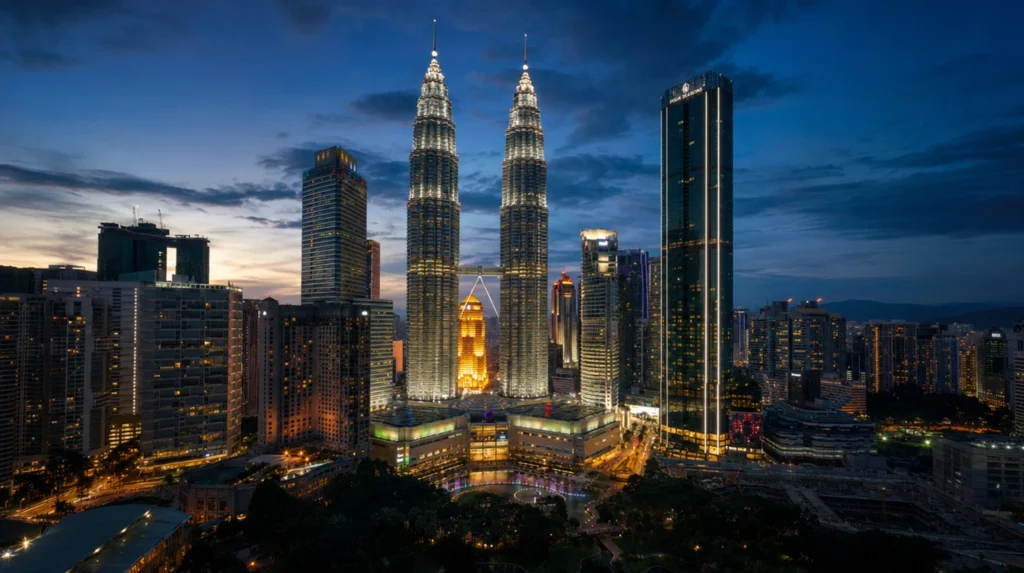
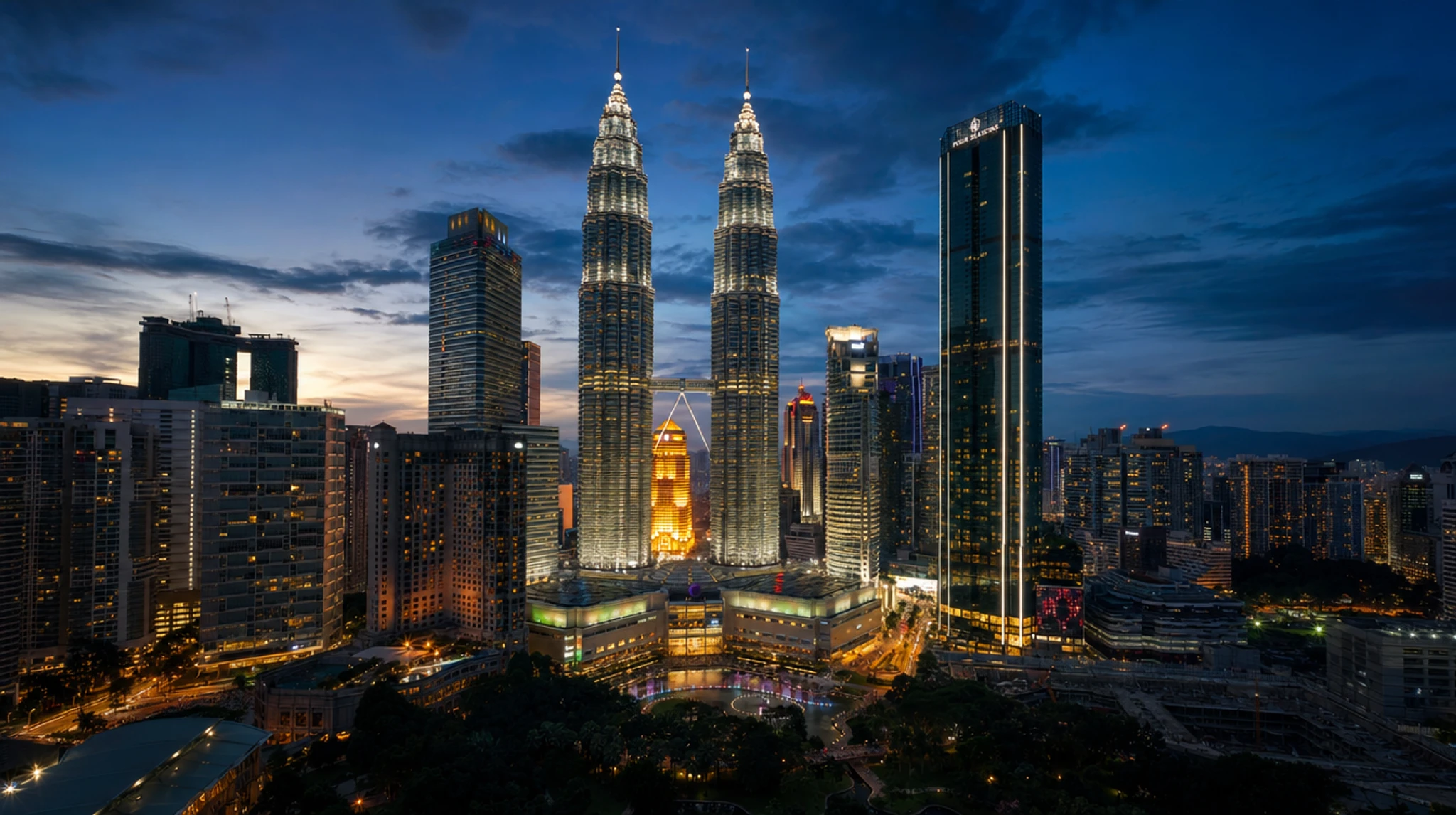
The capital is a layered, sometimes chaotic city where colonial shophouses sit under the shadow of the Petronas Twin Towers. Highlights: the Batu Caves, Jalan Alor night food street, Merdeka Square, KL Forest Eco Park (a patch of primary jungle in the middle of the city), and the Islamic Arts Museum. Give it three days, four if you want to eat properly.
🌶️ Penang (George Town)
If you visit one place in Malaysia outside KL, make it Penang. George Town is a UNESCO-listed maze of Peranakan mansions, Chinese clan houses, Hindu temples, mosques, and the most densely concentrated hawker food scene in the country. Spend three days just eating — char kway teow at Lorong Selamat, assam laksa at Air Itam market, Hokkien mee wherever you can find it.
🏮 Malacca
Malaysia’s other UNESCO-listed colonial city. Red Dutch buildings around Stadthuys Square, the ruined Portuguese A Famosa fort, Jonker Street night market, and Baba Nyonya cuisine (the Peranakan food that the Malays adopted from Chinese traders). A weekend is plenty; stay in a restored shophouse hotel.
🍵 Cameron Highlands
Four hours north of KL and 1,500 metres above sea level, the Cameron Highlands are Malaysia’s hill station: rolling tea plantations (BOH Tea is the big name), strawberry farms, mossy cloud forest, and weather cool enough for a jumper. Base yourself in Tanah Rata and spend a day hiking, a day touring the tea estates.
🏝️ Langkawi
A duty-free archipelago of 99 islands off the northwest coast. Pantai Cenang is the main beach strip — a little worn, but backed by decent mid-range resorts and seafood restaurants. The real reason to come: boat tours through limestone-karst islands, the Sky Bridge cable car, and mangrove cruises spotting eagles and monitor lizards.
🐢 Perhentian & Redang
On the east coast, closed in winter, paradise the rest of the year. White sand, water so clear it looks painted, and sea turtles you can snorkel alongside. Perhentian has two islands — Besar (quieter, resort-based) and Kecil (cheaper, backpacker vibe). Redang is slightly pricier and quieter. Book a package (accommodation + boat + meals) direct from Kuala Besut.
⛰️ Sabah (Borneo)
Sabah is the highlights reel of Malaysian Borneo: Mount Kinabalu (4,095m — a 2-day climb that hits you harder than you’d expect), orangutans at Sepilok, proboscis monkeys on the Kinabatangan River, and the world-class dive sites of Sipadan. Base in Kota Kinabalu for a few nights, then fly out to the jungle.
🌿 Sarawak (Borneo)
Wilder and less visited than Sabah. Kuching is a charming riverside city with a pastel-coloured waterfront and one of the best museums in Southeast Asia. From Kuching you can reach Bako National Park (proboscis monkeys, long-tailed macaques, wild boars wandering the beaches) in an hour. The big-ticket item is further east: Gunung Mulu National Park, home to the world’s largest cave chamber (Sarawak Chamber, big enough to park 40 jumbo jets).
Culture & Etiquette — What to Know Before You Go
Malaysia is a Muslim-majority country with a large Chinese Buddhist population, a significant Indian Hindu population, and smaller Christian and indigenous communities. The cultural tone shifts noticeably from neighbourhood to neighbourhood and state to state — KL feels cosmopolitan and liberal; rural Kelantan on the east coast is visibly more conservative. A few rules of thumb will carry you through almost any situation.
Dress code
Outside beach resorts, dress modestly — shoulders and knees covered, especially for women. In mosques, women need a headscarf (most mosques lend one at the door) and men need long trousers. Hindu temples and Chinese Buddhist temples are more relaxed but shoes come off at the door. On east-coast beaches, swimwear is fine on the sand but throw on a cover-up before walking into the village.
Ramadan
During Ramadan (mid-February to mid-March in 2026), Muslims fast from dawn until sunset. Restaurants in Muslim neighbourhoods may close for lunch; Chinese and Indian restaurants stay open as usual. Avoid eating or drinking conspicuously in front of fasting people out of respect. The flip side is that Ramadan bazaars spring up in every town around 4pm — enormous open-air food markets selling sweets, curries, grilled meats and iced drinks for the iftar break. If your trip overlaps Ramadan, the bazaars alone are worth the visit.
Greetings & small things
A handshake is standard, but some Muslim women prefer not to shake hands with men — wait for them to offer. Use your right hand for eating, passing things, and money transactions; the left hand is traditionally considered unclean. Point with your thumb rather than your index finger. Don’t touch people on the head, even children. When you enter a Malay home, shoes come off — watch what your host does.
Language
Bahasa Malaysia is the national language but English is spoken almost everywhere — menus, signs, hotel staff, taxi drivers. In the interior of Borneo you’ll hear more Iban, Kadazan, or Dusun than Malay. A few words of Bahasa go a long way: terima kasih (thank you), selamat pagi (good morning), sedap (delicious), berapa (how much). The locals will beam.
A Food Lover’s Guide to Malaysia
Plenty of countries claim to have the best food in Asia. Malaysia is the one that actually delivers — and it delivers at every price point, from a RM4 plate of char kway teow at a roadside stall to a RM400 tasting menu at a fine-dining restaurant in KLCC. The country’s three-way culinary inheritance (Malay, Chinese, Indian) plus local specialities from Peranakan, Hakka, Hokkien, and Tamil traditions means you could eat a different dish every meal for a month and still be scratching the surface.
The dishes you must try
🍚 Nasi Lemak
Malaysia’s unofficial national dish. Coconut rice served with sambal (chilli paste), crispy anchovies, roasted peanuts, boiled egg, and cucumber. Eaten for breakfast, lunch or dinner. Upgrade with fried chicken or rendang. The best versions come wrapped in a banana leaf at a mamak stall for under RM10.
🍲 Laksa (all varieties)
There are at least half a dozen different laksas in Malaysia, and they’re all glorious. Penang assam laksa (sour, fishy, tamarind-based) is the one food writers obsess over. Curry laksa (creamy, coconut-based) is the one you’ll find in KL. Sarawak laksa is a category of its own. Try as many as you can.
🥘 Char Kway Teow
Wok-fried flat noodles with prawns, Chinese sausage, bean sprouts and egg. Penang does the definitive version — smoky, slightly sweet, and cooked over such high heat that the char actually tastes like smoke. Find a hawker stall with a queue.
🥞 Roti Canai
Flaky flatbread cooked on a griddle and served with curry for dipping. Ask for roti telur (with egg) or roti pisang (with banana, for dessert). Every mamak restaurant in the country serves it for breakfast — a plate with teh tarik pulled tea costs about RM6 and sets up your whole day.
🍢 Satay
Grilled skewers — chicken, beef, or lamb — served with peanut sauce, rice cakes, cucumber and raw onion. The best satay in the country comes from Kajang, a KL suburb that considers itself the satay capital. Worth a Grab ride out from the city to try it at the source.
🥩 Rendang
Slow-cooked beef (or chicken) in a dry coconut-and-spice curry, cooked for so long the sauce has reduced to a thick, almost caramelised coating. Originally from neighbouring Indonesia but perfected across Malaysia. Peak nasi lemak territory.
🍜 Hokkien Mee
Two totally different dishes depending on where you order it. In KL, it’s thick dark-soy-fried noodles with pork crackling. In Penang, it’s a prawn-broth noodle soup. Both are essential. Don’t take sides.
🍧 Cendol
Shaved ice with green rice-flour jellies, coconut milk, and palm sugar syrup. The default Malaysian dessert — refreshing in a way that only makes sense once you’ve spent an afternoon walking around KL at 34°C. The cendol stands outside Penang’s Chowrasta Market are legendary.
Where to eat
Malaysia’s food scene is built on hawker centres and mamak stalls, not restaurants. Hawker centres (known as kopitiams in older neighbourhoods) are clusters of independent food stalls around a shared seating area — order from as many stalls as you like, and someone will come collect your money at each one. Mamak stalls are 24-hour Indian-Muslim eateries where you can get roti canai at 3am and no-one will blink. Both are cheap, safe, and the best way to eat in the country.
For the full hawker experience, head to Gurney Drive (Penang), Jalan Alor (KL), or the Red Garden food court (Penang). For mamak, any 24-hour place with yellow fluorescent lights and plastic chairs will do.
Practical Information
Currency
The Malaysian Ringgit (RM or MYR). Current rate as of April 2026 is roughly RM4.7 to 1 USD — your dollar (or pound, or euro) goes a long way here. ATMs are everywhere in cities and tourist areas; withdrawal fees are usually RM10–15. Credit cards work in mid-range hotels, chain restaurants, and shopping malls, but hawker stalls, small cafés, taxis, and rural anywhere are cash-only. Take out more than you think you need — nothing kills a food crawl faster than running out of cash between stalls.
SIM cards & data
Buy a tourist SIM the moment you land. Celcom, Digi and Maxis all sell prepaid packages at KLIA arrivals — RM35 (~US$7) gets you 30 days of unlimited data and a Malaysian number. Coverage is excellent in cities, good on highways, patchy in deep Borneo.
Tap water
Not recommended for drinking, even in KL. Brush teeth with bottled, and avoid ice at unfamiliar stalls. Bottled water is RM1–2 a litre at 7-Eleven.
Plugs & power
Malaysia uses UK-style three-pin plugs (Type G). Bring an adapter if you’re coming from the US, EU, or elsewhere in Asia.
Safety
Malaysia is one of the safer countries in Southeast Asia. Violent crime against tourists is rare; petty theft (bag snatching from motorbikes, mainly in KL’s tourist areas) is the main concern. Don’t walk with your bag on the road-side of the pavement, and keep an eye on your phone in crowded night markets.
Language
Bahasa Malaysia is official but English is near-universal. Sabah and Sarawak add dozens of indigenous languages. Menu-level English and business-level English are both excellent.
Budget Breakdown — What Malaysia Actually Costs
Malaysia is still one of the cheapest countries in Southeast Asia for value, though prices have crept up in the last few years. Here’s what you can realistically expect to spend per person per day in April 2026.
🎒 Backpacker — RM150 / ~US$32 / day
Hostel dorm (RM40), three hawker meals (RM35), coffee & snacks (RM15), public transit (RM10), one sight or activity (RM30), misc (RM20). Comfortable and doable — the only way it gets miserable is if you try to visit Sipadan or stay on Langkawi in peak season.
🧳 Mid-range — RM400 / ~US$85 / day
Private hotel room (RM200), mix of hawker and sit-down restaurants (RM100), taxi/Grab occasionally (RM40), activities and entrance fees (RM60). The sweet spot for most first-time visitors. You can stay in boutique hotels in George Town and Malacca at this rate.
💎 Luxury — RM1,200+ / ~US$255+ / day
Five-star hotel (RM800+), fine-dining dinners (RM250+), Grab and domestic flights (RM100+), spa and guided activities (RM150+). Malaysia’s high-end hotels — Shangri-La Rasa Ria, the Datai Langkawi, the Majestic Malacca — are genuinely world-class and still cheaper than comparable properties in Thailand or Indonesia.
🍽️ What individual things cost
Nasi lemak at a stall: RM4–8. Plate of char kway teow: RM7–12. Teh tarik: RM2. Beer (where available — it’s a Muslim country so cheap beer is not a given): RM12–20. Grab across KL: RM10–25. ETS train KL to Penang: RM65. Entry to Petronas Towers Skybridge: RM80. Dive day trip to Sipadan: RM700+.
Planning Your First Trip to Malaysia
Malaysia rewards longer visits, but most travellers come for 7–14 days. Here are three itineraries for different lengths and interests.
🕐 7 Days — The Greatest Hits (Peninsular only)
Days 1–3: Kuala Lumpur — Petronas Towers, Batu Caves, Jalan Alor food street, Islamic Arts Museum, a day trip to Putrajaya.
Days 4–5: Train up to Penang — George Town heritage walk, hawker food crawl, Kek Lok Si temple, Penang Hill.
Days 6–7: Short flight or train south to Malacca — Jonker Street, the old Dutch square, Peranakan museum, Nyonya dinner.
🕑 10 Days — Cities + Beach
Follow the 7-day itinerary through day 5 (Penang), then fly to Langkawi (days 6–8) for island time and mangrove tours, and return to KL for a final day of shopping and Indian food in Brickfields before flying home.
🕒 14 Days — Peninsular + Borneo
Days 1–3: Kuala Lumpur.
Days 4–5: Cameron Highlands (train to Ipoh, taxi up to Tanah Rata).
Days 6–8: Penang.
Days 9–10: Fly to Kota Kinabalu — Mt Kinabalu base or a river safari on the Kinabatangan.
Days 11–13: Fly to Kuching — Bako National Park, Sarawak Cultural Village, Kuching waterfront.
Day 14: Fly back to KL for departure.
Bookings to make in advance
- Long-distance trains (ETS) during weekends and holidays
- Perhentian/Redang packages (April–October is peak)
- Sipadan diving permits (often months ahead)
- Mt Kinabalu climb (2 months+ ahead — permits are capped)
- Langkawi mid-range hotels during school holidays
Frequently Asked Questions
Is Malaysia expensive to visit?
No. It’s one of the best-value destinations in Asia — cheaper than Thailand for comparable quality, and dramatically cheaper than Singapore or Japan. A mid-range traveller can have a very comfortable trip on RM400 (~US$85) per person per day.
Is it safe for solo travellers, including women?
Yes. Malaysia is one of the safer countries in Southeast Asia. Solo female travellers are common and generally report feeling comfortable, though modest dress outside beach areas helps, especially on the east coast and in rural areas.
Do I need a visa?
Most Western passports get 90 days visa-free on arrival. Always double-check your nationality on the official Malaysian immigration website before flying.
Can I drink alcohol in Malaysia?
Yes, but it’s not as ubiquitous as in, say, Thailand. Malaysia is a Muslim-majority country, so alcohol is expensive (RM15+ for a beer) and not sold in all restaurants. Chinese restaurants, hotel bars, and tourist-area bars all serve alcohol. In conservative states (Kelantan, Terengganu) it’s much harder to find.
How much of Malaysia can I see in one week?
Realistically, KL plus one other place — either Penang, Malacca, or Langkawi. Trying to add Borneo to a 7-day trip will leave you exhausted and seeing nothing properly. If you have 10+ days, add the beach.
Is English widely spoken?
Yes. Malaysia was British until 1957 and the language stuck. Menus, signs, hotels, taxis, shops — you can get by comfortably with English in every major destination. Learning a few words of Malay (terima kasih, selamat pagi) is appreciated but not required.
What’s the difference between Peninsular Malaysia and Borneo?
Peninsular Malaysia is the cities, beaches, colonial history, and street food. Borneo is the rainforest, the wildlife, the mountains, and the indigenous cultures. They feel like two different countries. First-timers usually focus on the Peninsula; people with more time add Borneo for a completely different experience.
What should I pack?
Light cotton or linen clothing, a rain jacket (there will be rain at some point, no matter when you visit), comfortable walking shoes, modest-dress options for mosque and temple visits, a light jumper for the Cameron Highlands, and insect repellent for jungle areas. Sunscreen is expensive in Malaysia — bring your own.
📘 Book Your Malaysia Trip
Ready to go? Here are our recommended resources for every part of a Malaysia trip:
- Flights: Skyscanner or Google Flights for international; AirAsia and Batik Air direct for domestic.
- Trains: KTMB eTicket (official Malaysian railway).
- Hotels: Booking.com and Agoda have the widest inventory; Agoda often wins for Southeast Asian mid-range properties.
- Tours & activities: Klook and GetYourGuide for Batu Caves day trips, Petronas tickets, mangrove cruises and dive packages.
- Travel insurance: Worth it. Jungle hiking, climbing Kinabalu, and diving all benefit from coverage.
Ready to Explore Malaysia?
Dive deeper into our city-by-city guides for the places you won’t want to miss.