
Languages of Afghanistan
All languages of Southern Asia →fluent beta classical · classes by phone with Maya at ranas.ai/maya
Afghanistan Travel Guide — The Hindu Kush, the Silk Road, and a Country Currently Off the Map
I write these guides to get people out the door, and this is the one guide on this site where I have to start by telling you not to go — at least not right now. Afghanistan holds some of the most staggering landscapes and layered history in Asia: a 65-metre brick minaret rising alone out of a river gorge, a valley of lapis-blue lakes stepped like a staircase, a shrine city that has drawn pilgrims for a thousand years. I’m not going to pretend that heritage doesn’t exist, and I’m not going to pretend it’s currently reachable the way Belize or Portugal is. This guide is here so you understand the country, its regions, and what a future visit might look like — not to talk anyone into booking a flight this year.
In This Guide
- Overview — A Crossroads of Empires, Currently Closed to Casual Visitors
- Nowruz and the Red Tulip Festival at the Blue Mosque
- Best Time to Visit Afghanistan (Climate, Season by Season)
- Getting There — Kabul’s Airport and the Overland Reality
- Getting Around — Domestic Flights, Terrain and Checkpoints
- Top Regions — Kabul, Bamiyan, Herat, Mazar-i-Sharif and the Wakhan
- Culture & People — Pashtun, Tajik, Hazara, Uzbek and Beyond
- A Food Lover’s Guide to Afghanistan
- Off the Beaten Path
- Practical Information
- Budget Breakdown — Why “Cost Per Day” Doesn’t Really Apply Right Now
- Frequently Asked Questions
Overview — A Crossroads of Empires, Currently Closed to Casual Visitors
Afghanistan sits landlocked at the hinge of Central Asia, South Asia and the Middle East, bordered by Pakistan, Iran, Turkmenistan, Uzbekistan, Tajikistan and a narrow finger of territory touching China. That position is precisely why the country matters historically: every empire that ever moved goods or armies between East and West — Achaemenid Persians, Alexander’s Macedonians, Kushans, Arabs, Mongols, Timurids, Mughals, and the British and Russian empires playing their nineteenth-century “Great Game” — passed through or fought over this ground. The result is a country with Buddhist cave monasteries, Islamic minarets counted among the tallest brick structures ever built, Silk Road caravanserai cities, and a mountain spine, the Hindu Kush, that splits the northern plains from the southwest deserts.
Since August 2021, Afghanistan has been governed by the Taliban as an Islamic Emirate, and the practical travel reality changed overnight: embassies closed, the tourism infrastructure that had been slowly rebuilding through the 2000s and 2010s mostly evaporated, and Western governments moved the country to their highest-level advisories. None of that erases the geography or the history — it just means the honest version of this guide is a portrait of a place, not an invitation.
What follows describes Afghanistan as it exists: its regions, its two UNESCO World Heritage Sites (both currently on the World Heritage in Danger list), its food, its people, and the practical realities for the narrow set of travelers — journalists, humanitarian staff, researchers, and a handful of specialist adventure-tour operators — who do currently operate here with dedicated security planning. If that isn’t you, read this as the guide it’s meant to be for now: context, not a checklist.
Nowruz and the Red Tulip Festival at the Blue Mosque
Afghanistan runs on the Solar Hijri calendar, and its New Year, Nowruz, falls on the spring equinox around 21 March. The country’s best-known Nowruz tradition is centered on the Shrine of Hazrat Ali — the turquoise-tiled “Blue Mosque” in Mazar-i-Sharif — where a decades-old ceremony called Jashn-e Dehqan or the Gul-e-Surkh (Red Tulip) festival traditionally coincides with the wild red tulips that carpet the surrounding plains each spring, alongside the ceremonial raising of a religious banner at the shrine.
The scale and openness of Nowruz celebrations has varied year to year under different Afghan governments, and public festivities are not guaranteed to run the way they did a decade ago — this is a note on the culture and calendar, not a claim about what’s currently permitted or accessible. If Afghanistan does become a realistic travel option again in the future, this is the week its own people build their year around, and it’s worth understanding regardless of whether you can currently attend.
Best Time to Visit Afghanistan (Climate, Season by Season)
This section is a climate reference, included for completeness and for the day advisories change — it is not a recommendation to travel now. Afghanistan’s weather is defined by the Hindu Kush: continental extremes, hard winters at altitude, and scorching, dry summers in the lowland basins.
March – May · Spring
Snowmelt greens the valleys, Nowruz falls in late March, and temperatures in Kabul and Herat are the most comfortable of the year before the summer heat sets in.
June – August · Summer
Hot and dry in Kabul, Kandahar and the southern deserts, with daytime temperatures regularly climbing into the high 30s Celsius in the lowlands; the higher valleys of Bamiyan and the Wakhan Corridor stay noticeably cooler and are the classic season for high-altitude travel when it has been possible.
September – November · Autumn
Harvest season — Afghanistan’s pomegranates, grapes and melons are at their best — with clear skies and mild days before winter closes in on the mountain passes.
December – February · Winter
Heavy snow closes many high mountain roads, including routes into the Wakhan and parts of the central highlands, isolating some communities for months; Kabul itself sees cold, occasionally snowy winters.
Getting There — Kabul’s Airport and the Overland Reality
Kabul International Airport (KBL), previously named Hamid Karzai International Airport, is the country’s main gateway, sitting at roughly 1,791 metres elevation. Commercial international service resumed gradually after 2021 and now includes Ariana Afghan Airlines and Kam Air alongside a handful of foreign carriers such as flydubai, Air Arabia, Turkish Airlines, Etihad Airways and Iranian carriers, with routes concentrated on regional hubs — Dubai, Doha, Sharjah, Istanbul, Jeddah, Islamabad, Delhi and Iranian cities. There are no direct flights from North America or most of Europe; anyone flying in connects through one of those regional hubs.
Overland, Afghanistan borders Pakistan, Iran, Turkmenistan, Uzbekistan, Tajikistan and China, but border crossings open to foreign tourists are limited, subject to closures without notice, and generally require far more paperwork and local coordination than a standard land border. Under current advisories, no government support is available if something goes wrong at any of these crossings — there is no US embassy operating in-country and no British embassy presence at all.
Getting Around — Domestic Flights, Terrain and Checkpoints
Afghanistan is mountainous and road infrastructure is uneven outside the ring road connecting the main cities, so domestic flights on Ariana Afghan Airlines and Kam Air — linking Kabul with Herat, Kandahar and Mazar-i-Sharif — are the practical way to cover long distances quickly and are how any current specialist tour typically moves between regions.
Road travel involves frequent checkpoints, variable road quality once off the main highways, and journey times that swing enormously with season — winter snow closes high passes into the Wakhan Corridor and parts of the central highlands for months at a stretch. Any overland movement between cities or regions is a security and logistics decision that, right now, sits squarely in the domain of professional fixers and security advance teams, not independent trip planning.
Top Regions — Kabul, Bamiyan, Herat, Mazar-i-Sharif and the Wakhan
Kabul
The capital and largest city, ringed by the foothills of the Hindu Kush, with a long, layered history as a Silk Road trading post and seat of successive Afghan dynasties. Bagh-e Babur, the Mughal-era garden tomb of Emperor Babur, is on Afghanistan’s UNESCO tentative list and remains one of the city’s most visited historic sites among those who do travel here.
Bamiyan Valley
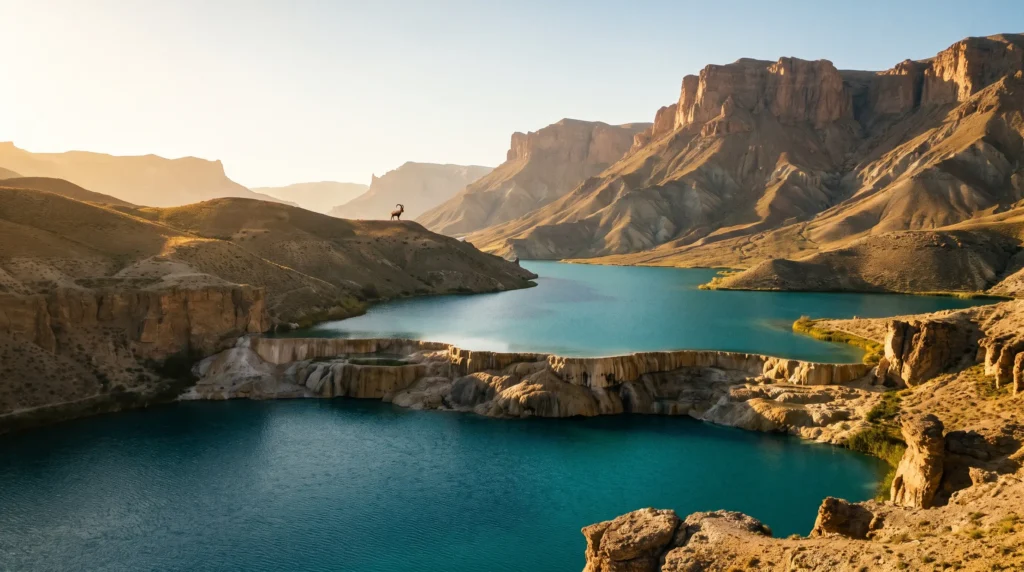
Central Afghanistan’s high-altitude heart, and a UNESCO World Heritage Site since 2003 for its Buddhist-era cultural landscape, rock-cut monastic caves, and the cliff niches where two colossal standing Buddhas — 53 and 35 metres tall, carved around the sixth century — stood for well over a millennium before the Taliban dynamited them in 2001. The site has been on the World Heritage in Danger list since its inscription. Nearby, Band-e-Amir — a chain of deep-blue lakes separated by natural mineral-dam walls — is Afghanistan’s first national park and sits on the UNESCO tentative list.
Herat
The great western city, historically a Persianate cultural capital on the road toward Iran, with a citadel and Timurid-era mosque and minaret complex that put it on Afghanistan’s UNESCO tentative list under “City of Herat.” Herat’s architecture reflects centuries as a crossroads between Persian, Central Asian and South Asian artistic traditions.
Mazar-i-Sharif
The main city of the north, built around the turquoise-domed Shrine of Hazrat Ali — the Blue Mosque — one of the most visually striking religious sites in the Islamic world and the anchor of the Nowruz traditions described above. The nearby ancient city of Balkh, one of the oldest urban settlements in Central Asia, is also on Afghanistan’s UNESCO tentative list.
Ghor Province & the Minaret of Jam
A remote, mountainous province whose main claim to fame is a genuine wonder: the Minaret of Jam, a 65-metre baked-brick tower raised around 1194 near the confluence of the Jam and Hari rivers, all that remains above ground of the lost Ghurid capital of Firozkoh. It was Afghanistan’s first UNESCO World Heritage Site, inscribed in 2002, and has remained on the World Heritage in Danger list ever since, threatened by erosion, flooding and its sheer inaccessibility.
The Wakhan Corridor
A narrow, high-altitude finger of territory in the far northeast reaching toward China, wedged between Tajikistan and Pakistan, home to Wakhi and Kyrgyz communities living at some of the highest inhabited altitudes in the world beneath the Pamir and Hindu Kush ranges. It has historically been considered one of the more stable, remote corners of the country, though it remains extremely difficult to reach and firmly inside the same national advisory as everywhere else.
Kandahar
The historic southern capital and the country’s second-largest city, with roots as an ancient trading center on routes toward Pakistan and Iran.
Culture & People — Pashtun, Tajik, Hazara, Uzbek and Beyond
Afghanistan is genuinely multi-ethnic: Pashtun and Tajik communities form the largest groups, alongside significant Hazara and Uzbek populations and smaller Turkmen, Baloch, Nuristani, Pashai and other communities, each with distinct languages, dress and regional strongholds. Pashto and Dari (a form of Persian) are the official languages and are mutually understood across most of the country, while Uzbek, Turkmen and other regional languages remain strong in their home areas.
Hospitality is a deeply held cultural value across Afghan society — guests are traditionally treated with generosity that can feel startling to outsiders — but this sits alongside a conservative social and religious framework that has hardened further since 2021. Current government policy imposes strict dress and conduct rules, particularly severe restrictions on women’s dress, mobility, education and public life, and foreign visitors of any gender are expected to dress modestly and conservatively at all times. Women traveling to or through Afghanistan face restrictions that go well beyond dress codes and should research current, specific requirements — including mahram (male chaperone) rules that have been enforced in various forms — before any travel, ideally directly through their government’s current advisory page rather than general guides like this one.
A Food Lover’s Guide to Afghanistan
Afghan food sits at the meeting point of Persian, Central Asian and South Asian cooking, built around rice, bread and slow-cooked meat. The national dish is Kabuli palaw — rice cooked in meat broth and topped with caramelized carrots, raisins and slivered almonds or pistachios, usually served with tender braised lamb. Fresh naan, baked in tandoor-style clay ovens, accompanies almost every meal.
Look for mantu (steamed dumplings filled with spiced ground beef or lamb, topped with a garlicky yogurt sauce and a tomato-based meat sauce) and ashak (leek-filled dumplings served the same way) — both closely related to dishes found across Central Asia. Kebabs of skewered, charcoal-grilled lamb or beef are a street-food staple, and green tea (chai sabz) is the default drink at every meal and every social gathering, poured continuously as a mark of hospitality.
Off the Beaten Path
Band-e-Amir National Park
Six lakes of improbably deep blue, dammed naturally by mineral travertine walls high in the central highlands near Bamiyan — Afghanistan’s first national park and a tentative UNESCO listing.
The Minaret of Jam
Already covered above as a top region, but worth repeating as a destination in its own right: reaching it has always meant a genuine expedition, days from the nearest paved road, which is exactly why it has stayed so little visited despite being one of the most extraordinary standing monuments in Islamic architecture.
Balkh
Once one of the great cities of the ancient world and a major Silk Road center, today a quiet town of ruins and shrines outside Mazar-i-Sharif, holding tentative UNESCO status under “City of Balkh.”
The Wakhan Corridor
For the rare traveler who has reached it with serious logistical and security support, this is as remote and untouched a high-mountain landscape as exists anywhere in Asia — herding communities, Marco Polo sheep, and views toward the Pamirs and the Karakoram.
Practical Information
Safety. This bears repeating in its own right, not just in the advisory box above: current guidance from the US State Department (Level 4, Do Not Travel) and UK FCDO (advises against all travel) applies to the entire country, citing terrorism, kidnapping, wrongful detention risk, civil unrest and a near-total absence of consular support. Check your own government’s current page before making any decision, and understand that travel insurance is commonly invalidated when it’s taken against explicit government advice.
Money. The Afghan afghani (AFN) floats against the US dollar, trading at roughly 65 to the dollar as of 2024, issued and regulated by Da Afghanistan Bank, the central bank. Card payments and international ATM networks are essentially unusable for foreign visitors; cash, carried and exchanged carefully, is the practical reality, and US dollars are widely recognized in Kabul and other major cities alongside afghanis.
Health. The CDC recommends all routine vaccinations be current, plus Hepatitis A and, for many travelers, Hepatitis B, typhoid and rabies pre-exposure vaccination; a polio vaccine or booster is specifically flagged given ongoing polio circulation in the region, and malaria prophylaxis is recommended for areas below 2,500 metres from April through December, with chloroquine-resistant strains present. Medical facilities are extremely limited outside a handful of Kabul hospitals and are not equivalent to Western trauma or emergency care.
Connectivity & dress. Mobile networks exist in major cities but international roaming and data reliability are inconsistent; do not assume connectivity for emergencies. Conservative dress is expected of all visitors — long sleeves and modest coverage for everyone, and additional, strictly enforced requirements for women, including head covering and, in many contexts, a male chaperone. Photography of government buildings, checkpoints and security personnel is commonly restricted and should be avoided entirely without explicit local permission.
Budget Breakdown — Why “Cost Per Day” Doesn’t Really Apply Right Now
Every other guide on this site gives you budget, mid-range and luxury daily costs. Afghanistan doesn’t fit that model at the moment, and giving invented numbers would be more misleading than useful. There is essentially no independent backpacker or mid-range tourism infrastructure left standing after 2021 — the hostels, tour desks and visa-on-arrival systems that a “budget traveler” section would normally describe largely don’t exist for foreign visitors in any organized way.
In practice, the people currently entering Afghanistan for anything resembling tourism go through a small number of specialist expedition operators who bundle permits, armed or unarmed security assessment, fixers, private vehicles and pre-vetted accommodation into a single quoted package — priced well above typical regional travel specifically because of the logistics and risk management involved, not because of hotel star ratings. If and when the advisory picture changes meaningfully, this section is the one we’ll rewrite first, with real, current numbers.
Planning Your First Trip to Afghanistan
Right now, the honest planning advice is: don’t, independently — and if you’re going through professional or humanitarian channels, you already have a security team doing this planning for you, not a blog. For everyone else, the most useful thing this guide can do is point you toward the neighboring region you can actually visit today. The old Silk Road cities of Uzbekistan — Samarkand, Bukhara, Khiva — sit on the same historic trade network and are fully open, as are Kazakhstan and Kyrgyzstan‘s stretches of the Central Asian steppe and Tian Shan mountains, which echo the high-altitude drama of the Wakhan without the risk. To the south, Pakistan shares deep cultural, culinary and historic threads with Afghanistan — including its own Mughal architecture and Hindu Kush foothills — and, while it carries its own regional advisories in places, has significantly more open, accessible travel infrastructure. Bookmark this guide; revisit it if the advisory picture changes.
Frequently Asked Questions
Is it safe to travel to Afghanistan in 2026?
According to current guidance, no government considers it safe for ordinary tourism. The US State Department rates it Level 4, Do Not Travel — its highest level — and the UK FCDO advises against all travel to the entire country. Always check your own government’s current page rather than relying on any single source, including this one.
Do I need a visa?
Yes — a visa is required for virtually all foreign nationals. Issuance is inconsistent because many countries’ embassies and consulates in Kabul remain closed or suspended since 2021; you would need to identify a currently functioning Afghan diplomatic mission and confirm requirements directly.
What happened to the Buddhas of Bamiyan, and can you still see anything there?
The two colossal Buddha statues, standing 53 and 35 metres tall and carved around the sixth century, were destroyed by the Taliban in 2001. The empty cliff niches, surrounding cave monasteries and the wider Bamiyan cultural landscape remain and are why the site keeps its UNESCO World Heritage status, currently on the danger list.
Can women travel to Afghanistan?
Current authorities enforce severe restrictions on women’s dress, movement and public presence, and these apply to foreign women as well as Afghan citizens. Anyone considering travel should research current, specific rules — including chaperone requirements — directly through their government’s advisory page before making any plans; this is not a decision to make from a general travel guide.
What is the currency and can I use cards?
The Afghan afghani (AFN) floats against the US dollar at roughly 65 to 1 as of 2024. International card networks and ATMs are not a reliable option for foreign visitors; cash is the practical necessity.
How many UNESCO World Heritage Sites does Afghanistan have?
Two: the Minaret and Archaeological Remains of Jam (inscribed 2002) and the Cultural Landscape and Archaeological Remains of the Bamiyan Valley (inscribed 2003) — both currently listed as World Heritage in Danger. Four more sites, including the cities of Herat and Balkh, sit on the tentative list.
A Guide for Understanding, Not Booking — For Now
Afghanistan holds a minaret older than most European cathedrals, lakes the color of stained glass, and a hospitality culture that visitors from decades past still talk about. It also holds, right now, a Level 4 Do Not Travel advisory and a government whose restrictions — especially on women — go far beyond anything else covered on this site. We’ll keep this guide updated as the advisory picture changes. Until then, treat it as a window into the country, not a itinerary.
Explore More
- Uzbekistan Travel Guide — the same Silk Road story, fully open today
- Pakistan Travel Guide — shared history and Hindu Kush foothills next door
- Kyrgyzstan Travel Guide — the same high Pamir and Tian Shan drama, minus the risk
- Kazakhstan Travel Guide — Central Asia’s steppe, accessible year-round
How this guide was built
Published . Because Afghanistan currently carries the highest-level travel advisories from multiple governments, this guide was built with an explicit safety-first brief: verify the advisory status first, from primary government sources, and write every other section honestly around that reality rather than around a typical destination-guide template. Sources consulted include the US State Department’s Afghanistan travel advisory, the UK FCDO’s Afghanistan travel advice, the US CDC traveler health page for Afghanistan, the World Bank’s Afghanistan population data, and Wikipedia entity pages for Afghanistan, the Minaret of Jam, the Bamiyan Valley, the Afghan afghani, Kabul International Airport, and the list of Afghanistan’s UNESCO World Heritage Sites. Numeric and checkable claims carry inline citations.
Sources cited on this page
- US State Department — Afghanistan Travel Advisory
- UK FCDO — Afghanistan Travel Advice
- US CDC — Afghanistan traveler page
- World Bank — Afghanistan Data
- Wikipedia — Afghanistan
- Wikipedia — List of World Heritage Sites in Afghanistan
- Wikipedia — Minaret of Jam
- Wikipedia — Bamyan Valley
- Wikipedia — Afghan Afghani
- Wikipedia — Kabul (Hamid Karzai) International Airport
More country guides you might like
Plan your trip to Afghanistan
The booking tools we use ourselves. FFU may earn a commission at no extra cost to you.
Plan & book your trip to Afghanistan
Booking through these searches supports our guides at no extra cost to you.