
Palau Travel Guide — Rock Islands, World-Class Diving & the Passport Pledge That Protects Paradise
Palau is the only country I’ve visited where you sign a promise to the nation’s children before immigration will let you in. It’s called the Palau Pledge, it gets stamped right into your passport, and it sets the tone for everything that follows: this is a place that decided, deliberately, to stay small. Barely 340 tiny islands scattered across the western Pacific, home to about 18,000 people, and yet it was the first country on Earth to declare its entire waters a shark sanctuary. I’ve dropped into a current at Blue Corner with grey reef sharks stacked below me like a school photo, floated through a lake full of jellyfish that lost their sting millennia ago, and eaten dinner in a village where the money that actually matters is still a strand of ancient glass beads. Palau is not an easy or a cheap add-on to a bigger Pacific trip — it’s remote, the flights are long, and the fees add up before you’ve even touched saltwater. But if you dive, or want to, there is nowhere else quite like it.
In This Guide
- Overview — Why Palau Punches So Far Above Its Weight
- Manta Season at German Channel — Dec–Apr
- Best Time to Visit Palau (Season by Season)
- Getting There — ROR, the Pledge & the Entry Form
- Getting Around — Boats, the Compact Road & Rental Cars
- Top Regions — Koror, the Rock Islands, Babeldaob & Beyond
- Culture & People — Clans, Bai and Stone Money
- A Food Lover’s Guide to Palau
- Off the Beaten Path
- Practical Information
- Budget Breakdown — What Palau Actually Costs in 2026
- Frequently Asked Questions
Overview — Why Palau Punches So Far Above Its Weight
Palau is an archipelago of roughly 340 islands in the western Pacific, part of the Micronesia region, with a total land area smaller than most mid-sized cities and a population of under 20,000. It’s a presidential republic in free association with the United States, independent since 1 October 1994 but tied to Washington through a Compact of Free Association that covers defense and brings significant US aid. None of that shows up when you’re in the water — what shows up is one of the most biodiverse and best-protected marine environments on the planet.
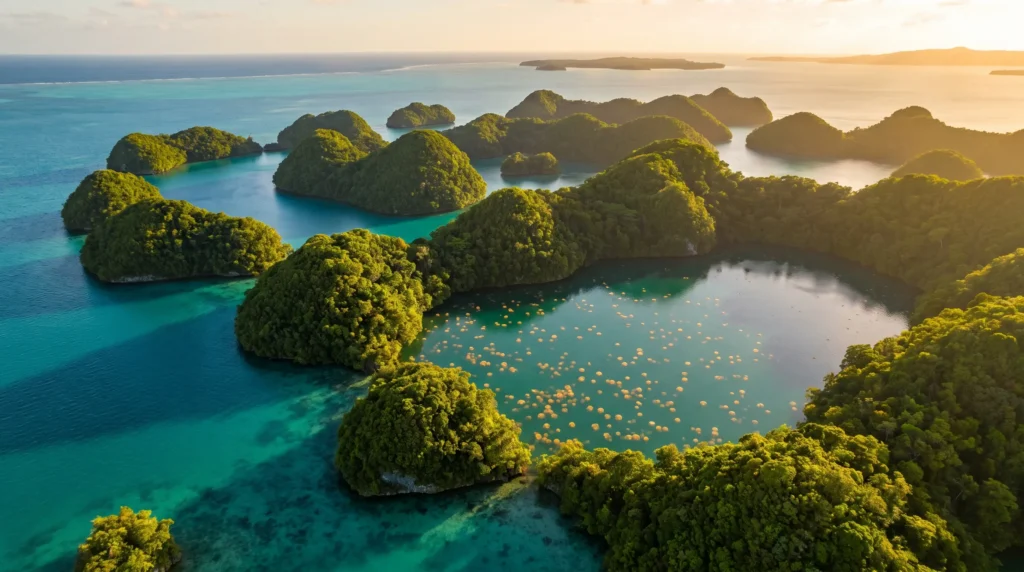
Palau made global conservation headlines in 2009 by creating the world’s first national shark sanctuary, closing roughly 600,000 square kilometres of its waters to commercial shark fishing. It followed that with the Palau National Marine Sanctuary and, in 2017, the Palau Pledge — a legally binding, passport-stamped promise every visitor signs at immigration, committing to act in an ecologically responsible way for the sake of Palau’s children. The centerpiece for most visitors is the Rock Islands Southern Lagoon, a UNESCO World Heritage Site since 2012 covering about 100,200 hectares and some 445 uninhabited, mushroom-shaped limestone islands rising out of an impossibly turquoise lagoon.
What you’re buying with the long flight and the fees is scarcity done right: the reef here supports over 385 coral species, at least thirteen shark species and the highest concentration of marine lakes found anywhere on Earth — landlocked seawater pools cut off from the ocean, each one its own miniature evolutionary experiment. Palau isn’t a beach-holiday country in the Caribbean sense — it’s a diving and snorkeling country that happens to have gorgeous beaches on the side.
Manta Season at German Channel — December to April
If you can time a trip around one thing, make it Palau’s dry season overlapping with manta ray cleaning activity at German Channel, the narrow, current-fed passage blasted through the reef by the Japanese in the 1930s and now one of the most reliable manta encounters in the Pacific. Calmer seas from roughly December through April mean better boat access to the outer dive sites and the clearest underwater visibility of the year.
Pair it with Blue Corner on the same day — a wall dive where you clip into the reef with a hook and watch grey reef sharks, napoleon wrasse and schooling barracuda work the current — and you’ve got back-to-back dives that regularly appear on “best dives in the world” lists. Outside of diving, this window also has the year’s steadiest weather for island-hopping the Rock Islands and Jellyfish Lake, so it’s the stretch serious trip-planners book out furthest in advance.
Best Time to Visit Palau (Season by Season)
December – April · Dry season (peak)
The most reliable sunshine, calmest seas and best dive visibility of the year, with daytime highs around 32°C (90°F). This is also peak booking season for liveaboards and dive resorts — reserve months out if your trip is anchored around specific dive sites.
May – July · Shoulder
Warm, increasingly humid, with more frequent afternoon showers as the southwest monsoon builds. Fewer boats on the water, softer rates, and diving is still excellent — you trade a bit of certainty for real savings.
August – November · Wet season, elevated storm risk
Palau’s heaviest rain and highest (though still comparatively low) chance of tropical storms and typhoons falls in this window; annual rainfall across the islands runs 120–160 inches. Direct typhoon hits are rare since Palau sits close to the equator, outside the main storm corridor, but travel insurance with trip-interruption cover is smart during these months.
Getting There — ROR, the Pledge & the Entry Form
Palau International Airport (ROR), on Babeldaob just north of Koror, is the only gateway, and it’s a genuinely long haul from almost anywhere. United Airlines connects via Guam a few times a week, China Airlines runs year-round service from Taipei, and there are seasonal or periodic links to Manila and — the longest route from Koror — a roughly 5.5-hour Qantas flight to Brisbane. There is no budget-carrier shortcut here; expect to route through one of those hub cities and build a buffer day into your itinerary in case of missed connections.
Before you fly, complete the Palau Entry Form online — it must be submitted no more than 72 hours before arrival, and it generates a QR code you present at immigration. At the airport you’ll also sign the Palau Pledge, an environmental and cultural commitment stamped directly into your passport; it’s compulsory, not optional, for every visitor. Most passports get 30 days on arrival without a pre-arranged visa, but your passport needs at least six months’ validity (the UK advises two blank pages as well), and you’ll need proof of onward travel.
Getting Around — Boats, the Compact Road & Rental Cars
Koror, the old capital and commercial heart, is compact and walkable to driveable in minutes; a bridge connects it to Babeldaob, the country’s largest island, where the actual capital, Ngerulmud, sits in Melekeok State. Babeldaob’s Compact Road loops the island’s rim and opened up waterfalls, villages and traditional bai meeting houses that used to require a boat. Rental cars are the easiest way to explore it; taxis and hotel shuttles cover Koror itself.
Everything in the Rock Islands, and most diving, happens by boat — day-tour operators and dive shops run out of Koror’s marina, and this is not a place where you improvise your own transport onto the water; permits, guides and licensed boats are how you access the Southern Lagoon. Getting to the outer states — Peleliu, Angaur, and especially the remote Kayangel Atoll or the Southwest Islands — means chartered boats or, for the furthest specks, small planes, and schedules bend around weather more than a clock.
Top Regions — Koror, the Rock Islands, Babeldaob & Beyond
Koror
Home to about two-thirds of Palau’s population and nearly all its hotels, dive shops and restaurants. Base yourself here — it’s the launch point for every Rock Islands boat trip and the only place with a real nightlife and restaurant scene.
Rock Islands Southern Lagoon
The UNESCO-listed heart of the trip: 445 uninhabited limestone islands, Blue Corner and German Channel for diving, Ulong Island’s white sandbars, and Jellyfish Lake, where millions of golden jellyfish that lost their sting in isolation drift through a marine lake cut off from the open sea. Jellyfish numbers fluctuate with ocean temperature cycles, so ask your operator about current conditions before you build a trip around it.
Babeldaob
Palau’s largest island and the seat of national government at Ngerulmud, laced by the Compact Road, Ngardmau Waterfall, traditional villages, and stone monoliths whose origins are still debated by archaeologists. Far quieter than Koror and worth a full day by rental car.
Peleliu
The site of one of the Pacific War’s bloodiest battles, fought from September to November 1944, where nearly the entire 10,000-strong Japanese garrison died alongside 1,794 Americans in what remains the highest-casualty-rate amphibious assault of the Pacific campaign. Rusting tanks, bunkers and a small war museum sit alongside beautiful, near-empty beaches; hire a known local guide, since unexploded ordnance is still occasionally found in uncleared areas.
Angaur
A small, laid-back island south of Peleliu, known for its population of wild long-tailed macaques (descendants of monkeys introduced generations ago), more WWII relics, and some of the loneliest beaches in the country.
Kayangel & the Southwest Islands
Kayangel is a tiny, remote atoll north of Babeldaob — postcard-perfect and rarely visited because reaching it takes real effort. Palau’s Southwest Islands sit even further out, culturally distinct (Sonsorolese and Tobian speaking) and visited by only a handful of travelers a year.
Culture & People — Clans, Bai and Stone Money
Palauan society is traditionally matrilineal — land, titles and clan authority pass through the maternal line, and senior women hold real influence in choosing chiefs, a structure that predates and still coexists with the modern republic. Villages historically centered on the bai, an elaborately carved and painted traditional meeting house; several restored examples survive, including on Babeldaob, and their storyboard-style carvings record legends and history in a way you can actually read if you know what to look for.
Traditional wealth in Palau isn’t gold — it’s udoud, ancient glass and stone beads of uncertain, possibly Southeast Asian origin, still used today in dowries and ceremonial exchanges alongside modern currency. Betel nut chewing is a daily social ritual much like it is across Micronesia and parts of Southeast Asia. Palauan and English are both official languages, but you’ll also hear Japanese in Angaur and Peleliu (a legacy of the pre-WWII Japanese administration), plus Sonsorolese and Tobian in the far southwest. The Palau Pledge you sign on arrival isn’t a tourism gimmick tacked onto an otherwise ordinary check-in — it reflects a genuinely community-driven push, backed by the Responsible Tourism Education Act, to keep visitor numbers aligned with what the reef and the islands can actually sustain.
A Food Lover’s Guide to Palau
Palauan cooking leans on the reef and the land in equal measure: reef fish (rainbow runner and mahi-mahi are staples), taro, tapioca, breadfruit and coconut show up at nearly every local meal. Sashimi-grade fish is everywhere and excellent, a direct legacy of the decades of Japanese administration before WWII, and you’ll find genuinely good Japanese and Filipino food in Koror alongside Palauan spots.
One dish worth knowing about before you see it on a menu: fruit bat soup, a traditional Palauan delicacy served whole in coconut broth. It’s a real part of local cuisine, not a tourist stunt, but it’s an acquired sight as much as an acquired taste, and it’s entirely fine to pass. For something gentler, look for ongraol (Palauan doughnuts) at local bakeries, and grilled reef fish with rice at any of the casual local restaurants around Koror rather than the hotel dining rooms.
Off the Beaten Path
Kayangel Atoll
A remote, ring-shaped atoll north of Babeldaob, reachable only by chartered boat over open water — the reward is postcard sand and almost total solitude.
The Milky Way
A shallow lagoon within the Rock Islands where fine white limestone mud is said to have skin-softening properties; boat tours stop here to let passengers coat themselves in it before rinsing off in the lagoon.
Ngardmau Waterfall
Babeldaob’s tallest waterfall, reached by a boardwalk and rail-car trail through rainforest — a good half-day break from the boat-and-tank routine.
Angaur’s Monkey Population
Long-tailed macaques descended from animals introduced generations ago now roam parts of this quiet southern island, alongside overgrown WWII airstrips and bunkers most visitors never see.
Practical Information
Money. Palau uses the US dollar as its official currency, so there’s no exchange rate to think about if you’re coming from the US. ATMs and card acceptance are reasonably reliable in Koror but scarce elsewhere — carry cash for the outer states, boat crews and small guesthouses.
Fees to budget for. Expect a mandatory environmental/”Green Fee” built into the cost of your air ticket, plus separate Rock Islands and Jellyfish Lake use permits (each typically valid for around five days) purchased through the Koror State Ranger office or your tour operator — factor these in on top of diving and accommodation costs.
Safety. The US State Department rates Palau Level 1, “Exercise Normal Precautions,” its lowest advisory tier — but flags the Rock Islands and other outlying islands for limited emergency medical infrastructure (multi-hour boat rides to reach critical care) and Peleliu specifically for unexploded WWII ordnance in uncleared areas. There are no traffic lights anywhere in the country, drunk-driving fatalities are a recognized risk, e-cigarettes are banned with serious fines, and firearms are strictly prohibited.
Health. The CDC recommends routine vaccines plus hepatitis A and typhoid coverage for most travelers, along with standard bug-bite precautions. Reef-toxic sunscreens (oxybenzone and octinoxate formulas) are illegal to bring in — pack zinc-oxide or titanium-dioxide mineral sunscreen instead, since customs can and does confiscate the wrong kind.
Connectivity. Internet is decent in Koror hotels, patchy to nonexistent on outer islands and liveaboards. Plugs: US-style, 120V. Time zone: UTC+9, no daylight saving.
Budget Breakdown — What Palau Actually Costs in 2026
Palau is not a backpacker destination — flights alone put a floor under the trip, and diving is the main event, not a side excursion.
Budget (US$90–150/day): A simple guesthouse or budget hotel in Koror, local Palauan/Filipino restaurants over hotel dining, snorkeling trips instead of full dive packages, and a rental car shared between a group for a Babeldaob day.
Mid-range (US$220–400/day): A mid-tier dive resort, a two-tank boat dive most days (commonly in the US$150–220 range once permits and gear are included), a Rock Islands day tour with Jellyfish Lake, and restaurant meals.
Luxury (US$600+/day): A liveaboard dive charter or upscale resort, private boat charters to Peleliu or Kayangel, and the full permit stack for extended Rock Islands and Jellyfish Lake access.
Fixed costs everyone pays regardless of budget: the environmental fee bundled into your airfare and Rock Islands/Jellyfish Lake use permits on top of any tour price. Tipping isn’t deeply embedded the way it is in the US, but it’s appreciated for dive guides and boat crews.
Planning Your First Trip to Palau
Seven nights is the practical minimum: base in Koror, dive or snorkel the Rock Islands (Blue Corner, German Channel, Jellyfish Lake) for four to five days, and give one full day to Babeldaob’s waterfalls and villages by rental car. Add two or three nights on Peleliu if WWII history interests you, or push out to Kayangel if you have the extra days and the sea cooperates. Because most routes connect through Manila, Guam or Taipei, it’s easy to bolt Palau onto a longer Pacific or Southeast Asia itinerary — divers often pair it with the reefs of the Philippines or continue west toward Indonesia‘s Coral Triangle sites for a bigger diving-focused trip.
Frequently Asked Questions
Is Palau safe for tourists in 2026?
Yes — the US State Department rates it Level 1, its lowest advisory tier, meaning “exercise normal precautions.” The specific flags are limited emergency medical care on the Rock Islands and other outlying islands, and unexploded WWII ordnance on Peleliu, which is why guides are strongly recommended there.
Do I need a visa?
Most nationalities get 30 days visa-free on arrival, but every visitor must submit the Palau Entry Form within 72 hours of arrival and sign the Palau Pledge at immigration; your passport needs at least six months’ validity.
Is Jellyfish Lake still open?
It generally is, but the jellyfish population has crashed and recovered before with warming ocean cycles, so numbers vary year to year — check current conditions with a licensed tour operator before building your trip around it.
Can beginner divers do Blue Corner and German Channel?
Both are current-driven dives best suited to divers with some experience and comfort using a reef hook; dive shops will typically want to see logged dives or run a check-out dive first. Newer divers still get excellent snorkeling and gentler dive sites around the Rock Islands.
Palau or Maldives or Fiji?
Choose Palau for the single best land-and-lagoon diving combination in the Pacific and a genuinely wild, low-density feel; choose the Maldives for overwater luxury and atoll resorts, or Fiji for an easier flight and a more built-out resort and family-travel scene.
What’s the biggest catch with visiting Palau?
The flights — there’s no cheap or short way in from most of the world — and the layered fees (environmental fee, Rock Islands permit, Jellyfish Lake permit) that stack on top of your accommodation and diving costs before you’ve spent a dollar on food.
Ready to Explore Palau?
A shark sanctuary the size of a small country, a lake full of jellyfish that forgot how to sting, and a promise you sign in your own passport before they’ll let you in. Palau asks more of you to get there than most Pacific destinations — but for divers and snorkelers, it delivers more than almost anywhere else on the planet.
Explore More
- Philippines Travel Guide — the closest major reef-diving neighbor, a short flight from Palau
- Indonesia Travel Guide — extend the trip into the wider Coral Triangle
- Fiji Travel Guide — another Pacific island nation, more built-out for resort travel
- Maldives Travel Guide — the Indian Ocean’s answer to Palau’s atoll diving
How this guide was built
Published . Built from authoritative sources — Wikipedia’s Palau, Jellyfish Lake and Battle of Peleliu entity pages, UNESCO’s Rock Islands Southern Lagoon World Heritage inscription, the US State Department’s Palau travel advisory, the UK FCDO’s Palau travel advice and entry requirements, the US CDC traveler page for Palau, Palau’s official Bureau of Tourism (PalauGov.pw), Island Times reporting on Rock Islands and Jellyfish Lake permit fees, and climate data via Climates to Travel. Numeric and checkable claims carry inline citations.
Sources cited on this page
- Wikipedia — Palau
- UNESCO — Rock Islands Southern Lagoon
- Wikipedia — Jellyfish Lake
- Wikipedia — Battle of Peleliu
- US State Department — Palau Travel Advisory
- UK FCDO — Palau Entry Requirements
- US CDC — Palau traveler page
- Palau Bureau of Tourism (PalauGov.pw)
- Island Times — Rock Island & Jellyfish Lake permit fees
- Climates to Travel — Palau climate
- FlightConnections — flights from Koror (ROR)
More country guides you might like

Plan your trip to Palau
The booking tools we use ourselves. FFU may earn a commission at no extra cost to you.
Plan & book your trip to Palau
Booking through these searches supports our guides at no extra cost to you.