
Languages of Algeria
All languages of Northern Africa →fluent beta classical · classes by phone with Maya at ranas.ai/maya
Algeria Travel Guide — Africa’s Biggest Country, Its Emptiest Roman Ruins & the Sahara Few Tourists Ever See
I get the same reaction every time I tell someone I want to write about Algeria: a pause, then “wait, can you even go there?” You can — and almost nobody does, which is exactly the point. Algeria is the largest country in Africa by land area, stretching from a lush Mediterranean coast through Roman cities that rival anything in Italy to a slice of the Sahara so vast it swallows the rest of the country whole. It has seven UNESCO World Heritage Sites and, on any given day at most of them, you’ll have the ruins to yourself while a guide in Rome is elbowing through a tour-bus crowd. I’m not going to pretend this is an easy trip — the visa process takes real effort, big chunks of the south are genuinely off-limits, and independent travel has hard limits — but for the traveler willing to do the paperwork, Algeria delivers a version of North Africa that Morocco and Tunisia sold off to mass tourism decades ago.
In This Guide
- Overview — Africa’s Giant, Overlooked on Purpose
- Yennayer — The Amazigh New Year, January 12
- Best Time to Visit Algeria (Season by Season)
- Getting There — ALG, Visas & the Paperwork Reality
- Getting Around — Trains, Domestic Flights & Guided 4x4s
- Top Regions — Coast, Casbah & Sahara
- Culture & People — Arab, Amazigh & a Revolution That Still Matters
- A Food Lover’s Guide to Algeria
- Off the Beaten Path
- Practical Information
- Budget Breakdown — What Algeria Actually Costs in 2026
- Frequently Asked Questions
Overview — Africa’s Giant, Overlooked on Purpose
Algeria is enormous — 2,381,741 square kilometers, the largest country in Africa and the tenth-largest in the world, with a population north of 47 million concentrated overwhelmingly along a thin, fertile Mediterranean strip in the north. Everything south of that strip is Sahara — not “desert-ish,” but the actual Sahara, the same one that runs through Morocco, Mali and Libya, dominating the overwhelming majority of the country’s territory.
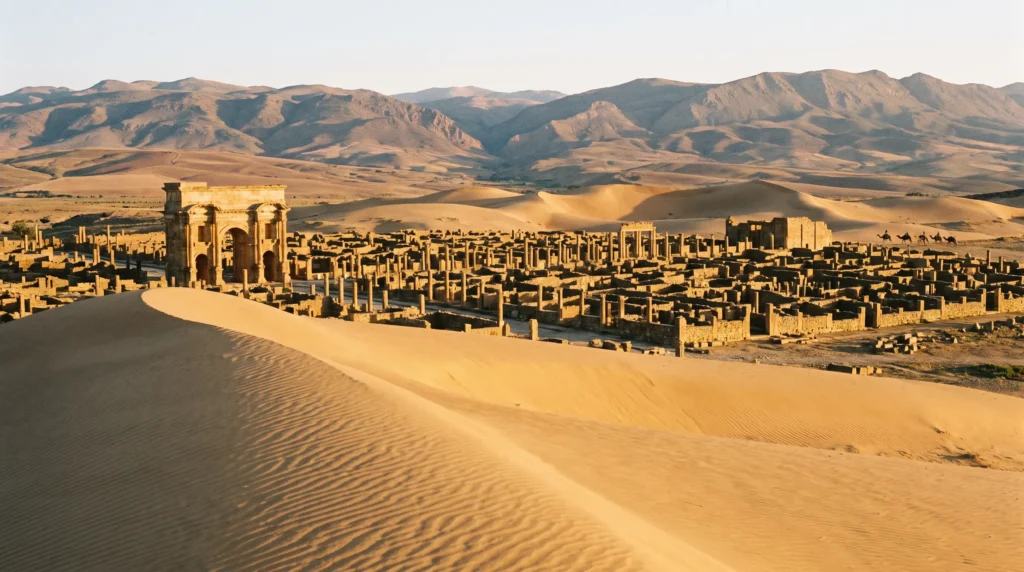
What that geography buys you as a traveler is range: the whitewashed Ottoman-era Kasbah of Algiers tumbling down to the Mediterranean, Roman provincial capitals at Timgad and Djémila so intact you can trace the original street grid, and, a thousand kilometers south, prehistoric rock art at Tassili n’Ajjer pecked into sandstone by people who lived there when the Sahara was still green. Seven sites in total carry UNESCO World Heritage status, an unusually deep bench for a country that barely registers on most travelers’ radar.
Here’s the honest part up front: Algeria is not a walk-in destination. Nearly every nationality needs a visa arranged before arrival, some border regions and the deep desert interior carry official do-not-travel advisories, and tourism infrastructure — while improving — is nowhere near as built-out as in Morocco or Tunisia next door. If you want an easy beach week, this isn’t it. If you want Roman ruins with nobody else in the frame and a genuine sense of discovery, keep reading.
Yennayer — The Amazigh New Year, January 12
If you can time a trip around one date, make it January 12: Yennayer, the Amazigh (Berber) New Year and, since 2018, an official paid national holiday across Algeria. The date traces back to the shift from the Julian to Gregorian calendar, and its recognition as a holiday capped decades of civil-rights advocacy by Algeria’s Amazigh communities, whose Tamazight language sits alongside Arabic as an official language of the state.
Celebrations center on communal feasts of couscous and chicken, traditional games, horse parades and family gatherings, with Kabylie — the mountainous Amazigh heartland east of Algiers — throwing the biggest and most visible festivities. It’s a warm, welcoming window into a part of Algerian identity that’s easy to miss if you only picture Arab-Islamic North Africa; showing up in Kabylie or Ghardaïa around January 12 gets you invited into something most visitors never even hear about.
Best Time to Visit Algeria (Season by Season)
October – April · The touring window
Mediterranean Algeria — Algiers, Oran, Constantine, the coastal ruins — is genuinely pleasant through this stretch: mild, often sunny, rarely wet for long. This is when city and ruin-hopping makes the most sense, and it overlaps with Yennayer in January and the coolest, most bearable conditions for the north.
December – February · Sahara season
Flip the calendar for the desert: winter is when the deep south — Tassili n’Ajjer, the M’Zab towns, the oasis routes — actually works. Days are warm and dry, nights drop sharply, and you avoid the summer furnace entirely. Any guided Sahara trip should be booked for this window.
June – September · Heat, and a hard no for the south
Coastal Algeria gets properly hot but stays tolerable near the water, and this is beach season for Algerians themselves around Oran and the Kabylie coast. Inland and especially in the Sahara, summer temperatures are dangerous rather than merely uncomfortable — this isn’t the season to attempt Tassili n’Ajjer or Tamanrasset regardless of what a tour operator promises.
One more timing note worth being upfront about: Ramadan shifts roughly 10-11 days earlier each year on the Gregorian calendar, and during it, restaurant hours, transport schedules and general daytime pace change noticeably in ways that can catch first-timers off guard — check the dates for your travel year before locking an itinerary.
Getting There — ALG, Visas & the Paperwork Reality
Houari Boumediene Airport (ALG), about 17 kilometers east of central Algiers, is the country’s main international gateway and one of the busiest airports in Africa, handling close to 10 million passengers in 2024 across roughly 80 destinations and 26 airlines. It’s the hub for flag carrier Air Algérie, which alone accounts for over half the airport’s flights, with connections from Paris, Istanbul, Dubai and other regional hubs. Secondary international airports serve Oran and Constantine.
Now the part that actually determines whether you go: the visa. Algeria does not offer visa-free entry or a general visa-on-arrival for US, UK, EU or Canadian passport holders — a visa has to be arranged in advance through an Algerian embassy or consulate, and applications typically require proof of accommodation or a travel-agency itinerary letter. Passports need at least six months of validity, and travelers with Israeli passport stamps can run into entry difficulties. The one meaningful exception: travelers whose itinerary puts at least 70% of their time in southern Algeria can access a visa-on-arrival arranged through an approved local travel agency — the government’s play to funnel more visitors toward the Sahara. Build in real lead time; this is not a book-flights-next-week destination.
Getting Around — Trains, Domestic Flights & Guided 4x4s
The Mediterranean north has real infrastructure: trains link Algiers, Oran and Constantine along the coast, long-distance buses reach almost everywhere else in the populated strip, and rental cars work fine for self-driving between the coastal ruin sites and cities.
The Sahara is a different proposition entirely — distances are Australia-scale, and domestic flights to Tamanrasset, Djanet and other southern towns are less a convenience than a necessity. Independent overland travel in the far south is both impractical and, in border-adjacent zones, explicitly discouraged by government travel advisories — this is where you want a registered local operator running a proper 4×4 convoy, not a rental car and a paper map. Treat any Sahara leg of your trip as a guided expedition, booked ahead, rather than a DIY road trip.
Top Regions — Coast, Casbah & Sahara
Algiers & the Kasbah
“Algiers the White” tumbles down a hillside to the Mediterranean in tiers of Ottoman, French-colonial and modern architecture. The Kasbah of Algiers, a UNESCO World Heritage Site since 1992, is the old fortified quarter — a labyrinth of narrow lanes, mosques and townhouses blending Ottoman, Andalusian and Mediterranean styles.
Tipasa
A former Phoenician trading post turned Roman colony, its ruins scattered right along the coastline with the Mediterranean as a backdrop — inscribed by UNESCO and one of the most photogenic Roman sites in North Africa.
Djémila
A mountain-perched Roman town widely considered the best-preserved Berbero-Roman ruin complex in North Africa, inscribed in 1982 — forum, temples, basilicas and a theater still legible in the stone.
Timgad
Founded by Emperor Trajan around 100 CE as a garrison town, Timgad’s grid-planned streets, arch and amphitheater are so complete that it’s often called the “Pompeii of Africa” — inscribed as a UNESCO site and a highlight of any northeastern Algeria itinerary.
Constantine
The “City of Bridges,” perched dramatically on a gorge with suspension bridges strung across the ravine connecting old and new town — one of Algeria’s most striking urban settings and a base for reaching Djémila and Timgad.
Oran
Algeria’s second city and the birthplace of Raï music, with a Spanish-colonial core, the Santa Cruz fort overlooking the bay, and a livelier, more Mediterranean nightlife feel than Algiers.
M’Zab Valley & Ghardaïa
Five fortified Ibadite towns (ksour) built in the 10th century in the northern Sahara, their tightly packed mudbrick architecture and communal water systems earning UNESCO inscription — an early template some historians link to modernist urban planning.
Tassili n’Ajjer & Djanet
Algeria’s only mixed cultural-and-natural UNESCO site: a heavily eroded sandstone plateau deep in the Sahara holding thousands of prehistoric rock paintings and engravings, some depicting animals from a wetter Sahara long since vanished. This is remote, guided-expedition territory — check current government travel advisories for the surrounding region before planning a visit.
Culture & People — Arab, Amazigh & a Revolution That Still Matters
Algeria’s identity runs through two deep currents: Arab-Islamic and Amazigh (Berber), with Tamazight standing alongside Arabic as an official language of the state — a recognition decades in the making. French remains widely spoken as a legacy of over a century of French colonial rule, and you’ll hear it comfortably alongside Arabic in cities, on signage and in business.
The Algerian War of Independence (1954–1962) against France is not a distant historical footnote here — it shaped modern Algerian identity profoundly, and independence was formally achieved on 5 July 1962 after one of the 20th century’s most significant anti-colonial struggles. Expect that history to come up in conversation, museums and monuments across the country, treated with real gravity.
Hospitality runs deep and genuine — mint tea offered within minutes of any conversation, extended family networks, and a warmth toward visitors that can feel disarming given how rarely Western tourists show up. Modest dress is appreciated outside resort contexts, and Friday is the weekly day of rest rather than Sunday.
A Food Lover’s Guide to Algeria
Couscous is the unshakeable national dish — steamed semolina piled with vegetables, chickpeas and lamb or chicken, varying by region and household. Chorba, a tomato-based soup thickened with vermicelli or frik (green wheat), typically opens meals, especially through Ramadan evenings. Mechoui — whole roasted lamb — appears at celebrations, and merguez, the spiced beef-and-lamb sausage now familiar across Europe, actually originated here and in neighboring Maghreb countries.
Bakery culture leans French — baguettes and pastries sit comfortably next to Arabic sweets like makroud (semolina cakes soaked in date syrup) and baklava. Sahara oases like Timimoun and the M’Zab region grow prized date varieties, and no meal wraps up without a round of sweet mint tea, poured from height in the North African style. Algiers and Oran both have a genuine café culture inherited from decades of French presence — strong coffee, slow mornings, sidewalk tables.
Off the Beaten Path
Timimoun — the Red Oasis
A striking ochre-red Saharan town built in a distinctive Sudanese-influenced mudbrick style, ringed by palm groves and salt lakes — one of the most photogenic and least-visited oasis towns in the country.
Chréa National Park
Yes, skiing in Africa: a small ski station in the Atlas Mountains barely an hour from Algiers, snow-capped in winter and a jarring, delightful contrast to the Sahara most people associate with the country.
Al Qal’a of Beni Hammad
The ruins of an 11th-century fortified Hammadid dynasty capital, once an important political and cultural center — inscribed by UNESCO and receiving only a trickle of visitors compared to the coastal Roman sites.
Kabylie
The green, mountainous Amazigh heartland east of Algiers — traditional stone villages, fierce regional pride, and the best place in the country to experience Yennayer celebrations firsthand.
Practical Information
Money. The Algerian dinar operates under a managed exchange rate with a large, well-known gap to the informal parallel market — expect roughly 130 dinars to the US dollar at official rates, with unofficial rates running considerably higher. Card acceptance and ATM access are limited outside major hotels in Algiers and Oran; carry cash, and change money only through official channels.
Safety. The US State Department rates Algeria Level 2 (Exercise Increased Caution) overall due to terrorism and kidnapping risk, with a Level 4 Do Not Travel designation specifically for areas near the eastern and southern borders and parts of the Sahara. The UK FCDO similarly advises against travel within roughly 30km of the borders with Libya, Mauritania, Mali, Niger and parts of Tunisia. Tourist areas in the north — Algiers, Oran, Constantine, the coastal ruin sites — see a visible police presence and are generally calm day to day, but check current advisories before finalizing any southern or border-adjacent itinerary, and know that travel insurance can be invalidated by ignoring them.
Health. CDC recommends up-to-date routine vaccines plus Hepatitis A, Hepatitis B and typhoid for most travelers, a polio booster given recent poliovirus detection, and caution around unchlorinated fresh water due to schistosomiasis risk. Rabies is present in the dog population, so discuss pre-exposure vaccination with a travel clinic if you’ll be in rural areas. Stick to bottled or treated water.
Connectivity. Local SIM cards are straightforward to buy in Algiers and Oran; coverage thins out fast in the Sahara. Time zone: UTC+1, no daylight saving.
Budget Breakdown — What Algeria Actually Costs in 2026
Algeria is inexpensive by Mediterranean and North African standards once you’re on the ground — the real cost of this trip is the visa effort and, if you head south, a guided Sahara expedition.
Budget (US$30–50/day): Basic guesthouses in Algiers, Oran or Constantine, street food (chorba, sandwiches, pastries), intercity trains and buses.
Mid-range (US$70–150/day): Comfortable hotels, restaurant meals, a rental car or private driver between the coastal ruin sites, domestic flights toward the south.
Luxury / Sahara expedition (US$250+/day): Multi-day guided 4×4 trips into Tassili n’Ajjer or the M’Zab region with licensed operators, private transport and top-tier hotels in Algiers.
Factor visa application fees and any required travel-agency documentation into your budget before booking flights — this is a cost most first-timers underestimate.
Planning Your First Trip to Algeria
Start the visa process well before you book flights — it’s the single biggest lead-time item on this trip. A first-timer’s classic route pairs the north’s Roman-and-Kasbah circuit — Algiers, Tipasa, Djémila and Timgad via Constantine — over seven to ten days, saving the Sahara (Tassili n’Ajjer, the M’Zab towns) for a dedicated guided expedition on a future trip rather than bolting it onto a short first visit. If you’re building a broader North Africa itinerary, our Morocco guide and Tunisia guide cover the region’s more tourism-ready neighbors, while our Egypt guide is the natural next stop for more ancient-world sites along the same coast.
Frequently Asked Questions
Is Algeria safe for tourists in 2026?
The main tourist circuit in the north — Algiers, Oran, Constantine, the coastal Roman sites — is generally calm with a visible security presence. Advisories concentrate on border-adjacent zones and parts of the deep south; the US rates the country Level 2 overall with Level 4 no-travel zones near certain borders, and the UK advises against travel within about 30km of several land borders. Check current government guidance before finalizing any itinerary that extends beyond the north.
Do I need a visa to visit Algeria?
Yes — US, UK, EU and Canadian passport holders all need a visa arranged in advance through an Algerian embassy or consulate; there’s no general visa-free entry or visa-on-arrival. The one exception is a visa-on-arrival option for travelers whose itinerary is at least 70% in southern Algeria, arranged through an approved local agency.
Can I visit the Sahara independently?
Not really, and you shouldn’t try. Distances are vast, infrastructure is thin, and parts of the border-adjacent south carry official do-not-travel advisories — a licensed local operator running a guided 4×4 itinerary is the standard and genuinely necessary way to see Tassili n’Ajjer, Djanet or the deep oasis routes.
What are the must-see UNESCO sites?
Of Algeria’s seven, first-timers get the most bang from Djémila and Timgad (Roman ruins), the Kasbah of Algiers, and Tipasa on the coast — all reachable without a Sahara expedition. The M’Zab Valley and Tassili n’Ajjer require more logistics but reward the effort.
Algeria or Morocco/Tunisia?
Choose Morocco or Tunisia for easier entry, built-out tourism infrastructure and well-worn circuits. Choose Algeria if you want equally serious Roman ruins and Sahara scenery with a fraction of the visitors — accepting the visa hassle and tighter travel-zone rules as the tradeoff.
Do I need to speak Arabic or French?
Neither is strictly required with a good guide, but French goes a long way in cities — it’s widely spoken alongside Arabic and Tamazight as a holdover from the colonial period. A few Arabic greetings are always appreciated.
Ready to Explore Algeria?
Roman forums with the wind and nobody else, an Ottoman Kasbah tumbling to the Mediterranean, and a slice of the Sahara most travelers only ever see from Morocco’s side of the dunes. Algeria asks more of you upfront than its neighbors — visa paperwork, respect for the no-go zones, a guided hand in the deep south — but it pays that effort back with a version of North Africa that hasn’t been smoothed out for tour buses yet.
Explore More
- Morocco Travel Guide — the Maghreb’s more tourism-ready neighbor, same Sahara
- Tunisia Travel Guide — easier entry, more Roman and Punic ruins
- Egypt Travel Guide — continue the ancient-world circuit along the same coast
- Jordan Travel Guide — more Roman ruins and desert scenery in the wider region
How this guide was built
Published as part of Facts From Upstairs’ country guide series. Built from authoritative sources — Wikipedia’s entity pages for Algeria, the Algerian dinar, Algeria’s visa policy, Yennayer and Houari Boumediene Airport; Wikipedia’s List of World Heritage Sites in Algeria; the US State Department’s Algeria travel advisory page; the UK FCDO’s Algeria travel advice; and the US CDC’s Algeria traveler health page. Numeric and checkable claims carry inline citations.
More country guides you might like
Plan your trip to Algeria
The booking tools we use ourselves. FFU may earn a commission at no extra cost to you.
Plan & book your trip to Algeria
Booking through these searches supports our guides at no extra cost to you.