
Languages of Belarus
All languages of Eastern Europe →fluent beta classical · classes by phone with Maya at ranas.ai/maya
Belarus Travel Guide — Medieval Castles, Primeval Forest, and What You Actually Need to Know Before You Go
I need to start this one differently than I start most guides. Belarus has genuinely extraordinary things in it — Europe’s last fragment of primeval lowland forest, a Renaissance castle that looks lifted from a fairy tale, a capital rebuilt as a Stalinist showpiece that reads more like a museum of the 20th century than a city. But as of this writing, the US State Department rates Belarus a Level 4 “Do Not Travel” advisory — its highest risk category — and the UK Foreign Office advises against all travel there too. That’s not a footnote I’m burying at the bottom — it’s the first thing you should know, and it should genuinely shape whether and how you go. This guide exists so that if you’re researching Belarus for family reasons, business, academic work, or because you’re simply curious about a country most Western travelers never see, you have accurate, sourced information rather than either propaganda or panic. I’m not going to sell you a lobster festival here. I’m going to tell you what’s actually there and what going actually involves.
In This Guide
- Overview — A Country Most Travelers Never See, For Reasons
- Kupalle Night — Midsummer Fire and Fortune-Telling
- Best Time to Visit Belarus (Season by Season)
- Getting There — Visas, MSQ Airport & the Air-Only Rule
- Getting Around — Trains, Marshrutkas & Minsk’s Metro
- Top Regions — Minsk, the Castle Belt & the Forest
- Culture & People — Slavic, Soviet & Somewhere In Between
- A Food Lover’s Guide to Belarus
- Off the Beaten Path
- Practical Information
- Budget Breakdown — What Belarus Actually Costs
- Frequently Asked Questions
Overview — A Country Most Travelers Never See, For Reasons
Belarus sits landlocked in Eastern Europe between Russia, Ukraine, Poland, Lithuania and Latvia, with roughly 9.1 million people spread across about 207,600 square kilometers — a country the size of Kansas, wedged between much larger neighbors whose history keeps steamrolling through it. It declared independence from the Soviet Union in August 1991, but in most practical senses it never fully left: the same president, Alexander Lukashenko, has run the country since 1994, and Britannica and Wikipedia both now describe the system as an authoritarian, semi-presidential state.
Geographically, this is flat, forested, lake-dotted country — closer in feel to Poland or the Baltic states than to Russia, with the same brick-Gothic and Renaissance castle architecture the region shares. Minsk, the capital, is home to roughly two million people and was almost entirely leveled in the Second World War, then rebuilt from scratch as a wide-boulevard Stalinist showcase — it now reads as one of the most intact examples of Soviet urban planning left standing anywhere. Outside the capital, four UNESCO World Heritage Sites anchor the country’s cultural draw: the Mir Castle Complex, the Radziwiłł family’s Nesvizh Palace, the Białowieża/Belovezhskaya Forest bison reserve shared with Poland, and a chain of 19th-century survey markers called the Struve Geodetic Arc that runs through ten countries.
Here’s the part I won’t soften: this is currently a Level 4, Do Not Travel country by US State Department reckoning, and the UK government advises against all travel to it as well, citing arbitrary detention risk, extremely limited consular assistance, and the possibility of conflict spillover from the war in neighboring Ukraine. That doesn’t mean nobody goes — diaspora visiting family, cross-border businesspeople, and a trickle of curious travelers still do — but it does mean this guide is written for informed decision-making, not for talking you into a trip. Read the practical section closely before you make any plans.
Kupalle Night — Midsummer Fire and Fortune-Telling
If there’s one date that captures why Belarus is culturally fascinating even when the politics are grim, it’s the night of 6–7 July: Kupalle (Ivan Kupala Night), an ancient pre-Christian Slavic midsummer festival of bonfires, flower-wreath fortune-telling and river bathing that survives here more intact than almost anywhere else in the Slavic world. Villages and open-air museums hold reenactments with young women floating flower wreaths on rivers to divine their romantic future, couples jumping hand-in-hand over bonfires, and communal searches for a mythical fern flower said to bloom only that one night.
It’s a genuinely striking window into pre-Soviet, pre-Christian Belarusian folk culture — the kind of tradition that got suppressed for decades and has since been semi-officially revived as a point of national identity. If you’re reading this in early July, that’s the one date on the calendar that would make the trip culturally worthwhile beyond the castles — assuming the advisory situation and your own risk tolerance check out first.
Best Time to Visit Belarus (Season by Season)
Late May – September · Warm season (recommended window)
Mild days, long evenings this far north, green forests, and the country’s outdoor festival calendar including Kupalle in early July. This is the only period most visitors would find genuinely comfortable — Belarus is not a winter-sports or winter-city destination for outsiders the way Scandinavia is.
April & October · Shoulder
Cool, often grey, with the forests either budding or turning — fewer crowds at Mir and Nesvizh, but shorter daylight and a real chance of cold rain.
November – March · Winter
Long, dark, and genuinely cold — Belarus sits at similar latitudes to Berlin and Warsaw but with a more continental climate, meaning colder winters than either. Minsk’s Soviet-era architecture and wide boulevards feel especially bleak under grey winter skies; this is a season for people with a specific reason to be there, not sightseeing.
Getting There — Visas, MSQ Airport & the Air-Only Rule
Minsk National Airport (MSQ) is the country’s only real international gateway. There are two separate legal pathways for many Western nationalities to enter without a full consular visa, and it’s worth understanding both because they have different rules. The 30-day visa-free program covers citizens of roughly 76 countries but requires arriving and departing exclusively through Belarus’s international airports (Minsk, Brest, Gomel, Grodno, Mogilev or Vitebsk) — overland entry voids it. It also requires proof of funds and mandatory medical insurance with at least €10,000 of coverage valid for your whole stay. Separately, Belarus’s e-visa covers roughly 67 nationalities including the US, Canada, the UK, EU countries, Australia and Japan, costs a consular fee of roughly €35–60 plus a €6 service fee depending on nationality, is single-entry and capped at 30 days, and is issued online in about a week without needing to visit a consulate — but again, entry must be through an international checkpoint, and it’s most reliably used via air.
A critical wrinkle for anyone with Belarusian heritage: Belarus does not recognize dual citizenship, so a Belarusian-born traveler holding a second passport will be treated by authorities as a Belarusian citizen regardless of which document they enter on — this affects consular protection and is flagged explicitly by both the US and UK governments. Commercial flight options into MSQ have also narrowed considerably given sanctions and airspace closures tied to the region’s conflicts, so check routing and connections carefully rather than assuming a normal European itinerary will work.
Getting Around — Trains, Marshrutkas & Minsk’s Metro
Belarus inherited a dense, cheap Soviet-era rail network, and trains remain the standard way to move between Minsk and the regional cities — Brest, Grodno, Vitebsk, Gomel and Mogilev are all a few hours out by rail. Minsk itself has a clean, efficient two-line metro system, a legacy of Soviet urban planning that still works well today. Marshrutkas (shared minibuses) fill in routes trains don’t cover, especially to smaller towns like Mir and Nesvizh, which sit close together in the country’s west and are usually visited as a single day trip from Minsk, roughly 90 minutes to two hours each way by car or bus.
Renting a car is possible and gives the most flexibility for reaching Belovezhskaya Pushcha and the smaller castle towns, though road signage outside Minsk is overwhelmingly in Belarusian/Russian Cyrillic, so a navigation app with offline Cyrillic support is worth arranging in advance.
Top Regions — Minsk, the Castle Belt & the Forest
Minsk
The capital and, for most visitors, the whole trip. Independence Avenue is one long, wide monument to Stalinist post-war reconstruction — colonnaded facades, oversized squares, a scale built for parades rather than pedestrians. The rebuilt Old Town around Independence Square, the Island of Tears memorial, and the National Library’s striking diamond-shaped tower (with an observation deck) round out a city that’s less about individual sights than about the overall texture of a Soviet showpiece frozen and preserved.
Mir
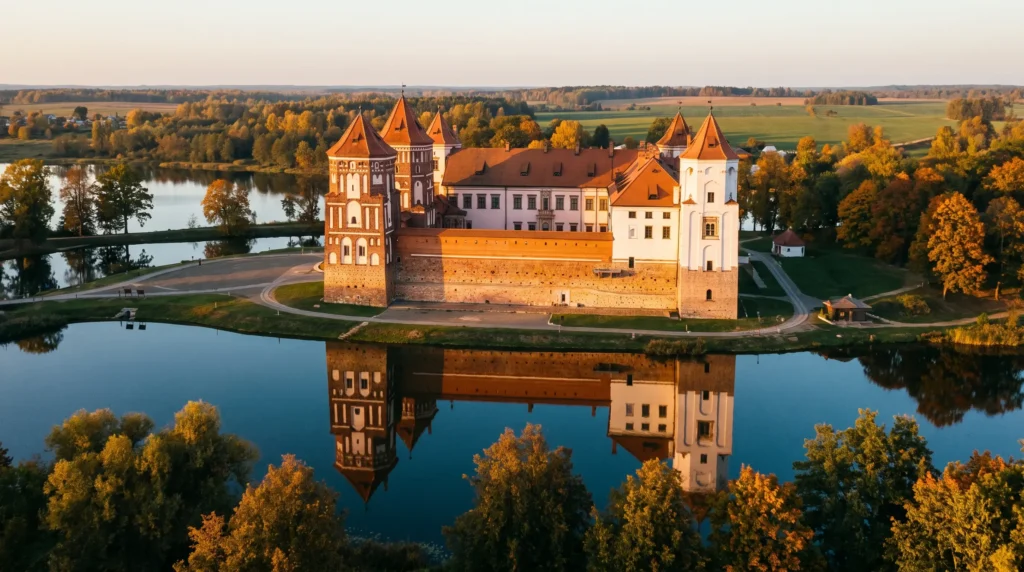
A small town built almost entirely around one thing: the Mir Castle Complex, a red-brick fortress begun in the early 16th century in Belarusian Gothic style and later softened with Renaissance flourishes by the Radziwiłł family, inscribed by UNESCO in 2000. It’s the single most photographed building in the country and genuinely earns it — squat towers, a moat, and a restoration good enough that it reads as lived-in rather than reconstructed.
Nesvizh
Twenty minutes from Mir, the Nesvizh Palace was the seat of the Radziwiłł dynasty, one of the wealthiest noble families in the old Polish-Lithuanian Commonwealth — construction began in 1582 in Renaissance-baroque style, and UNESCO inscribed the complex, along with its Corpus Christi Church, in 2005. The formal gardens and lake setting make it the more romantic of the two castle stops, usually paired with Mir on the same day trip out of Minsk.
Belovezhskaya Pushcha (Białowieża Forest)
Straddling the Polish border in the country’s west, this is one of the last and largest surviving remnants of the primeval lowland forest that once covered much of Europe, inscribed by UNESCO in 1979 (extended into Belarus in 1992) and now home to more than 800 European bison — the continent’s heaviest land animal, brought back from near-extinction after being wiped out here in the First World War. It’s a full-day trip from Minsk and the closest thing Belarus has to a marquee nature experience.
Brest
A border city on the Polish frontier, known for the Brest Hero-Fortress memorial complex — a grim, monumental Soviet war memorial marking the fortress’s brutal 1941 defense — and as a practical rail gateway if you’re combining Belarus with a Poland itinerary.
Vitebsk
In the north, Marc Chagall’s hometown, with a small museum devoted to him and a much softer, more provincial character than Minsk. Worth the detour for Chagall fans specifically.
Gomel
The country’s second city in population, in the southeast near the Ukrainian border, centered on the Rumyantsev-Paskevich Palace and park complex — seen by relatively few foreign visitors even in normal times.
Culture & People — Slavic, Soviet & Somewhere In Between
Belarusian identity sits at a genuine crossroads: both Belarusian and Russian are official languages, but Russian dominates in cities and daily life, while Belarusian survives more strongly in rural areas, in cultural revival movements, and in events like Kupalle. Decades of Soviet rule left a deep imprint — architecture, street names, war memorials and civic ritual all still carry it — layered on top of an older Grand Duchy of Lithuania/Polish-Lithuanian Commonwealth heritage visible in the castle belt and Catholic churches of the west.
Politically, this is not a country where casual conversation about the government is advisable with strangers, and both UK and US authorities warn that even past social-media activity can carry real legal risk for visitors. Away from that topic, Belarusians are broadly described by visitors as reserved on first meeting but warm once a relationship forms — a fairly standard Eastern European pattern, not a specifically Belarusian one.
A Food Lover’s Guide to Belarus
The national dish is draniki — potato pancakes, traditionally made with just grated potato, onion, salt and oil, no flour or egg needed to bind them. There are reportedly over 300 recorded potato dishes in Belarusian cuisine, which tells you where the culinary center of gravity sits. Pair draniki with machanka, a rich pork-and-sausage stew in sour cream sauce, traditionally spooned over pancakes rather than served as a standalone dish.
To drink, kvass — a mildly fermented, faintly sweet beverage made from black rye bread — is the everyday non-alcoholic staple, sold from street tanks in summer the way lemonade might be elsewhere. Belarusian cuisine overall draws on Baltic, Slavic, Jewish and German influences layered over centuries of shifting borders, which shows up in the dumplings, cured fish and rye breads found alongside the potato-heavy mains.
Off the Beaten Path
The Struve Geodetic Arc points
Five of the 34 surviving 19th-century survey markers from this ten-country UNESCO chain — laid down between 1816 and 1855 to help calculate the Earth’s exact size and shape — sit on Belarusian soil, largely unmarked and unvisited even by domestic tourists. A genuine curiosity for anyone into the history of science.
Rural agrotourism farmsteads
A small but real network of family-run guesthouses across the countryside offers a much softer, slower version of Belarus than Minsk’s boulevards — banya (sauna) sessions, home-cooked draniki, and forest walks, usually arranged through local operators rather than international booking platforms.
Polotsk
Reputed to be Belarus’s oldest city, in the north near the Latvian border, with a cathedral history stretching back to the 11th century — quiet, provincial, and about as far from the Level 4 headlines as the country gets in feel.
Practical Information
Safety — read this first. The US State Department rates Belarus Level 4, Do Not Travel, citing unrest, the risk of arbitrary detention with no outside contact, and a suspended US embassy providing no routine or emergency consular services. The UK FCDO separately advises against all travel, warns that anyone who has engaged in activity the Belarusian government now deems illegal faces meaningful arrest risk, and notes a low but real possibility that the war in neighboring Ukraine could spill across the border. Devices and communications are described as broadly monitored. Travel insurance can be invalidated by traveling against your government’s advice — check your policy explicitly before assuming you’re covered. If you decide to go regardless, register with your embassy in a neighboring country beforehand, since your own country’s consular presence inside Belarus may be unable to help you.
Money. The Belarusian ruble (BYN) is managed by the National Bank against a basket weighted toward the Russian ruble, US dollar and Chinese yuan, and currently trades around 3.27 to the dollar. International cards from Western issuers are unreliable to non-functional in Belarus given sanctions on the banking sector — plan on carrying cash (euros or dollars to exchange locally) rather than assuming card payment will work.
Health. The CDC rates Belarus at its standard “practice usual precautions” level, with routine vaccines (MMR, DTP, polio, flu) recommended along with Hepatitis A/B for most travelers and tick-borne encephalitis coverage if you’ll be doing extensive forest time. Tap water is generally best avoided in favor of bottled.
Connectivity & practicalities. Registering with local police is mandatory if your stay exceeds 10 days. Plugs are European two-pin (Type C/F), 220V. Time zone is UTC+3, no daylight saving.
Budget Breakdown — What Belarus Actually Costs
Published, reliable tourism-pricing data for Belarus is thin given how few Western travelers currently visit — treat the following as a directional estimate rather than a verified benchmark, built from regional comparisons with similarly priced Eastern European cities.
Budget (roughly US$40–70/day): Hostel or basic guesthouse in Minsk, cafeteria-style meals, metro and marshrutka travel, no private tours.
Mid-range (roughly US$90–160/day): Three-star hotel, sit-down restaurant meals, a guided day trip to Mir and Nesvizh, occasional taxis.
Top-end (roughly US$250+/day): Minsk’s better international-standard hotels, private guides and drivers, a Belovezhskaya Pushcha day trip with dedicated transport.
Remember that Western bank cards are unreliable here — budget in cash, and factor in currency exchange logistics before you arrive rather than assuming ATMs will simply work as they would elsewhere in Europe.
Planning Your First Trip to Belarus
Before anything else: read the current US State Department and UK FCDO advisories in full, confirm your entry pathway (e-visa versus the visa-free program), check that your government’s embassy situation in-country matches what you’d need if something went wrong, and confirm your travel insurance actually covers travel against standing government advice. If those checks clear and you proceed, the standard first-timer route is Minsk as a base (2–3 nights) with a single day trip out to Mir and Nesvizh castles, extending to Belovezhskaya Pushcha if you have a fourth or fifth day. Many travelers pair a Belarus stop with a longer Eastern European itinerary through neighboring Poland or the Lithuania/Latvia Baltic corridor, both of which share the same castle-and-forest architectural heritage without the current advisory status.
Frequently Asked Questions
Is it safe to travel to Belarus right now?
By official reckoning, no — the US rates it Level 4, Do Not Travel, its most serious category, and the UK advises against all travel entirely, both citing detention risk, monitored communications and minimal consular help if something goes wrong. Anyone considering a trip should read both advisories in full rather than relying on this or any other summary.
Do I need a visa?
Most Western nationalities can use either a 30-day e-visa (roughly 67 eligible nationalities, applied for online) or a separate 30-day visa-free program (roughly 76 countries) — but both require entering and exiting through an international air checkpoint, and both have their own paperwork requirements including proof of medical insurance.
I have Belarusian heritage or dual citizenship — does that change anything?
Significantly, yes. Belarus does not recognize dual nationality, so authorities will treat a dual citizen as Belarusian regardless of which passport they travel on, which limits foreign consular protection and can affect exit rights. Get specific legal advice before traveling if this applies to you.
What are the actual highlights if I do go?
Mir Castle and Nesvizh Palace — both UNESCO-listed and genuinely beautiful — plus Belovezhskaya Pushcha’s ancient forest and bison, and Minsk’s uniquely intact Soviet-era boulevards. If timed around 6–7 July, Kupalle Night adds a genuinely rare folk-culture experience.
Can I use my normal bank cards there?
Plan not to. International sanctions have badly disrupted card processing from Western issuers — bring cash (euros or US dollars) to exchange locally rather than assuming ATMs or card terminals will work.
Belarus or Poland/the Baltics for this kind of castle-and-forest trip?
If you want the architecture and landscape without the current advisory situation, Poland, Lithuania and Latvia share the same castle belt, forest ecosystems and Baltic-Slavic cultural overlap, with none of the Level 4 risk profile — genuinely worth considering as the lower-friction alternative.
Should You Go?
I’d rather send you in informed than send you in enthusiastic. Belarus holds real, rare things — a castle that could headline any European itinerary, one of the last primeval forests on the continent, a capital that is itself a kind of historical artifact. But it currently sits under the most serious travel warnings both the US and UK issue, and that status exists for specific, documented reasons, not bureaucratic caution. Read the advisories, understand your own risk tolerance and situation, and if you do decide to go, go with your eyes fully open and a plan for things going wrong. If you’re not sure, the neighboring countries below offer a very similar heritage without the same risk.
Explore More
- Poland Travel Guide — the western half of Belarus’s shared castle-and-forest heritage, without the advisory status
- Lithuania Travel Guide — the closest Baltic neighbor, once united with Belarus under the Grand Duchy of Lithuania
- Latvia Travel Guide — another Struve Geodetic Arc country and Baltic alternative
- Estonia Travel Guide — round out a Baltic-Eastern Europe itinerary further north
How this guide was built
Published . Built from authoritative sources — Wikipedia’s Belarus, Minsk, Belarusian ruble, Kupala Night, Belarusian cuisine, Mir Castle, Nesvizh Castle, Belovezhskaya Pushcha and World Heritage Sites in Belarus entity pages; the Belarusian Ministry of Foreign Affairs e-visa page; the official Belarus.by tourism portal’s visa-free program page; the US State Department’s Belarus country page; the UK FCDO’s Belarus travel advice; and the US CDC’s Belarus traveler health page. Given Belarus’s current Level 4 “Do Not Travel” status, this guide leads with and repeatedly foregrounds the official safety advisories rather than treating them as a footnote, in line with our house rule to be honest about real catches, not just charming ones. Numeric and factual claims carry inline citations; budget figures are explicitly flagged as directional estimates given the scarcity of reliable published tourism-pricing data for Belarus.
Sources cited on this page
- Wikipedia — Belarus
- Wikipedia — Minsk
- Wikipedia — Belarusian ruble
- Wikipedia — Kupala Night
- Wikipedia — Belarusian cuisine
- Wikipedia — Mir Castle Complex
- Wikipedia — Nesvizh Castle
- Wikipedia — Belovezhskaya Pushcha
- Wikipedia — List of World Heritage Sites in Belarus
- Belarus MFA — E-visa
- Belarus.by — Visa-free travel program
- US State Department — Belarus
- UK FCDO — Belarus
- US CDC — Belarus traveler page
More country guides you might like
Plan your trip to Belarus
The booking tools we use ourselves. FFU may earn a commission at no extra cost to you.
Plan & book your trip to Belarus
Booking through these searches supports our guides at no extra cost to you.