
Benin Travel Guide — Voodoo’s Birthplace, a Stilt City & West Africa’s Most Honest History Lesson
Benin is the country that makes you recalibrate what a “small” West African nation can hold. It gave the world Vodun — not the Hollywood version, the actual religion, practiced openly here by roughly a quarter of the population and taught in the strut of every drummer at the January festival in Ouidah. It was once the Kingdom of Dahomey, home to the Agojie warrior women and a royal court whose palace walls in Abomey are now a UNESCO World Heritage Site. And on the same stretch of Atlantic coast where kings once traded, a concrete arch called the Door of No Return now marks the spot where more than a million captives were forced onto slave ships bound for the Americas — Benin doesn’t hide that history, it built a walking route through it. Add a floating city of 20,000 people built on stilts to dodge slave raiders three centuries ago, and you have a country that rewards travelers willing to trade beach-resort ease for something considerably more real. I’ll tell you upfront where that trade gets hard — because it does.
In This Guide
- Overview — Why Benin Rewards the Traveler Who Digs Deeper
- The Voodoo Festival, January 10 — Ouidah’s Biggest Day
- Best Time to Visit Benin (Season by Season)
- Getting There — Cotonou’s Airport & Overland Borders
- Getting Around — Zemidjans, Bush Taxis & Boats
- Top Regions — Coast, Kingdom & Savanna
- Culture & People — Vodun, Fon, Yoruba & the Agojie
- A Food Lover’s Guide to Benin
- Off the Beaten Path
- Practical Information
- Budget Breakdown — What Benin Actually Costs in 2026
- Frequently Asked Questions
Overview — Why Benin Rewards the Traveler Who Digs Deeper
Benin is a narrow sliver of West Africa wedged between Togo, Nigeria, Burkina Faso and Niger, with just enough Atlantic coastline to have mattered enormously to history. For nearly three centuries it was the Kingdom of Dahomey, a militarized, highly organized state whose kings ruled from Abomey and whose royal army famously included regiments of women warriors — the Agojie, later fictionalized (loosely) in Hollywood. That kingdom’s palace compound survives in Abomey as a UNESCO World Heritage Site, ten palace enclosures wrapped in bas-relief walls telling the story of twelve successive kings.
Then there’s the harder history: for two centuries, the coastal town of Ouidah was one of the busiest ports of the transatlantic slave trade, and the country has built its most sobering attraction around confronting that directly — a memorial route from the old slave market to the beachside Door of No Return. Renamed from Dahomey in 1975, present-day Benin passed through a Marxist-Leninist period before becoming, in 1990, one of Africa’s earliest and most durable multi-party democracies.
None of this is polished for mass tourism. Roads are patchy, English is rare, and the far north carries real security risk I’ll flag clearly below. What you get in exchange is a country where Vodun ceremonies, royal history and a UNESCO safari complex all sit within a few hours of each other, almost entirely without other tourists in the frame.
The Voodoo Festival, January 10 — Ouidah’s Biggest Day
Vodun was formally recognized as an official religion in Benin, and 10 January was declared a national holiday to mark it — the date now anchors the world’s largest annual gathering of Vodun practitioners, held in Ouidah. Fetish priests, traditional chiefs, and adepts arrive from across West Africa, Haiti, Brazil and Cuba for a day of ceremonies, sacrifices, drumming, and dance, watched over by the country’s political and religious elite.
Practically: book Ouidah accommodation months ahead — every decent room in and around town sells out for the festival — and go in with respect rather than a checklist. This is a living religious practice, not a performance staged for cameras; ask before photographing any ceremony, and expect some rites to be closed to outsiders entirely. If you can only be in Benin for one week a year, this is the week.
Best Time to Visit Benin (Season by Season)
December – March · Dry season (Harmattan)
The Sahara’s Harmattan wind pushes in cooler, dustier, drier air, and this is the most comfortable window for road travel, wildlife viewing in the north, and city walking. It also captures the Voodoo Festival on January 10 — book early.
April – July · First rains, southern shoulder
The south’s rainy season builds from April, peaking through June and July, while temperatures climb and humidity thickens along the coast. Expect short, heavy afternoon downpours rather than all-day washouts.
August · Brief coastal dry spell
A short lull in the rains along the coast — a quieter, greener alternative to peak season if you don’t mind occasional showers.
September – November · Second rains, transition
Rain picks back up before tapering into the dry Harmattan season. Northern Benin, including Pendjari, follows a simpler single wet season roughly May–September and is at its best for wildlife once the dry season resumes in November.
Getting There — Cotonou’s Airport & Overland Borders
Cardinal Bernardin Gantin International Airport (COO), in the Cadjehoun district of Cotonou, is Benin’s only real international gateway. There are no direct flights from North America — the practical routes connect through Paris (Air France, Corsair), Brussels (Brussels Airlines), Istanbul (Turkish Airlines, seasonal), or via regional hubs like Addis Ababa, Casablanca or Lomé. Build in a long layover; this is not a one-stop-from-JFK destination.
A visa is required for almost every nationality and must be arranged before you fly — Benin’s e-visa is issued only through the official government portal, evisa.bj, with single- and multiple-entry options; do not use third-party sites that charge a large markup over the official fee. Yellow fever vaccination with a certificate is required for entry regardless of where you’re arriving from. Overland, Benin borders Togo, Burkina Faso, Niger and Nigeria, but the far-northern crossings into Burkina Faso and Niger currently carry serious security warnings — more on that in Practical Info below.
Getting Around — Zemidjans, Bush Taxis & Boats
The default urban ride is the zemidjan — a motorbike taxi, usually in a color-coded shirt, that swarms Cotonou and every other town. Agree the fare before you get on; meters don’t exist. For longer hops, shared bush taxis and minibuses connect Cotonou, Porto-Novo, Abomey, Parakou and the north, cheap but slow and not built for comfort.
Private drivers hired through your hotel or a local guide are the sane option for a first trip covering Ouidah, Abomey and Ganvié in a loop from Cotonou — roads are workable in the south but degrade heading north, especially in the rains. A domestic flight network barely exists, so reaching Pendjari in the far north realistically means a full day’s drive from Cotonou, usually broken at Parakou. Ganvié itself is reachable only by dugout canoe or motorized pirogue across Lake Nokoué.
Top Regions — Coast, Kingdom & Savanna
Cotonou
Benin’s largest city and de facto capital of commerce (the official capital, Porto-Novo, is quieter and more ceremonial). Cotonou’s centerpiece is Dantokpa Market, one of the largest open-air markets in West Africa, sprawling over roughly 20 hectares with tens of thousands of vendors trading everything from fabric to fetish ingredients.
Ouidah
The historical and spiritual heart of a Benin trip: the Sacred Forest, the Python Temple, the Portuguese fort-turned-museum, and the three-kilometer Slave Route walked from the old auction square to the Door of No Return memorial on the beach. Also ground zero for the January 10 Voodoo Festival.
Ganvié
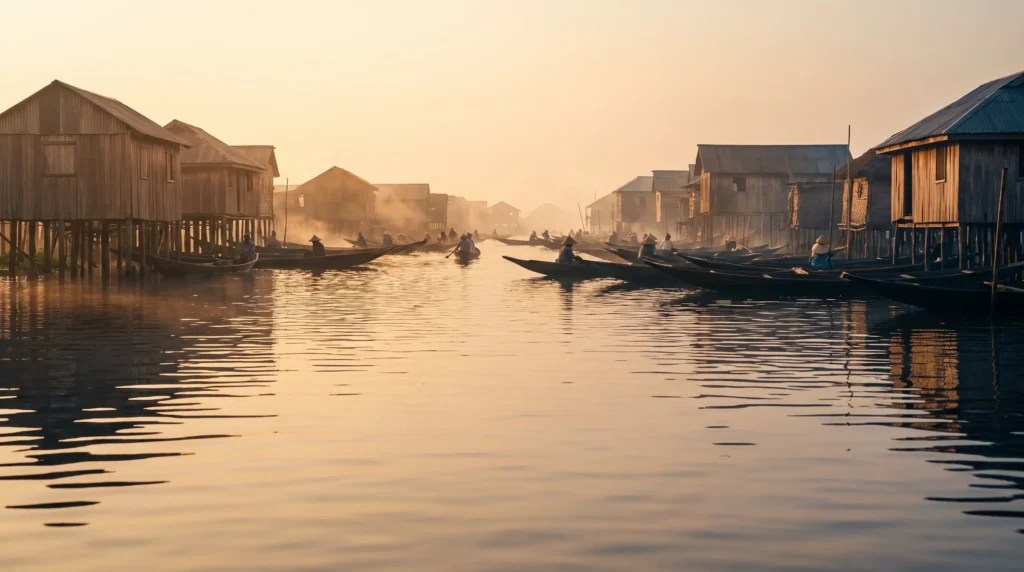
A stilt village of roughly 20,000 people built out on Lake Nokoué, founded by the Tofinu centuries ago as a refuge from slave raiders whose religious taboos kept them off the water — its name translates loosely to “we survived.” Schools, a market, churches and a mosque all operate on stilts; the only way in is by boat, ideally with a local guide rather than a tourist-priced hustler at the jetty.
Abomey
The former royal capital of Dahomey and home to the UNESCO-listed Royal Palaces, ten walled compounds built up over twelve reigns between 1625 and 1900, their clay walls decorated with symbolic bas-reliefs recording each king’s exploits. A 1984 tornado badly damaged the site; careful restoration got it removed from UNESCO’s endangered list by 2007.
Porto-Novo
The official capital, smaller and more laid-back than Cotonou, with a Brazilian-influenced old quarter reflecting returnee communities from Brazil after abolition, a royal palace-turned-museum, and none of the traffic chaos of its bigger neighbor.
Pendjari National Park
Part of the transnational W-Arly-Pendjari Complex, a UNESCO World Heritage Site shared with Burkina Faso and Niger, and one of West Africa’s last strongholds for elephants (around 2,800 individuals) and the critically endangered West African lion, alongside hippos, buffalo and antelope. Read the safety section before planning a visit — parts of the north currently carry “do not travel” advisories.
Parakou
The main crossroads city of the north, mostly useful as a practical overnight break on the long haul between Cotonou and Pendjari, with a lively market and a Islamic-Yoruba cultural mix distinct from the south.
Culture & People — Vodun, Fon, Yoruba & the Agojie
Benin’s roughly 13.75 million people split largely between Christian (just over half) and Muslim (about a quarter) communities, with traditional Vodun faiths openly practiced by nearly a fifth of the population and threaded through daily life well beyond that figure. The Fon dominate the south around Abomey and Cotonou, the Yoruba the southeast toward the Nigerian border, and Bariba and Dendi communities the north — each with distinct languages, though French remains the official lingua franca from schoolrooms to government offices.
The Kingdom of Dahomey’s royal army included the Agojie, all-female regiments whose reputation for discipline and ferocity made them famous among 19th-century European observers and, more recently, the loose inspiration for a Hollywood film — the real history, tied to the Abomey palaces, is more interesting than the movie. Vodun itself is not the caricature exported by pop culture; it’s a structured religious system with its own priesthood, cosmology and festival calendar, centered on Ouidah but practiced nationwide.
A Food Lover’s Guide to Benin
The staple is pâte (or akassa), a smooth, slightly fermented dough made from corn or cassava, served alongside sauces built on tomato, peanut, or the leafy gboma. Grilled street food is everywhere: skewered meat, fried plantain (alloco), and fresh fish straight off the boats in coastal towns.
Look for wagasi, a firm Fulani cow’s-milk cheese usually fried or grilled — one of West Africa’s few indigenous cheeses and a genuine curiosity for visitors. Palm wine and sodabi, a local palm-distilled spirit, are the traditional drinks of choice in the south; Beninoise, the national lager, covers everywhere else. Cotonou’s Dantokpa Market is the best place to eat your way through the range in a single afternoon, stall by stall.
Off the Beaten Path
Koutammakou-adjacent Atacora villages
The Batammariba people’s distinctive mudbrick tower houses, or takienta, are best known from Koutammakou across the border in Togo — but the shared cultural landscape, inscribed by UNESCO as a transboundary site extending into Benin’s Atacora region, means similar architecture and communities exist on the Beninese side too, far from any tour bus.
Agongointo-Zoungoudo
An underground network of 17th-century warrior bunkers near Bohicon, carved as refuges during regional conflicts — on Benin’s UNESCO tentative list and rarely visited by foreigners at all.
Lower Ouémé Valley
A river cultural landscape south of Porto-Novo, also on the tentative list, where fishing communities and seasonal floodplains offer a quieter counterpoint to Ganvié’s now-touristed canals.
Grand-Popo
A sleepy beach town near the Togo border with a moody, driftwood-strewn Atlantic coastline — good for a slow couple of days, though remember the coastal safety warning below before swimming.
Practical Information
Safety — read this carefully. Both the US State Department and UK FCDO currently advise against all travel to Benin’s departments bordering Burkina Faso and Niger, and against all but essential travel to Alibori and Atacora more broadly, including Pendjari and W National Park, due to terrorism and kidnapping risk. This is a real, current restriction, not boilerplate caution — check both advisories immediately before finalizing any northern itinerary, and know that travel insurance can be voided by ignoring them. The south (Cotonou, Ouidah, Abomey, Ganvié, Porto-Novo) carries a lower, more standard risk profile: watch for opportunistic crime and avoid remote areas after dark.
Coastal safety. Benin’s Atlantic beaches have dangerous rip currents and strong undertows; drownings are a recurring problem even for strong swimmers, so treat the coast as a place to walk, not swim.
Health. Yellow fever vaccination is mandatory for entry. CDC also recommends malaria prophylaxis for all travelers, plus hepatitis A and B, typhoid (especially outside cities), a polio booster, and meningococcal vaccine if traveling during the December–June dry season in northern areas. Stick to bottled or treated water and bring strong insect repellent.
Money. The West African CFA franc (XOF) is fixed to the euro at 655.957:1 and shared across eight West African states via the BCEAO. Cash is king outside Cotonou’s better hotels; carry small bills for markets, zemidjans and rural stops. Plugs: European-style, 220V. Time zone: UTC+1, no daylight saving.
Budget Breakdown — What Benin Actually Costs in 2026
Benin is inexpensive by international standards but not the cheapest country in the region — infrastructure gaps push up the cost of comfortable travel outside Cotonou.
Budget (US$35–60/day): Guesthouse rooms, street food and market meals, shared bush taxis and zemidjans, self-guided Ouidah and Ganvié day trips.
Mid-range (US$90–160/day): Small hotels in Cotonou or Ouidah, a hired driver for the Abomey-Ouidah-Ganvié loop, restaurant meals, a guided Ganvié pirogue tour.
Guided/lodge (US$250+/day): Pendjari safari lodges and guided game drives (when regional security conditions allow), private drivers for the full northern circuit, higher-end Cotonou hotels.
Factor in the e-visa fee (a standard 30-day single-entry runs roughly €50 through the official portal) and the yellow fever vaccination cost before you fly, since both are non-negotiable entry requirements. Tipping isn’t deeply entrenched but is appreciated at 5–10% in restaurants and for guides.
Planning Your First Trip to Benin
The classic first-timer route is the southern loop: land in Cotonou, day-trip to Ganvié for the stilt village, base two or three nights in Ouidah for the Sacred Forest and the Slave Route, then swing north to Abomey for the Royal Palaces before looping back to Cotonou. Seven to ten days covers this comfortably without touching the currently restricted north. Pair Benin with a stop in neighboring Ghana for Cape Coast’s own slave-trade history, or continue along the coast toward Senegal for Gorée Island’s parallel memorial. If Vodun and its diaspora echoes fascinate you, our Cuba guide traces the same spiritual lineage across the Atlantic.
Frequently Asked Questions
Is Benin safe for tourists in 2026?
The south — Cotonou, Ouidah, Abomey, Ganvié, Porto-Novo — is generally manageable with standard precautions. The north is a different story: both the US State Department and UK FCDO currently advise against all travel to border areas with Burkina Faso and Niger, and against all but essential travel across Alibori and Atacora, including Pendjari National Park, due to terrorism and kidnapping risk. Check current advisories before finalizing any northern plans.
Do I need a visa?
Yes — almost every nationality needs a visa, arranged in advance through the official e-visa portal (evisa.bj), not third-party resellers. Processing typically takes a few business days, so apply at least a week out.
Do I need any vaccines?
Yellow fever vaccination with a certificate is mandatory for entry. CDC also recommends malaria prevention medication, hepatitis A/B, typhoid, and a polio booster for most travelers.
Can I visit Pendjari National Park right now?
Only with extreme caution and current, on-the-ground advice. UK FCDO and US State Department guidance both flag Pendjari and the surrounding northern departments for elevated risk of terrorism and kidnapping as of early 2026 — verify the latest advisories and consult a specialized operator before committing to a northern safari itinerary.
Benin or Ghana for a West Africa first-timer?
Ghana is the gentler introduction — better English-language infrastructure, a more developed tourism circuit. Benin rewards travelers who want deeper cultural immersion (Vodun, Dahomey history) and don’t mind rougher logistics; many visitors do both on one trip, since they border each other via Togo.
What’s the one thing I shouldn’t skip?
Ganvié. A functioning stilt city of 20,000 people, built from an act of historical defiance, seen only by canoe — it’s the single image that makes Benin unlike anywhere else on the continent.
Ready to Explore Benin?
A stilt city built on survival, a royal capital whose walls still tell a kingdom’s story, and a religion practiced here long before it was ever exported to the Caribbean — Benin doesn’t soften its history for visitors, and that’s exactly what makes it worth the trip. Go in the dry season, respect the ceremonies you’re lucky enough to witness, and stay south of the current advisory lines.
Explore More
- Ghana Travel Guide — Cape Coast Castle and West Africa’s gentler entry point
- Senegal Travel Guide — Gorée Island and the coast further north
- Morocco Travel Guide — for the Casablanca layover en route
- Cuba Travel Guide — trace Vodun’s diaspora echoes across the Atlantic
How this guide was built
Published as part of Facts From Upstairs’ country guide series. Built from authoritative sources — UNESCO’s World Heritage Centre listings for the Royal Palaces of Abomey and the W-Arly-Pendjari Complex, the US State Department and UK FCDO Benin advisory pages, the US CDC traveler page for Benin, Benin’s official e-visa portal, and Wikipedia entity pages for Benin’s geography, currency, airport, festivals and heritage sites. Numeric and safety claims carry inline citations; where a specific figure could not be verified, it is described qualitatively instead.
Sources cited on this page
- Wikipedia — Benin
- Wikipedia — List of World Heritage Sites in Benin
- UNESCO — Royal Palaces of Abomey
- Wikipedia — Pendjari National Park
- US State Department — Benin
- UK FCDO — Benin
- US CDC — Benin traveler page
- Republic of Benin — Official e-Visa portal
- Wikipedia — Cadjehoun Airport
- Wikipedia — Fête du Vodoun
- Wikipedia — Ganvié
- Wikipedia — Door of No Return, Ouidah
- Wikipedia — CFA franc
- Wikipedia — Dantokpa Market
- Climates to Travel — Benin climate
More country guides you might like
Plan your trip to Benin
The booking tools we use ourselves. FFU may earn a commission at no extra cost to you.
Plan & book your trip to Benin
Booking through these searches supports our guides at no extra cost to you.