
Languages of Syria
All languages of Western Asia →fluent beta classical · classes by phone with Maya at ranas.ai/maya
Syria Travel Guide — What to Know About the Cradle of Damascus, Palmyra & a Country Still Finding Its Footing
I want to be upfront before anything else: this is not a “pack your bags” guide. Syria holds one of the oldest continuously inhabited cities on Earth, a UNESCO roll call most countries would kill for, and a food culture that shaped half the dishes you already love — and right now it is also a country where governments tell their citizens, in plain language, not to go. I’ve written this guide the way I’d want a well-traveled friend to write it: honest about why Syria matters, honest about why it’s not currently a destination, and useful if you’re planning ahead, researching heritage, or just trying to understand a place the news covers constantly but explains rarely.
In This Guide
- Overview — A Crossroads Country in Transition
- Six World Heritage Sites, All on the Danger List
- Best Time to Visit — If and When That Changes
- Getting There — What’s Reopening in 2026
- Getting Around Syria
- Top Regions — Damascus, Aleppo, the Coast & the Desert
- Culture & People
- A Food Lover’s Guide to Syria
- Off the Beaten Path
- Practical Information
- Budget Breakdown — Why We’re Not Publishing Numbers
- Frequently Asked Questions
Overview — A Crossroads Country in Transition
Syria sits at the hinge of the Eastern Mediterranean and the Levant, bordered by Turkey to the north, Iraq to the east and southeast, Jordan to the south, and Israel and Lebanon to the southwest, with a short Mediterranean coastline in the west. Roughly 26 million people live across a landscape that runs from fertile river plains and coastal mountains to the high desert steppe that dominates the country’s interior.
The country is currently governed by a transitional administration under President Ahmed al-Sharaa, established in March 2025 after the fall of the Assad government in late 2024, following more than a decade of civil war that began in 2011. That war killed hundreds of thousands of people, displaced millions internally and across borders, and badly damaged the very sites — Aleppo’s old city, Palmyra’s temples, the Krak des Chevaliers — that once anchored the country’s tourism identity. Reconstruction and political stabilization are underway in 2026, and some signs of normalization are real: Damascus International Airport has reopened to commercial traffic and a handful of regional and European carriers have resumed routes. But normalization of aviation is not the same as normalization of safety, and every major government advisory still tells its citizens to stay away.
What makes Syria worth understanding, even from a distance, is the sheer depth of what’s there: Damascus is one of the oldest continuously inhabited cities in the world, with settlement evidence stretching back to roughly 6300 BC and served as the seat of the Umayyad Caliphate from 661 to 750 CE. Aleppo, the historical rival to Damascus for the title of oldest city, carried a metro population estimated around 2.1 million as of 2021 and suffered years of urban battle damage that reconstruction crews are still working through. This guide is a way to hold both truths at once — respect for what Syria is, honesty about why it isn’t a trip right now.
Six World Heritage Sites, All on the Danger List
Syria has six UNESCO World Heritage properties — the Ancient City of Damascus (1979), the Ancient City of Bosra and the Site of Palmyra (both 1980), the Ancient City of Aleppo (1986), Crac des Chevaliers and Qal’at Salah El-Din (2006), and the Ancient Villages of Northern Syria (2011). Every single one has been on UNESCO’s List of World Heritage in Danger since 2013, the only country where 100% of its inscribed sites carry that designation.
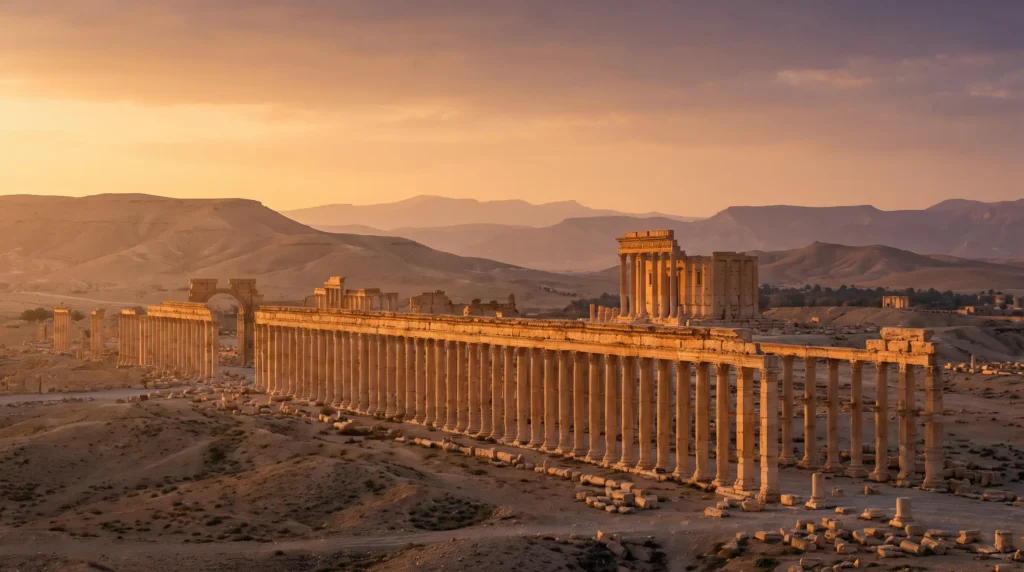
Palmyra is the starkest example: the desert caravan city that once linked Rome to Persia, and whose Queen Zenobia briefly ruled her own breakaway empire from it in the 260s CE, was captured by ISIS in 2015. Militants dynamited the Temple of Baalshamin, gutted the interior of the Temple of Bel, toppled the Monumental Arch, and destroyed several of the tower tombs before Syrian forces recaptured the site in 2017. Restoration work, including partial reconstruction of the Arch of Triumph, has continued since, and researchers estimate a large share of the site remains recoverable — but “recoverable” is a multi-decade project, not a travel-ready ruin. Aleppo’s old souks and Krak des Chevaliers, the best-preserved Crusader castle in the world, both took direct battle damage during the war years as well. If nothing else, let this be the reason Syria stays on your radar for a future decade, even while it stays off your itinerary for this one.
Best Time to Visit — If and When That Changes
There is no responsible “best time to visit Syria” answer in 2026, because the honest answer is: not now, per every major government advisory currently in force. What follows is climate context for planning purposes only, should the security and advisory picture change in future years.
Spring (March–May) and Autumn (September–November)
The Mediterranean climate along the coast and around Damascus is mildest in these shoulder windows — warm days, cool nights, and the least extreme temperature swings. This is the pattern most Levant countries (Jordan, Lebanon) treat as peak season.
Summer (June–August)
Interior and desert regions, including Palmyra, run brutally hot and dry; coastal areas are more temperate but humid.
Winter (December–February)
Cold and occasionally snowy inland and at elevation, milder on the coast. Regardless of season, the operative fact is the advisory status, not the weather — check it before anything else.
Getting There — What’s Reopening in 2026
Damascus International Airport, Syria’s main gateway, resumed regular commercial service in 2026 after Syrian civil aviation authorities reopened previously closed air corridors across the country’s airspace. Since then, a growing list of carriers has restarted or launched routes — Qatar Airways began daily Damascus service, Etihad added Abu Dhabi–Damascus frequencies, and Amsterdam–Damascus direct flights resumed in July 2026 after a fourteen-year gap in non-stop service between Syria and Western Europe, alongside Gulf regional carriers like Air Arabia and Flynas.
None of that changes the advisory calculus above — commercial flights resuming reflects aviation and diplomatic normalization, not a safety green light, and insurers and governments still treat the two as separate questions. For readers using this section for research rather than trip planning: land routes historically connected Syria to Lebanon, Jordan, Turkey and Iraq, all subject to their own crossing conditions and restrictions that have shifted repeatedly since 2011 and continue to do so.
Getting Around Syria
Historically, Syria’s road network connected Damascus, Aleppo, Homs, Hama and the coastal cities of Latakia and Tartus via intercity buses and shared taxis (servees), with a modest rail network linking the same corridor. Years of conflict damaged sections of this infrastructure and shifted control of different regions between different authorities at different times, so route conditions, checkpoints and reliability vary by area and change without much notice. This is not a “rent a car and go” country right now by any standard travel definition — logistics inside Syria depend entirely on current on-the-ground conditions that no general guide can responsibly summarize as stable.
Top Regions — Damascus, Aleppo, the Coast & the Desert
Damascus
The capital and one of the oldest continuously inhabited cities on Earth, with a metropolitan population near 2.8 million. Its old city — the 1979 UNESCO inscription — holds the Umayyad Mosque, one of the oldest and largest mosques in the world, alongside the covered Souk al-Hamidiyah and centuries of layered Roman, Byzantine, Umayyad and Ottoman architecture. Damascus is also considered by some traditions the fourth-holiest city in Islam.
Aleppo
Syria’s other ancient heavyweight and, before the war, its largest city and commercial engine, with an estimated 2021 population around 2.1 million. The Battle of Aleppo during the civil war caused massive destruction across the old city, including its historic souks and citadel approaches; reconstruction of affected districts is ongoing.
Palmyra
The desert’s great Roman-Persian trading city, famous for its colonnaded main street, the Temple of Bel, and Queen Zenobia’s third-century breakaway empire — and, more recently, for the scale of its wartime destruction and the slow work of piecing it back together.
The Coast — Latakia & Tartus
Syria’s short Mediterranean coastline holds its main port cities and historically its most temperate, agriculturally rich strip, distinct in climate and culture from the interior steppe.
Homs & Hama
Central Syria’s historic waypoints between Damascus and Aleppo; Hama is known for its norias, the giant wooden waterwheels that have drawn water from the Orontes River for centuries.
Krak des Chevaliers
Widely regarded as the best-preserved Crusader castle in the world, inscribed alongside Qal’at Salah El-Din as a joint UNESCO site in 2006 — and itself damaged during the conflict, another entry on the danger list.
The Northeast & Jazira
Syria’s Kurdish-majority northeast, bordering Turkey and Iraq, has followed a distinct political and administrative track through the war and its aftermath, with its own governance arrangements that have shifted repeatedly.
Culture & People
Syria’s population is roughly 80–90% Arab and about 9–10% Kurdish, with smaller Armenian, Circassian, Turkmen and Assyrian communities layered across the country. Religiously, the country is predominantly Muslim (around 94%, split between Sunni and Alawite/Shia traditions and the Druze minority), with a historic Christian population of roughly 4% concentrated partly around Damascus, Aleppo and Maaloula, one of the few places on Earth where Western Aramaic — the language associated with Jesus — is still spoken by some residents.
Arabic is the official language, but Kurdish, Turkmen, Armenian and Circassian are spoken within their respective communities. Syrian hospitality culture — generous, relationship-first, deeply rooted in extended family and neighborhood ties — is consistently described by those who have visited or lived there as one of the country’s defining and most resilient traits, even through a decade and a half of hardship.
A Food Lover’s Guide to Syria
Syrian cuisine sits at the root of a lot of dishes travelers already know from across the Levant: hummus, baba ghanouj, tabbouleh, fattoush and stuffed grape leaves (waraq enab) all trace through Syrian kitchens. Aleppo in particular has a longstanding reputation as one of the culinary capitals of the Arab world, known for kibbeh in dozens of regional variations, muhammara (a walnut-and-pepper dip), and Aleppan-style kebabs.
Damascus is closely associated with its sweets tradition — baklava and other syrup-soaked pastries, along with damascene rosewater and jasmine-scented treats sold in the old city’s souks. Ma’amoul (date- or nut-filled shortbread cookies) are a signature around religious holidays. None of this is currently something a foreign visitor can responsibly plan a trip around, but it’s worth knowing that Syrian cuisine — increasingly visible through the country’s diaspora restaurants worldwide — has an identity entirely its own, not simply a subset of its neighbors’.
Off the Beaten Path
Maaloula
A cliffside Christian town near Damascus where Western Aramaic has survived in daily use for centuries — a linguistic relic found almost nowhere else on the planet.
The Ancient Villages of Northern Syria
Sometimes called the “Dead Cities,” a cluster of roughly 40 abandoned Byzantine-era settlements between Aleppo and Idlib, inscribed by UNESCO as a single World Heritage property in 2011 and, like every other Syrian site, currently on the danger list.
Bosra
A black basalt Roman city in the south, home to one of the best-preserved Roman theaters anywhere in the world, inscribed by UNESCO in 1980 alongside Palmyra.
Practical Information
Safety. This is the section that matters most for Syria: both the US State Department (Level 4, Do Not Travel) and the UK FCDO (advises against all travel) maintain the strongest possible advisories, citing armed conflict, terrorism, kidnapping risk and unexploded ordnance, and neither government can guarantee consular assistance inside the country. Check both pages directly and recently — not this guide — before making any decision that touches Syria.
Money. Syria introduced a redenominated Syrian pound on 1 January 2026, exchanging 100 old pounds for 1 new pound; the currency has lost the overwhelming majority of its pre-2011 value, and dual official/market exchange rates have historically diverged sharply. International cards and standard banking infrastructure are not reliably functional for foreign visitors.
Health. The CDC currently rates Syria a Level 1 (usual precautions) travel health notice, but flags leishmaniasis, tuberculosis, MERS, hantavirus, and water- and food-borne illness as ongoing concerns, alongside routine vaccination (MMR especially, given global measles increases) and recommends medical evacuation insurance. Note that a health notice level is a distinct system from a security advisory — Syria’s health rating does not offset its Level 4 security advisory.
Connectivity & logistics. Telecommunications, banking and transport infrastructure remain uneven across regions still recovering from conflict and reconstruction. Time zone is UTC+3 (previously UTC+2 with DST; Syria has adjusted its clock policy in recent years). None of this is offered as trip-planning advice — it’s context for understanding a country in transition.
Budget Breakdown — Why We’re Not Publishing Numbers
Every other FFU country guide gives you a daily budget range across budget, mid-range and luxury tiers. We’re not doing that here, deliberately: there is no functioning, verifiable international tourism industry inside Syria right now, no reliable network of vetted hotels or tour operators serving foreign travelers, and currency conditions (a just-redenominated pound with a history of wide official/market divergence) make any number we’d publish either meaningless or actively misleading within weeks. If the advisory picture changes in future years, we’ll rebuild this section with real, current figures — not before.
Planning Ahead — For Research, Not Booking
If Syria is on your radar for a future trip once conditions genuinely change, the realistic first move is watching the advisory pages directly rather than planning logistics now. In the meantime, if it’s the Levant’s history and heritage that draws you, our guides to Jordan (Petra, Wadi Rum, the Dead Sea) and Lebanon (Baalbek, Byblos, Beirut) cover neighboring countries with comparable ancient history and currently different safety pictures — always worth checking their own current advisories too. For more Roman and Crusader-era sites, our Turkey guide covers a huge stretch of shared Levantine and Byzantine history from the safer side of the border, and Israel covers Jerusalem’s overlapping religious heritage.
Frequently Asked Questions
Is it safe to travel to Syria right now?
No, according to every major Western government advisory currently in force. The US State Department rates Syria Level 4 — Do Not Travel, its highest advisory level, and the UK FCDO advises against all travel to the country. Check both pages directly before making any decision — advisories are updated frequently and can change with little notice.
Why did Damascus airport reopen if it’s still not safe to visit?
Commercial aviation resuming reflects diplomatic and infrastructure normalization — airlines, regional governments and Syria’s own civil aviation authority restoring routes and airspace access — which is a separate question from the security conditions that drive a Do Not Travel advisory. Flights resuming is not equivalent to a government lifting or downgrading its travel advisory.
Are Syria’s ancient sites destroyed?
Damaged, unevenly, not uniformly destroyed. All six of Syria’s UNESCO World Heritage sites are on the List of World Heritage in Danger, and assessments have found significant damage at five of the six (Damascus’s old city was comparatively less affected). Palmyra suffered the most visible destruction under ISIS occupation (2015–2017), though restoration work, including partial rebuilding of the Arch of Triumph, has continued since Syrian forces recaptured it.
What language do people speak in Syria?
Arabic is the official language and the mother tongue of the large majority. Kurdish, Turkmen, Armenian, Circassian and, in a handful of villages like Maaloula, Western Aramaic are spoken by minority communities.
What currency does Syria use?
The Syrian pound (SYP), which was redenominated on 1 January 2026 — the government exchanged 100 old pounds for 1 new pound — after the currency lost the vast majority of its pre-2011 value amid the civil war and its economic fallout.
Who governs Syria in 2026?
A transitional government under President Ahmed al-Sharaa, established in March 2025 following the fall of the previous government in late 2024 after more than a decade of civil war. The political and security situation remains in flux, which is a core reason current advisories remain at their highest levels.
Following Syria From Here
We’ll update this guide as the security and advisory picture genuinely changes — not before, and not based on individual news cycles. If you want to understand the region’s shared ancient history right now, start with our Jordan and Lebanon guides; if you want to understand Syria itself, the single best move is bookmarking travel.state.gov and gov.uk/foreign-travel-advice and checking back periodically, the same way we will.
Explore More
- Jordan Travel Guide — Petra, Wadi Rum and the Dead Sea, next door
- Lebanon Travel Guide — Baalbek, Byblos and Beirut’s layered history
- Turkey Travel Guide — shared Levantine, Roman and Byzantine heritage
- Israel Travel Guide — Jerusalem’s overlapping religious history
How this guide was built
Published as part of Facts From Upstairs’ country guide series. Because Syria currently carries the highest-level travel advisories from multiple governments, this guide was written as a geography, history and culture reference rather than a trip-planning itinerary, and deliberately omits budget figures and route logistics that would misrepresent a country with no functioning international tourism industry. Built from Wikipedia entity pages for Syria, Damascus, Aleppo, Palmyra, Syrian pound and Damascus International Airport; UNESCO’s World Heritage Convention state party page and its 2013 “Six World Heritage sites placed on List of World Heritage in Danger” announcement; the US State Department’s Syria travel advisory; the UK FCDO’s Syria travel advice; and the US CDC’s Syria traveler health page. Numeric and checkable claims carry inline citations to the real source page consulted.
Sources cited on this page
- Wikipedia — Syria
- Wikipedia — Damascus
- Wikipedia — Aleppo
- Wikipedia — Palmyra
- Wikipedia — Syrian pound
- Wikipedia — Damascus International Airport
- Wikipedia — List of World Heritage Sites in Syria
- UNESCO — Syrian Arab Republic (World Heritage Convention)
- UNESCO — Six World Heritage Sites Placed on List of World Heritage in Danger
- US State Department — Syria Travel Advisory
- UK FCDO — Syria Travel Advice
- US CDC — Syria Traveler Health Page
More country guides you might like
Plan your trip to Syria
The booking tools we use ourselves. FFU may earn a commission at no extra cost to you.
Plan & book your trip to Syria
Booking through these searches supports our guides at no extra cost to you.