
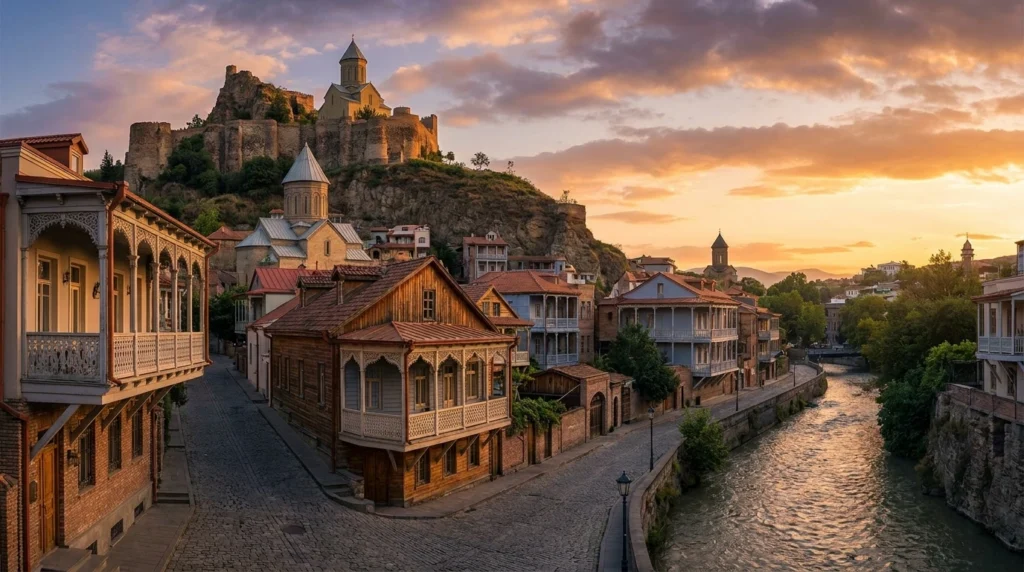
Tbilisi, Georgia: Sulphur Steam, Crooked Balconies and a Caucasus Skyline
I have arrived in a lot of capitals jet-lagged and grumpy, but Tbilisi is the only one that ever talked me into a public bath before breakfast. We walked down into Abanotubani while the brick domes were still steaming in the cold, paid for a private sulphur room, and came out an hour later feeling like new people — and that, to me, is the whole city in miniature. Tbilisi layers a 1,500-year-old Silk Road past over carved wooden balconies, Soviet concrete, Persian bathhouses and a brashly modern glass bridge, then hands you a glass of amber wine and tells you to relax. It is cheap, it is hospitable to the point of being overwhelming, and it rewards the traveller who wanders without a plan more than almost anywhere else I have written about. This is my honest, on-the-ground guide to getting it right.

Table of Contents
Why Tbilisi?
Tbilisi is the kind of capital that feels improbably layered for its size. Around 1.2 million people — roughly one-third of Georgia’s entire population — live in a city draped over the slopes of a narrow river valley, where Persian bathhouses, Orthodox churches, art-nouveau apartment blocks and brutalist Soviet ministries all jostle along the same street. It has been continuously inhabited for some 1,500 years, founded according to legend after King Vakhtang Gorgasali’s falcon fell into a hot spring while hunting, and that mix of accident, faith and warm water still defines the place. The city has been razed and rebuilt more times than almost any capital on earth — Persians, Arabs, Mongols, Turks and Russians all took a turn — and every one of them left a layer, which is exactly why it never feels like a single tidy postcard.
What sets Tbilisi apart is scale and contrast. It is small enough that you can cross the historic core on foot in an afternoon, yet dense enough that every alley reveals a crumbling balcony, a hidden courtyard church or a wine cellar that turns out to be someone’s living room. The old town climbs toward the medieval Narikala fortress on one ridge while, across the Kura (locally the Mtkvari), the gold-domed Holy Trinity Cathedral and the futuristic glass Bridge of Peace stake out the modern city. In between, funiculars and cable cars haul you up the hillsides to viewpoints that, in most countries, you would have to hike for. Few European capitals compress this much history, drama and sheer vertical theatre into so walkable a footprint, and fewer still let you do it on the kind of budget that makes a long stay genuinely tempting.
And then there is the welcome. Georgian hospitality is not a tourism slogan; it is a deeply held cultural reflex, codified at the dinner table in the ritual of the supra and presided over by a toastmaster, the tamada, whose job is to keep the wine and the eloquence flowing in equal measure. A guest, in the Georgian phrase, is a gift from God, and you will feel it — in the extra plate that appears unbidden, the glass that refuses to stay empty, the stranger who insists on walking you to the right marshrutka. Add some of the cheapest prices on the continent, an 8,000-year wine tradition you can taste in qvevri-buried amber wines, a café culture that spills onto every terrace and a techno scene that draws clubbers from across Europe, and Tbilisi becomes the rare city that is both effortless and unforgettable.
If you are weighing it against the obvious European city breaks, think of Tbilisi as the antidote to the over-touristed and the over-priced. It rewards curiosity rather than checklist-ticking: the best afternoons here are spent getting pleasantly lost in Sololaki’s painted stairwells, stumbling into a basement wine bar, or watching the city light up from a Mtatsminda bench. It is a place that asks very little of you and gives back an enormous amount — and that, more than any single monument, is the reason to come.

Neighborhoods: Finding Your Tbilisi
📍 Tbilisi Map: Every Place in This Guide
Tbilisi is a city of distinct, strongly-flavoured neighbourhoods packed into a small area, and where you base yourself shapes the whole trip. The historic core clusters on the right bank of the Kura around the old town, Abanotubani and Sololaki, with the grand sweep of Rustaveli Avenue just above; across the river, Avlabari and the Marjanishvili strip carry the city’s monuments and its nightlife respectively. Climb the surrounding ridges and you reach the residential heights of Mtatsminda, Vera and Vake, while the metro’s red line runs out to the modern sprawl of Saburtalo. The good news is that the centre is so compact and transport so cheap that you can stay almost anywhere and reach the rest in minutes — so choose for vibe rather than logistics. Below is how I’d break it down, district by district, with what each is best for and how to reach it.


Old Town (Kala)
This is the Tbilisi of the postcards: a labyrinth of cobbled lanes climbing the slope below Narikala, where carved wooden balconies sag over the street, laundry lines criss-cross the alleys, and hilltop churches appear at the end of almost every staircase. It is touristy and a little chaotic — souvenir stalls, wine shops, restaurant touts and tour groups all compete for the same narrow lanes — but it is also where the city began, and unlike many European old towns it still feels genuinely lived-in rather than embalmed. People hang their washing, repair their cars and argue over fences here, and the result is a quarter that reads like a stack of architectural eras: Persian, Georgian, Armenian and Soviet, leaning against each other on the hillside. Stay here once for the romance of it, accept that you will hear the tour groups, and know that everything else in the centre is within a short walk.
- Leghvtakhevi waterfall and the clock-tower puppet theatre
- Sioni and Anchiskhati churches
- The Narikala cable car from Rike Park
Best for: first-time visitors who want to walk everywhere. Access: Avlabari or Liberty Square metro, then on foot.
Abanotubani
The “bath district” at the foot of the old town is where Tbilisi’s whole founding myth plays out: dome-roofed brick bathhouses sit directly over the natural sulphur springs, their skylights letting the steam escape in little plumes you can see from the surrounding lanes. The name itself is literal — “abano” means bathhouse and “ubani” district — and the area is tied to the city’s 5th-century foundation, the very springs that gave Tbilisi its warm-water name. Booking a private room for an hour, scrubbed down by a kisa attendant if you are brave, is the single most Tbilisi thing you can do, and it is astonishingly cheap by spa-town standards. Beyond the baths themselves, the district is a tangle of guesthouses, teahouses and the dramatic Leghvtakhevi gorge that opens up just behind the domes, so it rewards a slow morning even if you skip the soak.
- Chreli Abano (the tiled blue-mosaic bathhouse)
- Orbeliani / Royal Baths
- The Leghvtakhevi gorge walk behind the baths
Best for: a sulphur soak and atmosphere. Access: a five-minute walk south of Maidan/Meidan Square.
Sololaki
West of Freedom Square, the old town melts into Sololaki — Tbilisi’s oldest planned residential quarter, laid out from the 19th century on neat grids of art-nouveau apartment blocks with painted stairwells, stained glass and hidden interior courtyards. It is easily distinguished from the tangled inner old town by those orderly streets, and it is where to come if you want the romance of crumbling Belle Époque grandeur without the souvenir stalls. Many of the most beautiful entrances are private, but plenty of cafés, wine bars and small galleries have moved into the ground floors, and the locals are surprisingly relaxed about visitors peering up at a painted ceiling. The quarter climbs toward Mtatsminda, so a wander here naturally turns into the walk up to the Mother of Georgia statue and the Narikala ridge. It is quieter than Kala but still wholly walkable to everything.
- Painted art-nouveau stairwells on Lado Asatiani St
- Gabriadze cafés and wine bars
- The hike up to the Mother of Georgia statue
Best for: staying central but calmer. Access: Liberty Square metro.
Avlabari & Rike
Across the river on the left bank, Avlabari is the historic Armenian quarter and the elevated platform for the colossal Sameba (Holy Trinity) Cathedral, whose gold dome dominates the skyline from almost everywhere in the city. The streets here are scruffier and more residential than the right-bank old town, which is part of the charm — this is where you see ordinary Tbilisi life unfold around an extraordinary monument. Below the cathedral, Rike Park spreads along the riverbank with musical fountains, an amphitheatre, the curving glass-and-steel Bridge of Peace and the lower station of the Narikala cable car. The whole strip is the city’s best evening promenade, busy with families and couples once the heat drops, and the cable car from here gives you the single most efficient route up to the fortress and its panorama.
- Holy Trinity Cathedral (Sameba)
- Rike Park and the Bridge of Peace
- Metekhi church and the King Vakhtang statue
Best for: photographers and big-monument views. Access: Avlabari metro.
Vera
Between Sololaki and Vake, Vera is a leafy, low-key residential pocket that blends historical houses with a growing crop of specialty cafés, bakeries and small restaurants. It sits on the west side of the centre, roughly a 30-minute walk from the old town, and trades sightseeing for liveability — tree-shaded streets, a neighbourhood park, and an easy stroll down to Rustaveli Avenue. This is the kind of area expats and longer-stay visitors gravitate to, and it makes a particularly good base for families who want green streets and quiet evenings over the noise of the old town. You give up a little atmosphere and gain a lot of calm, which after a few days of Old Town cobbles can be exactly what you want.
- Vera Park and the surrounding cafés
- Easy walk to Rustaveli Avenue
- Quiet guesthouses and apartment rentals
Best for: longer stays and families. Access: walkable from Rustaveli metro.
Vake
Historically the address of the Soviet-era elite — and still the city’s most expensive postcode — Vake is Tbilisi’s “posh” district: broad tree-lined avenues, handsome mid-century apartment blocks, smart restaurants and cocktail bars, and the big Vake Park rolling up toward Turtle Lake and its cable car. It is residential and upmarket rather than sightseeing-heavy, so it is not where most short-stay visitors base themselves, but it is a pleasant, safe and very local-feeling part of town to spend an afternoon. The cafés around Chavchavadze Avenue are where well-heeled Tbilisians actually hang out, and the park is a genuine lung for the city, popular with joggers, dog-walkers and families on weekends. If your idea of a good neighbourhood is one that locals would choose to live in, this is it.
- Vake Park and the WWII memorial steps
- Turtle Lake cable car
- Smart cafés around Chavchavadze Avenue
Best for: a quiet, upscale base. Access: bus or taxi; no metro in central Vake.
Marjanishvili & Chugureti
On the left bank, the area around Marjanishvili and the long Davit Agmashenebeli Avenue has been polished into a pedestrianised strip of restored 19th-century facades — branded “New Tiflis” — lined with wine bars, restaurants and the city’s biggest concentration of new openings. It is more local and less touristy than the right-bank old town, with a grittier, more creative edge, and increasingly it is where Tbilisi’s nightlife actually lives. The anchor is Fabrika, a vast Soviet sewing factory reborn as a hostel wrapped around a courtyard of bars, studios, barbers and street-food counters that buzzes from afternoon into the small hours. Spend an evening here and you will understand why young Georgians and the expat crowd have made this their patch.
- The pedestrian “New Tiflis” stretch of Agmashenebeli Ave
- Fabrika — a Soviet factory turned hostel and courtyard hub
- Marjanishvili Theatre and the surrounding bars
Best for: nightlife and a more local feel. Access: Marjanishvili metro.
Saburtalo
North-west of the centre, Saburtalo is the modern, mid-rise residential heart of the city: less charming and more concrete than the historic core, but cheaper, well-served by the metro’s red line, and handy if you want value and convenience over views. It is where a lot of long-stay travellers, students and digital nomads end up, drawn by affordable apartment rentals, supermarkets, gyms and a direct metro run into the centre. You won’t spend your sightseeing hours here, but as a base it is practical and quiet, and the Vake–Saburtalo park belt is close enough for a morning run. Think of it as the sensible-shoes option: not romantic, but it gets the job done at a fraction of old-town prices.
- Good-value apartment rentals
- Direct metro access to the centre
- The Vake-Saburtalo park belt nearby
Best for: budget and convenience. Access: red-line metro (Delisi, Vazha-Pshavela).
Mtatsminda
Rising above Sololaki, Mtatsminda — “holy mountain” — is less a place to sleep than the city’s great viewing balcony, reached by a historic funicular that has been hauling passengers up the slope since 1905. At the top sits an old-fashioned amusement park with a Ferris wheel, the Pantheon where many of Georgia’s writers and national figures are buried, and a terrace restaurant with the single best panorama in Tbilisi. Locals come up at sunset to watch the city’s lights flicker on across the valley, and it is genuinely worth timing your visit for that golden hour. The slopes below hold some of the most coveted (and steeply-priced) residential streets in the city, but for most visitors Mtatsminda is an excursion rather than a base — a half-day of fresh air, big views and a slightly faded fairground charm that is hard not to love.
- The 1905 Mtatsminda funicular
- The hilltop amusement park and Ferris wheel
- The Pantheon of Writers and Public Figures
Best for: sunset views and a half-day excursion. Access: the Mtatsminda funicular from Chonkadze Street.
Sololaki Ridge & the Botanical Garden
Tucked behind Narikala, in the fold of hills above Abanotubani, the National Botanical Garden of Georgia is a surprisingly large and wild green escape — waterfalls, a swinging bridge, and shaded paths that climb the gorge, all just minutes from the bustle of the old town. The ridge above links the fortress to the towering aluminium Mother of Georgia (Kartlis Deda) statue, a bowl of wine in one hand and a sword in the other, summing up the national attitude to guests and enemies alike. It is not a residential neighbourhood so much as the city’s green crown, but it is one of the best places to spend a warm morning, and the walk along the ridge from the cable-car station to the statue and down into the garden is one of Tbilisi’s finest free outings.
- The National Botanical Garden and its waterfall
- The Mother of Georgia (Kartlis Deda) statue
- The ridge walk linking Narikala to the garden
Best for: a green half-day and the city’s best ridge walk. Access: Narikala cable car, then on foot.
The Food

Georgian food is one of the genuine reasons to come — a cuisine that sits at the crossroads of the Mediterranean, the Middle East and Central Asia, leaning hard on walnuts, fresh herbs, sour plums, pomegranate, cheese and char-grilled meat, and Tbilisi is where the whole country’s regional cooking converges in one place. From the cheese pies of Adjara on the Black Sea to the dumplings of the mountain villages and the clay-pot stews of the eastern wine country, you can eat your way across Georgia without leaving the capital. Eating here is also astonishingly cheap by European standards: a budget sit-down meal runs roughly ₾15–25, a mid-range dinner with wine ₾40–70 a head, and even the city’s serious fine-dining rooms rarely top ₾100–200 per person. The deeper truth is that Georgian meals are social events rather than transactions: dishes arrive to be shared, the table fills up faster than you can clear it, and somewhere a bottle of amber wine is always being opened. Come hungry, come with company, and do not try to order one dish per person.
The Two Things You Must Eat
Khachapuri (cheese bread) and khinkali (soup dumplings) are the non-negotiables, the dishes every Georgian has strong opinions about and every visitor leaves obsessed with. Adjaruli khachapuri is the boat-shaped, egg-topped showstopper — a canoe of bread filled with molten sulguni cheese, finished with a knob of butter and a raw egg yolk you stir into the cheese at the table, then tear off pieces of the crust to dip. The Imeretian version is a flatter, round cheese pie, gentler and more everyday, while the Megrelian piles extra cheese on top. Khinkali, meanwhile, are big twisted soup dumplings, usually filled with spiced minced meat: you grab the knotted topknot, bite a small hole in the side, slurp out the scalding broth so it doesn’t run down your arm, eat the rest, and leave the chewy knot on your plate as a tally of how many you’ve put away. Doing it wrong is the surest way to mark yourself as a first-timer, so practise.
- Retro / Samikitno (Maidan) — round-the-clock khinkali and khachapuri (khinkali roughly ₾1.6–2 each)
- Pasanauri — a Tbilisi institution for mountain-style khinkali
- Machakhela — reliable Adjaruli khachapuri (around ₾12.5)
Modern Georgian Tables
Tbilisi’s restaurant scene has matured remarkably fast over the past decade, with a wave of chefs reinventing village recipes with serious technique, sourcing from small producers and pairing food with the country’s natural-wine revival. These are where to splurge for an evening, and even at the top end the bill would look like a bargain in any Western capital. Book ahead at weekends — the best rooms fill up with locals celebrating as much as with visitors, which is always a good sign.
- Barbarestan — dishes rebuilt from the 19th-century recipes of Barbare Jorjadze; dinner for two from ~₾300–400
- Shavi Lomi (Black Lion) — modern Georgian in a candlelit house off the tourist trail
- Keto and Kote — hillside terrace, contemporary Georgian, book ahead
Beyond Khachapuri and Khinkali
The deeper menu is where Georgian cooking really opens up, and it is also, happily, where vegetarians eat extraordinarily well — herb-and-walnut vegetable dishes, char-grilled meats, clay-pot bean stews and a whole register of pickles, cheeses and breads that vary from region to region. Order a spread of small plates (the Georgian instinct is always abundance) and you will find the meal builds itself: something green, something with walnut paste, a grilled skewer, a clay pot, a basket of bread. Below are the dishes I’d steer a first-timer toward, with rough prices, though the joy is in grazing widely rather than fixating on any one.
- Pkhali — pounded vegetables (spinach, beetroot, beans) with walnut and herbs (~₾6–10)
- Mtsvadi — Georgian shashlik, grilled over vine cuttings (~₾14–20)
- Lobio — clay-pot bean stew with cornbread (mchadi) (~₾8–12)
- Churchkhela — walnuts threaded and dipped in grape-must, the “Georgian Snickers” (~₾3–5)
And then there is the wine, which deserves its own paragraph. Georgia makes a credible claim to being the cradle of viticulture, with an unbroken 8,000-year tradition centred on the qvevri — the egg-shaped clay vessels buried underground in which grapes ferment skins-and-all, producing the deep-coloured “amber” or orange wines the country is famous for. UNESCO inscribed the qvevri method on its intangible-heritage list in 2013, and in Tbilisi you can taste the results everywhere from a ₾4 carafe of house wine to a serious tasting flight. Try a rkatsiteli or mtsvane amber and a saperavi red, and do not be surprised when a restaurant pours you “their cousin’s” homemade bottle.
The Supra and the Culture of the Table
To understand Georgian food you have to understand the supra, the ritual feast that is less a meal than a performance of hospitality. A proper supra is presided over by a tamada, or toastmaster, who steers the table through a long, deliberate sequence of toasts — to peace, to the motherland, to absent friends, to the departed, to the women present — each one a small speech, each one drained in full. The table itself groans under dishes stacked on dishes, plates literally overlapping because there is never enough flat surface for the abundance, and the rhythm is generous and unhurried: you graze, you toast, you talk, you toast again, for hours. Being invited to a Georgian home supra is one of travel’s great privileges, but you can taste a polished version of the same spirit at restaurants across Tbilisi that stage live polyphonic singing and traditional dance alongside the food. The etiquette to remember is simple and important: follow the tamada’s lead on the toasts, never toast seriously with beer (it is reserved for joke or insulting toasts), and never refuse outright — pace yourself instead, because declining a host’s food or wine can read as a quiet rejection of their welcome. Lift your glass, meet the eye of the person being toasted, and say gaumarjos.
Regional Cooking, All in One City
One of the quiet pleasures of eating in the capital is that it gathers the whole country’s regional kitchens within a few metro stops. From Adjara on the Black Sea coast comes the egg-topped boat khachapuri and a love of fish and spice; from the mountain provinces of Khevsureti and Pshavi come the hearty meat khinkali born of herders’ food; from Megrelia in the west come fierce chilli-and-walnut sauces, the cornmeal porridge ghomi and elarji, and a generally bolder, spicier palate. The eastern province of Kakheti, the wine country, brings clay-pot meats, the lamb-and-tarragon stew chakapuli, and of course the wine itself, while Imereti around Kutaisi contributes its lighter cheese pies and abundant fresh herbs. You can eat your way around this culinary map without leaving Tbilisi, and tracking down the regional specialities — a proper Megrelian elarji, say, or a Kakhetian mtsvadi grilled over vine cuttings — turns a few days of meals into a genuine education. Ask waiters where a dish “comes from”; Georgians love the question and the answer is always a small geography lesson.
Markets, Bakeries and Street Food
Not every great Tbilisi meal happens at a table. The city’s bakeries turn out tonis puri — flatbreads slapped onto the walls of a beehive-shaped clay oven and peeled off blistered and warm — for small change, and they are best eaten on the spot. Street corners sell churchkhela, the candle-shaped strings of walnuts dipped repeatedly in thickened grape juice that travellers either adore or find baffling, plus lobiani (bean-stuffed bread) and the spiced-meat pastry kubdari from the mountains. For the full sensory immersion, head to a bazaar: the sprawling Dezerter Bazaar near the train station is a riot of mounded spices, barrels of pickles, hanging churchkhela, wheels of sulguni cheese and farmers haggling over herbs. Even if you cook nothing, an hour wandering the stalls — sampling cheese, sniffing the dried blue-fenugreek that flavours so many dishes — tells you more about Georgian food than any restaurant menu can. Bring cash and a sense of curiosity.
Food Experiences You Can’t Miss
- A full supra (feast) with a tamada toasting through qvevri amber wine
- The Dezerter Bazaar for cheese, spices, churchkhela and pickles
- A natural-wine flight at a Marjanishvili wine bar like g.Vino or Vino Underground
- A morning lesson in shaping khinkali or baking khachapuri in a cooking class

Cultural Sights

Narikala Fortress
The fortress crowning the Sololaki ridge has guarded the city in some form since around the 4th century, expanded and rebuilt many times over by Persians, Arabs and Mongols as Tbilisi changed hands. Today it is a romantic ruin of stone walls and the restored St Nicholas church, but the real reward is the view: the whole tangle of the old town, the river, the cathedral and the modern bridges laid out below you. Founded c. 4th century. Admission free; the cable car up from Rike Park costs ₾2.5 each way and runs on the MetroMoney card, or you can walk up through the lanes from Abanotubani. Best at golden hour, when the low light turns the brick rooftops amber and the city begins to glitter. From here a ridge path leads on to the Mother of Georgia statue and the botanical garden, making it the natural start of a half-day on foot.
Holy Trinity Cathedral (Sameba)
The vast gold-domed cathedral over Avlabari is one of the largest Orthodox churches in the world by volume, consecrated in 2004 after a decade of construction funded largely by public donation, and conceived as a soaring symbol of Georgia’s post-Soviet religious and national revival. Standing on its terrace, with the dome rising more than 80 metres above you and incense drifting from the candlelit interior, it is genuinely awe-inspiring even if you are not religious. Admission free. Dress modestly — women are expected to cover their heads and wear skirts below the knee, and wraps are usually available at the door if you arrive unprepared. Come for a service if you can, when the famous Georgian polyphonic chant fills the space; it is one of the city’s most moving experiences.
The Sulphur Baths of Abanotubani
The dome-roofed bathhouses are both a sight and an experience, and no visit is complete without an hour in one. A private sulphur room — your own tiled chamber with a hot pool, fed by the naturally warm, faintly eggy spring water — typically runs ₾30–70 an hour depending on the bathhouse and the day, and for a few lari more an attendant will scrub you down with a coarse kisa mitt until your skin glows. Even Pushkin, passing through in the 1820s, declared them the best baths he had ever taken. Best early morning before the day-trippers and tour groups arrive, when you can have the steam and the silence largely to yourself. The blue-tiled facade of Chreli Abano is the most photographed, but the plainer bathhouses are just as good and a little cheaper.
Mtatsminda & the Funicular
The Mtatsminda ridge holds a hilltop amusement park, the Pantheon of Georgia’s writers and national figures, and the best long view over the entire city. Admission to the park itself is free; the historic funicular up the slope costs ₾12 one-way, and note that the MetroMoney card is not accepted here — you buy a separate ticket at the station. Best at dusk, when you can watch the lights come on across the valley from the terrace restaurant or the Ferris wheel, then ride back down through the dark. It is touristy in the gentle, old-fashioned sense of a city’s beloved fairground, and all the better for it.
Rustaveli Avenue & the Museums
The grand, plane-tree-lined 19th-century boulevard is the city’s ceremonial spine, lining up the Parliament building, the ornate Opera and Ballet Theatre, the Rustaveli Theatre and the Georgian National Museum along a single walkable kilometre. The museum is the must-do indoor sight: its Treasury holds spectacular pre-Christian goldwork from the ancient kingdoms of Colchis and Iberia, and its sobering Soviet Occupation exhibit traces the 20th-century history that still shapes the country. Best explored on foot in the late afternoon, ducking into a café when you need a break, with the museum saved for a hot midday hour out of the sun.
The Chronicle of Georgia
Zurab Tsereteli’s monumental columns on Keeni Hill above the northern suburbs — 30-plus metres of carved Georgian kings, queens and biblical scenes — feel like a Caucasus Stonehenge crossed with a Soviet-scale ambition, and despite their drama they draw barely any crowds. The platform offers sweeping views over the Tbilisi Sea reservoir, and at the right hour you may have the whole eerie, oversized monument to yourself. Admission free; reach it by taxi or Bolt, as it is well off the main transit routes and the final approach is up a long flight of steps. It is the sort of half-secret, slightly surreal sight that makes Tbilisi memorable.
Entertainment

For a city of barely over a million people, Tbilisi has an outsized after-dark reputation, and it earns it. The scene runs the full spectrum from world-famous underground techno temples to candlelit wine bars and faded Soviet-era theatres, and almost all of it is cheap enough to indulge in freely. What unites it is a certain intensity — Georgians do not do things by halves, and a night out here tends to start late, run long and acquire new friends along the way.
Techno & the Club Scene
Tbilisi punches far above its weight for nightlife, to the point where European clubbers fly in specifically for it. Bassiani, built into a former Soviet swimming pool beneath the Dinamo Arena, is regularly ranked among the world’s serious techno clubs and is as much a cultural and political statement as a party — its crowd was at the heart of the city’s 2018 “we dance together, we fight together” protests. Khidi, literally under a bridge by the river, is the other heavyweight. Typical cost ₾30–50 entry, often with a door selection, so dress down and go with intent. Arrive after midnight, bring photo ID, and do not expect to leave before dawn.
Fabrika & Courtyard Bars
A converted Soviet sewing factory on the left bank, Fabrika is the city’s daytime-to-late-night social hub — a hostel ringed by a vast courtyard of bars, third-wave coffee, design studios, a barber and street-food counters that fills up with a young, mixed crowd of Georgians, expats and travellers. It is the easy, no-pressure entry point to Tbilisi nightlife: drinks run ₾8–18, there is no cover, and you simply turn up, find a corner of the courtyard and let the evening unfold. By midnight it spills out into the surrounding Marjanishvili bars.
Wine Bars
Given the country’s 8,000-year wine pedigree, it is no surprise that natural and qvevri wine bars are one of the city’s great pleasures. They cluster around Marjanishvili and the old town — g.Vino, Vino Underground and 8000 Vintages are the names to know — and pour amber and saperavi wines by the glass alongside cheese and cured-meat plates. A tasting flight runs ₾20–40, and the staff are usually happy to walk you through the difference between a skin-contact rkatsiteli and a Kakhetian red. This is the most civilised way to spend a Tbilisi evening.
Opera, Ballet & Theatre
The beautifully restored Tbilisi Opera and Ballet Theatre on Rustaveli, with its Moorish-revival interior, stages genuinely world-class productions at a fraction of Western European prices, with tickets from around ₾20. The Rustaveli and Marjanishvili theatres keep Georgian-language drama alive, and even without the language the staging is often spectacular. Check listings when you arrive — a night at the opera here costs less than a club entry in most capitals.
Live Music & Jazz
From the Mtkvari-side summer terraces to intimate basement jazz rooms and rock bars around Rustaveli, live music is easy to stumble into, especially from late spring through autumn. Most venues are free or charge a low cover of ₾10–20, and the quality — particularly the jazz scene — is consistently high. Ask at your guesthouse what’s on; the best nights are rarely advertised in English.
Rooftop & Riverside Drinks
When the summer heat finally breaks in the evening, the city moves outdoors. Sunset drinks on a Sololaki or old-town rooftop, or a stroll-and-cocktail along the illuminated Rike Park riverbank, are a nightly ritual for locals and visitors alike. Cocktails run ₾15–25 at the smarter spots, less at the casual terraces, and the views over the lit-up fortress and cathedral are free.
Day Trips

One of Tbilisi’s greatest assets is its position: some of Georgia’s most spectacular sights sit within a day’s reach, from ancient cathedrals to high-Caucasus churches and the country’s storied wine valleys. You can do all of these by shared marshrutka minibus from Didube station, but for a small premium a shared driver or a day tour will stop for photos, wait while you explore, and turn a logistical scramble into a pleasure. Here are the ones worth your time, roughly in order of how easily they fit a day.
Mtskheta (30 min by car)
Georgia’s ancient capital and spiritual heart sits just 24 km north, making it the easiest and most rewarding half-day from the city. The 11th-century Svetitskhoveli Cathedral — traditionally said to hold Christ’s robe — anchors the small town, while the 6th-century Jvari Monastery stands dramatically on the ridge above the confluence of two rivers; both are UNESCO World Heritage. Combine the two with a riverside lunch and you have a perfect, unhurried morning that leaves the afternoon free back in Tbilisi.
Kazbegi / Stepantsminda (3–3.5 hr by car)
The single most jaw-dropping day trip, though a long one. The Georgian Military Highway climbs roughly 155 km north through switchbacks, mountain passes and old fortress towns to Stepantsminda, where the postcard-perfect Gergeti Trinity Church stands alone at 2,170 m beneath the snow-capped pyramid of Mount Kazbek (5,047 m). It is a full, ambitious day — leave early, go in clear weather, and treat the drive itself as half the attraction. A 4×4 transfer up to the church saves a steep hike.
Sighnaghi & Kakheti (1 hr 50 by car)
The walled hill town of Sighnaghi, about 110 km east, is the picturesque gateway to the Alazani Valley — the green, vine-striped heart of Georgian wine. Wander its restored ramparts and red-roofed lanes, then drop into a Kakhetian cellar (around Telavi or Sighnaghi itself) to taste qvevri wines straight from the source, ideally during the September–October rtveli harvest when the whole region smells of crushed grapes. It pairs beautifully with a long lunch and is, for many, the best day out from the capital.
Gori & Uplistsikhe (1.5 hr by car)
To the west, Stalin’s birthplace of Gori holds a curious, unreconstructed Soviet-era museum to the dictator, which pairs naturally with the nearby cave city of Uplistsikhe — a remarkable rock-cut settlement of halls, tunnels and a pagan temple carved into a cliff above the Mtkvari and inhabited for thousands of years. The two sit close together and are easily combined into one varied day of history and geology.
David Gareja (2 hr by car)
A remote and atmospheric cave-monastery complex carved into the striped semi-desert hills on the Azerbaijani border, founded in the 6th century and still partly active. The frescoes and the lunar landscape are extraordinary, but the international boundary here is disputed and access can change, so check the current security and access situation before committing to the trip.
Seasonal Guide
Tbilisi sits in a sheltered river valley with a markedly continental climate — properly hot summers and cool, sometimes snowy winters — so timing your visit makes a real difference to how the city feels. The shoulder seasons are the clear winners, but each season has its own character and a reason to come.
Spring (March – May)
The sweet spot. The hillsides green up, café terraces reopen, the parks burst into blossom and daytime temperatures climb from cool early-spring days into the comfortable high teens and mid-20s °C by May. Late spring is close to ideal — warm enough for long days outside but well short of the searing summer heat, and the surrounding Caucasus peaks are still capped with snow, which makes for spectacular day-trip backdrops. Pack layers, as evenings stay crisp.
Summer (June – August)
Hot and dry. July and August routinely push past 35 °C in the enclosed river valley, and Tbilisians who can afford to decamp to the cool of Kazbegi, the mountains or the Black Sea coast at Batumi. Evenings on the rooftops and along the river are gorgeous, and it is peak festival, wine-bar and nightlife season, but sightseeing in the middle of the day can be genuinely punishing — plan museums and baths for the hot hours and save walking for early morning and dusk.
Autumn (September – November)
The other great window, and many travellers’ favourite. September and October bring the rtveli wine harvest in nearby Kakheti — the most atmospheric time to visit the cellars — along with cooler, settled air, golden light and a city that feels relaxed after the summer crowds. This is arguably the single best stretch for pairing Tbilisi with wine-country day trips. By November it turns properly autumnal and damp.
Winter (December – February)
Cold and often grey in the city, with the odd dusting of snow, but it has its own appeal: prices drop, the crowds vanish, and lowering yourself into a steaming sulphur bath while it’s freezing outside is pure magic. It is also the gateway season for skiing at Gudauri, a couple of hours north on the Georgian Military Highway, so winter visitors can combine a few city days with time on the slopes.
Getting Around
Getting around Tbilisi is refreshingly simple and almost comically cheap. The historic centre is walkable, the metro is fast, the buses are cheap, and ride-hailing fills every gap — so you can move around the whole city for a couple of lari a day if you want to. Here is how the pieces fit together.
Walking
The historic core — Old Town, Abanotubani, Sololaki, Rustaveli and Rike — is compact and genuinely best explored on foot, with most of what you came to see within a 30-minute walk of Liberty Square. Be warned, though, that this is a city of cobbles, steep staircases and uneven pavements that climb the hillsides, so comfortable, grippy shoes are essential and a wheeled suitcase will hate you. The flip side is that wandering on foot is where Tbilisi reveals itself, one painted stairwell and hidden courtyard at a time.
Metro
Tbilisi’s metro opened in 1966 and runs two lines through 23 stations, carrying around half a million riders on a busy day, which makes it the fastest way to cover longer distances across the city. A single ride is a flat ₾1 regardless of distance, and transfers within 90 minutes are free across the metro, city buses and most cable cars — so a single tap can chain together a whole multi-leg journey. Stations are deep, Soviet-built and a sight in themselves; signage is in Georgian and Latin script.
Buses, Minibuses & Cable Cars
A modern fleet of blue city buses covers the gaps the metro misses, also at a flat ₾1, while the older marshrutka minibuses dart along fixed routes for the same fare and are handy for the hillside neighbourhoods. Three of the city’s cable cars — including the Rike Park–Narikala line — run on the same card system, so a ride up to the fortress is just ₾2.5. Buses run roughly from early morning until around midnight.
The MetroMoney Card
Buy a single rechargeable MetroMoney card for ₾2 at any metro station and top it up at the machines; it works on the metro, all city buses, minibuses and three of the four cable cars, and one card can tap multiple passengers through. There is no separate tourist day pass and you don’t need one — the flat ₾1 fares with free 90-minute transfers are so cheap that buying unlimited travel would actually cost you more. Keep a few lari topped up and you can ignore transport pricing entirely.
Airport Access
- Bus 337 from Tbilisi International (TBS) to Liberty Square — about 40–50 min, ₾1
- Bolt/taxi airport to centre — about 20–30 min, ₾25–40
Taxis & Ride-hailing
Use the Bolt app rather than flagging cabs — it is cheap, metered and avoids haggling. A cross-town ride rarely exceeds ₾10–15. Street taxis without a meter will quote tourists high; agree a price first if you must use one.
Navigation Tips
Apps: Bolt, Google Maps. Georgian street signs are dual-script (Georgian + Latin), addresses can be vague, and Old Town’s lanes confuse GPS — when in doubt, navigate to a landmark church or square and walk from there.
Budget Breakdown: Making Your Lari Count
| Tier | Daily | Sleep | Eat | Transport | Activities | Extras |
|---|---|---|---|---|---|---|
| Budget | ₾90–140 | ₾30–55 hostel/guesthouse | ₾25–40 | ₾3–5 | ₾15–30 | ₾10 |
| Mid-Range | ₾220–400 | ₾120–220 hotel/apartment | ₾60–110 | ₾15 | ₾40–80 | ₾30 |
| Luxury | ₾700+ | ₾400+ boutique hotel | ₾200+ | ₾40 private driver | ₾150+ | ₾80+ |
Where Your Money Goes
Tbilisi is one of Europe’s cheapest capital-city breaks, and that shapes the whole budget. The swing between the tiers above is driven almost entirely by accommodation and by whether you eat at neighbourhood diners or the new wave of chef-driven restaurants — everything else stays cheap. Public transport is effectively a rounding error at ₾1 a ride, most of the headline sights cost nothing to enter, and even the sulphur baths are an affordable treat. The one place your money genuinely disappears, in the best way, is wine: it is so good and so inexpensive that “just one more bottle” becomes the defining line item of any Tbilisi trip. A frugal traveller can have a wonderful time here on well under ₾150 a day, while ₾300–400 buys a comfortable mid-range experience with smart dinners and the odd day-trip driver.
To put the tiers into a real itinerary: a backpacker sleeping in an Old Town hostel dorm, eating khinkali and khachapuri at neighbourhood places, riding the metro and walking the rest, can comfortably keep a full day — bed, three meals, transport and a couple of beers — under ₾140. Step up to the mid-range and the picture changes character rather than scale: a private apartment in Sololaki or Vera, dinner at a chef-driven spot like Keto & Kote or Barbarestan, a private-baths session at Chreli-Abano, and a hired driver for a Kakheti wine day will run ₾300–400 without feeling extravagant. Even the luxury tier — a boutique hotel in a restored mansion, tasting menus, private guides and drivers throughout — tops out well below what the equivalent would cost in Western Europe, which is precisely why Tbilisi has become such a magnet for long-stay digital nomads and value-minded travellers alike.
The single biggest variable, beyond your bed, is how you handle the airport and the day-trips. The official Tbilisi Airport bus 337 costs the same flat ₾1 as any city ride and runs to Liberty Square, so reaching town need cost almost nothing; a metered or Bolt taxi will instead run ₾30–50 depending on traffic and time of day. Similarly, the mountains and wine country are where a splurge is most tempting — a shared marshrutka to Kazbegi is a few lari, but a private driver who waits while you explore Gergeti, Ananuri and the Jvari Pass is worth every one of the ₾200–300 it costs across a group. Wine tastings in Kakheti are often free or token-priced when you buy a bottle or two, which you inevitably will.
Money-Saving Tips
- Eat where the locals do — a full khinkali-and-khachapuri meal can come in under ₾20 a head
- Use the flat ₾1 metro and buses instead of taxis for longer hops across the city
- Most headline sights — Narikala, Sameba, Rustaveli, the Chronicle of Georgia — are free to enter
- Order dishes to share rather than per person; Georgian portions are built for a table
- Buy a MetroMoney card once and skip the airport-taxi premium with bus 337 into town
- Take the public airport bus 337 (₾1) rather than a taxi (₾30–50) to and from Tbilisi International
- Withdraw lari from a TBC or Bank of Georgia ATM on arrival instead of changing cash at the airport’s poorer rates
- Share a private driver across a group for Kazbegi or Kakheti — the per-head cost drops to little more than a marshrutka seat
Practical Tips
Language
Georgian (Kartuli) has its own beautiful, ancient curling alphabet and belongs to a small language family unrelated to any of its neighbours — so do not expect to recognise a single word on sight. The good news is that you rarely need to: Russian is widely understood, especially by Georgians over about 40, English is increasingly common among younger people and throughout the hospitality industry, and menus and signs in the centre are usually translated and dual-script. Even so, learning a couple of phrases pays outsized dividends here, where hospitality is a point of pride. “Gamarjoba” (hello), “madloba” (thank you) and “gaumarjos” (cheers) will earn you delighted smiles and, quite possibly, a free glass of wine.
Cash vs. Cards
Card payment is accepted in most restaurants, hotels, supermarkets and shops in the centre, and contactless is common, but you should still carry a reasonable amount of lari in cash. Markets like the Dezerter Bazaar, the marshrutka minibuses, the sulphur baths, smaller cafés and many rural day-trip stops are cash-only or strongly prefer it. ATMs are plentiful and reliable — TBC Bank and Bank of Georgia machines are the safest bets — and they generally offer a decent rate, so withdrawing on arrival rather than changing money at the airport usually works out best. Keep small notes for taxis and tips.
Safety
Tbilisi is very safe for travellers, with low violent-crime rates and a strong sense of personal security even late at night. The main caveats are political demonstrations on Rustaveli, which can flare around the Parliament — avoid the crowds — and the Russian-occupied regions of Abkhazia and South Ossetia, which are off-limits.
What to Wear
Tbilisi is relaxed and smart-casual works almost everywhere, but pack for the city’s big day-to-night temperature swings, especially in spring and autumn — a light layer for the evenings is wise year-round. The one firm rule is church dress: Orthodox cathedrals including Sameba expect modest cover, meaning shoulders and knees covered for everyone and a headscarf for women, with skirts preferred over trousers. Wraps and scarves are often available to borrow at the entrance, but carrying a light scarf in your day bag saves the hassle. Good walking shoes matter more than anything else given the cobbles and hills.
Cultural Etiquette
The supra (feast) is the centre of Georgian social life, and if you are lucky enough to be invited to one, a little awareness goes a long way. Expect a tamada (toastmaster) to lead a long, structured sequence of heartfelt toasts — to peace, to family, to the departed — and follow his lead on when to drink. Crucially, never raise a beer glass for a serious toast; beer is for joke or insulting toasts only, so use wine or chacha (grape brandy) for anything sincere. Refusing food or drink outright can read as a slight to a host who is showing love through abundance, so the polite move is to pace yourself and accept graciously rather than decline. Tipping around 10% is appreciated but not obligatory.
Connectivity
Staying connected is cheap and easy. Local SIM cards from Magti, Silknet or Cellfie (formerly Beeline) are sold at the airport and in shops across the city, and a generous tourist data bundle costs only a few lari — bring your passport to register. eSIM options work well too if your phone supports them. Wi-Fi is near-universal in cafés, restaurants and accommodation, and generally fast, so even without a SIM you will rarely be offline for long.
Health & Medications
No special vaccinations are required for Georgia; tap water in Tbilisi is safe to drink. Pharmacies (Aversi, PSP, GPC) are plentiful and well-stocked. Bring a basic kit for mountain day trips.
Luggage & Storage
Several Old Town hostels and the airport offer paid left-luggage; Bounce-style locker apps also operate in the centre, handy for a late-flight final day.
Frequently Asked Questions
How many days do I need in Tbilisi?
Three full days is the sweet spot for the city itself: one for the Old Town, the Abanotubani sulphur baths and the climb to Narikala; one for Sameba Cathedral, Rustaveli Avenue and the National Museum; and one for a day trip out to Mtskheta or the Kakheti wine country. That rhythm lets you see the highlights without rushing and still leaves time for the long lunches and aimless wandering that are half the point of being here. Add a fourth or fifth day and you can fit in the spectacular but long Kazbegi run up the Military Highway, or simply slow down and live like a local for a while — many visitors find they wish they had stayed longer.
Is Tbilisi good for solo travellers?
Exceptionally so. It is safe by day and night, very cheap, easy to navigate on foot and public transport, and packed with hostels, social wine bars and communal feasting that make it simple to fall into company. The famous Georgian hospitality means you rarely feel truly alone — strangers strike up conversations, and a solo diner is often adopted by a neighbouring table. Fabrika and the Old Town hostels are the obvious places to meet other travellers and join group day trips, and solo female travellers generally report feeling comfortable and welcome.
Do I need a transit pass or the MetroMoney card?
Just buy a single MetroMoney card for ₾2 at any metro station and keep a few lari topped up on it. There is no separate tourist day pass and you genuinely don’t need one, because every metro, bus and minibus ride is a flat ₾1 with free transfers for 90 minutes, and three of the cable cars use the same card. One card can even tap several travellers through, so a couple or family only needs one. Unlimited-travel passes would actually cost more than simply paying the trivial per-ride fares.
What about the language barrier?
It is much less of an obstacle than the unfamiliar alphabet suggests. Younger Georgians and almost everyone in hospitality speak at least some English, Russian is widely understood by older people, restaurant menus in the centre are usually translated, and street signs are dual-script in Georgian and Latin. Translation apps fill any remaining gaps. Learning a few Georgian pleasantries — gamarjoba (hello), madloba (thank you), gaumarjos (cheers) — is not necessary but is warmly received and tends to unlock the famous hospitality even faster.
When is the best time to visit, and is summer too hot?
The shoulder seasons of May–June and September–October are ideal: warm, settled weather, blossoming or golden landscapes, and manageable crowds, with autumn additionally offering the rtveli wine harvest in nearby Kakheti. July and August can be genuinely uncomfortable, regularly topping 35 °C in the enclosed river valley, and the city partly empties as locals flee to the mountains and coast. Summer is still doable — the nightlife and rooftop scene peak then — but plan to sightsee in the cool of early morning and evening and reserve the punishing midday hours for the baths, a museum or a long shaded lunch.
Can I use credit cards everywhere?
In most restaurants, hotels, supermarkets and shops in central Tbilisi, yes — cards and contactless are widely accepted. But you should always carry some lari in cash, because markets such as the Dezerter Bazaar, the marshrutka minibuses, the sulphur baths, smaller neighbourhood cafés and many rural day-trip stops are cash-only or prefer it. ATMs from TBC Bank and Bank of Georgia are everywhere, reliable and offer fair rates, so withdrawing cash locally beats changing money in advance or at the airport.
Is Tbilisi a good base for visiting the rest of Georgia?
It is the natural hub for the whole country and an ideal base for day trips. Mtskheta is barely 30 minutes away, the Kakheti wine country and Sighnaghi sit under two hours east, Gori and the Uplistsikhe cave city lie to the west, and the breathtaking Kazbegi region is a roughly three-hour drive north on the Georgian Military Highway. Marshrutka minibuses run to all of these from the city’s transport hubs, and shared drivers or day tours make them effortless. Many travellers sensibly base themselves in Tbilisi and radiate outward rather than constantly repacking, only relocating if they want to stay overnight in the high mountains.
Ready to Experience Tbilisi?
Soak in a sulphur bath at dawn, climb to Narikala for the sunset, and let a supra run long into the night — Tbilisi gives back exactly as much as you lean into it. For the full country context, read the Georgia Travel Guide.
Explore More City Guides
Where to Stay
Alex the Travel Guru
Alex has spent two decades writing budget-savvy, on-the-ground travel guides, with a soft spot for the Caucasus and the slow rituals of the Georgian table. Every figure in this guide was checked against tourism boards, transit operators and official advisories before publication.
More city guides you might like
Plan your trip to Tbilisi
The booking tools we use ourselves. FFU may earn a commission at no extra cost to you.
Plan & book your trip to Tbilisi
Booking through these searches supports our guides at no extra cost to you.