
Bohol Travel Guide — Chocolate Hills, Tarsiers & the Philippines’ Most Photogenic Island
Bohol is the island that makes you feel like you accidentally wandered into a nature documentary. In one day you can stand above a sea of more than a thousand improbable cone-shaped hills, lock eyes with a wide-eyed primate the size of your fist, paddle down a jungle river to a buffet lunch, and finish with sunset on a beach that regularly places on best-in-Asia lists. What I love about Bohol is that it doesn’t ask you to choose between adventure and relaxation — it’s a two-hour flight from Manila or a two-hour ferry from Cebu, and it packs Filipino island life, genuine Spanish-colonial history, and reef diving that rivals anywhere in the country into a landmass smaller than Rhode Island. The catch — and there’s always one — is that this is still recovering-from-earthquake and typhoon-alley territory, so I’ll be straight with you about the weather and the roads, not just the highlight reel.
In This Guide
- Overview — Why Bohol Is the Philippines’ Best All-Rounder
- Sandugo Festival & Bohol’s Event Calendar
- Best Time to Visit Bohol (Season by Season)
- Getting There — TAG Airport & the Cebu Ferry
- Getting Around — Tricycles, Habal-Habal & Rented Scooters
- Neighborhoods & Key Areas — Panglao, Tagbilaran, Loboc & Carmen
- Culture & People — Boholano Life, Faith & the 1898 Blood Compact
- A Food Lover’s Guide to Bohol
- Off the Beaten Path
- Day Trips From Bohol
- Practical Information
- Budget Breakdown — What Bohol Actually Costs in 2026
- Frequently Asked Questions
Overview — Why Bohol Is the Philippines’ Best All-Rounder
Bohol is an island province in the Central Visayas, the tenth-largest island in the Philippines, with a land area of roughly 4,821 square kilometers and a coastline over 260 kilometers long. Its capital and only city, Tagbilaran, is a workaday transport hub rather than a destination — the real draw is spread across 47 municipalities of rice paddies, limestone hills, mangrove rivers and reef-fringed coastline.
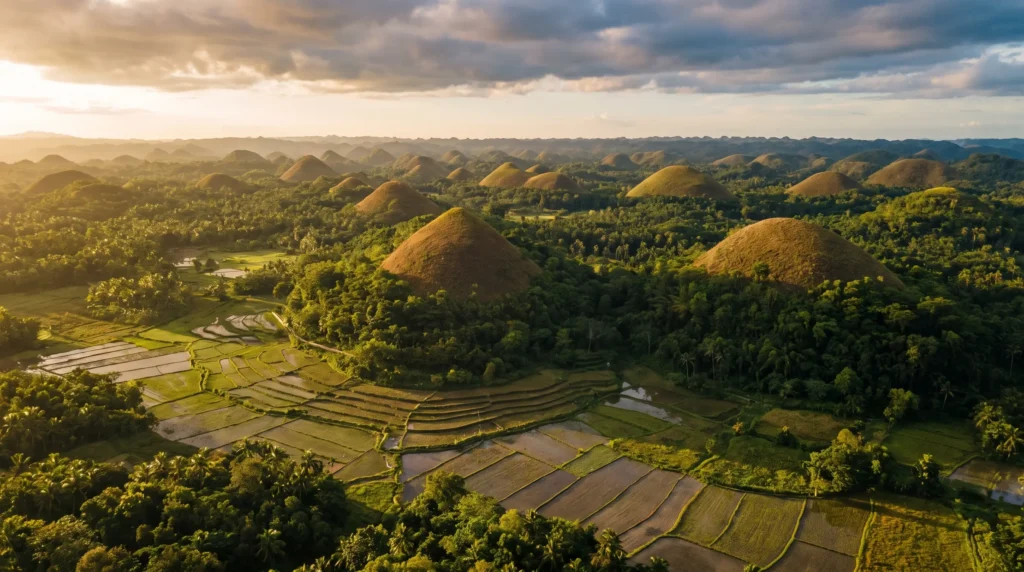
The headline act is the Chocolate Hills: a minimum of 1,260 (some counts run past 1,700) near-identical cone-shaped mounds spread over more than 50 square kilometers around Carmen, Batuan and Sagbayan, formed from marine limestone pushed above sea level and then sculpted by rainfall and groundwater over roughly two million years. They’ve been a protected national geological monument since 1988 and sit on UNESCO’s tentative World Heritage list. In 2023, Bohol was named the Philippines’ first UNESCO Global Geopark, formal recognition of the island’s outsized geology relative to its size.
Then there’s the wildlife: Bohol is one of the last strongholds of the Philippine tarsier, one of the smallest primates on the planet, alongside the diving around Panglao and Balicasag, and the mangrove-and-firefly ecosystem of the Loboc River. What Bohol doesn’t have is Boracay-scale crowds or Palawan-scale prices — it’s still a place where a jeepney ride through rice terraces costs less than a coffee, even as its Panglao beach strip has quietly become one of Southeast Asia’s better dive bases.
Sandugo Festival — Bohol’s Biggest Party
If you can time a trip around one date, make it late July: the Sandugo Festival in Tagbilaran, a week-long civic celebration commemorating the 1565 “blood compact” between Spanish explorer Miguel López de Legazpi and Boholano chieftain Datu Sikatuna — a peace pact sealed by both men cutting their arms and mixing their blood in wine. Streets fill with street-dancing competitions in elaborate costume, drum-and-lyre parades, and a re-enactment of the blood compact itself at the Blood Compact Shrine in Baclayon.
Outside Sandugo week, Bohol’s calendar runs on smaller fiestas — nearly every municipality has a patron-saint feast day with street food stalls, cockfighting, and brass bands — plus the Ubi Festival in Bilar (purple yam, the base of the local ube desserts) around November. None of these require advance booking; you just need to be on the island at the right week and ask a local guesthouse owner what’s on.
Best Time to Visit Bohol (Season by Season)
November – April · Dry season (peak)
The safest weather bet, with December–February the coolest and busiest stretch — book Panglao resorts and Chocolate Hills tours ahead around Christmas, New Year and Holy Week (a major domestic travel period in this heavily Catholic country).
March – May · Hot and dry
Reliable sun but the hottest, most humid stretch of the year — good diving visibility, but pace outdoor days around the heat and keep hydrated.
June – October · Rainy season
Bohol sits in typhoon-prone Visayas waters; the June–October window carries the real risk of tropical storms disrupting ferries and flights, alongside the year’s lowest prices and lush, green Chocolate Hills (which actually turn brown, giving the hills their name, mainly in the dry months of the year). Travel insurance with weather-delay coverage is worth the ten dollars in this window.
Getting There — TAG Airport & the Cebu Ferry
Bohol–Panglao International Airport (TAG), which opened in November 2018 on Panglao Island, is the province’s main gateway, with frequent daytime domestic flights to and from Manila on Philippine Airlines, Cebu Pacific and AirAsia, plus some international charter and Korea routings. Manila–Bohol flights run around 1 hour 40 minutes, making this the fastest way in from most of the world (you’ll usually connect through Manila’s international airport). Our Manila city guide covers that layover.
The scenic alternative is by sea: fast ferries connect Cebu City to Tagbilaran in roughly two hours, a popular routing for anyone island-hopping the central Philippines, and slower overnight boats link Bohol to Dumaguete, Siquijor and other Visayan islands. If your trip already includes Cebu, budget half a day for the crossing rather than flying twice.
Getting Around — Tricycles, Habal-Habal & Rented Scooters
Bohol has no rail or metro system, and public buses are slow and infrequent outside the Tagbilaran–Carmen corridor, so most visitors either rent a scooter (US$8–15/day, an international driving permit is technically required though rarely checked) or hire a van-and-driver for a full-day countryside tour — the classic way to see the Chocolate Hills, tarsier sanctuary, Loboc River and Baclayon Church in one loop.
Within towns, tricycles (motorbike sidecars) are the default short-hop transport — agree the fare before boarding, since few run meters. In more remote barangays, “habal-habal” motorbike taxis (sometimes carrying three or four passengers at once) fill the gaps. On Panglao itself, Alona Beach and the resort strip are walkable, but reaching dive sites or the airport still means a tricycle or hotel shuttle.
Neighborhoods & Key Areas — Panglao, Tagbilaran, Loboc & Carmen
Panglao Island (Alona Beach & Doljo)
Bohol’s tourism engine, connected to the mainland by two bridges and home to the airport, most resorts, and the province’s best beaches and dive shops. Alona Beach is the lively strip of white sand, bars and dive centers; quieter Doljo and Momo beaches sit further west. Hol Chan-style reef walls, Balicasag Island’s turtles, and whale shark encounters near Pamilacan are all short boat rides away.
Tagbilaran City
The provincial capital and only city on Bohol, and mostly a functional base for banks, malls, the port and onward transport rather than a destination in itself — most visitors pass through rather than linger.
Loboc
Home to the Loboc River, where floating restaurants cruise past jungle banks to a small waterfall, with buffet lunches, live guitar, and (on evening trips) firefly-watching in the mangroves. The town’s church and riverside promenade make a good lunch stop between the tarsier sanctuary and the Chocolate Hills.
Corella
A few minutes from Loboc, Corella hosts the Philippine Tarsier Sanctuary, a roughly 7,000-square-metre patch of natural forest run by the Philippine Tarsier Foundation, where guides lead small groups on quiet boardwalks to spot the sleeping, saucer-eyed primates without flash photography or touching.
Carmen, Batuan & Sagbayan
The heart of Chocolate Hills country. The main viewpoint complex sits in Carmen, about 55 kilometres from Tagbilaran, with the newer, less crowded Sagbayan Peak viewpoint roughly 18 kilometres further on and often paired with a small zipline.
Baclayon
Just outside Tagbilaran, Baclayon is the oldest Christian settlement on the island (founded 1596) and home to Baclayon Church, a coral-stone Jesuit-built church completed in 1727 — one of the Philippines’ oldest surviving stone churches, severely damaged in the 2013 earthquake and fully restored and reopened in 2018. The Blood Compact Shrine, marking the 1565 Legazpi–Sikatuna pact, sits nearby.
Anda & the Eastern Coast
Bohol’s quiet alternative to Panglao: powder-white beaches, sea caves and cenote-style lagoons, with a fraction of the development and almost none of the crowds — a two-and-a-half to three hour drive from Tagbilaran, which keeps it that way.
Culture & People — Boholano Life, Faith & the 1898 Blood Compact
Boholanos speak their own dialect of Cebuano and take visible pride in a history that predates Spanish colonization — most famously the 1565 blood compact between Datu Sikatuna and Miguel López de Legazpi, commemorated island-wide and re-enacted every Sandugo Festival. Catholicism runs deep (baroque coral-stone churches dot nearly every town, several rebuilt after the devastating magnitude-7.2 earthquake of October 2013, which damaged dozens of historic churches across the province) alongside a small but distinct Eskayan-speaking community with its own constructed language and script.
Day to day, life outside Panglao’s resort strip moves at rice-farming and fishing-village pace — expect genuine warmth, patience with your attempts at a few Cebuano words, and a culture that treats hosting travelers as an extension of hospitality rather than a transaction. Ask before photographing church interiors or religious processions.
A Food Lover’s Guide to Bohol
Bohol’s signature sweet is kalamay, a sticky rice-and-coconut confection cooked for hours in copper vats, best bought fresh in Jagna or Loon rather than the touristy Chocolate Hills gift shops. Loboc River cruises serve a set buffet of grilled fish, lechon (whole roast pig), fried chicken and rice — decent, not gourmet, but the setting carries it. Ube (purple yam) shows up everywhere, from jam to ice cream, especially around Bilar’s Ubi Festival season.
Bohol Bee Farm, an organic farm-to-table restaurant and inn near Panglao, is the island’s best-known food stop — honey-based dressings, malunggay (moringa) bread and ice cream, and a Sunday buffet worth planning a meal around. Along the coast, expect fresh grilled tuna, squid and lapu-lapu (grouper), plus the ubiquitous Filipino breakfast of garlic rice, fried egg and either longganisa sausage or tapa (cured beef). Wash it down with San Miguel beer or a glass of tuba, the local coconut wine.
Off the Beaten Path
Cabilao Island
A small island off Bohol’s northwest coast with some of the region’s best muck and wall diving — thresher sharks, seahorses and nudibranchs — and only a handful of dive resorts, no beach-club scene.
Anda’s Hidden Lagoons
Cenote-like cave pools and sea caves scattered along the eastern coast near Anda town, reachable by tricycle from a handful of basic guesthouses — bring your own snorkel gear, as facilities are minimal by design.
Danao Adventure Park
Inland canyon-and-cave country near Danao town, with ziplines, rappelling into river caves, and a “sky ride” — the adrenaline counterpart to the Chocolate Hills’ quiet viewpoints, and rarely crowded.
Can-umantad Falls
Bohol’s tallest waterfall, near Candijay in the island’s southeast, reached via a steep hike through farmland — a genuinely local scene with none of the crowds at Loboc’s more accessible falls.
Day Trips From Bohol
Balicasag Island — a marine sanctuary a short boat ride from Panglao, with a sheer wall drop-off, sea turtles practically guaranteed, and calm water good for snorkelers as well as divers.
Pamilacan Island — a small fishing island south of Bohol and the base for whale and dolphin-watching trips, best from roughly March to June when sightings peak, though boats run and see cetaceans in other months too.
Cebu City — two hours away by fast ferry, doable as a long day trip for Magellan’s Cross, Fort San Pedro and Cebu’s food scene, though it’s a better fit as a multi-day add-on than a rushed day trip. Pair it with our Philippines travel guide for the wider island-hopping picture.
Practical Information
Money. The Philippine peso (₱, PHP) is issued by the Bangko Sentral ng Pilipinas. Cards work at Panglao resorts, Tagbilaran malls and larger restaurants; carry cash for tricycles, markets, small eateries and rural areas, and use bank-affiliated ATMs where possible.
Safety. The U.S. State Department rates the Philippines overall at Level 2 (exercise increased caution) for crime and occasional civil unrest, with much more serious Level 3–4 warnings concentrated in parts of Mindanao and the Sulu Archipelago — regions nowhere near Bohol. Bohol itself is generally low-key and tourist-friendly; use normal precautions with belongings on ferries and in Tagbilaran at night, and check current advisories before you go.
Health. Hepatitis A and typhoid vaccinations are commonly recommended for travelers to the Philippines, especially outside resort areas; use DEET repellent against dengue-carrying mosquitoes, and avoid tap water and freshwater swimming where leptospirosis risk is flagged. Any animal bite (street dogs are common) warrants prompt medical attention given rabies risk.
Connectivity & practicalities. An eSIM or local Globe/Smart SIM gets you decent 4G on Panglao and Tagbilaran, patchier out in the Chocolate Hills countryside. Plugs: mostly Type A/B (US-style, 220V — bring a converter for US devices without dual voltage). Time zone: UTC+8, no daylight saving.
Budget Breakdown — What Bohol Actually Costs in 2026
Bohol is noticeably cheaper than Boracay or Palawan, and one of the better value islands in the Philippines outside its Panglao resort strip.
Budget (US$35–60/day): guesthouse or hostel dorm off Alona Beach, tricycle transport, street food and carinderia (local eatery) meals, a shared countryside tour.
Mid-range (US$90–180/day): a nicer Panglao hotel or Loboc riverside inn, a private van countryside tour, a two-tank dive (roughly US$60–90), the Loboc River cruise buffet, and a domestic flight in from Manila.
Luxury (US$300+/day): beachfront Panglao resorts, private island-hopping charters to Balicasag and Pamilacan, liveaboard-style dive packages, and chef-led meals at Bohol Bee Farm.
Fixed costs to expect: small entrance fees at the Chocolate Hills viewpoints and tarsier sanctuary, a marine sanctuary fee for Balicasag snorkeling/diving, and tipping 10% or rounding up where service isn’t already included.
Planning Your First Trip to Bohol
The classic first-timer split is countryside + coast: fly into TAG, base on Panglao for four or five nights (diving, Alona Beach, day trips to Balicasag and Pamilacan), then do the Chocolate Hills–tarsier sanctuary–Loboc River loop as a single full-day countryside tour, with an overnight in Loboc if you want the firefly cruise. Five to seven nights covers Bohol comfortably; add two or three more and a Cebu ferry crossing if you’re combining it with wider Visayas island-hopping. Pair it with our Philippines travel guide for the national picture, our Manila city guide for the gateway layover, or look further afield to Bali or Thailand if you’re stringing together a longer Southeast Asia island run.
Frequently Asked Questions
Is Bohol safe for tourists in 2026?
Yes, generally — the U.S. State Department’s Level 2 “exercise increased caution” advisory covers the whole Philippines for standard crime and safety awareness, while the serious Level 3–4 warnings apply to parts of Mindanao and the Sulu Sea, well away from Bohol. Use normal precautions with valuables and check current advisories before booking.
Do I need a visa for Bohol?
If you’re arriving via Manila or Cebu, standard Philippine entry rules apply: US, UK, EU, Canadian and Australian passport holders get 30 days visa-free, extendable at an immigration office, provided your passport is valid at least six months beyond your stay.
How many days do I need in Bohol?
Three days covers the highlights rushed (Chocolate Hills, tarsiers, Loboc River, one beach day); five to seven lets you add real diving time and a slower pace without feeling like you’re checking boxes.
Can I see the Chocolate Hills and tarsiers in one day?
Yes — most countryside tours combine the Corella tarsier sanctuary, Loboc River cruise, Baclayon Church and the Chocolate Hills viewpoint in Carmen into a single full-day loop from Panglao or Tagbilaran, typically 8–10 hours door to door.
Bohol or Palawan?
Choose Bohol for an easy mix of geology, wildlife and culture at a lower price point with straightforward access; choose Palawan (El Nido, Coron) for more dramatic limestone-island scenery and pricier, harder-to-reach island hopping. Bohol is the friendlier first Philippine island trip.
Is Panglao the same as Bohol?
Panglao is a separate, smaller island connected to Bohol proper by two short bridges — it’s where the airport, most resorts and Alona Beach sit, while the Chocolate Hills, tarsier sanctuary and Loboc River are all on the main island of Bohol itself.
Ready to Explore Bohol?
A thousand identical hills that turn chocolate-brown in the dry season, a primate with eyes bigger than its brain, a river cruise with lechon on the menu, and a beach strip cheap enough that the diving pays for itself. Bohol rewards exactly the kind of traveler who wants adventure and downtime on the same trip — book the countryside tour for your first full day, before the heat and crowds pick up.
Explore More
- Philippines Travel Guide — the national picture beyond one island
- Manila City Guide — the gateway most Bohol trips fly through
- Bali City Guide — another Southeast Asian island with rice terraces and reefs
- Thailand Travel Guide — for a longer Southeast Asia island-hopping run
How this guide was built
Published as part of Facts From Upstairs’ city guide series. Built from authoritative sources — Wikipedia entity pages for Bohol, the Chocolate Hills, Panglao Island, the Philippine tarsier, Baclayon Church, the Philippine peso and the Visa Policy of the Philippines; the US State Department’s Philippines country information page; and the US CDC traveler health page for the Philippines. Numeric claims carry inline citations.
Sources cited on this page
More city guides you might like
Plan your trip to Bohol
The booking tools we use ourselves. FFU may earn a commission at no extra cost to you.
Plan & book your trip to Bohol
Booking through these searches supports our guides at no extra cost to you.