
Languages of Qatar
All languages of Western Asia →fluent beta classical · classes by phone with Maya at ranas.ai/maya
Qatar Travel Guide — Doha’s Pearl Skyline, Desert Dunes & the Gulf’s Cultural Capital
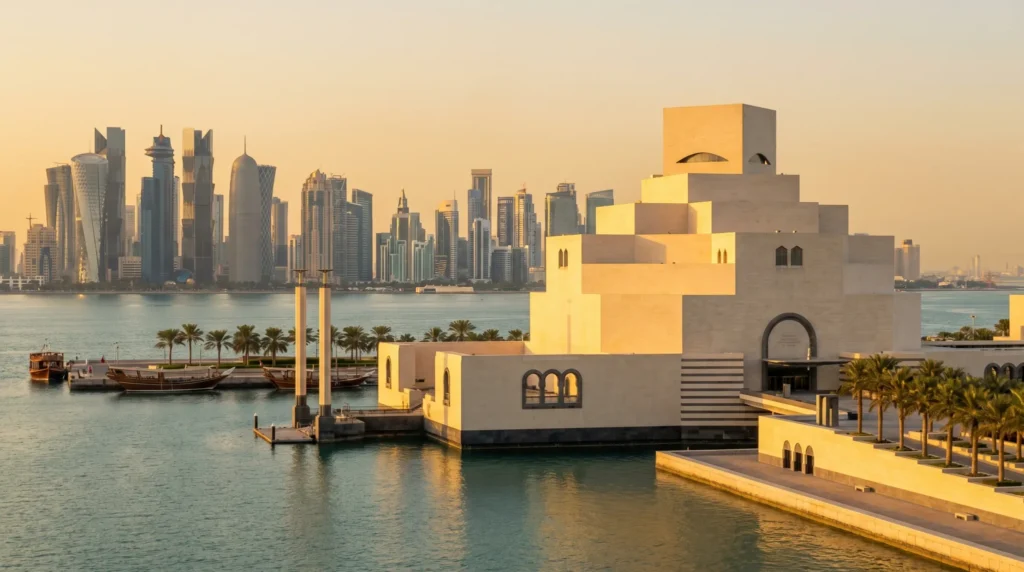
Most travellers used to see Qatar through an airport window — a six-hour layover at Hamad, a glimpse of the skyline, and on to somewhere else. The 2022 World Cup changed that, and the country worth coming back to is the one beyond the stadiums: a thumb of desert smaller than Connecticut where you can stand inside I. M. Pei’s Museum of Islamic Art at sunrise, bargain for saffron and falcons in the lantern-lit Souq Waqif by afternoon, and watch the dunes plunge straight into a turquoise inland sea at Khor Al Adaid by dusk. Qatar is compact, fast, and far less complicated than its reputation suggests — visa-free for most, walkable in its old quarters, and increasingly proud of its pearling-and-Bedouin roots rather than just its glass towers. Treat this as the brief I hand friends before they fly into Doha for more than a layover.

In This Guide
- Overview — Why Qatar Is More Than a Layover
- Qatar Winter 2026 — Desert Season & the Cool-Weather Calendar
- Best Time to Visit Qatar (Season by Season)
- Getting There — DOH Hamad International & Qatar Airways
- Getting Around — Doha Metro, Karwa Taxis & the Desert
- Top Cities & Regions
- Qatari Culture & Etiquette
- A Food Lover’s Guide to Qatar
- Off the Beaten Path
- Practical Information
- Budget Breakdown
- Planning Your First Trip to Qatar
- Frequently Asked Questions
Overview — Why Qatar Is More Than a Layover
Qatar is a small peninsula thrusting north into the Persian (Arabian) Gulf from the eastern flank of Arabia, sharing its only land border with Saudi Arabia and covering roughly 11,571 km² — smaller than the US state of Connecticut. Its population sits at around 3.1 million, but the demographics are extraordinary: Qatari citizens make up only about 10–12% of residents, with the overwhelming majority being expatriate workers from South Asia, the wider Arab world and beyond. Nearly the entire population lives in or around the capital, Doha, on the central east coast — making this one of the most urbanised countries on Earth. The land itself is flat, low desert; the highest point, Qurayn Abu al Bawl, reaches just 103 m.
The first story Qatar tells is transformation. Within living memory this was a poor British protectorate of pearl divers and fishermen; the collapse of the natural-pearl market in the 1930s and then independence from Britain in 1971 reshaped it, but it was natural gas that rewrote the country. Qatar sits atop the North Field, the largest single non-associated natural-gas field in the world, shared with Iran, and is among the planet’s top exporters of liquefied natural gas — the engine behind one of the highest GDPs per capita anywhere. That wealth funds the skyline of West Bay, the artificial island of The Pearl, and a cultural building programme unmatched in the Gulf.
The second story is the deliberate pivot to culture and tourism. Qatar hosted the 2022 FIFA World Cup — the first in the Arab world — and used it to fast-track a metro, hotels and stadiums; since then it has leaned hard into museums and heritage. The Museum of Islamic Art, designed by I. M. Pei and opened in 2008, anchors a cultural district that now includes the dune-inspired National Museum of Qatar (Jean Nouvel, 2019) and the gallery complex of Mathaf. Tourism arrivals hit roughly 5.08 million in 2024, a record, as the country pushes to diversify away from hydrocarbons.
Practically, Qatar in 2026 is one of the easiest Gulf states to visit. Citizens of around 95 countries enter visa-free or with a free visa-on-arrival for stays of 30 to 90 days , the riyal is pegged to the US dollar at 3.64, and English is near-universal in Doha. The 2017–2021 blockade by neighbouring Gulf states, which closed the only land border and regional airspace, ended with the Al-Ula reconciliation agreement in January 2021, and regional travel links have fully reopened. For the visitor, that means a compact, safe, well-connected country where a long weekend genuinely scratches the surface.

Qatar Winter 2026 — Desert Season & the Cool-Weather Calendar
If there is one window to build a trip around, it is the Qatari winter — roughly November through March, when the punishing summer heat breaks back to a comfortable 18–26°C and the whole country moves outdoors. This is desert-camping season, when the dunes of the south are dotted with tented camps, the Corniche fills with evening strollers, and Doha’s calendar of festivals, sports and shopping events clusters into the cool months. It is no accident that the 2022 World Cup was played in November–December: outside winter, midday heat in Qatar can exceed 40°C with crushing humidity.
Winter is also when the signature Qatari landscape is at its best — Khor Al Adaid, the “Inland Sea” in the far south-east, where the dunes of the Arabian sands roll down to a tidal lagoon, is a designated UNESCO-recognised natural reserve and only comfortable to visit from October to April. Tour operators run dune-bashing-and-overnight trips from Doha across the cool season. Book desert camps and the marquee winter events early; this is the single most-booked window of the Qatari travel year.
- Desert season: roughly October–April, peaking December–February, when overnight desert camping at the Inland Sea is comfortable.
- Qatar National Day: 18 December, with a major parade along the Corniche, fireworks and heritage displays.
- Sporting winter: the cool months host top-tier tennis, cycling and the season’s marquee events at Lusail and Education City.
- Temperatures: daytime 18–26°C, cool evenings — pack a light layer for desert nights, which drop sharply.
- Ramadan note: dates shift each year on the lunar calendar; daytime dining and some hours change, so check before booking.

Best Time to Visit Qatar (Season by Season)
Winter (Nov–Mar)
The only season most travellers should consider for a first trip — and a glorious one. Daytime temperatures sit at a comfortable 18–26°C, humidity drops, and the country lives outdoors: the Corniche, the souqs, the desert camps and the festival calendar all peak now. December and January are the coolest and busiest months, with Qatar National Day on the 18th. This is also the window for Inland Sea desert camping and for outdoor sport. Book ahead — winter is high season and hotel rates rise accordingly.
Spring (Apr–May)
A shoulder window that heats up fast. April is still pleasant in the high 20s to low 30s°C, but by May daytime highs push past 38°C and humidity builds toward the summer peak. Early April is a decent value period — desert tours still run and hotel rates ease off the winter peak — but desert camping becomes uncomfortable as the month progresses. Plan indoor, air-conditioned sights (museums, malls, souqs in the cooler evenings) if you travel in late spring.
Summer (Jun–Sep)
Brutally hot. Daytime temperatures routinely exceed 40°C and can approach 50°C, with stifling Gulf humidity that makes time outdoors genuinely hazardous in the middle of the day. Qatar in summer is an indoor, air-conditioned country — malls, museums, hotel pools and aquariums — and hotel rates can be at their lowest, so it suits a city-and-museum break for travellers who don’t mind dashing between buildings. Outdoor sightseeing and desert trips are off the table until dusk.
Autumn (Oct)
The transition back to the good season. October still carries summer heat early on but cools markedly toward month-end, and by late October desert camps reopen and outdoor evenings on the Corniche become pleasant again. It can be a smart shoulder-season choice — fewer crowds than December–January and softening prices — if you target the back half of the month and keep midday plans indoors.
Shoulder-season tip: late October and early April hit the sweet spot — temperatures easing toward the comfortable mid-20s to low-30s°C and hotel rates below the December–February winter peak. If you can only travel once, aim for November or February: full desert season, mild days, and slightly thinner crowds than the National Day fortnight.
One more variable to plan around is Ramadan, the Islamic holy month whose dates move roughly eleven days earlier each year on the lunar calendar. During Ramadan, eating, drinking and smoking in public during daylight hours are off-limits for visitors as well as residents, many restaurants close until sunset, and business hours shorten — but the city also comes alive after dark with festive iftar feasts and a particular warmth that some travellers seek out deliberately. Whichever month you choose, build your itinerary around the heat: front-load outdoor sightseeing into the mornings and evenings, keep the midday hours for air-conditioned museums and malls, and treat any plan that involves the desert as a strictly winter affair. Get the season right and Qatar is effortless; get it wrong and the heat will dictate your entire trip.
Getting There — DOH Hamad International & Qatar Airways
Qatar has one passenger gateway, but it is one of the best in the world: Hamad International Airport (DOH), about 15 km from central Doha, is the hub of Qatar Airways and has been repeatedly ranked the world’s best airport by Skytrax. Because Qatar Airways connects six continents through Doha, the country is unusually easy to reach — and easy to fold into a longer trip via a free or cheap stopover. Just passing through? Our Doha layover guide maps out what you can realistically see in 6, 8 or 12 hours.
- Hamad International (DOH) — the sole international airport, a vast modern hub with the famous “Lamp Bear” sculpture, indoor gardens and a water feature; the Doha Metro Red Line connects it directly to the city.
- Qatar Airways hub — the national carrier flies to roughly 170 destinations worldwide, making Doha one of the most connected single-airport cities on Earth.
- Stopover programme — Qatar Airways offers a discounted Doha stopover (often a low-cost hotel night) for transit passengers, an easy way to see the country en route elsewhere. Our step-by-step Qatar Airways stopover guide explains how to add one to four Doha nights to your ticket.
Flight times: Dubai–Doha about 1h, most of the Gulf and the Levant under 3h, London–Doha around 6h 45min direct, Singapore–Doha about 8h, New York–Doha around 12–13h direct. Qatar Airways runs nonstops to all of these.
Visa / entry: citizens of around 95 countries — including the EU, UK, US, Canada, Australia and the Gulf states — can enter visa-free or with a free visa-on-arrival valid for 30 to 90 days depending on nationality; the entry is granted on arrival with no pre-application for most. Passports should be valid for at least six months.
Getting Around — Doha Metro, Karwa Taxis & the Desert
Qatar is small and Doha is compact, so getting around is straightforward — the country built a gleaming driverless metro for the World Cup, taxis and ride-hailing are cheap, and the only place you genuinely need a guide or 4×4 is the desert. Almost everything a visitor wants is in or near Doha, within a short metro ride or taxi hop.
- Doha Metro: three driverless lines (Red, Green, Gold) opened in 2019, clean, fast and air-conditioned, linking the airport, West Bay, Msheireb, Education City and Lusail; pay with a rechargeable Travel Card.
- Metrolink feeder buses: free electric shuttle buses connect metro stations to nearby districts, malls and the souq, extending the network’s reach.
- Karwa taxis: the metered turquoise national taxi fleet is reliable and cheap; book via the Karwa app or hail at hotels and malls.
- Ride-hailing: Uber and the local Careem both operate across Doha and are convenient for late-night or door-to-door trips.
Desert & the Inland Sea: reaching Khor Al Adaid and the southern dunes requires a high-clearance 4×4 with an experienced driver — do not attempt the soft sand in a rental car. Book a guided dune tour or overnight camp from Doha.
Self-drive: Qataris drive on the right; car rental is inexpensive and roads are excellent and well-signed in English, which makes day-trips to Al Khor, Zubarah or the camel-racing tracks easy — but Doha traffic and aggressive driving take getting used to.
Walking & water taxis: the Corniche, Msheireb Downtown, Katara and The Pearl are all walkable, and traditional dhow boats offer short cruises across Doha Bay for skyline views.
Top Cities & Regions
📍 Map of Qatar: Every Place in This Guide


Doha — The Capital
Effectively the whole show: home to the overwhelming majority of Qatar’s population, Doha packs the country’s skyline, museums, souqs and waterfront into one fast-modernising city on the Gulf. Start with our full Doha city guide — this is the base for almost every Qatar itinerary, and everything below is within a short metro ride or taxi hop of the centre.
- The Museum of Islamic Art (I. M. Pei, 2008) on its own island, with one of the world’s great Islamic art collections and an MIA Park behind it.
- Souq Waqif — the restored heart of old Doha, a warren of alleys selling spices, textiles, falcons and Qatari food.
- The Corniche, the dhow harbour, the Msheireb Downtown smart-city district and the National Museum of Qatar (Jean Nouvel, 2019).
Signature eats: machboos (spiced rice with meat), grilled hammour from the Gulf, karak chai by the cup, and a Souq Waqif breakfast of balaleet and chebab.
Katara & The Pearl — The Cultural Coast
North of West Bay, the Cultural Village of Katara gathers an amphitheatre, galleries, a mosque clad in Persian tiles and a strip of restaurants along its own beach, while the adjacent artificial island of The Pearl-Qatar offers a Mediterranean-style marina of yachts, cafés and luxury retail. Together they are Doha’s leisure-and-culture quarter.
- Katara Cultural Village — the Greek-style amphitheatre, the Blue Mosque and the Gold Mosque, and the seasonal events programme.
- The Pearl-Qatar — the Porto Arabia marina, Qanat Quartier’s Venetian canals, and waterfront dining.
- Both are an easy taxi or Metro-plus-feeder-bus ride from central Doha.
Lusail & Education City — The New Districts
Lusail, the planned city just north of Doha, hosted the 2022 World Cup final at the gold-latticed Lusail Stadium and is now a district of marinas, boulevards and towers; Education City to the west gathers branch campuses of world universities alongside the Mathaf modern-art museum and the National Library.
- Lusail Stadium and the Lusail Boulevard, plus the Place Vendôme mall.
- Education City — the Qatar National Library (OMA), Mathaf: Arab Museum of Modern Art, and the Oxygen Park.
- Both are on the Metro, making them easy half-day additions to a Doha trip.
Al Zubarah — The UNESCO Pearling Town
On the remote north-west coast, Al Zubarah is Qatar’s only UNESCO World Heritage Site (inscribed 2013) — the excavated remains of an 18th–19th-century pearling and trading town, one of the best-preserved examples of a Gulf merchant settlement, anchored by a restored fort housing a visitor centre. It is a long but rewarding day-trip from Doha.
- The Al Zubarah Fort (1938) and the archaeological site of the walled town behind it.
- A window onto the pearling economy that sustained Qatar before oil and gas.
- Best combined with the camel-racing track at Al Shahaniya on the drive back.
Khor Al Adaid — The Inland Sea
In the far south-east, the dunes of the Arabian sands roll right down to a tidal lagoon connected to the Gulf — Khor Al Adaid, the “Inland Sea,” a UNESCO-recognised natural reserve reachable only by 4×4 across the dunes. It is the country’s signature natural landscape and the highlight of any winter desert trip.
- Overnight desert camps with dune-bashing, sandboarding and stargazing (Oct–Apr).
- The dramatic meeting of high dunes and tidal lagoon near the Saudi border.
- Accessible only with a guided 4×4 tour — never self-drive the soft sand.
Al Khor & the North
The northern town of Al Khor, once a pearling and fishing centre, anchors a coast of mangroves, dhow harbours and the Purple Island (Bin Ghanim), while the wider north holds the camel-racing track and quiet beaches away from Doha’s crowds.
- The Al Khor mangroves and Purple Island, named for the ancient purple-dye industry.
- Al Thakira mangrove kayaking, a rare patch of green in the desert country.
- An easy contrast to Doha’s skyline — old Gulf fishing life within an hour of the capital.
Qatari Culture & Etiquette — What to Know Before You Go
Qatari public life turns on Islam, family and a deep pride in Bedouin and pearling heritage. The country is a conservative Muslim society where Arabic is the official language and Islam shapes the rhythm of the day, yet it is also one of the most internationalised places on Earth, with expatriates from over a hundred nations and English spoken almost everywhere. Falconry, pearl diving and Bedouin hospitality are celebrated as living heritage — falconry was inscribed by UNESCO as a shared living human heritage in 2010 — and visitors who show a little cultural awareness are met with genuine warmth.

The Essentials
- Dress modestly in public — shoulders and knees covered for both men and women; swimwear is fine at hotel pools and private beaches but not in the city.
- Alcohol is served only in licensed hotel bars and restaurants; it is illegal to drink or be drunk in public, and you cannot buy it in shops without a residents’ permit.
- Avoid public displays of affection; same-sex relationships are criminalised, so discretion is advised.
- During Ramadan, do not eat, drink or smoke in public during daylight hours; many restaurants close until sunset.
- Ask before photographing people, especially Qatari women, and avoid photographing government or military sites.
Hospitality, Faith & Heritage
- Qatari hospitality centres on the majlis (sitting room) and on coffee — gahwa, lightly roasted and cardamom-spiced, served from a dallah pot in small handleless cups.
- The right hand is used for eating, greeting and giving; the left is considered unclean.
- Friday is the holy day; the working week runs Sunday to Thursday, and some sights and souqs open later on Friday mornings.
- Pearling and falconry are sources of national pride — the Souq Waqif falcon souq and the dhow-building yards keep these traditions visibly alive.
- Mosques are working places of worship — dress conservatively, remove shoes where indicated, and avoid visiting during the five daily prayers unless you are there to pray.
For all its conservatism, day-to-day Qatar is relaxed and welcoming toward visitors who make a modest effort. Western dress is common in the malls and hotels, the expatriate majority means English is everywhere, and locals are far more likely to be quietly delighted by a tourist attempting a few words of Arabic than offended by an honest mistake. The lines worth not crossing are clear and few — public drunkenness, public affection, immodest dress at religious sites, and disrespect toward Islam or the ruling family — and staying on the right side of them is simply a matter of common courtesy. Get those basics right and the famous Gulf hospitality opens up fast: an offered cup of cardamom coffee, a plate of dates, a conversation in a souq café that ends with directions to a restaurant only locals know.
A Food Lover’s Guide to Qatar
Qatari food is Gulf cooking at its most welcoming — built on rice, fish from the Arabian Gulf, slow-spiced meats, dates and the ever-present cardamom — and layered over it is one of the most diverse restaurant scenes in the region, courtesy of the country’s huge expatriate population. You can eat fiery Indian thalis, Lebanese mezze, Persian kebabs and Filipino home cooking within a block of each other, then sit down to a traditional Qatari machboos in a Souq Waqif courtyard. The good news for travellers is the range of price points: a karak chai and a shawarma cost a couple of riyals, while Doha also hosts a growing roster of celebrity-chef fine dining.

Must-Try Dishes
| Dish | Description |
|---|---|
| Machboos / Majboos (مجبوس) | The Qatari national dish — fragrant basmati rice slow-cooked with chicken, lamb or fish, loomi (dried black lime), cardamom, saffron and a blend of Gulf spices (bzar), traditionally served from a shared platter. |
| Hammour | The prized Gulf grouper, grilled or fried and served simply with rice and lemon; the backbone of Qatari seafood, alongside Gulf prawns and kingfish. |
| Balaleet & Chebab | Classic breakfasts — balaleet, sweet vermicelli with cardamom and a savoury omelette on top; and chebab, saffron-and-cardamom pancakes eaten with cheese or date syrup. |
| Harees & Thareed | Harees, a smooth porridge of wheat and slow-cooked meat especially popular during Ramadan; and thareed, a stew of meat and vegetables ladled over torn flatbread. |
| Luqaimat & Dates | Luqaimat — golden deep-fried dough dumplings drizzled with date syrup (dibs) and sesame; served with dates and the cardamom coffee that ends every Qatari meal. |
| Karak Chai | The unofficial national drink — strong black tea boiled with evaporated milk, sugar and cardamom, sold from roadside stalls for a riyal or two and drunk at all hours. |
Coffee, Dates & the Majlis
You cannot separate Qatari hospitality from gahwa, the lightly roasted, cardamom-scented Arabic coffee poured from a long-spouted dallah into small handleless finjan cups, always served with dates. Refusing is impolite; gently shaking the empty cup signals you have had enough. Arabic coffee culture across the Gulf was inscribed by UNESCO as intangible heritage in 2015.
- Order machboos at least once in a traditional Souq Waqif restaurant — it is the dish that defines the country’s table.
- Karak chai is the cheapest and most authentic thing you can drink in Qatar; find a roadside stall, not a hotel.
- No alcohol is sold in shops; licensed hotel bars and restaurants serve it, and tipping (around 10%) is appreciated but not obligatory where service is already added.
Beyond the traditional Qatari table, Doha has quietly become one of the Gulf’s most interesting eating cities. The expatriate population has seeded entire neighbourhoods of authentic South Asian, Levantine, Persian, Turkish and East African cooking — the budget end of which is some of the best-value food anywhere in the region — while the high end now draws international names to The Pearl, West Bay and the museum restaurants, including the celebrated rooftop dining above the Museum of Islamic Art. For the most memorable meal, though, skip the towers and head to a Souq Waqif courtyard at dusk: order machboos and grilled hammour, finish with luqaimat and cardamom coffee, and watch the old market fill up around you as the heat lifts and the lanterns come on.
Off the Beaten Path — Qatar Beyond Doha

Khor Al Adaid — The Inland Sea
The single most extraordinary natural sight in Qatar, where the dunes of the Arabian sands meet a tidal lagoon connected to the Gulf, deep in the south-east near the Saudi border. It is a UNESCO-recognised natural reserve reachable only by 4×4, and overnight camps here — dune-bashing in, dinner under the stars, sunrise over the lagoon — are the country’s defining outdoor experience.
Al Zubarah — The Ruined Pearling City
On the empty north-west coast, the excavated 18th–19th-century town of Al Zubarah is Qatar’s only UNESCO World Heritage Site, a rare survival of a Gulf pearling and trading settlement, with its restored fort now a visitor centre. Few tourists make the drive, which is exactly why it rewards — you often have the windblown ruins and the long Gulf horizon to yourself.
The Camel-Racing Track at Al Shahaniya
Inland on the road west, the Al Shahaniya track hosts traditional camel racing through the winter, now run with robot jockeys radio-controlled from 4×4s that race alongside the track. It is a surreal, deeply local spectacle — free to watch, and a window onto a Bedouin sport that predates the oil age by centuries.
Purple Island & the Al Khor Mangroves
An hour north of Doha, the mangroves at Al Thakira and the tidal islet known as Purple Island offer a rare patch of green — named for the ancient Phoenician-era purple-dye industry whose shell middens still litter the site. Kayaking through the mangrove channels at high tide is one of the few genuinely outdoorsy things to do near the capital, and a complete contrast to the desert and the skyline.
Zekreet & the Film City
On the empty west coast near Dukhan, the Zekreet peninsula holds wind-carved limestone mesas, the abandoned mock-village known as “Film City,” and Richard Serra’s monumental land-art installation “East-West/West-East,” four steel plates rising from the desert. It is a long, lonely drive over rough tracks, and one of the most atmospheric corners of the whole peninsula for those with a 4×4 and time.
Banana Island & the Coast
For a softer escape, the crescent-shaped Banana Island resort, reached by a short ferry from Doha, offers a Maldives-style day of overwater villas, calm swimming and beach time without leaving the country. Combined with the dhow harbours of Al Wakrah to the south — a restored old fishing souq on the water — it shows the gentler, seafaring side of Qatar beyond Doha’s towers.
Practical Information
Qatar is one of the most logistically painless countries in the Gulf for visitors — a stable, dollar-pegged currency, near-universal English, excellent infrastructure and very low crime mean most of the friction of travel simply isn’t here. The few things worth knowing in advance are the local laws around alcohol and behaviour, the seasonal heat, and the practicalities of plugs, SIMs and tipping. The table below covers the essentials at a glance.
| Currency | Qatari riyal (﷼ / QAR), pegged to the US dollar at 3.64 QAR = 1 USD. Cards and contactless are accepted almost everywhere in Doha; carry small riyal notes for karak stalls, taxis and the souq. |
| Cash needs | Minimal in the city — Doha is largely cashless — but useful for roadside karak, souq haggling and desert-tour tips. A small float of QAR notes covers the day. |
| ATMs | Plentiful in Doha (QNB, Doha Bank, Commercial Bank) and accept foreign Visa and Mastercard; far fewer outside the capital, so withdraw before heading to Al Zubarah or the desert. |
| Tipping | Not obligatory — many restaurants add a service charge — but around 10% is appreciated in restaurants, and rounding up for taxis and tipping desert-tour drivers and hotel staff is customary. |
| Language | Arabic is the official language; English is near-universal in business, hotels, signage and among the expatriate majority, so visitors rarely face a language barrier. |
| Safety | Qatar has very low crime and is consistently ranked among the safest countries in the world for visitors, including solo and female travellers. Respect local laws on alcohol, dress and public behaviour, and the main practical risk is the summer heat. |
| Connectivity | 4G/5G is excellent and widespread; Ooredoo and Vodafone sell tourist SIMs at the airport and in malls. Free WiFi is common in hotels, malls and the Metro. |
| Power | Type G (UK three-pin) plugs, 240V / 50Hz — UK travellers need no adaptor; US and continental-European visitors do. |
| Tap water | Desalinated and safe to drink in Doha, though many visitors prefer bottled water for taste; bottled is cheap and universally available. |
| Healthcare | Excellent modern hospitals and clinics in Doha (Hamad Medical Corporation, Sidra); carry travel insurance, as private care is costly. The emergency number is 999. |
Budget Breakdown — What Qatar Actually Costs in 2026

Budget Traveller
Qatar rewards the frugal more than its reputation suggests. Hostel and budget-hotel beds run from around QAR 120–250 a night, the Metro crosses the city for a couple of riyals, museums like MIA and the National Museum are inexpensive or free on certain days, and street food — shawarma, karak, machboos — costs a handful of riyals. Daily total: USD $60–90.
Mid-Range
Comfortable 4-star hotels (QAR 400–800 a night), sit-down meals at Souq Waqif and Katara restaurants (QAR 80–150 a head), a half-day desert tour or dhow cruise, and taxis or ride-hailing between sights. This tier buys a polished Doha city break. Daily total: USD $130–250.
Luxury
5-star and beach-resort hotels (The Pearl, Banana Island, the West Bay towers, from QAR 1,200+), fine dining at celebrity-chef restaurants, private desert camps and yacht charters, and Qatar Airways business-class arrivals. Qatar’s top end rivals Dubai’s and the experiences — a private overnight desert camp, a Museum of Islamic Art after-hours tour, a falcon-souq visit — are genuinely world-class. Daily total: USD $450+.
| Tier | Daily (USD) | Accommodation | Food | Transport |
|---|---|---|---|---|
| Budget | $60–90 | Hostel / budget hotel QAR 120–250 | QAR 40–80 (street food + karak) | Metro + bus QAR 6–15/day |
| Mid-Range | $130–250 | 4-star hotel QAR 400–800 | QAR 100–250 (restaurants) | Karwa taxis / ride-hailing |
| Luxury | $450+ | 5-star / resort QAR 1,200+ | QAR 400+ (fine dining) | Private driver + desert camp |
Planning Your First Trip to Qatar

- Pick your season first. November–March is the only sensible window for a first trip — mild days, full desert season, the festival calendar. Avoid June–September, when 40°C-plus heat confines you indoors.
- Decide layover or proper trip. A Qatar Airways stopover gives you 24–48 hours for the museums and souq; a standalone trip of 4–5 days adds a desert night, Al Zubarah and the Cultural Coast.
- Base yourself in or near Doha. Everything is within reach of the capital — West Bay for towers, Msheireb for the Metro hub, or Souq Waqif for atmosphere. You don’t need to move hotels.
- Book the desert and National Day early. Overnight Inland Sea camps and the December National Day period fill fast; reserve weeks ahead.
- Pack for modesty and aircon. Light, covering clothing for the city and mosques, a layer for fierce indoor air-conditioning and cool desert nights, and proper shoes for dunes and ruins.
The biggest mistake first-timers make is treating Qatar as a checklist of skyline photos and a single souq visit, then leaving underwhelmed. The country rewards a slower rhythm: an unhurried morning in the Museum of Islamic Art, an evening that drifts through Souq Waqif as the heat lifts, and at least one night out in the desert where the silence and the stars do the work no city can. Give it that, and a place many people only ever see from a departure lounge turns into one of the more memorable long weekends in the region.
Classic 4-Day Itinerary: Day 1 Doha old town — Souq Waqif, the Corniche, the Museum of Islamic Art · Day 2 the National Museum of Qatar, Msheireb Downtown, Katara and The Pearl · Day 3 a 4×4 desert day to Khor Al Adaid with an overnight camp · Day 4 Al Zubarah fort and the camel track on the drive, or Education City and Lusail, before departing from Hamad.
Frequently Asked Questions
Do I need a visa to visit Qatar?
Probably not. Citizens of around 95 countries — including the EU, UK, US, Canada, Australia and the Gulf states — can enter visa-free or receive a free visa-on-arrival valid for 30 to 90 days depending on nationality, granted at the airport with no advance application for most. Your passport should be valid for at least six months. Always check the current rules for your nationality before travelling.
Is Qatar safe to visit?
Yes — very. Qatar has extremely low crime and is consistently ranked among the safest countries in the world, including for solo and female travellers. The main rules to follow concern local laws, not crime: respect dress codes, the alcohol restrictions and public-behaviour norms, and treat the summer heat as the real hazard.
Can I drink alcohol in Qatar?
Yes, but only in licensed venues. Alcohol is served in hotel bars and restaurants and at some licensed leisure outlets, but it is not sold in ordinary shops, cannot be consumed in public, and being drunk in public is illegal. Importing alcohol is banned. If you want a drink, do it in a licensed hotel — and drink responsibly.
When is the best time to go?
November through March, without question. Daytime temperatures sit at a comfortable 18–26°C, the desert-camping season is open, and Doha’s festival and sports calendar peaks. December and January are the busiest months, with Qatar National Day on the 18th. Summer (June–September) sees 40°C-plus heat and is best avoided unless you plan an indoor, air-conditioned city break.
How many days do I need in Qatar?
A 24–48 hour Qatar Airways stopover covers the headline sights — the Museum of Islamic Art, Souq Waqif and the National Museum — while a standalone trip of four to five days lets you add an overnight desert camp at the Inland Sea, the UNESCO ruins of Al Zubarah and the Cultural Coast. Qatar is compact, so you rarely need to change hotels.
What should I wear in Qatar?
Dress modestly in public — shoulders and knees covered for both men and women — though Doha is relatively relaxed and you will see a range of styles. Cover up more at mosques and government buildings (women may need a headscarf), and keep swimwear to hotel pools and private beaches. Light, breathable fabrics work best, with a layer for fierce indoor air-conditioning.
Is Qatar expensive?
It can be, but it is more flexible than its reputation. Budget travellers manage on around USD $60–90 a day using the cheap Metro, street food and museum entry, while mid-range comfort runs $130–250 and luxury starts around $450. Hotels and alcohol are the main costs; transport, public sights and local food are reasonable.
How do I get to the desert and the Inland Sea?
Only with a guided 4×4 — never self-drive. Khor Al Adaid, the Inland Sea in the far south-east, is reachable solely by experienced drivers across the soft dunes, and tour operators run half-day trips and overnight camps from Doha across the cool season (October–April). An overnight camp, with dune-bashing, dinner and stargazing, is the highlight of most Qatar trips.
Ready to Explore Qatar?
Qatar rewards travellers who give it more than a layover. Come in the cool winter months, base yourself in Doha, and split your time between the museums and souqs of the city and a night out under the desert stars at the Inland Sea. Start with our Doha city guide, bargain for spices in Souq Waqif, stand inside the Museum of Islamic Art at golden hour, and let the Gulf’s most culturally ambitious country surprise you.
Explore More
More country guides you might like
Plan your trip to Qatar
The booking tools we use ourselves. FFU may earn a commission at no extra cost to you.
Plan & book your trip to Qatar
Booking through these searches supports our guides at no extra cost to you.