
Languages of Montenegro
All languages of Southern Europe →fluent beta classical · classes by phone with Maya at ranas.ai/maya
Montenegro Travel Guide — Boka Bay, Black Mountain & a 13,812 km² Country Where Adriatic Meets Alps
I have been arguing the case for Montenegro to friends thinking about the Adriatic since the year the country first became its own UN member state, and the case has only gotten easier. In a country smaller than Connecticut you can wake at 6am inside the medieval walls of Kotor with the Boka mist still on the bay, drive ninety minutes through the limestone karst behind Cetinje and have lunch at a stone tavern in the old royal capital, then keep going another two hours to stand on a 1,300-metre canyon rim at Đurđevića Tara and watch the deepest gorge in Europe drop away under your boots. My favourite Montenegro argument with travel friends is whether the wow moment of the country is the first sunset over Sveti Stefan or the first morning at Black Lake under Bobotov Kuk — I always come down on the side of Black Lake, partly because anything inside a UNESCO Natural World Heritage Site at 1,416 metres deserves the win, and partly because the coast is the easy story. Treat this guide as the brief I would hand my own brother before his first flight into Podgorica with a tank of fuel and a head torch in his hand luggage.

In This Guide
- Overview — Why Montenegro Punches Above Its 13,812 km²
- From Crnojević Cetinje to NATO 2017 — A Pocket History
- Best Time to Visit Montenegro (Season by Season)
- Bay of Kotor Season Calendar 2026
- Getting There — TGD, TIV & the Belgrade–Bar Railway
- Getting Around — Coastal Buses, Boka Ferry & Mountain Roads
- Top Cities & Regions of Montenegro
- Montenegrin Culture & Customs
- A Food Lover’s Guide — Pršut, Vranac & Riblja Čorba
- Off the Beaten Path — Ostrog, Biogradska, Prokletije & Stari Bar
- Practical Information
- Budget Breakdown
- Planning Your First Trip to Montenegro
- Frequently Asked Questions
Overview — Why Montenegro Punches Above Its 13,812 km²
Montenegro is a small Balkan republic on the eastern Adriatic, 13,812 km² of mostly limestone wedged between Croatia, Bosnia and Herzegovina, Serbia, Kosovo, Albania and a 293.5-kilometre stretch of Adriatic coastline. Britannica places the area at 13,883 km², roughly the footprint of Connecticut or Northern Ireland, “in the west-central Balkans at the southern end of the Dinaric Alps.” Just 623,327 people lived here in January 2025 according to the Statistical Office of Montenegro figures Wikipedia summarises, making Montenegro one of the smallest UN member states by population in Europe. The administrative capital, Podgorica, sits on the Zeta plain at just 40 metres elevation and houses around 172,000 residents — about 28% of the country in a single municipality. The historic and cultural capital, Cetinje, was founded in 1482 by Ivan Crnojević on a karst plain at 650 metres and remains the country’s symbolic heart.
The first story of Montenegro is geographic compression. The country contains “high mountains in the northern part of the country, through karst segment in central and western part, to almost 300 km of a narrow coastal plain,” with 50 peaks exceeding 2,000 metres in elevation despite the entire country fitting inside a 200-kilometre square. The highest is Zla Kolata at 2,534 metres on the Albanian border, with Bobotov Kuk in Durmitor close behind at 2,523 metres. Three of the country’s signature destinations — the Bay of Kotor (a 28-kilometre ria with a 107.3-kilometre shoreline), the Tara River canyon (the deepest gorge in Europe at 1,300 metres) and Lake Skadar (the largest lake in the Balkans at 370–530 km² seasonally) — sit within a 90-minute drive of each other.
The second story is a heritage stack disproportionate to the country’s footprint. Montenegro counts four UNESCO World Heritage entries: the Natural and Culturo-Historical Region of Kotor (inscribed in 1979 under cultural criteria (i)(ii)(iii)(iv) for the harmonious gathering of monuments along the bay), Durmitor National Park (1980, inscribed for the Tara canyon and the 18 glacial lakes nicknamed “mountain eyes”), the transnational Stećci Medieval Tombstones Graveyards (2016) and the Venetian Works of Defence between the 16th and 17th Centuries — Stato da Mar (2017, including Kotor’s 4.5-kilometre walls). The country also operates five national parks (Durmitor, Lovćen, Biogradska Gora, Lake Skadar and Prokletije), one of which — Biogradska Gora — protects 16 km² of European primeval forest with trees over 500 years old, “one of the last European virgin forests” in continental Europe.
The third story is identity, and it is unusual. The country’s name in Montenegrin (Crna Gora) and in English (Montenegro) both translate to “Black Mountain,” after the dark forest cover on Mount Lovćen visible from the Bay of Kotor. Montenegro is one of only a handful of countries in Europe to use both Cyrillic and Latin alphabets in equal status, with road signs, government documents and newspapers published in both. The 2023 census recorded a population that is 71.1% Eastern Orthodox, 19.9% Muslim and 3.4% Catholic, with ethnic identification splitting 41.1% Montenegrin, 32.9% Serbian, 11.1% Bosniak, 5% Albanian, alongside Croat and Roma minorities — a layered demography that explains why the country celebrates both Orthodox Christmas (7 January) and Bajram (Eid al-Fitr) as public holidays. The country declared itself “the first ecological state in the world” in a 1991 parliamentary declaration that still appears on the National Tourism Organisation’s home page.
The fourth story is the modern political one that explains why Montenegro feels older than its 2006 independence date suggests. Montenegro voted by referendum on 21 May 2006 to leave the State Union of Serbia and Montenegro, with 55.5% of voters in favour against a 55% threshold and an 86.49% turnout — a margin of roughly 2,000 votes from failure. Independence followed on 3 June 2006, NATO accession on 5 June 2017 (as the alliance’s 29th member), and EU candidate status was confirmed on 17 December 2010 with accession negotiations ongoing through 2026. The euro has been Montenegro’s de facto currency since 2002 (it had used the Deutschmark from 1999), making it one of only a handful of European countries on the euro without being in either the Eurozone or the EU. Reuters, BBC, Politico Europe, Deutsche Welle, the Guardian, the New York Times, the Financial Times and the Balkan Insight regional desk all maintain dedicated Montenegro coverage to triangulate against.
Practically, Montenegro in 2026 is the easiest country in the western Balkans for a first-time visitor. English is fluent across coastal tourism; the entire country fits inside a 7-day rental-car loop with two pivots (one on the coast, one in the north); the tap water is safe in towns; the currency is the euro; and US, UK, EU, Canadian, Australian and New Zealand citizens enter visa-free for 90 days in any 180-day period. The 2024 tourism numbers tell the story: 2,606,854 international arrivals and 15,594,299 overnight stays, with 96.1% of overnights from foreign visitors and 93.8% staying on the coast. The World Bank put Montenegro’s 2024 GDP per capita at USD 13,263 with life expectancy of 78 years — upper-middle-income territory, the highest in the post-Yugoslav region after Slovenia. Lonely Planet has called Montenegro “Europe’s last secret on the Adriatic,” and National Geographic, Travel + Leisure, AFAR and Condé Nast Traveler all maintain dedicated Montenegro coverage with current 2026 itineraries. Pack a head torch (for Ostrog and Durmitor), microfibre travel towel (for Skadar swims), and one fleece — even a July evening at Black Lake rarely tops 14 °C.

From Crnojević Cetinje to NATO 2017 — A Pocket History of Montenegro
Montenegro’s prehistory begins on the same Adriatic limestone the Romans called Doclea — a settlement on the Zeta plain near modern Podgorica that became one of the most important Roman provincial cities on the eastern Adriatic by the 3rd century AD. The Roman town of Acruvium — modern Kotor — was first mentioned in 168 BC, and the medieval city of Risan in the inner bay had been an Illyrian capital under Queen Teuta two centuries earlier. The Slavic story begins in the 7th century AD when South Slavic tribes settled the Dinaric karst and organised, by the 10th century, into the principality of Duklja under the Vojislavljević dynasty — the first medieval polity to be recognised as a kingdom in 1077 by Pope Gregory VII.
The name “Crna Gora” — Black Mountain — first appears in the late 13th century in reference to Mount Lovćen and the dark forest belt visible from the Bay of Kotor; over the next two centuries it gradually displaced “Zeta” as the administrative term for the territory. Ivan Crnojević moved his capital from the Adriatic shore to Cetinje in 1482 to defend against Ottoman pressure, building a court and a monastery within two years and bringing the Crnojević printing house — the first printing press in the South Slavic world (1493–1496) — that produced the second book in Cyrillic ever printed. While the surrounding lowlands fell under direct Ottoman rule for nearly four centuries, the Cetinje highland operated as a de facto theocratic republic under a hereditary line of Vladika prince-bishops from the Petrović-Njegoš family — never fully conquered by the Sultan despite repeated wars.
The 19th century is the era that built modern Montenegro. Petar II Petrović-Njegoš (1813–1851) modernised the state, introduced taxation and a senate, and wrote Gorski vijenac (The Mountain Wreath, 1847), a 2,819-line philosophical epic now considered the founding work of South Slavic literary identity; per his wishes he was buried atop Mount Lovćen and his secular mausoleum at 1,657 metres was completed in 1971 and inaugurated in 1974. Montenegro was internationally recognised as an independent principality at the 1878 Treaty of Berlin after the 1876–1878 wars against the Ottoman Empire, gaining Bar, Ulcinj and a stretch of Adriatic coast for the first time in centuries. Nicholas I (1841–1921) elevated the principality to a kingdom in 1910, introduced the country’s first constitution in 1905, established the perper currency in 1906, and earned the nickname “father-in-law of Europe” by marrying his twelve children into the royal houses of Serbia, Russia and Italy.
The 20th century opens with bloodshed and a complete erasure of independence. Austria-Hungary occupied Montenegro from January 1916; in November 1918 the controversial Podgorica Assembly voted to depose Nicholas I and unite the country with the Kingdom of Serbs, Croats and Slovenes (later Yugoslavia), with the king dying in French exile in 1921 and his remains repatriated only in 1989. The Second World War saw Italian then German occupation and the Yugoslav Partisan resistance under Tito; after 1945 Montenegro became one of the six federal republics of socialist Yugoslavia, with Podgorica renamed Titograd between 1946 and 1992 in honour of the marshal. A devastating earthquake of magnitude 6.9 struck the Adriatic coast on 15 April 1979, severely damaging Kotor, Budva, Ulcinj and Stari Bar; UNESCO inscribed the Bay of Kotor that same year, immediately listing it as endangered, and led an international restoration that took the site off the danger list only in 2003.
The transition that matters for travellers is the cleanest in 20th-century European history. Montenegro avoided the worst of the 1990s Yugoslav wars while remaining inside a rump Federal Republic of Yugoslavia (then the State Union of Serbia and Montenegro from 2003); on 21 May 2006 the country voted by referendum on independence, with 55.50% of voters in favour against a deliberately high 55% threshold and a turnout of 86.49% — a margin of approximately 2,000 votes from failure. Independence was formally declared on 3 June 2006; the United Nations admitted Montenegro on 28 June 2006 as its 192nd member, and the country joined the World Trade Organization in April 2012. The country was confirmed an EU candidate on 17 December 2010 and opened accession negotiations in June 2012, with chapters still being closed through 2026. Montenegro joined NATO on 5 June 2017 as the alliance’s 29th member — a politically fraught accession that survived a foiled coup attempt during the 2016 election.
Modern Montenegro is quiet by Balkan standards and busier by global ones. The country runs a parliamentary republic with a directly elected president; political competition has been intense since 2020, when an opposition coalition ended the 30-year governing run of the Democratic Party of Socialists (the post-communist successor party). The 2023 elections produced a fragile coalition government under Prime Minister Milojko Spajić and his Europe Now movement, anchored on the EU accession agenda. Reuters, the BBC, the Guardian, the New York Times, the Financial Times and Politico Europe all maintain Montenegro coverage; the local English-language press is anchored by CDM and Vijesti, with the Center for Investigative Journalism MANS providing scrutiny on EU-track reforms.

Best Time to Visit Montenegro (Season by Season)
Montenegro is a country of three climate zones layered on top of each other: a Mediterranean coast (Köppen Csa) with hot dry summers and mild damp winters; a transitional sub-Mediterranean inland belt around Podgorica and Lake Skadar; and a continental mountain north (Köppen Dfb/Dfc) where Žabljak above 1,400 m records cold winters with serious snowfall. The result is that the same week in late June can deliver a 28 °C beach day in Budva, a 32 °C lunch in Podgorica (the wettest capital in Europe but reliably hot in summer with 1,659 mm annual rainfall) and a 14 °C alpine afternoon at Black Lake under Bobotov Kuk — all within a 130-kilometre drive. Choose your season for the activity, not the calendar.
🌸 Spring (April–May)
April and early May are the connoisseur’s window. The Adriatic begins warming through 18–22 °C by Easter; the Tara River runs at peak emerald clarity from snowmelt (the same limestone particles that give the Soča its colour); wild flowers carpet Lovćen and Durmitor; and the coastal towns are still half-empty. Sea temperatures hit 21 °C by the second half of May along Budva, Petrovac and Ulcinj — swimmable for the brave. Rafting on the Tara River, Europe’s deepest gorge, opens around 1 May with the snowmelt, and the standard one-day Brstanovica–Šćepan Polje run of 18 km takes 2–3 hours through mostly grade II–III rapids. Lake Skadar in spring is one of Europe’s great birdwatching sites — the lake hosts 270 species, including endangered Dalmatian pelicans, and the Rijeka Crnojevića river bend is at its photogenic best with morning mist. The single weakness: snow can still close the highest passes (Sedlo, Crkvine, Žabljak’s Sedlo over Durmitor) into mid-May.
☀️ Summer (June–August)
Summer is the country’s blockbuster window and the period MONSTAT records for 96.1% of foreign overnights — so go in if you accept the trade. Coastal water temperatures hit 25–27 °C from late June; daytime air rarely drops below 27 °C in Kotor, Budva and Tivat; the Adriatic islands of Mamula and Lustica draw kayakers; and the calendar fills with festivals (KotorArt in July–August, the Sea Dance Festival on Buljarica beach near Petrovac in late August, the Lake Fest at Krupac Lake near Nikšić in early August). The downside is real: peak Budva and Sveti Stefan accommodation triples in price between mid-July and 25 August; the coastal road is often gridlocked between Tivat and Petrovac in afternoons; and the karst inland — Cetinje, Podgorica, Skadar lowlands — bakes through 35–40 °C, with record highs of 44.8 °C recorded in August. The mountain north (Žabljak, Kolašin, Plužine) is the heat-escape — Black Lake at 1,416 m holds 16–20 °C in July evenings and is a 3.5-kilometre walking circuit from town.
🍂 Autumn (September–October)
September is — for our money — the single best month to visit Montenegro. The Adriatic still holds a reliably swimmable 24–25 °C through the second week of October; the coastal crowds collapse the day Italian and German schools restart; the Tara canyon turns gold in early October; and grape harvest in the Plantaže vineyards at Ćemovsko polje runs from mid-September through mid-October — Plantaže being one of the largest single vineyard estates in Europe at 2,310 hectares. The Stari Grad of Kotor is at its quietest after 16:00 in late September, when the cruise ships move on and the cats reclaim the squares. October weather is genuinely Mediterranean — 22 °C daytime in Budva, 14 °C at Black Lake — and the Durmitor larch forests turn from green to flame-orange in a fortnight. The single weakness: rafting season closes mid-October as the river drops, and Vrsič-style mountain passes start dusting with snow by month-end.
❄️ Winter (November–March)
Winter is the sleeper season. Coastal Montenegro stays mild — Kotor and Budva rarely drop below 8 °C even in January, the towns retain a working Mediterranean rhythm, and a January coffee at Tartini Square in Tivat costs about €1.80. The mountain north flips entirely: Kolašin 1450 (the country’s main ski area, 5 lifts) and Savin Kuk near Žabljak run from mid-December through late March; Black Lake freezes solid for skating in February; and Durmitor’s deep snowpack (often 1.5–2 m) anchors the country’s small but serious back-country and ski-touring scene. Christmas in Cetinje (Orthodox 7 January) is genuinely festive — the old royal capital lights up the Cetinje Monastery and the Blue Palace — and Bay of Kotor’s Boka Nights festival in late December draws regional crowds. The single weakness: short days (sunset at 16:30 in December), some coastal restaurants close for January–February, and several Adriatic islands and the Aman Sveti Stefan lease are off-limits.

Bay of Kotor Season Calendar 2026
The Bay of Kotor — Boka Kotorska in Montenegrin — is not a fjord, even though every cruise brochure on Earth keeps calling it one. It is technically a ria of the vanished Bokelj River, formed by tectonic and karst processes rather than glacial action, and at 28 kilometres long with a 107.3-kilometre shoreline it operates as four interconnected sub-bays separated by the 340-metre Verige Strait. If you have come to Montenegro for the bay (and most people do), here is the month-by-month calendar of what is actually open, swimmable, sailable and photographable inside Boka — the single piece of geography that explains why so much of Montenegro’s tourism economy lives in this 87 km² of seawater.
January–February. Quiet, mild, occasionally spectacular. Daytime air 8–13 °C; sea around 13 °C and not swimmable; cruise ships absent; old-town tavernas in Kotor open on reduced winter hours; and the locals reclaim the city walls. The Boka Nights (Bokeljska noć) festival in December and the Saint Tryphon Day (Tripundanske svečanosti) on 3 February — Kotor’s patron saint, with a traditional kolo dance in front of the cathedral — are the genuine local calendar. Photography is at its best with low winter light; the Kotor walls are climbable in 90 minutes without sweat.
March. The shoulder shoulder. Sea still 14 °C , locals start opening their boats, the first cruise ships return mid-month; almond and citrus blooms push pollen across the bay; the karst slopes above Perast turn from grey to pale green. Day-trip from Kotor to Perast (15 minutes by Boka coastal bus or 25 minutes on foot along the new bayside path) and on to the Our Lady of the Rocks islet — the only man-made island in the Adriatic, built up over five centuries by sailors dropping a stone in tribute on each return voyage.
April–May. The shoulder season’s prime. Sea climbs from 17 °C in early April to 21 °C by late May. The Kotor walls (a 1,350-step climb up the limestone slope to the San Giovanni Fortress at 280 m) are doable without heat exhaustion before 11:00. Sailing season opens; the new Kotor–Lovćen cable car (operational since 2024) lifts you 1,348 metres up to the Ivanova Korita pass on Lovćen for views over the entire bay in 11 minutes — a step-change in regional transport that has redrawn day-trips from the coast.
June. The bay turns blockbuster. Sea hits 24 °C; cruise traffic peaks (Kotor saw days of 7+ ships in 2024); the Bay of Kotor Triathlon and the KotorArt summer festival kick off; restaurants in Stari Grad require reservations 2–3 days out for dinner. The bay’s signature one-day boat circuit — Kotor → Perast → Our Lady of the Rocks → Saint George Island → Mamula Island → Blue Cave under Cape Veslo → return — runs daily from late May through early October, typically €40–55 for a small-group day with lunch.
July–August. Peak Boka. The sea sits at 26 °C; Kotor old town hits 35,000+ daily visitors at cruise peak; the Tivat marina (Porto Montenegro, with 450+ berths and superyacht traffic) is the busiest yacht harbour on the eastern Adriatic. The five-day Boka Mediterranean Festival of Theatre runs in mid-July; the Saint Tryphon Cathedral choir performs every Sunday evening in Latin and Old Church Slavonic. Sleep early and walk Kotor at 06:00 — the same UNESCO old town carries 90% fewer people at sunrise than at noon.
September–October. The recovery curve. Sea stays at 25 °C through 10 October; the cruise calendar thins to 2–3 ships a week by late September; the Saint Nicholas bell tower in Perast (55 metres, the iconic Boka silhouette) clears for unrushed climbs; and the Kotor walls open at first light without queues. The Lustica peninsula’s beach restaurants (Žanjic, Mirišta) start closing kitchens after 30 September; book a sailing day before the second week of October if you want the Blue Cave still on the menu.

Getting There — Podgorica TGD, Tivat TIV & the Belgrade–Bar Railway
Montenegro has two international airports, both run by the state-owned Airports of Montenegro (Aerodromi Crne Gore): Podgorica (IATA TGD) handles the country’s capital and inland traffic, and Tivat (TIV) sits on the Bay of Kotor and serves the Adriatic coast. TGD is 11 km south of central Podgorica and inherited its quirky three-letter code from the Titograd era (1946–1992); TIV is 6 km from Kotor and 12 km from Budva, and is the genuine summer airport for any trip anchored on the coast. A third domestic airport at Berane reopened to seasonal traffic in 2024 for the northern mountains.
The flag carrier Air Montenegro replaced the bankrupt Montenegro Airlines in 2020 and now operates a small Embraer 195 fleet from both TGD and TIV to Belgrade, Vienna, Frankfurt, Paris, Istanbul, Rome and Moscow (plus seasonal coastal additions). The bigger picture: most foreign visitors arrive on low-cost European carriers — Wizz Air, Ryanair, easyJet and Eurowings all fly seasonal routes into TIV from London Luton, Manchester, Bristol, Berlin, Cologne, Brussels, Vienna, Warsaw, Budapest and (since 2024) Paris Beauvais, with airfares dropping to as low as €25 one-way in shoulder season. Trade-off: the budget airlines fly TIV mostly seasonally — May to October — and almost none operate year-round. From November to March, your reliable scheduled options are Air Serbia (Belgrade–TGD), Lufthansa (Frankfurt–TGD), Turkish Airlines (Istanbul–TGD) and Air Montenegro itself.
Visa policy is straightforward and generous: Montenegro is NOT in the Schengen Area and NOT in the EU, but US, UK, EU/EEA, Canadian, Australian, New Zealand, Japanese, South Korean, Singaporean, Israeli and most Latin American passport holders enter visa-free for 90 days in any 180-day period. Passport must be valid at entry; one blank page; no vaccination requirements. All visitors must register their stay with the police within 24 hours of arrival; if you stay in a hotel or registered apartment, the property does this automatically — only Airbnb hosts in unregistered units occasionally miss it. Currency over €10,000 must be declared on entry. The UK FCDO maintains a Level 1 (See Our Travel Advice) bulletin and notes occasional protest disruption around Podgorica Airport in the Zeta municipality.
The Belgrade–Bar railway is the great regional alternative for traffic from the Balkans and points east, and a journey worth taking in its own right. The 476.59-kilometre line crosses 254 tunnels and over 435 bridges between the Serbian capital and Montenegro’s main port of Bar, climbing to 1,032 metres near Kolašin before dropping to the Adriatic on a 25-permil gradient — Yugoslavia’s most expensive infrastructure project, opened in 1976 after 25 years of construction. The current journey takes about 11 hours due to track-condition speed restrictions on the Serbian sections (in places limited to 30 km/h); the Montenegrin half allows 50–80 km/h. Tickets cost roughly €25 in second class; sleeper berths add €12–18; book at the Železnice Crne Gore site or in person at Bar/Podgorica/Bijelo Polje stations. The Mojkovac–Kolašin–Podgorica final descent is one of the great train rides in Europe — better than anything between Switzerland and Norway, in our view.
By road, Montenegro borders five countries with passport-free crossings (Croatia at Debeli Brijeg/Karasovići near Herceg Novi; BiH at Vraćenovići and Šćepan Polje; Serbia at Dobrakovo near Bijelo Polje; Kosovo at Kulina near Rožaje; Albania at Sukobin near Ulcinj and Božaj south of Podgorica). The first stretch of motorway — Smokovac–Mateševo, 41 km of the Bar–Boljare highway, opened in 2022 — connects Podgorica to Kolašin in 30 minutes, replacing a 2-hour mountain road. No vignette is required (unlike Slovenia, Switzerland or Austria); standard motorway tolls apply on the Smokovac–Mateševo section (€3.50 for cars). The Croatian crossing at Debeli Brijeg, north of Herceg Novi, is the busiest summer entry point — expect 1–2 hour delays from late June through August.
By ferry, the Adriatic crossings are seasonal: Jadrolinija and Adria Ferries run summer routes from Bari and Ancona in Italy to Bar (12-hour overnight); from May to October there’s also the Kotor–Lustica peninsula coastal launch service. By bus, the Montenegro Lines and Eurolines coaches link Podgorica to Belgrade (8–10 h, €25–35), Sarajevo (7 h, €22), Pristina (7 h, €25), Tirana (4 h, €15) and Dubrovnik (3 h, €18 — a popular day-trip return).
Getting Around — Coastal Buses, Boka Ferry & Mountain Roads
Montenegro’s domestic transport ecosystem reflects its compact size: nothing is more than 4 hours away by road from anything else, and a rental car covers the whole country in two practical pivots. A foreign driver should know two things up front: Montenegro drives on the right with international rules; and the road network is fundamentally a single coastal artery (the magistrala E65/E80 from Herceg Novi to Ulcinj) plus three mountain spokes inland to Podgorica, Cetinje–Lovćen and Žabljak/Durmitor. Outside the new Smokovac–Mateševo motorway section, expect single-carriageway two-lane roads with serious switchbacks, occasional landslide closures in winter, and a very Mediterranean attitude to overtaking.
Rental cars. The pragmatic default for any trip beyond Kotor day-trip range. Hertz, Avis, Sixt, Europcar, Enterprise/National and the locally strong Meridian Rent-A-Car all operate at TGD and TIV, with mid-range compacts (Renault Clio, Hyundai i20) running €25–45 per day in shoulder season and €60–90 in peak August. Manuals dominate; automatics cost a 30–50% premium and need 60-day pre-booking. Most rentals come with a green-card insurance extension valid for Croatia, Serbia, BiH and Albania (verify the contract — Kosovo is sometimes excluded). Petrol runs roughly €1.45–1.55 per litre at Jugopetrol, Lukoil and Eko stations; diesel €1.30–1.45.
Buses. The country’s main public-transport spine. Eurolines, Mediteran Express, Olimpia and Crnatrans run reliable scheduled coaches between Podgorica and every major town — Podgorica–Kotor 2.5 h €8, Podgorica–Budva 1.5 h €6, Podgorica–Žabljak 4 h €13, Podgorica–Ulcinj 1.75 h €7. Buy at the bus station the same day; reservations are rarely needed off-peak. The Adriatic coast bus along the magistrala (Herceg Novi–Tivat–Kotor–Budva–Bar–Ulcinj) runs every 30–60 minutes through summer and is the practical alternative to a rental for a coastal-only trip.
The Verige (Kamenari–Lepetane) ferry. The Bay of Kotor has a single decisive shortcut: the Kamenari–Lepetane vehicle ferry across the 340-metre Verige Strait, which saves 25 km and roughly 35 minutes versus driving the bay’s outer rim. Operated by Pomorski Saobraćaj, the ferry runs every 15–20 minutes around the clock; cars €4.50, foot passengers €1, motorbikes €2 (2026 tariffs), no booking needed. Use it any time you are heading from Herceg Novi or Lustica to Tivat or Budva, and skip the slow back-of-bay route in summer.
Trains. Montenegrin Railways (Železnica Crne Gore, ZCG) operates one main route — the Bar–Podgorica–Kolašin–Mojkovac–Bijelo Polje (continuing as the Belgrade–Bar line into Serbia) — and one branch to Nikšić from Podgorica. The Bar–Podgorica run is 56 km and takes 60 minutes for €4.40 second class — a charming, slow, scenic alternative to the bus. The Podgorica–Kolašin section, which climbs to the Mateševo plateau through serial tunnels, is the showpiece — €5 for a 2.5-hour mountain ride. Don’t expect frequency or punctuality of Western European standard: 2–4 daily trains, often 30–60 minutes late.
The new Kotor–Lovćen cable car. A genuine 2024 transport upgrade. The 11-minute, 3.9-kilometre cable car climbs from Dub above Kotor to the Kuk station on the Lovćen plateau at 1,348 metres, opening up a same-day Lovćen visit (and the Njegoš Mausoleum at 1,657 m) without the 25-bend mountain road. Tickets €23 round-trip; runs daily 08:00–20:00 in summer, reduced to 09:00–17:00 in winter. The cable car has restructured the day-trip economics of the entire region — a sunrise climb of Kotor’s walls, lunch at Cetinje after the cable car up, and the Lovćen mausoleum in the afternoon is now a single-day itinerary.
Taxi and ride-hail. Bolt operates in Podgorica, Tivat, Kotor, Budva and Bar, and is reliably 30–50% cheaper than street taxis. Uber is not present. Local taxis are metered in Podgorica (starting €1.10, €0.80/km); flag-down rates on the coast are negotiable but widely overcharged in tourist months — always agree the price before getting in. The Bolt prices for Tivat–Kotor are typically €13–18 versus €20–30 for street taxis in summer.
Ferries to islands. Day-boat services run from Kotor and Tivat to Our Lady of the Rocks (€5–8 round trip; included in most bay tours), and from Herceg Novi or Đenovići to the Lustica peninsula (€10–20). The Aman Sveti Stefan tombolo bridge is currently closed to non-guests pending the resort’s reopening.

Top Cities & Regions of Montenegro
📍 Map of Montenegro: Every Place in This Guide
Montenegro is small enough that you can credibly visit eight different “regions” in a single seven-day rental-car loop. Population centres are concentrated on the coast and around Podgorica; the cultural heart is in Cetinje; and the wild interior — Durmitor, Biogradska Gora, Prokletije, Lake Skadar — is where the country earns its UNESCO and national-park reputations. The eight headline destinations below cover roughly 95% of why first-time visitors come.
Kotor — UNESCO Bay & the 1,350-Step Wall
Kotor is the country’s signature image and its UNESCO anchor. The medieval town sits at the head of the inner Bay of Kotor with 4.5 kilometres of fortified walls climbing the limestone slope of Mount Lovćen up to the San Giovanni Fortress at 280 metres altitude — a 1,350-step ascent that is the country’s best-known walk. First mentioned as the Roman Acruvium in 168 BC, the city centre is dominated by Saint Tryphon’s Cathedral (1166), the Romanesque-Gothic core that survived the 1979 earthquake and has been progressively restored under the UNESCO 1979 inscription. Population is just 13,347 in the urban area (21,916 municipality), but 250,000+ annual visitors pass through the walls. The 2024 Kotor–Lovćen cable car has redrawn the day-trip map: 11 minutes to the plateau replaces a 90-minute mountain drive. Stay overnight inside the walls if you can; the Stari Grad after the cruise ships leave is the city Lord Byron called “the most beautiful encounter between land and sea.”

Budva & Sveti Stefan — Old Town and the Aman Tombolo
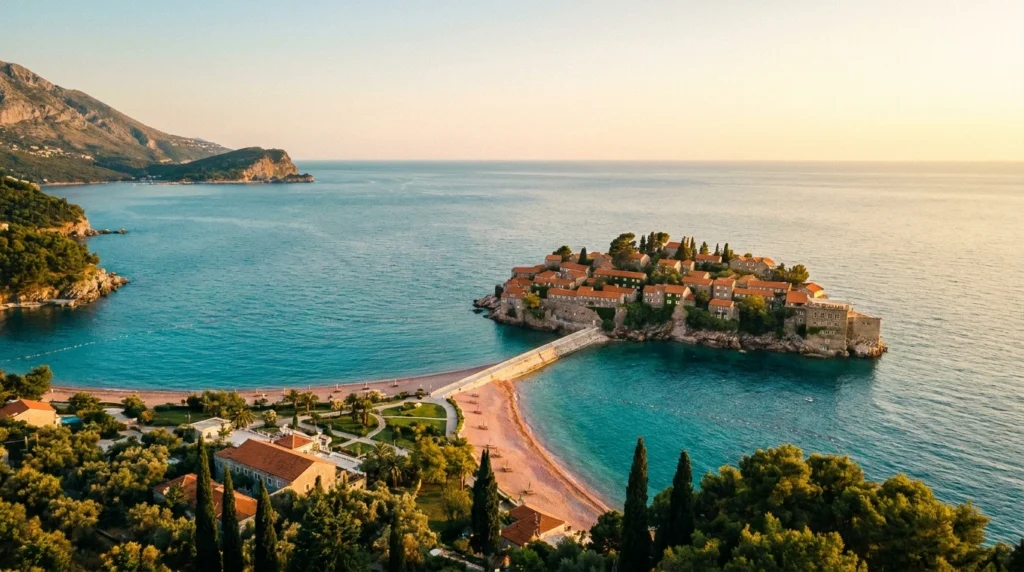
Budva is Montenegro’s tourism capital, with 17,479 urban residents and a 2,500-year-old Old Town first documented in the 5th century BC under Illyrian, then Greek, then Roman, then Venetian (1420–1797), then Habsburg control. The Stari Grad’s medieval walls, four squares (each anchored by a different church — St Ivan from the 17th century, Santa Maria in Punta from 840 AD, St Sava from the 12th and Holy Trinity from 1804) and the Mediterranean evening atmosphere absorb the bulk of the country’s coastal tourism revenue. Budva’s beaches stretch from the 1.6-kilometre Slovenska Plaža around the headland to Mogren and Jaz; the resort tomographically extends 6 km southeast to the iconic island village of Sveti Stefan, 12,400 m² of fortified medieval houses converted by Aman Resorts into a 51-room luxury hotel under a 30-year lease that opened in 2009. The Aman has been closed since early 2020 due to COVID and a contractual dispute with the Montenegrin government — at the time of writing in May 2026 the resort remains closed with no announced reopening; the iconic island is still the country’s most photographed silhouette from the viewpoint at Hotel Adrović on the main road.

Cetinje — The Old Royal Capital on a Karst Plain
Cetinje is the country’s symbolic and cultural capital and the place every Montenegro itinerary should pause for at least half a day. Founded in 1482 by Ivan Crnojević on a karst plain at 650 metres elevation, the town houses just 12,460 residents but contains a disproportionate share of the country’s cultural infrastructure: the Cetinje Monastery (rebuilt 1701, holding the relic of John the Baptist’s right hand and a fragment of the True Cross), the Blue Palace (presidential residence), the National Museum of Montenegro, the State Archives and the Crnojević printing house — site of the second printing press ever to operate in the South Slavic world (1493–1496). Cetinje is also one of the rainiest towns in Europe, recording around 3,300 mm of annual precipitation due to its karst-plain microclimate trapped under Mount Lovćen — bring waterproofs even in June. The town is a 30-minute drive from Podgorica, 45 minutes from Budva, and 90 minutes from Kotor (or 11 minutes via the new Kotor–Lovćen cable car plus a 20-minute drive).
Podgorica — The Capital on the Zeta Plain
Podgorica is Montenegro’s administrative capital and largest city, with 172,139 urban residents (179,505 metropolitan) and an elevation of just 40 metres in the Zeta River valley between Lake Skadar and the foothills of the Dinaric Alps. Reaffirmed as capital in 2006, the city was renamed Titograd in 1946 in honour of Marshal Tito and reverted to Podgorica after a 2 April 1992 referendum during the Yugoslav breakup. Travellers tend to undersell Podgorica because most arrive only to fly out — but the city’s Stara Varoš Ottoman quarter, the Saborni Hram Hristovog Vaskrsenja cathedral (consecrated 2013, the largest Orthodox church in the country), the Niagara Falls of the Cijevna river 10 km east of the centre, and the Plantaže winery vineyards at Ćemovsko polje 8 km southeast all reward a 24-hour stop. Podgorica is officially the wettest capital city in Europe (1,659 mm annual rainfall, mostly in winter), but summer is reliably hot and dry — record highs of 44.8 °C in August.
Durmitor National Park — UNESCO & Tara Canyon
Durmitor is the country’s wild northern showpiece: a 390 km² UNESCO World Heritage Site (inscribed 1980) protecting 48 peaks above 2,000 metres, 18 glacial lakes nicknamed the “mountain eyes,” and the deepest gorge in Europe — the Tara River canyon at 1,300 metres deep and 78 kilometres long. The park’s tourism centre is the small mountain town of Žabljak (population 2,500, elevation 1,456 m — the highest town in the Balkans), 3 km from Black Lake (Crno jezero), the most-visited natural attraction in the country and the headwaters circuit for any Durmitor day-trip. Bobotov Kuk (2,523 m), Durmitor’s highest summit, is a serious 10-hour round-trip from Žabljak best done with a guide and at first light. The Đurđevića Tara Bridge (365 m long, 172 m above the river, opened 1940 and at completion the largest concrete arch bridge in Europe) carries the road across the canyon and now also operates a 1,050-metre zipline for the brave.
Lake Skadar — The Largest Lake in the Balkans
Lake Skadar straddles the Montenegro–Albania border and ranks as the largest lake in the Balkan Peninsula by surface area, ranging seasonally from 370 km² in summer to 530 km² in winter (with roughly 65% in Montenegro and 35% in Albania). The Montenegrin portion has been a national park since 1983 (and the Albanian section a Ramsar wetland reserve since 1995). The lake is one of Europe’s most important bird habitats, supporting 270 species including the largest breeding colony of the endangered Dalmatian pelican on the continent, alongside 34 native fish species (7 endemic) — and it sits at just 6 metres above sea level with an average depth of 5 metres and a maximum of 8.3 metres. The two anchor settlements are Virpazar on the northern shore (the boat-tour hub, 25 km from Podgorica on the train line) and Rijeka Crnojevića at the iconic horseshoe river bend — one of Montenegro’s most photographed landscapes and the original capital of Ivan Crnojević before the 1482 move to Cetinje.

Lovćen National Park — The Black Mountain & Njegoš Mausoleum
Lovćen is the country’s namesake — both Crna Gora and Montenegro translate to “Black Mountain” — and a 62.20 km² national park established in 1952. The massif has two principal peaks (Štirovnik 1,749 m and Jezerski Vrh 1,657 m) and is most famous for the mausoleum of Petar II Petrović-Njegoš at the summit of Jezerski Vrh — the highest mausoleum in the world, built per Njegoš’s wishes and completed in 1971 (inaugurated 1974), reached by a 461-step tunnel-and-staircase climb from the parking area. Below the mausoleum the Njeguši village (the birthplace of the Petrović royal dynasty) preserves the country’s signature stone-house architecture and produces the country’s most famous food product — Njeguški pršut — under tightly regulated traditional methods.
Ulcinj — Long Beach & the Albanian-Cultural South
Ulcinj is the southernmost town on Montenegro’s coast, a 25-kilometre drive from the Albanian border at Sukobin, and the cultural capital of the country’s Albanian Muslim community — Albanians make up roughly 70% of the municipality and the call to prayer rather than church bells punctuates the day. The town’s signature draw is Velika Plaža (Long Beach) — a 12-kilometre arc of pale sand backed by pine forest and salt pans, the longest beach on the Montenegrin coast and one of the longest continuous sand beaches anywhere on the eastern Adriatic. Ada Bojana, the small triangular island formed where the Bojana River meets the Adriatic at the Albanian border, is the country’s only nudist beach and a globally recognised kitesurfing destination. The Stari Grad of Ulcinj — perched on a clifftop above the small Mala Plaža harbour — was historically known as a pirate capital of the Adriatic and was Ottoman-controlled for over 300 years until Montenegro acquired it in 1878.

From the Boka to the Skadar bend — four of the country’s signature images, all within a single rental-car loop.
Montenegrin Culture & Customs
Montenegrin culture is layered, contested and surprisingly visible to a careful traveller. The country sits at the meeting point of Eastern Orthodox Christianity (71.1% of the population, the dominant cultural anchor), Sunni Islam (19.9%, especially in Ulcinj, Plav, Rožaje and the Bay of Kotor’s older Albanian and Bosniak families) and Roman Catholicism (3.4%, concentrated in Kotor and the coastal Croat communities), with the 2023 census showing a society in which religious identification has actually grown more visible since independence. Ethnic identification is similarly layered — 41.1% Montenegrin, 32.9% Serbian, 11.1% Bosniak, 5% Albanian, plus Croat and Roma minorities — and in everyday social life these categories matter most around language choice, the church/mosque on the corner and the saint’s day a family observes.
Language and the two scripts. Montenegrin is the official language and was constitutionalised as such in 2007; Albanian, Bosnian, Croatian and Serbian also have official status, and in practice all are mutually intelligible variants of the same Štokavian South Slavic continuum, plus Albanian as a distinct Indo-European language. Montenegro is one of the few European countries to operate dual scripts in equal status: Cyrillic and Latin appear together on government documents, road signs, currency receipts and most newspapers. The Montenegrin alphabet adds two additional letters (Ś and Ź) to the Serbo-Croatian alphabet — a 2008 orthographic reform that distinguishes the language slightly from Serbian. English coverage is fluent across coastal tourism (Kotor, Budva, Tivat, Bar, Ulcinj) and good in Podgorica; serviceable Italian and Russian on the coast (older travellers will hear lots of Russian and Italian); and the basics — “hvala” (thank you), “molim” (please), “dobar dan” (good day) and “živjeli!” (cheers) — are genuine politeness rather than necessity.
Slava — the family patron saint day. The single most distinctive Montenegrin (and Serbian) tradition. Every Orthodox household celebrates a single hereditary patron saint’s day passed down through the male line — typically Saint Nicholas (Nikoljdan, 19 December), Saint George (Đurđevdan, 6 May), Saint John (Jovanjdan, 7 January) or Saint Demetrius (Mitrovdan, 8 November) — with a household feast that draws extended family and any visitors who happen to be present. If you are invited to a slava, accept; bring a small gift (chocolates or wine), don’t ask whose name day it is until your host raises it (it’s the day’s biggest topic), and try the slavski kolač (the round bread baked specifically for the day, broken and shared with red wine on the threshold).
Coffee culture. Montenegrin coffee culture is Ottoman-Turkish in lineage and Italian-Adriatic in tempo. The default is “domaća kafa” (Turkish-style finely ground coffee in a small džezva pot, served with rahat lokum and a glass of water), but espresso, macchiato and cappuccino are universally available; the locals will sit over a single coffee for two hours and the implicit social contract is that you do too. The coffee houses of Kotor, Budva and Cetinje are the country’s de facto public squares, and a coffee plus the Sunday paper is a normal three-hour activity.
Music, dance and folk traditions. Folk music is Dinaric and gusle-led — the gusle is a single-string bowed instrument used by epic poets to recite the deeds of ancestors and Njegoš’s Mountain Wreath in particular. Modern Montenegrin pop is dominated by regional Yugoslav stars (Sergej Ćetković, Knez), and the country’s Eurovision entries draw outsized national attention. Folk dance is the kolo (round dance) — typically performed at slava feasts, weddings and the Saint Tryphon Day in Kotor on 3 February. The Boka Navy Cathedral Day on 26 June is one of the country’s oldest continuous festivals, dating back to a confraternity of sailors first chartered in 809 AD.
Religious sites and dress. Orthodox monasteries (Cetinje, Ostrog, Morača, Piva) require modest dress — covered shoulders and knees, long trousers preferred for men, scarves available at the entrance for women. Mosques (Husein-paša Boljanić in Pljevlja, the Ulcinj Old Mosque, the Tirana-style minarets of Bar) require shoes-off and women’s hair covered. Catholic churches (St Tryphon’s in Kotor, St Eustace’s in Dobrota) follow standard European convention. None of these are “tourist photo” environments; bring a respectful silence, donate to the offering box, and don’t enter during a service unless invited.
Tipping, bargaining and small kindnesses. Tipping is appreciated but not assumed at 10% in restaurants; round up the bill in cafés and taxis. Bargaining is unusual in shops (fixed prices) but normal at markets — Cetinje’s flea market, the Podgorica green market and the Kotor old-town stalls are the exceptions. Bring small change for the church and mosque offering boxes; bring a “no” for the persistent rose sellers around Kotor’s Sea Gate.
A Food Lover’s Guide — Pršut, Vranac & Riblja Čorba
Montenegrin cuisine is best understood as three regional kitchens layered onto a country small enough to eat across in one day: a Mediterranean coast (seafood, olive oil, Italian-influenced pasta and risotto, citrus, prosciutto-style cured pork), a Karst-and-Cetinje highland (smoked ham, sheep cheese, polenta-style kačamak, lamb roasted under a metal sač lid) and a continental northern mountain belt (kajmak, beef stews, river trout, dense rye bread). The country’s food identity is anchored on a small handful of marquee products — Njeguški pršut, Njeguški sir, Vranac wine and the Plantaže winery — and a daily-life cuisine that draws on Ottoman, Italian, Greek and Hungarian influences via the Yugoslav years.
Njeguški pršut is the country’s signature charcuterie — a dry-cured smoked ham produced in the Njeguši village (population approximately 30) below Lovćen, the same village that produced the Petrović royal dynasty. The traditional production cycle takes about a year: three weeks salting in sea salt, three weeks pressing under stones to remove liquid, three months of light beech-wood smoke and cool mountain breeze drying, then nine months maturation. The “mixture of sea and mountain air and beech wood burned during the drying process” is the producer’s characteristic explanation for the flavour, and it is the operative geographic point — the village’s microclimate (700 m elevation, exposed to Adriatic and Karst winds) is what defines the product. Pair it with Njeguški sir, a sheep’s-milk cheese from the same village preserved in olive oil, and a glass of Vranac.
Vranac and the Plantaže winery. Vranac is Montenegro’s flagship grape — a deeply pigmented red, the most-planted variety in the country, granted protected geographical indication status in 1977. The dominant producer is Plantaže (formal name “13. Jul Plantaže”), founded in 1963 and based at Ćemovsko polje 8 km southeast of Podgorica — a single contiguous vineyard of 2,310 hectares, “one of the largest vineyards in Europe” by single-estate area, with over 11 million grapevines producing approximately 22 million kilograms of fruit and 17 million bottles of wine per year, exported to over 30 countries. Plantaže earned seven gold medals at the 2025 Mundus Vini Spring tasting; their Pro Corde 2018 Vranac and the Stari Podrum reserve are the wines to seek. The white grape Krstač is the indigenous Montenegrin counterpart — light, citrus-forward, mostly served with seafood on the coast. Plantaže also distils a respected grape brandy (Old Montenegrin Loza).
Riblja čorba and seafood. The coastal kitchen revolves around fish — riblja čorba (a tomato-based seafood soup with white fish, mussels and prawns), grilled sea bass (brancin) and gilthead bream (orada), squid stuffed with cheese and dill, octopus salad with capers, and the Bay of Kotor’s iconic black risotto with cuttlefish ink (crni rižoto). The Boka mussels (dagnje) are farmed inside the bay’s protected waters. Šunkarica — a thin Adriatic mackerel grilled whole — is the simplest and best beach lunch.
Kačamak, kajmak and the highland kitchen. Kačamak is the country’s polenta — a corn-and-buckwheat-flour porridge served with potato and kajmak (a salted, fermented cream that is somewhere between butter and clotted cream), often with a side of pickled cabbage or buttermilk. Cicvara is a denser variant with more cheese melted in. Popara is the breakfast version — broken stale bread re-cooked with milk and kajmak. The northern mountain stews use lamb (jagnjetina ispod sača — slow-cooked under a metal lid covered in embers) or veal; raštan kupus is a winter cabbage-and-smoked-meat stew that is the country’s home-comfort dish.
Signature Montenegrin dishes — what to order, where
| Dish | Where to try it | Approx. cost (2026) |
|---|---|---|
| Njeguški pršut + sir platter | Konoba Kole, Cetinje · Konoba Catovica Mlini, Morinj | €16–22 |
| Crni rižoto (cuttlefish ink risotto) | Galion, Kotor · Stari Mlini, Tivat | €14–18 |
| Riblja čorba (seafood soup) | Bastion, Kotor · Demižana, Perast | €7–10 |
| Jagnjetina ispod sača (sač-lid lamb) | Konoba Belveder, Cetinje · Etno Selo Šljeme, Žabljak | €18–28 |
| Kačamak with kajmak + potato | Konoba Badanj, Žabljak · Cetinje town tavernas | €6–9 |
| Boka mussels (dagnje na buzaru) | Konoba Catovica Mlini, Morinj · Stari Mlini, Tivat | €12–16 |
| Grilled brancin (sea bass) whole | Konoba Akustik, Petrovac · Forza Mare, Dobrota | €18–28 (per 100 g) |
| Stari Podrum Vranac (glass) | any restaurant — request “Plantaže Stari Podrum” | €4–6 |
| Bohinjska klobasa-style sausage (north) | Etno Selo Šljeme, Žabljak · Kolašin tavernas | €7–11 |
| Lokum (Turkish delight) at slava | Cetinje konditorajas · Podgorica old town | €2–4 |
Drinks beyond Vranac. Nikšićko pivo (Niksic Brewery, founded 1896 in Nikšić) is the country’s flagship lager and almost universal on tap. Rakija (fruit brandy, locally called rakija or loza) is the standard digestif — distilled from grapes (loza), plums (šljivovica), apricots or pears, often homemade and surprisingly strong (40–55% ABV). Domestic spring waters are excellent — Bjelasica, Aqua Monte and Diva Voda dominate the supermarket shelves. Coffee is universally Turkish-style (domaća kafa) or Italian-style espresso; the international chains have not arrived in force.

Off the Beaten Path — Ostrog, Biogradska, Prokletije & Stari Bar
Once you have done the Boka–Budva–Cetinje–Lovćen–Durmitor–Skadar core, Montenegro opens up into a second tier of destinations that cruise-day-trippers never reach but that locals consider the country’s deeper interior. The five below are the ones I send returning visitors to first.
Ostrog Monastery — Cliffside Pilgrimage
Ostrog is the Western Balkans’ most-visited Eastern Orthodox pilgrimage site, drawing 1 to 1.2 million pilgrims a year, and one of the most visually startling monasteries on the continent — built directly into the vertical face of the Ostroška Greda cliff above Nikšić, accessible only by a long, switchback mountain road that ends at the Lower (Donji) Monastery and a pilgrim path 3 km up to the Upper (Gornji) cliff sanctuary. Founded in the early 17th century by Vasilije Jovanović (later canonised as Saint Basil of Ostrog, who died there in 1671), the monastery was rebuilt to its present form in 1923–1926 after a serious fire. Pilgrims traditionally walk the final 3 km from the lower to the upper monastery barefoot before kissing the relics of Saint Basil ; visitors are welcome but expected to dress modestly (covered shoulders and knees, scarves available at entry) and to maintain silence near the cave church. The monastery sits at 900 m altitude and the cliff drops 800 m below — vertigo is real.
Biogradska Gora — One of Europe’s Last Virgin Forests
Biogradska Gora is a 54 km² national park in the Bjelasica massif near Kolašin, declared a protected area in 1878 by King Nicholas I — making it one of the oldest protected forests on the continent — and a national park since 1952. The park’s centrepiece is one of three remaining primeval forests in Europe (16 km² of European beech, sycamore, maple and ash, with trees over 500 years old) and the glacial Biogradsko Lake at its heart, accessible by a 3.5-kilometre walk-and-ride from the park entrance. Designated a UNESCO Biosphere Reserve in 1977 under the Man and Biosphere programme, the park supports 220 plant species, 150 bird species, 86 tree species and 350 insect species in a single Bjelasica catchment. Hikes from the lake to Crna Glava (2,139 m) take about 5 hours round-trip; in winter Kolašin 1450 ski area on the southern flank of the same massif is the country’s main downhill skiing centre.
Prokletije & Komovi — The Accursed Mountains
Prokletije (“the Accursed Mountains”) is Montenegro’s most dramatic and least-visited mountain region, on the southeastern border with Albania and Kosovo, with peaks above 2,500 metres including Zla Kolata (2,534 m, the country’s highest summit). Prokletije became Montenegro’s fifth national park in 2009 and is the eastern terminus of the cross-border “Peaks of the Balkans” trail — a 192-kilometre hut-to-hut circuit through Montenegro, Albania and Kosovo that has become one of Europe’s premier emerging long-distance hikes. The Komovi massif to the west — three principal peaks (Vasojevićki, Ljevorečki and Kučki Kom) plus Bukumirsko Lake — is gentler but equally remote, accessible from the village of Andrijevica. Both ranges are alpine wildernesses with brown bear, lynx, wolf and wild horses (the Komovi semi-feral herd is one of the few in southern Europe).
Stari Bar — The Earthquake-Frozen Old Town
Stari Bar is the inland old town of modern Bar, perched on Londša hill three kilometres from the coast and one of the most atmospheric ruins in the Adriatic. The town survived 1,400 years of Roman, Byzantine, Slavic, Venetian and Ottoman rule before the 1979 earthquake damaged the aqueduct that supplied its water, prompting most residents to relocate to the new coastal Bar; today Stari Bar is essentially a 4-hectare archaeological park within still-standing stone walls, with the world’s reportedly oldest cultivated olive tree (over 2,000 years old, certified by Montenegrin agricultural authorities) growing on its outskirts at Mirovica. The town hosts the annual Festival of Mediterranean Music (Festival mediteranske muzike) every July inside the old fortifications. The Roman Catholic Archdiocese of Bar — the only Catholic archdiocese in modern Montenegro — has been seated here since the 11th century.

Rijeka Crnojevića & Skadar Boat Trip
The single most underbooked half-day in Montenegro is the boat trip from Rijeka Crnojevića through the floodplain channels of the upper Skadar lake. The village itself — the original capital of Ivan Crnojević before the 1482 move to Cetinje — is a sleepy stone hamlet at the iconic horseshoe river bend, with a single 18th-century arched bridge crossing the river and three konobas (Pod starom maslinom is the local favourite) serving Skadar carp and crayfish. Local boatmen run two-hour cruises (€15–25) through the river-meander wetland to Pavlova Strana viewpoint and the Kom monastery — a 14th-century Orthodox monastery on a small lake island. The village is a 25-minute drive south of Cetinje and a 35-minute drive north of Virpazar; do this between 06:30 and 09:30 to catch the morning mist on the bend.
Petrovac & the Sveta Nedjelja Island
Petrovac is the lower-key southern coastal town between Sveti Stefan and Bar, with a small Stari Grad fortified by the Venetians, two crescent beaches (Lučice and Buljarica) and the small Sveta Nedjelja island just offshore — a rocky islet with a single 14th-century chapel reached by a 200-metre swim or a €5 fishermen’s boat from the harbour. Petrovac is the country’s mid-priced coastal alternative to Budva — fewer bars, half the price, no nightclubs, and an ageing Croat-Italian summer-house demographic that has changed remarkably little since the 1970s.
Practical Information
The practical fundamentals of a Montenegro trip are simple and consistent. The summary below is the cheat-sheet I send friends before their flight; the rest of this section unpacks the topics worth a paragraph each.
| Topic | Detail |
|---|---|
| Currency | Euro (EUR), unilaterally adopted 2002. Not in EU/Eurozone but euro is sole legal tender. ATMs universal. |
| Visa & entry | Visa-free 90 days in 180 days for US, UK, EU, Canada, Australia, NZ. NOT in Schengen. Currency over €10,000 must be declared. |
| Plug type | Type C and Type F (Schuko), 230V / 50 Hz — same as Germany, Austria, Italy. |
| Tap water | Safe in cities and most coastal towns; mountain springs in Durmitor and Lovćen are excellent. Bring a refillable bottle. |
| Emergency numbers | 112 (general); 122 (police); 123 (fire); 124 (ambulance) — 112 works on foreign SIMs. |
| Mobile data | Three networks: m:tel, Telenor, One. Tourist eSIM 7 GB/30 days from €12 (Holafly, Airalo). Roaming from EU phones is NOT bundled — Montenegro is outside the EU “Roam Like At Home” zone. |
| Tipping | 10% in restaurants if service is good; round up the bill in cafés/taxis; not expected in hotels for non-concierge service. |
| Driving | Right-hand drive, international rules. Headlights on at all times; legal blood alcohol limit 0.03% (effectively zero); seat belts mandatory in all seats. |
| Health | No compulsory vaccinations. CDC recommends Hepatitis A and B for unvaccinated travellers; tick-borne illnesses in mountain areas. Pharmacies (apoteka) widespread on coast. |
| Time zone | Central European Time (CET, UTC+1) / Central European Summer Time (CEST, UTC+2). Same as Italy, Croatia, Serbia. |
Money and ATMs. Cards (Visa, Mastercard) are accepted everywhere on the coast, in major hotels, all rental car companies and most restaurants in Podgorica and Cetinje. Smaller konobas, mountain villages and some Skadar boat operators are cash-only. ATMs are universal in towns; expect a €3–5 withdrawal fee on most networks plus your home bank’s foreign-transaction fee. Avoid the dynamic currency conversion (DCC) prompt at every ATM — always choose to be charged in euros, not your home currency. Currency exchange offices (mjenjačnica) on the coast offer better rates than banks for converting USD/GBP/CHF cash; airports (TGD, TIV) offer the worst rates in the country.
Safety and local risks. Montenegro is one of the safer countries in southeastern Europe. The US State Department maintains a Level 1 advisory (“Exercise normal precautions”) and notes violent crime against tourists is rare; the UK FCDO maintains a similar baseline with a note about occasional protest disruption around Podgorica Airport in the Zeta municipality. The genuine risks are: pickpocketing in crowded summer Kotor; ATM-skimming in May–September on coastal machines (use bank-lobby ATMs only); aggressive driving on the magistrala; and mountain weather changes on Durmitor that have caught hikers out as recently as the 2025 season.
Health and medical care. Pharmacies are well-stocked, English-friendly on the coast, and usually open 08:00–22:00 in summer. The main hospitals are KCCG (Klinički centar Crne Gore) in Podgorica and the regional general hospitals in Bar, Berane and Nikšić. EU citizens can use European Health Insurance Card (EHIC/GHIC) for emergency public-system care; non-EU travellers need private travel insurance and should expect to pay upfront and claim back. Tick-borne encephalitis and Lyme are present in mountain areas (April–October); use DEET-based repellent in Durmitor and Biogradska.
Tourist tax (boravišna taksa). Montenegro charges a small mandatory tourist tax of €1 per person per night in coastal municipalities and €0.50 per person per night in inland and mountain municipalities (2026 tariff). It is collected at hotel check-in (or by Airbnb hosts in registered units) and is the source of most municipal cultural-heritage funding. Children under 12 are exempt; ages 12–18 pay half.
Language and address conventions. Street signs in coastal towns appear in both Latin and Cyrillic; addresses follow continental European format (street name first, number second, e.g. “Stari Grad 287, 85330 Kotor”). Montenegrin postcodes start with 8: 81000 Podgorica, 85330 Kotor, 85310 Budva, 85000 Bar. The country code is +382; mobile numbers begin 06; landlines vary by region (020 Podgorica, 032 Kotor, 033 Budva, 030 Bar, 052 Žabljak).
Budget Breakdown — Backpacker, Mid-range & Luxury
Montenegro is one of the cheapest western-Balkan beach destinations and one of the more expensive Balkan mountain destinations — a paradox driven by coastal seasonality. In high August on the coast you will pay roughly the same as Croatia or southern Italy; in shoulder May or October you will pay 30–45% less. Inland (Cetinje, Podgorica, Žabljak, Kolašin, Plužine) is half the coastal price across the year. The three tiers below are based on per-person, per-day spending in 2026, sharing a double room.
🎒 Backpacker — €45–80 / day
Hostel dorm beds in Kotor, Budva, Podgorica and Žabljak run €15–28 a night in summer; private rooms in family pansions €30–55. Burek (filo-and-cheese pastry) breakfast at a local pekara is €1.50; bakery sandwiches €3; bus journeys between coastal towns €5–10; sit-down lunch at a basic konoba €8–12; dinner a glass of Vranac plus a cooked main €11–15. The country’s small size means you do not pay for long internal flights or expensive train hauls. Hard-budget couples can hit €45 a day per person on €80 hostel + bakery + bus. The non-negotiable category is “you have to spend”: rafting on the Tara is €60 a head day-trip; the Boka boat circuit €40–55; entry to Ostrog and the Njegoš Mausoleum are token (€3–5).
🛏️ Mid-range — €110–180 / day
Three-star hotels in Kotor, Budva, Tivat and Petrovac average €70–130 per double room in shoulder season and €120–220 in August; family-run boutique pansions in Perast, Cetinje, Žabljak and Kolašin run €60–110. A rental car at €35–50 per day plus €15 fuel makes the country properly accessible. Restaurant meals at coastal konobas run €18–28 a head with a glass of wine; in Podgorica €14–22; in mountain villages €11–16. Add €20–30 a day for entries (Durmitor entry €3, Skadar national park €4, Ostrog free, Lovćen mausoleum €5, Kotor walls €15, Kotor–Lovćen cable car €23 round trip). A mid-range couple sharing a double can credibly travel for €110 each per day in shoulder May and €170 each in August.
💎 Luxury — €350+ / day
The luxury tier in Montenegro runs through a small set of properties: the boutique Forza Mare and Hotel Cattaro in Kotor; Iberostar and Splendid in Budva; the Chedi Lustica Bay (Marriott portfolio) and Regent Porto Montenegro in Tivat; One&Only Portonovi at Kumbor; and (when re-opened) the Aman Sveti Stefan. Expect €450–900 per double room in summer, with One&Only Portonovi suites and the Chedi Lustica Bay sea-view villas pushing €1,400+. Yacht charters out of Tivat run from €400 a day for an 8-metre RIB to €4,500+ a day for a 22-metre catamaran with crew. Fine-dining options are concentrated in Tivat (Murano at the Regent, Olive at Lustica Bay) and Kotor (Galion). Expect €60–120 per head for tasting menus.
Sample 7-day budget for two people travelling together
| Item | Backpacker | Mid-range | Luxury |
|---|---|---|---|
| Accommodation × 7 nights | €280 (€40/night) | €700 (€100/night) | €3,500 (€500/night) |
| Food & drink (7 days) | €220 (€32/day couple) | €500 (€72/day couple) | €1,200 (€170/day couple) |
| Transport (rental + fuel) | €90 (buses) | €420 (compact rental + fuel) | €720 (premium rental) |
| Boka boat day | €90 (group tour 2 people) | €140 (private boat 4 hr) | €700 (yacht charter day) |
| Tara rafting + Durmitor day | €140 | €220 | €450 (private guide) |
| Entries & cable car (per person × 2) | €60 | €90 | €120 |
| Tourist tax (€1 × 2 × 7) | €14 | €14 | €14 |
| Buffer / souvenirs | €100 | €200 | €500 |
| Total for two people, 7 days | €994 | €2,284 | €7,204 |
Note: This budget excludes international flights to TGD or TIV. Shoulder-season fares from London or Berlin run €70–150 round-trip in May/September; from New York roughly USD $700–1,100 round-trip with one stop in Vienna or Frankfurt. The Boka cruise day inflates the budget if you take it as a private boat; the group circuits are reliably good at €40–55 a head and our default recommendation. The €3–5 Ostrog entry is symbolic; the donation box is the genuine local norm.
Planning Your First Trip to Montenegro
- Book the flights and the rental car together. Time your arrival into Tivat (TIV) for late morning between mid-May and early October, pick up the rental at the airport (verify the green-card insurance extension is included), drive 6 km north to Kotor and check in by 17:00 — this gets you the Bay of Kotor’s golden hour on day one. If flying via Dubrovnik (DBV) for cheaper fares, allow 90 minutes for the border crossing and confirm your rental’s cross-border permission.
- Spend the first three nights inside the Bay of Kotor. Use Kotor or Perast as a base for the bay (boat circuit, San Giovanni walls, Perast and Our Lady of the Rocks, the new Lovćen cable car to Cetinje). Stay inside Kotor’s walls if you can find a room; otherwise the Dobrota waterfront is the practical alternative — three minutes by car, twenty by foot to the Sea Gate. Day-trip to Lovćen, the Njegoš Mausoleum and Cetinje on day two; do the Boka boat circuit on day three.
- Pivot to the mountain north for two nights. Drive Kotor → Cetinje → Podgorica → Kolašin (3.5 hours via the new motorway) and stay two nights at Žabljak or in a Etno Selo (eco-village stay) inside Durmitor. Use day four for Black Lake, the Đurđevića Tara Bridge and a half-day Tara rafting; day five for Bobotov Kuk or Biogradska Gora. The drive back south to Skadar via Podgorica is 2 hours.
- Anchor the last two nights on the southern coast. Budva, Petrovac or Sveti Stefan-adjacent are the practical bases. Use the day for Sveti Stefan from the Hotel Adrović viewpoint, the Budva Old Town walls, a Skadar boat trip from Virpazar (early morning), and an Ulcinj-and-Velika Plaža day if you have a third night to spare. Drive back to TIV on the morning of departure (45 minutes Petrovac→Tivat).
- Pre-book the high-leverage items the same week your flights are confirmed. Aman Sveti Stefan (when re-opened, currently closed); the Forza Mare or Hotel Cattaro in Kotor inside the walls (book 3 months out for August); the Tara rafting full-day if you want a private boat; and the Kotor–Lovćen cable-car timed slot in peak August. Restaurant reservations are needed only inside the walls of Kotor and at Murano (Regent Porto Montenegro) — everywhere else accepts walk-ins.
Classic 7-Day Itinerary: Day 1 TIV airport → Kotor (sunset). Day 2 Kotor walls + Boka boat (Perast, Our Lady of the Rocks, Blue Cave). Day 3 Lovćen mausoleum + Cetinje (cable car up, drive down). Day 4 Drive to Žabljak via Podgorica (lunch at Plantaže winery). Day 5 Black Lake + Tara rafting half-day. Day 6 Drive south via Skadar (Virpazar boat) to Petrovac/Budva. Day 7 Sveti Stefan viewpoint, Budva Old Town, Tivat for departure.
Frequently Asked Questions
Is Montenegro expensive to visit in 2026?
Less than Croatia or Italy, more than Albania or Bosnia. A backpacker couple lives on €45–80 a day per person all-in; a mid-range couple on €110–180; a luxury Boka or Sveti Stefan week lands at €350–900 per couple per night. The euro has been Montenegro’s currency since 2002 (despite never being in the Eurozone), so card acceptance is universal in coastal towns and there are no currency surprises. Petrol is currently around €1.50/litre; restaurant mains €11–18 in mid-range coastal konobas; supermarket bread, wine and produce are 30–40% cheaper than in Croatia. The genuine cost trap is high-summer accommodation in Kotor and Sveti Stefan — book 60+ days ahead.
Do I need a visa for Montenegro?
No, for almost every Western traveller. US, UK, EU, Canadian, Australian, New Zealand, Japanese, South Korean and most Latin American passport holders enter visa-free for 90 days in any 180-day period. Montenegro is NOT in the Schengen Area and NOT in the EU, so the 90 days do not count against your Schengen allowance — which means Montenegro is a legitimate “Schengen reset” destination if you have already burned your 90-day Schengen window in Croatia or Italy. Passport must be valid at entry, with one blank page; no vaccinations required; cash declarations over €10,000.
Is Montenegro in the EU? Why is it on the euro then?
Montenegro is an EU candidate country (formal candidate since 17 December 2010), with accession negotiations opened in June 2012 and active through 2026 — the European Commission projects Montenegro could be the first Western Balkan state to complete accession in this round, possibly by 2028. The country is also a NATO member (since 5 June 2017, the alliance’s 29th member). The euro has been the de facto currency since 2002, after a brief Deutschmark interlude (1999–2002), through a unilateral euroisation policy — meaning Montenegro uses the euro without ECB voting rights or representation, and the Central Bank of Montenegro cannot print euros. Montenegro is one of only four European territories using the euro without being in either the EU or the Eurozone.
Is Montenegro safe to visit?
Among the safer countries in southeastern Europe. The US State Department maintains a Level 1 advisory (“Exercise normal precautions”), violent crime against tourists is rare, and walking Kotor old town at midnight is normal. Standard pickpocket caution applies in summer Kotor and on coastal buses; ATM-skimming has been reported on some coastal machines May–September (use bank-lobby ATMs). The genuine risks are: aggressive driving on the magistrala; mountain weather changes in Durmitor; tick-borne diseases in the mountain forests April–October. Demonstrations occur occasionally around the Podgorica Airport in the Zeta municipality and may be anti-NATO; avoid them.
Best month for the Adriatic versus Durmitor?
For the Adriatic, the second week of September is the country’s sweet spot — sea still 25 °C , accommodation 30–40% off August peak, and the Plantaže Vranac harvest in full swing. Late May is the snowmelt-rafting equivalent. For Durmitor, late June through mid-September is the proper hiking season; July is busiest for Black Lake; September is calmest for Bobotov Kuk and the Tara rafting closes by mid-October. For winter skiing at Kolašin 1450 or Savin Kuk, January and February are reliable. Avoid the bay between mid-July and 25 August unless you book 3 months out — the cruise calendar peaks and inland temperatures hit 40 °C.
Can I do Montenegro plus Croatia plus Albania in one trip?
Easily. Dubrovnik airport (DBV) is 95 km from Kotor (90 minutes via the Croatian border at Debeli Brijeg); Tirana airport is 190 km from Ulcinj (3 hours via Sukobin border). A common 10-day Adriatic loop is fly Dubrovnik, drive Kotor and Boka 3 nights, drive south through Sveti Stefan and Bar to Tirana, fly back from Tirana. Croatia is in Schengen since January 2023 (and the EU since 2013); Albania is outside both, like Montenegro. Border checks between all three are passport-stamp only and take 5–20 minutes off-peak (1–2 hours peak August). The genuine constraint is rental-car cross-border fees — most companies charge €25–60 per border, so price out a one-way drop versus a round-trip.
Do I need to rent a car in Montenegro?
Not for a Boka-only trip — you can do Kotor, Perast, Tivat and Budva on the half-hourly coastal bus. For anything that includes Lovćen, Cetinje, Durmitor, Skadar, Ostrog or Ulcinj, a rental car halves your time. The country has no vignette (unlike Slovenia or Switzerland); standard motorway tolls apply only on the Smokovac–Mateševo section (€3.50). Montenegrin driving has a reputation for assertiveness — the magistrala is single-carriageway with frequent overtaking; mountain roads are technical with 20+ hairpins. Drive defensively, use headlights at all times (legal requirement), and never test the 0.03% blood alcohol limit.
Is the tap water safe everywhere?
Yes in towns, generally yes on the coast, and excellent in the mountains. Podgorica, Kotor, Budva, Tivat, Bar and Ulcinj all run treated public water meeting EU standards. Mountain springs in Durmitor and Lovćen are direct surface water, considered some of the cleanest in Europe — every refuge serves potable tap. The exception is some Skadar lakeside villages and remote Prokletije/Komovi camps where the water comes from cisterns; bring purification tablets or a Sawyer filter. The CDC notes no nationwide warning.
Is Sveti Stefan and the Aman resort open?
The 51-room Aman Sveti Stefan resort, occupying the iconic 15th-century fortified island village, has been closed since early 2020 due to the COVID pandemic and a contractual dispute between Aman and the Montenegrin government over the 30-year lease that began with the 2009 reopening. As of May 2026 the property remains closed with no announced reopening date; the iconic island silhouette is still photographable from the Hotel Adrović viewpoint on the Budva–Petrovac road, but you cannot walk the tombolo bridge or enter the village without a reservation. The Aman’s mainland Villa Miločer (Queen Marija Karađorđević’s 1930s royal residence) is similarly closed. Check the Aman website for current status before booking around it.
Ready to Explore Montenegro?
Four UNESCO World Heritage entries, the deepest gorge in Europe, the largest lake in the Balkans, a 28-kilometre Adriatic ria with 4.5 kilometres of fortified medieval walls, a 1,657-metre poet-prince’s mausoleum, a 12-kilometre sand beach on the Albanian border, and a single 13,812 km² country in which Mediterranean coast, Karst plateau, glacial-canyon mountain north and Pannonia-edge wetlands meet inside one seven-day rental-car loop. Montenegro on the euro since 2002, in NATO since 2017, on the EU candidate track since 2010 — but still operating as the western Balkans’ last secret on the Adriatic. Book your Kotor and Žabljak nights the same week your flights are confirmed, time the trip for the second week of September through the first week of October, pre-load offline maps and a phrasebook of the Montenegrin alphabet — and let one of Europe’s most efficient small countries reorganise your understanding of how much landscape can fit inside half the size of New Hampshire.
Explore More
Kotor is the flagship city guide for Montenegro; the rest pair naturally with a Balkan or wider Adriatic-to-Central-Europe itinerary built around the country.
- Kotor City Guide — the UNESCO Bay, the 1,350-step walls, and our flagship Montenegro city.
- Dubrovnik City Guide — the obvious fly-in (DBV), 90 minutes north of the Boka across the Croatian border.
- Tirana City Guide — Albania’s capital, a 3-hour drive south of Ulcinj for an easy add-on.
- Athens City Guide — the classic onward Adriatic-to-Aegean hop for a longer Balkan trip.
- Budapest City Guide — a common Central-European bookend to a Montenegro week.
- Vienna City Guide — the usual one-stop connection for North-American flights into TGD/TIV.
- Istanbul City Guide — Turkish Airlines’ year-round gateway into Podgorica.
- Montenegro Trip Cost Guide
- All Country Guides
More country guides you might like
Plan your trip to Montenegro
The booking tools we use ourselves. FFU may earn a commission at no extra cost to you.
Plan & book your trip to Montenegro
Booking through these searches supports our guides at no extra cost to you.