
Languages of Serbia
All languages of Southern Europe →fluent beta classical · classes by phone with Maya at ranas.ai/maya
Serbia Travel Guide — Belgrade’s Rivers, Hilltop Fortresses & the Wildest Festivals in the Balkans
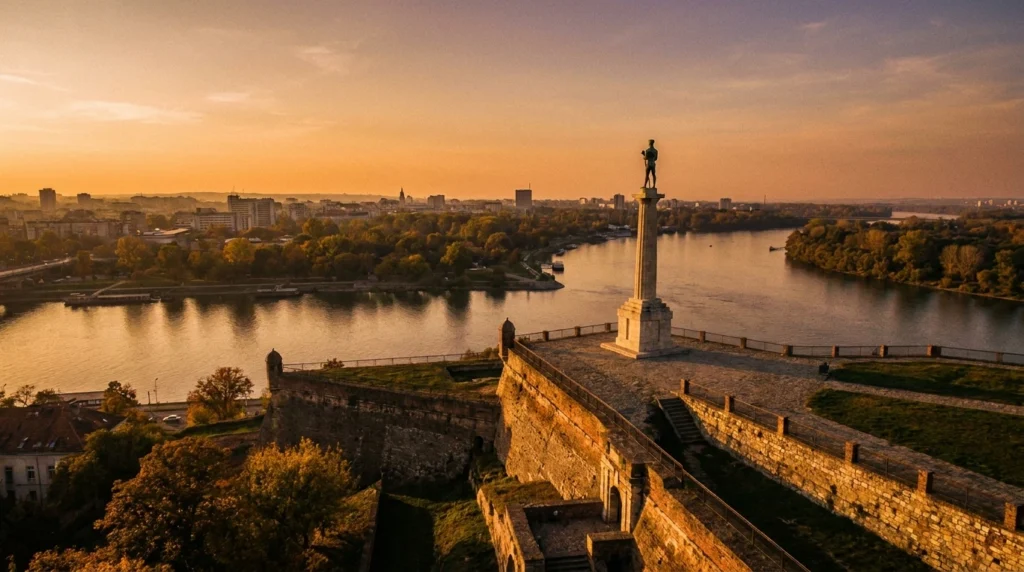
I think Serbia is the most under-visited country in Europe relative to how much fun it is, and I will keep saying it until the crowds finally catch on. My first night in Belgrade I ended up on a floating river club (a splav) on the Sava until 4am for the price of two cocktails back home, and the next morning I was standing on the walls of Kalemegdan fortress watching the Sava pour into the Danube. Serbia gives you a capital with the best nightlife in the Balkans, a second city (Novi Sad) crowned by the fortress that hosts EXIT, monasteries painted with Byzantine frescoes, canyons full of griffon vultures, and food so generous it borders on aggressive — all at prices that make Western Europe look absurd. This is the brief I would hand my own brother before he flew into Belgrade and started planning a road trip south.

In This Guide
- Overview — Why Serbia Belongs on Your 2026 Shortlist
- Serbia’s Festival Summer — EXIT, Guča & the 2026 Calendar
- Best Time to Visit Serbia (Season by Season)
- Getting There — Belgrade Airport, Trains & the Bus Network
- Getting Around — The New Fast Train, Buses & Cars
- Top Cities & Regions
- Serbian Culture & Etiquette
- A Food Lover’s Guide to Serbia
- Off the Beaten Path — Monasteries, Canyons & Spas
- Practical Information
- Budget Breakdown
- Planning Your First Trip to Serbia
- Frequently Asked Questions
Overview — Why Serbia Belongs on Your 2026 Shortlist
Serbia is a landlocked country of 88,361 km² in the central Balkans, sharing borders with eight neighbours — Hungary, Romania, Bulgaria, North Macedonia, Croatia, Bosnia and Herzegovina, Montenegro and Kosovo. About 6.6 million people live here, the great majority Serbs, and the country is at a crossroads in every sense: a Slavic, Orthodox-Christian nation that has been a frontier between empires — Roman, Byzantine, Ottoman and Habsburg — for two thousand years, which is exactly why it is so layered and interesting to travel. Serbia has been an official candidate for European Union membership since 2012, but it is not yet a member, uses its own currency the dinar, and sits outside both Schengen and the eurozone.
The first story is the rivers and the capital. Belgrade (Beograd), the “white city,” sits on the bluff where the Sava flows into the Danube, crowned by the vast Kalemegdan fortress — a site fought over in more than a hundred battles across two millennia. Below the walls, the rivers themselves are the city’s playground: a fleet of floating clubs and restaurants (the famous splavovi) gives Belgrade a nightlife reputation that draws visitors from across the continent. The bohemian Skadarlija quarter, the brutalist apartment blocks of New Belgrade, and a café culture that runs from dawn to small hours make it one of Europe’s most underrated city breaks.
The second story is the medieval and the wild. Scattered across the south are some of Europe’s great Orthodox monasteries — Studenica, Sopoćani and the cluster around Stari Ras — their interiors covered in Byzantine frescoes that count among Serbia’s five UNESCO World Heritage sites. Beyond them lies a landscape of canyons and gorges: the Iron Gates (Đerdap), where the Danube carves Europe’s largest river gorge along the Romanian border, the meandering Uvac canyon with its colony of griffon vultures, and the pine forests of Tara and the Zlatibor highlands.
The third story is the value and the welcome. Serbia is one of the cheapest countries in Europe to travel: a coffee costs a euro or so, a feast of grilled meat with rakija and a beer rarely tops €15, and a comfortable city-centre apartment can be had for a fraction of Western prices. Combine that with a famously warm, food-pushing hospitality and a calendar of huge summer festivals, and you have a country that delivers more sheer enjoyment per euro than almost anywhere else on the continent.

Serbia’s Festival Summer — EXIT, Guča & the 2026 Calendar
If you can shape your trip around one Serbian season, make it festival summer. The headline event is EXIT, held inside the 18th-century Petrovaradin Fortress above the Danube in Novi Sad each July — one of Europe’s biggest and most acclaimed music festivals, running since 2000 and repeatedly voted “Best Major European Festival.” Four nights of headline acts play out across dozens of stages tucked into the fortress tunnels, ramparts and moat, with the famous Dance Arena packed until sunrise.
The other unmissable event is utterly different: the Guča Trumpet Festival (Sabor trubača), a riotous Balkan-brass blowout held in the tiny town of Guča in early August. Hundreds of thousands of people descend to eat spit-roasted lamb, drink rakija and dance to competing brass orkestars in the street — it is loud, chaotic and one of the great folk-music spectacles on earth. Between them, Belgrade’s BELEF summer arts festival and Novi Sad’s role as a past European Capital of Culture round out a packed warm-season calendar.
Winter has its own draws: Belgrade’s restaurant-and-club scene is at full tilt through the cold months, the Kopaonik and Zlatibor ski resorts run from December, and Orthodox Christmas (7 January) and the Serbian New Year bring street celebrations.

Best Time to Visit Serbia (Season by Season)
Serbia has a continental climate — warm-to-hot summers, cold winters and two pleasant shoulder seasons — moderated in the south and west by the mountains. The Vojvodina plain in the north and the Belgrade basin are markedly warmer in summer than the highlands of the south-west. Belgrade averages summer highs around 28–30°C and winter temperatures hovering near freezing.
Spring (March–May) — Green Hills, Blossom & Empty Monasteries
Spring is one of the best times to come. By May, Belgrade’s café terraces and riverbanks are in full swing, the southern hills are green and the monasteries are crowd-free, with daytime temperatures around 18–24°C. It is ideal for the canyons, the Iron Gates and a road trip south before the summer heat builds.
Summer (June–August) — Festivals, Heat & River Life
Summer is festival season and peak energy. July brings EXIT at Petrovaradin and early August brings Guča, while Belgrade’s river clubs run nightly and the Danube and Sava beaches (Ada Ciganlija, Belgrade’s “sea”) fill up. The lowlands can be genuinely hot — 32–35°C is common in July and August — so many travellers head for the cooler mountains of Zlatibor, Tara and Kopaonik in high summer.
Autumn (September–November) — Wine, Foliage & the Best Light
September is arguably the single best month: warm, stable weather, the grape harvest underway in the Fruška Gora and Negotin wine regions, and the canyons and monasteries at their most photogenic. October brings golden foliage across Tara and the Iron Gates; by November it turns cold and grey, and the low season begins everywhere outside Belgrade.
Winter (December–February) — Nightlife, Skiing & Markets
Winter belongs to the city and the slopes. Belgrade’s nightlife and restaurant scene barely pauses, Christmas and New Year markets fill the squares, and the Kopaonik ski resort — Serbia’s largest, with around 60 km of pistes — runs from December to April. Lowland temperatures sit near 0°C; the mountains see reliable snow and the spa towns are at their cosiest.
Getting There — Belgrade Airport, Trains & the Bus Network
The main gateway is Belgrade Nikola Tesla Airport (BEG), about 18 km west of the centre and by far the country’s busiest, handling well over seven million passengers a year. It is the hub of national carrier Air Serbia and is served by most major European airlines plus low-cost operators, with growing long-haul links. The A1 minibus and public bus 72 connect the airport to the city cheaply; a regulated taxi to the centre costs a fixed fare of around €20.
A second international airport, Niš Constantine the Great Airport (INI) in the south, takes a handful of low-cost European routes and is handy for the south and the monasteries. Many travellers also fly into neighbouring hubs and come overland — Budapest, Sofia, Zagreb, Sarajevo and Skopje are all within a few hours by road or rail.
Overland is cheap and well-developed. International and intercity buses are the workhorses of Serbian travel, fast and frequent from Belgrade’s main bus station to every corner of the country and to neighbouring capitals. On the rails, the headline development is the high-speed Soko line between Belgrade and Novi Sad, which has cut the journey to around 30 minutes and is being extended towards the Hungarian border at Subotica. No passport hassles for visa-exempt visitors arriving by any route.
Getting Around — The New Fast Train, Buses & Cars
Serbia is compact and getting around is cheap, if not always fast. The single biggest improvement in years is the Soko high-speed train between Belgrade and Novi Sad, which covers the 75 km in roughly half an hour and is being extended north toward Subotica and Budapest. Beyond that corridor, the rest of the rail network is slow and patchy, so most Serbians and savvy travellers rely on the bus.
Buses & the Fast Train
Intercity and regional buses are the backbone of travel in Serbia — frequent, inexpensive and reaching almost everywhere, from Belgrade to Zlatibor, Tara, Niš and the southern monastery towns. Buy tickets at the station or online; on busy routes it is worth booking ahead. Within Belgrade and Novi Sad, city buses, trams and trolleybuses are cheap, and ride-hailing apps work well and are inexpensive. The Belgrade–Novi Sad fast train is the one rail journey every visitor should take.
Cars, Roads & Tolls
Driving is on the right, and a car is the best way to reach the canyons, monasteries and mountain villages off the bus routes. The motorway spine (the old “Highway of Brotherhood and Unity”) runs north–south from the Hungarian border through Belgrade to Niš and on toward North Macedonia; tolls are paid by ticket or the electronic TAG device. Rural roads in the south and west are scenic but slow. An International Driving Permit is recommended alongside your home licence.
Top Cities & Regions of Serbia
📍 Map of Serbia: Every Place in This Guide
Serbia’s highlights run from the flat, café-lined towns of the Vojvodina plain in the north, through the river capital of Belgrade in the centre, to the canyons, mountains and frescoed monasteries of the south and west. A classic first trip pairs a few days in Belgrade with a day trip to Novi Sad (now half an hour away by fast train), then a loop south to the Zlatibor and Tara highlands or east to the Iron Gates — none more than a few hours apart.


Belgrade — The White City on Two Rivers
Belgrade is Serbia’s capital and largest city — around 1.4 million people in the urban area — sprawling across the bluff where the Sava meets the Danube. The free-to-enter Kalemegdan fortress and its park are the historic heart; below run the bohemian cobbles of Skadarlija, the grand 19th-century facades of Knez Mihailova street, and the floating river clubs that give the city its legendary nightlife. The vast Temple of Saint Sava, the Nikola Tesla Museum, and the brutalist towers of New Belgrade round out a city that rewards wandering. Give it at least two or three nights: by day the museums, the riverside walks and the markets; by night the kafanas of Skadarlija and the floating clubs that earned Belgrade its reputation as the party capital of south-east Europe.
Novi Sad & Vojvodina — The Habsburg North
Novi Sad, Serbia’s second city and a former European Capital of Culture, has a distinctly Central-European feel — pastel Habsburg facades, a relaxed café culture, and the mighty Petrovaradin Fortress across the Danube that hosts EXIT each July. It is the capital of Vojvodina, the flat, multi-ethnic northern province, where the wine villages and monasteries of the Fruška Gora national park make an easy half-day escape. The fast train from Belgrade puts it just half an hour away, making it the single easiest and most rewarding day trip in the country — though its leafy squares, riverside beach (Štrand) and lively student scene easily justify an overnight stay.
Zlatibor & Tara — The Western Highlands
South-west of Belgrade, the Zlatibor highlands and the Tara National Park are Serbia’s mountain heartland — pine forests, traditional villages, the dramatic Drina river canyon, and the famous “house on the rock” in the middle of the Drina. The region is also home to filmmaker Emir Kusturica’s wooden hilltop village of Drvengrad (Mećavnik) and the heritage Šargan Eight narrow-gauge railway that loops through the hills in a figure of eight. Zlatibor itself is a popular year-round resort — hiking and a panoramic gondola in summer, gentle skiing in winter — and the cured pršuta ham and sheep’s cheese of the surrounding villages are among Serbia’s best.
The Iron Gates (Đerdap) — Europe’s Great River Gorge
East of Belgrade along the Romanian border, the Danube squeezes through the Iron Gates (Đerdap), the largest river gorge in Europe and the heart of Đerdap National Park. The cliffs hang dramatically over the river; the Roman Trajan’s Plaque and the medieval Golubac Fortress guard the entrance, and the prehistoric site of Lepenski Vir, one of Europe’s oldest settlements, sits on the bank.
Niš & the South — Monasteries & Roman Roots
Niš, Serbia’s third city, is the gateway to the south and the birthplace of the Roman emperor Constantine the Great. Its Ottoman fortress, the grisly Skull Tower (Ćele Kula) and the nearby Roman palace of Mediana tell two thousand years of history. The south is also the gateway to the great medieval monasteries — Studenica, Sopoćani and the Stari Ras complex — that hold Serbia’s finest Byzantine frescoes. From Niš, the spa town of Niška Banja and the highland scenery of Stara Planina on the Bulgarian border are within easy reach, making the city a practical base for exploring a part of Serbia that very few foreign visitors ever see.
Serbian Culture & Etiquette — What to Know Before You Go

Serbian culture sits at the meeting point of Orthodox Christianity, Slavic tradition and four centuries of Ottoman influence, with a strong dash of Central-European Habsburg sensibility in the north. The result is a people famous for warmth, fierce hospitality and a love of long meals, strong coffee and stronger rakija. Religion and family anchor social life — the slava, a household’s celebration of its patron saint, is the most important Serbian custom — but everyday life in Belgrade and Novi Sad is liberal, sociable and famously night-owlish.
The Essentials
- Accept the rakija. Refusing an offered drink or food from a host can mildly offend; a small toast (živeli!) and a sip goes a long way.
- Greet with a firm handshake and direct eye contact; close friends greet with three cheek-kisses.
- Coffee is a ritual, not a takeaway — expect to sit for an hour over a single cup; lingering is the point.
- Tipping is appreciated: round up or leave about 10% in restaurants and bars.
- Politics and the 1990s are sensitive subjects — it is fine if locals raise them, but let them lead.
Faith, Folk & the Slava
- The slava — the annual feast honouring a family’s patron saint — is inscribed on UNESCO’s Intangible Cultural Heritage list and is the cornerstone of Serbian identity.
- Serbian Orthodox monasteries, with their Byzantine frescoes, are the great cultural treasures of the south.
- The kolo circle dance and Balkan brass (the soul of the Guča festival) are the living heartbeat of folk music.
- Orthodox Christmas falls on 7 January, and the Serbian New Year is celebrated on 13–14 January by the Julian calendar.
A Food Lover’s Guide to Serbia

Serbian food is hearty, meat-forward and generous to the point of comedy — a cuisine forged at the crossroads of Ottoman grills, Hungarian paprika, and the rich dairy and produce of the Vojvodina plain. The undisputed icon is ćevapi (ćevapčići): little skinless grilled minced-meat sausages served with flatbread (lepinja), raw onion and the creamy red pepper relish ajvar.
The broader tradition is built around roštilj — the grill — and around pljeskavica, a giant spiced burger-patty that is Serbia’s answer to fast food, often stuffed with cheese (punjena). The Ottoman legacy shows in burek, the flaky filled pastry eaten for breakfast, and in the syrup-soaked sweets like baklava and tulumbe; the Habsburg north contributes schnitzels, strudels and the rich goulash-style stews of Vojvodina.
Eating out is astonishingly cheap by Western standards: a plate of ćevapi or a stuffed pljeskavica with sides costs only a few euros, and even a full sit-down dinner with drinks in a traditional tavern (a kafana) rarely breaks the bank. Portions are huge, lunch is the main meal, and no one will let you leave hungry.
Must-Try Dishes
| Dish | Description |
|---|---|
| Ćevapi | Grilled minced-meat fingers with flatbread, onion and ajvar — the national favourite. |
| Pljeskavica | A large, spiced grilled meat patty, often cheese-stuffed; Serbia’s beloved grill staple. |
| Burek | Flaky filo pastry filled with meat, cheese or spinach — the classic breakfast on the go. |
| Sarma | Sauerkraut or vine leaves rolled around minced meat and rice, slow-cooked; a winter staple. |
| Karađorđeva šnicla | A rolled, breaded veal or pork schnitzel stuffed with kajmak cheese — “the maiden’s dream.” |
| Ajvar & kajmak | Roasted-pepper relish and a rich clotted-cream cheese — served with almost everything. |
Drinks & Where to Eat
The national spirit is rakija, a potent fruit brandy — most famously šljivovica (plum) — offered at any hour and central to Serbian hospitality. Serbia is also a serious wine country with a long history, the best-known regions being the Fruška Gora in the north and Negotin in the east, while local beers (Jelen, Lav) are cheap and good. For the most authentic eating, head for a kafana — the traditional tavern that is part restaurant, part bar, part living room, often with live folk music. Belgrade’s Skadarlija quarter is the spiritual home of the kafana, and across the country these family-run places serve grilled meat, stews and rakija at prices that feel like a gift.
- Drinks: rakija (especially plum šljivovica), Fruška Gora and Negotin wines, Jelen and Lav beers, and strong Turkish-style “domaća kafa.”
- Where: the kafanas of Skadarlija in Belgrade, grill houses everywhere, and village taverns in Zlatibor and Vojvodina.
Off the Beaten Path — Monasteries, Canyons & Spas

For a small country, Serbia hides an extraordinary amount once you leave the capital. The crowds barely exist beyond Belgrade and Novi Sad, and a car and a few unhurried days unlock canyons, ancient monasteries, Roman ruins and spa towns that rank among the most rewarding — and least visited — corners of Europe.
The Frescoed Monasteries
The medieval Orthodox monasteries of the south are Serbia’s spiritual and artistic treasures. Studenica (founded 1190) and the nearby Sopoćani and Stari Ras complex are UNESCO World Heritage sites whose white-marble churches shelter some of the finest Byzantine frescoes in existence. Further afield, painted monasteries like Žiča, Manasija and Mileševa (home of the famous “White Angel” fresco, one of the most celebrated images in Serbian art) reward the journey. Many are still working monasteries with monks in residence; dress modestly, and you may be offered rakija and a quiet welcome that is itself part of the experience.
The Uvac Canyon & Đerdap
The Uvac canyon in the south-west is one of Serbia’s natural wonders — a river meandering in tight loops between sheer cliffs that shelter a protected colony of rare griffon vultures, best seen from the famous viewpoints or by boat. In the east, the Iron Gates gorge and Đerdap National Park combine dramatic Danube scenery with the prehistoric settlement of Lepenski Vir and the cliff-top Golubac Fortress.
Roman Serbia
Serbia sits on the spine of the Roman Balkans, and the legacy is everywhere: the UNESCO-listed late-Roman palace of Gamzigrad–Felix Romuliana, built by the Emperor Galerius around 300 AD, and Viminacium, a vast legionary city and capital of the Roman province of Moesia, complete with excavated mammoth remains.
Spa Towns & the Drina
Serbia has a deep banja (spa) tradition, from elegant Vrnjačka Banja to the thermal pools dotted across the country, long beloved for their healing waters. And in the west, the Drina river — with its photogenic little “house on the rock” near Bajina Bašta — offers rafting, kayaking and some of the most idyllic river scenery in the Balkans.
Practical Information
Serbia is an easy, low-cost destination for most travellers: visa-free for 90 days for US, UK, EU and many other nationalities, with safe cities, good mobile coverage and famously friendly locals. The main things to remember are that Serbia is outside the eurozone (you will need dinars) and outside Schengen (it is a separate entry stamp), and that the bus network, not the train, is your main way around. The essentials below cover money, connectivity and safety.
| Currency | Serbian dinar (RSD); euros are not legal tender — change money at banks or licensed menjačnica exchange offices. |
| Cash needs | Cards widely accepted in Belgrade and Novi Sad; carry dinars for kafanas, markets, rural buses and small towns. |
| ATMs | Plentiful in cities; use bank-branded ATMs and decline dynamic currency conversion. |
| Tipping | Round up or 10% in restaurants, bars and taxis. |
| Language | Serbian (Cyrillic and Latin scripts both in use); English widely spoken by younger people in cities. |
| Safety | Very safe; petty pickpocketing in crowds is the main risk. Emergency number 112 (also 192 police, 194 ambulance). |
| Connectivity | Strong 4G/5G; cheap prepaid SIMs from Telekom, A1 or Yettel. EU roaming does not apply (Serbia is non-EU). |
| Power | Type C and Type F plugs, 230V / 50 Hz. |
| Tap water | Safe to drink in Belgrade, Novi Sad and most towns; ask locally in remote areas. |
| Healthcare | Decent public and private care in cities; travel insurance recommended as EHIC/GHIC do not apply. Pharmacies (apoteka) widespread. |
Budget Breakdown — What Serbia Actually Costs
Serbia is one of the best-value destinations in Europe, and the savings are across the board: food, drink, transport and accommodation are all a fraction of Western European prices. Your daily spend is driven mostly by how you sleep and how much you go out — and going out is cheap. The figures below are per person, per day, excluding international flights, and assume you are paying in dinars rather than over-the-odds tourist euros. The biggest variable is the season: festival weeks in Novi Sad and ski weeks at Kopaonik push prices up sharply, while the rest of the year Serbia is reliably one of the cheapest places to travel anywhere on the continent.
Budget Traveller
On €35–55 a day you can stay in Belgrade hostels, eat ćevapi and burek for a couple of euros, ride cheap intercity buses, and still afford a night out on the splavovi. Serbia is genuinely one of the cheapest countries in Europe for travellers.
Mid-Range
€70–120 a day covers a comfortable city-centre apartment or 3-star hotel, restaurant meals with wine, museum entries, the fast train to Novi Sad and a rental car for a few days of canyon-and-monastery touring. This is the sweet spot for most first-timers.
Luxury
From €200 a day you can book Belgrade’s best boutique hotels, fine dining, private guides to the monasteries and canyons, and ski-in lodging at Kopaonik — still far below comparable prices in Western Europe.
| Tier | Daily (EUR) | Accommodation | Food | Transport |
|---|---|---|---|---|
| Budget | €35–55 | Hostel / guesthouse €12–25 | Grills & bakeries €8–15 | Buses €5–12 |
| Mid-Range | €70–120 | Apartment / 3-star €45–80 | Restaurants €20–35 | Rental car / fast train €30 |
| Luxury | €200+ | Boutique hotel €140+ | Fine dining €50+ | Private driver / ski pass €50+ |
Planning Your First Trip to Serbia
Serbia rewards a little planning because its draws are spread out: the nightlife and museums cluster in Belgrade, the festivals fall in narrow summer windows, and the monasteries and canyons need a car or a patient run of buses. Decide first whether your trip is a Belgrade city break, a festival mission, or a full road-tripping loop, then build outward from the capital. The steps below walk through it.
- Fly to Belgrade (BEG), or into Budapest/Sofia/Niš (INI) and come overland.
- Decide your axis: a Belgrade-and-Novi-Sad city break, a festival trip (EXIT early July, Guča early August), or a southern road-trip loop.
- Take the fast train to Novi Sad and the Fruška Gora; it is the easiest, best day trip from the capital.
- For the canyons, monasteries and mountains, rent a car or chain together intercity buses; allow extra time for slow rural roads.
- Carry dinars (Serbia is outside the eurozone) and remember it is non-Schengen — a separate border stamp.
Classic 7-Day Itinerary: 3 days Belgrade (Kalemegdan, Skadarlija, museums, splavovi), 1 day Novi Sad and Fruška Gora by fast train, 2 days Zlatibor/Tara or the Iron Gates by car, 1 day return and onward.
Frequently Asked Questions
Is Serbia expensive to visit?
No — Serbia is one of the cheapest countries in Europe. Budget travellers manage on €35–55 a day, mid-range on €70–120. Coffee costs around a euro, a plate of ćevapi a few euros, and even a full kafana dinner with rakija rarely breaks the bank. Belgrade in festival weeks and Kopaonik over New Year are the priciest moments.
Do I need a visa for Serbia?
For most Western travellers, no. Citizens of the US, UK, EU, Canada, Australia and many other countries can stay visa-free for up to 90 days within any 180-day period. Serbia is outside the Schengen area, so it is a separate entry stamp and not covered by a Schengen visa. Always check the latest rules with the Serbian foreign ministry before travelling.
Is Serbia in the EU or the eurozone?
Neither yet. Serbia has been an official EU candidate since 2012 but is not a member, and it uses its own currency, the Serbian dinar (RSD), not the euro. Euros are not legal tender, so change money into dinars at banks or licensed exchange offices; cards are widely accepted in the cities.
Is Serbia safe for solo travellers?
Yes — Serbia is a very safe country with low violent-crime rates and a strong record for solo and female travellers. Petty pickpocketing in crowds is the main concern. Locals are famously hospitable and helpful, and the European emergency number 112 works alongside the local police and ambulance numbers.
Should I use Cyrillic or Latin script?
Both are official and used interchangeably, so you will see the same words written both ways. Latin script is common on menus and tourist signage, but official signs and many street names use Cyrillic, so it helps to recognise a few Cyrillic letters when navigating. Younger people in cities widely speak English.
What are the best festivals in Serbia?
The two giants are EXIT, a major electronic and rock festival held in Novi Sad’s Petrovaradin Fortress in early July, and the Guča Trumpet Festival, a wild Balkan-brass celebration in the town of Guča in early August. Belgrade and Novi Sad also host year-round arts, film and music events.
How many days do I need in Serbia?
A long weekend is enough for Belgrade and a day trip to Novi Sad. To add the southern monasteries, the Iron Gates or the Zlatibor and Tara highlands, give yourself a week or more, ideally with a rental car for the rural routes the buses do not reach.
Explore More — City Guides & Related Reading
- Budapest City Guide — A few hours north and now linked by the new high-speed railway; the natural Danube pairing.
- Vienna City Guide — The grand Habsburg capital up the Danube; an easy add-on to a Central-European loop.
- Prague City Guide — A classic Central-European counterpoint for travellers chaining capitals.
- Warsaw City Guide — Another resurgent Slavic capital worth pairing on a wider regional trip.
- Paris City Guide — For travellers connecting through Western Europe before the Balkan leg.
- Rome City Guide — A Mediterranean classic to balance Serbia’s rivers, fortresses and canyons.
- All Country Guides
More country guides you might like
Plan your trip to Serbia
The booking tools we use ourselves. FFU may earn a commission at no extra cost to you.
Plan & book your trip to Serbia
Booking through these searches supports our guides at no extra cost to you.