
Languages of Lithuania
All languages of Northern Europe →fluent beta classical · classes by phone with Maya at ranas.ai/maya
Lithuania Travel Guide — Baroque Vilnius, an Island Castle & the Dunes of the Curonian Spit
I think Lithuania is the most quietly surprising country in the Baltics, and the one most travellers skip on their way between Riga and Warsaw — which is exactly why you should go. My first morning in Vilnius I climbed Gediminas’ Tower and looked out over one of the largest surviving medieval old towns in Northern Europe, a sea of baroque domes and red roofs with almost no crowds in it. The next day I was eating pink beetroot soup the colour of a flamingo, and the day after that I stood on a 60-metre sand dune on the Curonian Spit with the Baltic on one side and a lagoon on the other. Lithuania gives you a UNESCO old town, a fairy-tale island castle, a coast of shifting dunes, and a fierce, funny national character — at Baltic prices and without the queues. This is the brief I would hand my own brother before he flew into Vilnius.

In This Guide
- Overview — Why Lithuania Belongs on Your 2026 Shortlist
- Lithuania’s Festival Calendar — Song, Solstice & the 2026 Highlights
- Best Time to Visit Lithuania (Season by Season)
- Getting There — Vilnius Airport, Trains & the Baltic Routes
- Getting Around — Buses, Trains & the Coast
- Top Cities & Regions
- Lithuanian Culture & Etiquette
- A Food Lover’s Guide to Lithuania
- Off the Beaten Path — Dunes, Crosses & Cold-War Bunkers
- Practical Information
- Budget Breakdown
- Planning Your First Trip to Lithuania
- Frequently Asked Questions
Overview — Why Lithuania Belongs on Your 2026 Shortlist
Lithuania is the largest and southernmost of the three Baltic states, a country of 65,300 km² on the eastern shore of the Baltic Sea, bordering Latvia, Belarus, Poland and the Russian exclave of Kaliningrad. About 2.89 million people live here, and the country has one of the deepest histories in the region: the medieval Grand Duchy of Lithuania was, at its peak in the 15th century, one of the largest states in Europe, stretching from the Baltic almost to the Black Sea. After centuries under the Russian Empire and the trauma of Soviet occupation, Lithuania was the first Soviet republic to declare independence, in March 1990, and is today a settled member of the EU (since 2004), Schengen (since 2007), NATO and the eurozone (since 2015).
The first story is Vilnius, the capital. Its old town is one of the largest surviving medieval old towns in Northern Europe and a UNESCO World Heritage site — a baroque masterpiece of more than 1,000 buildings, church spires and hidden courtyards, all walkable and refreshingly uncrowded. It is also one of Europe’s most characterful capitals, home to the self-declared bohemian “republic” of Užupis, a constitution nailed to a wall, and a coffee-and-craft-beer scene that has made it a quiet favourite for city breaks.
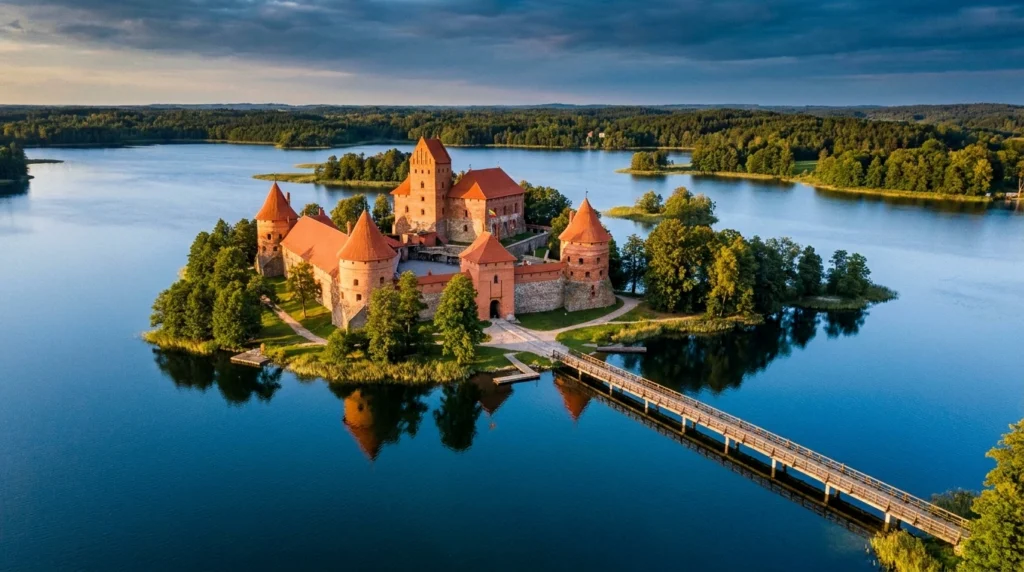
The second story is the coast and the castles. An hour from the capital, Trakai Island Castle rises straight out of a lake — the only island castle in Eastern Europe and the postcard image of the country. On the Baltic, the Curonian Spit is a 98-km finger of shifting sand dunes, pine forest and old fishing villages, shared with Russia and inscribed by UNESCO as a cultural landscape — one of four Lithuanian World Heritage sites alongside Vilnius, the prehistoric site of Kernavė and the Struve Geodetic Arc.
The third story is the value and the soul. Lithuania is one of the cheaper Eurozone countries, where a bowl of the famous pink soup or a plate of cepelinai dumplings costs a few euros and a city-centre room is a fraction of Western prices. Add a fierce, dry-humoured national character, a living folk tradition centred on the UNESCO-listed Song Festival, and a landscape of lakes, forests and dunes, and you have a country that delivers far more than its modest profile suggests.

Lithuania’s Festival Calendar — Song, Solstice & the 2026 Highlights
If you can shape your trip around one Lithuanian tradition, make it the Song Festival. The Baltic song-and-dance celebrations of Lithuania, Latvia and Estonia are jointly inscribed on UNESCO’s Intangible Cultural Heritage list — vast gatherings where tens of thousands of singers in folk costume fill an open-air arena, a tradition that helped these nations keep their identity alive through occupation. Lithuania’s national Song Festival is held in Vilnius every few years and is one of the most moving spectacles in Europe.
The other great seasonal moment is the summer solstice (Joninės / Rasos) around 23–24 June, when Lithuanians head to the countryside and the coast to light bonfires, weave flower wreaths, sing through the short midsummer night and search for the mythical fern flower — a pre-Christian midsummer rite that survives with real enthusiasm. Summer also brings the country’s beloved basketball season into focus — the unofficial national religion — and a packed calendar of music and arts festivals in Vilnius, Kaunas and the seaside resort of Palanga.
Winter has its own draw: Vilnius stages one of Europe’s most photographed Christmas markets and tree displays in Cathedral Square, the old town turns festive and snowy, and the Shrovetide Užgavėnės carnival in late winter sees masked figures drive out the cold.

Best Time to Visit Lithuania (Season by Season)
Lithuania has a temperate climate that leans continental, with warm summers, cold snowy winters and two short, changeable shoulder seasons. The Baltic coast is milder and breezier than the interior, and the country’s far-northern latitude means very long summer days and very short, dark winter ones. Vilnius averages summer highs in the low-to-mid 20s°C and winter temperatures around or below freezing.
Spring (March–May) — Thaw, Blossom & Quiet Streets
Spring is a quiet, gradually warming season. By May, Vilnius’s parks and café terraces come to life, daytime temperatures reach a pleasant 15–20°C, and the old town and Trakai are crowd-free before summer. It is an excellent time for the cities and Trakai, though the Baltic remains cold for the beach.
Summer (June–August) — Long Days, the Coast & Festivals
Summer is peak season and the obvious time to come. From June the days are gloriously long, the midsummer solstice fills the countryside with bonfires, and the Curonian Spit, the lakes and the seaside resort of Palanga are at their best, with temperatures of 20–25°C and occasional warm spells higher. July and August bring the festival calendar, the warmest (if still bracing) Baltic swimming, and the busiest — though never overwhelming — crowds.
Autumn (September–November) — Foliage, Mushrooms & the Best Light
September is a lovely, underrated month: mild, stable weather, golden light on the old town, and the start of the mushroom-and-berry foraging season that Lithuanians adore. October brings spectacular foliage in the forests and on the Spit; by November it turns cold, grey and dark, the start of the low season everywhere outside the cities.
Winter (December–February) — Markets, Snow & Cosy Cities
Winter is cold, snowy and atmospheric. Vilnius’s Christmas market and giant decorated tree in Cathedral Square draw visitors through December, the old town looks magical under snow, and the cafés and saunas are at their cosiest. Temperatures often sit below freezing and daylight is short, so it is a city-and-culture season rather than an outdoors one — but a genuinely lovely one for a festive break.
Getting There — Vilnius Airport, Trains & the Baltic Routes
The main gateway is Vilnius Airport (VNO), about 6 km south of the city centre and the country’s busiest, served by a mix of full-service and low-cost European airlines. It is unusually close to the centre: a short train ride (about 7 minutes) or city bus links the terminal to the main railway station, and a taxi to the old town costs only around €10–15.
Two other airports widen your options. Kaunas Airport (KUN), about 100 km away in the second city, is a major Ryanair base with cheap routes across Europe, while Palanga Airport (PLQ) on the coast is handy for the Curonian Spit and the seaside in summer. Between the three, Lithuania is well connected to most of Europe by low-cost carriers.
Overland travel is easy within the Baltics and beyond. Comfortable long-distance buses (Lux Express, Ecolines) link Vilnius with Riga, Tallinn, Warsaw, Kaliningrad and beyond, and the much-anticipated Rail Baltica project is building a modern standard-gauge line to connect the Baltic capitals to the wider European network. As an EU and Schengen member, Lithuania has no passport checks at its land borders with Latvia or Poland, so a multi-country trip flows seamlessly from one nation to the next. Most arriving travellers fly in, but the overland buses are cheap, frequent and surprisingly comfortable, with onboard wifi and power sockets, and they make the classic three-capital Baltic loop genuinely effortless. Drivers can also reach Lithuania by good motorways from Poland to the south.
Getting Around — Buses, Trains & the Coast
Lithuania is compact and easy to get around, and you do not need a car for the main highlights — though one helps for the lakes and remoter regions. The intercity bus network is the workhorse: frequent, cheap and comprehensive, linking Vilnius, Kaunas, Klaipėda and every town in between, with online booking through the national platform. Trains, run by LTG Link, are modern and comfortable on the main routes — the Vilnius–Kaunas line is fast and scenic, and a direct train reaches the coast at Klaipėda.
Trains, Buses & the Curonian Spit
The Vilnius–Kaunas train takes around an hour and the Vilnius–Klaipėda line about four, putting the whole country within a comfortable day’s reach. To reach the Curonian Spit, take the train or bus to Klaipėda, then the short passenger-and-car ferry across the lagoon to Smiltynė, from where buses run down the spit to Nida. Trakai is an easy 30-minute train or bus ride from Vilnius. Within Vilnius and Kaunas, city buses and trolleybuses are cheap and ride-hailing apps work well.
Cars & Roads
Driving is on the right, roads are good, and a car is the best way to explore the lakes of Aukštaitija, the Hill of Crosses and the quieter corners of the country. There are no motorway tolls for cars, but headlights must be on at all times and winter tyres are mandatory from November to April. Distances are short — Vilnius to the coast is under four hours — so a self-drive loop is very manageable.
Top Cities & Regions of Lithuania
📍 Map of Lithuania: Every Place in This Guide
Lithuania’s highlights run from the baroque capital of Vilnius in the south-east, through the interwar second city of Kaunas in the centre, to the port of Klaipėda and the dune coast of the Curonian Spit in the west — with the island castle of Trakai, the lakes of Aukštaitija and the Hill of Crosses scattered between. A classic first trip pairs a few days in Vilnius and Trakai with a run west to the coast, all within a few hours of one another.


Vilnius — The Baroque Capital
Vilnius is Lithuania’s capital and largest city — around 580,000 people — and its UNESCO-listed old town is one of the largest and best-preserved in Northern Europe. Climb Gediminas’ Tower for the view, wander the baroque churches and hidden courtyards, and cross the little bridge into Užupis, the bohemian artists’ “republic” with its own tongue-in-cheek constitution. The grand Cathedral Square, the Gates of Dawn, the haunting KGB Museum (Museum of Occupations) and a buzzing café-and-craft-beer scene make it one of Europe’s most rewarding and affordable city breaks.
Trakai & the Lakes — The Island Castle
Half an hour from the capital, Trakai is the country’s storybook image: a red-brick Gothic castle on an island in Lake Galvė, the only island castle in Eastern Europe and once a seat of the Grand Dukes of Lithuania. The town is also the historic home of the Karaim, a tiny Turkic community brought here in the 14th century, whose kibinai pastries are a local specialty. Beyond Trakai, the lake-and-forest landscapes of the Aukštaitija National Park are a paradise for canoeing and quiet escapes.
Kaunas — Modernism & Energy
Kaunas, Lithuania’s second city — around 300,000 people — was the country’s interwar capital and is famous for its remarkable 1920s–30s modernist architecture, recognised by UNESCO as a World Heritage site. A former European Capital of Culture, it has a lively student energy, a handsome old town at the confluence of two rivers, the striking Christ’s Resurrection Church, and a fast-growing street-art and café scene that makes it a worthy counterpoint to Vilnius.
The Curonian Spit & Klaipėda — The Dune Coast
On the Baltic, the port city of Klaipėda (the old Prussian Memel) is the gateway to the Curonian Spit — a 98-km sliver of giant sand dunes, pine forest and old fishing villages, shared with Russia and inscribed by UNESCO. The resort village of Nida, with its painted wooden cottages, weathervanes and the towering Parnidis dune, was a favourite of the writer Thomas Mann; nearby Palanga is Lithuania’s buzzing summer beach resort. This is the country’s natural showpiece.
The Hill of Crosses — A Pilgrimage Landmark
Near the northern city of Šiauliai, the Hill of Crosses (Kryžių kalnas) is one of the most extraordinary sights in the country — a small hill covered with hundreds of thousands of crosses left by pilgrims over two centuries, repeatedly bulldozed by the Soviet authorities and as often rebuilt overnight, a powerful symbol of Lithuanian faith and defiance. Pope John Paul II visited and prayed here in 1993, cementing its place as a site of international pilgrimage. It is an easy and unforgettable stop on the route between Vilnius or Kaunas and the coast.
Aukštaitija & the Lake District
For nature rather than monuments, head north-east to the Aukštaitija National Park, Lithuania’s oldest, a green maze of more than a hundred interconnected lakes, ancient pine and spruce forest, and traditional wooden villages. It is the country’s canoeing and quiet-escape heartland, where you can paddle for days between lakes, sleep in old farmsteads, swim from empty shores and barely see another visitor — the rural, unhurried Lithuania that most first-timers never reach.
Taken together, these places show how much variety Lithuania packs into a small footprint: a baroque UNESCO capital, a storybook island castle, a modernist second city, a wild dune coast, a haunting pilgrimage hill and a lake-laced national park, all within a few hours of one another. Most first-timers stop at Vilnius and Trakai and leave delighted, but those who push west to the Curonian Spit or north to the lakes and the Hill of Crosses discover a country that rewards every extra day with another, very different landscape.
Lithuanian Culture & Etiquette — What to Know Before You Go

Lithuanian culture is a blend of deep-rooted Catholic faith, a strong pre-Christian pagan heritage (Lithuania was the last country in Europe to be Christianised), and the hard-won pride of a small nation that survived occupation with its language and identity intact. Lithuanians can seem reserved and undemonstrative with strangers — a dry, deadpan humour is part of the national character — but they are warm and generous once you are inside the circle. Family, nature, food and song run through everyday life.
The Essentials
- Remove your shoes when entering a Lithuanian home; slippers are usually offered.
- Greet with a firm handshake and direct eye contact; Lithuanians tend toward formality with people they have just met.
- Bring a small gift — flowers (an odd number; even numbers are for funerals), wine or chocolates — if invited to a home.
- Tipping is modest: round up or leave about 10% in restaurants.
- Do not lump Lithuania in with Russia or call it “former Soviet” as an identity — Lithuanians are proud Northern Europeans and Balts.
Song, Faith & Folk
- The Baltic Song and Dance Celebrations are inscribed on UNESCO’s Intangible Cultural Heritage list and are the emotional core of national identity.
- Cross-crafting — the carving of the wooden crosses seen across the country and on the Hill of Crosses — is itself a UNESCO-listed folk art.
- The polyphonic sutartinės songs are an ancient and haunting Lithuanian vocal tradition, also UNESCO-recognised.
- Midsummer (Joninės), Shrovetide (Užgavėnės) and Catholic feast days shape the folk calendar.
A Food Lover’s Guide to Lithuania

Lithuanian food is hearty Northern-European country cooking — potatoes, rye bread, pork, dairy, beetroot and mushrooms — built for cold winters and famous for one show-stopping summer dish. The national icon is cepelinai (“zeppelins”): large potato dumplings stuffed with minced meat, named for their airship shape and served with sour cream and crispy bacon.
The dish that wins the internet, though, is šaltibarščiai — a cold beetroot soup made with kefir that turns a brilliant, almost fluorescent pink, served chilled in summer with a side of hot potatoes. Beyond these, the table runs to dark rye bread (the pride of the country), smoked meats and cheeses, fried bread sticks (kepta duona) eaten with beer, mushroom and berry dishes from the forests, and the curious šakotis, a spit-baked “tree cake” with spiky branches that appears at every celebration.
Eating out is excellent value: a plate of cepelinai or a bowl of pink soup costs only a few euros in a traditional tavern, and even a full restaurant meal in Vilnius stays affordable by Western standards. Lithuanians take rye bread, dairy and foraged ingredients seriously, and a new generation of chefs in Vilnius and Kaunas has turned these humble staples into a genuinely interesting modern cuisine.
Must-Try Dishes
| Dish | Description |
|---|---|
| Cepelinai | Large potato dumplings stuffed with meat, with sour cream and bacon — the national dish. |
| Šaltibarščiai | Cold, bright-pink beetroot-and-kefir soup served with hot potatoes; a summer favourite. |
| Kepta duona | Fried garlic rye-bread sticks, the classic beer snack. |
| Kibinai | Karaim meat-filled pastries, a specialty of Trakai. |
| Vėdarai & skilandis | Potato sausages and a smoked, cured cold-cut — rustic country classics. |
| Šakotis | Spit-baked “tree cake” with spiky branches, served at celebrations. |
Drinks & Where to Eat
Lithuania has a strong beer tradition — especially the distinctive farmhouse kaimiškas ales of the northern Aukštaitija region, considered one of Europe’s last living indigenous beer cultures. The herbal honey liqueur Žalgiris / midus (mead) is the traditional spirit, and kvass and birch sap are local soft drinks. For the most authentic eating, look for an old-school cellar tavern serving cepelinai and dark beer, or a modern bistro in Vilnius’s old town or Kaunas. Forage-driven fine dining is the country’s culinary surprise.
- Drinks: Aukštaitija farmhouse ales and modern craft beer, traditional mead (midus), kvass and birch sap.
- Where: cellar taverns in Vilnius old town, the bistros of Kaunas, and kibinai cafés in Trakai.
Off the Beaten Path — Dunes, Crosses & Cold-War Bunkers

For a small, flat-looking country, Lithuania hides an extraordinary amount once you leave Vilnius. Distances are short, crowds are rare, and a car and a few unhurried days open up dune coasts, ancient pagan sites, lake districts and some of the eeriest Cold-War relics in Europe. Because so few foreign visitors stray beyond the capital and Trakai, these places stay genuinely uncommercialised — you can have a hillfort, a forest lake or a stretch of white dune almost entirely to yourself, even in high summer.
The Curonian Spit & the Coast
The Curonian Spit, a UNESCO World Heritage site shared with Russia’s Kaliningrad region, is a 98-km sliver of shifting sand dunes, pine forest and fishing villages backed by a calm lagoon. Reached by ferry from Klaipėda, the resort village of Nida and the towering Parnidis dune are the highlights of Lithuania’s quietly spectacular Baltic coast.
Kernavė & the Pagan Past
Kernavė, a UNESCO-listed archaeological site about 35 km from Vilnius, was the first capital of medieval Lithuania and is now a haunting landscape of grass-covered hillforts above the Neris valley — the best place to feel the country’s deep, pre-Christian roots. It comes alive each summer with a living-history festival around the solstice.
The Lake District & the Forests
North of Vilnius, the Aukštaitija National Park is a maze of more than a hundred interconnected lakes, pine forests and traditional villages — Lithuania’s canoeing and quiet-escape heartland, dotted with old wooden farmsteads and a beekeeping museum. Further out, the Dzūkija forests in the south are the country’s mushroom-and-berry foraging paradise.
The Hill of Crosses & Šiauliai
The Hill of Crosses near Šiauliai is one of Lithuania’s most moving sights — a hillock blanketed with hundreds of thousands of crosses left by pilgrims, bulldozed repeatedly by the Soviets and rebuilt every time. It is a powerful symbol of faith and quiet resistance, and an easy stop on the way to the coast.
Cold-War Lithuania
For something stranger, the forests near Plokštinė hide a decommissioned Soviet underground missile base, now a Cold-War museum, while the chilling Soviet-Bunker survival experience near Vilnius and the KGB Museum in the capital tell the story of the occupation years. Together they make Lithuania one of the most rewarding places in Europe to understand the 20th century.
Practical Information
Lithuania is an easy, low-friction destination: it is in both the EU and the Schengen zone, uses the euro, has safe tap water and excellent mobile coverage, and runs cheap, reliable buses and trains between its towns. EU and UK citizens travel visa-free and need only a valid passport or ID card. The essentials below cover money, connectivity and safety; everything is close together and well-signposted in both Lithuanian and, increasingly, English.
| Currency | Euro (€); Lithuania adopted the euro on 1 January 2015, the last of the Baltic states to do so. |
| Cash needs | Cards accepted almost everywhere, even for small amounts; carry a little cash for rural markets and small towns. |
| ATMs | Plentiful in towns; use bank-branded ATMs (SEB, Swedbank, Luminor) and decline dynamic currency conversion. |
| Tipping | Round up or 10% in restaurants. |
| Language | Lithuanian; English widely spoken by younger people in cities, Russian common among older people. Google Translate covers menus and signs. |
| Safety | Very safe; petty pickpocketing in tourist spots is the main risk. EU emergency number 112. |
| Connectivity | Excellent, fast 4G/5G; EU roaming works for European SIMs. Cheap prepaid SIMs from Telia, Bitė or Tele2. |
| Power | Type C and Type F plugs, 230V / 50 Hz. |
| Tap water | Safe to drink everywhere. |
| Healthcare | Good public and private care; EHIC/GHIC covers EU/UK visitors. Pharmacies (vaistinė) widespread. |
Budget Breakdown — What Lithuania Actually Costs
Lithuania is one of the better-value countries in the Eurozone, noticeably cheaper than Western Europe across food, transport and accommodation, if a little pricier than the Balkans. Your daily spend is driven mostly by how you sleep and how much you move around; food and intercity travel stay cheap at every tier. The figures below are per person, per day, excluding international flights. A few habits stretch a budget further still: eat your main meal at lunch when taverns run cheaper set menus, buy intercity bus tickets online in advance, and base yourself in Kaunas or Klaipėda, where rooms cost noticeably less than in central Vilnius.
Budget Traveller
On €45–70 a day you can stay in Vilnius or Kaunas hostels, eat cepelinai and pink soup in cellar taverns, ride cheap intercity buses, and still see the old town and Trakai. Lithuania is one of the cheaper Eurozone countries for travellers.
Mid-Range
€90–150 a day covers a comfortable city-centre hotel or apartment, restaurant meals with wine or craft beer, museum entries, the train to the coast and a rental car for a few days of lakes-and-castle touring. This is the sweet spot for most first-timers.
Luxury
From €250 a day you can book Vilnius’s best boutique hotels, fine dining built on foraged ingredients, private guides and a stay in a stylish lodge on the Curonian Spit — still well below comparable Western European prices.
| Tier | Daily (EUR) | Accommodation | Food | Transport |
|---|---|---|---|---|
| Budget | €45–70 | Hostel / guesthouse €18–35 | Taverns & bakeries €10–18 | Buses/trains €5–12 |
| Mid-Range | €90–150 | Hotel / apartment €60–100 | Restaurants €25–40 | Rental car / train €35 |
| Luxury | €250+ | Boutique hotel / lodge €160+ | Fine dining €60+ | Private driver €60+ |
Planning Your First Trip to Lithuania
Lithuania is compact and easy to plan, but its highlights split between the cities of the south-east and the coast in the west, so it pays to decide your shape before you go. The most common mistake is treating it as a single city break and missing the dunes; the most rewarding trips pair a few days in Vilnius and Trakai with a run to the Curonian Spit. Decide first whether you want a city-and-castle break, a coast trip, or a full cross-country loop, then build around the cheap buses and trains. The steps below walk through it.
- Fly to Vilnius (VNO), or to Kaunas (KUN) / Palanga (PLQ) for cheaper routes and the coast.
- Decide your axis: a Vilnius-and-Trakai city break, a Curonian Spit coast trip, or a full Vilnius-to-coast loop via Kaunas.
- Do Trakai as an easy half-day from Vilnius by train or bus; add Kernavė if you have a car.
- For the coast, train or bus to Klaipėda, ferry to the spit, then buses or a bike down to Nida.
- Consider pairing Lithuania with Latvia and Estonia — the three Baltic capitals are linked by frequent buses.
Classic 7-Day Itinerary: 3 days Vilnius + Trakai (+ Kernavė), 1 day Kaunas and the Hill of Crosses en route west, 2 days the Curonian Spit and Nida from Klaipėda, 1 day return.
Frequently Asked Questions
Is Lithuania expensive to visit?
No — Lithuania is one of the cheaper countries in the Eurozone. Budget travellers manage on €45–70 a day, mid-range on €90–150. Cepelinai and pink soup cost a few euros, intercity buses and trains are very cheap, and city-centre rooms are far below Western European prices. It is a little pricier than the Balkans but excellent value.
Do I need a visa for Lithuania?
For most Western travellers, no. Lithuania is an EU and Schengen member, so US, UK, Canadian, Australian and New Zealand citizens can visit visa-free for up to 90 days in any 180-day period, and EU/EEA citizens can stay freely. A Schengen visa, where required, covers Lithuania.
What is the best time to visit Lithuania?
Summer (June to August) is the most popular, with long days, warm weather and the coast and lakes at their best; midsummer around 23–24 June is special. May and September are mild, quiet shoulder months ideal for the cities and Trakai, while December brings Vilnius’s famous Christmas market and snowy old town.
Is Lithuania safe for solo travellers?
Yes — Lithuania is a very safe country with low violent-crime rates and a strong record for solo and female travellers. Petty pickpocketing in tourist areas is the main concern. The EU emergency number 112 works in English, and the cities are easy and pleasant to navigate on foot.
Do people speak English in Lithuania?
Yes, widely, especially among younger people in Vilnius, Kaunas and the coast. Russian is common among older Lithuanians, and Lithuanian itself is one of the oldest living Indo-European languages. Learning a couple of words — ačiū (thank you), labas (hello) — is warmly appreciated.
How many days do I need in Lithuania?
A long weekend covers Vilnius and Trakai comfortably. To add Kaunas, the Hill of Crosses and the Curonian Spit, give yourself about a week. Distances are short — Vilnius to the coast is under four hours — so even a week lets you see the whole country at a relaxed pace.
What is the Curonian Spit and is it worth it?
The Curonian Spit is a 98-km finger of giant sand dunes, pine forest and old fishing villages on the Baltic, shared with Russia and inscribed by UNESCO. It is Lithuania’s natural showpiece — absolutely worth the trip, especially the village of Nida and the towering Parnidis dune. Reach it via Klaipėda and the short lagoon ferry.
Explore More — City Guides & Related Reading
- Paris City Guide — For travellers connecting through Western Europe before the Baltic leg.
- Rome City Guide — A Mediterranean classic to balance Lithuania’s northern forests and dunes.
- Barcelona City Guide — A sun-and-sea counterpoint for a wider European itinerary.
- Tokyo City Guide — For long-haul travellers chaining Lithuania into a bigger trip.
- London City Guide — A common gateway hub with direct low-cost flights to Vilnius.
- Istanbul City Guide — A cross-continental capital to pair on a longer journey.
- All Country Guides
More country guides you might like
Plan your trip to Lithuania
The booking tools we use ourselves. FFU may earn a commission at no extra cost to you.
Plan & book your trip to Lithuania
Booking through these searches supports our guides at no extra cost to you.