
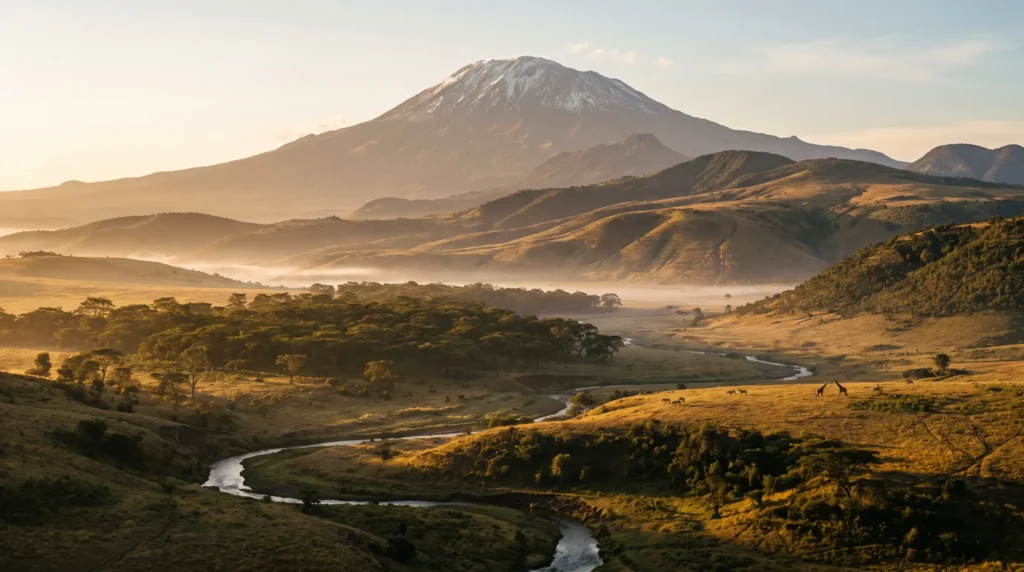
Arusha Travel Guide — Tanzania’s Safari Capital, at the Foot of Mount Meru
Nobody comes to Arusha to see Arusha, and that’s exactly what makes it interesting. This is a working city, not a stage set for tourists — a city of well over half a million people that happens to sit at 1,400 metres on the southern flank of Mount Meru, an hour’s drive from an international airport, and within striking distance of the Serengeti, the Ngorongoro Crater, Tarangire and Lake Manyara. Nearly every overland safari in northern Tanzania starts and ends here, which means Arusha’s real identity is logistics — Land Cruisers being loaded, camping gear being checked, coffee farms being toured on the one free morning before departure. I like it precisely because it doesn’t pretend otherwise. Spend a day or two actually in the city — the Maasai market, the clock tower roundabout, a coffee tour on the Moshi road — and you’ll understand the Northern Circuit a lot better than if you fly straight past it into the bush.
In This Guide
- Overview — Why Arusha Matters
- Festival Week — Cape to Cairo, Late May
- Best Time to Visit Arusha (Season by Season)
- Getting There — JRO, Nairobi & the Border Crossings
- Getting Around — Dala-Dalas, Taxis & Safari Vehicles
- Where to Base Yourself — Arusha’s Neighborhoods
- Culture & People — Maasai, Chagga, Arusha and Beyond
- A Food Lover’s Guide to Arusha
- Off the Beaten Path
- Day Trips — Ngorongoro, Tarangire & Lake Manyara
- Practical Information
- Budget Breakdown — What Arusha Actually Costs in 2026
- Frequently Asked Questions
Overview — Why Arusha Matters
Arusha grew from a small Maasai settlement founded in the 1830s into a city of roughly 618,000 people as of the 2022 census — up from fewer than 8,000 residents in 1952, one of the fastest-growing urban stories in East Africa. It was incorporated as a town in 1948 and only granted official city status in 2012, but its importance was already outsized: it hosts the East African Community’s headquarters and the African Court on Human and Peoples’ Rights, and it sits at the eastern edge of the Great Rift Valley on the southern slopes of Mount Meru, Tanzania’s second-highest peak.
None of that is why you’re reading this. You’re reading this because Arusha is the staging ground for the Northern Circuit — Serengeti, Ngorongoro, Tarangire, Lake Manyara and Arusha National Park itself, all reachable within a few hours’ drive. Practically every overland safari operator in the country is headquartered here, every Kilimanjaro climbing outfit stages its gear here, and Kilimanjaro International Airport — the country’s third-busiest, handling just over a million passengers in 2024 — sits about 60 kilometres to the east.
What Arusha isn’t is a beach resort or a colonial old town dressed up for visitors. It’s a real, busy, mid-sized African city with a temperate highland climate — annual temperatures averaging around 25°C — traffic circles that double as informal markets, and a skyline of one real landmark (the clock tower) rather than twenty. Treat it as a base and a warm-up, not a bucket-list destination in its own right, and you’ll enjoy it far more than travelers who expect a polished safari-lodge experience the moment they land.
Festival Week — Cape to Cairo, Late May
If you can time a visit around late May, Arusha throws its own party rather than sending you straight to the parks. The Cape to Cairo Arusha International Tourism and Cultural Festival ran its second edition from 28 May to 3 June 2026, a week combining an international marathon at Sheikh Amri Abeid Stadium (held on 31 May), traditional music and dance showcases, and organized excursions into the national parks, expecting more than 5,000 visitors into the city for the week. Tanzania National Parks and the Ngorongoro Conservation Area Authority co-organize it, and it’s positioned deliberately just before the Karibu-Kili trade fair in early June, stretching the industry’s own tourism season by a couple of extra weeks.
It’s a young, growing event rather than an old institution — don’t expect Rio-scale spectacle — but if you’re already planning a late-May safari, a night or two in Arusha during festival week turns a transit stop into an actual stop. Confirm exact 2027 dates closer to the time, since the festival calendar shifts year to year.
Best Time to Visit Arusha (Season by Season)
June – October · Dry season (peak)
The classic safari window: little rain, thinned-out vegetation that makes game easier to spot, and the wildebeest migration typically working through the western and northern Serengeti, including the famous Mara River crossings around July–September. This is also when Kilimanjaro and Meru climbing conditions are most reliable. Expect the highest lodge prices and the most other vehicles at popular crater viewpoints.
Late December – March · Short rains gone, calving season
A genuinely excellent and under-marketed window. The southern Serengeti and Ndutu plains fill with newborn wildebeest calves roughly January to March, drawing predators into dense, dramatic action, while Arusha itself sees warm, mostly dry weather. Christmas and New Year push prices up briefly; January and February are calmer.
March – May · Long rains
The quietest and cheapest months, with some camps closing and roads in the parks turning to mud. Not the time for a first Serengeti trip, but a legitimate budget window for Arusha city time, coffee-farm visits, and cultural tourism if you don’t mind grey afternoons.
Getting There — JRO, Nairobi & the Border Crossings
Kilimanjaro International Airport (JRO) is the main gateway, roughly 60 kilometres east of Arusha city and about the same distance from Moshi, with direct or one-stop connections via Amsterdam (KLM), Doha (Qatar Airways), Addis Ababa (Ethiopian Airlines), Brussels (Brussels Airlines), Istanbul (Turkish Airlines) and other regional hubs. The airport handled just over 1 million passengers in 2024, and shuttle buses and private transfers cover the hour-plus drive into town.
A popular alternative for budget-conscious travelers is flying into Jomo Kenyatta International Airport in Nairobi, Kenya, then taking a shuttle bus (roughly 5–7 hours depending on the border crossing at Namanga) — often cheaper on airfare even after factoring in the bus. Arusha also has its own small domestic airport for internal flights to Zanzibar, Dar es Salaam and the northern parks’ airstrips.
Getting Around — Dala-Dalas, Taxis & Safari Vehicles
Within the city, shared minibuses called dala-dalas are the cheapest way to move around but are crowded and not designed with luggage in mind; most visitors use Bolt (the dominant ride-hailing app in Tanzania) or hotel-arranged taxis instead, which are inexpensive by Western standards and far less stressful. Walking central Arusha — around the clock tower, the Maasai market and the main market — is entirely feasible during the day.
For the parks themselves, you won’t be driving yourself: safaris run in 4×4 Land Cruisers with pop-up roofs, either as private hire or shared group vehicles, arranged through a tour operator based in Arusha. This is standard practice across the Northern Circuit and one of the main reasons Arusha exists as a city in the form it does — it’s where the vehicles, drivers and camping equipment are based.
Where to Base Yourself — Arusha’s Neighborhoods
Clock Tower & Central Business District
The unofficial heart of town, built around a roundabout with a small clock tower monument that local lore likes to claim marks the halfway point between Cape Town and Cairo — a charming bit of civic folklore rather than a surveyed fact, but it’s become the city’s signature landmark regardless. Banks, safari operator offices, budget hotels and the city’s busiest streets radiate out from here.
Maasai Market & Central Market area
A dense block of stalls selling Maasai beadwork, fabric (kanga and kitenge), carvings and tanzanite jewelry — genuinely useful for souvenirs, but come ready to bargain hard and expect persistent hawkers near the entrances. The Central Market a few blocks over is the real produce and spice market where locals actually shop.
Njiro
An upmarket residential and hospitality suburb south of the center, popular with NGO staff, diplomats and longer-stay visitors, with better restaurants, supermarkets and quieter streets than downtown.
Sakina & Themi
Working, mixed-income neighborhoods near the main bus stands, useful mainly for onward transport connections rather than sightseeing.
Ilboru
Sitting directly on Mount Meru’s lower slopes, this is where many Meru-climb trailheads and some quieter guesthouses are based — a good pick if you want cooler air and mountain views without leaving the city entirely.
Usa River & Tengeru (Moshi road corridor)
Technically outside the city proper but functionally part of the Arusha safari-base sprawl: this stretch toward Kilimanjaro Airport is where many of the coffee-farm lodges, Arusha National Park entrances and higher-end tented camps sit, making it a genuinely pleasant alternative base if you’d rather wake up to farmland and mountain air than city traffic.
Culture & People — Maasai, Chagga, Arusha and Beyond
The city takes its name from the Arusha Maasai, agropastoralist Maasai-speakers who settled the area in the 1830s, and Maasai identity remains highly visible here — in the market stalls, in the red-shuka-clad herders you’ll see even at roadside junctions, and in cultural tourism programs run out of nearby bomas (homesteads). The wider Arusha region and neighboring Kilimanjaro region are also home to large Chagga populations from Kilimanjaro’s slopes, plus a long-established Indian merchant community whose influence shows up clearly on the food scene.
Because Arusha hosts the East African Community headquarters and the African Court on Human and Peoples’ Rights, it has an unusually international, diplomatic layer for a city its size — NGO workers, UN-adjacent staff (a legacy of the International Criminal Tribunal for Rwanda once being based here) and long-term expatriates give parts of town, especially Njiro, a cosmopolitan feel that contrasts with the dustier, more purely Tanzanian energy of the central market district.
A Food Lover’s Guide to Arusha
Everyday Tanzanian staples anchor most menus: ugali (a stiff maize porridge) served with meat stew, beans or vegetables; nyama choma, slow-grilled meat (often goat) sold by weight at roadside barbecue joints; and pilau, spiced rice showing the coastal and Indian Ocean trade influence that runs through Tanzanian cuisine generally. Chips mayai — a fried-egg-and-french-fry omelet — is the ubiquitous cheap street snack.
Arusha’s Indian-influenced restaurants, a legacy of the city’s long-established South Asian trading community, are genuinely excellent and worth seeking out for a change of pace from stew-and-starch. The region’s coffee is a highlight in its own right: Arusha and the surrounding highlands grow high-altitude Arabica, and several coffee-farm tours on the Moshi road corridor combine a plantation walk with a cupping session — a good half-day activity if you’re waiting out a flight connection. Fresh produce, including tropical fruit rarely seen at this altitude, comes through the Central Market daily.
Off the Beaten Path
Momella Lakes, Arusha National Park
Most visitors race past Arusha National Park on the way to bigger names, which is a mistake: it’s the only northern-circuit park where walking safaris are routinely permitted (with an armed ranger), and its Momella Lakes draw flamingos and other waterbirds against a Mount Meru backdrop. The park sits directly around Meru, which at 4,562 metres is Africa’s eighth-highest peak and a genuinely worthwhile multi-day climb for anyone who wants Kilimanjaro-adjacent scenery without Kilimanjaro-scale crowds or cost.
Mererani Hills — the only place tanzanite exists
About 40 kilometres southeast of Arusha lies the Mererani Hills, the sole source on Earth of tanzanite, a violet-blue gemstone discovered in 1967 and found nowhere else in nature. A handful of tour operators run mine-area visits and the Tanzanite Experience museum in town explains the geology — a genuinely unusual half-day detour, though buy stones only from reputable, certified dealers given the well-documented history of scams around uncertified “tanzanite” elsewhere in the country.
Lake Natron & Ol Doinyo Lengai
A long, rough, worthwhile detour north of Arusha toward the Kenyan border: an alkaline lake that turns flocks of lesser flamingos pink against a lunar shoreline, overlooked by Ol Doinyo Lengai, an active volcano sacred to the Maasai. Roads are rough and it’s usually a two-day add-on rather than a day trip, but it sees a fraction of Serengeti’s visitor numbers.
Day Trips — Ngorongoro, Tarangire & Lake Manyara
These aren’t really “day trips” in the casual sense — most require an overnight or are bundled into multi-day safari packages — but all depart from Arusha and define why the city exists as a base.
Ngorongoro Conservation Area
About a three-hour drive from Arusha, the Ngorongoro Crater is a collapsed volcanic caldera roughly 610 metres deep with a floor spanning some 260 square kilometres, holding an estimated 25,000 large animals year-round — one of the most reliable big-game concentrations in Africa, UNESCO-listed since 1979. It drew over 750,000 visitors in 2023, so arrive early to beat the crater-rim traffic.
Serengeti National Park
Further out — figure a half- to full-day’s drive, or a short flight — the Serengeti covers roughly 14,763 square kilometres and anchors the Great Migration, in which more than 1.5 million wildebeest and hundreds of thousands of zebra and gazelle move in a roughly 800-kilometre annual cycle. UNESCO-listed since 1981, it’s the marquee reason most travelers fly into this part of Tanzania at all.
Tarangire National Park
Roughly two hours southwest of Arusha, famous for its baobab-studded landscape and some of Tanzania’s densest elephant populations, especially during the dry season when animals concentrate around the Tarangire River.
Lake Manyara National Park
The closest of the “big” parks to Arusha, best known for its tree-climbing lions (not guaranteed, but a genuine local phenomenon) and flamingo-lined soda lake — often paired with Ngorongoro as a first or last stop on a circuit.
Practical Information
Money. The Tanzanian Shilling (TZS) is the local currency, issued by the Bank of Tanzania. Many safari operators, park fees and upscale hotels quote and accept US dollars directly, but bring newer, unmarked bills — older or worn notes are frequently refused. Cards work at bigger hotels and lodges; carry shillings for markets, dala-dalas and street food.
Visas. Most nationalities, including US, UK and EU passport holders, can obtain an e-visa in advance or a visa on arrival; the US State Department cites roughly US$100 for a one-year multiple-entry tourist visa, with a passport valid at least six months and a blank page required. Apply online in advance where possible to skip the arrival queue.
Safety. The US State Department currently rates Tanzania at Level 3, “Reconsider Travel,” citing crime, occasional unrest and a terrorism risk concentrated in the far southeastern Mtwara region near Mozambique — a different part of the country entirely from the Arusha/Northern Circuit safari route. The UK FCDO specifically advises against travel only within 20 kilometres of the Mozambique border over the same militant activity, with no equivalent warning for the northern safari circuit. That said, petty theft, bag-snatching and scams targeting tourists do happen in Arusha itself — use hotel-arranged or app-based transport after dark, keep valuables out of sight, and check current advisories for both regions before booking anything near the southern coast.
Health. Malaria risk is present at Arusha’s altitude and lower, so prescription antimalarials are strongly advised regardless of trip length; the CDC also recommends Hepatitis A and typhoid vaccination for most travelers. Yellow fever vaccination isn’t required arriving directly from the US, but is required if you’ve transited a yellow-fever-risk country beforehand.
Connectivity. Vodacom, Tigo and Airtel all sell cheap local SIMs at the airport and in town; eSIMs work well if you’d rather skip the queue. Plugs: UK-style Type G, 230V. Time zone: East Africa Time, UTC+3, no daylight saving.
Budget Breakdown — What Arusha Actually Costs in 2026
Arusha city itself is inexpensive by international standards; the safaris that depart from it are not, and they dominate most visitors’ total spend.
Budget (US$40–90/day, city only): guesthouse room, dala-dala or Bolt rides, street food and local restaurants, market shopping — no safari included.
Mid-range safari-inclusive (US$250–400/day): shared-vehicle camping or budget-lodge safari package covering guide, driver, 4×4, park fees, meals and basic accommodation — the most common way travelers experience the Northern Circuit.
Luxury (US$600+/day): private-guide safaris, premium tented camps or lodges inside or bordering the parks, and add-ons like a Serengeti hot-air balloon flight at dawn.
Whatever tier you land in, budget separately for park entrance fees (charged per person, per park, per day, and typically payable only in USD or by card at gate offices) and tips for guides, drivers and camp staff, which are customary and expected across the industry.
Planning Your First Trip to Arusha
The classic first-timer structure is city plus circuit: land at JRO, spend a day in Arusha for the market, a coffee-farm tour and jet lag recovery, then head out for four to seven nights covering Tarangire, Ngorongoro and the Serengeti before returning to fly out of the same airport. Ten days to two weeks lets you add Lake Manyara or a Meru climb without rushing. Many travelers combine a Northern Circuit safari with a few days on Zanzibar‘s beaches afterward — a short domestic flight away — and some route through Nairobi on the way in or out to save on airfare. For the country-level picture beyond the Northern Circuit, see our full Tanzania travel guide.
Frequently Asked Questions
Is Arusha safe for tourists in 2026?
The Northern Circuit safari route itself isn’t the concern flagged in current advisories — those center on the far southeastern Mtwara region near the Mozambique border, hundreds of kilometres away. Arusha does see ordinary petty crime and tourist-targeted scams, so use arranged transport, keep valuables discreet, and check your government’s current advisory before booking, since the US currently rates Tanzania overall at Level 3.
Do I need a visa to visit Arusha?
Yes, for most nationalities including the US, UK and EU. An e-visa applied for in advance or a visa on arrival is standard, commonly around US$50–100 depending on nationality and validity period; carry a passport valid at least six months with a blank page.
How many days do I need in Arusha and the parks?
One or two days for the city and a coffee-farm tour, plus a minimum of four to five days for a worthwhile Ngorongoro-and-Serengeti circuit. Rushing the parks into two days is the single most common regret travelers report.
Can I do a safari on a tight budget?
Yes — group camping safaris booked through Arusha-based operators are considerably cheaper than lodge-based trips, though park fees and transport costs stay largely fixed regardless of comfort level. Compare several licensed operators rather than booking the first quote.
Do I need malaria pills?
Prescription antimalarials are strongly recommended for Arusha and the surrounding parks, per CDC guidance for the region. Talk to a travel clinic several weeks before departure.
Arusha or Nairobi as a safari base?
Arusha puts you closer to the Serengeti, Ngorongoro and Tarangire; Nairobi is closer to the Maasai Mara and often has cheaper long-haul flights. Many travelers fly into one and bus or fly to the other — see our Nairobi guide for the comparison.
Ready to Explore Arusha?
Arusha won’t win a beauty contest against the crater rim or the Serengeti plains it feeds travelers into every single day — but that’s the point. It’s the real, unglamorous, genuinely useful hinge between “landing in Tanzania” and “watching a million wildebeest move across the horizon.” Give it a day of its own before you head into the bush.
Explore More
- Tanzania Travel Guide — the full country picture beyond the Northern Circuit
- Nairobi City Guide — the Maasai Mara’s gateway city next door in Kenya
- Zanzibar City Guide — the classic post-safari beach pairing
- Addis Ababa City Guide — another East African hub worth a stopover
How this guide was built
Published as part of Facts From Upstairs’ city guide series. Built from authoritative sources — Wikipedia entity pages for Arusha, Mount Meru, Kilimanjaro International Airport, the Ngorongoro Conservation Area, Serengeti National Park, the Tanzanian Shilling and tanzanite; the US State Department’s Tanzania country page; the UK FCDO’s Tanzania travel advice; the US CDC’s Tanzania traveler health page; and a Travel And Tour World report on the 2026 Cape to Cairo Arusha festival. Numeric claims carry inline citations.
Sources cited on this page
- Wikipedia — Arusha
- Wikipedia — Mount Meru (Tanzania)
- Wikipedia — Kilimanjaro International Airport
- Wikipedia — Ngorongoro Conservation Area
- Wikipedia — Serengeti National Park
- Wikipedia — Tanzanian Shilling
- Wikipedia — Tanzanite
- US State Department — Tanzania
- UK FCDO — Tanzania
- US CDC — Tanzania traveler page
- Travel And Tour World — Cape to Cairo Arusha Festival 2026
More city guides you might like

Plan your trip to Arusha
The booking tools we use ourselves. FFU may earn a commission at no extra cost to you.
Plan & book your trip to Arusha
Booking through these searches supports our guides at no extra cost to you.