
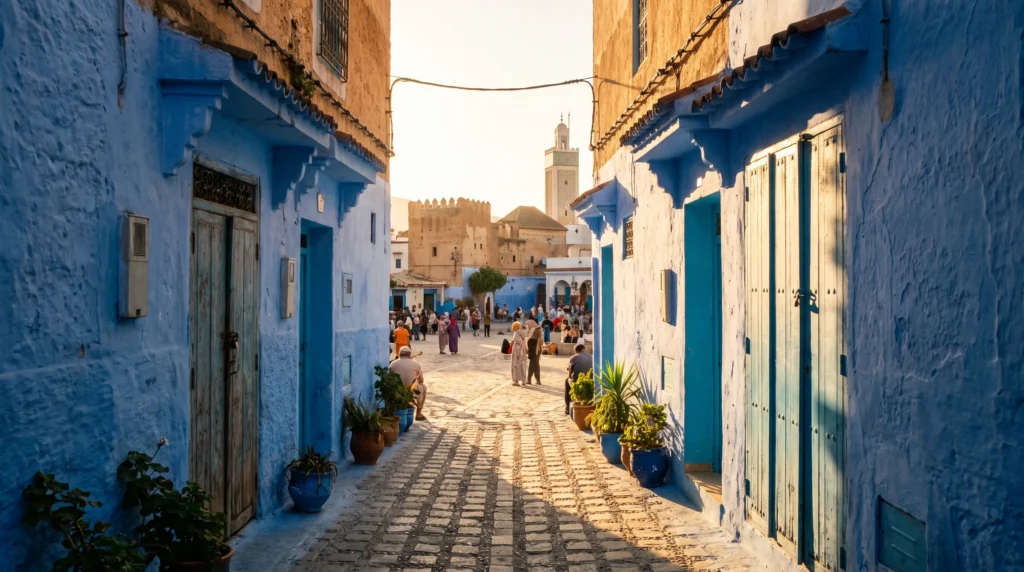
Chefchaouen Travel Guide — Inside Morocco’s Blue City in the Rif Mountains
I will tell you the honest version before the pretty version: Chefchaouen is small, it is touristy in the medina’s main arteries, and men trying to sell you kif (the local hashish, technically illegal but sold semi-openly) will ask within your first ten minutes. Now the pretty version — none of that matters once you turn down your first cobalt-blue alley and the light does something to the walls that no photo, including yours, will fully capture. Founded in 1471 as a mountain fortress against Portuguese incursions, this town of roughly 46,000 people sits at about 564 meters in the foothills of the Rif Mountains , closed to non-Muslims for over four centuries and painted, by most local accounts, blue sometime after Jewish refugees settled here in the 1930s — though the specific reasons people give (keeps mosquitoes away, symbolizes heaven, was simply a 1970s tourism push) genuinely conflict, and I’ve stopped pretending there’s one clean answer. What isn’t in dispute: this is one of the most photogenic small towns on the planet, it’s an easy add-on to a Tangier or Fez trip, and a day and a half is enough to fall for it completely.
In This Guide
- Overview — Why Chefchaouen Is Worth the Detour
- Spring Light and the Best Weeks to Shoot the Blue
- Best Time to Visit Chefchaouen (Season by Season)
- Getting There — Nearest Airports & Bus Routes
- Getting Around — The Medina Is Your Only Vehicle
- Neighborhoods — Medina, Plaza Uta el-Hammam & Beyond
- Culture & People — Andalusian Roots, Rif Identity
- A Food Lover’s Guide to Chefchaouen
- Off the Beaten Path
- Day Trips From Chefchaouen
- Practical Information
- Budget Breakdown — What Chefchaouen Actually Costs in 2026
- Frequently Asked Questions
Overview — Why Chefchaouen Is Worth the Detour
Chefchaouen (also spelled Chaouen, or simply “Chefchaouen” on every road sign) sits in the Rif Mountains of northwestern Morocco, in the Tangier-Tétouan-Al Hoceïma region, between the cities of Tétouan and Ouazzane. It was founded in 1471 by Ali ibn Rashid al-Alami as a small kasbah to resist Portuguese incursions along the coast, then grew fast after 1492 when Andalusian Muslims and Sephardic Jews expelled from Spain resettled here, which is why the medina’s tilework, doorways, and street plan feel more southern-Spanish than anything else in Morocco.
The town stayed closed to non-Muslims for roughly four centuries, only opened up after Spanish colonial forces entered in 1920, and remained a genuine backwater until relatively recently. Today it’s one of Morocco’s most photographed towns anyway — narrow lanes washed in every shade from powder to indigo, wound around a hilltop kasbah and a lively main square. Unlike Marrakech or Fez, there’s no single “must-see monument” pulling the crowds; the town itself, walked slowly, is the attraction.
That popularity has a cost. Around 120,000 tourists a year pass through a town of 46,000 people, supporting some 200 hotels and guesthouses packed into a medina built for a fraction of that footfall. Expect selfie queues on the most Instagrammed staircases by mid-morning, kids and men offering to “guide” you for a tip you didn’t ask for, and the low hum of hash offers on the main drags — this is one of Morocco’s cannabis-growing heartlands, and it shows. None of that erases what makes the place special: turn one street away from the postcard corners and Chefchaouen is still a quiet, blue, mountain town where old men play cards in the shade and nobody’s selling you anything.
Spring Light and the Best Weeks to Shoot the Blue
If photography is even half your reason for coming, aim for late March through May. The winter rains have freshened the paint, wildflowers show up in the surrounding hills, days are warm without being punishing, and the light in the medina’s narrow lanes is softer than the harsh overhead glare of a July noon. Early morning — before 9am, ahead of the tour-bus groups arriving from Tangier and Tétouan — is when the famous staircases near Bab Onsar and around Plaza Uta el-Hammam are actually empty.
Autumn (September–November) is the other sweet spot: same mild temperatures, drier air after summer, and noticeably thinner crowds than spring. If your trip lands during Ramadan, note that daytime rhythms shift — many cafés and some restaurants close until sundown, and Morocco itself reverts its clocks from UTC+1 back to UTC+0 for the month, so double-check flight and bus times against local clocks.
Best Time to Visit Chefchaouen (Season by Season)
March – May · Spring (recommended)
Mild days, cool nights, green hills, and the best natural light for the blue alleys. Book riads a few weeks ahead for Easter and any long European holiday weekends, when day-trippers from Spain pile in.
June – August · Summer (hot, busiest)
Daytime highs regularly push past 30°C in the lower town, though the mountain elevation keeps evenings pleasant. This is peak season for tour groups from Tangier and Fez — arrive at sights before 9am or after 5pm to dodge the worst of both the heat and the crowds.
September – November · Autumn (undersold)
Arguably the best value window: temperatures ease, the summer crowds thin out, and the harvest-season souks are stocked with fresh produce and, in the surrounding valleys, the cannabis harvest that quietly underwrites a lot of the regional economy.
December – February · Winter (quiet, cold, wet)
The Rif Mountains get genuinely cold and rainy at this elevation — pack layers, expect some closed rooftop terraces, and enjoy the lowest prices and the emptiest photos of the year.
Getting There — Nearest Airports & Bus Routes
Chefchaouen has no airport of its own. The closest international gateway is Ibn Battouta Airport in Tangier (TNG), roughly 120 kilometers northwest, reached by a direct CTM coach or a shared/private grand taxi in about 2.5–3 hours. Fez–Saïss Airport (FEZ) is the other common option, about 208 kilometers away, with bus connections running around five to six hours including a change in Fez or Ouazzane.
Most independent travelers fly into Tangier or Casablanca, spend a night in Tangier, then take the CTM bus (Morocco’s reliable national line) directly to Chefchaouen’s bus station on the edge of the new town, a 10–15 minute walk or short petit-taxi ride from the medina gates. Coming from Fez, the same CTM network runs several buses a day via Ouazzane; from Casablanca, budget a full travel day either way, since there’s no train line this far into the Rif.
Getting Around — The Medina Is Your Only Vehicle
Chefchaouen’s medina is entirely pedestrian: steep, stepped, cobbled lanes that no car (and barely a scooter) can navigate. You will be walking, uphill, a lot — pack shoes with grip, not sandals, for the wet-stone staircases near Ras el-Ma. The whole old town can be crossed on foot in about 20 minutes end to end, though you’ll want far longer than that to actually see it.
Petit taxis (small, official, metered or fixed-fare) handle the short hop between the bus station in the ville nouvelle (new town) and the medina gates, typically a few dirhams for a shared ride. For day trips into the surrounding mountains — Akchour, Tétouan, Tangier — grand taxis (shared, larger sedans) or a pre-booked driver are the standard options; agree the fare before you get in either type.
Neighborhoods — Medina, Plaza Uta el-Hammam & Beyond
The Medina (Old Town)
The reason you came: a maze of whitewashed-turned-blue alleys climbing the hillside, dotted with small riads, weavers’ stalls, and cats. There’s no fixed route — the fun is getting mildly lost, which is safe here in a way it isn’t in Morocco’s bigger medinas, since the whole old town is small enough that you’ll pop back out near a gate within minutes.
Plaza Uta el-Hammam
The medina’s social heart: a broad, tree-lined square ringed with café terraces, facing the red-walled Kasbah (a small fortress and museum built by the town’s founder) and the Great Mosque with its unusual octagonal minaret. Come at sunset, order a mint tea, and watch the square fill up — this is the one spot in town where sitting still is the whole activity.
Ras el-Ma
The medina’s northern edge, where a mountain spring feeds a stone water source that’s been a communal washing and gathering spot for generations. It’s cooler, greener, and quieter than the square, and a good place to see daily life (laundry, kids swimming in summer) rather than souvenir stalls.
Spanish Mosque Hill (Jama Bouzafar)
A short, well-marked hike above town to an unused mosque built during the Spanish protectorate era, now valued purely for its view — the entire blue medina spread below the Rif’s darker green slopes. Go for sunset, bring water, and expect company; this is the single most popular viewpoint in town.
Suika & the Souks
The commercial pulse of the medina — woven blankets, leather goods, spices, and the local wool garments (djellabas) the region is known for. Prices are set for tourists first; bargaining is expected and mild haggling is part of the ritual, not an insult.
Ville Nouvelle (New Town)
Where the bus station, most ATMs, pharmacies, and everyday Moroccan life (as opposed to tourist-facing medina life) actually happen. Cheaper food, functional rather than photogenic, and worth a walk through if you want to see Chefchaouen without a filter.
Culture & People — Andalusian Roots, Rif Identity
Chefchaouen’s culture is a layered thing: founded by Muslim refugees from Reconquista Spain, expanded by Sephardic Jewish families who fled the same expulsions, and set within the broader Amazigh (Berber) and Rifian identity of northern Morocco, distinct in dialect and dress from the Arab-majority south. Darija (Moroccan Arabic) and Tarifit (a Berber language) are both spoken locally, French is the default second language for business and signage, and Spanish is common this close to Ceuta and the old protectorate border — a legacy of Spain’s decades-long administration of northern Morocco.
The town’s Jewish history is now a memory rather than a living community — most families left after Moroccan independence and the founding of Israel — but the Andalusian imprint remains everywhere: in the tilework patterns, the horseshoe-arched doorways, and a general architectural vocabulary that echoes Granada and Córdoba more than Marrakech. Dress modestly in the medina (shoulders and knees covered is the norm for both genders), ask before photographing individuals, especially women, and expect friendliness that sometimes comes bundled with a sales pitch — both are genuine parts of how the town works.
A Food Lover’s Guide to Chefchaouen
Northern Moroccan cooking leans lighter and more herb-forward than the south’s tagine-and-couscous reputation suggests, though you’ll still find excellent versions of both here. Look for bissara, a thick fava bean soup drizzled with olive oil and cumin, sold as a breakfast staple in the medina’s small, no-frills spots. Goat cheese from the surrounding Rif hills turns up on nearly every menu, often grilled and served with local honey.
Rooftop restaurants around Plaza Uta el-Hammam do the tourist-facing tagines (lamb with prunes, chicken with preserved lemon and olives) reliably well, if at a markup versus the ville nouvelle’s plainer, cheaper canteens. Mint tea — poured from height, sweet enough to make your teeth ache the first time — is the social glue of every transaction, business or otherwise; accepting a cup, even briefly, is part of how negotiations (for a rug, a room, directions) actually happen here. Alcohol is scarce in the medina itself, consistent with the town’s conservative character, though a handful of hotel bars carry Moroccan wine and Casablanca beer for travelers who want it.
Off the Beaten Path
Kef Toghobeit Cave
A short drive from town lies one of Africa’s deepest known cave systems, a serious caving destination rather than a casual walk-in attraction — worth arranging only through a specialist guide or club, not a street tout.
The Ville Nouvelle’s morning souk
Skip the medina’s tourist stalls one morning and walk down to the new town’s produce and livestock market instead, where the town actually does its shopping — no postcards, no haggling theater, just Chefchaouen on a Wednesday.
Rif hillside villages
Hire a local guide for a half-day walk into the terraced villages above town, where the cannabis cultivation that quietly funds much of the region is visible on the hillsides in season. It’s a candid, non-judgmental way to understand the local economy that most day-trip itineraries skip entirely.
Day Trips From Chefchaouen
Akchour Waterfalls & Talassemtane National Park
About 30 kilometers from town, Akchour is Chefchaouen’s best half-day escape: a river gorge hike through Talassemtane National Park leading to a smaller cascade (roughly an hour’s walk) and, further on, the taller Grand Cascade and the natural rock arch known as God’s Bridge (Pont de Dieu). Trail access is free; local guides charge roughly 100–200 MAD and are worth it for the longer route. Grand taxis from Chefchaouen’s ville nouvelle run there directly, or join a shared minibus tour.
Tétouan
An hour or so south, Tétouan’s medina was inscribed as a UNESCO World Heritage Site in 1997 for its exceptionally well-preserved Andalusian character — the town absorbed waves of Muslim and Jewish refugees from Spain, much like Chefchaouen itself, and its whitewashed lanes, Royal Palace, and old Mellah (Jewish quarter) make a genuinely different day out from the blue medina.
Tangier
Two to three hours by bus, Tangier pairs a Chefchaouen trip naturally as either your arrival or departure point — its own sprawling medina, the Kasbah museum, and the Café Hafa clifftop views over the Strait of Gibraltar make it worth an overnight rather than a rushed transit stop.
Ouazzane
A smaller, far less touristed hill town about 60 kilometers away, known for its own historic zawiya (religious lodge) and as a quieter counterpoint if Chefchaouen’s crowds have worn you out.
Practical Information
Money. The Moroccan dirham (MAD) is a closed currency — you generally can’t obtain it outside Morocco and can’t legally export it, so change leftover cash before departure or at the airport. ATMs are reliable in the ville nouvelle but scarcer inside the medina; cards are accepted at larger riads and restaurants but cash rules the souks. Declare amounts over 100,000 dirhams or US$10,000 on arrival.
Safety. Morocco sits at Level 2 (“exercise increased caution”) on the US State Department’s advisory scale, largely a general terrorism-risk caution rather than anything Chefchaouen-specific. Day-to-day, the real friction is petty: persistent unofficial “guides,” inflated souvenir prices, and open (illegal but tolerated) offers of kif/hashish on the main tourist streets. Violent crime against tourists is rare here; pickpocketing and street scams are the more realistic risks, more common in Tangier and Casablanca than in Chefchaouen itself.
Health. The CDC recommends being current on routine vaccines plus Hepatitis A, and Hepatitis B and typhoid for many travelers, with rabies pre-exposure vaccination worth considering given free-roaming dogs. Avoid untreated tap water and freshwater swimming outside developed sites; bottled water is cheap and everywhere.
Connectivity & plugs. An eSIM (Orange or Maroc Telecom) covers the medina fine; expect patchier signal on the Akchour trail. Plugs are Type C and E, 230V/50Hz — the same two-round-pin standard as continental Europe, so a European adapter works, not a UK or US one. Time zone: UTC+1 year-round, except during Ramadan when Morocco reverts to UTC+0 for the month.
Budget Breakdown — What Chefchaouen Actually Costs in 2026
Chefchaouen is one of Morocco’s better travel-dollar towns — cheaper than Marrakech’s riad market, with simple, honest guesthouse pricing.
Budget (US$25–45/day): A shared or basic medina guesthouse room, bissara and tagine at ville nouvelle canteens, walking everywhere, one shared grand taxi to Akchour.
Mid-range (US$60–120/day): A riad room with a rooftop terrace and mountain view, restaurant dinners around Plaza Uta el-Hammam, a guided Akchour or Tétouan day trip, some souk shopping.
Luxury (US$180+/day): A boutique riad suite with a private hammam or plunge pool, a private driver-guide for day trips, tailored rug and leather shopping with export shipping arranged.
Bargaining is expected in the souks (start around half the quoted price and meet in the middle) but not in restaurants or fixed-price shops. Tipping 10% is appreciated, not obligatory, at sit-down restaurants; small change for porters and guides is customary.
Planning Your Chefchaouen Trip
The efficient version: two nights is enough to properly wander the medina, catch sunrise and sunset light, and fit in one Akchour or Tétouan day trip; three nights lets you slow down and add Ouazzane or a second Rif hike. Most itineraries either bookend Chefchaouen with Tangier (fly in, bus up, bus back for your flight home) or thread it between Tangier and a longer loop into Fez, one of Morocco’s great imperial medina cities, roughly five to six hours away by bus. If Chefchaouen is your first stop in the country, it’s worth reading our broader Morocco travel guide for visa, rail, and imperial-cities context before you build the rest of the route.
Frequently Asked Questions
Is Chefchaouen safe for tourists in 2026?
Yes, in the way most of Morocco is: petty hassling (unofficial guides, inflated prices, hash offers) is the real friction, not violent crime. Morocco overall sits at a general Level 2 advisory for terrorism risk rather than anything specific to this town.
Do I need a visa to visit?
US, UK, EU, Canadian and most Western passport holders can enter visa-free for stays up to 90 days, provided the passport has at least six months’ validity and a blank page for the entry stamp.
How many days do I need in Chefchaouen?
Two full days covers the medina thoroughly plus one day trip (Akchour or Tétouan). One day is workable if you’re just passing through between Tangier and Fez, but you’ll be rushing the best golden-hour light.
Is it OK to photograph the blue streets and local people?
The alleys, doorways and staircases are fair game and exactly why people come. For portraits of individuals — especially women and anyone in traditional dress — ask first; a smile and a gesture toward your camera goes a long way, and a small tip is sometimes expected if you’ve asked someone to pose.
What’s the deal with the hashish offers?
The Rif region is one of the world’s major cannabis-growing areas, and kif/hash is sold semi-openly to tourists despite being illegal under Moroccan law. Declining firmly and walking on is standard practice; buying carries real legal risk that a friendly street offer will not mention.
Chefchaouen or Fez — which first?
If you only have a few days in northern Morocco, Chefchaouen’s small scale and mountain air make it the easier, more relaxing stop; Fez is denser, bigger, and arguably more historically significant as an imperial city. Many travelers do both on one loop through Tangier.
Ready to Explore Chefchaouen?
Blue alleys that shift shade with the hour, mint tea on a square that’s been the town’s living room for over 500 years, and mountain waterfalls a short taxi ride away — Chefchaouen delivers exactly what its photos promise, hustle and all. Go for two nights, wear real shoes, and say no to the kif offers with a smile.
Explore More
- Morocco Travel Guide — visas, imperial cities and the full country picture
- Fez City Guide — Morocco’s oldest imperial medina, a bus ride away
- Marrakech City Guide — the south’s souk-and-riad counterpart
- Granada City Guide — the Andalusian roots that shaped Chefchaouen’s architecture
How this guide was built
Published as part of Facts From Upstairs’ city guide series. Built from authoritative sources — Wikipedia’s Chefchaouen entity page for history, geography and population; the UNESCO World Heritage Centre listing for the Medina of Tétouan; the US State Department’s Morocco travel advisory and entry-requirement pages; the US CDC traveler page for Morocco; Bank Al-Maghrib’s official dirham exchange-rate pages; Wikipedia’s entry on daylight saving time in Morocco for time-zone rules; World Standards’ plug/voltage reference for Morocco; and specialist trekking source Slow Morocco plus route-planner Rome2Rio for on-the-ground distance and access details to Akchour and the nearest airports. Numeric and checkable claims carry inline citations.
Sources cited on this page
- Wikipedia — Chefchaouen
- UNESCO — Medina of Tétouan
- US State Department — Morocco
- US CDC — Morocco traveler page
- Bank Al-Maghrib — Dirham exchange rates
- Wikipedia — Daylight Saving Time in Morocco
- World Standards — Morocco plugs & voltage
- Slow Morocco — Akchour Waterfalls
- Rome2Rio — Tangier Airport to Chefchaouen
- Rome2Rio — Chefchaouen to Fez Airport
More city guides you might like
Plan your trip to Chefchaouen
The booking tools we use ourselves. FFU may earn a commission at no extra cost to you.
Plan & book your trip to Chefchaouen
Booking through these searches supports our guides at no extra cost to you.