
Languages of Iraq
All languages of Western Asia →fluent beta classical · classes by phone with Maya at ranas.ai/maya
Iraq Travel Guide — Mesopotamia, the Kurdistan Region, and a Country of Two Realities
I have to split this guide in two before I’ve even started, because Iraq genuinely is two different travel propositions wearing one passport stamp. There’s the Kurdistan Region in the north — Erbil, Sulaymaniyah, mountain valleys, a citadel that may be the oldest continuously inhabited settlement on Earth — where a real, if small, tourism scene has quietly grown for over a decade, complete with visa on arrival and boutique hotels. And then there’s the rest of the country — Baghdad, Babylon, the Shia shrine cities, Basra, the marshes — which holds staggering history but currently sits under a US State Department Level 4 “Do Not Travel” advisory, the same tier as active war zones. I’m not going to pretend those two facts don’t both belong in the same guide, and I’m not going to soften either one. What follows is honest about which parts of Mesopotamia you can realistically visit right now, and which parts remain, for the moment, a story rather than an itinerary.
In This Guide
- Overview — The Cradle of Civilization, Split by Advisory Lines
- Newroz — Kurdish New Year and the Bonfire Festival
- Best Time to Visit Iraq (Season by Season)
- Getting There — Erbil, Baghdad, and the E-Visa Maze
- Getting Around — Checkpoints, Drivers and Domestic Flights
- Top Regions — Kurdistan, Baghdad and the Ancient South
- Culture & People — Arab, Kurdish and a Mosaic Beyond
- A Food Lover’s Guide to Iraq
- Off the Beaten Path
- Practical Information
- Budget Breakdown — What Iraqi Kurdistan Actually Costs
- Frequently Asked Questions
Overview — The Cradle of Civilization, Split by Advisory Lines
Iraq occupies the land the ancient Greeks called Mesopotamia — “between the rivers” — where the Tigris and Euphrates run down from the Turkish highlands through deserts and marshland to the Gulf, and where the first cities, the first written laws and the first wheel are generally credited to have appeared. Roughly 46 million people live here today, in a federal parliamentary republic that shares borders with Turkey, Iran, Kuwait, Saudi Arabia, Jordan and Syria. Independent since 1932, the country carries a modern history that most travelers already know in outline — decades of war, the 2003 invasion and its aftermath, and the 2014–2017 ISIS conflict that damaged three of its own UNESCO sites before Iraqi and coalition forces retook the territory.
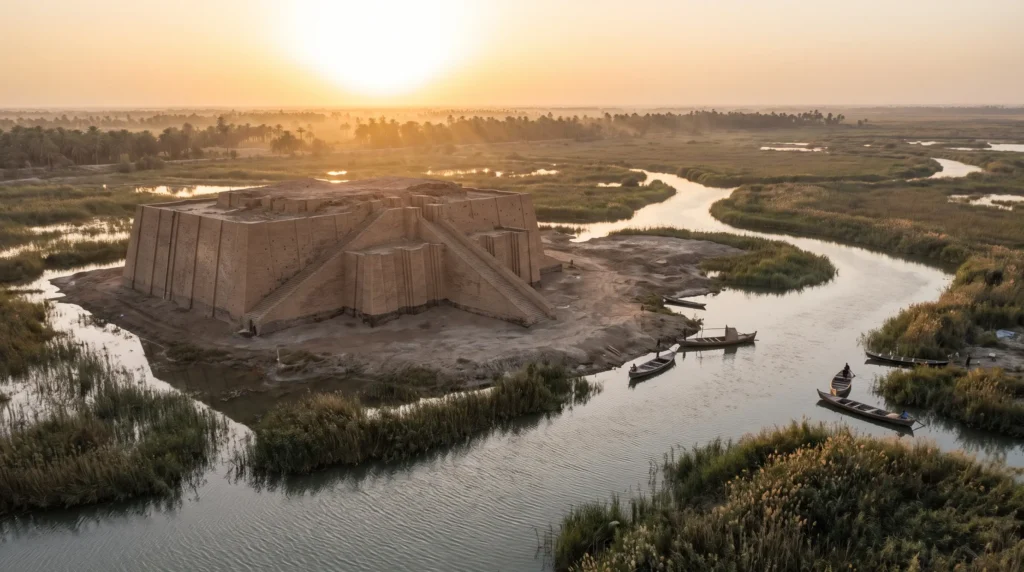
What surprises most first-time researchers is that Iraq isn’t monolithic in how safe or accessible it is. The semi-autonomous Kurdistan Region in the north — built around Erbil, Sulaymaniyah and Duhok — has run its own visa system, its own airports and a slowly growing hospitality industry for well over a decade, largely insulated from the instability that defines headlines about “Iraq” further south. Federal Iraq, by contrast, holds the sites most people actually picture when they hear the word Mesopotamia: the ruins of Babylon, the ziggurat of Ur, the spiral minaret of Samarra, the Shia shrine cities of Najaf and Karbala. Almost all of it currently sits inside a Do Not Travel advisory.
Six UNESCO World Heritage Sites carry Iraq’s name, from the Parthian fortress-city of Hatra to the wetlands of the southern marshes — and three of them remain on the List of World Heritage in Danger. This guide covers all of it honestly: what’s realistically bookable today, what belongs on a someday list, and how to tell the difference before you commit any money.
Newroz — Kurdish New Year and the Bonfire Festival
If you’re going to time a Kurdistan trip around one date, make it Newroz (Nowruz), the Kurdish and broader Persianate New Year that falls around the spring equinox, 20–21 March. Across Erbil, Sulaymaniyah, Duhok and the mountain villages, families climb hillsides at dusk, light bonfires, and dance in long chains to drum and woodwind music late into the night — it’s the single biggest, most colorful expression of Kurdish identity and culture on the calendar, openly and safely celebrated across the region.
The timing lines up neatly with the best weather window of the year: by late March, winter’s cold has broken in the mountains, wildflowers are starting across the Zagros foothills, and the brutal summer heat is still months away. Hotels in Erbil fill up around Newroz, so if you’re building a Kurdistan itinerary, book that week’s accommodation early and expect a livelier, louder version of the region than you’ll find any other time of year.
Best Time to Visit Iraq (Season by Season)
March – May · Spring (best window)
The most comfortable stretch almost everywhere. Kurdistan’s mountains turn green, Newroz falls in late March, and daytime temperatures in Erbil and Baghdad stay in a genuinely pleasant range before the summer heat builds.
June – August · Summer (avoid if possible)
Brutal. Baghdad, Basra and the southern plains routinely push past 45°C and occasionally toward 50°C in peak summer, with little relief after dark. Kurdistan’s higher towns and mountain valleys run noticeably cooler than the lowlands but are still hot by midday. Most experienced visitors simply skip this window.
September – November · Autumn
Heat breaks gradually through September, and by October conditions again resemble spring — clear skies, manageable daytime temperatures, good visibility for the mountains around Rawanduz and the Kurdistan countryside.
December – February · Winter
Mild by day in Baghdad and the south, genuinely cold with mountain snow in parts of Kurdistan — Halgurd and other high peaks near the Iranian border see real winter conditions. Rain is more frequent countrywide than any other season, though nothing close to a true monsoon.
Getting There — Erbil, Baghdad, and the E-Visa Maze
Erbil International Airport (EBL), Kurdistan’s main gateway and Iraq’s second-largest airport, runs scheduled service to roughly 31 destinations on 18 airlines, with direct connections to major hubs across Europe and the Middle East. Baghdad International Airport (BGW) is the country’s largest, serving around 32 destinations on 23 airlines, and is the main entry point for federal Iraq, including onward domestic connections — Iraqi Airways flies Baghdad–Erbil in about an hour, alongside connecting service from Royal Jordanian and others.
Visa policy is where the two Iraqs diverge most sharply. Since March 2025, Iraq suspended visa-on-arrival for most nationalities entering federal Iraq — US, UK, EU and Canadian citizens must now secure an e-visa online before travel, at a cost of roughly US$160 for a 30-day stay. The Kurdistan Regional Government runs its own, separate system: citizens of the US, UK, EU, Canada and other “List A” countries can still obtain a 30-day visa on arrival at Erbil or Sulaymaniyah airport, or apply in advance through Kurdistan’s own e-visa portal for a modest fee. Flying directly into Erbil and staying within the Kurdistan Region is, in practice, the simplest and most-traveled entry route for Western visitors.
Getting Around — Checkpoints, Drivers and Domestic Flights
Within the Kurdistan Region, a hired driver or small guided tour is the standard way to move between Erbil, Sulaymaniyah, Duhok and the mountain valleys — roads are generally in decent condition, and English-speaking guides are easy to arrange through Erbil-based tour operators. Checkpoints are frequent but routine for tourists carrying a passport and visa stamp.
Moving between Kurdistan and federal Iraq, or within federal Iraq itself, is a different proposition: domestic flights (Iraqi Airways and others) linking Baghdad, Erbil, Basra and Najaf are the practical way to cover distance without extended road time through areas with active advisories, and this is how professional tour operators and journalists typically move. Independent road travel across provincial lines in central and southern Iraq carries the same cautions flagged in the advisory above — this isn’t a self-drive-rental-car kind of country outside Kurdistan.
Top Regions — Kurdistan, Baghdad and the Ancient South
Erbil (Hewlêr)
The Kurdistan Region’s capital and Iraq’s most visited city by tourists, built around the Erbil Citadel — a fortified tell that NASA and archaeologists have both described as possibly the oldest continuously occupied settlement on Earth, with evidence of habitation stretching back to the 5th millennium BC. Inscribed by UNESCO in 2014, the citadel rises 25–32 metres above the surrounding plain and now houses a textile museum, an interpretation center and a gems museum among its restored quarters. Ring it with the sprawling Qaysari Bazaar and the palm-lined Shar Park, and Erbil is comfortably the most tourist-ready city in the country.
Sulaymaniyah (Slemani)
Kurdistan’s cultural and intellectual heart, generally considered relaxed and welcoming, with a strong café culture, the Amna Suraka (“Red Security”) museum documenting Saddam-era Kurdish persecution, and easy access to the mountains beyond.
Duhok & the Zagros Foothills
Iraq’s greenest corner, with the Duhok Dam lake, the ancient rock reliefs at Gunduk and Khinis, and jumping-off points for hiking in the mountains that separate Kurdistan from Turkey.
Rawanduz & the Hamilton Road
A dramatic mountain gorge and one of the most scenic drives in the Middle East, climbing toward the Bekhal and Gali Ali Beg waterfalls en route to the Iranian border — Kurdistan’s answer to an alpine road trip.
Lalish
The holiest site of the Yazidi faith, a valley sanctuary of conical spires near Duhok, open to respectful visitors and one of the most distinctive religious landscapes anywhere in the region.
Baghdad
The capital, home to more than eight million people, sits on the Tigris at the heart of federal Iraq. The National Museum of Iraq holds one of the great archaeological collections on Earth, and Al-Mutanabbi Street’s Friday book market is a genuine slice of the city’s intellectual life — but Baghdad sits squarely inside current Do Not Travel guidance, with specific no-go areas like Sadr City flagged separately even within that.
Babylon & Karbala/Najaf
Babylon, inscribed by UNESCO in 2019, was the largest settlement in ancient Mesopotamia under Nebuchadnezzar II and remains one of history’s most resonant place names, while Najaf and Karbala hold two of Shia Islam’s holiest shrines and draw millions of pilgrims annually. All three currently fall under advisory guidance ranging from essential-travel-only to Do Not Travel.
Basra & the Southern Marshes
Iraq’s southern port city and gateway to the Ahwar — the Mesopotamian Marshes — a mixed UNESCO site combining the wetlands’ biodiversity with the archaeological remains of Ur, Uruk and Eridu, three of the world’s earliest cities. The Marsh Arabs’ reed-house culture here is one of the most unusual living traditions anywhere in the Middle East, currently reachable mainly through specialist operators rather than independent travel.
Culture & People — Arab, Kurdish and a Mosaic Beyond
Iraq’s population is overwhelmingly Muslim — around 90–95%, split roughly 61% Shia and 35% Sunni — alongside historic Christian, Yazidi, Mandaean and small Jewish communities that have called Mesopotamia home for millennia. Arabic and Kurdish are both official languages, with Kurdish dominant across the Kurdistan Region and Turkmen, Syriac and Armenian recognized regionally elsewhere.
Hospitality runs deep in both Arab and Kurdish tradition — being invited for tea or a meal is common and should be accepted graciously. Modest dress is expected of all visitors, more strictly in conservative and religious areas of federal Iraq than in cosmopolitan Erbil, and women travelers generally find Kurdistan noticeably more relaxed than the south; a headscarf isn’t required of foreign women in Kurdistan but is respectful at religious sites everywhere. Photography of checkpoints, military installations and government buildings is restricted throughout the country — ask before photographing anything that looks official, and always ask before photographing people, especially at religious sites.
A Food Lover’s Guide to Iraq
The dish most associated with Iraq is masgouf — whole carp, split and butterflied, grilled upright beside an open wood fire until the skin crisps, traditionally served alongside the Tigris. It’s less common in restaurants outside the region than travelers expect, but where it’s done properly it’s the meal to plan a night around.
Everyday eating leans on grilled kebabs, dolma (stuffed vegetables and grape leaves), quzi (slow-roasted lamb over spiced rice), and a rich tradition of stews called timman served with rice. Kurdish cuisine in the north shares much of this DNA but adds its own dumplings and mountain-herb dishes. Bread is central everywhere — flatbreads baked in tandoor-style ovens accompany nearly every meal — and sweet, strong black tea, poured from tall kettles and served in small glasses, is the constant social ritual across both Arab and Kurdish Iraq, alongside rich, date-based desserts like kunafa and baklava-style pastries.
Off the Beaten Path
Hatra
A fortified Parthian city that withstood repeated Roman sieges in the 2nd century AD, inscribed by UNESCO in 1985 as Iraq’s first World Heritage Site — and, following damage during the 2014–2017 conflict, currently on the List of World Heritage in Danger.
Ashur (Qal’at Sherqat)
The religious and political capital of the ancient Assyrian Empire on the Tigris, inscribed in 2003, also currently listed as in danger following conflict-era damage.
Samarra
An enormous Abbasid-era capital, inscribed in 2007, famous for the spiral minaret of the Great Mosque — one of the most photographed silhouettes in Islamic architecture — and, again, currently on the danger list.
Halgurd-Sakran National Park
Kurdistan’s highest mountain terrain, near the Iranian border, popular with the region’s small but growing hiking community — always go with a local guide familiar with the terrain, given occasional remnants of old landmines in parts of the borderlands.
Practical Information
Safety. This bears repeating from the advisory above: the US State Department rates all of Iraq Level 4, Do Not Travel, while the UK FCDO takes a region-by-region view, advising against all travel to specific provinces and border zones and essential-travel-only elsewhere, including Kurdistan. Check your own government’s current page before booking, and know that consular support is severely limited in areas where advisories recommend against travel.
Money. The Iraqi dinar (IQD) trades at roughly 1,310 to the US dollar, and its value is closely managed by the Central Bank of Iraq rather than freely floating. US dollars are widely accepted alongside dinars in Kurdistan’s tourist areas; cards are usable in Erbil’s bigger hotels and malls but cash is king almost everywhere else, so carry both currencies.
Health. The CDC recommends being current on routine vaccines plus Hepatitis A for essentially all travelers, Hepatitis B for many, and typhoid for those staying with local families; rabies pre-exposure vaccination is worth considering given common street dogs, and repellent with 20%+ DEET is recommended given rising Crimean-Congo hemorrhagic fever activity and leishmaniasis risk from sand flies. Stick to bottled or filtered water and avoid swimming in untreated fresh water due to schistosomiasis risk.
Connectivity. Kurdistan has decent mobile data coverage in cities; a local SIM (Korek or Asiacell) is cheap and easy to buy in Erbil. Plugs: mainly type C and G, 230V. Time zone: UTC+3 year-round, no daylight saving.
Budget Breakdown — What Iraqi Kurdistan Actually Costs
These numbers reflect the Kurdistan Region, where independent, non-specialist travel is realistic; federal Iraq currently runs through specialist operators at premium, security-inclusive pricing that doesn’t fit a normal per-day budget breakdown.
Budget (US$35–60/day): Guesthouse or budget hotel in Erbil or Sulaymaniyah, kebab-and-rice street meals, shared taxis and local buses, self-guided citadel and bazaar time.
Mid-range (US$90–170/day): Comfortable hotel, a private driver for day trips to Rawanduz or Lalish, restaurant meals, entry fees at museums and heritage sites.
Luxury/specialist (US$250+/day): International-standard Erbil hotels, private guided multi-day Kurdistan circuits, or — for federal Iraq sites like Babylon and Ur — bundled security-inclusive tours run by specialist operators.
Tipping isn’t deeply ingrained but is appreciated in tourist-facing businesses; round up taxi fares and leave 10% in sit-down restaurants in Erbil.
Planning Your First Trip to Iraq
For nearly every first-time visitor, the realistic plan is a Kurdistan-only trip: fly directly into Erbil, spend two nights exploring the citadel, bazaar and museums, then head out to Rawanduz and the Hamilton Road for a day of mountain scenery, a night in Duhok or Sulaymaniyah, and a stop at Lalish if timing allows. Five to seven days covers the region comfortably without ever crossing into an area under Do Not Travel guidance. If you’re drawn to the wider region’s ancient history and Ottoman-era architecture without the advisory complications, pair this trip conceptually with our Turkey guide (Kurdistan borders Turkey’s own southeast) or Jordan guide, whose Nabatean ruins at Petra scratch the same “civilization carved into stone” itch that Babylon and Hatra represent — minus the advisory. Istanbul makes a natural add-on flight connection through most Erbil itineraries too.
Frequently Asked Questions
Is Iraq safe to visit in 2026?
It depends entirely on where. The US State Department rates the whole country Level 4, Do Not Travel. The UK FCDO is more granular, advising against all but essential travel to the Kurdistan Region rather than against all travel there, while still advising against all travel to specific federal provinces and border zones. In practice, Erbil and Sulaymaniyah see steady, if modest, tourist traffic; Baghdad and the south do not. Always check your own government’s current page before deciding.
Do I need a visa, and is it different for Kurdistan?
Yes to both. Federal Iraq requires US/UK/EU/Canadian citizens to obtain an e-visa online before arrival, since federal visa-on-arrival was suspended in March 2025. The Kurdistan Region runs its own system — many Western nationalities can still get a 30-day visa on arrival at Erbil or Sulaymaniyah airport, or apply in advance through Kurdistan’s own e-visa portal.
Can I visit Babylon, Ur or Samarra right now?
Realistically, only through specialist tour operators with security planning, given current advisory levels covering most of federal Iraq. Independent travel to these sites isn’t the norm the way it is in Kurdistan.
Is Iraqi Kurdistan different from “Iraq” in terms of culture and feel?
Noticeably. Kurdish, not Arabic, is the dominant everyday language, the atmosphere in Erbil and Sulaymaniyah is markedly more relaxed and modern, and the region has run its own visa and security apparatus separately from Baghdad for years.
What’s the currency situation — cash or card?
Bring both dinars and US dollars; dollars are widely accepted in Kurdistan’s tourist businesses, but cards only work reliably in Erbil’s bigger hotels and malls. The dinar trades at roughly 1,310 to the dollar.
How many UNESCO sites does Iraq have, and can I see them?
Six: Hatra (1985), Ashur (2003), Samarra (2007), Erbil Citadel (2014), the Ahwar of Southern Iraq (2016), and Babylon (2019) — three of which remain on the World Heritage in Danger list. Only Erbil Citadel sits inside the region most tourists can currently visit independently; the other five are in federal Iraq under varying degrees of advisory caution.
Ready to Explore Iraq?
Iraq holds one of the oldest continuously inhabited places on Earth, the literal birthplace of writing and the wheel, and six UNESCO World Heritage Sites spanning seven thousand years of human ambition. Right now, the honest itinerary is Kurdistan — Erbil’s citadel, Sulaymaniyah’s cafés, the mountain roads toward Rawanduz — with the rest of the country’s staggering history waiting, patiently, for its own advisory picture to change.
Explore More
- Turkey Travel Guide — the mountains and culture of Kurdistan continue north of the border
- Jordan Travel Guide — the region’s other accessible ancient-civilization hub
- Petra City Guide — carved Nabatean ruins that echo Babylon and Hatra’s scale
- Istanbul City Guide — the natural connecting hub for most Erbil flights
How this guide was built
Published . Because Iraq carries a genuinely split advisory picture rather than a single blanket warning, this guide was built to verify that split first, from primary government sources on both sides, and to write every other section honestly around it — treating the Kurdistan Region as real, currently-visited territory while flagging federal Iraq’s headline sites as sitting under Do Not Travel guidance. Sources consulted include the US State Department’s Iraq travel advisory, the UK FCDO’s Iraq travel advice, the US CDC traveler health page for Iraq, and Wikipedia entity pages for Iraq, the Iraqi dinar, Iraq’s visa policy, Erbil International Airport, Erbil Citadel, the list of Iraq’s UNESCO World Heritage Sites, and time in Iraq. Numeric and checkable claims carry inline citations.
Sources cited on this page
- US State Department — Iraq Travel Advisory
- UK FCDO — Iraq Travel Advice
- US CDC — Iraq traveler page
- Wikipedia — Iraq
- Wikipedia — List of World Heritage Sites in Iraq
- Wikipedia — Iraqi Dinar
- Wikipedia — Visa Policy of Iraq
- Wikipedia — Erbil International Airport
- Wikipedia — Erbil Citadel
- Wikipedia — Time in Iraq
More country guides you might like
Plan your trip to Iraq
The booking tools we use ourselves. FFU may earn a commission at no extra cost to you.
Plan & book your trip to Iraq
Booking through these searches supports our guides at no extra cost to you.