
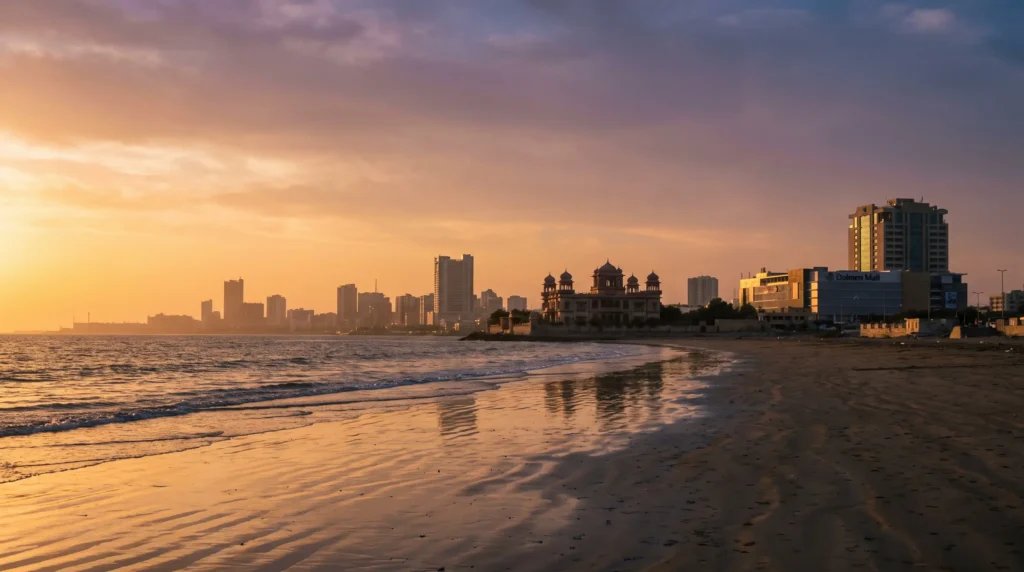
Karachi Travel Guide — Pakistan’s Megacity of Biryani, Beaches & the Arabian Sea
Karachi does not do quiet introductions. It is Pakistan’s largest city by a wide margin — somewhere around 18.9 million people inside city limits, over 20 million across the wider metro — sprawled along the Arabian Sea coast, and it runs on a rhythm most first-time visitors aren’t ready for: chaotic, warm, food-obsessed, and far more welcoming than the headlines suggest. I’ll be straight with you up front, because that’s the deal here — Karachi is not a beach-holiday postcard. It’s a working port megacity, Pakistan’s financial and commercial capital, and it takes a bit of patience and street smarts to enjoy properly. But if you like cities with texture — colonial stone next to fishing boats next to a Sufi shrine next to a biryani stall with a line out the door — this is one of South Asia’s most underrated stops, and one almost no Western traveler has actually been to.
In This Guide
- Overview — Why Karachi Is Pakistan’s Most Underrated City
- Winter Is Festival Season — Karachi Eat & the Literature Festival
- Best Time to Visit Karachi (Season by Season)
- Getting There — Jinnah International Airport & the Visa Rules
- Getting Around — Metro, Rickshaws, Ride-Hailing & Traffic
- Neighborhoods — Clifton, Saddar, DHA & Beyond
- Culture & People — A Port City of Everyone
- A Food Lover’s Guide to Karachi
- Off the Beaten Path
- Day Trips — Makli, Ranikot & the Coast
- Practical Information
- Budget Breakdown — What Karachi Actually Costs in 2026
- Frequently Asked Questions
Overview — Why Karachi Is Pakistan’s Most Underrated City
Karachi began as a small fishing settlement called Kolachi, fortified in 1729, before the British developed it into a major port under the Raj. Today it is Pakistan’s largest city and the capital of Sindh province, sitting on the Arabian Sea with a metro population above 20 million — bigger than New York, bigger than London, and mostly absent from Western travel itineraries.
It is also the country’s undisputed economic engine: the Port of Karachi and nearby Port Qasim together handle roughly 95% of Pakistan’s foreign trade, and the city generates a hugely disproportionate share of national tax revenue. That commercial weight shows up everywhere — in the skyline of banking towers along I.I. Chundrigar Road, in the sheer density of restaurants, and in a food culture that genuinely rivals Lahore’s for the national title.
What Karachi does not have is a polished tourism machine. There’s no beach resort strip, no walkable old-town circuit built for visitors, and public information in English can be thin. What it does have is scale, history layered from colonial Frere Hall to Mughal-Sindhi necropolises an hour outside town, and food that is, on balance, the best reason to come.
Winter Is Festival Season — Karachi Eat & the Literature Festival
Time a visit for February if you can. The city’s cooler, dry winter window is also when Karachi throws its two signature cultural events: the Karachi Eat Food Festival, running annually since 2016 in Clifton with 95-plus food stalls and a genuinely festive crowd, and the Karachi Literature Festival, which draws South Asian authors, publishers and a packed public program.
Both land when the weather actually cooperates — daytime temperatures sit in the pleasant low-to-mid 20s Celsius rather than the punishing summer highs — so you get the city’s best food event and its best weather in the same few weeks. Dates shift year to year, so check current listings before you book, but aiming for February is a safe bet either way.
Best Time to Visit Karachi (Season by Season)
November – February · Cool, dry season (best)
This is Karachi at its most livable: low humidity, daytime highs in the 20s°C, clear skies, and the festival calendar in full swing. It’s also peak season for outdoor sightseeing, beach visits and day trips, so book better hotels a few weeks ahead around February’s festival dates.
March – May · Hot, dry, escalating
Temperatures climb fast and humidity starts building toward the coast. Still workable for a visit if you front-load outdoor activity into mornings and evenings, but May is genuinely uncomfortable by midday.
June – September · Monsoon & peak heat
Karachi’s monsoon runs roughly June through September, with sudden downpours capable of flooding low-lying streets, layered on top of extreme heat — the city has recorded temperatures as high as 48°C in April in recent years, and summer heatwaves are a genuine health risk. This is the season to avoid unless you have a specific reason to be here; annual rainfall is modest overall (around 296mm), but it arrives in short, intense bursts that can disrupt a day’s plans entirely.
Getting There — Jinnah International Airport & the Visa Rules
Jinnah International Airport (KHI), near Gulistan-e-Jauhar and Malir on the city’s east side, is Karachi’s only real gateway and Pakistan’s second-busiest airport by passenger traffic, handling roughly 6.7 million passengers in the year to mid-2025. National carrier Pakistan International Airlines is joined by Airblue, Fly Jinnah, SereneAir and AirSial, with the busiest routes running to Islamabad, Dubai, Lahore, Jeddah and Sharjah — reflecting both domestic demand and the huge Gulf-based Pakistani diaspora. There’s no direct long-haul service from North America; most Western travelers connect via the Gulf (Dubai, Doha, Abu Dhabi) or Istanbul.
Visa reality check. This is the part that trips people up: as of early 2026, Pakistan suspended its free visa-on-arrival–style entry for most nationalities and moved almost everyone onto a paid e-visa system, now open to 192 countries through the official government portal. Single-entry tourist e-visas start around US$40 for stays of up to 90 days, and official processing is quoted at 7–10 working days — though real-world approvals have run longer, so apply at least three to four weeks before you fly, never at the last minute. Only a short list of nationalities (including China, Malaysia and the Gulf states) get the fee waived, and none of that changes the need to apply in advance. Overseas Pakistanis holding a valid NICOP or POC card are exempt.
Getting Around — Metro, Rickshaws, Ride-Hailing & Traffic
Karachi is enormous and traffic is the defining fact of daily life here — journeys that look short on a map can eat an hour at peak times. The most practical option for visitors is ride-hailing (Careem and Uber both operate widely and are inexpensive by Western standards); drivers know the city better than any map app, and fares are transparent up front.
Auto-rickshaws are cheap and everywhere but require haggling if you’re not using an app-based option, and traditional decorated “Chingchi” rickshaws and buses are a genuine only-in-Pakistan experience if you’re up for the chaos. A modern bus rapid transit system (the Green Line and related corridors) has expanded in recent years and is worth using on routes it actually covers, though it doesn’t yet blanket the whole city. Walking works within neighborhoods like Clifton or Saddar’s core, but Karachi as a whole is not a walkable city between districts — budget for cars, not sidewalks.
Neighborhoods — Clifton, Saddar, DHA & Beyond
Clifton
Karachi’s most upscale district: a seaside neighborhood with foreign consulates, high-end shopping, and the city’s best-known beach. Clifton Beach has offered camel rides to visitors since the 1950s, and the area is also home to Mohatta Palace (a museum in a stunning 1920s pink-stone mansion), the shrine of Abdullah Shah Ghazi, and the Jehangir Kothari Parade promenade.
Saddar
The old commercial heart of the city, home to Empress Market — a Victorian-era covered market building from the late 19th century still trading fresh produce, spices, textiles and handicrafts — plus the legendary Burns Road food street and Tariq Road’s shopping strip. This is where colonial-era Karachi is most visible: Frere Hall’s Gothic clocktower gardens sit nearby, and the whole district rewards a slow walk.
DHA (Defence Housing Authority)
A large, leafy, planned residential zone in South Karachi alongside Clifton — Karachi’s most expensive real estate, with manicured streets, private clubs and a growing restaurant scene aimed squarely at the city’s upper-middle class.
Boat Basin
A dedicated food strip inside Clifton, lined with tandoori joints and casual eateries serving biryani, nihari and haleem alongside fried chicken and shawarma — come hungry, come at night, and expect a queue at the good stalls.
I.I. Chundrigar Road & Old City
The financial district — Pakistan’s answer to Wall Street, lined with bank headquarters — sits close to the historic waterfront core near the port, where Karachi’s original settlement grew up.
Gulshan-e-Iqbal & the Northern Suburbs
Middle-class residential districts, useful mainly for university visits (Karachi University sits here) and as a reminder that most of Karachi’s 18.9 million residents live far from anywhere a guidebook mentions — which is itself worth seeing once.
Culture & People — A Port City of Everyone
Karachi is Pakistan’s melting pot in a way no other city in the country is. Urdu is the dominant language and lingua franca — a post-independence shift from Sindhi, which remains widely spoken alongside it — but the city’s population also carries deep Sindhi, Punjabi, Pashtun, Baloch, and Muhajir (post-Partition migrant) roots, plus long-standing Christian, Parsi and Ismaili communities.
Sufi devotional culture runs through daily life here more visibly than in most of urban Pakistan — the shrine of Abdullah Shah Ghazi in Clifton draws steady crowds of pilgrims, and Thursday-evening devotional gatherings at shrines around the city are open to respectful visitors. English sits comfortably alongside Urdu in business, education and signage, a legacy of the colonial era, which makes Karachi noticeably easier to navigate for English-speaking visitors than its language diversity might suggest.
A Food Lover’s Guide to Karachi
This is, honestly, the headline reason to visit. Karachi’s claim to Sindhi biryani — a tangier, more heavily spiced cousin of the biryani found elsewhere in Pakistan and India, built on potato and a distinctive layering of fried onions and dried plums — is fiercely defended locally, and it’s worth tasting the difference for yourself. Nihari, a slow-cooked, deeply spiced beef or mutton stew traditionally eaten for breakfast, and haleem, a wheat-and-lentil-based meat porridge pounded to a rich paste, round out the trio that defines the city’s food identity.
Burns Road in Saddar and Boat Basin in Clifton are the two essential food streets — both dense with stalls and small restaurants serving all three dishes alongside kebabs, karahi, and fresh seafood pulled straight from the Arabian Sea. Since 2016, the annual Karachi Eat Food Festival in Clifton has become the city’s biggest food event, gathering 95-plus stalls and a genuinely city-wide crowd. Street chaat, fresh sugarcane juice, and Karachi’s version of fried fish (try it at any seafront stall) are worth seeking out too — just stick to stalls with visible turnover and freshly cooked food, not anything sitting out.
Off the Beaten Path
Chaukhandi Tombs
A field of elaborately carved sandstone graves just outside the city on the Karachi–Hyderabad highway, on UNESCO’s tentative World Heritage list — a smaller, closer cousin of Makli’s much larger necropolis, and easy to combine with a half-day out of the city.
Manora Island & Fort
A short boat ride from Keamari across Karachi’s harbor, Manora mixes a colonial-era fort, a lighthouse, a Hindu temple and a beach that sees a fraction of Clifton’s crowds — a genuinely different side of the city’s maritime history.
Frere Hall
A Gothic-Venetian colonial building from the British era, now housing a library and gallery space, set in gardens that are one of the few genuinely quiet green spots in central Karachi.
Empress Market at Dawn
Most visitors see Empress Market mid-morning, busy and overwhelming. Go at first light instead, when produce is being unloaded and the Victorian arcades are nearly empty — a completely different market to photograph and understand.
Day Trips — Makli, Ranikot & the Coast
Makli Necropolis (Thatta)
The single best day trip from Karachi, roughly 98 kilometres east near the town of Thatta. Inscribed by UNESCO in 1981, Makli spreads somewhere between 500,000 and a million graves across roughly 10 square kilometres, making it one of the largest funerary sites on Earth — Sufi saints, scholars and Sindhi royalty buried here across four centuries, with the most architecturally spectacular tombs dating from the Mughal-era peak of roughly 1570–1640. The carved sandstone Chaukhandi style blends Muslim, Hindu, Persian, Mughal and Gujarati motifs and is unlike anything else in Pakistan. Hire a car and driver for the day; there’s minimal on-site infrastructure, so bring water and sun protection.
Ranikot Fort — the “Great Wall of Sindh”
A vast, sparsely visited fortification roughly 250 kilometres and about three hours’ drive from Karachi, with walls reported to run around 30 kilometres, enclosing two inner citadels known as Meri Kot and Shergarh. There are no cafés or facilities on site, so this is a full-day trip best done with a driver, plenty of water, and in the cooler winter months.
Hawke’s Bay & French Beach
Roughly 20 kilometres southwest of the city, Hawke’s Bay’s long sandy shoreline is Karachi’s classic weekend escape for swimming and picnics, with French Beach — smaller, cleaner and more low-key — a short drive further along the coast toward Paradise Point.
Practical Information
Money. The Pakistani Rupee (PKR) is issued by the State Bank of Pakistan and traded at roughly 278 to the US dollar as of mid-2026 — check a current rate before you travel, since the rupee moves. Karachi is largely cash-first outside malls, chain hotels and upscale restaurants; carry rupees for markets, rickshaws and street food, and use ATMs at recognized bank branches.
Safety. The US State Department currently rates Pakistan at Level 3, “Reconsider Travel,” citing terrorism, crime and kidnapping risk, and notes that while attacks concentrate in Balochistan and Khyber Pakhtunkhwa, incidents have also occurred in major cities including Karachi. Karachi is also named as one of the cities where the US government maintains greater security resources and infrastructure than in most of the country. The UK FCDO’s current advisory does not single out Karachi itself; its “avoid” zones concentrate on the Afghan and Indian border regions, Balochistan, Khyber Pakhtunkhwa districts and northern Sindh, rather than the city. That said: use registered taxis or ride-hailing apps rather than walking alone at night, keep a low profile with valuables, and check your own government’s current advisory before booking — this is genuinely not a destination to wing without reading up first.
Health. The CDC recommends being current on routine vaccines plus Hepatitis A, Typhoid and a polio booster for most travelers, with Hepatitis B, malaria prophylaxis, and Japanese encephalitis considered depending on itinerary and length of stay. Drink bottled or filtered water, use a strong DEET-based repellent against dengue-carrying mosquitoes, and avoid contact with stray dogs given rabies risk.
Connectivity & logistics. A local SIM or eSIM is cheap and easy to arrange; 4G coverage in the city is solid. Plugs: mainly Type C and Type D sockets at 230V, 50Hz — bring an adapter if you’re arriving from North America. Time zone: Pakistan Standard Time, UTC+5, with no daylight saving.
Budget Breakdown — What Karachi Actually Costs in 2026
Karachi is genuinely inexpensive by international standards, biryani and all — the real cost of a Karachi trip is usually the flight and the e-visa fee, not the daily spend.
Budget (US$25–45/day): Modest guesthouse or budget hotel, street food and food-street meals (biryani, nihari, haleem), rickshaws and ride-hailing for transport.
Mid-range (US$60–120/day): Comfortable 3–4 star hotel in Clifton or DHA, restaurant dining, a private car-and-driver day trip to Makli or the beaches, some shopping at Tariq Road.
Luxury (US$200+/day): International-brand 5-star hotels, private guided touring, fine dining, and door-to-door driver service for the whole stay.
Factor in the one-time e-visa cost (from roughly US$40) and, if you’re arriving from outside the Gulf region, a long-haul flight plus a connection — these fixed costs matter more to a Karachi budget than daily spending does. Tipping 10% is appreciated but not always expected at smaller eateries.
Planning Your First Trip to Karachi
Three to four days covers the city well: a day for Clifton and Saddar (Empress Market, Frere Hall, Mohatta Palace, the Boat Basin food strip), a day for the Old City and I.I. Chundrigar’s port-city energy, and a full day trip out to Makli. If you have a week, add Ranikot Fort or the beaches at Hawke’s Bay. Karachi pairs naturally with a broader Pakistan itinerary — many travelers continue north to Lahore for Mughal architecture and food culture of its own, or fly on to the Gulf via Dubai or Doha, both a short hop from KHI on the same airlines that serve Karachi daily.
Frequently Asked Questions
Is Karachi safe for tourists in 2026?
It’s complicated, and worth taking seriously rather than glossing over. The US State Department rates all of Pakistan Level 3, “Reconsider Travel,” though it notes Karachi has more security infrastructure than most of the country and that serious incidents concentrate in Balochistan and Khyber Pakhtunkhwa. The UK’s advisory doesn’t flag Karachi city itself for avoidance. Practically: stick to known neighborhoods, use ride-hailing over walking at night, keep a low profile, and read your own government’s current advisory closely before you book.
Do I need a visa for Pakistan?
Almost certainly yes, and you need to apply in advance. Since early 2026 nearly all nationalities require a paid e-visa through the official government portal, with fees from around US$40 and official processing of 7–10 working days — apply three to four weeks ahead to be safe.
Is Karachi’s biryani really different from other Pakistani or Indian biryani?
Locals will tell you emphatically yes — Sindhi biryani leans tangier and more heavily spiced, built around potato and a distinct fried-onion-and-dried-plum layering that sets it apart from Lahori or Hyderabadi styles. Try it at a Burns Road or Boat Basin stall and judge for yourself.
How many days do I need in Karachi?
Three to four days covers the city’s core sights and food scene comfortably; add a day or two for Makli Necropolis and, if time allows, Ranikot Fort or the beaches west of the city.
What’s the best way to get around the city?
Ride-hailing apps (Careem, Uber) are the easiest and most transparent option for visitors; traffic is heavy at nearly all hours, so build buffer time into any itinerary that involves crossing the city.
When should I avoid visiting?
Skip June through September if you can — the monsoon brings sudden flooding-capable downpours on top of extreme heat, and the city has recorded temperatures as high as 48°C in recent Aprils. November through February is the sweet spot.
Ready to Explore Karachi?
A colonial clocktower, a Sufi shrine, a Victorian market at dawn, and a bowl of nihari that will ruin every other version you’ve had — Karachi rewards travelers willing to do a little homework first. It isn’t polished, and it isn’t easy, but almost nobody else in your circle has been, and that’s exactly the point.
Explore More
- Lahore City Guide — Pakistan’s Mughal capital and food-culture rival
- India Travel Guide — the subcontinent next door
- Dubai City Guide — the closest major hub, minutes from KHI by air
- Doha City Guide — another easy Gulf connection from Karachi
How this guide was built
Published as part of Facts From Upstairs’ city guide series. Built from authoritative sources — Wikipedia’s entity pages for Karachi, Jinnah International Airport, Makli Necropolis and Clifton; UNESCO’s World Heritage listing for the Historical Monuments at Makli, Thatta; the State Bank of Pakistan; Pakistan’s official e-visa portal (NADRA); the US State Department’s Pakistan travel advisory; the UK FCDO’s Pakistan travel advice; the US CDC’s Pakistan traveler health page; and World Standards’ electricity reference for Pakistan. Numeric and checkable claims carry inline citations.
Sources cited on this page
- Wikipedia — Karachi
- Wikipedia — Jinnah International Airport
- Wikipedia — Makli Necropolis
- Wikipedia — Clifton, Karachi
- UNESCO — Historical Monuments at Makli, Thatta
- State Bank of Pakistan
- Pakistan Online Visa System (NADRA)
- US State Department — Pakistan
- UK FCDO — Pakistan
- US CDC — Pakistan traveler page
- World Standards — Pakistan electricity
- Rover Adventure Club — Ranikot Fort
- Tripadvisor — Hawke’s Bay
More city guides you might like
Plan your trip to Karachi
The booking tools we use ourselves. FFU may earn a commission at no extra cost to you.
Plan & book your trip to Karachi
Booking through these searches supports our guides at no extra cost to you.