
Mendoza Travel Guide — Malbec, the Andes and Argentina’s Most Livable Desert City
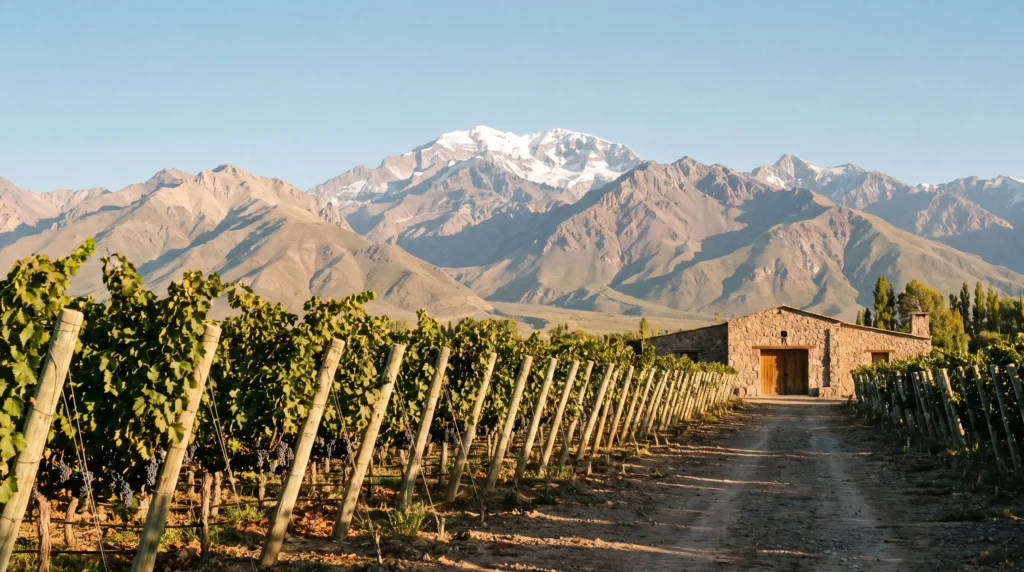
Mendoza is the city that convinced me deserts can be lush. It sits on an arid plain in the rain shadow of the Andes, gets under nine inches of rain a year, and yet feels like walking through a shaded botanical garden — because five centuries ago the Huarpe people dug irrigation channels off the mountain snowmelt, the Spanish colonists expanded them, and today roughly 100,000 street trees drink from acequias that still run along literally every block. Then there’s the other reason you’ve heard of it: this is the heart of Argentina’s Malbec country, one of only eleven cities on Earth recognized as a Great Wine Capital, with Aconcagua — the tallest mountain outside Asia — visible on a clear day from the edge of town. I’ll be straight with you: Mendoza is not a place you stumble into on a South America loop, it’s a place you plan for. The upside is that almost nobody regrets making the detour.
In This Guide
- Overview — Why Mendoza Is Argentina’s Most Livable Surprise
- Vendimia — Argentina’s Biggest Wine Harvest Festival
- Best Time to Visit Mendoza (Season by Season)
- Getting There — MDZ, Buses & the Andes Crossing
- Getting Around — Bikes, Colectivos & the Metrotranvía
- Neighborhoods — City, Chacras & the Wine Departments
- Culture & People
- Food & Wine — Malbec, Asado and Beyond
- Off the Beaten Path
- Day Trips — Alta Montaña & the Uco Valley
- Practical Information
- Budget Breakdown — What Mendoza Actually Costs in 2026
- Frequently Asked Questions
Overview — Why Mendoza Is Argentina’s Most Livable Surprise
Mendoza was founded on 2 March 1561 by Spanish captain Pedro del Castillo, and for three hundred years it grew as a quiet oasis town on the trade route between Buenos Aires and Santiago de Chile. Then, on the night of 20 March 1861, a magnitude-7.2 earthquake leveled almost the entire colonial city and killed an estimated 5,000 people — one of the deadliest quakes in Argentine history. Out of that disaster came the city you walk through today: French engineer Julio Balloffet redesigned Mendoza from scratch starting in 1863, with unusually wide streets, low buildings, and five leafy plazas arranged like a compass rose specifically so residents would have open ground to run to if the earth moved again.
That post-disaster layout is a big part of why Mendoza feels so different from other Argentine cities — airy, walkable, shaded, low-rise. The other big part is water engineering: an acequia network of open irrigation channels runs along essentially every street, diverting Andean snowmelt to water roughly 100,000 street trees in a place that receives well under nine inches of rain a year. Without it, this would be scrubland; because of it, Mendoza is one of the greenest cities per capita in South America.
And then there’s the wine. Greater Mendoza sits at the center of the largest wine-producing region in South America, and the city itself is one of only eleven members of the Great Wine Capitals Global Network, alongside Bordeaux, Porto and Napa Valley. Aconcagua, the highest mountain in the Americas at 6,961 meters, rises 112 kilometers to the northwest — visible from the city on a clear day and reachable by a single bus ride for anyone who wants to stand at its base without ever putting on crampons.
Vendimia — Argentina’s Biggest Wine Harvest Festival
If you can build a trip around one week, make it the Fiesta Nacional de la Vendimia. In 2026 the festival hits its 90th edition — themed “90 Harvests from the Same Vine” — with the main events running 6–10 March, opening with the Vía Blanca de las Reinas parade through downtown on the evening of 6 March, El Carrusel the following morning, and the Central Act and coronation of the new Vendimia Queen at the open-air Frank Romero Day Greek Theatre on 7 March, with a repeat performance on 9 March.
The Central Act is a genuine spectacle — a stadium-scale theatrical production with hundreds of dancers, folded around Argentina’s biggest harvest celebration — and it books out hotels across the whole province, so lock in accommodation months ahead if you’re aiming for early March. Every wine department also runs its own smaller Vendimia departmental festivals in the preceding weeks, which are easier to get into and arguably more fun if you’d rather skip the crowds and drink with locals instead.
Best Time to Visit Mendoza (Season by Season)
March – May · Harvest & autumn (my pick)
This is grape-crush season across the wine departments, the Vendimia festival lands in early March, and autumn color turns the vineyards gold through April and May. Days are warm, nights cool fast at altitude — bring a jacket even in March.
June – August · Winter
Cold, dry, and the quietest tourist season in the city itself, but this is also when Las Leñas and other Andean ski resorts a few hours south come alive — a genuinely underrated pairing of wine country and skiing in one trip.
September – November · Spring
Vineyards bud out, jacaranda trees bloom purple along the plazas, and the shoulder-season pricing rivals autumn’s. This is the quieter mirror image of harvest season.
December – February · Summer
Hot and dry in the city (30°C+/86°F+ afternoons are routine), but this is the only window for climbing Aconcagua and the best weather for the high-altitude Alta Montaña road trip to Puente del Inca and the Chilean border.
Getting There — MDZ, Buses & the Andes Crossing
Governor Francisco Gabrielli International Airport (MDZ), commonly still called by its old name El Plumerillo, sits about 8 kilometers northeast of downtown and handles direct flights from Buenos Aires, Santiago de Chile, and a handful of other regional hubs, plus seasonal connections further afield. Most long-haul travelers connect through Buenos Aires’ Ezeiza or Aeroparque airports first — Mendoza sits 1,037 kilometers from the capital, roughly a 1.5-hour flight or a 12–14 hour overnight bus.
The overland route from Santiago, Chile is one of the great bus rides in South America: 380 kilometers across the Andes via the Cristo Redentor pass and the Los Libertadores tunnel, roughly 6–7 hours including the border crossing, with switchback views that make the trip a destination in itself. Argentina’s long-distance bus network (cama and semi-cama sleeper classes) is excellent and connects Mendoza to Buenos Aires, Córdoba, Bariloche and beyond.
Getting Around — Bikes, Colectivos & the Metrotranvía
Central Mendoza is compact and flat, and thanks to Balloffet’s post-earthquake redesign, it’s genuinely one of the most walkable city centers in Argentina — wide sidewalks, shade the whole way, and the five central plazas within easy reach of each other. For the wine departments outside downtown, options split three ways: hop-on bike tours through Maipú’s flat vineyard roads (rent a bike near the Maipú train station and pedal between bodegas), a remise (private car) or rideshare for Luján de Cuyo and the Uco Valley, or a guided wine-tour van if you’d rather not worry about tasting-room etiquette around a rental car.
Within the city, the Metrotranvía light-rail line and a citywide bus network (the same rechargeable card works for both) cover most practical needs, and taxis and rideshare apps are cheap by international standards. Renting a car makes sense mainly for the Alta Montaña road trip toward Aconcagua and Chile, where public transport options thin out fast.
Neighborhoods — City, Chacras & the Wine Departments
Ciudad (Downtown Mendoza)
The historic core, rebuilt after 1861 around Plaza Independencia and four satellite plazas (España, Chile, San Martín, Italia), plus the enormous Parque General San Martín on the western edge — over 300 hectares of lakes, a rose garden, and Cerro de la Gloria, a hilltop monument with sweeping views back toward the Andes. This is where you’ll base yourself for restaurants, hotels and nightlife.
Chacras de Coria (Luján de Cuyo)
A leafy, upscale village-within-the-city about 20 minutes south of downtown, all cobblestone lanes and boutique guesthouses, and the easiest jumping-off point for Luján de Cuyo’s cluster of premium wineries — this is Mendoza’s most concentrated high-end Malbec territory.
Maipú
The classic first-timer wine day: dozens of bodegas within cycling distance of each other on flat roads, from historic family wineries to slicker tasting rooms, plus an olive oil mill or two and a small wine museum. If you only have one afternoon for wine outside a tasting menu, this is it.
Godoy Cruz
A residential, workaday department just south of downtown that’s increasingly folding into the city’s food and craft-beer scene — good value accommodation with an easy hop into the center.
Vistalba & Perdriel
Further into Luján de Cuyo, home to some of the region’s most architecturally striking winery restaurants — this is where you book the long, multi-course lunch with a view of the Andes foothills.
Uco Valley (Valle de Uco)
Technically a day trip rather than a neighborhood, but it belongs on this list: a higher-altitude sub-region an hour-plus south, increasingly considered Argentina’s most exciting terroir for high-elevation Malbec and Chardonnay, with dramatically modern winery architecture set against the mountains.
Culture & People
Mendocinos are proud, unhurried and food-and-wine-centric in a way that shapes the whole rhythm of the city — lunch runs long, dinner rarely starts before 9pm, and the traditional afternoon siesta still closes many shops between roughly 1pm and 5pm, especially outside the main tourist strip. The population carries strong Spanish and Italian immigrant roots, visible in the food, the Sunday-family-asado culture, and the general Argentine passion for conversation over a shared bottle.
The Vendimia festival isn’t just a tourist draw — it’s the year’s biggest civic event, with department-level pageants feeding into the national final, and locals treat the crowning of the Vendimia Queen with the kind of attention other cities reserve for a championship game. Expect the city to genuinely empty out for siesta and genuinely fill the streets for Vendimia week.
Food & Wine — Malbec, Asado and Beyond
Malbec is the headline grape and Mendoza grows the vast majority of Argentina’s supply, but don’t stop there — Luján de Cuyo and the Uco Valley also turn out excellent Cabernet Franc, Bonarda and increasingly polished Chardonnay and Torrontés at altitude. Winery lunches here are an institution: multi-course tasting menus paired flight-by-flight, often built around Argentina’s other great obsession, the asado — slow-grilled beef, chorizo and morcilla over an open wood fire.
In the city, look for empanadas mendocinas (baked, not fried, typically beef with olives and egg), chivito (roast kid goat, a regional specialty), and provoleta — a thick slab of grilled provolone, often the opening act before the asado proper. Olive oil is a genuine local product too, thanks to the same irrigation water that keeps the streets green; several Maipú bodegas double as olive mills and run oil tastings alongside the wine. For something lighter, the covered municipal markets and countless heladerías (Argentine ice cream, closer to Italian gelato) are everywhere downtown.
Off the Beaten Path
Cerro de la Gloria at sunset
Most visitors do this monument in Parque General San Martín as a quick daytime photo stop; go back near sunset instead, when the Andes light up gold and the crowds have thinned.
Villavicencio Natural Reserve
A high-altitude nature reserve about an hour from the city, home to the historic Hotel Termas de Villavicencio (the source of Argentina’s best-known bottled mineral water) and a winding mountain road with condor sightings and dramatic switchbacks — most tourists drive past it en route to Alta Montaña without stopping.
Cacheuta hot springs
A thermal-water spa complex tucked into a canyon along the Mendoza River, popular with locals rather than tour buses — a good half-day soak before or after the Alta Montaña drive.
San Rafael’s wine-and-adventure scene
Three-plus hours south, a smaller, far less touristed wine department that pairs vineyards with rafting on the Diamante River and access to the Cañón del Atuel canyon.
Day Trips — Alta Montaña & the Uco Valley
Ruta 7 Alta Montaña (the Aconcagua road trip)
The classic full-day trip: west out of the city along National Route 7 through the town of Uspallata, past Puente del Inca (a striking natural sulfur-stained rock bridge) and Aconcagua Provincial Park, where you can see the mountain’s south face from a viewpoint without a permit, before the road climbs to the Cristo Redentor statue at the Chile border. Actually summiting Aconcagua is a multi-week, permitted expedition attempted mostly in the December–February window — this drive is how the other 99% of visitors experience it.
Uco Valley wine tour
A full day dedicated to the higher-altitude Uco Valley, an hour-plus south of the city, hitting two or three architecturally ambitious wineries with a long lunch in between — best done with a driver or organized tour given the distances between estates.
Potrerillos & the Mendoza River
Closer in, roughly 45 minutes west, a reservoir-and-mountain landscape good for rafting, zip-lining or simply a scenic lunch stop en route to or from the Alta Montaña drive.
Practical Information
Money. The Argentine peso floats and has moved significantly over the past year — it traded around 1,488 per US dollar in early July 2026, so check a live rate before you go rather than trusting an old number. Cards are widely accepted in the city and at wineries; carry some cash for markets, small kiosks and rural day trips.
Visa & insurance. US, UK, EU and Canadian passport holders get visa-free entry, typically for up to 90 days. Since a July 2025 regulation, all foreign visitors must be able to show proof of travel medical insurance covering the length of their stay at the border — build this into your pre-trip checklist, since airlines and border officials can both ask for it.
Safety. The US State Department rates Argentina overall Level 1 — Exercise Normal Precautions (last updated May 2026), with a specific Level 2 exception for the city of Rosario, hundreds of kilometers northeast of Mendoza. Mendoza itself is generally easygoing; use normal city-travel sense around the bus terminal and at night.
Health. The CDC recommends Hepatitis A for most travelers and Hepatitis B for unvaccinated travelers under 60; yellow fever vaccination is only relevant if you’re also visiting Corrientes or Misiones provinces, not Mendoza. Standard precautions apply: bottled or filtered water outside hotels, mosquito precautions, and caution around freshwater exposure.
Altitude & connectivity. The city itself sits at a mild 747 meters, so altitude isn’t a concern downtown, but the Alta Montaña drive climbs well over 3,000 meters — take it easy if you’re prone to altitude symptoms. An eSIM covers most of the province; connectivity thins out past Uspallata. Plugs: Type C and Type I, 220V. Time zone: UTC−3 year-round, no daylight saving.
Budget Breakdown — What Mendoza Actually Costs in 2026
Mendoza runs cheaper than Buenos Aires’ tourist zones for lodging and street food, but wine-country experiences (tasting menus, premium bodega visits) can climb fast — the peso’s volatility also means dollar-equivalent prices shift month to month, so treat these as rough bands.
Budget (US$35–65/day): Hostel dorm or basic guesthouse downtown, empanadas and market lunches, self-guided Maipú bike-and-wine day, colectivo and Metrotranvía for transport.
Mid-range (US$90–180/day): Boutique hotel in Chacras de Coria or downtown, a couple of paid winery tastings plus one multi-course winery lunch, a half-day Alta Montaña tour, restaurant dinners with a good Malbec.
Luxury (US$300+/day): Wine-estate lodge stays, private driver-guided full-day tours across Luján de Cuyo and the Uco Valley, chef’s-table pairings at architect-designed winery restaurants.
Tipping around 10% is customary at sit-down restaurants where it isn’t already included; wineries often charge a tasting fee that’s credited back if you buy bottles.
Planning Your First Trip to Mendoza
The classic itinerary is four to five nights: two days split between Maipú (bikes and casual bodegas) and Luján de Cuyo or the Uco Valley (the long lunch and premium tastings), one full day for the Alta Montaña drive to Puente del Inca and the Chile border, and the rest for the city itself — plazas, Parque General San Martín, and Cerro de la Gloria at sunset. Most people arrive via Buenos Aires, a 1.5-hour flight or overnight bus away, and many combine Mendoza with a crossing over the Andes to Santiago, Chile — the 380-kilometer bus ride over the Cristo Redentor pass is a bucket-list drive on its own. If you have more time, our full Argentina guide covers the rest of the country, and our Chile guide picks up the wine trail on the other side of the mountains.
Frequently Asked Questions
Is Mendoza safe for tourists in 2026?
Yes, generally. The US State Department rates Argentina overall at Level 1 — Exercise Normal Precautions, with its one regional exception (Rosario) far from Mendoza. Use normal precautions around the bus terminal and at night, and keep an eye on your government’s current advisory before you travel.
Do I need a visa, and what’s this insurance requirement?
US, UK, EU and Canadian passport holders don’t need a visa for stays up to about 90 days. Since a July 2025 regulation, though, every foreign visitor must be able to show proof of travel medical insurance covering their stay — buy a policy before you fly and keep the confirmation handy at the border.
Can I visit Mendoza’s wineries without a car?
Easily in Maipú, where rental bikes and flat roads connect a cluster of bodegas — no car needed. Luján de Cuyo and the Uco Valley are more spread out and better done with a private driver, rideshare, or a guided wine-tour van, especially since you’ll be drinking.
What’s the exchange rate situation like?
The Argentine peso floats and has been volatile — it traded around 1,488 per US dollar in early July 2026 but moves meaningfully month to month, so check a live rate close to your trip rather than budgeting off an old number.
Can I see Aconcagua without climbing it?
Yes — the Ruta 7 Alta Montaña day trip takes you into Aconcagua Provincial Park for a viewpoint of the mountain’s south face, no permits or technical experience required. Actually summiting is a multi-week expedition best attempted December through February.
Mendoza or Buenos Aires for a first Argentina trip?
If you only have one stop, Buenos Aires is the bigger, more essential Argentine experience. But if wine, mountains and a slower pace appeal to you, Mendoza pairs beautifully as a 4-5 night add-on reachable by a short flight — don’t try to do it as a rushed overnight from the capital.
Ready to Explore Mendoza?
Shaded plazas fed by mountain snowmelt, Malbec by the barrel at a winery with the Andes as a backdrop, and one of the tallest peaks outside Asia close enough to see from your hotel window. Mendoza rewards travelers who slow down for it — book the long lunch, skip the rush, and let the siesta win.
Explore More
- Argentina Travel Guide — the full country beyond Mendoza’s wine country
- Buenos Aires City Guide — Argentina’s capital, a short flight away
- Santiago City Guide — across the Andes via the Cristo Redentor pass
- Chile Travel Guide — continue the wine trail into Casablanca Valley
How this guide was built
Published as part of Facts From Upstairs’ city guide series. Built from authoritative sources — Wikipedia entity pages for Mendoza, Aconcagua, the 1861 Mendoza earthquake and Governor Francisco Gabrielli International Airport; the Great Wine Capitals Global Network; the US State Department’s Argentina travel advisory and country information page; and the US CDC traveler page for Argentina, plus a live exchange-rate source for the Argentine peso. Numeric and checkable claims carry inline citations.
Sources cited on this page
- Wikipedia — Mendoza, Argentina
- Wikipedia — Aconcagua
- Wikipedia — 1861 Mendoza earthquake
- Wikipedia — Governor Francisco Gabrielli International Airport
- Great Wine Capitals Global Network — Mendoza
- Time Out Buenos Aires — Vendimia Festival 2026
- US State Department — Argentina Travel Advisory
- US State Department — Argentina Country Information
- US CDC — Argentina Traveler Page
- Trading Economics — Argentine Peso Exchange Rate
More city guides you might like
Plan your trip to Mendoza
The booking tools we use ourselves. FFU may earn a commission at no extra cost to you.
Plan & book your trip to Mendoza
Booking through these searches supports our guides at no extra cost to you.