
Paro Travel Guide — Tiger’s Nest, Bhutan’s Only Airport & the World’s Most Deliberately Uncrowded Valley
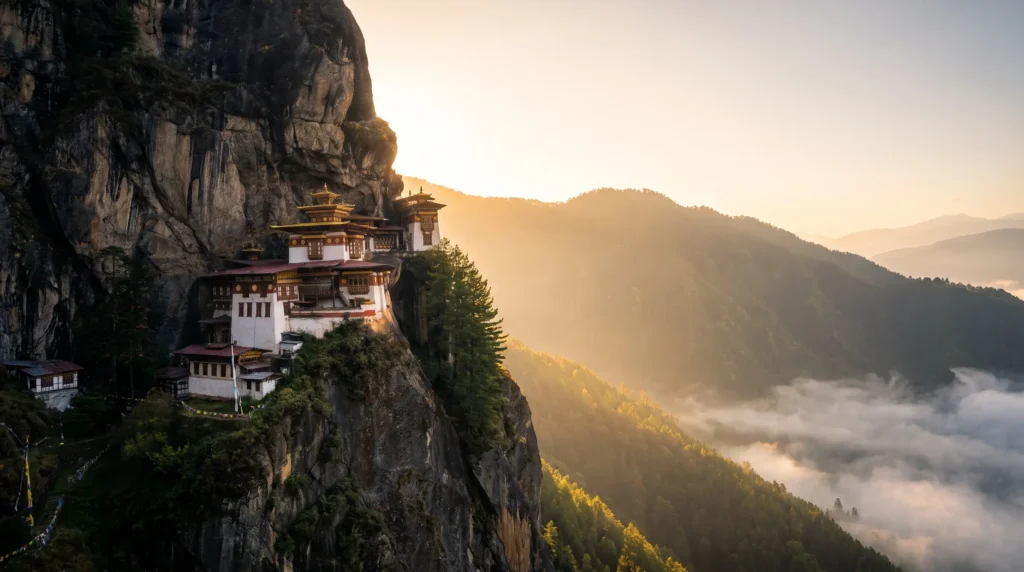
Paro is a small town — about 11,400 people, easily walked end to end — that happens to hold the single most photographed building in the Himalayas and the only runway any of us can use to get into Bhutan at all. Paro International Airport is famously one of the hardest commercial airports on Earth to land at, tucked into a valley ringed by peaks up to 5,500 meters, which means your first twenty minutes in Bhutan are already unlike anywhere else you’ve flown into. Then there’s Paro Taktsang — the Tiger’s Nest monastery — glued to a sheer cliff 900 meters above the valley floor, which you’ll hike to for three hours each way and which will absolutely be worth every step. I’ll say the honest part up front too: Bhutan isn’t a place you drift into on a whim. There’s a mandatory nightly fee, a visa process, and a national policy built specifically to keep visitor numbers low — which is exactly what makes the valley feel the way it does when you’re standing in it.
In This Guide
- Overview — Why Paro Is Almost Everyone’s Bhutan
- Paro Tshechu — Masked Dances & the Giant Thongdrel
- Best Time to Visit Paro
- Getting There — The World’s Trickiest Runway
- Getting Around Paro
- Neighborhoods — Town, Valley & the Dzong
- Culture & People — Dzongs, Dress & Gross National Happiness
- A Food Lover’s Guide to Paro
- Off the Beaten Path
- Day Trips — Thimphu, Chele La & Beyond
- Practical Information
- Budget Breakdown — What Paro Actually Costs in 2026
- Frequently Asked Questions
Overview — Why Paro Is Almost Everyone’s Bhutan
Paro sits in a wide, willow-and-rice-terrace valley in western Bhutan, at roughly 2,200 meters above sea level, and it punches enormously above its weight for a town of around 11,400 people. That’s because Paro International Airport is Bhutan’s only international gateway — every visitor who arrives by air lands here first, threading between Himalayan ridgelines on an approach so demanding that, for years, only a small, specially certified pool of pilots worldwide was cleared to fly it.
The valley’s headline sight is Paro Taktsang, the “Tiger’s Nest” monastery, which appears in nearly every photograph anyone has ever taken of Bhutan: a cluster of white temple buildings seemingly stuck to a granite cliff face, 900 meters above the valley floor and 3,120 meters above sea level. Founded where legend says Guru Rinpoche — the tantric master credited with bringing Buddhism to Bhutan — flew in on the back of a tigress and meditated in a cliffside cave, the current temple complex dates its foundation to 1692. Below it in town, Rinpung Dzong — the fortress-monastery that has run Paro’s religious and administrative life since 1646 — anchors a valley that also holds the National Museum of Bhutan, working rice paddies, and some of the country’s oldest farmhouses.
Here’s the part I won’t soften: Bhutan runs a deliberate “High Value, Low Volume” tourism policy, and Paro is where that policy becomes concrete. Every non-Indian tourist pays a Sustainable Development Fee on top of trip costs, needs an approved visa arranged in advance, and typically travels with a licensed local guide. It is not a spontaneous backpacker stop — you book Bhutan the way you’d book a small, carefully managed expedition, not the way you’d book a weekend in Bangkok. That structure is also precisely why Taktsang’s trail isn’t lined with souvenir stalls and why Rinpung Dzong’s courtyard isn’t overrun. You’re paying, in a very literal sense, for the emptiness.
Paro Tshechu — Masked Dances & the Giant Thongdrel
If you can build a trip around one date, make it Paro Tshechu, a five-day festival held on the 11th through 15th days of the second month of the Bhutanese lunar calendar — which typically lands somewhere in late March or April — in the courtyard of Rinpung Dzong. Monks and lay dancers perform elaborate cham — masked dances retelling stories of Guru Rinpoche and the triumph of good over evil — over several days, drawing Bhutanese from across the region dressed in their finest gho and kira.
The climax comes before dawn on the final day, when a massive appliquéd thongdrel — a sacred silk banner depicting Guru Rinpoche’s eight manifestations — is unfurled on the dzong’s facade for a few hours only, taken down before direct sunlight can touch it. Bhutanese believe simply viewing the thongdrel cleanses accumulated sin, and watching a courtyard full of people filing past at first light, still half-asleep, is one of the more genuinely moving things you can witness as a visitor here. Because the date follows the lunar calendar, confirm exact days with your tour operator six to nine months out — sources routinely differ by a week or two on the projected dates for any given year.
Best Time to Visit Paro
March – May · Spring (peak)
Clear mountain views, rhododendrons blooming on the higher passes, and Paro Tshechu usually falling somewhere in this window. This is Bhutan’s busiest season for good reason — book flights and guides well ahead, since Drukair and Bhutan Airlines seats and the country’s limited hotel stock both tighten up fast.
June – August · Monsoon
Warm, wet, and hazier — mountain views become unreliable and some trekking routes turn muddy. Paro town itself stays walkable between downpours, and this is the quietest, cheapest stretch if you don’t need a perfect Himalayan panorama from Chele La.
September – November · Autumn (peak)
Bhutan’s clearest, most reliable weather: crisp air, sharp mountain views, and the country’s other big festival season (Thimphu Tshechu usually falls in autumn). Paro’s rice terraces turn gold before harvest — arguably the single best month for photographs in the whole valley.
December – February · Winter
Cold at night, often below freezing, but dry and clear by day with the sharpest possible views of the snow-capped peaks ringing the valley — including, on a good day, Jomolhari. Fewer crowds, lower hotel rates, and the Tiger’s Nest hike is genuinely more comfortable in cool, dry air than in spring heat.
Getting There — The World’s Trickiest Runway
Paro International Airport is Bhutan’s sole international airport and sits in a valley surrounded by peaks reaching roughly 5,500 meters, which restricts landings to daylight hours under visual (not instrument) conditions — a big part of why it’s routinely ranked among the world’s most difficult commercial airports. Only Bhutan’s two carriers, Drukair (Royal Bhutan Airlines) and Bhutan Airlines, fly here, connecting to a compact network of regional hubs — Delhi, Kolkata, Kathmandu, Bangkok, Singapore and Dubai among them — meaning almost everyone reaches Bhutan via a connection through one of those cities.
The descent itself is part of the experience: the final approach banks between ridgelines and farmhouses close enough that you can pick out prayer flags before touchdown, a maneuver only a relatively small pool of specially certified pilots is cleared to fly. Since your flight, visa and Sustainable Development Fee are almost always bundled through a licensed Bhutanese tour operator, “getting there” for most visitors is less a logistics puzzle and more a matter of picking the operator and letting them handle the paperwork.
Getting Around Paro
Paro town itself is small enough to walk end to end in well under an hour — the main street, Rinpung Dzong, and the river footbridge all sit within easy strolling distance of most hotels. Almost all visitor movement beyond town, though, happens by private car with driver, arranged as part of your tour package; self-drive rental isn’t really part of how independent travel works here, and most itineraries come with a dedicated vehicle and guide for the length of the trip.
The one big exception is Taktsang itself, which has no road access at all: you reach it on foot or by mule along a switchbacking forest trail, roughly three hours up and two back down at an easy pace, with a teahouse roughly halfway that makes a natural rest stop. For day trips further afield — Thimphu, Chele La pass, or onward into central Bhutan — your guide’s vehicle does the driving on winding, well-maintained but slow mountain roads, where distances that look short on a map take longer than you’d expect.
Neighborhoods — Town, Valley & the Dzong
Paro Town Center
A single traditionally painted main street lined with shopfronts, a produce and archery-goods market, and a handful of restaurants — small enough to see in twenty minutes, charming enough to want to linger for an afternoon. This is also where most mid-range hotels and guesthouses cluster.
Rinpung Dzong & the Old Bridge
The valley’s administrative and spiritual anchor, built in 1646 by Zhabdrung Ngawang Namgyal, the lama who first unified Bhutan, and still functioning today as both the district’s monastic body’s seat and its government offices. A traditional covered cantilever bridge crosses the Paro River just below it — one of the most photographed single frames in the valley, especially at golden hour.
Ta Dzong & the National Museum
A round, seven-story watchtower built in 1649 above Rinpung Dzong, now housing the National Museum of Bhutan’s collection of textiles, thangka paintings, weapons and natural history exhibits — a good primer before you head into the dzongs and monasteries themselves.
Satsam Chorten & the Taktsang Trailhead
The base area for the Tiger’s Nest hike, about 10 kilometers north of town, with a car park, ticket checkpoint, and the first switchbacks up through blue pine forest. Arrive early — both for cooler hiking temperatures and to beat the mid-morning cluster of tour groups.
Drukgyel & the Upper Valley
North of the Taktsang turnoff, the valley narrows toward Drukgyel Dzong, a dramatic ruined fortress (gutted by fire in 1951, partially restored since) that once guarded Bhutan’s approach from Tibet, with Mount Jomolhari visible on clear days beyond it. This stretch is quieter, greener, and largely free of the day-trip crowds that gather around Taktsang itself.
Bondey & the Southern Valley
South of town toward the airport, a more workaday stretch of farmhouses, rice terraces and the road out toward Chuzom and the Thimphu highway — less visited but a good window into everyday valley life away from the main tourist circuit.
Culture & People — Dzongs, Dress & Gross National Happiness
Dzongkha is Bhutan’s national language, though English is the medium of school instruction nationwide and widely spoken in tourism, hotels and among guides, which makes independent conversation easy even without a word of Dzongkha. Bhutan is famous for measuring progress through Gross National Happiness rather than GDP alone, a policy framework that shows up in everyday Paro life as a strong emphasis on environmental protection, cultural preservation and modest, unhurried development — no billboards, no high-rises, and a national dress code (the gho for men, kira for women) still worn daily, not just for festivals.
Buddhism, in its Drukpa Kagyu form, shapes daily rhythm here more visibly than in most places you’ll visit: prayer flags strung across every ridge and bridge, prayer wheels spun by hand outside temples, and dzongs that still function as working monastic and government seats rather than museum pieces. Photography inside temple interiors is typically restricted or banned outright — ask your guide before raising a camera, and always ask before photographing monks or ceremonies up close, at Paro Tshechu especially.
A Food Lover’s Guide to Paro
Bhutan’s national dish is ema datshi — chilies, treated as a vegetable rather than a mere seasoning, stewed in a thick yak or cow’s-milk cheese sauce. It’s fiery, addictive, and served at nearly every meal alongside red rice, the slightly nutty, pinkish local staple grown right in Paro’s own valley terraces. Look also for kewa datshi (potatoes in cheese sauce) and shakam paa (dried beef stir-fried with chilies and radish) as milder companions if the chili sauce proves too much on day one.
Momos — Tibetan-style dumplings, filled with cheese, pork or vegetables — are everywhere and make an easy, satisfying lunch between sightseeing stops. Butter tea (suja), salty and rich, is the traditional hot drink, while ara, a home-distilled rice or grain spirit, turns up at village meals and celebrations. Most hotel and tour-package meals in Paro run as generous buffet spreads mixing Bhutanese dishes with milder continental and Indian options — ask your guide to steer you toward a genuinely local farmhouse meal at least once, ideally including a taste of the valley’s own red rice harvest.
Off the Beaten Path
Kyichu Lhakhang
One of Bhutan’s oldest temples, said to date to the 7th century, sitting quietly in the valley a short drive from town — far fewer visitors than Taktsang, and a good, calm counterpoint to the busier sights.
Drukgyel Dzong
The ruined fortress at the valley’s northern end rarely makes it onto tight one-day itineraries, which makes it one of the better spots for an unhurried, uncrowded look at Bhutanese military architecture and a clear-day view of Jomolhari beyond.
Farmhouse Visits & Hot Stone Baths
Several valley families open their traditional rammed-earth farmhouses to visitors for a meal or a dotsho — a hot stone bath heated with fire-warmed river stones dropped straight into the tub, often infused with local herbs. Arrange it through your guide rather than turning up unannounced.
Chumphu Ney
A lesser-known hillside hermitage and meditation site above the valley, reached by a quieter trail than Taktsang’s — a good option if you want a comparable hike-to-a-cliffside-shrine experience without the crowds building around Bhutan’s most famous monastery.
Day Trips — Thimphu, Chele La & Beyond
Bhutan’s capital, Thimphu, sits about 54 kilometers and roughly an hour to an hour and a half’s drive east of Paro, and is easily done as a day trip or, better, folded into a multi-night itinerary. Highlights include the giant Buddha Dordenma statue overlooking the city, Tashichho Dzong, and the weekend handicrafts market — Thimphu has its own guide on this site if you want the full rundown.
Chele La Pass, at roughly 3,988 meters, is the highest motorable road pass in Bhutan and a straightforward half-day trip from Paro, strung with prayer flags and offering, on a clear morning, sweeping views of both Jomolhari and the valleys toward Haa. Combine it with a stop in the quieter, less-visited Haa Valley beyond the pass if you have an extra day and want a genuinely off-circuit detour.
Travelers continuing beyond western Bhutan typically fly domestically or drive several hours east toward the Punakha and Wangdue valleys for the country’s other major dzongs and river-rafting spots — a natural extension if you have five days or more rather than the minimum three.
Practical Information
Money. Bhutan’s currency, the Ngultrum, is pegged 1:1 to the Indian Rupee, and Indian Rupees circulate as legal tender alongside it, which is convenient if you’re arriving via India. Cards are accepted at larger hotels in Paro and Thimphu but far less reliably elsewhere; carry cash for smaller purchases, temple donations and market stalls.
Visa & fees. Every non-Indian visitor needs an approved visa arranged in advance and pays the Sustainable Development Fee — currently US$100 per person per night for most nationalities (Indian nationals pay a separate, much lower rate in Rupees), with a 50% discount for children aged 6–12 and a full exemption under age 6. In practice, nearly all independent travelers book through a licensed Bhutanese tour operator, who arranges the visa and folds the SDF into the trip cost — verify current rates and any policy changes directly with your operator or Bhutan’s official tourism channels before booking.
Safety. The US State Department rates Bhutan at Level 1, “Exercise Normal Precautions,” its lowest advisory tier, reflecting Bhutan’s reputation as a genuinely low-crime, low-hassle destination for visitors. The main practical risks are altitude and terrain rather than crime — Paro sits above 2,200 meters and mountain trails demand reasonable fitness and sturdy footwear.
Health. Altitude illness is the main concern for anyone trekking to higher elevations; ask a doctor about acclimatization if you have a history of altitude sensitivity, and pace the Taktsang hike rather than rushing it. Routine vaccinations plus hepatitis A and typhoid are commonly recommended for the region; check current CDC guidance before you travel. Connectivity: local SIMs are available in Paro and Thimphu, and hotel Wi-Fi is generally reliable in town, patchier at remote lodges. Plugs: mostly type D and G sockets, 230V. Time zone: Bhutan Time, UTC+6, no daylight saving.
Budget Breakdown — What Paro Actually Costs in 2026
Budgeting for Bhutan works differently than most destinations, because the US$100-per-night Sustainable Development Fee is a fixed cost layered on top of whatever tier of trip you choose — there’s no genuinely “shoestring” Bhutan the way there might be a shoestring Nepal next door.
Simple package (US$80–150/day on top of the SDF): Basic hotel or guesthouse, set Bhutanese-buffet meals, shared group guiding and vehicle.
Mid-range (US$200–350/day on top of the SDF): Comfortable 3–4 star hotel, private guide and driver, a farmhouse meal or hot stone bath add-on, more flexible itinerary timing.
Luxury (US$500+/day on top of the SDF): Five-star lodges (Aman, COMO, Six Senses and similar operate properties in the Paro/Thimphu corridor), private touring, curated cultural experiences and top-tier dining.
Fixed costs to expect regardless of tier: the nightly SDF, museum and dzong entry fees (modest, usually a few dollars each), and tipping for guides and drivers, which is customary though not legally mandated. Since flights, visa and SDF are typically bundled by your tour operator, ask for an itemized quote up front so you know exactly what’s included.
Planning Your Paro Trip
Three to four nights in and around Paro covers the essentials without rushing: a day for Rinpung Dzong, Ta Dzong and the town itself, a full day for the Taktsang hike (build in a rest day either side if you’re not acclimatized), and a day trip to Thimphu or Chele La Pass. Most visitors extend into central Bhutan — Punakha and Wangdue — for a week-plus trip, or pair Bhutan with a stop in Kathmandu on the way in or out, since Kathmandu is one of Drukair’s regional hub connections. If you’re building a wider Himalayan itinerary, our Nepal travel guide and Bhutan travel guide both cover the broader country-level planning that sits around a Paro-based trip.
Frequently Asked Questions
Do I need a visa to visit Paro?
Yes, unless you hold an Indian passport. All other nationalities need an approved visa arranged in advance, almost always handled by the licensed Bhutanese tour operator you book through, alongside the mandatory Sustainable Development Fee.
What is the Sustainable Development Fee and how much is it?
It’s a mandatory nightly fee funding healthcare, education, environmental protection and cultural preservation in Bhutan, currently US$100 per person per night for most nationalities, with a 50% discount for children aged 6–12 and a full exemption under age 6. It’s separate from — and additional to — your accommodation, guiding and transport costs.
Is the Tiger’s Nest hike hard?
It’s a genuine hike, not a stroll: roughly three hours up and two back down on a switchbacking trail, gaining about 900 meters from the trailhead to the monastery. Reasonable fitness helps, but the pace is entirely up to you, there’s a teahouse roughly halfway to rest and refuel, and mules are available for part of the route if you’d rather not walk the whole thing.
Is Bhutan safe to visit?
Very much so — the US State Department rates it Level 1, “Exercise Normal Precautions,” its lowest risk tier. The practical risks travelers actually encounter are altitude and rough trail terrain, not crime.
How many days should I spend in Paro?
Three to four nights covers the valley’s core sights — Rinpung Dzong, the National Museum, Taktsang and a Thimphu or Chele La day trip — without feeling rushed, though many itineraries use Paro as the entry/exit point for a longer central-Bhutan loop.
Why is Paro’s airport considered so dangerous?
It’s not “dangerous” in the sense of a poor safety record, but it is exceptionally demanding: the valley is ringed by peaks up to roughly 5,500 meters, landings are restricted to daylight visual-approach conditions, and only a relatively small pool of specially certified pilots is cleared to fly it. It’s a remarkable, memorable approach to watch from the window rather than something to worry about.
Ready to Plan Paro?
A monastery stuck to a cliff, a fortress that’s run the valley since the 1600s, a runway that only a handful of pilots on Earth are trained to land on — Paro packs an outsized amount of wonder into a town you can walk across in twenty minutes. It takes more paperwork than most trips, and it isn’t cheap, but that’s precisely the trade that keeps this valley from turning into anywhere else in the Himalayas.
Explore More
- Thimphu City Guide — Bhutan’s capital, an hour east of Paro
- Bhutan Travel Guide — the full country-level planning picture
- Kathmandu City Guide — a common regional gateway on the way to or from Bhutan
- Nepal Travel Guide — for building a wider Himalayan itinerary
How this guide was built
Published as part of Facts From Upstairs’ city guide series. Built from Wikipedia entity pages for Paro, Bhutan, Paro International Airport, Paro Taktsang and Rinpung Dzong; the official Paro Dzongkhag Administration’s Paro Tsechu festival page; VisitBhutan.com’s Sustainable Development Fee summary; the US State Department’s Bhutan travel advisory; and the US CDC’s Bhutan traveler page. Numeric and checkable claims carry inline citations. Bhutan currently has no inscribed UNESCO World Heritage Sites — Rinpung Dzong and several other Paro-area sites sit on Bhutan’s UNESCO Tentative List rather than the full World Heritage List, and this guide describes that status accurately rather than overstating it.
Sources cited on this page
- Wikipedia — Paro, Bhutan
- Wikipedia — Paro International Airport
- Wikipedia — Paro Taktsang (Tiger’s Nest)
- Wikipedia — Rinpung Dzong
- Wikipedia — Bhutan
- Paro Dzongkhag Administration — Annual Paro Tsechu
- VisitBhutan.com — Sustainable Development Fee
- US State Department — Bhutan Travel Advisory
- US CDC — Bhutan Traveler Page
More city guides you might like
Plan your trip to Paro
The booking tools we use ourselves. FFU may earn a commission at no extra cost to you.
Plan & book your trip to Paro
Booking through these searches supports our guides at no extra cost to you.