
Languages of Russia
All languages of Eastern Europe →fluent beta classical · classes by phone with Maya at ranas.ai/maya
Russia Travel Guide — The Trans-Siberian, the Hermitage & Why You Need to Read the Fine Print First
I need to start this one differently than any other guide on this site, because Russia is different than any other country on this site. It is, by land area, the largest country on Earth by a huge margin — eleven time zones, fourteen land neighbors, a train ride from Moscow to Vladivostok that takes about a week. It has the Hermitage, Lake Baikal, onion domes stacked on Red Square, and a rail and river network that can carry you from the Baltic to the Pacific without a single flight. It is also, right now, a country under a Level 4 “Do Not Travel” advisory from the US State Department and an “advise against all travel” notice from the UK FCDO, both citing the ongoing war in Ukraine, drone and air-defense activity in major cities, and a real risk of wrongful detention for foreign nationals. Both of those things are true at once, and I am not going to pretend the second one doesn’t exist to sell you on the first. This guide exists for planning, research, and for the day the situation changes — read the practical section before you read anything else.
In This Guide
- Overview — The Largest Country on Earth
- White Nights in St. Petersburg
- Best Time to Visit Russia (Season by Season)
- Getting There — Visas, Flights & the Reality of Access
- Getting Around — The Trans-Siberian, Metro & Domestic Flights
- Top Regions — Moscow, St. Petersburg, Siberia & Beyond
- Culture & People
- A Food Lover’s Guide to Russia
- Off the Beaten Path
- Practical Information — Read This Before Anything Else
- Budget Breakdown — What Russia Actually Costs in 2026
- Frequently Asked Questions
Overview — The Largest Country on Earth
Russia spans roughly 17.1 million square kilometers across eleven time zones and shares land borders with fourteen countries, from Norway and Finland in the west to North Korea and China in the east. Around 146 million people live there, with Moscow — Europe’s most populous metropolitan area — as the capital, and Saint Petersburg, the old imperial capital, as the country’s cultural anchor. Sixteen of its urban areas hold more than a million residents, but the country’s real character shows in the space between them: birch forest and taiga rolling east for thousands of kilometers, punctuated by cities that took root along rivers and rail lines rather than roads.
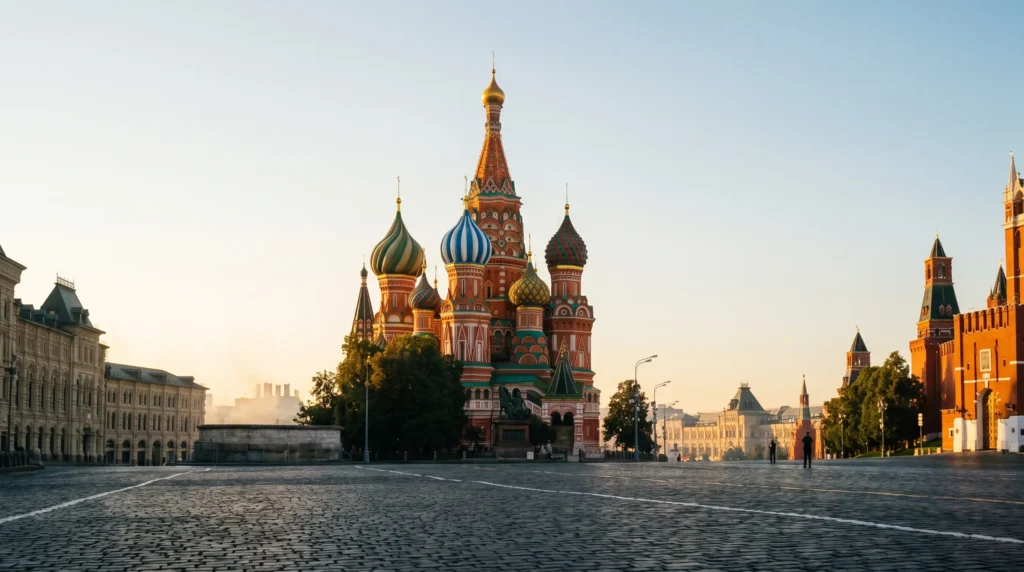
The headline sights are genuinely world-class. The Kremlin and Red Square in Moscow were inscribed on the UNESCO World Heritage List in 1990 — among the very first sites from the USSR to make the list — and the ensemble, including St. Basil’s Cathedral, took more than five centuries to build. The State Hermitage Museum in St. Petersburg holds one of the largest art collections on the planet inside a former imperial palace on the Neva. Out east, Lake Baikal — the world’s oldest and deepest lake at around 25 million years old and 1,700 meters deep, holding roughly a fifth of the planet’s unfrozen fresh water — has been a UNESCO World Heritage Site since 1996. Altogether Russia carries 32 UNESCO World Heritage Sites.
None of that changes the fact that this is, right now, one of the most complicated countries in the world to responsibly recommend visiting. I’ll get to the specifics in the practical section, but the short version up front: this guide is written for research, future planning, and readers who are not US or UK passport holders and are weighing their own government’s current advice — not as an “everything’s fine, go book it” pitch.
White Nights — St. Petersburg’s Sun That Won’t Set
If there’s one seasonal hook that defines Russian travel content, it’s this: for several weeks around the summer solstice, St. Petersburg — sitting at nearly 60° north — never gets properly dark. The White Nights festival runs broadly from late May into July, with the deepest twilight around June 21–22, when the sun dips below the horizon for only a couple of hours before rising again. The signature public event is Scarlet Sails (Alye Parusa) — a sailing ship with crimson sails glides down the Neva to fireworks and a packed waterfront, timed to the Saturday nearest the solstice. The Mariinsky Theatre runs a dedicated White Nights arts festival across the same window, and locals treat the whole stretch as an excuse to be outside at 2am, because the light lets them.
Best Time to Visit Russia (Season by Season)
Late May – early July · White Nights
St. Petersburg’s showcase season: endless daylight, packed cultural calendar, warmest weather of the year, and the highest hotel rates in the city by a wide margin. Moscow is pleasant in the same window without the midnight-sun effect.
September · Golden Autumn
Crisp air, turning birch and maple, fewer crowds than summer, and the best light for photographing the Kremlin’s domes and the Hermitage’s gilded rooms.
December – February · Deep winter
This is when Russia looks like Russia in the popular imagination — snow on Red Square, frozen Neva, and Lake Baikal’s clear turquoise ice thick enough to walk and drive on, usually from around late January into March. Temperatures in Siberia routinely fall well below –20°C; Moscow and St. Petersburg are milder but still properly cold. Pack for it seriously.
March – April, late Oct – Nov · Shoulder/mud season
The unglamorous stretch: melting snow, gray skies, shortest tourist infrastructure hours. Skippable unless your dates are fixed for other reasons.
Getting There — Visas, Flights & the Reality of Access
Start with the visa, because it will decide everything else. Citizens of the US, UK, Canada, Australia and the EU are not eligible for Russia’s e-visa program (which covers around 64 other nationalities for stays of up to 30 days); they need a full paper visa, which requires an official invitation letter from a registered Russian tour operator or hotel, travel medical insurance accepted by Russian authorities, and biometric fingerprinting as part of the application. For UK applicants specifically, that process runs roughly £250–350 all-in and takes one to three weeks, with in-person biometric appointments required. Standard tourist visas allow up to 90 days within a 180-day period.
Flights are the other complication. Direct flights between Russia and the US, UK, Canada and the EU have been suspended since 2022 as part of mutual airspace closures tied to the war in Ukraine; travelers from those countries typically route through Istanbul, Dubai, Yerevan, or another third country and switch to a Russian or allied carrier for the final leg. Moscow’s main international gateways are Sheremetyevo (SVO), Domodedovo (DME) and Vnukovo (VKO); St. Petersburg is served by Pulkovo (LED). Overland entry from EU Schengen states is largely closed at the land borders; entry via Georgia, Kazakhstan, Mongolia, or a Baltic-adjacent crossing is the more common overland route for those who go.
Getting Around — The Trans-Siberian, Metro & Domestic Flights
Once inside the country, Russia’s rail network is the star. The Trans-Siberian Railway runs over 9,289 kilometers from Moscow to Vladivostok, crossing eight time zones, and the full end-to-end journey takes about eight days if you ride it straight through rather than breaking it into stops. Most travelers who ride it break the trip into legs — Moscow to Yekaterinburg, Irkutsk for Lake Baikal, then on to Ulan-Ude or Vladivostok — sleeping in a shared kupe compartment and eating meals from the dining car or platform vendors at station stops.
Domestically, Aeroflot and several Russian carriers connect the major cities in a few hours where the train would take days — Moscow to Irkutsk, for instance, is roughly a five-hour flight versus three-plus days by rail. Within Moscow and St. Petersburg, the metro systems are famously ornate (several Moscow stations are effectively underground palaces) and cheap and efficient by any international standard. High-speed Sapsan trains link Moscow and St. Petersburg in around four hours.
Top Regions — Moscow, St. Petersburg, Siberia & Beyond
Moscow
The Kremlin, Red Square and St. Basil’s Cathedral anchor the historic core; beyond it, the Moscow Metro’s Stalin-era stations, the Tretyakov Gallery’s icon and avant-garde collections, and Gorky Park round out a city that runs at a genuinely different scale than most European capitals.
Saint Petersburg
Peter the Great’s “window on Europe”: the Hermitage inside the Winter Palace, the Church of the Savior on Spilled Blood, canals that earn the “Venice of the North” comparison, and the White Nights season described above. Peterhof’s fountain palace and Catherine Palace’s Amber Room sit a short trip outside the city.
Golden Ring
A cluster of ancient towns northeast of Moscow — Suzdal, Vladimir, Sergiev Posad, Yaroslavl — built around monasteries and kremlins that predate Moscow’s own rise to power. The most accessible slice of old Russia for a multi-day loop by car or bus.
Lake Baikal & Irkutsk
The deepest, oldest lake on Earth, ringed by taiga and reachable via the Trans-Siberian through Irkutsk. Olkhon Island is the base for lake access; summer brings hiking and boat trips, winter brings the ice season, when the lake’s clarity turns the surface a startling turquoise.
Kamchatka Peninsula
Volcanoes, geysers and brown bears on Russia’s remote Pacific edge — reachable only by air from Moscow or Vladivostok, and priced and logistically handled more like an expedition than a city break.
The Russian Arctic & Murmansk
Aurora season runs the winter months above the Arctic Circle; Murmansk is the practical gateway for northern lights trips and icebreaker excursions toward the polar ice.
Sochi & the Black Sea Coast
Russia’s subtropical resort belt and 2014 Winter Olympics host city — beach town at sea level, ski resorts in the Caucasus foothills a short drive up, in the same afternoon.
Culture & People
Russia’s cultural identity runs through literature, ballet and Orthodox Christianity in roughly equal measure — Tolstoy, Dostoevsky and Pushkin are taught as national scripture, the Bolshoi and Mariinsky theatres are genuine points of civic pride rather than tourist props, and onion-domed churches mark almost every town skyline. The country is also home to more than 190 recognized ethnic groups beyond ethnic Russians, from Tatars and Bashkirs to Siberian and Arctic indigenous peoples, each with distinct languages and traditions that rarely make it into the standard Moscow-St.Petersburg itinerary.
Social etiquette skews formal with strangers and warm once trust is established — expect firm handshakes, minimal small talk with service staff, and genuine hospitality once you’re inside someone’s home. English fluency is limited outside major hotels and tourist-facing businesses in the two biggest cities; a translation app and the Cyrillic alphabet basics go a long way.
A Food Lover’s Guide to Russia
Start with the staples: borscht (beet soup, often with sour cream), pelmeni (meat dumplings), and blini (thin pancakes served with everything from caviar to condensed milk). Pirozhki — hand pies stuffed with cabbage, meat or potato — are the street-food default, and a proper Russian breakfast table runs to kasha (buckwheat porridge), smoked fish and rye bread.
Caviar and vodka are the culinary clichés for a reason — both are taken seriously, with regional vodka distilleries and a genuine caviar-tasting culture in St. Petersburg especially. Georgian and Uzbek restaurants are everywhere in Moscow and St. Petersburg, reflecting the broader ex-Soviet food landscape, and are often the best meal you’ll have in either city. Tea (chai), traditionally brewed strong in a samovar and diluted to taste, remains the default hot drink over coffee in most homes.
Off the Beaten Path
Olkhon Island, Lake Baikal
The lake’s largest island and spiritual center for the local Buryat people, with shamanic sites, rock formations and a village pace that feels a world away from Moscow.
Kizhi Island
A UNESCO-listed open-air museum of wooden churches in Karelia, built entirely without nails, including the 22-domed Transfiguration Church.
Republic of Tatarstan (Kazan)
A genuinely bicultural city where a working Kremlin holds both a mosque and a cathedral side by side — a different, Volga-Tatar Russia rarely covered in Western guides.
Altai Mountains
Alpine lakes, trekking and Central Asian-adjacent culture along the Mongolian and Kazakh borders — Russia’s answer to the Rockies, and correspondingly under-visited by international travelers.
Practical Information — Read This Before Anything Else
Safety and government advisories. As of this writing, the US State Department rates Russia Level 4, “Do Not Travel” — the same tier as active war zones — citing terrorism risk (including the 2024 Crocus City Hall attack that killed 130 people), civil unrest and drone/missile activity tied to the war in Ukraine in cities including Moscow, Kazan and St. Petersburg, and a significant risk of wrongful detention of foreign nationals, with the explicit warning that “U.S. citizens may serve their entire prison sentence without release.” The UK FCDO separately advises against all travel to Russia for the same underlying reasons, plus a documented lack of flights to get out and limited ability for the UK government to provide consular support if something goes wrong. I’m not going to write around this: if you hold a US or UK passport, both governments are telling you plainly not to go, and this guide is not a counter-argument to that.
Money. The Russian Ruble (RUB) is the currency, managed by the Central Bank of the Russian Federation. Since 2022, Visa and Mastercard cards issued outside Russia do not work inside the country because the networks suspended Russian operations; travelers who do go typically carry cash (euros or yuan convert more easily than dollars in practice) and rely on Russia’s domestic Mir payment system, which foreign cards cannot access.
Health. The CDC currently rates Russia at its baseline Level 1, “Practice Usual Precautions,” with routine vaccines (MMR, COVID-19, flu, polio, DTaP) plus Hepatitis A/B recommended for most travelers, and tick-borne encephalitis vaccination worth discussing for extensive rural or forest travel given regional tick activity. Bring your own basic medical kit; pharmacy stock and English-language signage vary widely outside major cities.
Connectivity, plugs, registration. Foreign SIMs largely do not roam normally in Russia; a local SIM (which requires passport registration) is the practical option. Visa holders staying more than seven business days are generally required to register their address with local authorities, usually handled by the hotel automatically. Plugs are the European two-round-pin type (Type C/F), 220V. Time zone varies wildly by region — Moscow sits at UTC+3, Vladivostok at UTC+10.
Budget Breakdown — What Russia Actually Costs in 2026
Costs vary enormously between Moscow/St. Petersburg and the regions — figures below assume Western currency can actually be converted and spent, which is itself the practical constraint described above.
Budget (US$50–90/day): Hostel dorm, cafeteria-style stolovaya meals, metro and regional trains, free museum days where offered.
Mid-range (US$120–220/day): Three-star hotel, restaurant meals, a Hermitage or Kremlin ticket with guide, a Sapsan high-speed train leg between Moscow and St. Petersburg.
Luxury (US$350+/day): Historic five-star hotels in Moscow or St. Petersburg, a private Trans-Siberian or Baikal charter itinerary, Bolshoi or Mariinsky premium seats.
Whatever tier you plan around, budget separately and generously for the visa (invitation letter, insurance, consular fees) and for the reroute through a third country, since these add real, non-optional cost on top of any per-day figure.
Planning Your First Trip to Russia
If and when your own government’s advisory situation changes, the classic first loop is Moscow (3–4 nights: Kremlin, Red Square, Tretyakov, metro tour) plus St. Petersburg (3–4 nights: Hermitage, Peterhof, canals), linked by the four-hour Sapsan train. Adding Lake Baikal via Irkutsk turns a city break into a proper cross-country trip; a full Trans-Siberian run to Vladivostok is a multi-week undertaking in its own right. For neighboring regions worth pairing with Russian itineraries once travel opens back up, our Georgia guide and Mongolia guide both connect naturally by rail or short flight, and Finland and Estonia sit a short hop from St. Petersburg for anyone building a wider Baltic-and-beyond route.
Frequently Asked Questions
Is it safe to travel to Russia right now?
Both the US State Department (Level 4, “Do Not Travel”) and the UK FCDO (advises against all travel) currently say no, citing the war in Ukraine, drone and air-defense incidents in major cities, terrorism risk, and a documented risk of wrongful detention for foreign nationals with very limited consular support available. Check your own government’s current advisory before making any plans.
Do US and UK citizens need a visa?
Yes, and it’s not a simple one — both nationalities are excluded from Russia’s e-visa program and must apply for a standard visa with an official invitation letter from a registered tour operator or hotel, travel insurance, and biometric fingerprinting. Budget several weeks and a few hundred dollars/pounds for the process alone.
Do Western bank cards work in Russia?
No. Visa and Mastercard suspended Russian operations in 2022, so foreign-issued cards do not work at ATMs or points of sale inside the country; cash and Russia’s domestic Mir system are the practical fallback, which foreign visitors generally cannot access either.
What’s the best way to see Lake Baikal?
Fly or take the Trans-Siberian to Irkutsk, then continue to Olkhon Island or the lake’s western shore. Summer suits hiking and boat trips; a window from roughly late January to March brings the clear ice season, when the lake’s famous turquoise ice can be walked and driven on.
Can I still ride the full Trans-Siberian Railway?
The railway itself operates domestically, running the roughly 9,289 kilometers between Moscow and Vladivostok across eight time zones in about eight days end-to-end. The barrier is getting into the country in the first place, not the train once you’re there.
What language should I expect to get by with?
Russian is the only realistic default. English is spoken at international hotels and some tourist sites in Moscow and St. Petersburg, but thins out fast elsewhere — learn the Cyrillic alphabet basics and travel with an offline translation app.
Thinking About Russia?
Russia holds some of the most staggering cultural and natural sights on the planet — the Hermitage, the Kremlin, a lake older than the Alps, a railway that crosses eight time zones. It also currently sits under some of the strongest government travel advisories in the world for good, specific reasons. Treat this guide as the research phase, check your government’s current advisory the week you’d actually travel, and make the call with clear eyes either way.
Explore More
- Georgia Travel Guide — Caucasus culture and a common overland route into/out of the region
- Mongolia Travel Guide — the Trans-Siberian’s steppe-crossing sibling route
- Finland Travel Guide — a short hop from St. Petersburg, same latitude, very different politics
- Estonia Travel Guide — Baltic neighbor with deep, complicated shared history
How this guide was built
Published as part of Facts From Upstairs’ country guide series. Built from authoritative sources — Wikipedia’s Russia, Lake Baikal and Trans-Siberian Railway entity pages, the UNESCO World Heritage Centre’s Kremlin and Red Square listing, the Central Bank of the Russian Federation, the US State Department’s Russia travel advisory, the UK FCDO’s Russia travel advice, the US CDC’s Russia traveler health page, and visa-process reporting from Russiable’s US/UK visa and White Nights guides. Numeric and safety claims carry inline citations; given how fast the advisory situation can change, verify current government advice directly before making any travel decision.
Sources cited on this page
- Wikipedia — Russia
- Wikipedia — Lake Baikal
- Wikipedia — Trans-Siberian Railway
- UNESCO — Kremlin and Red Square, Moscow
- Central Bank of the Russian Federation
- US State Department — Russia Travel Advisory
- UK FCDO — Russia Travel Advice
- US CDC — Russia Traveler Health Page
- Russiable — Russian Visa for US, UK, Canada & Australia
- Russiable — White Nights St. Petersburg Guide
More country guides you might like
Plan your trip to Russia
The booking tools we use ourselves. FFU may earn a commission at no extra cost to you.
Plan & book your trip to Russia
Booking through these searches supports our guides at no extra cost to you.