
Saint Vincent and the Grenadines Travel Guide — Tobago Cays, Bequia & the Caribbean’s Sailing Capital
I keep telling people that Saint Vincent and the Grenadines is what the Caribbean looked like before it got famous, and I keep having to defend that claim, because a few of these islands — Mustique, Bequia — are extremely famous, just quietly. This is a country of about 111,000 people spread across 32 islands and cays in the southern Windwards, and the pitch is simple: one volcanic main island with rainforest and a still-active volcano, and a scattering of small, sandy, mostly boat-only Grenadines strung south toward Grenada, each with its own personality. There is no cruise-strip, no mega-resort corridor, and — outside carnival week — no crowds. What there is instead is the best sailing water in the eastern Caribbean, a genuinely oldest-in-the-hemisphere botanical garden, and Tobago Cays, a marine park so good it turns up in yacht-charter daydreams under a different name every year. I love it here. I also won’t pretend the ferry schedules, the 2021 volcanic eruption’s long tail, and Hurricane Beryl’s 2024 damage on a few southern islands don’t matter — they do, and I’ll flag exactly where.
In This Guide
- Overview — One Volcanic Island, 31 Small Ones
- Vincy Mas — the Caribbean’s Least-Crowded Big Carnival
- Best Time to Visit (Season by Season)
- Getting There — Argyle International & the Inter-Island Ferries
- Getting Around — Mail Boats, Water Taxis & Yacht Charters
- Top Regions — Saint Vincent, Bequia, Mustique, Canouan, Tobago Cays
- Culture & People
- A Food Lover’s Guide to SVG
- Off the Beaten Path
- Practical Information
- Budget Breakdown — What SVG Actually Costs in 2026
- Frequently Asked Questions
Overview — One Volcanic Island, 31 Small Ones
Saint Vincent and the Grenadines sits in the southern Windward Islands of the Lesser Antilles, between Saint Lucia to the north and Grenada to the south, and is made up of the main island of Saint Vincent (about 344 km²) plus 32 smaller islands and cays strung southward, of which only seven are inhabited. The whole country covers roughly 389 km² — smaller than most cities — and the capital, Kingstown, sits on Saint Vincent’s sheltered southwest coast.
Saint Vincent itself is the surprise for people expecting only postcard beaches: it’s rugged, volcanic and green, dominated by La Soufrière, an active stratovolcano rising to 1,234 metres that erupted as recently as April 2021. Head south and the character flips entirely — Bequia, Mustique, Canouan, Union Island, Mayreau, Palm Island and Petit Saint Vincent are classic Grenadine islands: small, sandy, mostly reachable only by boat, and collectively the reason this country punches so far above its population in the international yachting world.
The country became fully independent from Britain on 27 October 1979 and remains a Commonwealth realm with a parliamentary constitutional monarchy — English is the official language everywhere, layered over Vincentian Creole in daily speech. Tourism is genuinely a boutique industry here, not a volume one: there is no international airport that existed before 2017, no cruise terminal to rival its neighbors, and most of the Grenadines can only be reached by ferry, mail boat, or your own chartered sail. That’s the whole appeal — and also exactly why it takes more planning than a typical Caribbean trip.
Vincy Mas — the Caribbean’s Least-Crowded Big Carnival
If your trip lands in late June or early July, you’re walking into Vincy Mas, Saint Vincent’s national carnival, which runs roughly from late June through the first week of July and closes with Carnival Monday and Carnival Tuesday as official public holidays — in 2026, that’s 6–7 July. The build-up fills Victoria Park in Kingstown with the Soca Monarch competitions, Dimanche Gras brings out the costumed “Kings and Queens” alongside the Calypso Monarch finals, and the whole thing ends with a full mas-band parade through Kingstown’s streets.
Unlike Trinidad’s carnival, Vincy Mas doesn’t pull huge international crowds, which means you can actually get a hotel room, but it also means hotels fill fast with returning Vincentian diaspora — book well ahead if your dates overlap. One honest caveat: UK and US advisories both flag that theft and opportunistic crime tick up during carnival crowds, same as any big street festival anywhere — normal city-carnival awareness applies.
Best Time to Visit Saint Vincent and the Grenadines (Season by Season)
January – May · Dry season (peak)
The most reliable sailing conditions of the year, steady trade winds, minimal rain, and the busiest yacht-charter and hotel calendar — book Bequia, Mustique or Canouan accommodation two to three months ahead for this window.
Late June – early July · Vincy Mas
Hot, increasingly humid, and carnival energy on Saint Vincent itself — see above. Still relatively dry compared to the deep wet season that follows.
June – November · Wet / hurricane season
Warmer, wetter, and the Atlantic hurricane season proper, with the statistical peak risk in August–October. This isn’t theoretical here: Hurricane Beryl tore through the southern Grenadines in July 2024 as an unusually early, powerful storm, and both the US and UK governments still note that Canouan, Mayreau, Palm Island, Petit Saint Vincent and Union Island were in varying stages of recovering their tourist infrastructure well afterward. Travel insurance with hurricane/trip-interruption cover is not optional for a June–November booking, and it’s worth confirming your specific southern-island hotel is fully reopened before you commit.
Getting There — Argyle International & the Inter-Island Ferries
Argyle International Airport (SVD), on Saint Vincent’s windward coast about 8 km from Kingstown, opened in 2017 as the country’s first true international gateway, replacing the old, short-runway E.T. Joshua Airport. It handles regional connections through hubs like Barbados, Trinidad, Puerto Rico and Miami, plus a growing set of charter and seasonal direct links — there’s still no nonstop from most of North America or Europe, so budget a connection.
From Saint Vincent, the Grenadines are reached by domestic ferries and mail boats: scheduled services run to Bequia (about an hour), and less frequently to Canouan, Mayreau and Union Island, plus small aircraft to Union Island’s own airstrip for the southern Grenadines. Mustique and Palm Island are effectively resort-access islands — most visitors arrive by charter flight or private boat arranged through the property itself rather than public ferry. If you’re piecing together a multi-island itinerary, build in slack: interisland schedules here are genuinely tide-and-weather-dependent, not timetable-precise.
Getting Around — Mail Boats, Water Taxis & Yacht Charters
On Saint Vincent itself, minibuses (privately owned, route-numbered, cheap) cover the ring road and are the backbone of local transport; rental cars and taxis fill the gaps for reaching the Falls of Baleine or the volcano trailhead. There is no real public transport between islands beyond the ferries mentioned above — this is a country where “getting around” mostly means “getting on a boat.”
That’s precisely why SVG is one of the eastern Caribbean’s premier bareboat and crewed-yacht charter bases: Bequia and the Blue Lagoon on Saint Vincent are major charter hand-off points, and a week sailing south through Canouan, Mayreau and Tobago Cays to Union Island is one of the classic Caribbean sailing itineraries. If you’re not sailing, water taxis link nearby islands informally and are the standard way to hop between, say, Union Island and Palm Island or Petit Saint Vincent.
Top Regions — Saint Vincent, Bequia, Mustique, Canouan, Tobago Cays
Saint Vincent (the mainland)
Rainforest interior, black-volcanic-sand beaches, waterfalls, and La Soufrière itself — a demanding but non-technical day hike to the crater rim when the volcano is quiet, plus Kingstown’s covered market and the Botanic Gardens (see below). Most visitors base here for one to three nights before island-hopping south.
Bequia
The Grenadines’ most accessible and arguably most charming island: Admiralty Bay’s harborfront town of Port Elizabeth, a genuine whaling and boat-building heritage, model-boat workshops, and a laid-back sailing-community vibe that’s closer to New England-in-the-tropics than Ibiza-in-the-Caribbean.
Mustique
The famous one — a private-island resort community with a decades-long history as a royal and celebrity retreat, mostly accessible only to guests of its villas and the one hotel. Day-trippers can visit by boat for the beaches and Basil’s Bar, but this isn’t a budget stop.
Canouan
A quieter luxury island with high-end resort development and some of the best reef-protected beaches in the chain; increasingly the Grenadines’ second “exclusive” island after Mustique, but with more day-visitor access.
Mayreau & Union Island
Mayreau is tiny, largely undeveloped, and the gateway to Tobago Cays; Union Island is the southern Grenadines’ transport hub, with its own airstrip and ferry connections onward to Palm Island, Petit Saint Vincent and Carriacou (Grenada). Both took direct damage from Hurricane Beryl in 2024 — check current hotel status before booking.
Tobago Cays Marine Park
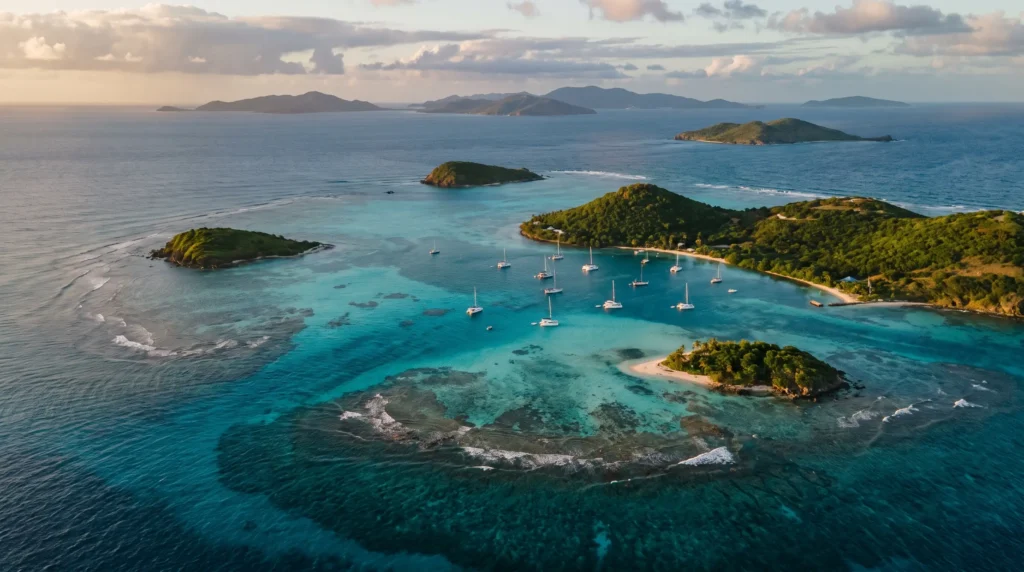
Five uninhabited islets — Petit Rameau, Petit Bateau, Baradal, Petit Tabac and Jamesby — ringed by the roughly 4-km Horseshoe Reef inside a protected marine park covering around 66 km² of shallow, turquoise lagoon. Green turtles graze the sea-grass meadows in water shallow enough to snorkel without a boat, and it’s the single most photographed anchorage in the Grenadines — day-trip by boat from Union Island or Mayreau, or anchor here yourself on a charter.
Palm Island & Petit Saint Vincent
Two of the smallest, most private resort islands in the chain — effectively single-property islands reached by short boat transfer from Union Island, aimed squarely at travelers who want zero neighbors.
Culture & People
Across roughly 111,000 people, Vincentian culture blends West African, British colonial, French, and Indigenous Kalinago and Garifuna threads — the Garifuna people themselves trace their origin partly to Saint Vincent, where Kalinago and escaped/shipwrecked West African communities merged before British forces exiled most Garifuna to Roatán and the Central American coast in 1797. That history is a point of quiet national pride, and it’s the same Garifuna lineage that later became a defining culture of Belize, Honduras and Guatemala’s coasts.
Music and dance run through daily life — steel pan, soca and calypso dominate, cranked up several notches for Vincy Mas — and church remains central to Vincentian community life on Sundays across the islands. On the water, Bequia’s whaling and wooden-boat-building traditions (regulated, small-scale, and now largely ceremonial rather than commercial) are a genuinely unique cultural thread found almost nowhere else in the Caribbean.
A Food Lover’s Guide to Saint Vincent and the Grenadines
The national dish is roast breadfruit and fried jackfish — breadfruit roasted whole over coals, split, and served alongside small fried jackfish, a genuinely everyday plate you’ll find at local lunch spots rather than tourist menus. Rice and peas, callaloo soup, and fresh-caught snapper, mahi-mahi and lobster (in season) round out the coastal staples, and roti stalls reflect the broader Eastern Caribbean’s Indian-indentured-labor food heritage.
Bequia’s harborfront has an outsized food scene for its size, driven by the yacht-charter crowd — expect excellent fresh seafood and a genuine rum-bar culture. Hairoun, the local lager, is the standard beach beer; Sunset Rum and the region’s spiced rums are the classic sundowner. On Union Island and the smaller Grenadines, meals lean simple and fresh: whatever the boats brought in that morning, grilled.
Off the Beaten Path
Saint Vincent and the Grenadines Botanic Gardens
Established in 1765 in Kingstown, this roughly 8-hectare (20-acre) garden is the oldest botanic garden in the Western Hemisphere, with a direct link to Captain William Bligh, who brought breadfruit specimens here in 1793 on the voyage that followed the Bounty mutiny. Quiet, shaded, and almost entirely overlooked by beach-focused itineraries.
La Soufrière crater hike
The volcano last erupted explosively in April 2021 after an effusive phase that began in December 2020, prompting the evacuation of thousands of residents from the northern end of Saint Vincent — no deaths were reported thanks to early warning. The mountain remains an active, monitored volcano; check current access and activity status with local authorities or a licensed guide before attempting the crater-rim trail, and never go without one.
Falls of Baleine
A boat-access-only waterfall on Saint Vincent’s rugged northwest coast, reachable only by sea since there’s no road — a half-day trip most visitors pair with snorkeling en route.
Mayreau’s Salt Whistle Bay
Often cited among the prettiest anchorages in the entire Caribbean, and still refreshingly undeveloped even as neighboring islands build out — go before that changes.
Practical Information
Money. The Eastern Caribbean Dollar (XCD) has been pegged to the US dollar at EC$2.70 = US$1 since 1976, one of the longest-running currency pegs in the world, administered by the Eastern Caribbean Central Bank on behalf of SVG and five other member states. US dollars are widely accepted; cards work in Kingstown and larger resorts but carry XCD cash for the smaller Grenadines, water taxis and local eateries.
Safety. The US State Department rates SVG at its lowest advisory tier, Level 1 (Exercise Normal Precautions) as of mid-2026, while UK guidance is more cautious, citing an increase in gang-related gun violence including some incidents in populated public areas, alongside standard advice to avoid poorly lit areas at night and use registered taxis. Read both current advisories before you go — they don’t fully agree, which is itself useful information.
Health. The CDC notes that medical facilities in SVG don’t meet US standards and that there is no hyperbaric chamber on-island, meaning any diver needing decompression treatment must be evacuated — factor that into how aggressively you dive here. Most overseas providers expect cash payment upfront, so travel medical insurance with evacuation coverage is genuinely important, not just a nice-to-have. Standard mosquito precautions apply against dengue and Zika.
Connectivity. An eSIM or local SIM covers Saint Vincent and Bequia well; coverage thins out on the smaller southern Grenadines. Plugs: UK-style three-pin (230V) is standard. Time zone: Atlantic Standard Time, UTC-4, no daylight saving.
Budget Breakdown — What Saint Vincent and the Grenadines Actually Costs in 2026
This is a boutique Caribbean destination, not a backpacker circuit — costs sit closer to Barbados or the British Virgin Islands than to bigger-volume islands, and the private-island Grenadines (Mustique, Palm Island, Petit Saint Vincent) skew the top end considerably.
Budget (roughly $70–130/day): Guesthouse or small hotel on Saint Vincent or Bequia, minibus travel and local eateries, public ferries rather than water taxis, self-guided hikes and beaches.
Mid-range (roughly $200–400/day): A comfortable hotel on Bequia or Canouan, restaurant meals, a day-trip boat to Tobago Cays, occasional water-taxi hops, maybe a few days on a bareboat or skippered charter split among a group.
Luxury (roughly $600+/day): A villa or the resort on Mustique or Petit Saint Vincent, private charter flights between islands, crewed yacht charters through the southern Grenadines.
Expect ferry and departure fees between islands, and standard 10–15% tipping at restaurants where a service charge isn’t already added to the bill.
Planning Your First Trip to Saint Vincent and the Grenadines
The classic first-timer route is mainland + one or two Grenadines: fly into Argyle (SVD), spend two or three nights on Saint Vincent for the Botanic Gardens, a waterfall trip and maybe the volcano trail, then ferry to Bequia for three or four nights of harbor-town ease, adding a day-trip south to Tobago Cays if your dates allow. Ten days lets you push further south to Canouan or Union Island; two weeks or more is where a proper sailing charter starts to make sense. Pair the trip with our Saint Lucia guide or our Grenada guide for a two-country Windward Islands itinerary, or our Barbados guide if you’re routing through its regional hub airport.
Frequently Asked Questions
Is Saint Vincent and the Grenadines safe for tourists in 2026?
The US State Department currently rates it Level 1, its lowest-risk tier, while the UK’s FCDO takes a more cautious tone around gang-related gun crime in specific areas — the honest read is that mainstream tourist areas (Bequia, the resort Grenadines, central Kingstown by day) are relaxed, but check both current advisories, use registered taxis, and be more alert at night in Kingstown.
Do I need a visa?
US citizens don’t need a visa and get up to 30 days on arrival; UK citizens don’t need a visa and get up to 6 months. Both need a passport valid at least six months beyond arrival.
Is Mustique open to non-guests?
Day visitors can arrive by boat to use the public beaches and visit Basil’s Bar, but the island’s villas and hotel are for guests only — it isn’t a wander-in-and-explore kind of place.
Have the Grenadines recovered from Hurricane Beryl?
Largely, but unevenly — as of mid-2026, both US and UK government advisories still note that Canouan, Mayreau, Palm Island, Petit Saint Vincent and Union Island were in varying stages of recovery from the July 2024 storm’s damage to tourist infrastructure. Confirm your specific hotel’s current status directly before booking a stay on those islands.
Can I visit the volcano?
La Soufrière is an active, monitored volcano that erupted explosively as recently as April 2021. The crater trail reopens between periods of unrest — always check current alert status and go with a licensed guide, never solo.
What’s the easiest way to see Tobago Cays without a yacht charter?
Book a day-trip boat from Union Island or Mayreau — most run snorkeling stops at the Horseshoe Reef and turtle-grazing sea-grass beds and return the same day, no sailing experience required.
Ready to Explore Saint Vincent and the Grenadines?
Turtles grazing in ankle-deep turquoise water at Tobago Cays, a working botanic garden older than the United States, a volcano you can (carefully) climb, and a string of small islands where the biggest decision most days is which beach has fewer footprints on it. It takes more planning than a flight-and-resort Caribbean trip — but that’s exactly what’s kept it this good.
Explore More
- Saint Lucia Travel Guide — the nearest Windward Island neighbor to the north
- Grenada Travel Guide — the Spice Isle, just south down the chain
- Barbados Travel Guide — the region’s main air hub and a classic pairing
- Dominica Travel Guide — another volcanic, off-the-beaten-path Windward Island
How this guide was built
Published as part of Facts From Upstairs’ country guide series. Built from authoritative sources — Wikipedia entity pages for Saint Vincent and the Grenadines, Argyle International Airport, the 2021 La Soufrière eruption, the Botanic Gardens and Tobago Cays; the Eastern Caribbean Central Bank’s currency page; the US State Department’s SVG travel advisory; the UK FCDO’s SVG travel advice (entry requirements and safety & security); the US CDC traveler page for SVG; and the SVG Prime Minister’s Office public holidays page for Vincy Mas/Carnival dates. Numeric and checkable claims carry inline citations.
Sources cited on this page
- Wikipedia — Saint Vincent and the Grenadines
- Wikipedia — Argyle International Airport
- Wikipedia — 2021 eruption of La Soufrière
- Wikipedia — Saint Vincent and the Grenadines Botanic Gardens
- Wikipedia — Tobago Cays
- Eastern Caribbean Central Bank — Currency
- US State Department — Saint Vincent and the Grenadines Travel Advisory
- UK FCDO — Entry Requirements
- UK FCDO — Safety and Security
- US CDC — Saint Vincent and the Grenadines Traveler View
- Saint Vincent and the Grenadines Prime Minister’s Office — Public Holidays
More country guides you might like
Plan your trip to Saint Vincent and the Grenadines
The booking tools we use ourselves. FFU may earn a commission at no extra cost to you.
Plan & book your trip to Saint Vincent and the Grenadines
Booking through these searches supports our guides at no extra cost to you.
Curated multi-day tours to Saint Vincent and the Grenadines — Exoticca →