
Tonga Travel Guide — Swim With Humpback Whales in the Last Polynesian Kingdom
Tonga is the only Pacific nation that was never colonized — it went straight from an ancient, unbroken monarchy to independence in 1970, and it still runs on that same rhythm today: a king, a parliament of nobles, and a Sunday so sacred that shops, buses, and even the international airport shut down by law. I came for the thing everyone comes for — getting in the water with a humpback whale and her calf, something almost nowhere else on Earth permits — and stayed for how unhurried the whole place feels, 171 islands scattered across open ocean with barely more than a hundred thousand people spread across 45 of them. It is not glossy. Tourism infrastructure here is genuinely thin compared to Fiji or French Polynesia next door, ferries run on island time, and in January 2022 the country survived an eruption so violent it registered on barometers on the other side of the planet. Go anyway. Few places left will let you float silently a few meters from a 40-ton animal and feel this small in the best possible way.
In This Guide
- Overview — The Only Pacific Kingdom Never Colonized
- Humpback Whale Season & the Heilala Festival
- Best Time to Visit Tonga (Season by Season)
- Getting There — Fua’amotu Airport & the Sunday Rule
- Getting Around — Inter-Island Flights, Ferries & Boats
- Top Regions — Tongatapu, Vava’u, Ha’apai & Beyond
- Culture & People — Monarchy, Church & Kava
- A Food Lover’s Guide to Tonga
- Off the Beaten Path
- Practical Information
- Budget Breakdown — What Tonga Actually Costs in 2026
- Frequently Asked Questions
Overview — The Only Pacific Kingdom Never Colonized
Tonga is unique among Pacific nations for one specific reason: it never became anyone’s colony. It was a British-protected state, not a possession, and became fully independent on 4 June 1970 with its monarchy — Tupou VI now sits on a throne with a continuous line stretching back centuries — intact the whole time. That history still shapes daily life more than almost anywhere else in the region: a semi-constitutional monarchy, a hereditary nobility, and a devoutly Christian population (roughly 64% Protestant, with the Free Wesleyan Church historically dominant) for whom Sunday remains genuinely off-limits to commerce.
Geographically, Tonga is 171 islands strung across roughly 800 kilometers of open South Pacific, with only 45 of them inhabited and a population of about 100,000, around 70% of whom live on the main island of Tongatapu. The three groups travelers actually visit are Tongatapu in the south (the capital, Nuku’alofa, and the archaeological heartland), Ha’apai in the middle (barely developed, gorgeous, and quiet), and Vava’u in the north (the country’s tourism engine and the epicenter of whale swimming). Sitting at UTC+13, close to the International Date Line, Tonga is among the first places on the planet to see each new day.
The country made unwanted world headlines in January 2022, when the underwater volcano Hunga Tonga–Hunga Ha’apai produced the largest eruption of the 21st century so far — a plume that punched roughly 58 kilometers into the mesosphere, an atmospheric shockwave detected as far away as Alaska and the UK, and a tsunami that damaged or destroyed some 600 buildings, mostly homes. Tonga has rebuilt since, and the disaster is now mostly a striking conversation piece rather than a lingering hazard for visitors — but it is a useful reminder that this is a young, still-forming volcanic archipelago, not a manicured resort backdrop. What Tonga offers instead of polish is space and access: whale encounters regulated tightly enough to actually protect the animals, ancient stone monuments you can walk up and touch without a ticket booth in sight, and a kingdom that has never had to perform its own culture for anyone.
Humpback Whale Season & the Heilala Festival
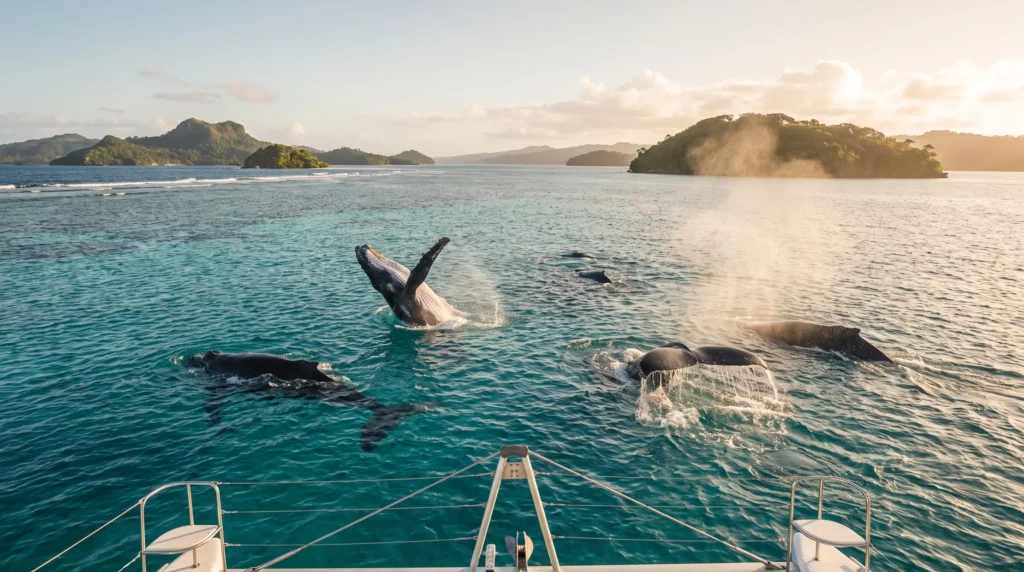
Humpback whales migrate up from Antarctic feeding grounds to breed and calve in Tonga’s warm, sheltered waters, arriving from late June and remaining through October, with August and September the peak months for encounters. Vava’u is the main hub, though Ha’apai and ‘Eua also see whales pass close to shore. This is one of the only places on Earth where licensed operators can legally place snorkelers in the water with humpbacks, and the rules are strict for good reason: a maximum of four guests and one licensed guide per group in the water at a time, encounters capped at 90 minutes followed by a mandatory hour-long break, boats limited to seven hours on the water per day, a required 5-meter distance from the animals, and an outright ban on scuba gear and artificial lights near whales. Book only with a licensed operator — the rules exist to keep the whales undisturbed as much as to keep swimmers safe.
Time a late-June or early-July trip around another date: the Heilala Festival, Tonga’s biggest annual celebration, which runs alongside the King’s Birthday public holiday on 4 July with a pageant float parade, brass bands and days of cultural events filling Nuku’alofa’s streets. Arrive in that window and you can catch the first whales of the season and the kingdom’s biggest party in the same trip.
Best Time to Visit Tonga (Season by Season)
May – October · Dry season (best overall)
Cooler, drier, and calmer seas — the season nearly everyone should aim for. Whale swimming runs late June through October, peaking in August and September, so this window does double duty for weather and wildlife. Book Vava’u whale-swim operators and accommodation well ahead for August and September — capacity is genuinely limited by the swim regulations themselves, not just demand.
Late June – Early July · Heilala Festival
The cultural sweet spot: whales have just arrived, the King’s Birthday and Heilala Festival fill Nuku’alofa with parades and pageantry, and dry-season weather is settling in.
November – April · Wet season & cyclone risk
Warmer, more humid, with heavier rain and the South Pacific cyclone season concentrated December through March. This is the cheap, quiet stretch if you don’t mind rescheduling flexibility and travel insurance that actually covers cyclone disruption — and it’s when whales have left Tongan waters entirely.
Getting There — Fua’amotu Airport & the Sunday Rule
Fuaʻamotu International Airport, about 20 kilometers from Nukuʻalofa on Tongatapu, is Tonga’s main international gateway. There are no direct flights from North America or Europe — you connect through Fiji Airways from Nadi or Suva, Air New Zealand from Auckland, or Qantas from Sydney, all of which serve Fua’amotu. Build a night or two into Fiji, New Zealand or Australia around the connection rather than treating it as a pure layover; onward flights aren’t frequent enough to rush.
Note the one genuinely unusual operational rule: by law, Fua’amotu is closed on Sundays and only opens in a declared emergency with ministerial approval. Plan arrival and departure days around this — it will wreck a tight itinerary if you don’t. US, UK, EU, Australian, New Zealand and Canadian passport holders don’t need a visa for stays up to 31 days, just a passport valid six months beyond your visit and an onward ticket.
Getting Around — Inter-Island Flights, Ferries & Boats
Domestic carrier Lulutai Airlines connects Tongatapu to Vava’u, Ha’apai, ‘Eua, and the remote northern islands of Niuatoputapu and Niuafo’ou. These are the practical way to reach Vava’u or Ha’apai in an afternoon rather than a day-long ferry crossing; book them as early as you book your international flights, since seats on small aircraft sell out around whale season and the Heilala Festival.
Inter-island ferries link the main groups at a fraction of the airfare, but schedules shift with weather and demand — treat published timetables as a starting point, not a guarantee, and build slack into any itinerary that depends on one. Within Tongatapu, taxis and a limited bus network cover Nuku’alofa and the main sights; renting a car or hiring a driver is the easiest way to reach the trilithon and blowholes on the island’s east and west ends in a single day. In Vava’u, the town of Neiafu is walkable, and boats — not roads — are how you actually get around the Port of Refuge and out to the whale-swim and snorkel sites.
Top Regions — Tongatapu, Vava’u, Ha’apai & Beyond
Tongatapu
The main island, the capital Nuku’alofa, and the country’s archaeological core. East of town in Heketā stands the Ha’amonga ‘a Maui, a 13th-century coral-limestone trilithon commissioned around 1200 AD by King Tu’itātui — three slabs, each upright weighing 30–40 tons, still standing as a protected national park since 1972. Nearby Lapaha holds the ancient royal tombs of the Tu’i Tonga line — both sites together form “The Ancient Capitals of the Kingdom of Tonga,” currently on Tonga’s UNESCO tentative list rather than fully inscribed. On the south coast, the Mapu’a Vaea blowholes send seawater jetting through limestone tunnels along several kilometers of shoreline at high tide.
Vava’u
The whale-swimming capital and Tonga’s most developed tourism region, centered on the harbor town of Neiafu and its Port of Refuge. This is where the licensed whale-swim operators are based, where sailors have quietly kept boats for decades, and where sea caves like Swallows’ Cave and the semi-submerged Mariner’s Cave give you something to do on the days you’re not in the water with a humpback.
Ha’apai
The middle group and the least developed of the three — low, flat islands, empty white beaches, and a scattering of the Lapita-era archaeological sites that document some of the earliest human settlement in the Pacific, over 2,800 years ago. Come here for quiet rather than infrastructure; guesthouses are basic and that’s the appeal.
‘Eua
A short flight or ferry from Tongatapu, ‘Eua is dense rainforest and dramatic cliffs rather than atolls — hiking trails, sea caves, and land-based whale watching along its eastern coast during the season.
The Niuas (Niuatoputapu & Niuafo’ou)
Tonga’s remote far north, reachable only by infrequent flights or cargo boat. Almost no tourism infrastructure exists here at all — this is genuinely for travelers who want isolation over convenience.
Culture & People — Monarchy, Church & Kava
Tonga is a semi-constitutional monarchy under King Tupou VI, with a parliament that includes seats reserved for hereditary nobles alongside elected representatives — a governance structure that has survived, largely unbroken, since long before independence in 1970. Christianity, particularly the Free Wesleyan Church, runs deep through daily life; roughly 64% of the population identifies as Protestant, and Sunday observance is taken seriously enough that shops, transport and even the international airport close by law. Plan around it rather than fighting it — it’s a genuinely restful enforced pause, not an inconvenience aimed at tourists.
Kava ceremonies remain a real social institution, not a tourist performance, and mat- and tapa-cloth weaving (ngatu) are still practiced and gifted at major life events. Flying foxes — Tonga’s giant fruit bats — are considered the property of the king and protected from hunting by anyone else; the village of Kolovai on Tongatapu’s western tip is the best-known place to see colonies of them roosting in daylight. The Heilala Festival around the King’s Birthday on 4 July is the year’s biggest public celebration, drawing thousands to Nuku’alofa for its parade and pageant.
A Food Lover’s Guide to Tonga
Tongan cooking centers on root vegetables, coconut, and whatever came off a boat that morning. Lu pulu — corned beef and onion wrapped in taro leaves and baked in coconut cream — is close to a national dish, alongside lu sipi (mutton flaps done the same way) for those who want it richer. ‘Ota ika, raw fish marinated in coconut milk, lime and chili, is the local answer to ceviche and turns up at almost every gathering.
The umu — an earth oven of hot stones — is how Sunday feasts and special occasions get cooked, layering pork, root crops, and wrapped fish for hours underground; if you’re invited to one after church, go. Kava, made from the root of the pepper plant, is drunk communally and ceremonially rather than recreationally, and it’s worth trying once with people who know the etiquette. Fresh papaya, watermelon and coconut round out most meals, and in Nuku’alofa and Neiafu a handful of small restaurants serve all of the above alongside simpler Western fare for travelers easing in.
Off the Beaten Path
Ha’amonga ‘a Maui & the Ancient Royal Tombs
The trilithon at Heketā and the royal tombs at nearby Lapaha form Tonga’s strongest bid for a future UNESCO listing, and today you can walk right up to both with essentially no other visitors around.
Mapu’a Vaea Blowholes
Time a visit to high tide, when jets of seawater erupt through the limestone shoreline along several kilometers of coast near the village of Houma.
Kolovai’s Flying Foxes
A colony of the king’s protected fruit bats roosts in daylight in the trees of this western Tongatapu village — an easy half-day add-on to a blowholes trip.
Ha’apai’s Lapita Sites
Scattered archaeological sites documenting some of the Pacific’s earliest human settlement, nearly 2,800 years old, with essentially no tourist infrastructure built around them yet.
‘Eua’s Rainforest Interior
Hiking trails through dense native forest and along sea cliffs on an island most Vava’u-bound visitors never bother adding to their route.
Practical Information
Money. The Tongan pa’anga (T$, TOP) is issued by the National Reserve Bank of Tonga and pegged to a basket of the Australian dollar, New Zealand dollar, US dollar and Japanese yen rather than fixed to any single currency. Cards are usable in Nuku’alofa and Neiafu but far less reliable elsewhere — carry enough cash for outer islands and smaller guesthouses.
Safety. The US State Department rates Tonga Level 1, “Exercise Normal Precautions” — its lowest advisory tier — noting low overall crime but recommending against traveling alone at night or into remote areas, since house break-ins and, rarely, assaults on foreign visitors have occurred. Check the UK FCDO’s current Tonga advice before you travel as well.
Health. The CDC recommends Hepatitis A and B and typhoid vaccination for most travelers, flags year-round dengue risk requiring mosquito bite prevention, notes a global measles alert (confirm MMR status before departure), and advises avoiding contact with freshwater due to leptospirosis risk.
Sundays & connectivity. Nearly everything closes on Sunday by custom and, for the airport, by law — build rest days around it rather than errands. Internet is workable in Nuku’alofa and Neiafu, patchy to nonexistent in Ha’apai and the Niuas. Time zone: UTC+13. Plugs: Type I, 240V.
Budget Breakdown — What Tonga Actually Costs in 2026
Tonga isn’t a bargain-basement Pacific destination — limited competition among tour operators and everything’s-imported logistics push prices above what you’d pay in Southeast Asia, though it’s generally gentler on the wallet than Fiji’s resort belt.
Budget (US$60–100/day): Guesthouse or backpacker room in Nuku’alofa or Neiafu, local eateries and market produce, buses and shared taxis, snorkeling over whale-swim charters.
Mid-range (US$150–260/day): A comfortable guesthouse or small resort, restaurant meals, one domestic flight to Vava’u or Ha’apai, and a licensed whale-swim day trip — typically the single biggest line item on a Tongan itinerary.
Luxury (US$400+/day): Private charter boats in Vava’u, multi-day sailing, top-tier eco-lodges, and priority whale-swim bookings during peak August–September weeks.
Whale-swim trips carry a real, non-negotiable cost because the licensing system caps group sizes deliberately — treat that price as funding the regulation that makes the experience sustainable at all, not padding.
Planning Your First Trip to Tonga
The classic first-timer route: fly in via Fiji, New Zealand or Australia to Fua’amotu, spend two or three nights on Tongatapu for the trilithon, royal tombs and blowholes, then take a short domestic flight up to Vava’u for four or five nights centered on a licensed whale-swim operator during the July–October window. Ten to twelve days covers it comfortably without rushing the connections; add Ha’apai if you want a few days with genuinely no other tourists in sight. Since there’s no direct flight from North America or Europe, pair the trip with a few days in our Fiji guide or New Zealand guide around your connection, or continue on to Samoa for more of Polynesia’s kingdom-era history.
Frequently Asked Questions
Is Tonga safe for tourists in 2026?
Yes — the US State Department rates it Level 1, “Exercise Normal Precautions,” its lowest risk category, with low overall crime. Standard advice applies: don’t travel alone at night, be cautious in remote areas, and check current UK FCDO and US State Department guidance before you go.
Do I need a visa for Tonga?
US, UK, EU, Australian, New Zealand and Canadian passport holders can enter visa-free for stays up to 31 days, with a passport valid six months beyond arrival and proof of onward travel.
Can beginners swim with the whales?
Yes — it’s a snorkel-and-fin experience, not scuba (scuba near whales is banned outright), so no diving certification is needed, just reasonable swimming fitness and comfort in open water. Book only licensed Vava’u operators; the group-size and distance rules exist to protect the whales, and reputable operators enforce them strictly.
What’s the deal with Tonga and Sundays?
Sunday is a genuine day of rest by law and custom — shops, transport and even the international airport close, the last only opening in a declared emergency with ministerial approval. Build your flight dates and any tight connections around it.
Tonga or Fiji?
Choose Fiji for polished resort infrastructure and easier logistics; choose Tonga for an unbroken monarchy, far fewer other travelers, and the legal, regulated chance to swim with humpback whales — an experience Fiji doesn’t offer at anything like the same scale.
Which island group should a first-timer pick?
If you only have a week, base in Vava’u during whale season and add a couple of Tongatapu days either side for the trilithon and blowholes — it’s the combination that covers the most ground for the least inter-island logistics.
Ready to Explore Tonga?
A 13th-century trilithon with no ticket booth, blowholes firing thirty meters into the air, and — for a few months a year — the legal, closely regulated chance to float beside a humpback whale and her calf. Tonga doesn’t perform for visitors; it simply keeps being itself, on its own unhurried, Sunday-observing schedule, and that’s exactly the point.
Explore More
- Fiji Travel Guide — the easiest connecting gateway into the South Pacific
- Samoa Travel Guide — more Polynesian kingdom history next door
- New Zealand Travel Guide — the main southern connection point
- Australia Travel Guide — Qantas’s direct line to Tongatapu
How this guide was built
Published as part of Facts From Upstairs’ country guide series. Built from authoritative sources — Wikipedia entity pages for Tonga’s geography, government and history, the Fua’amotu International Airport and Ha’amonga ‘a Maui and Mapu’a Vaea and Hunga Tonga–Hunga Ha’apai and Tongan pa’anga entries; UNESCO’s tentative list entry for The Ancient Capitals of the Kingdom of Tonga; the National Reserve Bank of Tonga’s currency page; the US State Department and UK FCDO Tonga travel advisory pages; the US CDC traveler health page for Tonga; the Oceanic Society’s guide to swimming with whales in Tonga; and Matangi Tonga’s reporting on the Heilala Festival and King’s Birthday. Numeric and checkable claims carry inline citations.
Sources cited on this page
- Wikipedia — Tonga
- Wikipedia — Fua’amotu International Airport
- Wikipedia — Ha’amonga ‘a Maui
- Wikipedia — Mapu’a Vaea
- Wikipedia — Hunga Tonga–Hunga Ha’apai
- Wikipedia — Tongan pa’anga
- UNESCO — The Ancient Capitals of the Kingdom of Tonga (Tentative List)
- National Reserve Bank of Tonga — Currency
- US State Department — Tonga
- UK FCDO — Tonga
- US CDC — Tonga traveler page
- Oceanic Society — Swimming With Whales in Tonga
- Matangi Tonga — Heilala Float Parade & King’s Birthday
More country guides you might like
Plan your trip to Tonga
The booking tools we use ourselves. FFU may earn a commission at no extra cost to you.
Plan & book your trip to Tonga
Booking through these searches supports our guides at no extra cost to you.