
Languages of Vanuatu
All languages of Melanesia →fluent beta classical · classes by phone with Maya at ranas.ai/maya
Vanuatu Travel Guide — Volcanoes, Kastom & the World’s Happiest Islands
I will tell you the thing about Vanuatu that nobody puts in the brochure first: getting there is a little bit of a mission right now, and once you land, almost nothing is rushed, polished, or apologetic about being remote. This is an archipelago of roughly 83 islands strung in a Y-shape through the South Pacific, home to about 336,000 people who speak more languages per capita than almost anywhere on Earth. You can stand at the rim of an active volcano close enough to feel the ground thump under your boots, dive a WWII ocean liner sunk in seventy metres of postcard-blue water, and watch men leap headfirst off a rickety wooden tower with vines tied to their ankles — all in the same country, often the same week. Vanuatu is not a place you visit for a beach chair. It is a place you visit because you want the Pacific the way it was before infinity pools, and you’re willing to trade a bit of convenience to get it.
In This Guide
- Overview — Why Vanuatu Rewards the Effort
- Land Diving Season on Pentecost Island
- Best Time to Visit Vanuatu (Season by Season)
- Getting There — Bauerfield, Regional Airlines & the Air Vanuatu Gap
- Getting Around — Domestic Flights, Trucks & Boats
- Top Regions — Efate, Tanna, Espiritu Santo & Beyond
- Culture & People — Kastom, Kava & the Melanesian Way
- A Food Lover’s Guide to Vanuatu
- Off the Beaten Path
- Practical Information
- Budget Breakdown — What Vanuatu Actually Costs in 2026
- Frequently Asked Questions
Overview — Why Vanuatu Rewards the Effort
Vanuatu spent nearly a century as an oddity of colonial administration — the Anglo-French Condominium of the New Hebrides, run jointly by Britain and France until independence on 30 July 1980. That double heritage is why the country runs on three official languages today: Bislama (the Melanesian pidgin that ties everything together), English, and French, layered over more than a hundred distinct local languages across the islands — one of the highest concentrations of linguistic diversity on the planet for a population this size.
Geographically it’s a Y-shaped chain of roughly 83 islands stretching about 1,300 kilometres north to south, sitting directly on the Pacific Ring of Fire. That’s not scenery trivia — it’s the whole point of a Vanuatu trip. Active volcanoes, frequent earthquakes, hot springs and jungle-shrouded blue holes exist here precisely because the ground itself is still being made. The highest point, Mount Tabwemasana on Espiritu Santo, tops out at 1,879 metres, and the most famous peak, Mount Yasur on Tanna, is one of the most consistently active — and most walkably accessible — volcanoes anywhere on Earth.
What Vanuatu does not have, as of 2026, is a fully rebuilt tourism machine. A severe earthquake struck Port Vila in December 2024, and the national carrier, Air Vanuatu, collapsed into liquidation the same year, cutting off nearly all its international routes. Recovery is underway on both fronts, but this is genuinely a “call ahead and double-check” destination right now — which, frankly, is part of why it still feels wonderfully uncrowded.
Land Diving Season on Pentecost Island — the Original Bungee Jump
If your trip lands between April and July, build a few days around Pentecost Island for the Naghol, or land-diving ceremony: villagers in South Pentecost construct a wooden tower up to 30 metres tall, and men dive off it headfirst with nothing but jungle vines tied to their ankles, pulling up just short of the ground. It’s performed most Saturdays through the season as a rite of passage and a blessing for the yam harvest, and it is the acknowledged inspiration behind A.J. Hackett’s modern bungee jump.
This is a living kastom ceremony, not a staged show — expect to pay a village fee, dress modestly, and follow your guide’s lead on photography. Combine it with a Tanna volcano trip and you’ve bookended the season with two of the most singular things you can watch a human being do on purpose.
Best Time to Visit Vanuatu (Season by Season)
May – October · Dry season (peak)
Cooler, drier, and the safest weather window of the year — this is when most travellers go, and when dive visibility and hiking conditions are at their best. July and August are the busiest and priciest months for the limited accommodation stock that exists.
April & late September – October · Shoulder
Warm, mostly dry, thinner crowds, and — in April through July — your window for the Pentecost land-diving season. Good value if you don’t mind the odd shower.
November – April · Wet / cyclone season
Vanuatu’s tropical cyclone season runs roughly November to April, with the highest risk of strong winds, flooding and landslides; humidity and rainfall both climb. Cyclone Pam, a category 5 storm in March 2015, damaged an estimated 90% of buildings and roads in its path — a reminder this isn’t an abstract risk. Travel is still possible in this window with flexible plans and real travel insurance, but it’s not when I’d send a first-timer.
Getting There — Bauerfield, Regional Airlines & the Air Vanuatu Gap
Bauerfield International Airport (VLI), just outside Port Vila on Efate, is Vanuatu’s main international gateway and can handle wide-body jets. Here’s the honest catch: Vanuatu’s own flag carrier, Air Vanuatu, went into liquidation in May 2024 after cancelling its international flights, and as of 2026 it operates only domestic routes while restructuring continues. That means international access currently runs through regional carriers instead — Fiji Airways, Air Calédonie, Aircalin, Qantas, Virgin Australia and Air Niugini connect Port Vila to Nadi, Nouméa, Brisbane, Sydney and other regional hubs. Book routes and check operating status closer to your travel date rather than assuming last year’s schedule still holds — the Vanuatu Tourism Office and your airline’s own site are the places to reconfirm.
There is no realistic overland or ferry option from outside the Pacific — this is a fly-in archipelago, most often paired with Fiji, New Caledonia or an Australia/New Zealand stopover.
Getting Around — Domestic Flights, Trucks & Boats
With 65 inhabited islands spread across 1,300 kilometres, domestic flights are the backbone of getting around, linking Port Vila to Tanna, Espiritu Santo, Pentecost and the outer islands in twenty minutes to a couple of hours. Book these early in peak season — seats on smaller aircraft are limited and schedules can shift with weather.
Within Port Vila and Luganville, shared minivans and utes (“trucks”) work like informal shuttle-buses along fixed routes for a small flat fare — just flag one down. Rental cars and 4WDs are available on Efate and Santo for exploring at your own pace, though many roads outside town remain unsealed and unlit, and driving after dark is genuinely riskier than travellers expect. Between islands without an airstrip, small boats and outboard “banana boats” are the local norm — arrange these through your accommodation or a licensed operator rather than informally at the dock.
Top Regions — Efate, Tanna, Espiritu Santo & Beyond
Efate & Port Vila
Home to the capital and the main international airport, Efate is most travellers’ first stop: waterfront restaurants, cascading Mele waterfalls, snorkelling reefs, and day trips to nearby islets. It’s also where the December 2024 earthquake did the most visible damage — much has been repaired, but ask your accommodation for a current status update on specific sites before you go.
Efate, Lelepa & Artok — Chief Roi Mata’s Domain
Vanuatu’s sole UNESCO World Heritage Site, inscribed in 2008, spans three locations across Efate, Lelepa and Artok islands tied to the life, death and mass burial of Roi Mata, the 17th-century paramount chief credited with uniting warring tribes into a lasting peace. The site is a living cultural landscape — tabu (taboo) restrictions on Roi Mata’s residence and burial ground have been observed for roughly 400 years and are still respected today. Visits go through licensed community guides by boat from Efate.
Tanna
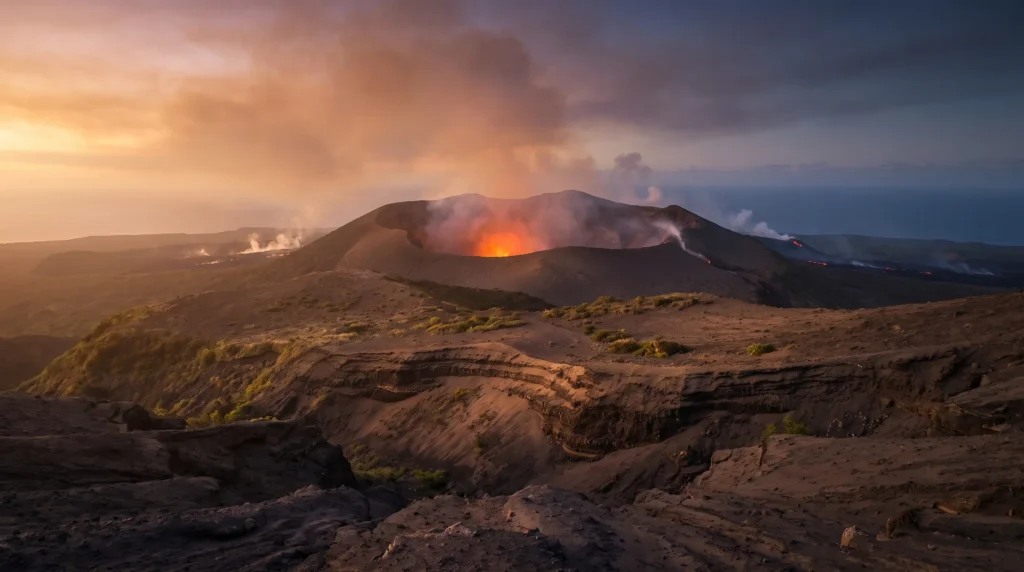
The main draw is Mount Yasur, a 361-metre volcano and one of the most accessible active volcanoes on Earth — eruptions occur multiple times an hour, and evening visits let you watch the glow up close from the crater rim. Pair it with Tanna’s kastom villages and give it at least two nights; a rushed day trip barely scratches it.
Espiritu Santo
Vanuatu’s largest island, known simply as “Santo,” is the country’s adventure and diving hub. The SS President Coolidge — a converted WWII troopship that struck mines and sank in 1942 — is one of the largest and most accessible wreck dives in the world, resting on its side between roughly 20 and 70 metres just off Luganville. Inland, freshwater “blue holes” like Nanda (Jackie’s) Blue Hole offer some of the clearest swimming water you’ll find anywhere, jungle-framed and only a few metres deep.
Pentecost Island
Remote and rarely visited outside land-diving season, Pentecost rewards travellers who make the effort with genuine kastom village life and minimal tourist infrastructure.
Efate’s Outer Islets & Epi, Malakula, Ambrym
For those with more time: Ambrym’s active volcanoes and traditional wood carving, Malakula’s Small Nambas and Big Nambas cultural areas, and Epi’s quiet dugong-spotting waters are all a step further off the circuit than Efate, Tanna or Santo.
Culture & People — Kastom, Kava & the Melanesian Way
Vanuatu’s culture centres on kastom — the Bislama word for traditional custom, law and belief systems that still govern land rights, chiefly authority and community life across most of the islands, alongside Christianity introduced by missionaries. With more than 100 living languages spoken across roughly 83 islands, cultural practice varies significantly from one island — sometimes one village — to the next, and that diversity is treated as a point of pride, not an inconvenience.
Chiefly systems remain socially powerful, most visibly at Chief Roi Mata’s Domain, where centuries-old authority structures and tabu observances are still respected in daily life. Kava — a mildly narcotic drink pressed from the kava root — is the social glue of an evening almost everywhere in the country, traditionally consumed by men at dusk in a “nakamal” (kava bar); visitors are usually welcome to join with a bit of local guidance on etiquette. Vanuatu is also a major kava exporter, and the industry has grown sharply over the past decade as an economic mainstay alongside tourism, copra and beef.
A Food Lover’s Guide to Vanuatu
The national dish is laplap: grated root vegetable (taro, yam, cassava or banana) wrapped in leaves with coconut milk and sometimes meat or fish, then slow-cooked underground in a traditional “lap-lap” earth oven — the Pacific cousin of a Polynesian umu or Fijian lovo. Fresh reef fish, flying fox, and island cabbage feature heavily, and Port Vila’s produce and craft markets are the easiest place to try a cross-section of it.
Kava is less a drink than a ritual: strong, earthy, mildly numbing to the lips, and traditionally served from a coconut shell at a village nakamal after dark — ask locally before drinking, as strength and serving customs vary by island. Vanuatu beef, raised on volcanic-soil pasture, has a strong regional reputation and shows up on menus in Port Vila’s better restaurants alongside French-influenced cooking, a lasting flavour of the colonial condominium era.
Off the Beaten Path
Ambrym’s Volcanoes and Wood Carvers
Home to two active volcanoes and a tradition of ceremonial wood and tree-fern carving that draws collectors from across the Pacific — a far quieter alternative to Tanna’s crater rim crowds.
Malakula’s Nambas Cultures
Vanuatu’s second-largest island preserves some of the country’s most distinct kastom communities, the Small Nambas and Big Nambas, accessible mainly through guided village visits.
Nanda (Jackie’s) Blue Hole, Santo
A jungle-ringed freshwater swimming hole with visibility that makes the “blue hole” name feel understated rather than marketing — reachable by a short drive and a short walk from Luganville.
Epi Island
Quiet waters known for dugong sightings and almost no tourist infrastructure at all — bring cash, patience, and low expectations of Wi-Fi.
Practical Information
Money. The Vatu (VT/VUV) is a freely floating currency managed by the Reserve Bank of Vanuatu, with no subunit — prices are always whole numbers. Cards are accepted in Port Vila and Luganville hotels and larger restaurants; carry cash for markets, trucks and outer islands, where ATMs are scarce or absent.
Safety. The US State Department rates Vanuatu Level 1 (exercise normal precautions) as of its most recent update, but flags that Port Vila’s infrastructure and roads were damaged in the December 2024 earthquake, with repairs still ongoing, and that tourism safety inspections for dive and water-sports operators are inconsistent. The UK FCDO adds that road surfaces, street lighting and vehicle maintenance standards are often below what UK travellers expect, and that some lagoons have water-quality issues and resident sharks. Buy dive and medical evacuation insurance without exception — the nearest hyperbaric chamber and serious medical care can be hours or a flight away.
Health. The CDC recommends being current on routine vaccines plus Hepatitis A and B and typhoid for most travellers, and — importantly — antimalarial medication for all visitors, since malaria transmission (mostly P. vivax) occurs across the country. Use strong DEET repellent, avoid swimming in untreated freshwater (leptospirosis risk), and drink bottled or treated water outside resorts.
Connectivity & other basics. Wi-Fi is workable in Port Vila and Luganville, patchy to nonexistent on outer islands — download offline maps first. Same-sex relations are criminalised, though prosecution of consenting adults is rare; public affection of any kind is best kept low-key. Plugs are Australian/NZ-style (Type I), 220–240V. Time zone is UTC+11.
Budget Breakdown — What Vanuatu Actually Costs in 2026
Vanuatu is not a cheap-backpacker destination — remoteness and import dependency push prices toward South Pacific, not Southeast Asian, levels.
Budget (US$60–100/day): Guesthouse or budget bungalow on Efate, market meals and local trucks for transport, snorkelling over dive trips.
Mid-range (US$150–300/day): A mid-tier Port Vila or Santo hotel, restaurant dinners, a Mount Yasur volcano tour (entrance around 9,800 VT, roughly US$80, plus transfer), one or two dives on the SS President Coolidge, and a domestic flight or two.
Luxury (US$450+/day): Private-island or overwater-style resort stays on Efate, multi-day Espiritu Santo dive packages, chartered inter-island transfers, and a guided Pentecost land-diving expedition in season.
Budget extra for onward-travel proof at check-in and for the visa fee (roughly 5,150 VT / ~US$40) if you’re from a country not on the visa-exempt list. Tipping isn’t customary but is appreciated for exceptional service.
Planning Your First Trip to Vanuatu
The classic first-timer route is Efate + Tanna: land at Bauerfield, spend two or three nights around Port Vila (Chief Roi Mata’s Domain, Mele Cascades, local markets), then fly to Tanna for two nights around Mount Yasur. With more time, add Espiritu Santo for the SS President Coolidge and blue holes, or — if your dates land in April through July — Pentecost for land-diving season. Ten to fourteen days lets you cover three islands without feeling rushed; a week is enough for Efate and Tanna alone. Many travellers pair Vanuatu with a stopover in Fiji given the regional flight connections, or extend the South Pacific run with Samoa or New Zealand as a gateway hub.
Frequently Asked Questions
Is Vanuatu safe to visit in 2026?
Yes, with normal precautions — the US State Department rates it Level 1, its lowest risk category — but infrastructure in Port Vila is still recovering from the December 2024 earthquake, and dive/water-sports safety standards vary by operator, so choose licensed operators and buy solid medical evacuation insurance.
Do I need a visa?
Most nationalities, including the US, UK, EU, Canada, Australia and New Zealand, get a free 30-day visitor permit on arrival with no advance visa needed; other nationalities apply for a tourist visa in advance.
How do I actually fly into Vanuatu right now?
Since Air Vanuatu’s 2024 liquidation left it flying domestic routes only, international access runs through regional carriers — Fiji Airways via Nadi, Aircalin via Nouméa, and seasonal Qantas/Virgin Australia links from Australia are the most common. Check current schedules directly with the airline before booking.
Can beginners visit Mount Yasur?
Yes — it’s one of the most accessible active volcanoes anywhere, with vehicle access to near the crater rim and a short walk up, no technical climbing required. Evening visits are the most popular for visible lava glow.
Vanuatu or Fiji?
Choose Vanuatu for volcanoes, kastom culture and a rawer, less-developed Pacific; choose Fiji for more built-out resort infrastructure, easier international flight access, and a gentler first-timer learning curve.
What’s the cheapest way to see the highlights?
Base in Port Vila for Efate’s sights, fly economy to Tanna for a two-night volcano visit instead of a rushed day trip, and eat at markets rather than resort restaurants — domestic flights, not accommodation, are usually the biggest controllable cost.
Ready to Explore Vanuatu?
A volcano you can walk right up to, a UNESCO domain still governed by a 400-year-old taboo, and a bungee jump’s actual birthplace on a hillside in Pentecost — Vanuatu asks a little more patience of you than most Pacific destinations right now, and pays it back with a version of the South Pacific that hasn’t been smoothed down for package tours.
Explore More
- Fiji Travel Guide — the easiest regional pairing and flight connection
- Samoa Travel Guide — continue the South Pacific island-hop
- Australia Travel Guide — the main gateway hub for Vanuatu flights
- New Zealand Travel Guide — another common regional stopover
How this guide was built
Published as part of Facts From Upstairs’ country guide series. Built from authoritative sources — Vanuatu’s Department of Immigration and Passport Services, the Reserve Bank of Vanuatu, UNESCO’s Chief Roi Mata’s Domain inscription, the US State Department and UK FCDO Vanuatu advisory pages, the US CDC traveler page for Vanuatu, and Wikipedia entity pages for Vanuatu’s geography, Bauerfield Airport, Mount Yasur, Air Vanuatu and the national economy. Numeric and safety claims carry inline citations; where a fact could not be independently verified with a firm number (for example, exact current flight schedules), it is described qualitatively instead.
Sources cited on this page
- Wikipedia — Vanuatu
- UNESCO — Chief Roi Mata’s Domain
- Vanuatu Department of Immigration and Passport Services — Tourist Visa
- Reserve Bank of Vanuatu
- US State Department — Vanuatu
- UK FCDO — Vanuatu safety and security
- US CDC — Vanuatu traveler page
- Wikipedia — Bauerfield International Airport
- Wikipedia — Mount Yasur
- Wikipedia — Air Vanuatu
- Wikipedia — Economy of Vanuatu
- Devpolicy Blog — Vanuatu after Cyclone Pam
- Air Vanuatu — Guide to Visiting Mount Yasur
More country guides you might like
Plan your trip to Vanuatu
The booking tools we use ourselves. FFU may earn a commission at no extra cost to you.
Plan & book your trip to Vanuatu
Booking through these searches supports our guides at no extra cost to you.