
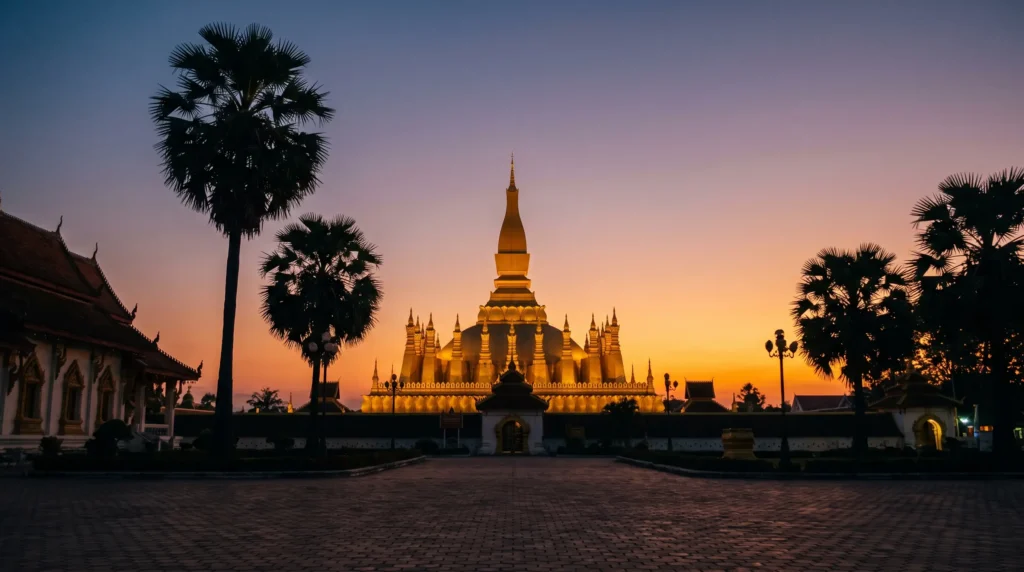
Vientiane Travel Guide — The World’s Quietest Capital, Golden Stupas & the Mekong at Sunset
Vientiane is the capital nobody expects to like this much. There’s no skyline, no gridlock in the way Bangkok or Hanoi mean it, and most guidebooks give it two paragraphs on the way to somewhere else. I get why — it’s a low-rise, tree-shaded riverside town of around 840,000 people, and it plays it that way on purpose. But spend three days here and the appeal clicks into place: monks collecting alms at dawn outside gold-flecked temples older than the country’s independence, a night market strung along the Mekong with Thailand’s lights visible on the far bank, and a food scene quietly stacking French bakery skills onto Lao and Thai flavors. It is the only landlocked country’s capital in Southeast Asia, and it feels like it — unhurried, a little sleepy after dark, completely charming if you arrive without a Bangkok-sized itinerary. This isn’t a city to rush through; it’s one to slow down in for a few days before the trains carry you north.
In This Guide
- Overview — Why Vientiane Is Southeast Asia’s Quietest Capital
- Boun That Luang — Vientiane’s Biggest Festival
- Best Time to Visit Vientiane (Season by Season)
- Getting There — Wattay Airport, the China-Laos Railway & the Friendship Bridge
- Getting Around — Tuk-Tuks, Bikes & a Very Walkable Riverfront
- Neighborhoods — Chanthabuly, the Riverfront & Beyond
- Culture & People — Buddhism, Alms and a Communist State
- A Food Lover’s Guide to Vientiane
- Off the Beaten Path
- Day Trips from Vientiane
- Practical Information
- Budget Breakdown — What Vientiane Actually Costs in 2026
- Frequently Asked Questions
Overview — Why Vientiane Is Southeast Asia’s Quietest Capital
Vientiane traces its roots to a settlement on the Mekong dating back to the 9th century, but it became a capital in 1563 when King Setthathirath moved the seat of the Lan Xang kingdom here from Luang Prabang. It stayed the administrative center through the French colonial era and remained the capital when Laos became a “people’s democratic state” under the Lao People’s Revolutionary Party in 1975 — a one-party communist government that still runs the country today.
None of that history announces itself loudly. Vientiane has no high-rises worth photographing and no traffic that will test your nerves. What it has instead is a compact, walkable core along the Mekong River, gold-domed temples tucked between noodle shops, and a French-colonial layer of bakeries and shophouse architecture that gives the city a completely different texture from Bangkok or Hanoi. Laos itself carries three UNESCO World Heritage Sites — Luang Prabang, the Vat Phou temple complex, and the Plain of Jars — and Vientiane is the near-universal gateway to all three, connected north to Luang Prabang by the new China-Laos high-speed railway.
The honest pitch: Vientiane is not a bucket-list destination on its own. It’s a genuinely pleasant two-to-four-day stop that rewards a slow pace, and it’s the easiest, cheapest base for pushing on to the rest of Laos.
Boun That Luang — Vientiane’s Biggest Festival
If you can time a trip around one date, make it the Boun That Luang festival, held around the full moon in November at Pha That Luang, the 45-metre golden stupa that is Laos’s national symbol. The multi-day celebration draws monks and pilgrims from across the country for candlelit processions circling the stupa, an alms-giving ceremony at dawn, a hot-air balloon and fireworks display, and a sprawling fairground of food stalls and trade booths that spills out around the temple grounds for nearly a week.
November also happens to land right at the start of the cool, dry season — the best weather window of the year — so a festival trip doubles as good-weather timing. Book riverside hotels well ahead; this is the one week Vientiane’s normally easy-to-find rooms actually sell out.
Best Time to Visit Vientiane (Season by Season)
November – February · Cool, dry season (peak)
The best months by a wide margin: lower humidity, daytime temperatures generally in the comfortable 20s°C, and the Boun That Luang festival in November. This is when riverfront cafés and the night market are most pleasant to linger in.
March – May · Hot season
Temperatures climb hard, with the city’s record highs reaching into the low-40s°C. Slow-travel days, air-conditioned museum stops, and lots of water are the move. Also, regionally, this is smoky “burning season” in parts of northern Southeast Asia, which can haze up longer views.
June – October · Wet season
Warm, humid, and prone to short, heavy downpours rather than all-day washouts. Mekong water levels rise noticeably, the countryside turns lushly green, and hotel prices soften. It’s a perfectly workable time to visit if you don’t mind planning around afternoon rain.
Getting There — Wattay Airport, the China-Laos Railway & the Friendship Bridge
Wattay International Airport (VTE) sits just 3 kilometres from the city centre, making it one of the most conveniently placed capital airports in the region — a tuk-tuk or taxi into town takes about ten minutes. It’s a regional hub rather than a long-haul one: expect direct flights from Bangkok, Hanoi, Ho Chi Minh City, Kunming, Shanghai and Seoul, with onward domestic hops to Luang Prabang and Pakse.
Overland, the Thai-Lao Friendship Bridge crosses the Mekong from Nong Khai, Thailand, and is the classic entry point for anyone coming from Bangkok by bus or train — a straightforward, well-worn border crossing. The bigger recent change is the China-Laos Railway, opened in December 2021, which runs 422 kilometres from the Chinese border at Boten down through Luang Prabang and Vang Vieng to Vientiane. It’s transformed north-south travel in Laos: what used to be a grinding, switchback bus ride is now a smooth couple of hours by rail.
Getting Around — Tuk-Tuks, Bikes & a Very Walkable Riverfront
Vientiane’s compact center — roughly the stretch between Wat Si Saket, the Presidential Palace and the Mekong riverfront — is genuinely walkable, especially in cool season mornings. For anything further, tuk-tuks are the default: agree the fare before you get in, and expect to pay more than locals do (it’s a fixed feature of tourist travel here, not a scam specifically aimed at you).
Bicycles and scooters are cheap and easy to rent, and the flat, low-traffic streets make Vientiane one of the more relaxed Southeast Asian capitals to ride in. Ride-hailing apps operate and are worth having as a backup. To reach Pha That Luang, Patuxai, or the outer bus stations, a short tuk-tuk or app-hailed ride beats walking in the heat. For getting out of the city entirely — north to Vang Vieng and Luang Prabang, or south toward the Thai border — the train station sits outside the center, so budget time and a short taxi ride to reach it.
Neighborhoods — Chanthabuly, the Riverfront & Beyond
Chanthabuly (the old quarter)
The historic heart of the city and where most visitors base themselves — home to Wat Si Saket, the Presidential Palace, the Nam Phu fountain square, and the highest concentration of French-colonial shophouses, guesthouses and Western-Lao fusion restaurants.
The Mekong Riverfront
A landscaped promenade that fills with joggers at dawn and a full night market by evening — clothes, snacks, and the best sunset view in the city, with Thailand visible across the water. This is where Vientiane’s low-key social life actually happens.
Pha That Luang / Sisattanak
The government and monument district: the golden stupa itself, Patuxai’s Champs-Élysées-style boulevard, and the wide institutional streets built around Laos’s most important religious site.
Sikhottabong
The airport district and a more residential, less touristed slice of the city — useful if you’re arriving late or leaving early and want a quiet stay near Wattay.
Xieng Khouan (Buddha Park), outer south
Technically outside the city proper, about 25 kilometres southeast along the Mekong, but firmly on the visitor circuit: a surreal sculpture garden of concrete Buddhist and Hindu statues built in 1958, easily combined with a half-day riverside outing.
Culture & People — Buddhism, Alms and a Communist State
Theravada Buddhism shapes daily rhythm here more visibly than almost anywhere else in the capital-city version of Southeast Asia: saffron-robed monks make an alms round at dawn along several central streets, and locals kneel roadside with sticky rice for the offering. Photograph respectfully and from a distance — this is a lived religious practice, not a staged tourist show, even where visitors do gather to watch.
Politically, Laos has been a one-party communist state since 1975, and that history is visible in monuments like Patuxai — originally built to honor independence-war dead, then renamed “Victory Gate” after the Pathet Lao’s 1975 win, though notably not demolished. Public criticism of the government is not something visitors should engage in, and it’s wise to keep political conversation light. Day to day, though, Vientiane’s culture feels unhurried and warmly hospitable rather than austere — greetings, a smile, and basic Lao phrases go a long way.
A Food Lover’s Guide to Vientiane
Lao food gets overshadowed by its Thai neighbor, which is a shame, because Vientiane does it well. The signature dish is laap (also spelled larb) — minced meat or fish tossed with lime, fish sauce, chilies, mint, and toasted rice powder, always served with sticky rice eaten by hand. Pair it with tam mak hoong, Laos’s spicier, funkier cousin of Thai papaya salad, made with padaek (fermented fish sauce) instead of the milder Thai version.
The Mekong riverfront and its night market are the easiest place to graze — grilled river fish, sausages, and sticky-rice baskets sold from stalls as the sun goes down. Vientiane’s French-colonial legacy also shows up on breakfast tables: proper baguettes, strong drip coffee, and khao ji pate (a Lao baguette sandwich, close cousin to Vietnam’s banh mi) sold from carts across the old quarter. Beerlao, the ubiquitous national lager, is on every table and genuinely good. For something sweeter, look for khao niaw mamuang — sticky rice with mango — sold seasonally from street carts.
Off the Beaten Path
COPE Visitor Centre
A sobering, essential stop: a small museum documenting the impact of unexploded ordnance (UXO) left from the Indochina War and the prosthetics work still being done for survivors today. Both the US State Department and UK FCDO flag UXO as a genuine, present-day hazard in parts of Laos, particularly off well-used roads and trails — this museum is where that history is explained without sensationalism.
Wat Si Saket’s cloister of Buddhas
Vientiane’s oldest surviving temple, ringed by a cloister wall holding thousands of small Buddha images — quieter and less visited than Pha That Luang, and arguably more atmospheric.
Chao Anouvong Park & the far riverfront
Walk south past the main night-market strip and the crowds thin out fast, leaving open river views, a statue of the last king of Vientiane, and locals doing evening aerobics rather than selling souvenirs.
Day Trips from Vientiane
Xieng Khouan (Buddha Park)
About 25 km southeast of the city on the Mekong, a half-day round trip by tuk-tuk, taxi, or local bus to see the concrete sculpture garden’s giant reclining Buddha and its surreal pumpkin-shaped structure you can climb through.
Vang Vieng
A karst-mountain town around 130 km north of Vientiane — about 2 hours by road, or a fraction of that on the China-Laos Railway’s fast train. Vang Vieng earned a rough reputation in the early 2010s for reckless river-tubing party tourism and a string of tourist deaths; a 2012 government crackdown shut down the riverside bars, and the town has rebuilt its identity around kayaking, rock climbing, and cave trips through its dramatic limestone scenery. It works well as either a long day trip or an overnight add-on before continuing to Luang Prabang.
Nong Khai, Thailand
A same-day round trip across the Thai-Lao Friendship Bridge for a change of scenery, a different national cuisine, and a look at the Mekong from the opposite bank — popular as a visa-related border run as well as a casual excursion.
Practical Information
Money. The Lao Kip floats freely and has traded in a roughly 21,000–22,500-per-US-dollar range through 2026, after a period of sharper devaluation from 2021–2024 that has since stabilized. US dollars and Thai baht are widely accepted alongside kip in tourist businesses, though carrying some kip for markets and tuk-tuks is sensible. Note that arriving travelers must declare cash equivalents above US$2,500 and cannot bring Lao currency across the border.
Safety. Vientiane itself is generally calm and low-crime, and it isn’t the focus of current advisories. The US State Department rates Laos overall at “Level 2: Exercise Increased Caution,” with a specific “reconsider travel” warning for Xaisomboun Province and repeated warnings about unexploded ordnance off main roads elsewhere in the country. The UK FCDO similarly flags parts of the south near the Thailand-Cambodia border area for caution. None of this should affect a standard Vientiane city visit — check current advisories before heading to rural or border areas.
Health. The CDC recommends Hepatitis A and typhoid vaccination for most travelers, with Japanese encephalitis and rabies pre-exposure vaccination worth considering for longer or more rural trips; malaria risk is concentrated in southern provinces and is not present in Vientiane or Luang Prabang. Stick to bottled or filtered water and avoid contact with floodwater after heavy rain.
Connectivity. A local SIM or regional eSIM is cheap and easy to pick up near the airport or in the old quarter; hotel and café Wi-Fi is generally solid in the center. Plugs: a mix of two-pin types (A/C), 230V. Time zone: UTC+7, no daylight saving.
Budget Breakdown — What Vientiane Actually Costs in 2026
Vientiane is one of the more affordable Southeast Asian capitals — noticeably cheaper than Bangkok, roughly on par with Phnom Penh.
Budget (US$25–45/day): Guesthouse dorm or basic private room, noodle-shop and street-stall meals, tuk-tuk shares or a rented bicycle, free temple visits or small entry fees.
Mid-range (US$60–120/day): Boutique or mid-tier hotel in Chanthabuly, a mix of restaurant and street meals, private tuk-tuk or app-hailed rides, entry fees for Pha That Luang and Buddha Park, one fast-train leg to Vang Vieng or Luang Prabang.
Luxury (US$200+/day): Riverside hotel with Mekong views, private guided city and temple tours, a driver for day trips, higher-end Lao-French dining.
Visa fees (US$30–50 depending on nationality and entry method) are a fixed upfront cost most first-timers underestimate. Tipping is appreciated but not obligatory; rounding up is the norm.
Planning Your First Trip to Vientiane
Two to three nights is enough to see Vientiane properly: Pha That Luang and Patuxai on day one, Wat Si Saket and the old quarter on day two, Buddha Park as a half-day add-on. Most travelers then use Vientiane as a launchpad north — the China-Laos Railway makes Vang Vieng a two-hour hop and Luang Prabang (Laos’s UNESCO-listed former royal capital) under two hours beyond that, pairing naturally with our Luang Prabang guide. If you’re building a wider Indochina loop, Vientiane connects easily to our Thailand and Vietnam guides, or south toward Cambodia.
Frequently Asked Questions
Is Vientiane safe for tourists in 2026?
Yes, in the sense that matters for a standard city visit — Vientiane is calm and not the focus of current safety warnings. The broader Laos advisory sits at “Level 2: Exercise Increased Caution,” driven mainly by a specific warning for Xaisomboun Province and unexploded ordnance risks off main roads elsewhere in the country, not the capital itself. Check current advisories if your itinerary includes rural or border areas.
Do I need a visa for Laos?
Most nationalities need a visa, available as an eVisa in advance through the official portal or on arrival at major crossings and the airport, typically for around 30 days and US$30–50 depending on nationality. ASEAN-country citizens generally enter visa-free.
How many days do I need in Vientiane?
Two to three days covers the city comfortably. Vientiane rewards a relaxed pace rather than a packed schedule — most visitors are happier treating it as a calm bookend to a longer Laos trip than as a multi-day destination on its own.
Vientiane or Luang Prabang — which one first?
Fly into Vientiane (it’s the main international gateway), then take the fast train north to Luang Prabang, which has the temples, the UNESCO old town, and the more dramatic scenery. Doing it in that order lets the trip build rather than taper off.
Can I drink the tap water?
No — stick to bottled or filtered water throughout Laos, including in Vientiane. Ice in reputable restaurants is generally fine, but the CDC’s standard food-and-water precautions apply.
What’s the easiest way to get from Vientiane to Vang Vieng or Luang Prabang?
The China-Laos Railway’s fast train is the easiest option by far — around 2 hours from Vientiane to Vang Vieng and roughly 1.5 hours onward to Luang Prabang. Book tickets a few days ahead in high season; buses run the same route but take considerably longer.
Ready to Explore Vientiane?
Monks on their dawn alms round, a golden stupa that’s survived invasion and colonial neglect, sunset beers on a Mekong promenade with another country visible across the water — Vientiane doesn’t ask you to rush, and that’s the whole point. Give it a few unhurried days before the train pulls you north.
Explore More
- Luang Prabang City Guide — Laos’s UNESCO-listed former royal capital, a fast train ride north
- Thailand Travel Guide — across the Friendship Bridge from Nong Khai
- Vietnam Travel Guide — continue the Indochina loop east
- Cambodia Travel Guide — temples and the Mekong further south
How this guide was built
Published as part of Facts From Upstairs’ city guide series. Built from authoritative sources — Wikipedia entity pages for Vientiane, Laos, Pha That Luang, Patuxai, Wattay International Airport, the China-Laos Railway and Vang Vieng; the US State Department and UK FCDO Laos travel advisory pages; the US CDC traveler page for Laos; and Trading Economics’ Lao Kip exchange-rate data. Numeric and checkable claims carry inline citations.
Sources cited on this page
More city guides you might like
Plan your trip to Vientiane
The booking tools we use ourselves. FFU may earn a commission at no extra cost to you.
Plan & book your trip to Vientiane
Booking through these searches supports our guides at no extra cost to you.