
☰ On this page
- 📋 In This Guide
- Rome, Italy: Eternal City — 28 Centuries of Layered Stone
- 🌷 Late-April / Early-May 2026 — Why You’re Right in the Window
- Best Time to Visit Rome (Season by Season)
- Getting There — Flights, Trains & Arrival
- Getting Around — Metro, Bus and the Walking City
- Neighbourhoods Worth Knowing
- Cultural Sights & Ancient Rome
- A Food Lover’s Guide to Rome
- Entertainment & Nightlife
- 🗓️ Sample Itineraries
- Day Trips from Rome
- 📸 Photography Notes
- Practical Information
- Budget Breakdown — What Rome Actually Costs
- ✅ Pre-Trip Checklist
- 🤔 What Surprises First-Timers
- Frequently Asked Questions
- Ready to Experience Rome?
- Explore More
Part of our Italy travel guide.
Rome is the only city on Earth where you can walk past a working 2,000-year-old Pantheon dome on the way to lunch, eat a plate of cacio e pepe in a trattoria that’s been pulling pasta from the same hand-cranked machine since 1953, watch a 4th-century basilica sit atop a 1st-century house atop a 2nd-century BC pagan temple — all on the same block. The city stretches across the seven hills of central Italy on a 35-kilometre bend of the Tiber, holds 2.8 million residents inside its sprawling Comune boundary, and contains, in a footprint roughly half the size of Greater London, more layered archaeology per square kilometre than anywhere else on the planet. The city has been continuously inhabited for 28 centuries — the traditional founding date is April 21, 753 BC — and almost every structure you walk past contains the rubble of two or three earlier ones.
What makes Rome different is the layering. You don’t move from one period of the city to the next — you move down through them. The Basilica of San Clemente, ten minutes from the Colosseum, is a 12th-century church on top of a 4th-century church on top of a 2nd-century AD Roman house and Mithraic temple on top of a 1st-century AD warehouse. The basilica still functions; you can attend Mass on the top floor and walk down a staircase that drops you a thousand years per landing. The principle holds across the city. Almost no street stands on its original ground level. Almost every dig produces a wall, a column, a paved square that was buried by 1,500 years of rebuild.
This guide covers Rome end to end — from the obvious Colosseum-Vatican-Trevi triangle to the eastern neighbourhoods most travellers never reach. If you’re routing through Italy or comparing notes with a regional neighbour, see our Italy travel guide and our Florence, Venice, and Athens city guides. For the Iberian counterpoint after Rome, our Madrid city guide picks up where this one hands off.
📋 In This Guide
- Overview — Why Rome Belongs on Every Bucket List
- 🌷 Late-April / Early-May 2026 — Why You’re Right in the Window
- Best Time to Visit Rome (Season by Season)
- Getting There — Flights, Trains & Arrival
- Getting Around — Metro, Bus and the Walking City
- Neighbourhoods Worth Knowing
- Cultural Sights & Ancient Rome
- A Food Lover’s Guide to Rome
- Entertainment & Nightlife
- 🗓️ Sample Itineraries — 3, 5 and 7 Days
- Day Trips from Rome
- 📸 Photography Notes
- Practical Information
- Budget Breakdown — What Rome Actually Costs
- ✅ Pre-Trip Checklist
- 🤔 What Surprises First-Timers
- Frequently Asked Questions
- Ready to Experience Rome?
- Explore More
Rome, Italy: Eternal City — 28 Centuries of Layered Stone
Rome’s traditional founding date — April 21, 753 BC — is celebrated annually as Natale di Roma with parades in costume through the Imperial Fora, free entry to the Forum and Palatine, and a re-enactment of the city’s foundation myth (Romulus tracing the original walls with a plough). The city was a kingdom, then a republic, then an empire that at its peak under Trajan in 117 AD covered 5 million square kilometres and held a quarter of humanity. The Western Empire fell in 476; the city’s population collapsed from a million in the second century to perhaps 30,000 by the seventh. The papacy filled the vacuum. From the Middle Ages forward Rome was reborn as the capital of Christendom, the destination of jubilee pilgrimages, and the source of the architecture and art that built the Renaissance and the Baroque.
The modern city is the product of three superimposed Romes. Ancient Rome — the Forum, the Colosseum, the Pantheon, the aqueducts, the catacombs — sits below or beside everything. Papal Rome — St. Peter’s, the Vatican Museums, the Baroque churches and fountains, the Bernini and Borromini interventions of the 17th century — defines the skyline of the central historic core. Modern Rome — the post-1870 capital after Italian unification, the Mussolini-era boulevards (Via dei Fori Imperiali, EUR), the post-war suburbs — gives the city its working geography. Rome was made the capital of unified Italy in 1871, and the population has grown roughly tenfold since.
For a traveller, the practical consequence is that you are visiting a city where the past is not preserved — it is in use. The Pantheon is a working Catholic church (Sunday Mass at 10:30 a.m.). The Largo di Torre Argentina, a 4th-century BC temple complex where Julius Caesar was assassinated in 44 BC, is also a recognised cat sanctuary with about 150 strays. The Spanish Steps are a place to sit, the Trevi Fountain coin tradition keeps a homeless shelter funded, and the Roman family eating Sunday lunch at the table next to yours has probably been eating in the same trattoria since their grandparents were children.
🏛️ Historical Context
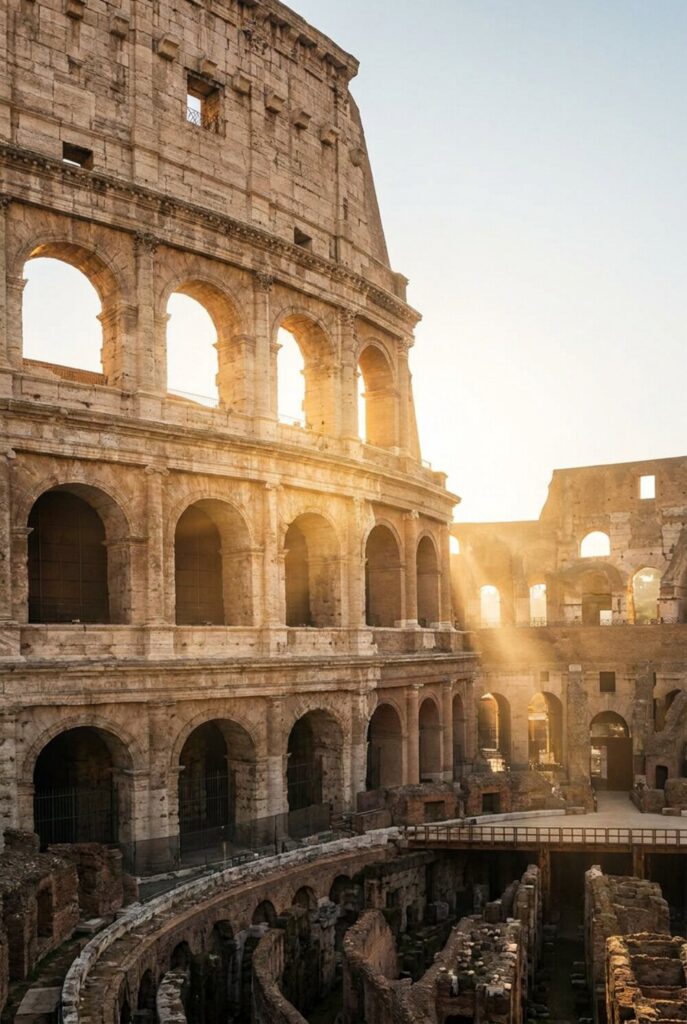
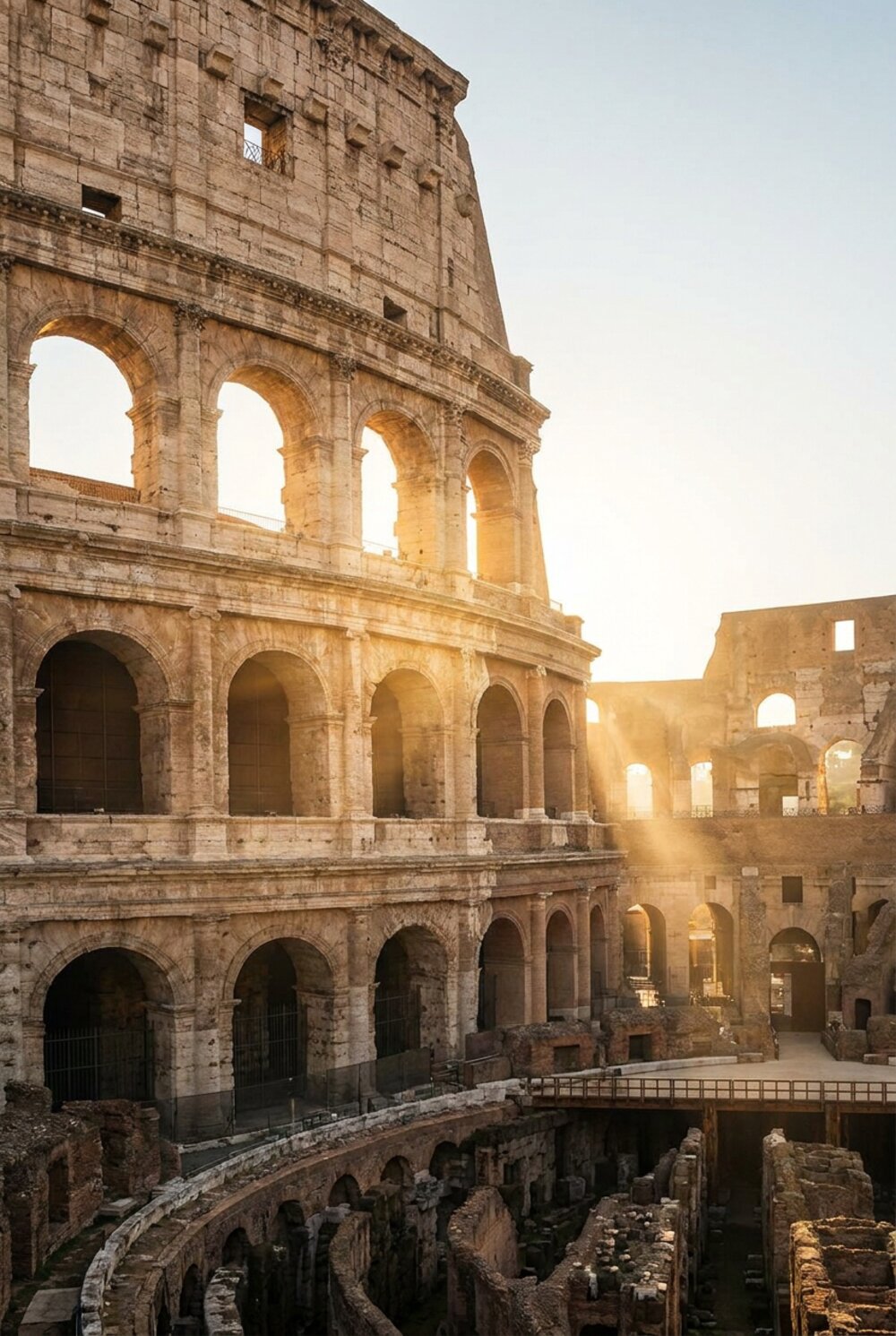
The Colosseum opened in 80 AD with 100 days of inaugural games — gladiatorial combats, animal hunts, mock naval battles in the flooded arena, public executions — that killed an estimated 9,000 wild animals and several hundred gladiators and condemned criminals. The amphitheatre held 50,000-80,000 spectators (modern estimates vary), distributed by social class through 80 entrances; the emperor entered through the southern arch, senators sat in the front rows on marble benches, women and slaves stood on the wooden top tier. The arena was used for spectacles for almost 400 years, last hosted gladiatorial games in 435 AD, and was eventually quarried for stone — the travertine of Renaissance St. Peter’s, the Palazzo Farnese, and many other buildings comes from the Colosseum’s exterior. The fact that 70% of the structure has survived earthquakes, fires and 1,500 years of stone-thieves is genuinely remarkable.
🎌 Did You Know?
Rome has 280 fountains by official count — more than any other city on Earth — and most of them still produce drinking water. The 2,000-year-old aqueduct system, originally 11 separate Roman aqueducts running into the city for a combined 800 kilometres, still feeds water to many of them. The most famous, the Trevi Fountain (1762, Nicola Salvi), is fed by the Acqua Vergine aqueduct restored from a 19 BC original. The little cast-iron drinking fountains everywhere in the city — the nasoni (“big noses”) — number around 2,500 across Rome and run continuously; the running water is potable, cold, and free. Block the spout at the bottom and water shoots up from a small hole on top, which is the local trick for filling water bottles.
🌷 Late-April / Early-May 2026 — Why You’re Right in the Window
Late April through mid-May is the best three-week stretch on the Roman calendar. The wisteria on Via Margutta and the umbrella pines of the Villa Borghese gardens are at their late-spring fullest, the rose garden at Roseto Comunale (across from the Circus Maximus on the Aventine Hill) opens for its annual six-week public bloom from April 21, and the daytime highs sit at 19-23°C — properly warm enough for terrace meals, not yet the August oven that drives Romans out of the city. The Spanish Steps’ azaleas are placed each year for late April; the Pincio terrace above Piazza del Popolo gives the most photographed citywide view; the Aventine keyhole at the Knights of Malta gate (the framed view of St. Peter’s dome through a 17th-century keyhole) is at its most reliable in clear spring afternoons.
This is also the best-stacked civic week of the year. April 21 is Natale di Roma — Rome’s birthday — and the city throws a full public celebration: free entry to the Forum and Palatine all day, costumed parades through the Imperial Fora at noon, evening illuminations on the Colosseum and the Pantheon, and re-enactments of the foundation myth at the Circus Maximus. April 25 is Liberation Day (Festa della Liberazione), the public holiday that marks the 1945 liberation from fascist rule — most museums close, most restaurants stay open, and Romans use it as the kick-off of the long-weekend tradition that runs through May 1 (Festa del Lavoro / International Workers’ Day, also a public holiday) and June 2 (Festa della Repubblica). The Vatican Easter calendar — Holy Week, the Easter Sunday papal blessing from St. Peter’s central balcony — typically falls in late March or early April; in 2026, Easter Sunday is April 5, so it has just passed when you arrive. The Vatican is back to standard opening hours by mid-April.
One important caveat for spring 2026: Rome is hosting the 2025 Jubilee year (Giubileo Ordinario), a once-every-25-years pilgrimage event running from December 24, 2024 through January 6, 2026. The official jubilee window has closed by late April 2026, but the infrastructure projects, restoration scaffolding (parts of the Trevi Fountain and St. Peter’s Square were under restoration through 2025), and elevated visitor numbers from the jubilee carry-over are still meaningful through the spring. Hotel rates in the Centro Storico are 15-25% above 2019 norms; Vatican Museum reservations sell out 4-6 weeks ahead for the popular Saturday and morning slots.
⚠️ Important — Public Holiday Closures and Pre-Booked Tickets
If your trip overlaps April 25 (Liberation Day) or May 1 (Workers’ Day), most state-run museums close — including the Colosseum, Forum, Borghese Gallery, and Capitoline Museums on May 1. The Vatican Museums close on April 25 only when it falls on a Wednesday (which it does not in 2026) and on most Sundays except the last of each month. Pre-booked tickets are non-refundable. Build the holidays into your day-trip planning instead — Tivoli’s Villa d’Este is open most public holidays, and the Borghese Gardens and historic centre are walkable any day. Vatican Museums and the Borghese Gallery (limited capacity, 360 visitors per 2-hour time slot) sell out 4-6 weeks ahead in spring 2026; book the moment your dates are firm.
Best Time to Visit Rome (Season by Season)
Rome has four distinct seasons but the meaningful split is between the bearable months (April-May, September-October) and the rest. Summer is hot and emptied of locals; winter is mild but damp; the shoulder months are when most experienced Italy travellers actually visit.
Spring (March – May)
The best window of the year. March is uneven (12-17°C, intermittent rain) but quiet; April climbs to 16-21°C with reliable sun by mid-month; May settles into 20-24°C, the longest comfortable terrace-eating stretch of the year. The Spanish Steps’ azaleas are placed in late April, the Borghese Gardens are at their fullest, and Rome’s birthday (April 21) plus Liberation Day (April 25) plus May 1 produce a ten-day stretch of public events. Crowds at the Vatican and Colosseum hit 70-80% of summer peak; book ahead. Hotel rates are mid-range, 15-25% below July-August.
Summer (June – August)
The hardest season and the one most travellers wrongly book. Daytime highs sit 30-35°C through July, push to 35-40°C in August, and the urban heat-island effect adds another 3-5°C in stone-paved central squares. Most Romans leave the city for the entire month of August (the historic ferragosto exodus); about 35% of independent restaurants and shops close for two-to-four-week annual breaks. The city is genuinely emptier in August but also harder to enjoy — the heat, the closed neighbourhoods, the queue at the Vatican that starts at 6 a.m. The redemption is the Estate Romana cultural programme: open-air cinema in the Tiber Island arena, jazz at the Casa del Jazz, and the floodlit Caracalla Baths summer opera season (Rome Opera House moves outdoors July-August). Hotel rates climb sharply in June and July, drop slightly in August.
Autumn (September – November)
The locals’ choice and arguably the single best month is October. September starts hot (still 25-30°C) but cools through the month; October settles at 18-23°C with low humidity, sharp blue afternoons, and the wine harvest taking over the Castelli Romani hill towns south of the city. November cools sharply (12-17°C) with the first significant rain of the year, but tourist crowds drop dramatically and hotel rates fall 25-35% off summer peak. The Rome Film Fest in late October draws a global audience; the All Saints’ Day public holiday on November 1 closes most state-run sites.
Winter (December – February)
Mild, damp, and underrated. Daytime highs 8-13°C, occasional cold snaps to 3-5°C, light snow once every five years or so. Christmas decorations on Via del Corso from late November, the Vatican’s nativity scene in St. Peter’s Square, the Christmas Eve midnight Mass at St. Peter’s (need a free pass through the Vatican Prefecture), and the Befana market in Piazza Navona running January 6 are the seasonal anchors. January and February have the smallest crowds and the lowest hotel rates of the year. The Colosseum on a cold Tuesday morning in February is a different experience — fewer than 30% of the visitor numbers of an August Saturday.
🧳 Travel Guru Tip
If you have one week and want Rome at its most photogenic with the smallest crowds, target the second or third week of October. The light is at its sharpest, the Roman afternoons are 20-22°C in the sun, the trattorias have shifted to autumn truffle and porcini menus, and the hotel rates have dropped 25% off August peak. The October-November window is the locals’ answer to the impossible question of when to visit — better than April for weather (less rain, more reliable sun) and better than April for prices.
| Experience | Best months | Best locations | Notes |
|---|---|---|---|
| Wisteria bloom | Mid-Apr – early May | Via Margutta, Villa Borghese | Pincio terrace at sunset |
| Rose garden bloom | Late Apr – mid-Jun | Roseto Comunale (Aventine) | Free entry, opens April 21 |
| Caracalla opera season | Jul – early Aug | Baths of Caracalla open-air stage | €40-180; book 2 months ahead |
| Truffle and porcini menus | Oct – Nov | Trastevere, Testaccio, Prati | Tartufo bianco peaks Oct-Nov |
| Christmas markets | Late Nov – Jan 6 | Piazza Navona (Befana), Via del Corso | Befana on Jan 6 closes the season |
| Empty marquee sights | Jan – Feb weekday mornings | Colosseum, Vatican, Forum | Pre-book the 8:30 a.m. slot Tue-Thu |
Getting There — Flights, Trains & Arrival
Rome has two airports of practical interest. Leonardo da Vinci–Fiumicino (FCO) is the primary international hub 32 km southwest of the city — every long-haul intercontinental carrier, all Alitalia/ITA Airways routes, and most full-service European carriers. Ciampino (CIA) is the budget-airline alternative 15 km southeast of the city — Ryanair and Wizz Air primarily, useful only if the fare differential is large. Both are well-connected to the centre.
From North America, direct flights to FCO run year-round from New York (JFK, Newark, 8h45m), Boston (8h15m), Toronto (8h30m), Atlanta, Chicago, Dallas, Los Angeles, Miami, Philadelphia and Washington Dulles. From Europe, expect 1h30m from London (Heathrow, Gatwick), 1h25m from Paris CDG, 1h35m from Madrid, 1h45m from Amsterdam, and 1h55m from Athens. Round-trip fares from London or New York in shoulder season typically land at £140-260 / $580-880 if booked 8-12 weeks ahead.
Italy’s high-speed train network is the underused entry from elsewhere in Italy. Frecciarossa and Italo trains link Rome to Milan in 2h55m, Florence in 1h30m, Naples in 1h10m, and Venice in 3h45m, with departures every 20-30 minutes from Roma Termini. Standard fares booked 4-6 weeks ahead run €30-70 (Florence) or €40-100 (Milan). The journey is more pleasant than a domestic flight by every measure including time, and the trains drop you in central Rome rather than 30 km out of town.
From FCO, the Leonardo Express train runs every 15 minutes to Roma Termini (32 minutes, €14 one-way), is the cleanest option for travellers staying near Termini, the Esquiline, or the central Trastevere area. The FL1 commuter train runs every 15 minutes to Roma Trastevere, Roma Ostiense and Roma Tiburtina (€8 one-way) and is useful if you’re staying in Trastevere. A taxi to central Rome is a flat fare set by city ordinance — €55 to anywhere within the Aurelian Walls, regardless of traffic — though Uber and Free Now are typically €40-60. From Ciampino, the SIT bus to Termini takes 45 minutes for €6, or a fixed-fare taxi at €40.
✨ Pro Tip — The Roma Pass and the OMNIA Card
Rome has two competing tourist cards and only one is worth buying for most travellers. The Roma Pass (€32 for 48 hours, €52 for 72 hours) covers unlimited public transport plus free entry to your first one or two state-run sites (Colosseum, Forum, Palatine count as one site for the bundle) plus discounts on subsequent ones. It’s worth it if you’ll do the Colosseum + at least one other museum and use the bus or Metro 4+ times. The OMNIA Card (€129 for 72 hours) bundles the Roma Pass plus Vatican Museums and St. Peter’s Dome plus a hop-on-hop-off bus — it makes financial sense only if you’ll definitively do all three Vatican stops. For most travellers the better play is to skip both cards, buy the Vatican ticket separately, book the Colosseum on coopculture.it directly, and pay for individual Metro tickets at €1.50 each.
Getting Around — Metro, Bus and the Walking City
Rome is fundamentally a walking city. The historic centre — bounded loosely by the Vatican, the Borghese Gardens, Termini Station, the Colosseum, and Trastevere — covers roughly 4 km² and the densest concentration of marquee sights are within 25 minutes of each other on foot. Most Roman pavements are uneven cobblestone (sampietrini, the small basalt cubes), so wear shoes you can do 8-10 km a day in. The walk from the Spanish Steps to the Trevi to the Pantheon to Piazza Navona to Campo de’ Fiori is the iconic introductory loop and takes about 90 minutes with stops.
When you can’t walk, the Metro is limited but useful. Three lines (A, B, C) cross at Termini and form a rough X across the city; only Line A is genuinely tourist-useful, running from Battistini through the Vatican (Ottaviano), Spagna (Spanish Steps), Termini, and east to Anagnina. Line B passes the Colosseum (Colosseo station), Termini, and continues north to Tiburtina. Line C is partial and primarily serves the eastern suburbs. A single ride is €1.50, valid for 100 minutes and including transfers; a 24-hour pass is €7, a 72-hour pass €18, a weekly €24. Buy at any tabaccheria (newsstand) or Metro station ticket machine.
Buses are extensive but slow — Rome’s traffic and the cobblestone-narrow streets mean the buses crawl through central districts. Useful tourist routes: Bus 64 (Termini to Vatican via Piazza Venezia), 40 Express (the same route, faster), 23 (Vatican to Trastevere to Testaccio along the Tiber), 30 (Testaccio to Piazza Venezia to the Borghese Gardens), and the H bus that runs from Termini through Largo di Torre Argentina to Trastevere. Trams are the under-rated option — the 8 (from Largo di Torre Argentina to Trastevere) and the 19 (which loops through Rome’s pre-war eastern neighbourhoods to the Vatican) are scenic and often less crowded than buses. Night buses (the N-prefix routes) replace daytime services from midnight to 5:30 a.m.
Driving in central Rome is genuinely a bad idea. The historic centre is a Limited Traffic Zone (Zona a Traffico Limitato or ZTL) with camera enforcement — non-resident vehicles entering during enforcement hours (broadly 6:30 a.m.-6 p.m. weekdays, 2 p.m.-6 p.m. Saturdays in some zones, plus all-day “ZTL Notturno” Friday-Saturday nights in Trastevere and Centro Storico) are automatically fined €100+. Rental cars get the fine forwarded with a €30-60 admin fee. If you must drive into Rome, park outside the ZTL (Villa Borghese underground, Termini, or the suburban Park & Ride lots) and walk or Metro into the centre.
⚠️ Regulatory — Pickpockets, ZTL Fines & Basilica Dress Codes
Three practical Rome rules every visitor needs. (1) Pickpockets: Metro Line A (especially between Termini and Ottaviano), Termini Station itself, the Spanish Steps, Trevi Fountain piazza, and the queues outside the Colosseum and Vatican Museums are the highest-incidence pickpocket zones. Crews work in coordinated groups of 3-4, often involving a child distractor, a fake jostle on the Metro doors, or a “menu showing” at a restaurant table. Wear bags across the front, keep phones in zipped inner pockets, and never leave a phone face-up on a café table near the street. (2) ZTL fines: Driving into the historic centre with a rental car triggers automatic camera fines of €100+ each pass, sometimes multiple per day. Hotel valet parking inside the ZTL is fine if pre-arranged with the hotel; otherwise park at Villa Borghese underground or Termini and walk. (3) Basilica dress code: St. Peter’s, all the major basilicas (Santa Maria Maggiore, San Giovanni in Laterano, San Paolo Fuori le Mura), and most active churches enforce a strict dress code: shoulders covered, knees covered for both sexes, no exposed midriff or bare-shouldered tops. Cover-up shawls are fine; you’ll be turned away at the door if you arrive in a tank top and shorts. Carry a light scarf in summer.
Neighbourhoods Worth Knowing
Comparing Rome with the rest of the country? Our guide to where to stay in Italy covers Florence, Venice and the Amalfi Coast too.
📍 Rome Map: Every Place in This Guide
Rome is divided into 22 official rioni (historic districts) and 15 modern quartieri, but for a traveller the practical map is simpler. The historic centre splits into a half-dozen distinct neighbourhoods, each with its own anchor sight and its own rhythm.
🏛️ Centro Storico — The Pantheon & Piazza Navona
The dense lattice of pedestrian streets between Largo di Torre Argentina and the Tiber, anchored on Piazza Navona, the Pantheon, and Campo de’ Fiori. This is where most travellers should stay if hotel rates allow — a five-minute radius from your front door covers the Pantheon (free entry, 2,000-year-old concrete dome that engineers are still trying to replicate), Piazza Navona (Bernini’s Four Rivers Fountain at its centre), Sant’Andrea della Valle (the basilica where Tosca opens), Campo de’ Fiori (the morning produce market and evening pre-dinner aperitivo scene), and a dozen of the city’s best gelaterias and trattorias. The neighbourhood is genuinely walkable and almost entirely pedestrianised by ZTL.
- What to do: Pantheon at 9 a.m. opening (free entry from October 2024 onwards but ticket-bookable for €5 to skip queues); Piazza Navona at evening apéritif hour; gelato at Giolitti or Della Palma; Sant’Eustachio espresso; Campo de’ Fiori market 7-1 daily.
- Best for: First-time central anchor, walking, evening passeggiata.
- Access: No Metro stops directly inside; walk from Spagna (Line A) or Barberini (Line A), or Bus 40/64 from Termini.
⛪ Vaticano & Prati — St. Peter’s and the Museums
Vatican City is an independent state of 0.49 km² and 800 residents, ruled by the Pope, surrounded by Rome on all sides except the western strip along the Tiber. St. Peter’s Basilica (free entry, modest dress code, dome climb €10-15 for the 551-step climb), St. Peter’s Square (Bernini’s 1656 colonnade, where Wednesday papal audiences are held weekly), and the Vatican Museums (€20 entry, €5 fast-track booking, €27 for the Saturday-night opening) are the unmissable trio. The Sistine Chapel is the final room of the Vatican Museums circuit; it’s a queue funnel, not a separate ticket. Across the river from the Vatican, the Prati neighbourhood is the post-1870 Italian-government-built quarter — wide grid streets, mid-rise apartment blocks, and Via Cola di Rienzo with its boutique shopping and aperitivo bars (a calmer, less touristy alternative to Centro Storico for staying).
- What to do: Vatican Museums at the 8 a.m. opening (book 4-6 weeks ahead) — through to the Sistine Chapel and out at St. Peter’s Basilica via the under-known scala santa shortcut; St. Peter’s dome climb at sunset; Castel Sant’Angelo and the bridge of Bernini’s angels; Mercato Trionfale (the largest covered food market in central Rome).
- Best for: First-time Vatican-marathon day; staying in Prati for quiet evenings.
- Access: Metro A (Ottaviano-San Pietro) or Bus 40/64 from Termini; the FL1 commuter train from FCO drops you at San Pietro station 10 minutes’ walk from the Basilica.
🏛️ Trastevere — The Working Roman Village
The medieval working-class neighbourhood across the Tiber from the historic centre, anchored on Piazza Santa Maria in Trastevere with its 12th-century mosaic-fronted basilica. Trastevere has been touristed for forty years but retains its narrow-cobble lanes, ivy-covered walls, ochre-and-burnt-sienna palette, and a substantial cluster of family-run trattorias that have been doing the same Roman dishes for two or three generations. The Sunday morning Porta Portese flea market on the south side of the neighbourhood — 5 km of stalls, the largest in Italy — is a genuine fixture of Roman life. The Gianicolo Hill above Trastevere has the best citywide panoramic view (better than the Pincio for sunset because it faces east-northeast across the rooftops).
- What to do: Dinner in a Trastevere trattoria (Da Enzo, Roma Sparita, Da Teo are the names that locals don’t quite mind sharing); midday sit on the steps of Santa Maria in Trastevere with a takeaway pizza al taglio; Gianicolo sunset walk; Sunday morning Porta Portese flea market.
- Best for: Eating, walking, late-evening passeggiata, returning travellers.
- Access: Tram 8 from Largo di Torre Argentina (10 minutes); Bus 23 along the Tiber; or 15-20-minute walk from Piazza Venezia.
🍝 Testaccio — The Real Roman Food Quarter
Rome’s traditional working-class butcher and dock-worker neighbourhood, immediately south of the Aventine on the Tiber’s east bank. The neighbourhood is built on Monte Testaccio — an artificial 35-metre hill made entirely of broken Roman amphorae from the 1st-3rd centuries AD, accumulated over 250 years of olive oil unloading at the nearby Tiber port. The Mercato di Testaccio (the modern covered market that replaced the historic Piazza Testaccio market in 2012) has the best produce and the best lunchtime stalls in central Rome — Mordi e Vai for sliced-meat panini (€5-7), Dess’Art for desserts, the cheese counter from the Cesi family. Surrounding the market, a half-dozen of Rome’s most uncompromising trattorias (Felice a Testaccio, Flavio al Velavevodetto, Checchino dal 1887) practice the offal-heavy quinto quarto Roman cucina povera. This is the neighbourhood food travellers should aim for.
- What to do: Mercato di Testaccio lunch (€5-12 panini, eat at counter); a Roman dinner at Felice (book; the cacio e pepe is mixed at the table); Monte Testaccio amphora-hill walking; the Protestant Cemetery where Keats and Shelley are buried.
- Best for: Food-focused travellers, lunch over dinner, returning visitors.
- Access: Metro B (Piramide) plus 8-minute walk; or Bus 30, 75, 280; or 25-minute walk from Centro Storico.
🏛️ Monti — The Shabby-Chic Neighbourhood Below the Forum
The narrow-lane neighbourhood between the Colosseum, the Forum, and Termini Station that has been Rome’s slowly gentrifying creative quarter for the past fifteen years. Monti was historically the densest plebeian district of Imperial Rome (the Suburra of Caesar’s youth), then a working-class neighbourhood through the 19th and 20th centuries, and is now a cluster of boutique-hotel-meets-vintage-shop-meets-cocktail-bar streets centred on Piazza della Madonna dei Monti and the small square in front of San Pietro in Vincoli (the church that holds Michelangelo’s Moses statue, free entry). Via dei Serpenti, Via del Boschetto and Via Leonina are the artery streets — small shops, wine bars, and a clutch of solid trattorias.
- What to do: San Pietro in Vincoli for Michelangelo’s Moses (free, often empty); evening apéritif on Piazza della Madonna dei Monti; vintage shopping on Via del Boschetto; dinner at La Taverna dei Fori Imperiali or Trattoria Vecchia Roma.
- Best for: Walking distance to the Forum and Colosseum, evenings, neighbourhood feel.
- Access: Metro B (Cavour) plus 5-minute walk; Bus 117 from Termini.
🌳 Aventino & Garbatella — The Quiet Sides
Two underrated neighbourhoods south of the historic centre. The Aventine Hill is the southernmost of the seven hills, residential, leafy, with the Roseto Comunale rose garden facing the Circus Maximus, the Giardino degli Aranci (Orange Garden) terrace with one of the best westward city panoramas, and the famous Knights of Malta keyhole on Piazza Cavalieri di Malta — the keyhole frames a perfectly aligned distant view of St. Peter’s dome through a cypress-tree avenue (free; queue 5-10 minutes). Garbatella, further south, is the 1920s-30s “garden city” experiment of Roman urban planning — an Italian working-class neighbourhood of low-rise courtyard blocks with Mediterranean gardens, now a quiet film-set for Italian TV (used in Romanzo Criminale, Nero Wolfe, and others).
- What to do: Knights of Malta keyhole at Piazza Cavalieri di Malta; Roseto Comunale rose garden (April 21 onwards, free); Giardino degli Aranci sunset; explore Garbatella’s courtyard architecture.
- Best for: Off-tourist walks, quiet residential neighbourhoods, Roman afternoon.
- Access: Metro B (Circo Massimo for Aventine, Garbatella for Garbatella).
Cultural Sights & Ancient Rome
Skip-the-line access makes or breaks these sights — see the 9 Rome tours actually worth it in 2026.
Rome’s cultural sights split into three categories that benefit from being read in order: the great ancient sites that anchor the imperial city; the basilicas and Vatican that anchor papal Rome; and the museums and galleries that hold the Renaissance, Baroque and modern collections.
Colosseum (1st century AD, Piazza del Colosseo): €18 standard ticket; €24 with arena floor access; €40 with underground hypogeum tour. Closed January 1 and December 25. Combined ticket includes Forum and Palatine on a 24-hour window. Book 3-4 weeks ahead at coopculture.it; same-day tickets sell out by 10 a.m. Avoid the Colosseum-area scalpers.
Roman Forum & Palatine Hill: Bundled with the Colosseum on the same €18 ticket, valid 24 hours, single entry to each site. The Forum is the political and ceremonial heart of ancient Rome; the Palatine is where the imperial palaces stood. 2-3 hours combined.
Pantheon (118-128 AD, Piazza della Rotonda): Free entry historically, €5 ticket since July 2023 (free for under-18s and the first Sunday of each month). The world’s largest unreinforced concrete dome — 43.3 metres in diameter — and the best-preserved building from antiquity anywhere. The 9-metre oculus at the dome’s centre is open to the sky; rain falls into the floor and drains through 22 small holes in the marble. 30-45 minutes.
Vatican Museums & Sistine Chapel (Vatican City): €20 standard, €5 fast-track skip-the-line booking, €27 for the Friday and Saturday late-evening openings (April-October). Closed Sundays except the last of each month (free admission, the busiest day). 3-4 hours minimum to walk from Pinacoteca through the Raphael Rooms to the Sistine Chapel and out at St. Peter’s Basilica. Book 4-6 weeks ahead at museivaticani.va.
St. Peter’s Basilica (Vatican City): Free entry; modest dress required (covered shoulders and knees). 1.5-2 hours; queues 30-90 minutes at the security tent in St. Peter’s Square. The dome climb (551 steps or 320 with the lift) costs €10 for stairs, €15 for the lift to the roof + stairs from there. Bramante, Michelangelo, Maderno and Bernini all worked on the building between 1506 and 1626.
Borghese Gallery (Villa Borghese, Pinciano): €25 with reservation. Limited capacity — 360 visitors per 2-hour time slot, 9 a.m. to 7 p.m. Tuesday-Sunday. Closed Mondays. Bernini sculpture (Apollo and Daphne, the Rape of Proserpina, David — all worth a full hour each), Caravaggio paintings, Titian, Raphael, Canova. Book 4-6 weeks ahead at galleriaborghese.beniculturali.it. Cannot be walk-in.
Capitoline Museums (Piazza del Campidoglio): €11.50. Two palazzos (Palazzo dei Conservatori and Palazzo Nuovo) connected by an underground passage that runs beneath Michelangelo’s 1538 redesigned piazza. The original 5th-century BC bronze Capitoline Wolf with Romulus and Remus, the colossal head and hand of Constantine, the Dying Gaul. 2-3 hours.
Castel Sant’Angelo (Lungotevere Castello): €15. Hadrian’s 2nd-century mausoleum that became a papal fortress and prison; the spiral ramp up to the original burial chamber, the papal apartments above, and the rooftop angel statue with one of the best central-city panoramas. 90 minutes.
💬 The Saying
“Rome is the city of echoes, the city of illusions, and the city of yearning.” Federico Zeri, the Italian art historian who lived most of his career in Rome and built one of the 20th century’s most important private collections of Italian Renaissance art, made this observation in a 1990s interview about the relationship between the city and the people who try to study it. It is an unusually accurate description of the experience of arriving in a city where every wall is older than the language you speak — Rome is recognisable to a degree no other ancient city is, but the recognition is filtered through 2,000 years of memory and a thousand layers of misinterpretation. The yearning is the visitor’s; the illusions are the city’s.
— Federico Zeri, Italian art historian (1921-1998)A Food Lover’s Guide to Rome
Rome has its own regional cuisine — la cucina romana — that is genuinely distinct from Tuscan, Neapolitan, or Northern Italian cooking. The Roman tradition is built on cucina povera (poor cuisine): cheap cuts of meat, simple pasta with strong-flavoured sauces, the offal of the slaughterhouse worker’s neighbourhood (the quinto quarto, the “fifth quarter” left after the four prime cuts went to the wealthy). The defining four pasta dishes — cacio e pepe, carbonara, amatriciana, and gricia — all originate from this tradition and use only 4-5 ingredients each. The Roman trattoria’s menu is also seasonal in a way northern restaurant culture often isn’t: artichokes are March-April, fava beans April-May, porcini October-November, white truffle from Alba arrives in late October.
The dishes worth chasing: cacio e pepe (Pecorino Romano cheese, fresh-cracked black pepper, pasta water — Felice a Testaccio mixes it tableside; Da Felice’s version since 1936 is the benchmark); carbonara (guanciale, egg yolks, Pecorino Romano, black pepper — never cream — at Roscioli, Da Enzo, or Salumeria Roscioli); spaghetti alla amatriciana (guanciale, San Marzano tomato, Pecorino, chilli — at Armando al Pantheon or Felice); rigatoni alla gricia (the carbonara minus the egg — try Flavio al Velavevodetto in Testaccio); saltimbocca alla romana (veal with prosciutto and sage); coda alla vaccinara (oxtail stewed with celery and cocoa — a Testaccio specialty at Checchino dal 1887, founded by the slaughterhouse butchers); carciofi alla giudia (Jewish-style flash-fried whole artichokes — at Piperno or Ba’Ghetto in the Jewish Ghetto); supplì (rice-and-mozzarella croquettes — the Roman counterpart to Sicilian arancini, eat at I Supplì on Trastevere’s Via San Francesco a Ripa); pizza al taglio (pizza by-the-slab cut and weighed — Pizzarium near the Vatican is the famous one; €4-8 a slice).
The trattoria scene is the genuine middle tier. Roma Sparita in Trastevere (the cacio e pepe served in a parmesan-crust bowl), Da Felice in Testaccio, La Tavernaccia da Bruno in Trastevere, Armando al Pantheon (book 2-3 weeks ahead, the best mid-range Roman in the centre), Pierluigi in Centro Storico for the slightly more polished version, Cesare al Casaletto for the cult-classic on the Janiculum hill. For Michelin one-star contemporary Roman, La Pergola at the Rome Cavalieri (the only three-star in Rome, €290+ tasting menu), Per Me Giulio Terrinoni in Centro Storico, and Glass Hostaria in Trastevere.
The cheap eats Romans actually use: a tramezzino (crustless triangular sandwich) at any bar; pizza al taglio by weight at any pizzeria al taglio (€8-15 for a substantial slab lunch); supplì from a hole-in-the-wall fritteria; gelato — and here the rule is “real” gelato has muted natural colours and is stored covered in metal tubs, not piled high in plastic mounds (Giolitti since 1900, Fatamorgana for unusual flavours, Gelateria del Teatro for the freshest seasonal); espresso standing at the bar (€1.20-1.50 vs. €4-6 sitting at a table — the price difference is enforced by law). Sant’Eustachio Il Caffè behind the Pantheon is the espresso destination most locals don’t quite agree about (legendary or overrated, depending who you ask).
✨ Pro Tip — How to Spot a Tourist-Trap Trattoria
Five red flags that filter out 90% of bad Roman restaurants. (1) Multilingual menu with photographs of every dish — real trattorias have a single Italian menu, sometimes handwritten or printed each day. (2) A waiter standing on the street trying to bring you in — Roman trattorias don’t need to. (3) “We have free WiFi and Trip Advisor 1st place 2018” stickers in the window — the actually good places aren’t trying. (4) Carbonara with cream, or with peas, or with pancetta instead of guanciale — these are tourist Carbonaras and the kitchen has given up. (5) Pasta arriving in under 8 minutes from order — the pasta should be cooked from raw to order; a 12-15 minute wait is correct. The trattorias to actually book: Armando al Pantheon, Da Felice in Testaccio, Roma Sparita in Trastevere, Salumeria Roscioli, Piperno in the Jewish Ghetto. Book 2-3 weeks ahead through TheFork or directly by phone.
Entertainment & Nightlife
Rome’s nightlife is more dispersed than most European capitals — there is no single bar district, but rather a half-dozen distinct scenes that activate at different hours. The Roman evening starts with the passeggiata — the leisurely 6-8 p.m. walk through the historic centre with a stop for an aperitivo (a Negroni, a spritz, or a glass of prosecco at €8-12) on a piazza terrace. Dinner runs 8:30-10:30 p.m.; bars pick up at 11 p.m. and run until 2 a.m. on weeknights, 3-4 a.m. weekends.
The cocktail scene is genuinely world-class. Drink Kong in Centro Storico, Jerry Thomas Speakeasy (the password-required pioneer that started the Italian craft-cocktail movement in 2010), The Court at the Palazzo Manfredi (with the rooftop Colosseum view), and Argot in Centro Storico are the names on the World’s 50 Best Bars rotation. Wine bars cluster in Centro Storico (Roscioli, Cul de Sac, Il Goccetto) and Trastevere (Bir & Fud, Enoteca Ferrara). The natural-wine movement has its Roman headquarters in Pigneto and San Lorenzo — emerging post-industrial neighbourhoods east of Termini that the Roman creative class has slowly settled.
Live music: Auditorium Parco della Musica (Renzo Piano-designed concert venue with three concert halls, classical and contemporary programming) is the city’s flagship; Casa del Jazz hosts the year-round jazz programme; the open-air Cavea at the Auditorium runs summer concerts under the stars. The Rome Opera House (Teatro dell’Opera di Roma) has its winter season inside the historic 19th-century building and an open-air summer season at the Baths of Caracalla — the latter is a once-in-a-trip experience for travellers visiting in July. For traditional and electronic clubs, Goa Club in Ostiense and Lanificio 159 in Pietralata are the long-running staples; Monk Club in Pigneto runs the indie/electronic alternative.
🗓️ Sample Itineraries
Rome opens the classic route in our 10-day Italy itinerary.
Three itineraries that work — pick the one that matches your trip length and travel rhythm. Each anchors centrally and uses walking and the Metro as the connective tissue.
3 Days — The Essential Eternal City
Day 1 (Ancient Rome): 8:30 a.m. Colosseum (book 4 weeks ahead), then walk down through the Forum and up the Palatine Hill, exit at the Capitoline Hill and visit the Capitoline Museums. Late lunch in Monti at La Taverna dei Fori Imperiali. Afternoon walk through the Imperial Fora to Trajan’s Market (the world’s first shopping mall, 113 AD), then evening on Via dei Fori Imperiali for the floodlit Colosseum view, dinner in Monti. Day 2 (Vatican): 8 a.m. Vatican Museums opening (book 4-6 weeks ahead), 3-hour walking circuit through to the Sistine Chapel and out at St. Peter’s via the back staircase. Lunch in Prati on Via Cola di Rienzo. Afternoon St. Peter’s Basilica and dome climb (15 € lift to roof + 320 stairs to top). Evening crossing Castel Sant’Angelo bridge at dusk, dinner in Centro Storico (Armando al Pantheon, book ahead). Day 3 (Centro Storico): Pantheon at 9 a.m. opening, then walk Piazza Navona, Campo de’ Fiori (morning market), Largo di Torre Argentina cat sanctuary, lunch in the Jewish Ghetto (Piperno for carciofi alla giudia). Afternoon Trevi Fountain, Spanish Steps, walk up to the Pincio terrace at sunset, dinner in Trastevere (Roma Sparita or Da Enzo, walk-in by 7 p.m.).
“Rome is not the city for someone in a hurry. It is the city for the person who has decided that the long lunch, the slower afternoon, the longer walk home are not concessions but the actual goal.”
— Inspired by Federico Fellini, on his Rome films and the Roman rhythm
5 Days — Rome & the Catacombs & Tivoli
Days 1-3 as above. Day 4: Borghese Gallery (book 4-6 weeks ahead, 9 a.m. or 11 a.m. slot, 2-hour limit), then Villa Borghese gardens walk to the Pincio terrace, lunch in Centro Storico. Afternoon at the Domus Aurea (Nero’s Golden House, partially excavated and only by guided tour Saturday-Sunday, €18, book at coopculture.it) or Baths of Caracalla. Evening apéritif in the Jewish Ghetto, dinner in Testaccio (Felice or Checchino dal 1887). Day 5: Tivoli day trip — Villa d’Este (the 16th-century cardinal’s villa with the most extraordinary water-jet garden in Italy, €15) and Hadrian’s Villa (the emperor’s 2nd-century retreat, €12), train + bus from Roma Termini, 90 minutes each way, easy to combine in one day. Return Rome evening, last-night dinner in Trastevere or near your hotel.
7 Days — Rome Plus the Roman Orbit
Days 1-5 essential triangle plus Borghese plus Tivoli. Day 6: Day trip south to Pompeii or Naples (Frecciarossa to Naples 1h10m, then Circumvesuviana train 35 minutes to Pompeii Scavi, €18 entry, 4 hours minimum). Lunch on the Naples waterfront. Return Rome evening (late). Day 7: Roman half-day at the Catacombs of San Callisto on the Appian Way (the original Christian burial system, €10 with guided tour, 90 minutes), then a slow walk back along the original Roman road through the Parco Regionale dell’Appia Antica. Afternoon at the EUR district (the Mussolini-era 1930s “Square Colosseum” — Palazzo della Civiltà Italiana, now Fendi headquarters, free to view from outside; the under-rated Museo della Civiltà Romana with its 1:250 scale model of Imperial Rome). Last-night dinner in Centro Storico (Pierluigi or Salumeria Roscioli for the splurge).
🎯 Strategy
If you only have one trip to Rome, do five days minimum and resist the temptation to combine with Florence and Venice in a 7-day Italian-classics tour. The standard “2 days Rome + 2 Florence + 2 Venice” itinerary moves you through three of Europe’s deepest cities at airport-shuttle pace and gives sufficient time in none of them. The disciplined choice is 5 days in Rome with one or two day-trips to Tivoli and the Castelli Romani, then come back another year for a Florence-Tuscany trip and a third time for Venice and the Veneto. Rome rewards the second and third visit far more than the first — the city is genuinely too dense to read in a single trip.
Day Trips from Rome
Rome’s reach extends about 2 hours by train in any direction before the Lazio countryside opens into Tuscany, the Apennines, or the Tyrrhenian coast. The five day-trips below are the proven ones, each readable as a one-day round trip from a central hotel.
Tivoli (45 min by Cotral bus from Ponte Mammolo Metro): The hill town 30 km east of Rome that holds two UNESCO sites — Villa d’Este (the 16th-century cardinal’s villa with 51 fountains, the iconic “Avenue of the Hundred Fountains,” and the Organo idraulico water-organ that has played music using only water pressure since 1571) and Hadrian’s Villa (the emperor’s 2nd-century retreat, 120 hectares of imperial palace ruins). €15 + €12 entries. The classic Rome day trip.
Ostia Antica (30 min by FL5 train from Roma Termini): Rome’s ancient port city, abandoned in the 9th century after the Tiber silted up, and now a 50-hectare archaeological site that is essentially a less-touristed Pompeii. €18 entry. 3-4 hours. The mosaics in the Baths of Neptune, the theatre, the apartment-block insulae, and the unique Mithraic temples are the highlights. Closer than Pompeii, less crowded than the Forum, often empty after lunch.
Castelli Romani — Frascati & Castel Gandolfo (40-60 min by FR4 train): The hill towns south of Rome where Roman emperors and (until 2016) the Pope kept summer residences. Frascati produces Lazio’s signature white wine; Castel Gandolfo holds the Apostolic Palace and its Vatican Gardens (now opened as a museum since Pope Francis stopped using the residence). Lunch on a hilltop terrace with a Frascati DOC and a porchetta sandwich is the canonical experience.
Pompeii (2h+ via Frecciarossa to Naples + Circumvesuviana): The classic — the 79 AD Vesuvius eruption preserved an entire Roman city of 11,000 people under volcanic ash; €18 entry, 4 hours minimum, easily the most extraordinary archaeological site in Italy. Combine with a quick lunch in Naples for the Caravaggio at the Pio Monte della Misericordia and a slice of pizza at L’Antica Pizzeria da Michele. Long day — first train at 7:30 a.m., last back at 8 p.m.
Florence (1h30m via Frecciarossa from Roma Termini): The 1h30m high-speed train makes Florence a feasible (if rushed) day trip. €30-70 round-trip if booked ahead. The Uffizi (book in advance), Duomo dome climb, Ponte Vecchio, lunch at All’Antico Vinaio. The disciplined version is to spend two days minimum in Florence, but a single day catches the highlights.
📸 Photography Notes
Roman light is famously warm. The city sits at 41°54’N — roughly the same latitude as New York and Madrid — and the Mediterranean sun has a golden tone particularly in the late-afternoon hour that gave Italian Renaissance painting its characteristic glow. The golden hour in late April runs roughly 7:30-8:15 p.m.; in October it’s 5:30-6:15 p.m. Rome at sunset is the postcard most travellers think they’ll get and almost always do.
The classic Roman frames and where to make them: the Colosseum from Via dei Fori Imperiali at sunset (the Trajan’s Column side, with the floodlit amphitheatre behind); the Pantheon from Piazza della Rotonda at blue hour (5:30-6:15 p.m. in late October when the dome lighting comes on); St. Peter’s from the Aventine keyhole at the Knights of Malta gate (free, but queue 5-10 minutes); the Vatican from the Pincio terrace facing west; the Tiber and Castel Sant’Angelo from the Ponte Sisto in Trastevere at dusk; the Roman Forum from the Capitoline Hill terrace by Michelangelo’s Cordonata; the Piazza del Popolo from the Pincio at the eastern terrace at sunset; the Spanish Steps from the Trinità dei Monti at the top facing down. The Knights of Malta keyhole is the under-photographed great Rome frame; the cypress avenue is precisely aligned with St. Peter’s dome 4 km to the northwest.
The under-shot frames: the courtyard of the Palazzo dei Conservatori at the Capitoline Museums (the colossal head and hand of Constantine, with bright outdoor light); the Caelian Hill alleys behind the Colosseum (Via dei Santi Quattro, Via dei Querceti — the back-of-Rome lanes that almost no tourist photographs); the Galleria Sciarra (a small late-19th-century covered passage near the Trevi with restored Liberty-style frescoed walls — free, walk-through); the Gianicolo terrace at sunrise (better than sunset because most travellers go to sunset locations); the Quartiere Coppedè (a 1920s fairytale-architecture neighbourhood north of Villa Borghese — Salvador Dalí filmed scenes here).
🧳 Travel Guru Tip — The Tripod and Drone Question
Tripods are technically prohibited inside the Colosseum, the Vatican Museums, the Sistine Chapel, the Pantheon, and most Roman basilicas. Small handheld tripods (under 50 cm) are usually waved through; full-sized professional tripods will be stopped at security. The Sistine Chapel forbids all photography and the rule is enforced — wardens shout “No foto!” loudly and repeatedly, and persistent rule-breakers are escorted out. Drone use over central Rome is illegal under ENAC airspace regulations (the entire historic centre is in restricted airspace), and the Vatican has its own strict prohibitions. Fines run €1,000-15,000 and confiscation. For your sunset shots, the railings on the Pincio, the Capitoline Hill terrace, and the Janiculum belvedere all work as makeshift stabilisers; modern phones at ISO 1600+ in low light are sufficient for handheld blue-hour photography.
Practical Information
Rome by Numbers
- 280 — fountains in Rome (more than any other city), most fed by surviving Roman aqueducts
- 0.49 km² — Vatican City’s area, the world’s smallest independent state, with 800 residents
- 80 AD — Colosseum opening year, with 100 days of inaugural games, holds 50,000-80,000 spectators
- 2,500 — nasoni (cast-iron drinking fountains) across the city, with continuously running potable water
Currency: Euro (€). Cards (Visa, Mastercard, increasingly American Express) are accepted at most hotels, restaurants, shops and Metro ticket machines. Contactless tap-to-pay is widespread. Cash is still useful for trattorias outside the centre, market stalls, gelaterias, and tipping — €100-150 in mixed bills covers a five-day trip’s small expenses. ATMs are everywhere; use bank-branded ATMs (Intesa Sanpaolo, UniCredit, BNL) rather than the standalone Euronet kiosks, which charge punitive fees of 8-12% with bad exchange rates.
Visa & entry: Most Western passport-holders (US, UK, Australia, NZ, Canada) enter visa-free for 90 days within any 180-day Schengen period. EU citizens need only a national ID card. Starting in mid-2025 the EU’s new ETIAS pre-authorisation requires non-EU travellers to register online before travel — €7 fee, valid for 3 years. Check etias.com for current rules.
Language: Italian. Most service staff in central Rome have functional English; outside the historic core (Testaccio, Garbatella, San Lorenzo) you’ll need basic Italian. Five phrases that go a long way: buongiorno (hello/good morning, until lunch), buonasera (good afternoon/evening, after 4 p.m.), grazie (thank you), per favore (please), and scusi (excuse me). “Il conto, per favore” gets the bill; “una carafe d’acqua” gets free tap water. Italians appreciate the effort even when your accent is poor.
Tipping: Service is included in Italian restaurant prices by law (the “coperto” or cover charge of €1-3 per person on the bill). A 5-10% additional tip on a sit-down meal is appreciated but optional; rounding up to the nearest €5 is acceptable. No tipping at espresso bars (the price is the price), at gelaterias, or at fast counters. Taxi tips are similarly rounding-up rather than percentage-based.
Safety: Rome is genuinely safe by global capital standards — violent crime is low and most tourist neighbourhoods are well-policed. The dominant practical concern is pickpocketing, particularly on Metro Line A, in Termini Station, around the Spanish Steps, and at the Trevi Fountain (see the regulatory note in Getting Around). Avoid the immediate area around Termini at night. Trastevere, Centro Storico, and Monti are comfortable for solo female travel even late at night.
Power and electronics: Italy uses Type C, F, and L plugs at 230V/50Hz. UK, US and Australian travellers need an adapter. Most modern phone chargers and laptop bricks accept 100-240V automatically.
Health: No vaccinations required. Pharmacies (the green-cross signs) are everywhere and pharmacists give free medical advice for minor issues. The 24-hour pharmacies are listed on the door of any closed pharmacy. EU citizens use the EHIC; everyone else should carry travel insurance. The Salvator Mundi International Hospital and the Rome American Hospital have English-speaking staff.
Budget Breakdown — What Rome Actually Costs
Rome is mid-range expensive — pricier than Spain or Portugal, slightly cheaper than Paris, well below London or Zurich. Hotels in the Centro Storico are the genuine cost driver; food and transit are reasonable for a major capital.
💚 Budget — €60-100 / day ($65-110)
Hostel dorm or budget hotel double in Termini, Esquilino, or San Lorenzo (€35-65 per night per person). Bakery breakfast (€3-5); pizza al taglio lunch by weight (€5-8); trattoria dinner with house wine (€20-28); €1.50 Metro ticket or €7 day pass; free entry to all churches including the Pantheon’s first Sunday of the month, plus the under-25 EU citizen reductions at most state-run sites.
💙 Mid-range — €170-300 / day ($185-325)
3-4 star hotel in Centro Storico, Monti, or Prati (€120-220 per night for a double); breakfast at a café (€3-7 standing, €8-12 sitting); lunch in a bistro or pizza al taglio (€12-25); dinner in a quality trattoria (€35-60 with wine); two museum visits (€18 + €25 = €43); Metro by day pass (€7) or single tickets (€1.50); a couple of cocktails (€10-14 each).
💜 Luxury — €600+ / day ($650+)
Five-star hotel — Hassler Roma, Hotel de Russie, Palazzo Manfredi, Hotel Eden, Six Senses Rome (€700-1,400+ per night, often more in season); Michelin-starred dinner (€180-290 per person at La Pergola, the only three-star); private archaeological tour or after-hours Vatican (€350-600); private car for transfers (€80-130 per hour); private Borghese Gallery booking outside public hours.
| Item | Budget (€) | Mid-range (€) | Luxury (€) |
|---|---|---|---|
| Bed (per night) | 35-65 (hostel/budget hotel) | 120-220 (3-4 star) | 700-1,400+ (5-star palace) |
| Dinner | 20-28 (trattoria) | 35-60 (quality bistro) | 180-290 (3-Michelin-star) |
| Daily transport | 2-7 (single or day pass) | 7-15 (day pass + occasional taxi) | 80-130/hr (private car) |
| One activity | 0-12 (church entries, Pantheon) | 18-25 (museum) | 350-600 (private guide) |
| USD daily | $65-110 | $185-325 | $650+ |
✅ Pre-Trip Checklist
The minimum kit and admin to have sorted before you fly. Rome rewards travellers who pre-book the marquee tickets — Vatican Museums and Borghese Gallery sell out 4-6 weeks ahead in spring, and Colosseum same-day tickets sell out by 10 a.m.
- Documents: Passport valid for 3 months beyond your planned departure date from Schengen. ETIAS pre-authorisation (when active in 2025-26, €7, etias.com). Print or screenshot hotel confirmations.
- Insurance: Travel insurance with cover for medical evacuation. Italy’s hospitals are excellent but private payment may be required upfront for non-EU travellers. World Nomads, SafetyWing, IMG Patriot are standard.
- Pre-booked tickets: Vatican Museums (€20-27, museivaticani.va, 4-6 weeks ahead); Colosseum-Forum-Palatine combined ticket (€18+, coopculture.it, 3-4 weeks ahead); Borghese Gallery (€25, galleriaborghese.beniculturali.it, 4-6 weeks ahead — cannot walk in); Pantheon (€5 reservation skips queue but free entry first Sunday of month). One quality trattoria booked per night.
- Metro pass: Buy a 24/72-hour pass (€7/€18) at any Termini ticket machine on arrival, or pay per ride (€1.50 single, 100-minute validity).
- Cash: €100-150 in mixed bills on arrival is sufficient. Cards work everywhere except some small trattorias and gelaterias.
- Footwear: Walking shoes you can do 10-12 km a day in. Sampietrini cobblestones are everywhere in central Rome; high heels are a guaranteed twisted ankle.
- Layers: Even in late April, Rome can swing 10°C between morning and afternoon. Pack a light jacket and a packable umbrella for the occasional spring shower. A scarf or shawl is essential for basilica entry — covered shoulders required.
- Apps to download: Roma Mobilità (Metro and bus, real-time platform info), Google Maps (works perfectly for Rome transit), TheFork (restaurant booking, 30-50% lunch discounts at second-tier trattorias), Trenitalia for inter-city train booking, Probably the Best for English-language Vatican Museums skip-the-line, FreeNow and Uber for taxis.
- Power adapter: Type C/F/L plugs at 230V. UK, US, AU travellers need an adapter; most modern electronics handle the voltage automatically.
- Pickpocket defences: A cross-body bag with the zip facing your front. Phone in zipped inner pocket on Metro Line A. Wallet in front pocket only. Skip the petition signers and “free flowers/bracelets” near the Spanish Steps and Vatican.
- Refillable water bottle: Rome’s nasoni drinking fountains run continuously and the water is excellent. Skip the bottled water economy.
🤔 What Surprises First-Timers
- The Pantheon is bigger and stranger than the photos suggest. The 43.3-metre dome — still the world’s largest unreinforced concrete dome 1,900 years after construction — opens to the sky through a 9-metre oculus that lets rain fall onto the floor. The interior is genuinely awe-inducing in a way that photographs flatten. 30 minutes minimum.
- Espresso costs €1.20 standing at the bar. Sitting at a table in the same café costs €4-6. The price difference is enforced by Italian law; Romans drink standing. Order a “caffè” (an espresso, the default), pay at the cassa first if instructed, hand the receipt to the barista, drink in 90 seconds.
- Cards work almost everywhere now. Despite Italy’s reputation as a cash economy, contactless tap-to-pay is universal. €100 in cash covers a five-day trip’s edge cases (the small trattoria in Trastevere, the gelateria, the tip).
- Restaurants apply a “coperto” of €1-3 per person. This is a cover charge for the bread and the place setting. It’s normal, legal, and doesn’t replace a tip — though the tip is genuinely optional in Italy.
- Mass at the Pantheon happens. The building is a working Catholic church (Santa Maria ad Martyres). Sunday Mass at 10:30 a.m. and Saturday vigil at 5 p.m.; the building closes to tourists during services, which is actually the most atmospheric way to see it.
- The Trevi Fountain crowds are constant. 9 a.m. is barely better than 9 p.m. The 11 p.m.-7 a.m. window is the only genuinely empty time. Throw the coin (right hand, over your left shoulder, with your back to the fountain) and move on.
- Pasta arrives slowly. Real Roman pasta is cooked from raw to order — 12-15 minutes is correct. If your pasta arrives in 5 minutes, the kitchen has pre-cooked and is reheating; walk out next time.
- The basilica dress code is strictly enforced. No shorts, no exposed shoulders, no exposed midriff. Cover up before approaching the door; you’ll be turned away otherwise. Carry a light scarf.
- Siesta is real for some shops. Many small shops close 1-3:30 p.m. and reopen until 7:30-8 p.m. Plan small-shop errands accordingly.
- The cats of Largo di Torre Argentina are an institution. The 4th-century BC temple ruins below street level — where Caesar was assassinated — are also a recognised cat sanctuary with about 150 strays. The sanctuary is staffed by volunteers and welcomes donations; the new walkway since 2023 lets visitors descend to street level.
Frequently Asked Questions
Do I need to speak Italian?
Functionally, no — most central Rome service staff have working English. But “buongiorno”, “grazie”, and “per favore” go a long way and warm every interaction. Outside the historic core (Testaccio, San Lorenzo, Garbatella) you’ll need basic Italian; Google Translate’s camera mode handles the menus.
Is Rome expensive?
Mid-range expensive. Hotels in the Centro Storico are the genuine cost driver — €120-220 per night for a decent double. Food is excellent value at every tier from €5 pizza al taglio up to €290 three-Michelin-star tasting. Transit is among the cheapest of any major capital. Plan €170-300 per day total mid-range.
Is Rome safe?
Yes for violent crime; pickpocketing is the practical concern. Metro Line A, Termini Station, the Spanish Steps, and the Trevi Fountain are the highest-incidence zones. Wear bags across the front, keep phones zipped away, and avoid the Termini area at night. Solo female travel is comfortable in Centro Storico, Trastevere, and Monti.
How far ahead do I need to book the Vatican?
4-6 weeks ahead for spring and summer; 1-2 weeks for January-February. Book the 8 a.m. opening or the Friday/Saturday late-evening sessions to avoid the worst crowds. Skip the Sunday free admission unless you enjoy queues.
Can I see the Pope?
Wednesday papal audiences in St. Peter’s Square (or in the Audience Hall in winter), 9:30-10 a.m. start; free pass required from the Vatican Prefecture (apply online at the Vatican website 1-2 weeks ahead). Sunday Angelus prayer from the papal apartment window is also free, no booking required — just turn up at noon to St. Peter’s Square.
Should I do Rome and Florence in one trip?
If you have 8+ days, yes — the 1h30m Frecciarossa makes it practical. With 5 days or fewer, do Rome only and come back another year for Florence-Tuscany.
Can I drink the tap water?
Yes — Rome tap water is excellent, fed by 2,000-year-old aqueducts that still supply most of the city. Carry a refillable bottle and use the nasoni street fountains. Block the spout at the bottom and water shoots up from a hole on top — perfect for refilling.
What should I avoid doing in Rome?
Driving into the ZTL (€100+ camera fines); eating at any restaurant directly facing a major monument or with photo-menus; ordering carbonara with cream; sitting at a café table for an espresso (€4-6 vs. €1.20 standing); leaving phones face-up on outdoor café tables; engaging with bracelet sellers near the Vatican; visiting the Trevi at noon (try 11 p.m. instead).
Is Rome good for kids?
Excellent. Gladiator-themed Colosseum tours, the underground Domus Aurea VR experience, the Time Elevator history-of-Rome ride, gelato everywhere, the Villa Borghese gardens with rowboat lake and bicycle rental, and the Vatican Museums’ shorter “junior” itineraries. Sampietrini cobblestones are tough on strollers — use a sturdy framed pushchair, not a flimsy travel one.
What’s the one thing first-timers always regret skipping?
The Borghese Gallery. Most travellers do the Vatican and the Colosseum, then run out of energy. The Borghese — a single 17th-century villa with the world’s most extraordinary collection of Bernini sculpture (Apollo and Daphne, the Rape of Proserpina, the David), six Caravaggios, three Raphaels, a Titian, and the Canova reclining Pauline Bonaparte — is the museum that first-timers most consistently regret skipping. €25, 2-hour limit, 360 visitors per slot, must be pre-booked. Build it in.
Ready to Experience Rome?
Rome rewards travellers who pre-book the right four or five things and leave the rest open. The Vatican Museums slot, the Colosseum entry, the Borghese Gallery — book before you fly. The trattoria dinners, the late-evening passeggiata, the side-street walk that ends at a fountain you didn’t know existed — those are best discovered the day you find them.
For a tailored Rome trip — including 2026 Liberation Day and Workers’ Day calendar coordination, restaurant reservations at Armando al Pantheon or Felice a Testaccio, Borghese Gallery and Vatican Museums booked the moment they open, or a 5-day Rome + Tivoli + Pompeii itinerary — start with our trip-planning team. We’ll match you with the right neighbourhood, the right hotel class, and the reservations made the moment they open.
Explore More
🇮🇹 Italy travel guide
The country guide that picks up where Rome hands off — Tuscany, the Amalfi Coast, the Dolomites, Sicily, and the Frecciarossa network as a whole.
🎨 Florence city guide
The Renaissance capital 1h30m by Frecciarossa — the Uffizi, the Duomo dome, and the obvious Italy follow-up to Rome.
🚤 Venice city guide
The lagoon city 3h45m by train — St. Mark’s, the canals, and the watery counterpoint to Rome’s dense stone.
🏛️ Athens city guide
The other classical capital 1h55m by air — the Acropolis, the Plaka, and the Greek roots of the Roman story.
🇪🇸 Madrid city guide
The Spanish capital 2h25m by air — the Prado, the late dinners, and a sunnier Latin counterpoint to Rome.
🗺️ Plan a custom trip
Tell us when you’re going and we’ll design a day-by-day Rome itinerary that respects the holidays, the marquee bookings, and the Roman rhythm.
More city guides you might like
Plan your trip to Rome
The booking tools we use ourselves. FFU may earn a commission at no extra cost to you.
Plan & book your trip to Rome
Booking through these searches supports our guides at no extra cost to you.