
Languages of Poland
All languages of Eastern Europe →fluent beta classical · classes by phone with Maya at ranas.ai/maya
Poland Travel Guide — Royal Castles, Solidarity Shipyards & Pierogi-Fuelled Old Towns
Poland Travel Guide
📋 In This Guide
- Overview — Why Poland Belongs on Every Bucket List
- 🎄 Krakow Christmas Market 2026
- Best Time to Visit Poland (Season by Season)
- Getting There — Flights & Arrival
- Getting Around — PKP Intercity & City Transit
- Top Cities & Regions
- Polish Culture & Etiquette
- A Food Lover’s Guide to Poland
- Off the Beaten Path
- Practical Information
- Budget Breakdown
- Planning Your First Trip to Poland
- Frequently Asked Questions
Overview — Why Poland Belongs on Every Bucket List
Poland is the Central European country where rebuilt Gothic old towns, Stalinist towers, Solidarity shipyards and pine-covered Tatra peaks sit inside a single train timetable. It is the ninth-largest country in Europe at 312,696 square kilometres, with a population of roughly 37 million, seventeen UNESCO World Heritage sites, and seven neighbours — Germany, the Czech Republic, Slovakia, Ukraine, Belarus, Lithuania and the Russian exclave of Kaliningrad.
Geography is the first thing first-time visitors underestimate. Poland runs from the Baltic Sea coast at Gdańsk in the north, across 650 kilometres of flat North European Plain through Warsaw and Poznań, down to the Tatra Mountains on the Slovak border, where Rysy peaks at 2,499 metres and winter skiing costs a fraction of Alpine prices. The Vistula (Wisła), Poland’s defining river, runs 1,047 kilometres from the Tatras past Kraków, Warsaw and Toruń to the Baltic at Gdańsk. You can cross the country end-to-end on a Pendolino in under six hours and pass almost every landscape it has to offer.
The 20th century left scars that every visitor should understand. Poland lost roughly six million citizens in World War II — more than any other country as a share of population, including three million Polish Jews murdered in the Holocaust. Warsaw was flattened by 1945; 85% of the Old Town was rubble, and the rebuilt version you walk through today was painstakingly reconstructed from 18th-century Canaletto paintings between 1945 and 1984. Communism followed until the Gdańsk Shipyard strike of August 14, 1980 — led by an electrician named Lech Wałęsa — grew into the Solidarity movement that peeled the first brick out of the Eastern Bloc by 1989. The first Polish pope, John Paul II, supplied the spiritual scaffolding. Poles discuss this history openly, and the country’s best museums — POLIN, Warsaw Rising, European Solidarity Centre, Auschwitz-Birkenau — treat it with the seriousness it deserves.
Practically, Poland is one of Europe’s easiest and best-value entry points. It is a European Union member and inside the Schengen border-free area — the same ninety-day tourist rules as France or Germany — but it kept its own currency, the Polish złoty (PLN or zł), which is why a Kraków weekend costs roughly forty percent less than an equivalent one in Vienna or Munich. A 0.5 L glass of lager in a Warsaw neighbourhood pub is 10–18 PLN (around US$3–5), a plate of pierogi in a milk bar is under 25 PLN, and the trains run on time. Add world-class cold-war history, seventeen UNESCO sites, and the warmth captured in the Polish proverb gość w dom, Bóg w dom, and you have one of the most rewarding value destinations on the continent.
🎄 Krakow Christmas Market 2026 — Europe’s Best-Value Advent
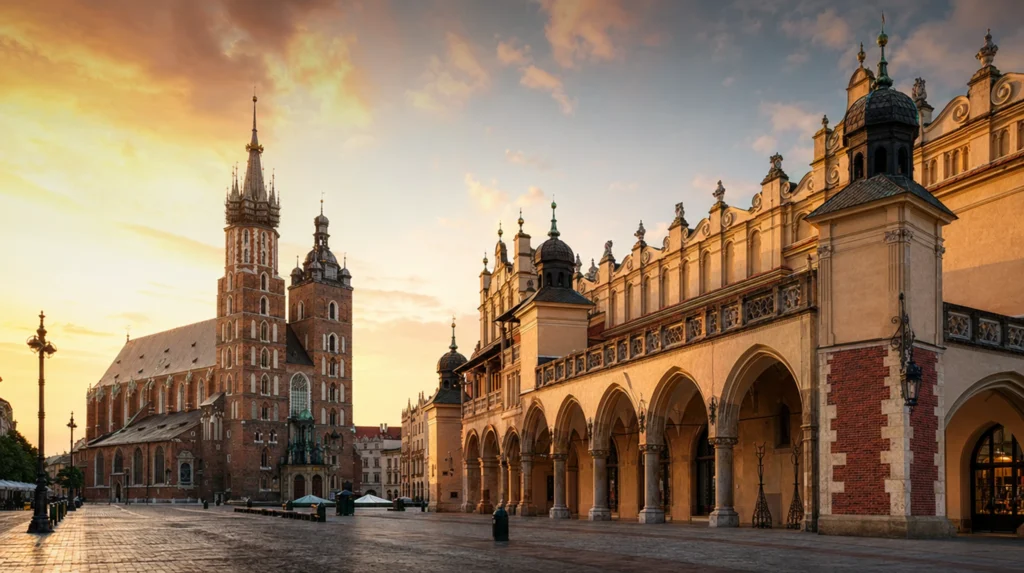
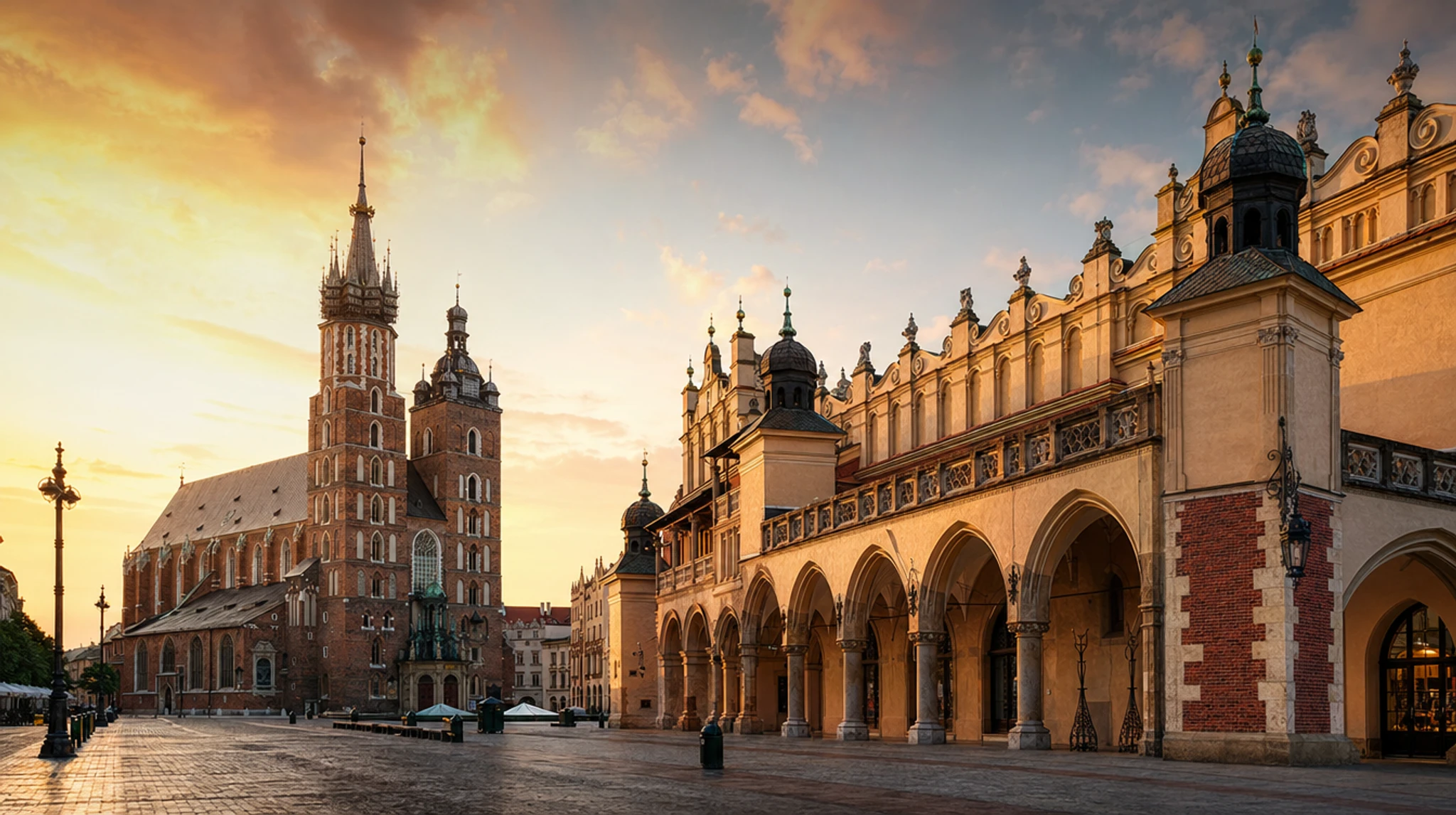
Kraków’s Christmas market (Targi Bożonarodzeniowe) is the event that quietly turns the city’s main square into the most atmospheric Advent destination in Central Europe — and at roughly half the price of Vienna or Nuremberg. The market fills Rynek Główny, the 40,000 m² medieval square that is the largest in Europe, from the last weekend of November 2026 through the Feast of the Epiphany on January 6, 2027. Wooden stalls ring the Cloth Hall, the St. Mary’s Basilica hejnał trumpet call sounds every hour from the taller tower, and mulled wine (grzaniec) arrives in ceramic mugs you keep as a deposit-back souvenir.
- Opening weekend: Late November 2026 (traditionally the last Friday of November)
- Peak window: December 6 (St. Nicholas) – December 24, 2026 — longest queues at weekends
- Closing: January 6, 2027 (Feast of the Epiphany, public holiday)
- Rynek Główny stalls: grilled oscypek mountain cheese with cranberry, pierogi ruskie, kiełbasa charcoal grills, pączki doughnuts, handmade amber and linden-wood ornaments
- Wawel Castle hill: smaller evening market with nativity cribs (szopki) — a Kraków folk-art tradition listed by UNESCO in 2018
- Alternative for 2026: Corpus Christi on Thursday, June 4, 2026 — nationwide Catholic processions, most famous in Łowicz where parishioners wear full folk costume
Best Time to Visit Poland (Season by Season)
Spring (Mar–May)
The shoulder-season value window. Daytime temperatures climb from 5°C in early March to 20°C by late May, and Warsaw’s Łazienki Park and Kraków’s Planty ring fill with early-April blossom. Easter is the single biggest family holiday — expect Święconka food-basket blessings on Holy Saturday and near-total shutdown on Easter Monday (Śmigus-Dyngus, “Wet Monday”, where children playfully douse each other with water). Corpus Christi on June 4, 2026 brings full-costume processions through every parish in the country, most famously in Łowicz. Warnings: Tatra trails remain snow-covered until mid-May, and Zakopane ski lifts close early April.
Summer (Jun–Aug)
Peak season. Temperatures run 18–26°C in Warsaw and Kraków, with heatwaves pushing past 32°C two to three times each summer. The Baltic coast (Sopot, Hel peninsula, Łeba dunes) fills with Polish holidaymakers in July and August, and the Mazurian Lakes become Central Europe’s sailing capital. Kraków’s Pierogi Festival runs mid-August in Małego Rynku square with 30+ filling variants sold from wooden chalets. Wrocław Good Beer Festival in late June draws Central Europe’s craft brewers. Warnings: Kraków’s Old Town and Auschwitz-Birkenau are busy by 10am; pre-book timed-entry tickets at visit.auschwitz.org six to eight weeks ahead.
Autumn (Sep–Nov)
The underrated season. Golden light fills the Tatra valleys from late September; the forests of the Bieszczady, Białowieża and Kashubia turn crimson by mid-October. Temperatures drop from 20°C in early September to 4°C by late November. Warsaw’s Chopin Piano Competition runs every five years in October at the Warsaw Philharmonic (next edition 2030). All Saints’ Day (Wszystkich Świętych) on November 1 is extraordinary — entire cemeteries glow with tens of thousands of candles and Warsaw’s Powązki is among the country’s most moving sights. Best-value hotel pricing of the year falls in October and early November.
Winter (Dec–Feb)
Christmas-market country and Poland’s only proper ski season. Kraków, Wrocław, Gdańsk and Warsaw run markets from late November through early January; Kraków’s Rynek Główny is the largest and most atmospheric. Temperatures run −5°C to 2°C in the cities and −10°C on the Tatra ridges, with reliable snow in Zakopane from mid-December through mid-March. Ski lift-ticket day-passes at Kasprowy Wierch and Szczyrk run 170–240 PLN — a fraction of Alpine prices. Short daylight (sunset 3:45pm in December) suits museum-and-café itineraries over long walking days.
Shoulder-season tip: Late April through mid-May (pre-summer crowds, first Planty café terraces, blossoms in Łazienki) and mid-September through mid-October (Tatra gold, wine harvest in Lubuskie, emptier Auschwitz tour slots, post-summer pricing) are the two windows most first-time visitors miss.
Getting There — Flights & Arrival
Warsaw handles most intercontinental arrivals; Kraków and Gdańsk are busy European gateways. Most Old-Town-first itineraries begin at one of the three.
- Warsaw Chopin Airport (WAW) — Poland’s primary hub, 21.4 million passengers in 2024. SKM S2/S3 suburban train to Warsaw Central in 20 minutes for 4.40 PLN on a ZTM ticket; taxis to the Old Town are 50–70 PLN.
- Kraków John Paul II International Airport (KRK) — Poland’s second-busiest airport. SKA1 train from terminal to Kraków Główny in 18 minutes for 17 PLN, every 30 minutes.
- Gdańsk Lech Wałęsa Airport (GDN) — Northern Poland’s gateway; PKM train to Gdańsk Główny in 25 minutes for 4.50 PLN, onward SKM to Sopot and Gdynia.
Flight times: New York–Warsaw 8h 30min nonstop on LOT Dreamliner; London–Warsaw 2h 30min; Dubai–Warsaw 6h; Tokyo–Warsaw via Helsinki or Doha 13–14 hours.
Carriers: LOT Polish Airlines (SkyTeam flag carrier, founded 1929), Ryanair (major bases at Kraków, Warsaw Modlin, Gdańsk), Wizz Air, plus Lufthansa, KLM and British Airways on European routes.
Visa / entry: Poland is Schengen — citizens of the US, UK, Canada, Australia, Japan, South Korea and 60+ others enter visa-free for up to 90 days in any 180-day window. From late 2026, visa-exempt travellers need a €7 ETIAS pre-authorisation online.
Getting Around — PKP Intercity & City Transit
Poland is a rail country. PKP Intercity (PKP IC) runs the national network, with Pendolino EIP services on the Warsaw–Kraków, Warsaw–Gdańsk and Warsaw–Katowice corridors topping out at 200 km/h — the highest rail speed in the country. Cheaper EIC and TLK expresses cover almost every town a traveller will want to reach. Long-distance buses (FlixBus, PolskiBus, Regiojet) fill gaps, particularly the Kraków–Zakopane and Kraków–Wrocław corridors where they often match the train on time and undercut on price.
- Pendolino EIP (Warsaw–Kraków): top speed 200 km/h; 2 hours 20 minutes city-to-city.
- Warsaw → Gdańsk: approximately 2 hours 40 minutes by Pendolino EIP.
- Warsaw → Wrocław: approximately 3 hours 40 minutes by EIC express.
- Kraków → Zakopane: approximately 2 hours 30 minutes by TLK train or 2 hours by direct bus.
- Warsaw → Poznań: approximately 2 hours 45 minutes by EIC.
Rail tickets: There is no single Polish rail pass for tourists — point-to-point fares on intercity.pl and Koleo are almost always cheaper than any pass. Warsaw–Kraków Pendolino runs 70–180 PLN in second class if booked a week early; buy seven or more days ahead for the lowest buckets.
City transit: Warsaw’s ZTM metro / tram / bus network is clean and cheap — a single 20-minute ticket is 3.40 PLN, a 75-minute ticket is 4.40 PLN, a 24-hour pass is 15 PLN, a 72-hour pass is 36 PLN. Kraków’s MPK (trams + buses) and Gdańsk’s ZTM + SKM regional train use comparable pricing.
Apps: Koleo (the nationwide rail booking app — far better UX than PKP’s own), jakdojade.pl (city transit journey planner nationwide), mobiTicket (mobile tickets), Google Maps for walking.
Top Cities & Regions
📍 Map of Poland: Every Place in This Guide
🏙️ Warsaw
Poland’s capital and largest city — 1.86 million people inside a skyline that juxtaposes the Soviet-era Palace of Culture with glass towers and a painstakingly reconstructed Old Town. Warsaw is also the country’s museum capital and the most convincing rebuild story in Europe.
- Warsaw Old Town (UNESCO, rebuilt 1945–1984 from Canaletto paintings after 85% wartime destruction)
- Palace of Culture and Science (Pałac Kultury, 1955) — Stalin’s 237-metre “gift” still the tallest building in the country
- POLIN Museum of the History of Polish Jews and the Warsaw Rising Museum
Signature eats: pierogi ruskie and żurek at Zapiecek, pączki from A. Blikle (opened 1869), vodka flights at Wódka Bar, milk-bar schabowy at Bar Prasowy.
🏰 Kraków
The royal former capital and Poland’s cultural heart — a UNESCO-listed Old Town centred on Rynek Główny, the 40,000 m² medieval square that is the largest in Europe. The city escaped World War II almost structurally intact and remains the country’s most atmospheric base.
- Wawel Royal Castle & Cathedral — coronation site of Polish kings from 1320
- Rynek Główny (40,000 m²) with the Cloth Hall (Sukiennice) and St. Mary’s Basilica hejnał trumpet call
- Kazimierz Jewish Quarter, Schindler’s Factory Museum, and gateway to Auschwitz-Birkenau (70 km west)
Signature eats: obwarzanek pretzel (EU-protected designation), pierogi at Przystanek Pierogarnia, grilled oscypek on Plac Nowy, zapiekanka from the Okrąglak.
⚓ Gdańsk
The Hanseatic Baltic port where World War II began on September 1, 1939 and where Solidarity was born on August 14, 1980. Gdańsk is also the amber capital of the world and, together with Sopot and Gdynia, the cultural heart of the Tricity (Trójmiasto).
- Long Market (Długi Targ) and Neptune’s Fountain along the Royal Route — centrepiece of the reconstructed Hanseatic Old Town
- European Solidarity Centre at the Gdańsk Shipyard (where Lech Wałęsa’s August 1980 strike began)
- Museum of the Second World War and Westerplatte (site of the first shots of WWII)
Signature eats: Baltic cod and smoked herring at Bar pod Rybą, pierogi z kapustą, Goldwasser herbal liqueur (first distilled 1598).
🌉 Wrocław
Silesia’s capital — a university river city of 12 islands and more than 100 bridges, famous for the 350+ tiny bronze dwarves hidden throughout the Old Town as a cheeky tribute to the anti-communist Orange Alternative movement.
- Market Square (Rynek) with its Gothic Old Town Hall — second-largest medieval square in Poland after Kraków’s
- Ostrów Tumski (Cathedral Island) — the oldest part of the city, with gas lamps still lit by hand every evening
- Racławice Panorama (114m × 15m cycloramic painting of the 1794 battle) and UNESCO-listed Centennial Hall (1913)
Signature eats: śląskie kluski (Silesian potato dumplings), rolada śląska (beef roulade), kiełbasa lisiecka, craft beer at Browar Stu Mostów.
⛰️ Zakopane (Tatra Mountains)
Poland’s winter capital at the foot of the Tatras — the only part of the country with alpine-style peaks, and the cultural centre of Góral (highlander) Poland with its distinctive wooden architecture and folk music. A 2-hour bus or 2h 30min train ride south of Kraków.
- Kasprowy Wierch cable car (1,987m summit) and Morskie Oko — the Tatras’ iconic emerald-green glacial lake
- Krupówki pedestrian street for Góral markets and charcoal oscypek grills
- Chochołowskie Termy and Bukowina Termy thermal baths after a ski day
Signature eats: oscypek (grilled smoked sheep cheese, EU-protected), kwaśnica (sauerkraut soup), placki ziemniaczane z gulaszem, góralska herbata (tea with vodka).
🐐 Poznań
Greater Poland’s capital and the cradle of the Polish state — a Renaissance Old Town square, mechanical billy-goats that butt heads at noon on the town hall tower, and one of the country’s most exciting food scenes. Three hours west of Warsaw on the Berlin line.
- Old Market Square (Stary Rynek) and the Renaissance Town Hall with its 12pm billy-goat clock-tower animation (mechanism since 1551)
- Ostrów Tumski — seat of Poland’s first bishopric (968 AD); Poznań Cathedral holds the tombs of the first two Polish kings
- Imperial Castle (Zamek) — built 1904–1910 for Kaiser Wilhelm II, now a cultural centre and cinema
Signature eats: rogal świętomarciński (St. Martin’s croissant, EU-protected designation), pyry z gzikiem (potatoes with curd cheese), kaczka z pyzami (duck with steamed dumplings).
Polish Culture & Etiquette — What to Know Before You Go
Polish culture rewards courtesy and a slightly formal opening manner. Strangers do not smile without reason — Central European baseline, not rudeness — but once introduced, “gość w dom, Bóg w dom” takes over and hospitality becomes unshakeable. Catholicism remains central; the Solidarity and Pope John Paul II legacies still anchor national identity, and the shadow of World War II and the communist era is discussed openly, not avoided.
The Essentials
- Greet with Dzień dobry (jeen DOH-brih, “good day”) on entering a shop, restaurant, or lift — switch to Dobry wieczór after roughly 6pm. Cześć is informal for friends only.
- Proszę (please / you’re welcome / here-you-are) and Dziękuję (thank you) are the non-negotiable polite vocabulary. Using them earns visible warmth.
- Remove shoes on entering a Polish home — slippers (kapcie) are usually offered at the door. This is near-universal, including in modern apartments.
- Flowers for a host: always an odd number, never chrysanthemums (funeral flowers), and present them unwrapped at the door.
- Catholic observance remains strong — dress modestly in churches, stay quiet during services, and do not photograph the altar during Mass.
Visiting Auschwitz-Birkenau (Respectful Visit Guidance)
- Entry is FREE but requires a timed-entry reservation on visit.auschwitz.org — book 2–3 months ahead in summer. From 10:00 to 16:00 entry is only with an educator (guided tour, around 90 PLN).
- This is a memorial and cemetery — no selfies, no walking on the railway tracks at Birkenau, no posed photographs; keep voices low throughout the site.
- Children under 14 are not recommended by the museum; detailed age guidance is published on the official site before booking.
- No large bags (greater than 30×20×10 cm) are permitted in the museum; a coat-check is available at both Auschwitz I and Birkenau.
- Allow 3.5 hours minimum for Auschwitz I plus Birkenau combined with the free shuttle bus between sites; dress modestly, expect to walk 5–7 km.
A Food Lover’s Guide to Poland
Polish food is the cooking of a cold, forested country with a Baltic coast and a mountain south — hearty, centred on pork, cabbage, dumplings and soured rye, sharpened by dill and marjoram, eaten with a cold lager or a shot of Żubrówka. Bar mleczny (milk bars), the subsidised communist-era cafeterias, still serve a two-course meal for under 25 PLN; Warsaw and Kraków also hold Michelin stars at Atelier Amaro and Bottiglieria 1881. Vegetarians eat well on pierogi ruskie, żurek wegetariański and placki ziemniaczane.
Must-Try Dishes
| Dish | Description |
|---|---|
| Pierogi | The national dumpling — half-moons of thin dough filled and boiled, then often pan-fried in butter. Canonical fillings are ruskie (potato + farmer’s cheese + onion, Ukrainian-origin not Russian), mięsne (minced meat), and z kapustą i grzybami (sauerkraut + mushroom, the traditional Christmas Eve filling). Sweet summer versions — z jagodami (blueberries), z truskawkami — arrive with sour cream and sugar. |
| Bigos (hunter’s stew) | Poland’s unofficial national dish — a long-simmered mix of sauerkraut, fresh cabbage, hunter sausage, pork shoulder, smoked bacon, dried porcini, prunes and juniper. Improves the longer it cooks and is traditionally better on day three. Served with rye bread and Żubrówka bison-grass vodka. |
| Żurek | The signature Polish soured-rye soup — a tangy cloudy broth fermented over 3–5 days (zakwas), served with white kiełbasa, a hard-boiled egg cut in half, and sometimes inside a hollowed bread bowl. The Easter-breakfast soup, eaten year-round in milk bars for under 20 PLN. |
| Kotlet schabowy | Poland’s everyday pork cutlet — pounded pork loin breaded in flour, egg and breadcrumbs, pan-fried in lard, served with mashed potatoes and either mizeria (cucumber-in-sour-cream) or braised cabbage. The bar mleczny standby, the Sunday-lunch default. |
| Oscypek | Smoked sheep’s cheese from the Podhale region around Zakopane — spindle-shaped, made only April–October from unpasteurised mountain sheep milk, smoked over pine, stamped with Góral patterns. EU-protected. Grilled at Kraków Christmas markets and on Krupówki with a spoon of cranberry jam. |
| Pączki | The Polish jelly doughnut — pillowy deep-fried yeast dough filled with rose-petal jam (traditional), plum jam, custard or advokat, glazed with fondant and candied orange peel. Numbers explode on Tłusty Czwartek (Fat Thursday before Lent); Varsovians queue 90 minutes at A. Blikle (1869) on that day. |
| Kiełbasa | Poland claims more than a hundred regional sausages; three to know are kiełbasa wiejska (country-style smoked), kabanosy (thin dried snacking length) and kiełbasa krakowska (EU-protected, beef and pork). Grilled at Christmas markets, from charcoal on the street, or cold-sliced on rye with mustard and pickled gherkin. |
Bar Mleczny & Vodka Culture
Bar mleczny (“milk bar”) is Poland’s best-kept travel-budget secret — state-subsidised cafeterias from the communist era still serving a soup, a main and a compote for 15–25 PLN. Vodka (wódka) is the national spirit; Poland is one of the two countries that claim its invention, documented here from the 15th century. The canonical order is a cold 50 ml shot with a dill pickle or pickled herring chaser.
- Iconic milk bars: Bar Prasowy (Warsaw, since 1954), Familijny (Warsaw), Pod Temidą (Kraków) — cash and PLN only, counter ordering
- Signature vodkas: Żubrówka (bison-grass, Białowieża), Wyborowa (since 1823), Belvedere (rye), Krupnik (honey-spiced, often warm)
Off the Beaten Path — Poland Beyond the Guidebook
Wieliczka Salt Mine
Poland’s first UNESCO listing (inscribed 1978) and one of the oldest active salt mines in the world — continuously operated from the 13th century until 2007, when tourism took over from mining. Visitors descend 135 metres on the 3.5 km tourist route past salt-carved chambers, an underground cathedral (the Chapel of St. Kinga, carved over 70 years), subterranean brine lakes, and a 135-metre-deep restaurant and concert hall. A 15-minute train from Kraków Główny reaches the village entrance; timed-entry tickets are required and English-language tours run roughly every 30 minutes in peak season.
Białowieża National Park
The last remaining fragment of the primeval forest that once covered the North European Plain — a joint UNESCO listing with Belarus. Home to Europe’s largest population of European bison (żubr, around 700 animals on the Polish side), plus wolves, lynx, elk and more than 120 bird species. Guided access only inside the strict reserve; the Bison Reserve open-air enclosures near Białowieża village are self-guided. Overnight stay in the village is the right move — early-morning wildlife drives start at 4:30am. A short rail spur from Hajnówka reaches the village.
Malbork Castle
The largest brick castle in the world by land area (about 21 hectares), and the largest castle of any material by the same measure — built from 1274 as the headquarters of the Teutonic Order. UNESCO-listed, on the Nogat river 60 km south of Gdańsk; direct PKP InterCity trains from Warsaw reach it in 2 hours 40 minutes. The audio-guide tour takes three hours across three nested castles: the High, the Middle and the Low. Summer “Siege of Malbork” reenactment weekends are a spectacle worth planning around.
Toruń
Nicolaus Copernicus’s birthplace and one of the best-preserved medieval brick-Gothic towns in Northern Europe — the entire Old Town is UNESCO-listed. Famous nationally for piernik (gingerbread) made here since the 14th century; the Muzeum Piernika holds baking workshops in period clothing where visitors grind spices by hand and bake their own. Direct InterCity trains from Warsaw in 2 hours 45 minutes; Gdańsk in 2 hours 30 minutes. A weekend in Toruń pairs naturally with Gdańsk or Poznań.
Mazurian Lake District
A vast chain of around 2,000 interconnected lakes in north-eastern Poland, voted into the final round of the New 7 Wonders of Nature in 2011. Summer sailing capital of Central Europe, with Mikołajki as its “Mazurian Venice” and Giżycko as the working boating hub. Nearby the Wolf’s Lair at Gierłoż — Hitler’s eastern headquarters 1941–1944 and the site of the July 20, 1944 assassination attempt — is preserved as a ruins park in the pine forest. Kayak, sail or bike the Krutynia river route for the quieter side of the lakes.
Practical Information
| Currency | Polish złoty (PLN / zł); 1 USD ≈ 3.95 PLN, 1 EUR ≈ 4.28 PLN (April 19, 2026). NOT the euro, despite EU membership. |
| Cash needs | Cards accepted in hotels and most Warsaw and Kraków restaurants; milk bars, bakeries, market stalls and rural spots run on cash. Keep 200–500 PLN in small notes. Avoid “0% commission” kantor booths in Old Towns — rates are 10–20% worse than an ATM. |
| ATMs | Bankomaty at PKO BP, Pekao, Santander and ING branches are reliable. Decline dynamic currency conversion — choose PLN. Avoid Euronet freestanding ATMs in tourist zones. |
| Tipping | Not automatic. Round up 5–10% by telling the server the total as they take payment. No tipping in milk bars or counter service. |
| Language | Polish — a West Slavic language. English is widely spoken in Warsaw, Kraków, Wrocław, Gdańsk and among under-40s; thinner in small towns. Google Translate camera handles menus. |
| Safety | Very safe overall — violent crime against visitors is rare. Main risk is pickpocketing on Warsaw’s Nowy Świat and Kraków’s Rynek in high season. |
| Connectivity | 4G/5G blanket coverage from Orange, Play, Plus and T-Mobile. eSIMs (Airalo, Holafly) work nationwide from touchdown. |
| Power | Type E plugs; 230V / 50 Hz. Standard Continental European fit. |
| Tap water | Safe to drink nationwide; bottled still or sparkling is more common at the table in sit-down restaurants. |
| Healthcare | EU-standard public hospitals; EHIC for EU visitors, others need travel insurance. Green-cross apteki everywhere; duty-rota night pharmacies posted on every closed one’s door. |
Budget Breakdown — What Poland Actually Costs
💚 Budget Traveller
Hostels (Oki Doki and Chillout in Warsaw; Greg & Tom, Mundo and Flamingo in Kraków), supermarket breakfasts from Żabka or Biedronka, milk-bar lunches at 15–25 PLN for a full meal, Warsaw 72-hour transit pass at 36 PLN, and point-to-point PKP IC second-class trains booked a week early. Doable at US$45–75 per day. A 0.5 L lager in a neighbourhood pub is 10–18 PLN (~US$2.50–4.50), a plate of pierogi at Zapiecek or Pierogarnia u Vincenta is under 30 PLN, and Kraków, Wrocław, Gdańsk and Poznań are all cheaper than Warsaw.
💙 Mid-Range
3-star or boutique hotel inside the Old Town (Warsaw Polonia Palace, Kraków Pod Różą), one sit-down meal and one milk-bar or street-food meal a day, Pendolino EIP tickets booked a week early, and two or three paid sights (Wawel Castle combined ticket 60 PLN; Wieliczka Salt Mine 110 PLN; Auschwitz-Birkenau educator 90 PLN). Plan US$110–180 per day. A mid-range dinner for two with wine runs 220–360 PLN (~US$55–90).
💜 Luxury
5-star hotels (Hotel Bristol Warsaw, Hotel Copernicus Kraków, Raffles Europejski Warsaw, Dwór Oliwski Gdańsk), Pendolino first-class tickets, Michelin-starred tasting menus at Atelier Amaro (Warsaw) or Bottiglieria 1881 (Kraków), and private Auschwitz, Wieliczka and Malbork tours. Plan US$300+ per day. A tasting menu with wine pairings runs 650–1,200 PLN per person. Bristol Presidential Suite and Raffles Vistula-view rooms run US$550–1,200+ per night in peak season.
| Tier | Daily (USD) | Accommodation | Food | Transport |
|---|---|---|---|---|
| Budget | $45–75 | Hostel 65–130 PLN / budget hotel 220–350 PLN | 50–110 PLN/day (milk bars) | Warsaw 72h pass 36 PLN or PKP IC 2nd class |
| Mid-Range | $110–180 | 3-star hotel 380–650 PLN | 150–280 PLN/day | Pendolino EIP 70–180 PLN intercity |
| Luxury | $300+ | 5-star hotel 1,400–3,800 PLN+ | 500–1,200 PLN/day | Pendolino 1st class / private transfer |
Planning Your First Trip to Poland
- Pick your route. The classic first-timer circuit is Warsaw + Kraków + a Kraków day trip (Auschwitz-Birkenau or Wieliczka). A week adds Gdańsk for two nights; ten days opens Wrocław and Zakopane.
- Book Auschwitz-Birkenau 2–3 months ahead. Timed-entry reservations at visit.auschwitz.org sell out in summer — from 10:00 to 16:00 entry is only with an educator tour (approximately 90 PLN).
- Pay in Polish złoty, not euro. Poland is EU but NOT eurozone — shops that “accept” euros use a worse rate. Use a bankomat at a Polish bank for PLN and always decline “charged in your home currency.”
- Buy point-to-point PKP IC tickets early. intercity.pl or Koleo Pendolino fares are cheapest 7–14 days ahead; no Polish rail pass is worth buying on dynamic pricing.
- Learn five Polish words. Dzień dobry, Proszę, Dziękuję, Do widzenia, Na zdrowie — every shop, milk bar and tram interaction goes better with them.
Classic 7-Day Itinerary: Days 1–3 Warsaw · Day 4 Pendolino to Kraków, Old Town & Wawel · Day 5 Auschwitz-Birkenau day trip · Day 6 Wieliczka Salt Mine morning, Kazimierz evening · Day 7 fly home from Kraków.
Frequently Asked Questions
Is Poland expensive to visit?
No — one of the best-value destinations in the EU. Budget travellers get by on US$45–75 per day with hostels and milk-bar meals; mid-range travellers plan US$110–180. Kraków, Wrocław, Gdańsk, Poznań and Zakopane are all cheaper than Warsaw. A milk-bar lunch is under 25 PLN, a 0.5 L lager in a neighbourhood pub is 10–18 PLN, Pendolino fares booked a week early stay under 180 PLN.
Do I need to speak Polish?
No. English works almost everywhere among under-40s in Warsaw, Kraków, Wrocław, Gdańsk and Poznań and in tourist-facing businesses nationwide. A little Polish goes a long way — Dzień dobry, Proszę, Dziękuję, Do widzenia and Na zdrowie. In small towns, with older generations, and inside old-school milk bars, Google Translate camera mode handles menus.
Is the PKP Intercity rail pass worth it?
No single-country Polish rail pass makes financial sense — point-to-point tickets on intercity.pl or Koleo are almost always cheaper. Warsaw–Kraków Pendolino runs 70–180 PLN in second class booked 7–14 days early, and FlixBus often matches the train on time. A Eurail Global Pass only pays off as one leg of a wider multi-country rail trip.
Is Poland safe for solo travellers?
Very — violent crime against visitors is rare and Poland ranks among the safer countries in Europe. Solo women regularly report feeling comfortable on urban transit late at night. Main risks are pickpocketing on Warsaw’s Nowy Świat and Kraków’s Rynek Główny in high season, and the “0% commission” kantor booths offering rates 10–20% worse than an ATM.
When is Kraków Christmas Market?
Kraków’s Targi Bożonarodzeniowe runs from the last weekend of November 2026 through January 6, 2027, filling Rynek Główny — Europe’s largest medieval square at 40,000 m². Biggest crowds fall December 15–24. Stalls sell oscypek with cranberry, pierogi, kiełbasa from charcoal grills, grzaniec, and handmade szopki (nativity scenes, a UNESCO tradition).
Can I get by as a vegetarian or vegan?
Easily in Warsaw and Kraków, with some effort elsewhere. Both now have dozens of vegan restaurants (Krowarzywa, Youmiko, Falla, Krowa Lokalna). Traditional menus offer pierogi ruskie, pierogi z kapustą i grzybami, placki ziemniaczane, żurek wegetariański, and barszcz with uszka as meat-free fallbacks. In small towns the default is still pork-and-cabbage-centric.
What about Auschwitz-Birkenau — is it appropriate as a day trip?
Yes, and it should be treated as the reason you came, not a sidebar. Book a timed entry 2–3 months ahead at visit.auschwitz.org; entry is free but from 10:00 to 16:00 you can only enter with an educator. Allow 3.5 hours for Auschwitz I plus Birkenau. This is a cemetery — no selfies, no posed photographs, keep voices low. Children under 14 are not recommended.
Ready to Explore Poland?
Poland rewards travellers who slow down — pick Warsaw plus Kraków, add one or two more cities, learn five Polish words, and let the pierogi and rebuilt Old Towns take care of the rest. Start in Warsaw for the 20th-century history, Kraków for the royal Old Town, Gdańsk for Solidarity and the Baltic, or Zakopane for the Tatras.
Explore More
Cities we cover in Poland
More country guides you might like

Plan your trip to Poland
The booking tools we use ourselves. FFU may earn a commission at no extra cost to you.
Plan & book your trip to Poland
Booking through these searches supports our guides at no extra cost to you.