
Languages of Bulgaria
All languages of Eastern Europe →fluent beta classical · classes by phone with Maya at ranas.ai/maya
Bulgaria Travel Guide — Cyrillic Birthplace, Thracian Gold & the Highest Peaks in the Balkans
I keep telling people Bulgaria is the country that got slept on for thirty years and is finally being noticed. My first afternoon in Plovdiv I was sitting on the steps of a 2,000-year-old Roman amphitheatre eating a banitsa pastry that cost the same as a coffee at home, while a wedding party photographed itself outside an Ottoman mosque, while a saxophone busker played in front of a Bulgarian Revival house with carved wooden eaves. That stratification is the whole country in one sentence: Thracians under Greeks under Romans under Byzantines under Ottomans under Communists, and underneath the lot of them an Orthodox Bulgaria that has spoken its own language and written it in its own alphabet for eleven hundred years. This guide is the brief I would give my own brother before he boards the morning Wizz Air to Sofia.

In This Guide
- Overview — Why Bulgaria belongs at the top of your 2026 shortlist
- Thracians, Cyrillic & Communism — A Pocket History of Bulgaria
- Rose Festival in Kazanlak — Bulgaria’s 2026 Calendar
- Best Time to Visit Bulgaria (Season by Season)
- Getting There — Flights, SOF Airport & Schengen 2025
- Getting Around — Trains, Sofia Metro & the Rhodope Narrow-Gauge
- Top Cities & Regions
- Bulgarian Culture & Etiquette
- A Food Lover’s Guide to Bulgaria
- Off the Beaten Path — Belogradchik, Buzludzha & Cave Country
- Practical Information
- Budget Breakdown
- Planning Your First Trip to Bulgaria
- Frequently Asked Questions
Overview — Why Bulgaria Belongs at the Top of Your 2026 Shortlist
Bulgaria is the 16th-largest country in Europe by area, covering 110,994 km² between the Danube River, the Black Sea, and the Greek and Turkish frontiers — roughly the size of Iceland, slightly larger than Cuba. The country sits on the Balkan peninsula’s south-east shoulder where the Slavic-Orthodox world meets the eastern Mediterranean and the steppe, and that hinge position is the entire reason Bulgaria is so unlike anywhere else in the EU. Bulgaria is the oldest Slavic country with a continuous name (the official toponym Bulgaria has not changed since 681 AD), the only EU member whose alphabet was invented domestically, and the only Balkan state whose Orthodox Church has existed without interruption since 870 AD. Roughly 6.44 million people live here in 2024, down from a 1989 peak of 9.01 million; the demographic contraction is one of the country’s defining contemporary stories.
The first story is the mountains. Bulgaria contains the highest peaks of the entire Balkan peninsula. Musala, in the Rila Mountains, reaches 2,925 metres — higher than any point in Romania, Serbia, North Macedonia, Albania, Greece, Turkey or anywhere else in south-east Europe. The second-highest peak in the Balkans is also Bulgarian: Vihren in the Pirin Mountains at 2,914 metres. Together with the Rhodope Mountains in the south and the Balkan Range (Stara Planina) running east-west across the country’s middle, these four ranges cover roughly half of Bulgaria’s land area. The Rila and Pirin glacial cirques hold a combined 365 lakes — Rila has 189, Pirin 176 — most carved out by the Würm glaciation 10,000–12,000 years ago.
The second story is the alphabet. Bulgaria is the country where Cyrillic was invented. The script you see on every Russian, Ukrainian, Serbian and Mongolian street sign was developed at the Preslav Literary School in the late 9th century by disciples of Saints Cyril and Methodius — most likely Clement of Ohrid and Naum, both working under the patronage of Tsar Simeon I the Great (893–927). Cyril and Methodius themselves had earlier devised the older Glagolitic alphabet for the Slavic mission to Great Moravia in 863; when their students were expelled they were taken in by the Bulgarian Tsar Boris I, and Cyrillic — a more practical Greek-uncial-derived script — was created here as Glagolitic’s successor. Modern Bulgarian, with its 30 Cyrillic letters, is now also the third official script of the European Union after Latin and Greek.
The third story is the Thracians. Long before Bulgarians, Greeks or Slavs, the Thracians ran a network of small kingdoms that filled the territory of modern Bulgaria, southern Romania and northern Greece. Their gold-working tradition is the most accomplished of any prehistoric European culture, and four of the most important hoards on the continent — Panagyurishte (24-carat gold drinking vessels from the late 4th century BC), Valchitran (a 16th–12th century BC sun-cult treasure of 12.4 kg), Letnitsa (silver appliqués) and Rogozen (165 silver vessels) — were all discovered in Bulgaria. The Odrysian kingdom, the major Thracian state, occupied roughly modern Bulgaria from the 5th century BC to the 1st century AD. UNESCO has inscribed two Thracian tombs in Bulgaria — Kazanlak (4th c. BC, 1979) and Sveshtari (3rd c. BC, 1985) — and a third, the recently restored Panagyurishte gold treasure, has been on Bulgaria’s tentative list since 1984.
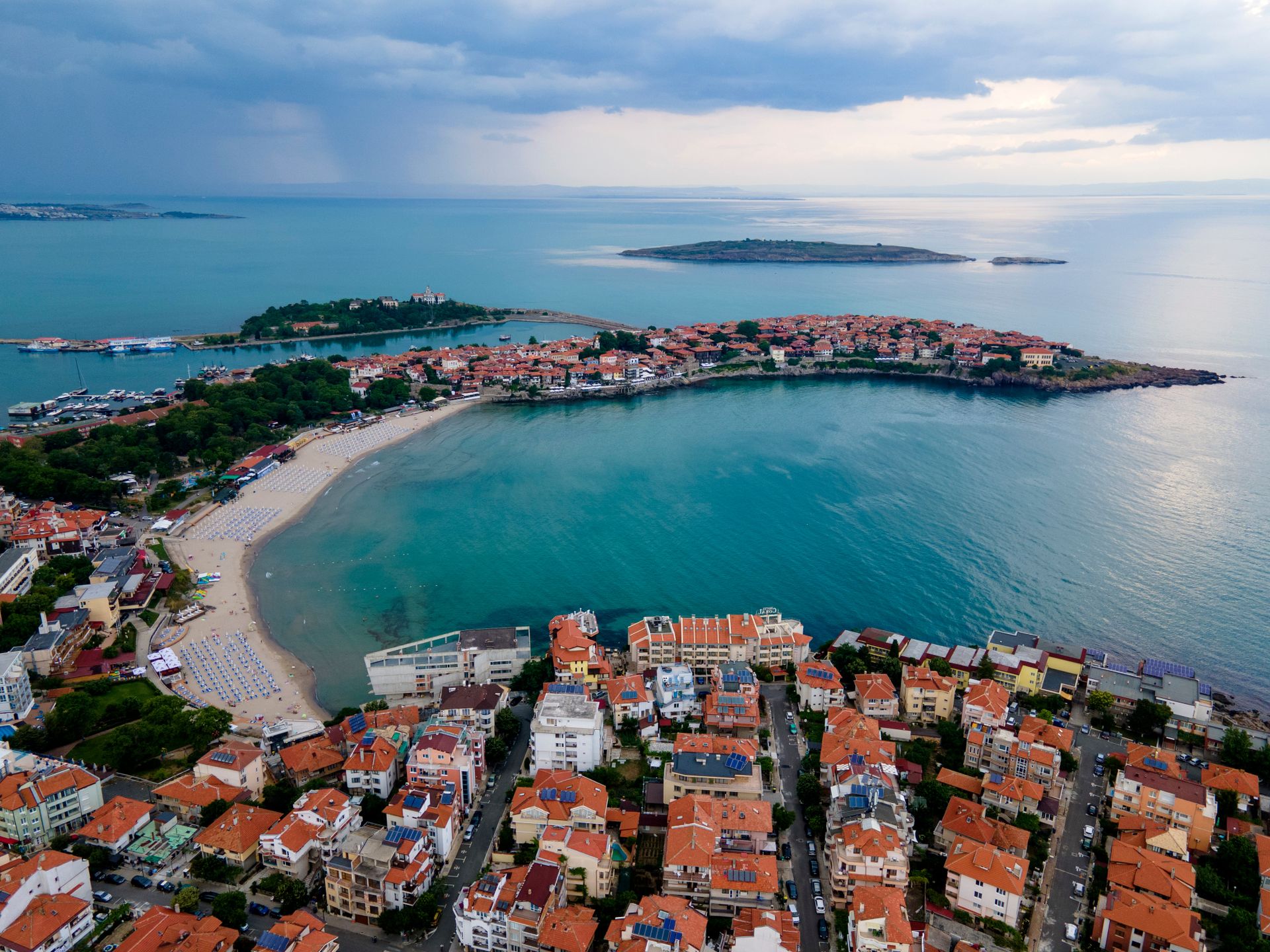
The fourth story is the Black Sea. The Bulgarian coast runs 378 km from the Romanian border at Durankulak to the Turkish border at Rezovo, with about 130 km of that distance being natural sandy beaches — the highest beach-to-coastline ratio in the Black Sea basin. The big beach resorts — Sunny Beach, Golden Sands, Albena, Sozopol, Nessebar — sit between Varna and Burgas, and their season runs reliably from late May to early October. Two of the coastal towns, Nessebar and Sozopol, were Greek colonies before the Athenians had finished building the Parthenon: Sozopol (then Apollonia Pontica) was founded by Milesian Greeks in the 7th century BC and once held a 13-metre statue of Apollo before the Romans carted it off in 72 BC. Nessebar, founded as Mesembria in the 6th century BC, is now a UNESCO site (1983) and contains the highest density of Byzantine churches per square metre on the entire Black Sea.
The economic and political picture in 2026 is the most settled the country has been since the end of communism in 1989. Bulgaria joined NATO on 29 March 2004, the European Union on 1 January 2007, the Schengen Area for air and sea borders on 31 March 2024, and full Schengen — including land borders with Romania and Greece — on 1 January 2025. The decisive milestone for travellers, however, is the euro: Bulgaria became the 21st Eurozone state on 1 January 2026, retiring the Bulgarian lev after a 27-year currency-board peg of 1.95583 BGN to the euro. The country’s GDP is projected at roughly USD $117 billion nominal and $264 billion at purchasing-power parity in 2024, with GNI per capita of $15,370 — comfortably upper-middle income. Tourism brought 12.6 million arrivals in 2024 — about double the resident population — with Romania (2.3 M) and Turkey (2.3 M) leading the source markets ahead of Ukraine, Greece and Germany.
Thracians, Cyrillic & Communism — A Pocket History of Bulgaria
The pre-Roman headline is the Thracians. The Odrysian kingdom, the largest Thracian state, ruled the Bulgarian heartland from the 5th century BC until the Romans annexed it as the province of Thracia in 46 AD. Thracian gold-working is the unsung peak of European prehistoric craftsmanship: the Panagyurishte Treasure (a 6.1 kg set of nine 24-carat gold drinking vessels from the late 4th century BC), the Valchitran Treasure (12.4 kg of gold ritual vessels from the 16th–12th centuries BC), and the silver Rogozen Treasure (165 silver vessels weighing 20 kg) were all unearthed by Bulgarian farmers and quarrymen in the 20th century. The Thracian Tomb of Kazanlak (4th century BC, UNESCO 1979) preserves the best Hellenistic frescoes ever found in Bulgaria — a procession scene, four ranks of horses, the deceased and his wife at a funeral feast.
The Roman period ran 46–395 AD; the eastern provinces stayed Roman/Byzantine for another five centuries. The big shift comes in 681 AD, when Khan Asparuh — leader of a Turkic-Bulgar federation crossing the Danube from the steppe — defeated the Byzantines and forced Emperor Constantine IV to recognise a Bulgar state south of the Danube. That state, the First Bulgarian Empire, became one of the three medieval superpowers of the Balkans alongside Byzantium and the Frankish realm. Khan Tervel (701–718) commissioned the Madara Rider — a 23-metre rock relief of a horseman spearing a lion, carved on a 100-metre cliff face near Shumen and now a UNESCO site since 1979. Bulgaria adopted Christianity under Boris I in 864 AD, and his son Simeon I the Great (893–927) presided over the Golden Age — proclaiming himself “Tsar of the Bulgarians and the Romans” and founding the Preslav Literary School where the Cyrillic alphabet was developed.
The First Empire was destroyed in 1018 by the Byzantine emperor Basil II, who blinded 14,000 captured Bulgarian soldiers and earned the epithet Boulgaroktonos (“Bulgar-Slayer”). 167 years of Byzantine rule ended in 1185 when the brothers Asen and Petar led a successful uprising in Veliko Tarnovo, founding the Second Bulgarian Empire with Tarnovo as its capital. Tsar Ivan Asen II (1218–1241) extended the empire from the Adriatic to the Black Sea and was the patron of the painted Boyana Church — whose 1259 frescoes by Master Vasilij are the most important Bulgarian medieval art and a UNESCO site since 1979.
The Ottomans took Tarnovo in 1393 and the last Bulgarian fortress, Vidin, fell in 1396. Five centuries of Ottoman rule followed — Bulgarians call it Tursko robstvo, “the Turkish yoke” — during which the Bulgarian Patriarchate was abolished, churches were converted into mosques and the country produced almost no original literature. Resistance came from the haiduks, mountain bandit-rebels celebrated in folk song, and from the National Revival movement of the 18th–19th centuries that produced figures like Paisius of Hilendar (his 1762 History of the Slav-Bulgarians is the country’s founding nationalist text). The April Uprising of 1876 was crushed with 30,000 civilian deaths, but it triggered the Russo-Turkish War of 1877–78 — and the Treaty of San Stefano on 3 March 1878 ended five centuries of Ottoman rule. That date is now Bulgaria’s national holiday.
The modern country was assembled in three acts. Act One: the Treaty of Berlin (1878) carved out a small autonomous Principality of Bulgaria; the country reunified Eastern Rumelia in 1885, declared full independence in 1908 under Tsar Ferdinand I, and emerged from the Balkan Wars (1912–13) and WWI (1914–18) on the losing side both times — losing access to the Aegean and most of Macedonia. Act Two: Bulgaria allied with Nazi Germany in WWII but famously refused to deport its 50,000 Bulgarian Jews — saved by Metropolitan Stefan, MP Dimitar Peshev and the Bulgarian Orthodox Church in March 1943, one of the few wartime rescues of an entire national Jewish population. The Soviet Red Army crossed the Danube on 9 September 1944; a 45-year communist People’s Republic of Bulgaria followed, the last 35 years under Todor Zhivkov (1954–1989) — the longest-serving leader of any Warsaw Pact country. Act Three: Zhivkov was deposed on 10 November 1989, the day after the Berlin Wall fell; Bulgaria joined NATO in 2004, the EU in 2007, full Schengen on 1 January 2025 and the Eurozone on 1 January 2026.
Rose Festival in Kazanlak — Bulgaria’s 2026 Calendar
If you can shape your trip around one Bulgarian event, make it the Rose Festival in Kazanlak on the first weekend of June. Kazanlak is the small market town at the centre of the Rosa Valley (Rozova Dolina), the 95 km long, 12 km wide depression between the Balkan Mountains and the Sredna Gora that produces a substantial fraction of the world’s rose oil. Bulgarian rose oil — distilled from Rosa damascena, the Damask rose — is one of three primary global producers (alongside Turkey and Saudi Arabia) that together control more than 70% of world supply. About 3,000 kilograms of rose petals yield one kilogram of essential oil; pickers walk into the fields between 4 and 9 a.m. when overnight humidity has trapped the volatiles, and the day’s haul is distilled the same morning.
The festival itself dates from 1903 and runs across three days at the start of June (the 2026 edition is scheduled for 5–7 June, anchored to the rose-picking peak in late May/early June). The set-piece is the dawn ritual on Saturday morning: the festival queen and her entourage, in traditional Thracian costumes, lead a small procession into the rose fields outside the village of Yasenovo and harvest the first basket. By 11 a.m. the action moves into Kazanlak’s central square for the main parade, with folk-music ensembles from across the Sredna Gora and the Rhodope, traditional kukeri mummers, brass bands, and a beauty pageant for the title of Queen Rose. The town’s Museum of Roses tells the production story; the still operating distilleries at Karlovo and Klisura — both villages along the Rosa Valley road — open their doors for guided tastings of attar (the technical word for rose oil), rose water, rose liqueur, and rose-petal jam.
The other reason to come for early June is the Valley of the Thracian Rulers, the necropolis surrounding Kazanlak that contains roughly 1,500 documented Thracian burial mounds — including the painted Tomb of Kazanlak (a UNESCO site since 1979) and the spectacular 4th-century-BC Golyama Kosmatka tomb where archaeologist Georgi Kitov found the gold mask of King Seuthes III in 2004. The original Kazanlak tomb is closed to the public to preserve its frescoes, but a full-size replica next to it is open daily and the Iskra Museum in town holds the gold mask of Seuthes III alongside replica grave goods.
The 2026 calendar around the festival is loaded. March 1 is Baba Marta, when Bulgarians give each other red-and-white wool tassels (martenitsi) for spring health; 3 March is the National Day; 21 March is the Persian-Bulgarian-Romani New Year (Nowruz), celebrated in Plovdiv’s Stolipinovo neighbourhood. 24 May is the Day of Bulgarian Education and Slavonic Literacy, the country’s celebration of Cyril and Methodius — schools close, students lay roses at the Saints Cyril and Methodius monument in front of the National Library in Sofia, and Sofia University holds an open-air concert. The Rose Festival fills the first weekend of June; the Apollonia Arts Festival in Sozopol runs the first ten days of September; Surva — the international festival of mummers’ games — runs in late January in Pernik with 6,000 costumed performers from across the Balkans.
The other major early-June draw is Nestinarstvo, the Bulgarian firewalking ritual, performed in the Strandzha Mountain village of Bulgari on the night of 3–4 June (the feast of Saints Constantine and Helena). The Nestinari (firewalkers) circle a bed of glowing oak embers carrying icons of the saints, then walk barefoot across them in a trance — a survival of pre-Christian Thracian fire ritual that UNESCO inscribed on its Intangible Cultural Heritage list in 2009. Bulgari is a four-hour drive south-east from Burgas; the rite begins around 11 p.m. and runs until the embers cool. There is no admission fee but no infrastructure either — bring a torch and good shoes.

Best Time to Visit Bulgaria (Season by Season)
Bulgaria is a four-season country and there is no objectively wrong month — the choice depends entirely on whether you are coming for the mountains, the coast, the cities or the wine harvest. The country’s climate sits at the southern edge of the European continental zone with substantial Mediterranean influence in the south. Sofia (550 m elevation) averages 10.9°C annually with a January mean of -0.5°C and July mean of 21.5°C; Plovdiv in the Upper Thracian Plain is roughly 3°C warmer year-round; the Black Sea coast at Ahtopol averages 13.4°C with much milder winters and reliably hot summers. National extremes range from -38.3°C (Tran, January 1947) to 45.2°C (Sadovo, August 1916).
Spring (March–May) — The Sweet Spot for Cities & Wildflowers
If you want one optimal month for a circuit of Sofia–Plovdiv–Veliko Tarnovo, the answer is May. Daytime temperatures sit in the 18–24°C range in the lowlands , the Rhodope and Pirin alpine meadows are at peak wildflower density, the Black Sea is still too cold for swimming (but quiet for walking), and the rose fields of Kazanlak begin colouring in the second half of the month for the first-week-of-June festival. March is shoulder-season cheap but unreliable: lowland snow can persist into the second week, and the high passes of the Balkan Range are often closed. April is reliably warm in Plovdiv, the Thracian Plain almonds blossom in early April, and the Easter holiday — Bulgarian Orthodox Easter falls on Sunday 12 April 2026 — produces one of the country’s best religious spectacles at Rila Monastery and Bachkovo Monastery, both of which hold late-night midnight liturgies with full chant.
Summer (June–August) — Black Sea, Folklore & the Hot Plain
Summer is the high season and is essentially split between the Black Sea coast and the mountain refuges. Lowland Bulgaria — Sofia, Plovdiv, Stara Zagora, Veliko Tarnovo — sees daytime peaks of 30–35°C through July and August; the Thracian Plain regularly hits 38°C and 2024’s heatwave saw 41°C in Plovdiv on 16 July. The Black Sea sits at the equilibrium temperature of about 24–26°C from mid-July through mid-September, with reliably calm conditions, no jellyfish problem to speak of, and beach water that holds Blue Flag certification on roughly 30% of the coast. The mountains provide the escape valve: Bansko, Borovets, Smolyan and the Rila and Pirin national parks all sit above 900 m and stay 8–10°C cooler than the plain. The folkloric calendar is at its peak in summer too — the Koprivshtitsa National Folklore Festival runs every five years (next: August 2025/2030), the Pirin Sings festival runs in early August, and the Apollonia Arts Festival runs the first ten days of September in Sozopol.
Autumn (September–November) — Foliage, Wine & Empty Cities
Autumn is the second sweet spot. Mid-September to mid-October sees Plovdiv at 22–26°C daytime, the Black Sea still swimmable at 22°C through end of September, and the Rhodope and Pirin beech forests turning red-gold from the third week of October. The wine harvest runs early September to late October across the Thracian Lowlands and the Struma Valley; small wineries in Melnik (the country’s smallest town, with its 13th-century churches and the local Shiroka Melnishka Loza grape) open their doors for tastings. The Sofia summer heat breaks in the third week of August and the city stays comfortable into early November. November itself is the wettest month — Sofia averages 50 mm rainfall — and best avoided unless you specifically want the off-season prices in Bansko (which are roughly 60% lower than December–March).
Winter (December–February) — Bansko Ski Season & Frozen Rila
Winter is the season for Bansko and Borovets. Bulgaria has six commercial ski resorts — Bansko (75 km of runs, 14 lifts), Borovets (58 km, in Rila), Pamporovo (37 km, in the Rhodopes), Vitosha (24 km, immediately above Sofia), Chepelare (in the Rhodopes), and Mountain Resort Kulinoto. The reliable ski window is mid-December through mid-April, with Bansko’s gondola operating on snow conditions; Bansko regularly logs 250–300 cm seasonal snowpack at the 2,560 m summit station. The Sofia winter hovers around -1°C to +3°C with reliable snow cover; the Black Sea coast at 4–8°C is empty and atmospheric (Nessebar’s old town is genuinely magical without crowds). The country’s coldest weather hits the Strandzha and Rila valleys; expect -15°C overnight in Bansko in mid-January. Christmas (25 December) is a quiet family holiday; Christmas markets in Sofia, Plovdiv and Veliko Tarnovo run from late November through 24 December.
Getting There — Flights, SOF Airport & Schengen 2025
The default entry for any Bulgaria trip is Vasil Levski Sofia International Airport (SOF / LBSF), 10 km east of the city centre. Sofia handled 7,922,702 passengers in 2024 — a 9.9% year-on-year increase — and crossed 8 million for the first time in 2025. Wizz Air dominates with 29.3% market share, followed by Ryanair (24.8%), Bulgaria Air the flag carrier (15.9%) and Lufthansa (8.6%); the airport runs from a 3,600 m single runway with Cat IIIB capability, meaning weather diversions are rare. Terminal 2 (opened December 2006) handles all scheduled international jets; Terminal 1 (1947) handles low-cost and charter; a 65,000 m² Terminal 3 is targeted at completion by 2030 with Skytrax 5-star design.
The fastest way from arrivals to central Sofia is the Sofia Metro M4 line, opened on 2 April 2015, which runs from a station immediately adjacent to Terminal 2 to the city centre in 20 minutes flat for €0.85 (1.60 BGN equivalent). The metro runs every 4–6 minutes during the day and 8–10 minutes after 8 p.m., with last departures around 23:30. Taxi from the rank outside arrivals to Sofia centre is €13–15 (do not take any unmarked car or any driver who approaches you inside the terminal — pickpocketing and overcharge scams happen here per US State Department advice). Bolt and Yellow Taxi are reliable; the OK Supertrans rank uses metered tariffs.
The two coastal airports — Burgas (BOJ) and Varna (VAR) — are the practical entry points for any trip that focuses on the Black Sea. Both run dense seasonal charter and low-cost networks (Wizz Air, Ryanair, EasyJet, TUI) from May through September, and skeleton year-round connections to Vienna, Sofia, Frankfurt, Düsseldorf and London. Burgas Airport sits 10 km north-east of the city; Varna Airport sits 7 km west. Plovdiv Airport (PDV) is much smaller and serves mainly winter charter into Bansko via shuttle (90-minute drive).
Visa requirements changed twice in 2024–25 in Bulgaria’s favour. Bulgaria joined the Schengen Area for air and sea borders on 31 March 2024 and for land borders on 1 January 2025, meaning you can now drive or train from Romania (over the Danube bridge at Vidin or Ruse) or Greece (over the Promachonas-Kulata crossing) into Bulgaria without any passport check. Citizens of the US, UK, Canada, Australia, New Zealand, Japan, South Korea and most other visa-exempt nationalities can enter for 90 days within any 180-day period without a visa; passports must be valid for at least three months beyond the planned departure from the Schengen area, with one blank page per entry stamp. The European Travel Information and Authorization System (ETIAS) becomes mandatory for visa-exempt travellers in late 2026; €7, valid 3 years.
Overland is increasingly viable. The Vidin–Calafat bridge (Danube Bridge 2, opened 2013) connects Bulgaria to Romania and is the main lorry route from Western Europe; the older Ruse–Giurgiu bridge (1954) is the secondary crossing 250 km east. From the south, the E79/A3 motorway runs from Thessaloniki to Sofia in about three hours via the Kulata-Promachonas crossing. The Sofia–Belgrade direct train is currently suspended for line upgrades but the Sofia–Istanbul Bosfor Express runs nightly with sleeper cabins (12 hours, €45). Ferries from Burgas to Batumi (Georgia) and Poti (Georgia) run weekly during summer.
Getting Around — Trains, Sofia Metro & the Rhodope Narrow-Gauge
Bulgaria is a small country — Sofia to Varna by road is 470 km, Sofia to Burgas 385 km — but the Rila and Balkan ranges crease its middle and slow most cross-country journeys to a more European pace. Plan on 5–7 hours by train Sofia–Varna and 4 hours by motorway , with the Sofia–Burgas Trakia motorway (A1, completed 2013) being the country’s only east-west autoroute. Domestic flights from Sofia to Varna and Burgas (Bulgaria Air, 60 minutes) make sense only in winter when the highways are slow. The state rail operator BDŽ — Bulgarian State Railways runs the country’s 3,999 km of track and carries about 21.3 million passengers a year.
Trains — Cheap, Slow, Atmospheric
BDŽ runs three classes of train: Express (БВ — first/second class with reservations), Fast (БВ — second class only) and Regio (ПВ — local stoppers). Standard tickets are remarkably cheap: Sofia to Plovdiv (160 km, 2 hr 30 min) is €7.50 second class; Sofia to Varna (8 hours overnight in a 4-berth couchette) is €25; Sofia to Burgas (6 hr 30 min) is €18. The Siemens Desiro electric multiple units, introduced from 2010, are the modern fleet — clean, air-conditioned, with 2+2 seating and Wi-Fi on the newer Velaro stock. The Septemvri–Dobrinishte narrow-gauge in the Rhodope Mountains is the country’s most scenic line: 125 km of 760 mm track climbing from 220 m at Septemvri to 1,267 m at Avramovo (the highest narrow-gauge station in the Balkans) and dropping into Bansko and Dobrinishte. The full run takes 5 hours and costs €4. Tickets are best bought at the station window or via the BDŽ app; the website only accepts Bulgarian ID payment.
Sofia Metro & Urban Transit
The Sofia Metro opened on 28 January 1998 and now runs four lines, 47 stations and 52 km of track, carrying 470,000 passengers a day and 93 million a year — Europe’s 14th busiest urban metro. A single ride is €0.85 and runs 5:30 a.m. to 24:00; the M1 covers Mladost and Lyulin, the M2 runs north-south, the M3 added in 2020 covers the western suburbs, and the M4 (the airport line) opened on 2 April 2015. Trams (the network is pre-WWII and atmospheric — the famous yellow articulated cars run from Banya Bashi mosque past the National Theatre) and trolleybuses cover the older central districts; a single trip is €0.85, an unlimited day pass €2.
Buses Are the Default
Outside the Sofia–Plovdiv–Burgas corridor, intercity buses are the default mode: faster, more frequent and almost as cheap as trains. The main private operators are Union Ivkoni, Biomet and Etap, all running modern coaches with Wi-Fi, USB charging and reserved seating. Sofia Central Bus Station (next to the train station) handles all long-distance routes; tickets are €5–25 depending on distance and bookable via Eurolines or directly. Buses to Bansko run roughly every 90 minutes; to Veliko Tarnovo every 2 hours; to Plovdiv every 30 minutes. The Black Sea coast bus network is dense in summer and skeletal in winter.
Driving in Bulgaria
Driving is right-hand and Bulgaria uses Bulgarian-Cyrillic road signs everywhere — though motorway and major-junction signs also carry Latin transliteration. The Trakia (A1, Sofia–Burgas), Hemus (A2, Sofia–Varna, partially complete), Maritsa (A3, Plovdiv to Turkey), and Struma (A4, Sofia to Greece) motorways form a half-built X across the country with completed lengths of 360 km, 173 km, 117 km and 158 km respectively. A digital vignette (toll sticker) is mandatory for all motorways and major two-lane highways: weekly €7, monthly €15, annual €87. Buy online at bgtoll.bg or at any petrol station. Speed limits are 50 km/h urban, 90 km/h rural, 140 km/h motorway. Police checkpoints are routine; carry your passport, the rental contract and a high-vis vest. The Bansko ski-season weekends produce the country’s worst traffic on the E79 between Sofia and Blagoevgrad — Friday afternoons can run to 4 hours for the 160 km drive.
Top Cities & Regions of Bulgaria
📍 Map of Bulgaria: Every Place in This Guide
Bulgaria’s flagship sights distribute across eight clearly separated regions, none of them more than a four-hour drive from Sofia. The optimal first-trip itinerary is the triangle Sofia–Plovdiv–Veliko Tarnovo for a long weekend, the loop Sofia–Bansko–Rila Monastery–Plovdiv for a week, and the full Sofia–Plovdiv–Veliko Tarnovo–Varna–Sozopol–Bansko–Sofia circuit for ten days. The Black Sea coast deserves three days; the Rhodopes and Belogradchik need their own dedicated trip.
Sofia — The Triple-Hilled Capital
Sofia is Bulgaria’s capital and largest city — population 1,295,591 (2025) in the city proper and 1,619,690 in the metropolitan area, sitting at 550 m at the foot of Vitosha mountain. It is the third-highest European capital after Andorra la Vella and Madrid, and the only one with a 2,290-metre mountain (Vitosha’s Cherni Vrah peak) inside its administrative boundary. The site has been continuously inhabited for about 7,000 years; the Celtic Serdi tribe gave the Roman name Serdica after their settlement here around 390 BC. Emperor Constantine the Great famously called Serdica “my Rome” and considered making it capital before settling on Constantinople. The Roman ruins of Serdica still emerge from the metro tunnels — the Largo complex outside the Council of Ministers preserves the city’s 4th-century forum.

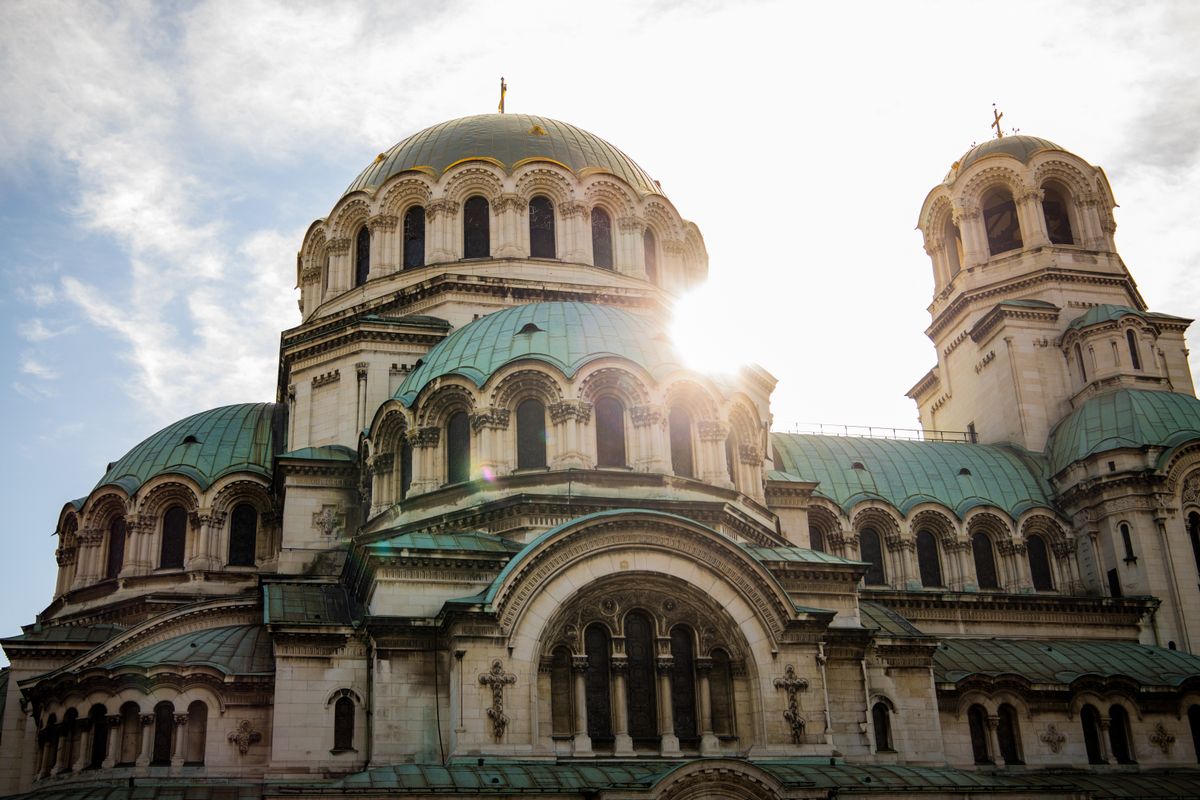
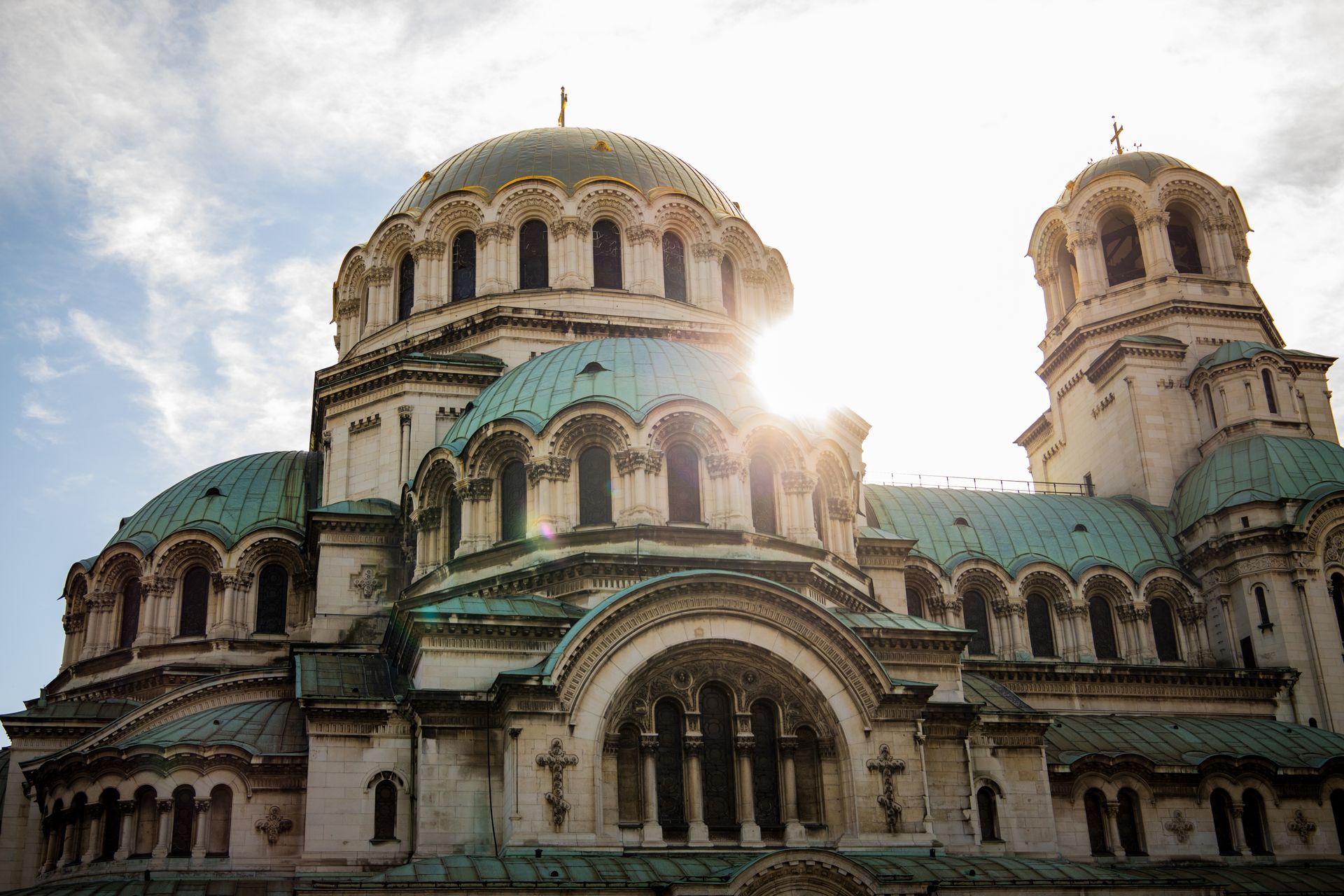
The headline sight is the Alexander Nevsky Cathedral (1882–1912) — a 5,000-capacity Neo-Byzantine basilica with 12 bells, a gold-leaf central dome and a crypt that doubles as the National Gallery’s Orthodox icon collection. Built as a memorial to the 200,000 Russian soldiers who fell in the 1877–78 Liberation War, it remains the largest cathedral in the Balkans by floor area. Two minutes’ walk away is the Saint George Rotunda, a 4th-century Roman church that is the oldest standing building in Sofia, surrounded by Roman Serdica ruins in a sunken courtyard. The other essentials are the Boyana Church (10 km south-west, UNESCO 1979, with the 1259 frescoes by Master Vasilij), the National Archaeological Museum (housed in Sofia’s largest Ottoman mosque, the 1494 Büyük Camii), and the Vitosha Boulevard pedestrian street with its view straight up to the Cherni Vrah summit.

Plovdiv — Europe’s Oldest Continuously Inhabited City
Plovdiv is Bulgaria’s second-largest city — 329,489 residents (2024) in the city, 675,000 in the metropolitan area — sitting on the Maritsa River 144 km south-east of Sofia at the geographical centre of the Upper Thracian Plain. It is one of the oldest continuously inhabited cities in Europe with archaeological evidence of habitation back to the 6th millennium BC, and it has had at least seven names: Eumolpia (Thracian), Philippopolis (renamed by Philip II of Macedon in 342 BC), Trimontium (“three hills” — its Roman name from 46 AD), Pulpudeva, Filibe (Ottoman) and finally Plovdiv. The city built itself on seven syenite hills, three of which still anchor the centre. Plovdiv was European Capital of Culture in 2019 (sharing the year with Matera).
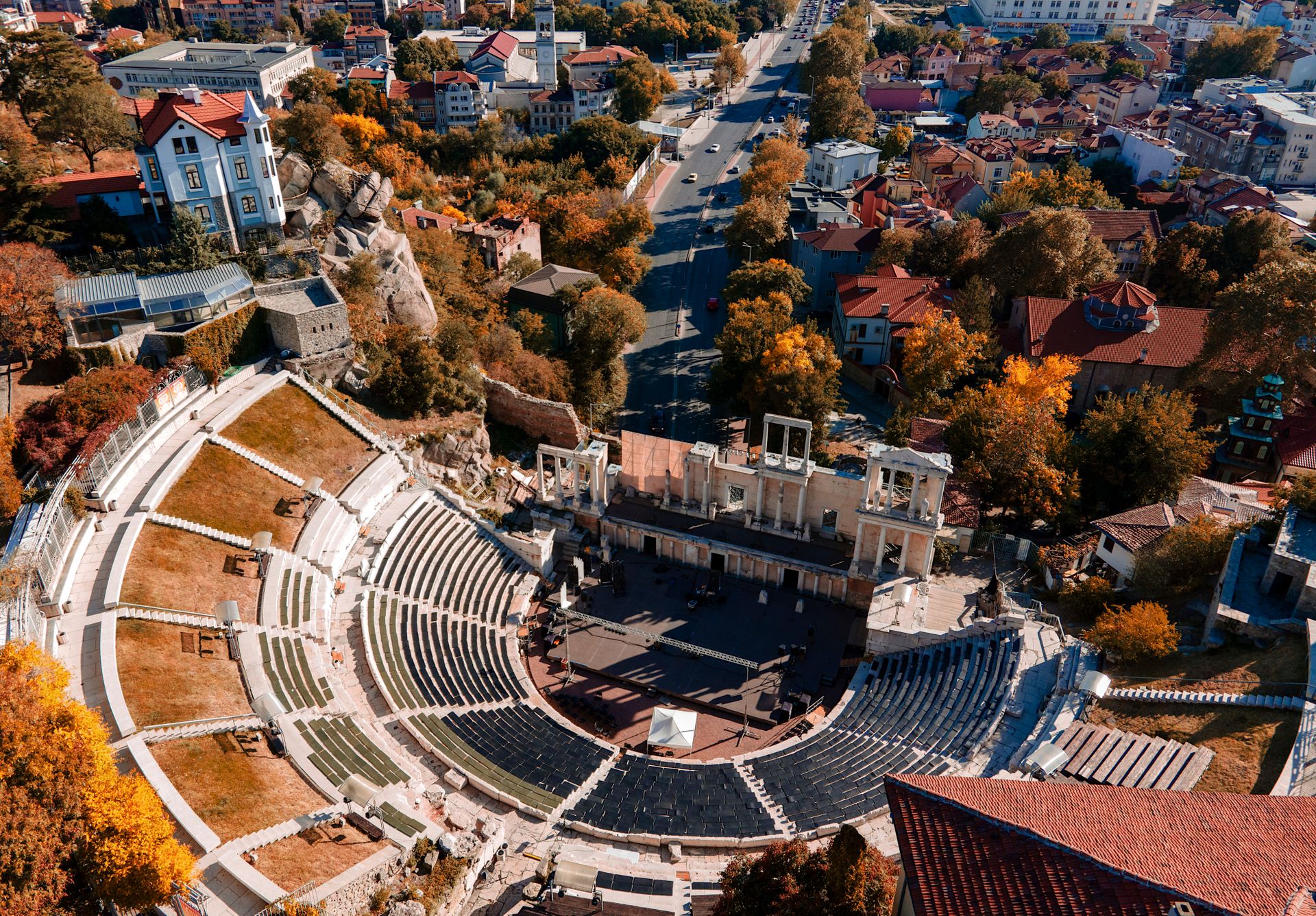
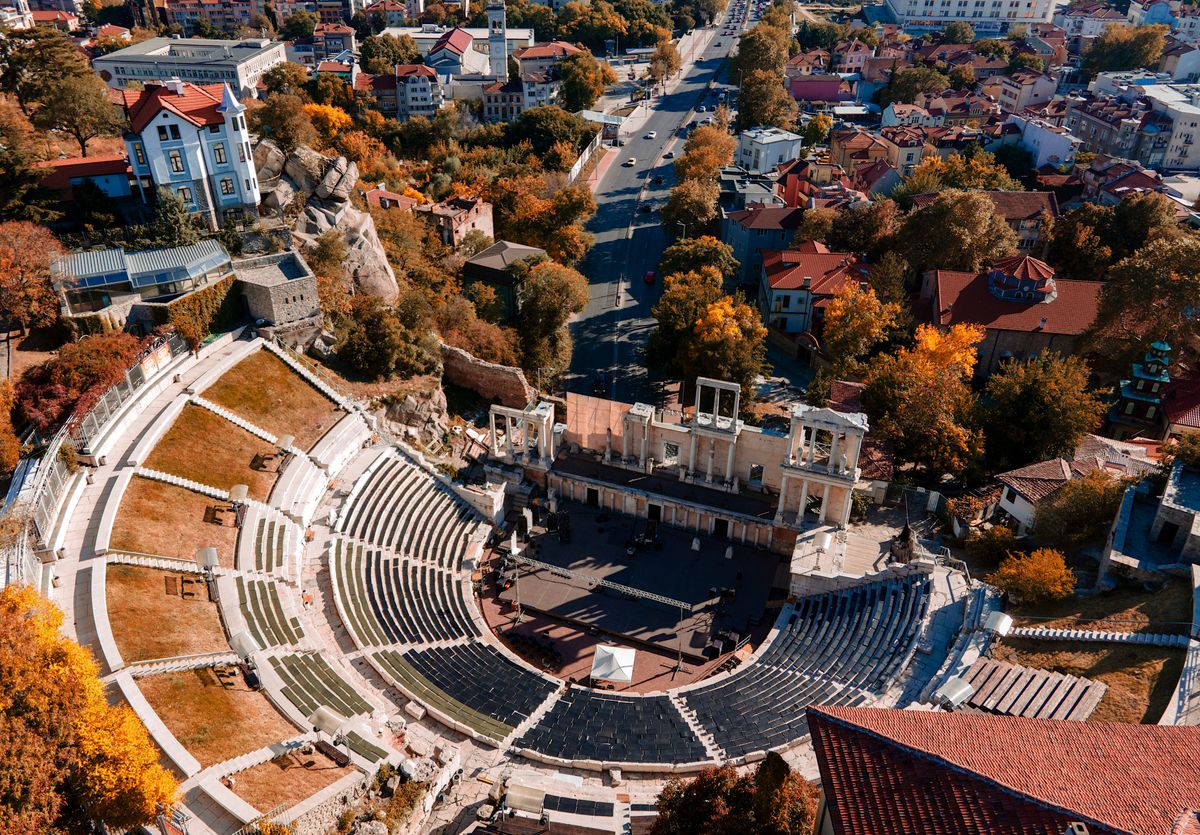
The headline sight is the Roman Theatre of Philippopolis, a 6,000-seat amphitheatre cut into the southern slope of the Three-Hill citadel by Emperor Trajan around 90–117 AD and still in use for summer opera. Two streets north is the Roman Stadium, a 240 m running track for 30,000 spectators preserved under modern Plovdiv’s main pedestrian street — only the curved northern end is excavated and visible from the Dzhumaya Mosque square. The Plovdiv Old Town on Nebet Tepe hill is wall-to-wall with Bulgarian Revival mansions: bay-windowed wooden houses with carved eaves, courtyard gardens and elaborately painted ceilings, of which the Balabanov, Hindliyan, Argir Kuyumdzhioglu and Lamartine houses are open as museums. The contemporary draw is Kapana — the “Trap” — a 17th-century artisans’ quarter that was converted in 2014 into Plovdiv’s creative cluster, with about 70 small bars, design studios and street-art alleys, all walkable from the central pedestrian street.
Veliko Tarnovo — Capital of the Second Bulgarian Empire
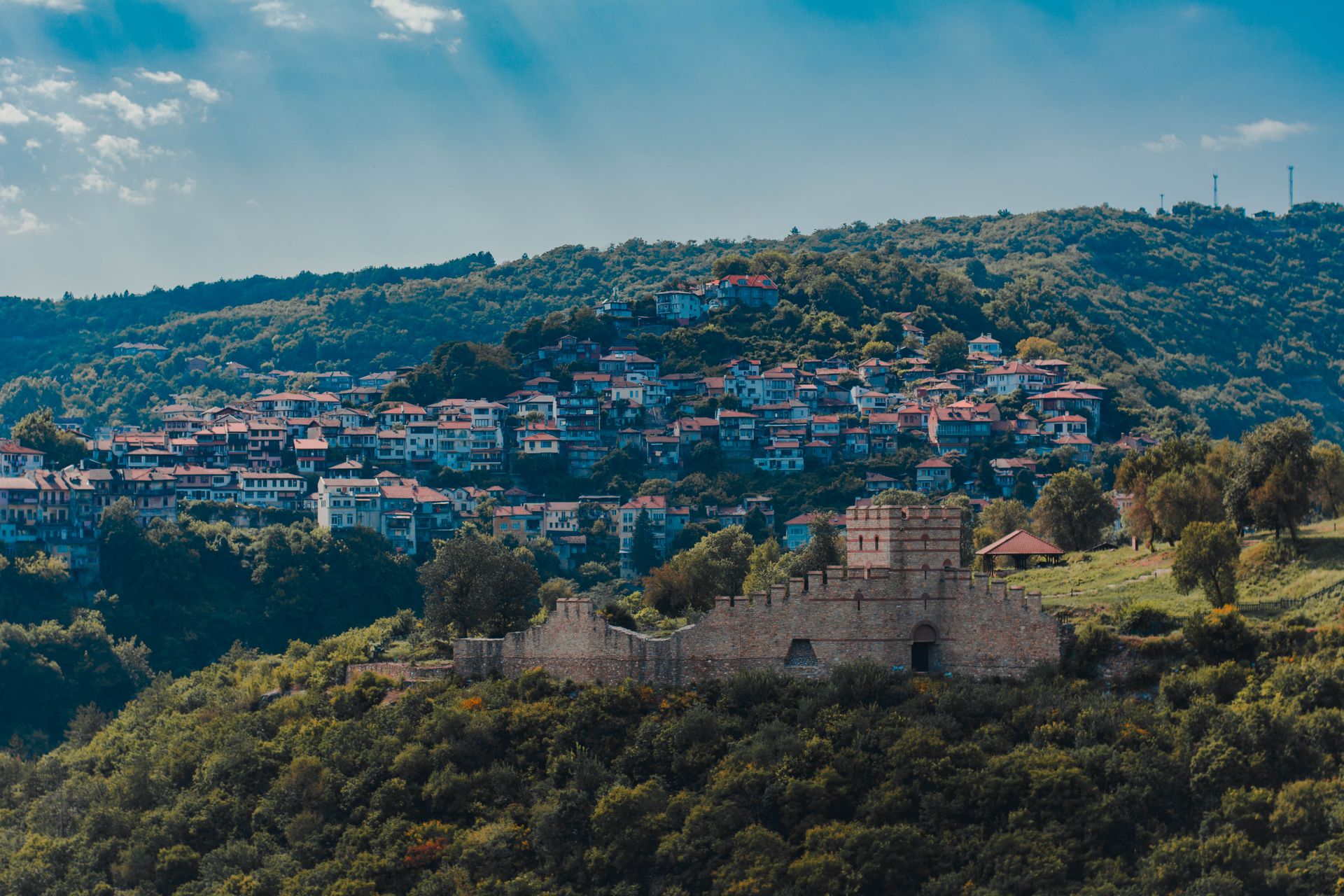
Veliko Tarnovo is the spiritual capital of medieval Bulgaria — 59,166 residents (2022) on three steep hills above a deep meander of the Yantra River in north-central Bulgaria. It served as the capital of the Second Bulgarian Empire from 1185 to 1396, and the Tsarevets fortress on the eastern hill once held the royal palace, the Patriarchal Cathedral and 18 churches. The fortress was destroyed by the Ottomans in 1393; partial reconstruction was completed in 1981 for the 1,300th anniversary of the Bulgarian state. The fortress walls and the Patriarchal Church are open daily; the after-dark Sound and Light show projects 30 minutes of Bulgarian medieval history onto the Tsarevets walls in laser, fireworks and choral chant — performed three nights a week from April to October and bookable from Tarnovo’s tourist information office.
The town spreads down the riverbank in tiers of Bulgarian Revival houses; the central Samovodska Charshia craft bazaar is the country’s best-preserved 19th-century artisans’ market, with active workshops for coppersmiths, ceramicists and icon painters. The riverside Asenov quarter holds the 13th-century Church of the Holy Forty Martyrs (where Tsar Ivan Asen II was crowned), and the village of Arbanasi 4 km uphill preserves five 16th–17th-century painted churches with frescoes that rival anything in Bulgaria. Veliko Tarnovo attracts roughly 450,000 tourists annually — busy in summer but never overcrowded outside the August peak.

Bansko & Pirin Mountains — Bulgaria’s Premier Ski Resort
Bansko is the country’s flagship ski resort, sitting at 925 m at the foot of the Pirin Mountains 160 km south of Sofia. The ski area has 75 km of pistes and 14 lifts, with the gondola lift (built 2003) climbing from the town to the Banderishka Polyana base area at 1,635 m, and a chairlift network reaching the 2,560 m summit station — vertical drop just under 1,000 m. The resort hosts FIS Alpine Ski World Cup races most years and the season runs reliably December–April. Bansko’s Old Town below the gondola — about 200 surviving Bulgarian Revival houses, three painted churches, the Velyanova House museum — is unusually intact for a ski resort and worth half a day’s wandering between runs. The town has emerged as one of Europe’s largest digital nomad hubs: the annual Bansko Nomad Fest pulled 700 attendees in 2023.

Above Bansko rises Pirin National Park, a 403.56 km² UNESCO site (1983) covering most of the Pirin range, with 118 glacial lakes, the 2,914 m Vihren peak (Bulgaria’s second-highest, the Balkans’ third-highest), and Europe’s southernmost glaciers — the small Snezhnika and Banski Suhodol névé fields. The summer hiking season (June–September) is one of the best in Europe: the four-day Pirin traverse from Predel pass to Demyanitsa hut hits all three of the high cirques (Vihren-Kutelo, Polezhan-Kamenitsa, Yalovarnika), and the day hike up Vihren from the Bezbog hut is a 6-hour return on the well-marked red trail.
Black Sea Coast — Varna, Burgas, Sozopol & Nessebar
The Bulgarian Black Sea coast runs 378 km from the Romanian border to the Turkish, with about 130 km of natural sandy beach. The two gateway cities are Varna (population 322,683 — the third Bulgarian city, with the world’s oldest gold treasure dated 4600–4200 BC at the Varna Necropolis) and Burgas (population 210,382 — the fourth city, with Bulgaria’s second-largest port and the country’s main fishing fleet). Varna’s Sea Garden runs 8 km along the coast and houses the Archaeological Museum (the Gold of Varna collection — 3,000 gold artefacts unearthed since 1974), an aquarium dating from 1932, and the Naval Museum. Burgas is a smaller, scrappier city built around three connected lakes that host 250+ bird species along the Via Pontica migration route.

The two essential old-town stops on the coast are Sozopol and Nessebar. Sozopol — a small peninsula 35 km south of Burgas — was founded in the 7th century BC by Milesian Greeks as Antheia and renamed Apollonia Pontica; the Romans destroyed the 13-metre statue of Apollo (made by sculptor Calamis in the 5th century BC) in 72 BC. The Old Town today preserves about 200 Bulgarian Revival wooden houses around five small Byzantine churches; the Apollonia Festival of Arts runs the first ten days of September. Nessebar — at the northern end of Sunny Beach, the country’s largest mass-tourism resort — is a UNESCO site (1983) on a Black Sea peninsula linked to the mainland by a narrow isthmus, and contains the highest density of historic churches per square metre on the entire Black Sea, with about 40 surviving Byzantine, Bulgarian and Ottoman-era buildings.

Rila Monastery & Mountains — The Spiritual Heart
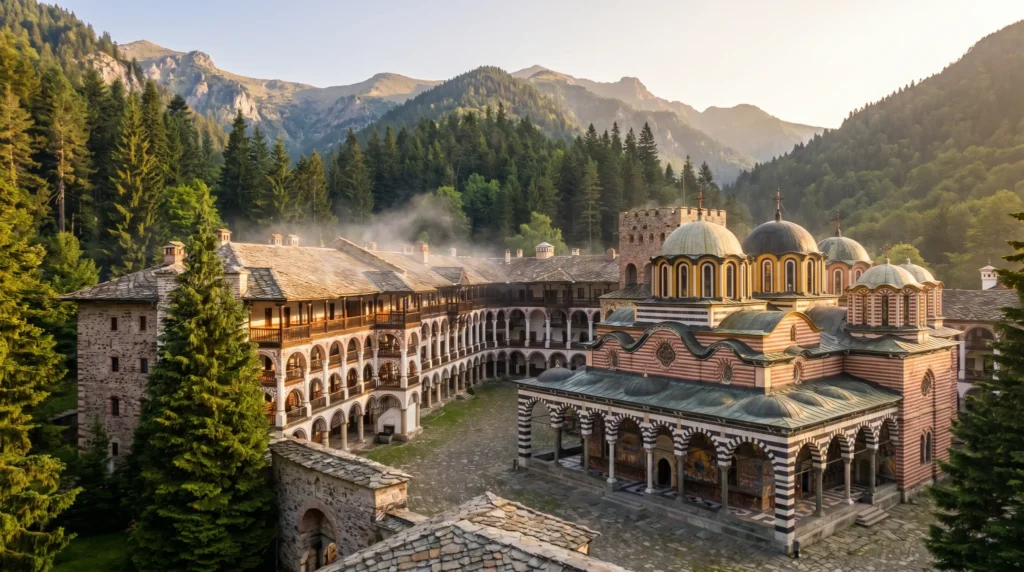
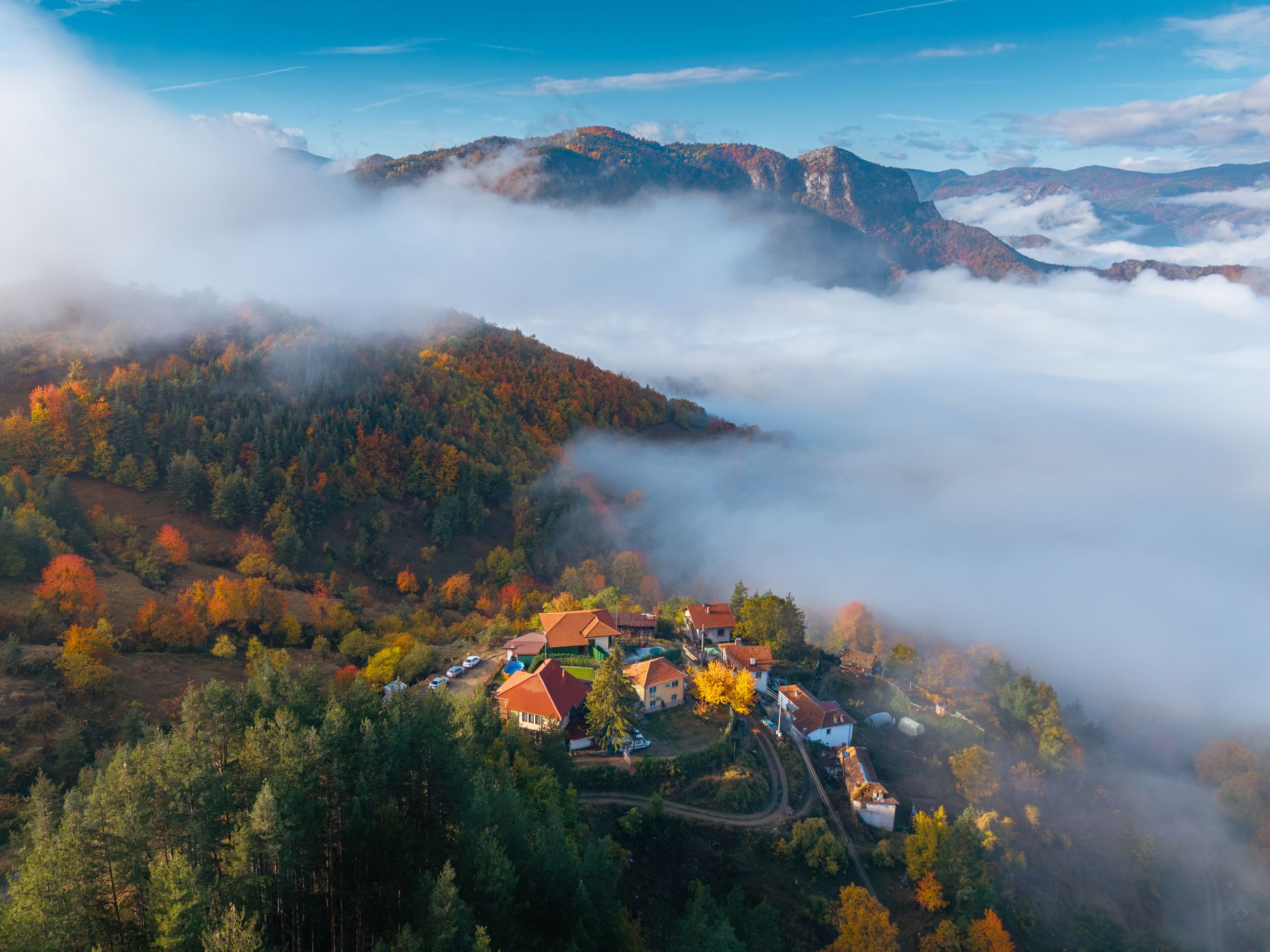
The Rila Mountains are the highest range in the Balkans — six peaks above 2,800 m, headed by Musala at 2,925 m — and contain Bulgaria’s most-visited cultural site, Rila Monastery. The monastery sits at 1,147 m altitude, 117 km south of Sofia, and was founded in the 10th century by Saint Ivan of Rila during the reign of Tsar Peter I. The current main church (1834–1837), with its five domes, striped red-and-white voussoir arches and the famous gold-plated iconostasis carved by Atanas Teladur over five years, is the canonical image of Bulgarian Orthodoxy. The 1846 frescoes by Zahari Zograf and Dimitar Zograf — the country’s two most important Bulgarian Revival painters — fill the porch with 36 New Testament scenes and a celebrated Last Judgement. The library contains 250 manuscripts and 9,000 printed works; the museum’s centrepiece is Rafail’s Cross — a single piece of boxwood carved 1790–1802 with 104 religious scenes and 650 microscopic figures. About 60 monks still live in residence; the complex was inscribed by UNESCO in 1983.
Above the monastery, the Seven Rila Lakes at 2,100–2,500 m are the most-photographed alpine landscape in Bulgaria — a chain of glacial cirque lakes named after their shapes (Tear, Eye, Kidney, Twin, Trefoil, Fish, Lower). The chairlift from Pionerska base runs daily June–October and saves 600 m of vertical climb; the loop walk from the upper station hits all seven lakes in 4–5 hours. Musala — the Balkan high point — is reached in a long day from Borovets via the Yastrebets gondola; the summit observatory was built in 1981.
Rhodope Mountains — Folk Music, Caves & the Greek Border
The Rhodope Mountains span 14,735 km² across southern Bulgaria and northern Greece — the largest range in Bulgaria, lower than Rila or Pirin (highest peak Golyam Perelik at 2,191 m) but with the most extensive karst landscapes, the deepest gorges and the largest coniferous forest on the Balkans. The Rhodope are the cradle of Bulgarian folk music: the asymmetric meters (7/8 rachenitsa, 11/8 kopanitsa, 13/16) and the haunting kaba gaida bagpipe tradition both originate here. Bulgaria’s contribution to the 1977 Voyager Golden Record was a Rhodope folk song, “Izlel ye Delyo Haydutin”, performed by Valya Balkanska — making her one of three musicians whose recordings are now drifting through interstellar space.
The headline towns are Smolyan (the regional capital, with the country’s best Planetarium and the Smolyan Lakes), Devin (Bulgaria’s largest mineral-water spa town, with seven thermal springs at 36–76°C), Pamporovo (the smallest of Bulgaria’s three big ski resorts, 1,650 m base, 37 km of pistes ) and Shiroka Laka (a 19th-century National Architectural Reserve famous for its kaba gaida master classes). The natural wonders are the Trigrad Gorge (a 7 km vertical-walled river canyon with the Devil’s Throat Cave whose underground waterfall plunges 42 m ), Yagodina Cave (10.5 km long, the third-longest in Bulgaria), Bachkovo Monastery (1083, the country’s second-most-important monastery after Rila), and the Buynovo Gorge with the Wonder Bridges natural rock arches.

Belogradchik Rocks & the North-West
The country’s most photogenic geological wonder is the Belogradchik Rocks in north-west Bulgaria — a 50 km² band of red sandstone formations rising up to 200 metres above the western foothills of the Balkan Range, near the small town of Belogradchik 195 km north of Sofia. Geological dating starts the formation in the Permian period (about 230 million years ago) with the iron-oxide colouring fixed during the Jurassic. The rocks were incorporated into a Roman fortress, expanded by the Bulgarians in the 14th century and again by the Ottomans, who built the surviving Belogradchik Fortress around them. The named formations include the Madonna, the Schoolgirl, the Horseman, the Bear and the Castle Rocks, with viewpoints accessible by a marked 90-minute loop walk from the fortress entrance. The nearby Magura Cave (closed to general visitors but the source of the world’s earliest pictographic calendar from 4000 BC) and Vidin on the Danube — the Baba Vida fortress is the only fully preserved medieval Bulgarian fortification — round out the north-west itinerary.
Bulgarian Culture & Customs
Bulgarian culture rests on three foundations: the Slavic-Orthodox Christian tradition, the Thracian-Greek-Roman antiquity that preceded it, and the five centuries of Ottoman rule that imprinted everything from the food vocabulary (yogurt, kebap, banitsa) to the architecture of regional towns. Understanding these three layers explains almost every cultural quirk a traveller will encounter.
Religion & the Orthodox Year
Roughly 71% of Bulgarians identify as Eastern Orthodox, with smaller communities of Sunni Muslims (about 8%, mainly Turkish Bulgarians and the Pomak ethnic Bulgarian Muslims of the Rhodope), Catholics, Protestants and a non-religious 16%. The Bulgarian Orthodox Church was founded in 870 AD when the Fourth Council of Constantinople granted Bulgaria an autocephalous archbishopric, was raised to a Patriarchate in 919, and is one of only nine independent Orthodox patriarchates worldwide. Patriarch Daniil was elected on 30 June 2024 following the death of Patriarch Neophyte. The church follows the Julian calendar for Easter (12 April 2026, a week before the Western Easter) and the Gregorian for fixed feast days. The most-visited religious days are Easter Saturday at Rila Monastery (midnight liturgy with full chant), 24 May (Saints Cyril and Methodius), 15 August (Dormition of the Theotokos), and 6 December (Saint Nicholas, the patron saint of fishermen and the Black Sea coast).
The Cyrillic Alphabet & Bulgarian Language
Bulgarian is a South Slavic language closely related to Macedonian; it is unusual among Slavic languages in lacking grammatical cases (the inflectional system collapsed in the medieval period) and in possessing a definite article suffixed to nouns — knigata “the book” rather than la livre or das Buch. The 30-letter Cyrillic alphabet was developed at the Preslav Literary School at the end of the 9th century by disciples of Saints Cyril and Methodius and is the third official script of the European Union. Older inscriptions in the related Glagolitic alphabet survive on stone slabs at Pliska and Preslav. About 250 million people now write in Cyrillic worldwide. English is widely spoken among Bulgarians under 40 — universal in Sofia, Plovdiv, Bansko and the Black Sea resorts; Russian among Bulgarians over 50 (compulsory in schools 1944–1989); German in the older Bansko/Pamporovo ski clientele.
Folk Music & the Voyager Golden Record
Bulgarian folk music is unusually well-preserved and globally celebrated. Its hallmark is the asymmetric meter — measures with odd numbers of beats per bar arranged in irregular groupings — including the 7/8 rachenitsa (2+2+3), the 11/8 kopanitsa (2+2+3+2+2) and the 13/16 krivo horo. The traditional instruments are the kaba gaida (a deep-toned bagpipe in F, native to the Rhodope), the gadulka (vertical bowed lute with sympathetic strings), the kaval (end-blown shepherd’s flute), and the tambura (long-necked fretted lute). The Bulgarian State Television Female Vocal Choir’s recordings, marketed internationally as Le Mystère des Voix Bulgares, won a Grammy in 1990 and brought the Bulgarian polyphonic close-harmony singing tradition to a worldwide audience. Most strikingly, Bulgaria’s recording on the Voyager Golden Record — Valya Balkanska’s “Izlel ye Delyo Haydutin”, a Rhodope folk song accompanied by kaba gaida — is now travelling on Voyager 1 in interstellar space, more than 24 billion km from Earth as of 2026.
Mummers, Firewalkers & Living Folk Traditions
Two of the world’s most extraordinary surviving European folk rituals are still practised in rural Bulgaria. Surva is the international festival of mummers’ games held in late January in Pernik (35 km west of Sofia) — the country’s largest folkloric event, with about 6,000 costumed kukeri mummers in horned masks and bell-belts gathered to perform purification dances that drive away winter evil. The kukeri tradition, with its bronze-bell waist-belts and shaggy goat-hair costumes, is at least 4,000 years old and probably descends from Thracian Dionysiac rites. Nestinarstvo — the ecstatic firewalking ritual — is performed on the night of 3–4 June in the Strandzha Mountain village of Bulgari, where dancers in white shirts circle a bed of glowing oak embers carrying icons of Saints Constantine and Helena and walk barefoot across the coals in a trance state. UNESCO inscribed Nestinarstvo on its Intangible Cultural Heritage list in 2009.
Etiquette — Read the Head Before the Words
The single most consequential thing to know about Bulgarian non-verbal communication is the head gesture. A traditional Bulgarian shakes the head side-to-side for “yes” (da) and nods for “no” (ne) — the inverse of most other countries. Urban Bulgarians under 40 increasingly use the Western convention but it is not universal, particularly in rural areas. When in doubt, listen for the words: da always means yes, ne always means no. Other useful conventions: handshake on first meeting, light cheek-kiss between friends; remove shoes when entering a private home; bring flowers (an odd number — even numbers are funeral flowers) when invited to dinner; do not speak about politics or about Macedonia (a sensitive subject) on first meeting; tipping is 10–12% in restaurants where service is good. The traditional New Year’s pastry — banitsa s kasmeti — is broken up at midnight and contains foil-wrapped paper messages or dogwood twigs that predict the eater’s fortune for the year.
A Food Lover’s Guide to Bulgaria
Bulgarian cuisine is the missing-link cuisine of the eastern Mediterranean. It shares the cucumber-tomato-yogurt foundation of Greek and Turkish cooking, the cabbage-pork-paprika foundation of central European cooking, and an Ottoman pastry tradition that runs unbroken from Sofia to Istanbul, but it has its own grammar — particularly around the soured-milk tradition (yogurt, ayran, kefir) where Bulgarians invented the science. The defining ingredient of the country is sirene, the white brined cheese that anchors a quarter of all dishes; the second is the small, intensely sweet sun-ripened tomato of the Thracian Plain; the third is the locally distilled rakia served as an aperitif before every formal meal.
The National Dishes
The single most-recognised Bulgarian dish is shopska salata — diced tomato, cucumber, raw red and green pepper, finely chopped onion and parsley, dressed with vinegar and sunflower oil, then heaped with grated sirene in a small white pyramid. The salad was invented by the state tourism agency Balkantourist in the 1950s as a deliberate attempt to create a national dish in the colours of the flag (white-green-red), and it succeeded so well that most Bulgarians today don’t realise it isn’t traditional. Eat it at the start of every meal, with a 50 ml shot of rakia.
The country’s most-emblematic pastry is banitsa — phyllo dough layered with sirene, eggs and yogurt, baked at 200–250°C until the top blisters golden and the inside is custardy. Variations include spanachnik (with spinach), tikvenik (with sweet pumpkin and walnut, the autumn version), and the New Year fortune-telling banitsa with foil-wrapped paper wishes baked into the spiral. Eat for breakfast with a glass of boza (a slightly fermented millet drink) or ayran (a salted yogurt-and-water drink, the same drink as in Turkey).
The grilled meat tradition is dense. Kebapche is a 60g cylinder of seasoned minced pork (cumin and pepper) grilled over charcoal, served three to a plate; kyufte is the patty version. Kavarma is a slow-cooked stew of pork or lamb, mushrooms, onions, peppers and tomatoes, traditionally served in a small earthenware pot called a guvech. Sarmi are stuffed cabbage rolls (vine leaves in summer, sour cabbage in winter), and mish-mash is a Bulgarian shakshuka of eggs scrambled with tomato, pepper and sirene. The country’s most distinctive soup is tarator, a cold yogurt-based soup of cucumber, garlic, dill, walnut and a splash of olive oil — the perfect lunch for a 35°C Plovdiv afternoon.
Bulgarian Yogurt & the Lactobacillus Story
Bulgaria’s contribution to global food science was the identification of Lactobacillus delbrueckii subsp. bulgaricus — the lactic-acid bacterium that ferments milk into the country’s distinctively tart, viscous yogurt. The discovery is credited to the Bulgarian medical student Stamen Grigorov, who while studying at the University of Geneva in 1905 isolated the rod-shaped bacterium from a sample of yogurt his mother had sent from his home village of Studen Izvor. The bacterium was given the species name bulgaricus in 1907 in his honour. Russian Nobel laureate Élie Metchnikoff at the Pasteur Institute used Grigorov’s research to develop his theory that regular yogurt consumption explained the unusual longevity of Bulgarian peasants — the foundation of the modern probiotic industry. Bulgarian yogurt today is produced under Bulgarian Bureau of Standards rules requiring two-strain inoculation (L. bulgaricus + Streptococcus thermophilus) and 4–4.5% fat. The most-celebrated artisan brand, Vitalakt, runs 25 dairies in mountain villages.
Rakia, Wine & the Bulgarian Drinks Cabinet
The national spirit is rakia — a single-distilled fruit brandy at about 40% ABV, made from grapes (grozdova), plums (slivova), apricots (kaisieva) or quinces. Most rural households still distil their own from the autumn fruit harvest, and any meal at a Bulgarian family home will start with a small chilled shot. Bulgaria has eight major wine regions; the four most important are the Thracian Lowlands (the heartland of Mavrud, the country’s flagship indigenous red), the Struma Valley in the south-west (the warm Mediterranean micro-region around Melnik, with the Shiroka Melnishka Loza grape that the playwright Winston Churchill drank by the case), the Black Sea coast (white wines including the indigenous Misket), and the Danubian Plain (Gamza and Cabernet). The country exported wine for centuries to the USSR and is now repositioning toward Western markets; small producers like Bessa Valley, Castra Rubra and Edoardo Miroglio offer cellar-door tastings.
Where to Eat
Bulgaria has only one Michelin-starred restaurant — Cosmos in Sofia, awarded in the 2024 inaugural Bulgarian guide — but the country’s eating culture is built around mehana (the village tavern with traditional food and live folk music) and gradinata (the urban garden restaurant). The Plovdiv neighbourhood of Kapana, the Sofia Kvartal Yuchbunar and the Bansko Old Town all run dense walking circuits of mehanas. The country is unusually vegetarian-friendly: shopska salata, banitsa, tarator, mish-mash, lyutenitsa, white-bean bob chorba, all the breads and most of the appetisers are meatless or vegetarian-adjacent.
| Dish | What it is | Best eaten where |
|---|---|---|
| Shopska salata | Tomato + cucumber + pepper + onion topped with grated sirene cheese | Anywhere — every meal starts with one |
| Banitsa | Phyllo pastry with sirene, eggs and yogurt; served warm | Bakery breakfast, with boza or ayran |
| Tarator | Cold yogurt soup with cucumber, garlic, dill, walnut | Plovdiv summer terraces |
| Kebapche / kyufte | Charcoal-grilled minced pork roll / patty | Mehana with rakia and salata |
| Kavarma | Slow-cooked pork-mushroom-pepper stew in earthenware | Bansko in winter, Veliko Tarnovo year-round |
| Sarmi | Stuffed cabbage or vine-leaf rolls with rice and pork | Family home Sundays; Christmas Eve |
| Mekitsi | Fried yogurt-dough pastries dusted with icing sugar or sirene | Mountain village breakfast |
| Lyutenitsa | Red pepper, tomato, aubergine and garlic relish; jarred or homemade | Spread on bread with sirene as a meze |
| Mish-mash | Eggs scrambled with tomato, pepper, sirene | Brunch anywhere |
| Rakia | Distilled fruit brandy, ~40% ABV (grape or plum) | Pre-meal, chilled, 50 ml shots |
| Mavrud wine | Indigenous Thracian red, dense tannins, ageworthy | Plovdiv, Asenovgrad cellars |
| Boza | Lightly fermented millet drink, low alcohol | Breakfast with banitsa |
| Ayran | Salted yogurt-and-water drink | Hot afternoon refreshment |
Off the Beaten Path — Belogradchik, Buzludzha & Cave Country
The flagship circuit of Sofia–Plovdiv–Tarnovo–Black Sea covers the canonical Bulgaria but skips the country’s stranger corners. Here are five worthwhile detours that almost no first-time visitor makes — and almost every returning visitor wishes they had.
Buzludzha — The Communist UFO
The Buzludzha Monument sits at 1,432 m on the saddle of the Stara Planina range, 12 km from the village of Shipka and 41 km north-west of Kazanlak. Inaugurated in 1981 as the headquarters of the Bulgarian Communist Party — a 60-million-leva structure built by 6,000 workers and decorated with 60 tonnes of mosaic — the monument was abandoned after the 1989 transition and stripped of its valuables through the 1990s. The 70-metre steel-reinforced concrete saucer, perched dramatically on its mountain ridge, has become an unintentional monument to the failure of state communism and one of Europe’s most photographed brutalist ruins. The interior was sealed for safety in 2018, but in 2023 the Buzludzha Project Foundation (in partnership with the Getty Foundation) began a €5 million conservation programme to stabilise the ceiling mosaics. The exterior remains accessible year-round; the road is open May–November.
Perperikon — The Thracian Sanctuary
Perperikon is an enormous Thracian sanctuary city carved into a 470 m rocky outcrop in the eastern Rhodope Mountains, 15 km north-east of Kardzhali. The site was occupied continuously from 5000 BC to the 14th century AD, with peak development under the Odrysian Thracian kingdom in the 4th–1st centuries BC and a major reconstruction under the Romans. Many archaeologists identify Perperikon as the temple of Dionysus where Alexander the Great was given the prophecy that he would conquer the world — though the attribution is contested. The site preserves a vast rock-cut palace, a sanctuary, an acropolis, a residential quarter and a necropolis, all chiseled directly into the bedrock. Excavations since 2000 under archaeologist Nikolay Ovcharov have revealed fortifications, religious vessels and the largest concentration of Thracian rock-cut tombs in the Rhodopes.

Trigrad Gorge & the Devil’s Throat Cave
The Trigrad Gorge is a 7-km vertical-walled river canyon in the western Rhodope Mountains, 30 km south of Devin and almost on the Greek border. The walls rise 250 metres from the river; the Devil’s Throat Cave at the gorge’s southern end contains an underground waterfall that plunges 42 m — the highest underground cataract in the Balkans — and a famously eerie room called the Hall of Hum, named for the resonance of the water. Bulgarian folklore identifies the cave as the entrance to Hades through which Orpheus descended to retrieve Eurydice. The Yagodina Cave 25 km west — at 10.5 km the third-longest in Bulgaria — is the alternative show cave with three levels of stalactite galleries and a year-round 6°C temperature.
Devetashka Cave & the Krushuna Waterfalls
The Devetashka Cave 15 km east of Lovech is one of the largest cave entrances in Europe — 35 m high, 55 m wide — and home to a colony of about 30,000 bats of 13 different species, plus a small subterranean river. Hollywood made the cave briefly famous when Sylvester Stallone shot scenes from The Expendables 2 here in 2011. The cave is closed to the public 1 June–31 July to protect the bat breeding season but open the rest of the year for €4 admission. Twenty kilometres south, the Krushuna Waterfalls are a series of about a dozen tufa cascades pouring through a beech-and-yew forest, with the main waterfall dropping 20 m through travertine pools — a 90-minute round-trip walk from the village car park.
Melnik & the Sandstone Pyramids
Melnik claims the title of Bulgaria’s smallest official town: 156 inhabitants in 2024, down from 20,000 in the 18th century when it was a major Greek-Bulgarian Ottoman trading hub. The town sits in a basin entirely surrounded by extraordinary Melnik sand pyramids — eroded reddish-yellow sandstone formations up to 100 m tall, declared a Natural Monument in 1960. Five of the original 73 Bulgarian Revival mansions survive (the Kordopulov House from 1754 is the largest in Bulgaria) along with several 13th-century churches and the ruined Slav fortress of Tsar Slav above the town. Melnik is also the heart of the Struma Valley wine region — the local Shiroka Melnishka Loza grape produces a distinctive long-aged red, and Winston Churchill is reputed to have ordered 500 litres a year directly from the Kordopulov cellar. The drive from Sofia is 170 km via the E79 motorway and takes 2 hours 15 minutes.
Practical Information
This is the quick-reference table I email to friends planning a Bulgaria trip. Bulgaria became the 21st Eurozone state on 1 January 2026, joined Schengen for land borders on 1 January 2025, and remains the cheapest EU country by Eurostat consumer price levels (about 56% of the EU average). All practicalities below are verified against the UK FCDO, US State Department and US CDC May 2026 advisories.
Two further notes before the table. First, business hours: most museums and the Rila Monastery treasury close on Mondays, banks run weekday office hours, and rural shops keep a long afternoon break in summer. Second, connectivity: 4G and 5G coverage is excellent in every city and along the motorway network, with only the deepest Rhodope and Pirin valleys dropping out — useful to know if you intend to hike the high cirques, where a paper map and a charged power bank still matter. Bulgaria keeps Eastern European Time, one hour ahead of Central Europe.
| Category | Details |
|---|---|
| Currency | Euro (EUR) since 1 January 2026; lev coins valid through 31 January 2026 only. ATMs widespread; cards universal in cities, often refused in rural mehanas. |
| Languages | Bulgarian (official, Cyrillic script). English widely spoken under-40; Russian over-50; German in ski resorts; Turkish in eastern Rhodope. |
| Visas | EU Schengen since 1 Jan 2025 (full); 90 days visa-free for US/UK/CA/AU/NZ/JP within any 180. ETIAS €7 from late 2026. |
| Entry passport | Valid >3 months beyond Schengen exit; 1 blank page per stamp; 10,000 EUR cash declaration limit. |
| Health/CDC | Routine vaccinations (MMR, Tdap, COVID); Hepatitis A and Typhoid recommended for rural/extended; tap water safe across Bulgaria. |
| Tap water | Safe everywhere — Sofia’s mains supply comes from Rila springs and tests among the cleanest in Europe. |
| Plug type | Type C and Type F (Europlug / Schuko CEE 7/4), 230 V, 50 Hz. Same as the rest of continental Europe. |
| Mobile / SIM | Vivacom, A1, Yettel — €10 prepaid for 10 GB at any carrier shop or airport kiosk. EU roaming applies for EU/EEA SIMs at home prices. |
| Emergency | 112 (single number for police, ambulance, fire). Tourist police hotline 0700 13146 in Sofia. |
| Safety | US State Dept Level 1 (normal precautions). Petty theft and ATM skimming the main risks; violent crime rare. UK FCDO no exceptional warnings. |
Budget Breakdown — What Bulgaria Costs in 2026
Bulgaria is currently the cheapest country in the European Union by Eurostat’s harmonised consumer price level — about 56% of the EU-27 average for restaurants and hotels in 2024. The euro adoption on 1 January 2026 has, in the early months, produced the typical changeover bumps — a few central Sofia cafés have rounded up — but the underlying value proposition is unchanged. A traveller who spent two weeks in Greece would spend about 60% as much in Bulgaria for the same standard of accommodation, food and transport.
Budget Tier — €35–60 per day
The budget tier covers hostels, the night train, the lower-end mehana and the public bus. Hostel dorm beds in Sofia, Plovdiv and Veliko Tarnovo run €15–22 (Hostel Mostel and Canape Connection in Sofia, Hostel Old Plovdiv and Hostel Mostel in Plovdiv). Private double rooms in family-run guesthouses outside the centre run €30–45. A full mehana meal with rakia, salata, soup and a grill plate is €12–18. Bus from Sofia to Plovdiv €8; train Sofia–Burgas night sleeper €25; metro day pass €2; museum entry €3–6. Bansko ski day pass in low season (December) is €45 — about half the price of Kitzbühel or Zermatt.
Mid-Range Tier — €70–130 per day
The mid-range tier puts you in 4-star hotels and the better mehanas. A central Sofia 4-star (Sense Hotel, the Grand Hotel Sofia, Hyatt Regency) runs €110–170 for a double room with breakfast. Plovdiv Old Town boutique hotels (Hebros, Star Hotel, Aleksander Boutique) run €90–140. Bansko ski-week packages including 5-night chalet, lift pass and equipment hire run €450–650 in January. Mehana with appetisers, salata, soup, grill, dessert, rakia and Mavrud wine for two: €40–55. Sofia airport private transfer €30; intercity coach €10–25; rental car (compact) €25–40 a day with the digital vignette included.
Luxury Tier — €260+ per day
The luxury tier in Bulgaria gets you what €600+ buys in Vienna or Prague. Sofia’s premium hotels — the InterContinental Sofia (formerly the Radisson Blu Grand), the Sense (with its rooftop pool over the Cathedral) and the Sofia Grand Hyatt — run €260–450 a night. The Black Sea coast’s two flagship resorts — the Stenata Spa Hotel in Sozopol and the Therma Palace in Albena — run €280–500. The country’s only Michelin-starred restaurant, Cosmos in Sofia, opens at €130 for a tasting menu without wine. The five-star Kempinski Hotel Grand Arena in Bansko, sitting at the foot of the gondola, runs €280–400 in peak ski week with full board.
| Item | Budget | Mid | Luxury |
|---|---|---|---|
| Hotel/night (Sofia) | €18 hostel dorm | €95 boutique | €280 5-star |
| Restaurant dinner | €10 mehana | €25 mid | €85 fine dining |
| Coffee in centre | €1.80 | €2.50 | €4 hotel lobby |
| Sofia–Plovdiv intercity | €7.50 train | €10 coach | €60 private car |
| Bansko day ski pass | €45 low season | €55 high season | €85 ski-in chalet |
| Museum / fortress entry | €3 | €6 | €20 private guide |
| Daily total / person | €35–60 | €70–130 | €260+ |
Planning Your First Trip to Bulgaria
Five steps from “I’m thinking about Bulgaria” to “I’m at gate B12 in Sofia waiting for my luggage”. This is the workflow I run for every friend who asks me to plan their first Bulgarian trip.
- Pick the season. May–early June for Plovdiv-Tarnovo culture plus the Rose Festival; mid-September–October for the same circuit at autumn light and lower prices; January–March for Bansko ski; mid-July–early September for a Black Sea beach week. The single best month for a first-time circuit is late May: lowland temperatures of 22°C, the Rhodope wildflowers at peak, the rose harvest just starting in Kazanlak, and the Black Sea about to open.
- Book the flight. Sofia (SOF) is the default for a cultural circuit. Wizz Air is the dominant carrier with the cheapest fares from London Luton, Vienna, Berlin, Milan and Tel Aviv; Ryanair the second pick from Stansted, Dublin and Manchester; Bulgaria Air the flag carrier for connections from Frankfurt, Madrid, Warsaw. A summer Black Sea trip flies into Burgas (BOJ) or Varna (VAR) instead. Book 8–12 weeks ahead for shoulder-season fares of €35–60 each way from Western Europe.
- Lock in the route. The first-trip default is the Sofia–Plovdiv–Veliko Tarnovo circuit (5 days). With a week, add Bansko + Rila Monastery. With ten days, add the Black Sea (Sozopol-Nessebar) loop. Direct trains and intercity coaches handle every leg — there is no good reason to rent a car for a first trip unless you are heading to the Rhodope or Belogradchik. The Bulgarian rail network is cheap and atmospheric but slow; coaches are 30% faster on most routes.
- Book the accommodation. Bulgaria’s hospitality is small-scale and family-run; Booking.com and Airbnb both work well. Sofia centre (Vitosha Boulevard / Lavov Most), Plovdiv Old Town (Trimontium / Kapana), and Tarnovo’s Asenova quarter are the prime areas. Bansko sells out 4–6 weeks ahead for January–February ski weeks; the Black Sea sells out 6–8 weeks ahead for July–August. The single most common first-trip mistake is booking a glass-tower business hotel in central Sofia and missing the boutique guesthouses 200 m away in the old neighbourhood — at half the price.
- Pre-load the practicals. Download offline Google Maps for the entire country (8 GB), the BDŽ rail app, the Sofia Metro app, and Bolt for ride-share. Memorise the 112 emergency number. Note the Cyrillic spellings of your destinations (СОФИЯ, ПЛОВДИВ, ВАРНА, БУРГАС). Pack an EU plug adaptor if travelling from outside Europe (Type C / Type F, 230 V). Confirm your travel insurance covers the Pirin and Rila high mountain zones if you plan to hike above 2,000 m.
Frequently Asked Questions
Is Bulgaria safe for tourists?
Yes. The US State Department rates Bulgaria at Level 1 — Exercise Normal Precautions, the lowest tier; the UK FCDO has no exceptional warnings. Petty pickpocketing on Sofia’s Vitosha Boulevard, ATM skimming and taxi overcharging are the most common tourist incidents; violent crime rates are below the EU median. Solo female travellers report Bulgaria as comfortable; standard precautions apply.
Do I need a visa to visit Bulgaria?
Citizens of the US, UK, Canada, Australia, New Zealand, Japan, South Korea and most other visa-exempt nationalities can stay 90 days within any 180-day period without a visa. Bulgaria joined Schengen for air and sea borders on 31 March 2024 and for land borders on 1 January 2025 — full Schengen membership. ETIAS pre-travel authorisation will be mandatory from late 2026 for visa-exempt travellers.
What currency does Bulgaria use?
Bulgaria adopted the euro on 1 January 2026, becoming the 21st Eurozone member. The previous currency, the Bulgarian lev (BGN), had been pegged to the euro at 1.95583 BGN per EUR via a currency board since 1999. Lev coins were valid through 31 January 2026 only; the Bulgarian National Bank will exchange unlimited amounts of legacy lev banknotes indefinitely.
How many days do I need for Bulgaria?
Three days for Sofia plus a Rila/Boyana day trip gives the highlights. Five days lets you add Plovdiv. Seven days lets you do the Sofia–Plovdiv–Veliko Tarnovo cultural triangle plus Bansko or Rila. Ten days adds the Black Sea coast (Sozopol and Nessebar). Two weeks lets you add the Rhodope Mountains and the Belogradchik Rocks. The country is small but the mountain crossings are slow.
Is Bulgarian hard to learn?
Spoken Bulgarian is moderately difficult — the grammar collapsed the cases (no nominative/dative/genitive), which makes it easier than Russian, Czech or Polish, but the verb system has more tenses and aspects than English. Written Bulgarian is the larger barrier: you need to learn Cyrillic, the 30-letter alphabet developed at the Preslav Literary School around 893 AD. The good news: most Cyrillic letters look like Greek or Latin letters, and you can learn the alphabet on a flight from London. English is widely spoken in cities, so you can travel in Bulgaria without learning Bulgarian.
What’s the best month to visit Bulgaria?
Late May / early June. The Plovdiv weather is at 22-25°C , the Rhodope wildflowers are at peak, the Rose Festival opens in Kazanlak in the first weekend of June, the Black Sea is just opening for swimming, and the August heatwave and crowds have not yet arrived. The second-best window is late September / early October for autumn foliage and the wine harvest. The third is late January / February for Bansko ski.
Is Bulgaria expensive?
No — Bulgaria is the cheapest country in the European Union by Eurostat consumer price levels (2024 data). A budget traveller can manage on €35–60 a day; a mid-range traveller on €70–130. Sofia and the Black Sea coast in peak summer are the priciest; the Rhodope Mountains and the Danubian Plain are the cheapest.
Can I drink the tap water in Bulgaria?
Yes, everywhere. Sofia’s tap water comes from springs in the Rila Mountains and is among the cleanest in Europe; Plovdiv, Varna, Burgas and Veliko Tarnovo all meet EU drinking-water standards. The Devin and Hisarya regions are mineral-water spa towns and locals often drink the bottled mineral water for taste, but the tap is universally safe. The US CDC has no water-quality advisory for Bulgaria.
Is Bulgaria part of the EU and Schengen?
Yes to both. Bulgaria joined the EU on 1 January 2007 and NATO on 29 March 2004. It joined the Schengen Area for air and sea borders on 31 March 2024 and for land borders on 1 January 2025 — full Schengen membership. Bulgaria adopted the euro on 1 January 2026, becoming the 21st Eurozone state.
Why do Bulgarians shake their heads for “yes”?
The traditional Bulgarian gesture for “yes” (da) is a side-to-side head shake; the gesture for “no” (ne) is a vertical nod — the inverse of most countries. The convention is a survival of an old Balkan/Anatolian tradition and is so deeply embedded that even modern Bulgarians under 40 will fall back on it under stress. When in doubt, listen for the spoken word: da always means yes, ne always means no.
How does Bulgarian Orthodox Easter work?
The Bulgarian Orthodox Church follows the Julian calendar for the calculation of Easter, which means Bulgarian Easter usually falls one to five weeks later than Western Easter. In 2026 Orthodox Easter is on Sunday 12 April. The midnight liturgy at Rila Monastery and Bachkovo Monastery on Easter Saturday is one of the country’s most powerful religious experiences — full chant, candle procession, and a 4 a.m. shared meal of kozunak (Easter sweet bread) and red-dyed eggs.
Is Bulgaria good for a first solo trip?
Yes — particularly the Sofia–Plovdiv–Tarnovo cultural triangle. English is widely spoken in cities, distances between flagship sights are short, costs are low, and hostels in Sofia and Plovdiv are well-rated and social. Solo female travellers report Bulgaria as comfortable; standard precautions apply, and the 112 emergency number works in English. The country is also unusually safe at night for an Orthodox-Slavic country — the major squares of Sofia, Plovdiv, Varna and Burgas are walkable to midnight.
Ready to Explore Bulgaria?
If this guide convinced you to put Bulgaria on the 2026 shortlist, the next steps are straightforward: book a Wizz Air flight into Sofia for late May, lock in three nights in central Sofia and three in Plovdiv Old Town, and add a day-trip to Rila Monastery. The country rewards the curious — every village mehana has a story, every Orthodox monastery has a fresco worth ten minutes, and every shop will let you taste the local rakia. Save this guide for the practicalities and we’ll see you on a Plovdiv terrace at sunset.
Explore More — City Guides & Related Reading
City guides for your Bulgaria trip and the region
Country guides nearby
More country guides you might like
Plan your trip to Bulgaria
The booking tools we use ourselves. FFU may earn a commission at no extra cost to you.
Plan & book your trip to Bulgaria
Booking through these searches supports our guides at no extra cost to you.