
Colmar Travel Guide — Alsace’s Fairy-Tale Capital of Half-Timbered Houses & Wine
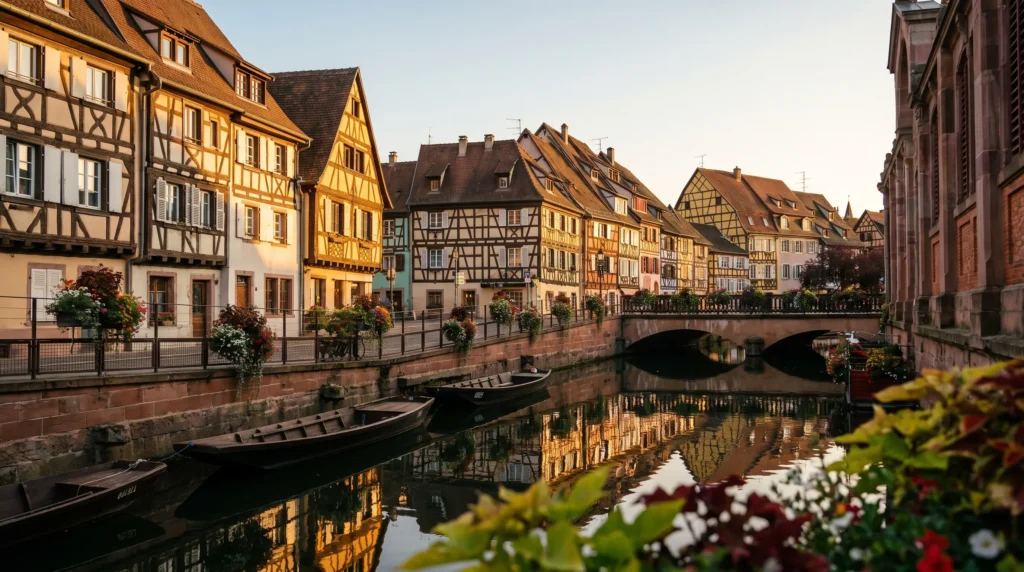
I’ll say the quiet part out loud: Colmar looks fake. Painted half-timbered houses lean over a canal called Petite Venise, geraniums spill from every windowsill on cue, and the whole old town reads like a film set — which is fitting, since Miyazaki’s animators reportedly used it as inspiration for Howl’s Moving Castle, and you can still walk past the actual 1537 building, Maison Pfister, that helped make the case. What makes it work isn’t a theme-park trick, though — it’s that Colmar has spent the last thousand years being fought over by France and Germany, and the result is a genuinely bilingual culture stacked on top of Alsace’s driest, sunniest, most productive wine country. Come for the postcard canal, stay for the Isenheim Altarpiece and the fact that you can be tasting Riesling in a 15th-century village twenty minutes later.
In This Guide
- Overview — Why Colmar Is Alsace’s Fairy-Tale Capital
- Colmar’s Christmas Markets — Six Villages of Lights in One Old Town
- Best Time to Visit Colmar (Season by Season)
- Getting There — Trains, Airports & Border Hops
- Getting Around — On Foot, By Bike, By Boat
- Neighborhoods — Petite Venise, Vieille Ville & Beyond
- Culture & People — A City That’s Been Both French and German
- A Food Lover’s Guide to Colmar
- Off the Beaten Path
- Day Trips — Wine Villages, Strasbourg & the Vosges
- Practical Information
- Budget Breakdown — What Colmar Actually Costs in 2026
- Frequently Asked Questions
Overview — Why Colmar Is Alsace’s Fairy-Tale Capital
Colmar sits in the Haut-Rhin department of Alsace, in northeastern France, with a city population of roughly 67,000 and a wider metro area closer to 200,000. It has been a free imperial city, French under Louis XIV, German after the Franco-Prussian War, French again after both World Wars, and the site of a brutal 1945 battle known as the Colmar Pocket — which is the short version of why the street signs, the food, and even the timber-framed architecture feel like a hinge between two cultures rather than purely French or German.
The old town survived the 20th century’s wars largely intact, which is the real reason it looks like an illustration: the Koïfhus (the old customs house, completed in 1480), the 1537 Maison Pfister, and the Gothic Église Saint-Martin all still stand within a ten-minute walk of each other. Colmar also calls itself the capital of the Alsace Wine Route, and it earns the title honestly — it sits in a rain shadow of the Vosges mountains that makes it one of the driest cities in France, with roughly 595mm of rain a year, which is exactly the kind of dry, sunny microclimate that grows very good Riesling and Gewürztraminer.
What Colmar doesn’t have is a beach, a coastline, or much in the way of modern skyline — this is a compact, walkable, museum-and-market kind of trip, best measured in days rather than weeks. That’s also its charm: you can see the highlights in an afternoon and still have three more days of wine villages and slow lunches left to fill.
Colmar’s Christmas Markets — Six Villages of Lights in One Old Town
If there’s one week to build a trip around, it’s late November through December. Colmar’s Christmas markets — La Magie de Noël — run across six separate squares and neighborhoods in the old town, each with its own theme (gourmet stalls, children’s market, wine-focused market), and for 2026 they’re scheduled to run from 23 November to 29 December, with the gourmet market and Ferris wheel staying open into early January. Standard hours run 11am–7pm Monday to Thursday and 10am–8pm Friday to Sunday, with the whole city center going car-free for the season.
The honest catch: this is the single most crowded window of Colmar’s year, and hotel prices climb accordingly. Book two to three months ahead, arrive on a weekday if you can, and go either right at opening or after dark on a Tuesday — the canal-side lights over Petite Venise are the reason half these photos exist on the internet in the first place.
Best Time to Visit Colmar (Season by Season)
May – June · Spring bloom, before the summer crowds
Warm days, long light, window boxes in full flower, and Colmar’s own “Colmar Celebrates Spring” festival in the old town. This is the sweet spot most visitors miss.
July – August · Peak summer
The driest, sunniest stretch of the year, ideal for the wine route and outdoor cafés — but also peak prices and the busiest canal-side selfie traffic. Book Petite Venise-view rooms well ahead.
September – October · Harvest season
Grape harvest along the wine route, golden light in the vineyards, and noticeably thinner crowds than summer — arguably the best all-around window if you care more about wine than markets.
Late November – December · Christmas markets
Cold, festive, and full — see the seasonal hook above. Pack layers; Alsace winters are damp-cold rather than brutally cold.
Getting There — Trains, Airports & Border Hops
Colmar has no major international airport of its own. The two closest are EuroAirport Basel-Mulhouse-Freiburg and Strasbourg-Entzheim, both roughly 70 kilometres away with direct or connecting flights across Europe. EuroAirport is the more useful of the two for international arrivals since it’s shared by France, Germany and Switzerland and sits close to the Basel rail hub; a taxi or transfer to Colmar takes roughly 40–50 minutes.
By train, Colmar sits on the main Alsace line with direct connections to Strasbourg (about 64km, with the fastest direct services around 27–33 minutes) and Mulhouse/Basel to the south. Paris connects via TGV to Strasbourg or Mulhouse with an onward regional hop, making Colmar a realistic day trip or add-on from either city. Driving in from Germany (Freiburg) or Switzerland (Basel) across the Rhine is straightforward and a genuinely scenic way to arrive.
Getting Around — On Foot, By Bike, By Boat
Colmar’s old town is small enough to walk end to end in under half an hour, and that’s really the whole game — nearly everything worth seeing (Petite Venise, the Unterlinden Museum, the Koïfhus, Saint-Martin) sits inside a compact historic core with no need for a car once you’ve arrived. Bike rental is widely available and popular for reaching the edges of town or the start of the wine route.
For Petite Venise specifically, flat-bottomed boat tours punt along the canal — touristy, but a genuinely nice fifteen minutes off your feet. A local bus network (Trace) covers the wider city and nearby villages if you’re staying outside the center, and for the wine route itself, a rental car or organized half-day tour is the practical choice since the smaller villages aren’t well served by rail.
Neighborhoods — Petite Venise, Vieille Ville & Beyond
Petite Venise (Little Venice)
The postcard: a canal quarter along the Lauch river where tanners, fishmongers and market gardeners once lived and worked, now lined with pastel half-timbered houses and window-box geraniums. Quai de la Poissonnerie is the prettiest single stretch — come at golden hour or after dark when it’s lit for a much quieter version of the same view everyone photographs at noon.
Vieille Ville (Old Town) — Place de l’Ancienne Douane & Koïfhus
The historic commercial heart, anchored by the Koïfhus (the old customs house, completed in 1480 and the oldest public building in the city) and Place de l’Ancienne Douane’s café terraces. This is where Maison Pfister (1537) stands, along with the covered market hall rebuilt in 1865.
Quartier des Tanneurs (Tanners’ Quarter)
Tall, narrow, steep-roofed houses that once dried hides on their upper floors — a less-photographed but architecturally distinct pocket right next to Petite Venise, worth the extra five minutes’ wander.
Unterlinden / Museum Quarter
Home to the Unterlinden Museum, a former Dominican convent that now houses Matthias Grünewald’s Isenheim Altarpiece alongside medieval and Renaissance art — Colmar’s single unmissable indoor attraction. The Dominican Church nearby holds Martin Schongauer’s Madonna of the Rose Bower.
Quartier Saint-Martin
Centered on the Gothic Église Saint-Martin, built 1235–1365 — Colmar’s main church and a useful landmark for orienting yourself in the old town’s tangle of lanes.
Outside the Ramparts
The modern city beyond the historic core is unremarkable by design — this is where locals actually live, and where you’ll find the train station, everyday shops, and cheaper accommodation a short walk or bus ride from the sights.
Culture & People — A City That’s Been Both French and German
Alsace changed hands between France and Germany four times between 1871 and 1945, and Colmar carries that history visibly: French is the official language, but Alsatian dialect (a Germanic tongue) is still spoken by older generations, German is widely understood in tourism, and the region’s cuisine, architecture and even its wine grape names read as Germanic even though the passports say French.
Colmar’s most famous native son is Frédéric Auguste Bartholdi, the sculptor behind the Statue of Liberty, born here in 1834 — his childhood home is now the Bartholdi Museum. Locals are proud, understated, and generally happy to switch to English for visitors, though a French greeting goes a long way in shops and restaurants.
A Food Lover’s Guide to Colmar
Alsatian food is French technique with German heartiness, and Colmar is a good base for all of it. Start with tarte flambée (flammekueche) — a thin, crackery flatbread topped with crème fraîche, onions and lardons, cooked hot and fast. Choucroute garnie (sauerkraut piled with sausages, pork and potatoes) is the classic winter plate, and baeckeoffe — a slow-baked casserole of marinated meats, potatoes and vegetables, traditionally sealed with bread dough — is the one worth booking a table for.
Colmar is also the self-declared capital of the Alsace Wine Route, and the wines to look for are Riesling, Gewürztraminer, Pinot Gris and Crémant d’Alsace (the region’s sparkling wine) — nearly every restaurant pours a strong regional list. For something sweet, kougelhopf (a turban-shaped brioche studded with raisins and almonds) shows up at every bakery, and the Christmas-market season brings bredele — small spiced butter cookies — by the bagful.
Off the Beaten Path
Hansi Museum
A small museum dedicated to Jean-Jacques Waltz (“Hansi”), the Alsatian illustrator whose folksy, patriotic postcards essentially invented the region’s visual identity — the same aesthetic Colmar’s postcard shops still sell today.
Toy Museum & Natural History and Ethnography Museum
Two quieter museums that rarely make the highlight reel but are genuinely good rainy-day options once you’ve done Unterlinden.
Early morning Quai de la Poissonnerie
Show up before 9am and the entire canal quarter — usually shoulder-to-shoulder by midday in summer — is close to empty. Same view, none of the crowd.
Contemporary Art Space (Espace d’Art Contemporain)
Free entry, five exhibitions a year, and a useful counterweight to all the medieval altarpieces if you want a dose of the present day.
Day Trips — Wine Villages, Strasbourg & the Vosges
The single best day trip from Colmar is the Alsace Wine Route itself — a roughly 170-kilometre corridor of vineyards running along the eastern foothills of the Vosges, established in 1953 as one of France’s oldest designated wine routes and passing dozens of villages, several of which sit within a 20-minute drive of Colmar. Don’t miss Eguisheim (concentric medieval streets and a castle square), Riquewihr (arguably the most postcard-perfect village on the route), and Kaysersberg (a fortified hilltop village with its own château ruins) — all reachable by rental car, organized tour, or in some cases seasonal bus.
Strasbourg, about 64km and under 40 minutes away by direct train, is the obvious pairing — its Grande-Île old town and 19th-century Neustadt district were UNESCO-listed in 1988, extended in 2017, making the historic center of Alsace’s capital one of France’s most complete architectural showcases outside Paris.
Across the Rhine, both Freiburg (Germany) and Basel (Switzerland) sit close enough to EuroAirport for an easy half-day or full-day border hop if you want to add a second country to the trip without much extra travel time.
Practical Information
Money. France uses the euro; cards are accepted almost everywhere, including small cafés, but carry some cash for market stalls, especially during the Christmas markets. Declare cash if carrying €10,000 or more on entry or exit.
Safety. France’s official traveler advisories sit at a general “exercise increased caution” level, citing occasional terrorism risk at tourist sites and transit hubs plus the possibility of protests turning disruptive — none of which is specific to Colmar, which is a low-key, low-crime provincial city by any standard. Check your government’s current advice before you travel.
Health. No vaccinations are required for France; the CDC recommends staying current on routine immunizations (including measles) and considering Hepatitis A/B depending on your itinerary. Tap water is safe to drink.
Connectivity & practicalities. An EU-roaming or local eSIM covers you easily; old-town Wi-Fi is generally good. Plugs: European two-pin (Type C/E), 230V. Time zone: Central European Time (UTC+1, UTC+2 in summer).
Budget Breakdown — What Colmar Actually Costs in 2026
Colmar is mid-range by French standards — pricier than rural Alsace, cheaper than Paris or Strasbourg’s best hotels.
Budget (US$70–120/day): Hostel or budget guesthouse outside the old town, bakery lunches and tarte flambée dinners, walking everything, museum-pass days instead of guided tours.
Mid-range (US$150–280/day): Old-town hotel with a canal or half-timbered view, sit-down Alsatian dinners with a bottle of local Riesling, a half-day wine-route tour, Unterlinden Museum entry.
Luxury (US$400+/day): Boutique wine-country stays outside town, Michelin-listed dining, private wine-route guides with tastings at named domaines, a Strasbourg or Basel day trip by private transfer.
Expect a real seasonal swing: Christmas-market weeks and peak summer push hotel prices noticeably higher than shoulder-season rates — booking two to three months ahead for either window pays off.
Planning Your First Trip to Colmar
Two full days covers Colmar’s old town comfortably: one for Petite Venise, the Koïfhus quarter and the Unterlinden Museum, one for a half-day wine-route loop through Eguisheim, Riquewihr and Kaysersberg. Add a third day for Strasbourg as an easy train day trip, or extend into a proper Alsace-and-Rhineland loop by continuing to Munich for more of Germany, or looping back through Switzerland via Basel.
Frequently Asked Questions
Is Colmar worth visiting if I’ve already seen Strasbourg?
Yes — Colmar is smaller and more compact than Strasbourg, with its own distinct old town and a much easier jumping-off point for the Alsace Wine Route villages. Most visitors pair the two rather than choosing one.
Do I need a visa to visit Colmar?
US, UK, Canadian and Australian passport holders get Schengen visa-free entry for up to 90 days in any 180-day period; check your passport’s validity requirements before travel.
How many days do I need in Colmar?
Two days covers the old town and one wine-route half-day; three to four lets you add Strasbourg or a slower pace through the villages without rushing.
Is Colmar crowded during the Christmas markets?
Yes, significantly — this is the city’s peak season by far, with six markets running across the old town from late November through late December. Book well ahead, visit on weekdays, and come early or after dark for a quieter version of the same views.
Which airport should I fly into for Colmar?
EuroAirport Basel-Mulhouse-Freiburg and Strasbourg-Entzheim are both roughly 70km away with similar international connections — choose based on which has the better fare from your origin.
Colmar or Riquewihr as a home base?
Colmar for range of restaurants, museums and transit links; Riquewihr or another wine village if you want to wake up inside the postcard and don’t mind renting a car for day trips.
Ready to Explore Colmar?
A canal quarter that looks painted, an altarpiece worth crossing a continent for, and a wine route that starts practically at the edge of town — Colmar packs an outsized trip into a small, walkable frame. Go in the shoulder season for the wine and the quiet, or go at Christmas for the lights and accept the crowds as the price of admission.
Explore More
- Munich City Guide — more Christmas markets and German-Alsatian food culture
- Switzerland Travel Guide — Basel and the Rhine, just across the border
- Vienna City Guide — another storybook European old town
- Germany Travel Guide — continue the Rhineland trip north
How this guide was built
Published as part of Facts From Upstairs’ city guide series. Built from authoritative sources — Colmar’s official tourist office (tourisme-colmar.com), the official Colmar Christmas markets site (noel-colmar.com), INSEE (France’s national statistics institute), the official Alsace Wine Route page (visit.alsace), the UNESCO World Heritage Centre listing for Strasbourg, the US State Department and UK FCDO France pages, the US CDC traveler page for France, SNCF Connect for rail timings, and Wikipedia’s Colmar entity page. Numeric claims carry inline citations.
Sources cited on this page
- Colmar Tourist Office
- La Magie de Noël à Colmar — practical info
- INSEE — Colmar (68066)
- Visit Alsace — The Alsace Wine Route
- UNESCO — Strasbourg, Grande-Île and Neustadt
- US State Department — France
- UK FCDO — France
- US CDC — France traveler page
- SNCF Connect — Colmar to Strasbourg
- Colmar Tourist Office — travel by plane
- Wikipedia — Colmar
More city guides you might like

Plan your trip to Colmar
The booking tools we use ourselves. FFU may earn a commission at no extra cost to you.
Plan & book your trip to Colmar
Booking through these searches supports our guides at no extra cost to you.